

influData Pricing and Review: Features, Pros, Cons & Costs
The entry plan costs €599 a month. Included in that is twenty creator email addresses.
Not twenty searches, which are unlimited, and not twenty profile views. Twenty contactable creators per month, on a plan that commits you for a year. That single line does more to define who this platform is for than any feature list, because it quietly rules out anyone who intends to actually reach out at volume.
influData is a creator discovery and analytics platform holding around 90 million profiles and 5 million brand records, with AI search, audience quality scoring, sentiment analysis, social listening and an unusually modern integration surface. It is well reviewed, used by more than a thousand companies across 50 countries, and genuinely good at the job it is built for. What follows is what each tier includes, which limits actually bind, and why the real entry price is not the one on the pricing page.
influData Overview
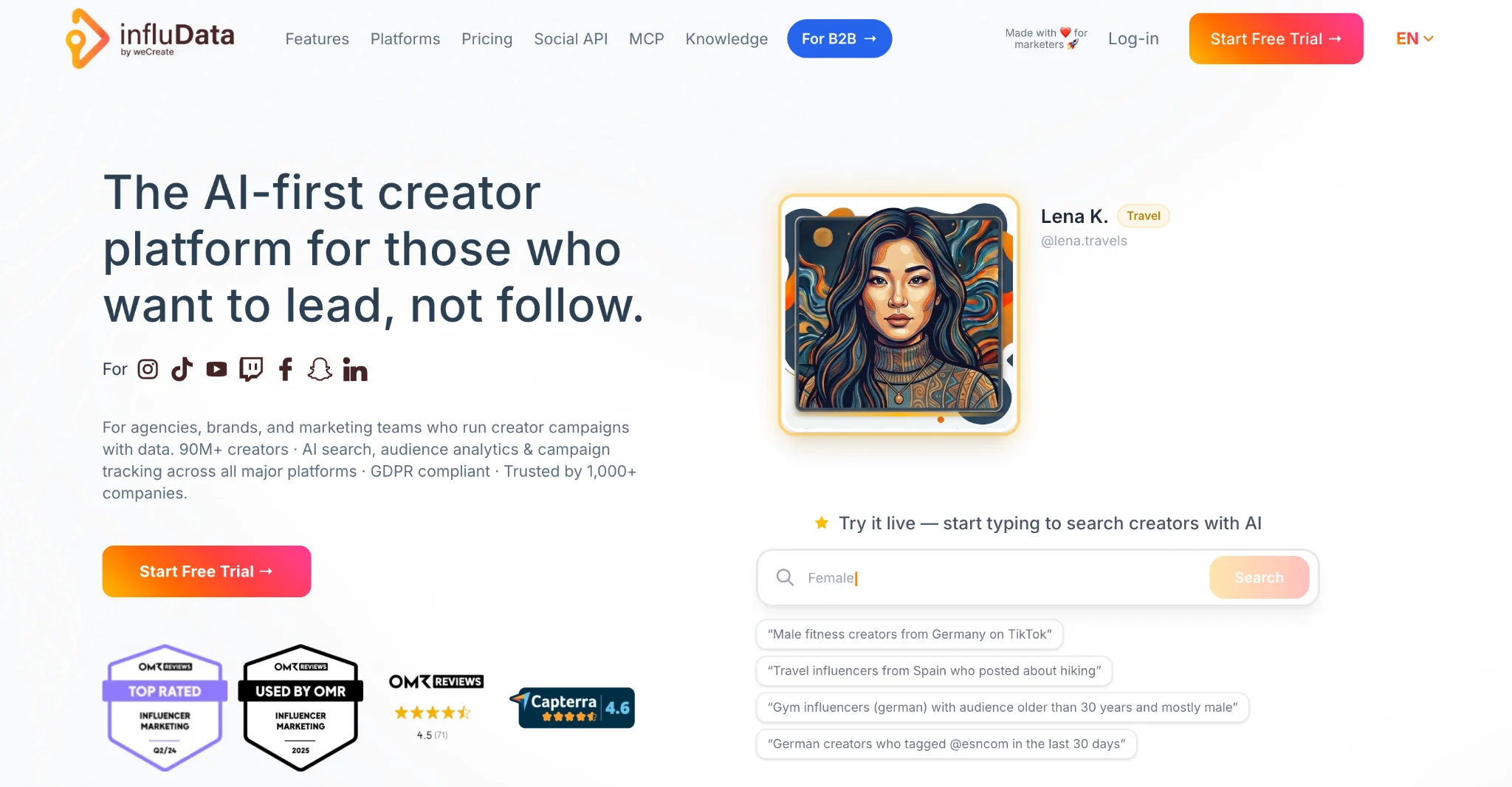
This is a research and measurement tool rather than a campaign platform, and reading it that way makes the pricing make sense. The product answers three questions well: who are the right creators, are their audiences real, and what happened after they posted. It does not brief them, ship them product, generate discount codes or pay them.
Coverage sits at roughly 90 million creators, which is modest next to competitors advertising several hundred million, and the company is explicit about where that sits: about 15 million Instagram profiles, 10 million on TikTok, 5 million on YouTube plus 100,000 Shorts creators, and around 100,000 on Twitch, alongside Facebook and Snapchat. A smaller, better-maintained index is a defensible trade, and reviewers broadly treat it as one, though several note that TikTok data lags Instagram in depth.
The measurement side is where the product is most opinionated. Audience quality scoring, sentiment analysis across comments and captions, brand safety flags and a controversy detector that surfaces when conversation around a creator turns hostile all point at the same buyer: a team that has to defend a creator choice internally before money moves. Brands that also need the operational layer around that research will be pairing it with dedicated influencer CRM tools rather than replacing them.
Who Should Use influData
The fit question is whether your bottleneck is deciding who to work with, because that is the problem this solves.
- Agencies vetting creators for clients. Audience quality scoring, brand safety flags and demographic reports are exactly what you need to justify a shortlist to someone paying for it.
- Brands with a compliance or legal review step. Controversy detection and sentiment analysis give you documentation before a partnership rather than an explanation after it.
- Teams already running outreach elsewhere. If your creator contacts and sequences live in another system, the 20-email limit on the entry plan stops mattering.
- European brands. A German company with EU data handling is a materially easier internal conversation for a European brand than a US platform.
- Teams that want creator data in their own tools. The API, Airtable access and MCP connector make this unusually easy to pipe elsewhere.
- Not brands that need to contact creators at scale. Twenty emails a month on Pro and a hundred on All-In are hard ceilings, and outreach volume is what most creator programs actually run on.
Key Features
AI Prompt Search
Discovery runs on natural-language prompts as well as structured filters, so you can describe the creator you want rather than assembling a query. Filters underneath cover followers, categories, keywords, content, brand mentions, location, language, audience demographics, engagement, gender and posting timeframe. Search and profile analysis are unlimited on every plan, which is the single most generous thing about the pricing and worth weighing against the limits that are not.
Audience Quality and 50+ Creator Metrics
Each creator profile carries around fifty metrics, including follower authenticity scoring. This is the core of the product and the reason to buy it: knowing whether an audience is real before you pay for access to it is the difference between a campaign that underperformed and a campaign that was never going to work.
Audience Demographic Reports
Full demographic breakdowns are metered rather than unlimited, at 300 a year on Pro, 1,200 on All-In and unlimited under fair use on Enterprise. That works out at 25 a month on the entry plan. Reviewers also note these reports can take 15 to 30 minutes to generate, so treat them as a considered step on a shortlist rather than something you run casually across a long list.
Sentiment and Controversy Detection
Comments and captions are analysed for sentiment, with summarisation and positivity rates, plus a detector that flags when conversation around a creator turns hostile. For a brand that has watched a partner become a liability overnight, an early-warning signal on comment sentiment is a genuinely useful thing to own, and very few discovery tools attempt it.
Brand Safety Reporting
A dedicated brand safety report pulls risk signals into one document. This is the artefact that gets forwarded to a legal or brand team, and having it generated rather than assembled by hand is most of its value. It is also the feature most likely to justify the platform internally at a company where creator partnerships need sign-off.
AI Lookalike Builder and Audience Overlap
Lookalike search finds creators resembling one that performed, and audience overlap analysis shows how much two creators share followers. Overlap is the underrated one: paying three creators whose audiences are 60% the same is a common and expensive mistake, and almost nothing in the mid-market surfaces it. The lookalike builder sits on All-In rather than Pro.
Social Listening and Campaign Tracking
Brand mentions are tracked in real time across posts, stories and reels, with listening trackers capped at 3 on Pro, 10 on All-In and 20 on Enterprise. Campaign seats follow the same pattern at 10, 30 and 60. Reviewers name campaign tracking as one of the weaker areas of the product, so if measurement after the post is your main requirement, test it specifically during the trial.
Chrome Extension, API and MCP Connector
A Chrome extension surfaces creator analysis while browsing, and the platform publishes an API alongside Airtable access on Enterprise. More unusually, it ships an MCP connector for Claude and ChatGPT, which lets creator data be queried directly from an AI assistant. That is ahead of where most of this category sits, and teams weighing it against building on an influencer marketing API from a full platform should compare what arrives alongside the data.
influData Pricing
Three tiers, two of them published, and every one of them on a twelve-month minimum contract. There is no monthly option and no way out inside the year, which raises the stakes on the trial considerably, particularly since the free trial is reported to run just two days.
Search and analysis are unlimited throughout. What is metered is everything that turns research into action: team members, creator email addresses, audience demographic reports, campaign seats and listening trackers. Those are the numbers that decide which tier you actually need.
Pro
- €599 per month on a twelve-month minimum, which is €7,188 a year.
- Unlimited search and analysis worldwide, 300 audience demographic reports a year, campaign reporting, social listening.
- 1 team member, 10 campaign seats, 3 listening trackers, up to 500 export results, PDF and CSV export.
- 20 creator emails a month, and no AI lookalike builder, no content search and no brand analytics.
All-In
- €1,199 per month on a twelve-month minimum, which is €14,388 a year.
- 3 team members, 30 campaign seats, 1,200 audience reports a year, 10 listening trackers.
- Adds content search, brand analytics and reporting, artist management and agency discovery, the AI lookalike builder and campaign sentiment analytics.
- 100 creator emails a month, five times the entry plan, which is the change most likely to decide the tier.
Enterprise
- Priced on request, on the same twelve-month minimum.
- 5 team members, 60 campaign seats, 20 listening trackers, 500 creator emails a month.
- Unlimited audience reports under fair use, plus uptime SLA, SSO, custom data import, Airtable access and an API connection.
- The API sitting only at this tier is worth noting early if piping data elsewhere is part of your plan.
The Limits That Actually Decide the Tier
- Creator emails are the binding constraint. 20 a month on Pro is 240 a year. At €7,188, that is €30 per contactable creator before you have sent anything.
- All-In brings that to about €12 per contact at 1,200 a year, and Enterprise to a few euros. If outreach is part of your workflow, the entry tier is not the entry tier.
- Pro is a single-seat product. One team member at €599 a month. All-In gives three for €1,199, which is €400 a seat, so the second and third users cost €300 each.
- Audience reports run out faster than they look. 300 a year is 25 a month, and each takes 15 to 30 minutes to generate, so they are a shortlist tool rather than a screening one.
- Everything is annual. No monthly plan exists at any tier, and the free trial is reported at two days, so the evaluation window is short and the commitment is long. Push for a longer trial before signing.
influData Reviews
The review base is substantial by this category’s standards, which makes the criticisms worth taking seriously rather than dismissing.
- 4.5/5.0 (OMR Reviews, 83 reviews)
- 4.6/5.0 (Capterra, 27 reviews)
Across 110 reviews the praise is consistent: discovery that saves real research time, audience demographics and follower quality analysis that people trust, a clear interface, a Chrome extension reviewers actively like, and support described as responsive. TikTok search draws specific praise, which is notable given how many competitors treat TikTok as an afterthought.
The criticism clusters in four places and each one maps to something in the pricing. Cost comes up most often, with multiple reviewers calling it expensive relative to competitors. Speed is second: audience reports taking 15 to 30 minutes, and slower data activation for non-Instagram creators. Platform coverage is third, with reviewers naming gaps around Twitch, X and LinkedIn and noting TikTok data is less deep than Instagram. And metering itself draws complaints, with users describing deeper insights as gated behind additional token purchases.
Integrations
The integration surface is modern and unusually developer-friendly for this category, but it points at data rather than at commerce.
- MCP connector for Claude and ChatGPT. Creator data queryable directly from an AI assistant, which almost nothing else in this category ships.
- Social API access. Programmatic access to the underlying data, available at the Enterprise tier.
- Airtable. Enterprise-tier export into a working database rather than a spreadsheet.
- Chrome extension. Creator analysis surfaced while browsing social platforms directly.
- Custom data import. Bringing your own creator lists into the platform, again Enterprise only.
What is absent is the commerce layer entirely. No Shopify, no WooCommerce, no discount code generation, no affiliate tracking and no payouts. That is consistent with a research product, and it means a D2C brand measuring creators on revenue is running this alongside something else rather than instead of it.
Pros of influData
Unlimited Search and Analysis on Every Plan
No caps on how many creators you can find or profile, at any tier. In a category where credit meters on discovery are standard, that removes the anxiety that makes research tools frustrating to use, and it means the €599 buys genuinely unlimited access to the thing most people came for.
Vetting Depth That Survives Internal Scrutiny
Audience authenticity scoring, fifty-plus metrics per creator, demographic reports, sentiment analysis, brand safety reporting and controversy detection together produce something you can put in front of a legal or brand team. Most discovery tools give you numbers; this gives you a defensible case, and that is a different product.
An Integration Surface Ahead of the Category
An MCP connector for Claude and ChatGPT, a published API, Airtable access and a Chrome extension is a more forward-looking set than most competitors offer. For a team that wants creator data inside its own workflows rather than trapped in a vendor dashboard, this is a real advantage and a sign of where the product is heading.
Cons of influData
Twenty Creator Emails a Month on a €7,188 Contract
This is the cost trap and it is unusually sharp. The entry plan allows twenty contactable creators a month, which works out at roughly €30 per contact across the year, and no amount of unlimited searching changes that. Any brand intending to run outreach at normal volume is buying All-In at €1,199 a month whether the pricing page presents it that way or not, so budget against €14,388 a year rather than €7,188.
Twelve-Month Contracts and a Two-Day Trial
Every tier commits you for a year, there is no monthly option, and the free trial is reported to run two days. That is a short window to test a tool this deep, against a long commitment if you get it wrong. Ask for an extended trial in writing and use it on your actual niche and your actual workflow rather than on a demo dataset.
Metering Sits Behind Most of the Value
Audience reports are capped and slow to generate, listening trackers are limited to three on Pro, campaign seats to ten, and reviewers describe deeper insights as requiring additional token purchases. Search being unlimited is generous; nearly everything that turns a search into a decision is rationed. Map your monthly consumption of each metered item before choosing a tier, because the wrong choice is locked in for a year.
No Commerce Layer, and Campaign Tracking Is the Weak Spot
There is no Shopify or WooCommerce connection, no discount codes, no affiliate attribution and no payouts, so the platform cannot connect a creator to an order. Reviewers separately name campaign tracking as an area needing improvement. Brands that need platforms that connect to a store will be adding a second subscription on top of a five-figure annual contract.


Is influData Worth It?
As a vetting and measurement tool, yes, and 4.5 across 83 OMR reviews plus 4.6 across 27 on Capterra is a stronger evidence base than most of this category can show. Unlimited search and analysis, authenticity scoring that people trust, demographic depth, sentiment and brand safety reporting, audience overlap, a Chrome extension reviewers genuinely like, and an integration surface including an MCP connector that puts it ahead of competitors. For an agency justifying creator choices to clients, or a brand that needs partnerships to survive internal review, this does a job worth paying for.
The reservations are structural. Twenty creator emails a month makes Pro a research seat rather than a working plan, so the honest entry price is €1,199 a month. Everything valuable beyond search is metered, contracts run twelve months with a reported two-day trial, the database is smaller than headline competitors, TikTok depth trails Instagram, campaign tracking is the weakest module, and nothing connects to a store. Brands weighing it should also price these:
- Influencer Hero. Discovery across eight social platforms with Instagram, YouTube and TikTok emphasised, plus fake follower screening, CRM boards, influencer gifting through Shopify and WooCommerce, affiliate codes and payouts. Publicly listed plans from $649 a month.
- Afluencer. A creator marketplace from $49 a month where influencers apply to your listings, useful for commission-based creator partnerships when contact volume rather than analysis is the constraint.
- Captiv8. Enterprise creator intelligence with deep audience analysis and paid amplification, aimed at teams running large multi-market programs.
- Tagger. Discovery and campaign management with strong social listening and reporting, suited to brands wanting research and execution in one workflow.
- Julius. Curated creator profiles with hand-verified data, useful when accuracy on a smaller set matters more than database size.
Final Thoughts
Do the metering arithmetic before the feature comparison, because with a twelve-month contract you only get to choose once. Write down how many creators you will contact in a normal month, how many demographic reports you will pull, how many listening trackers you need and how many people will log in. Compare that against 20, 25, 3 and 1 on Pro, and against 100, 100, 10 and 3 on All-In. For most teams doing real outreach the answer lands on All-In, and the decision is whether €14,388 a year for research and vetting is proportionate to a program that still needs separate tooling to brief, gift, track and pay creators. If it is, this is a well-built and well-reviewed platform. If it is not, the influData alternatives that fold vetting into a working campaign system are where the same budget goes further.

.png)


.jpg)