

10 Best Influencer Marketing Platforms for Shopify Brands
Influencer marketing has become one of the most effective growth channels for DTC brands, especially those built on Shopify. For Shopify merchants, Influencer Marketing Platforms help streamline key workflows like creator discovery, outreach, affiliate tracking, and campaign performance analysis—all while connecting directly to Shopify stores to track sales and ROI. Many modern platforms even allow brands to identify influencers within their own customer base, manage product gifting, and automate commissions through Shopify integrations, making influencer campaigns far easier to scale.
In this article, we’ll explore the best Influencer Marketing Platforms that help Shopify brands discover creators, manage partnerships, and drive measurable revenue through influencer collaborations.
Best Influencer Marketing Platforms for Shopify Brands
| TOOL | REVIEWS | BEST FOR | TRIAL INFO | PRICING | ||
|---|---|---|---|---|---|---|
1 |

|
⭐ | Shopify creator affiliates | Book Demo | Pricing | Website |
2 |

|
⭐ | Creator management | Book Demo | Pricing | Website |
3 |

|
⭐ | Influencer CRM & automation | Book Demo | Pricing | Website |
4 |

|
⭐ | Influencer discovery | Book Demo | Pricing | Website |
5 |

|
⭐ | Influencer marketplace campaigns | Book Demo | Pricing | Website |
6 |

|
⭐ | Influencer partnerships | Book Demo | Pricing | Website |
7 |

|
⭐ | Enterprise influencer platform | Book Demo | Pricing | Website |
8 |

|
⭐ | Enterprise influencer analytics | Book Demo | Pricing | Website |
9 |

|
⭐ | Influencer discovery | Book Demo | Pricing | Website |
10 |

|
⭐ | Campaign management | Book Demo | Pricing | Website |
1. Shopify Collabs
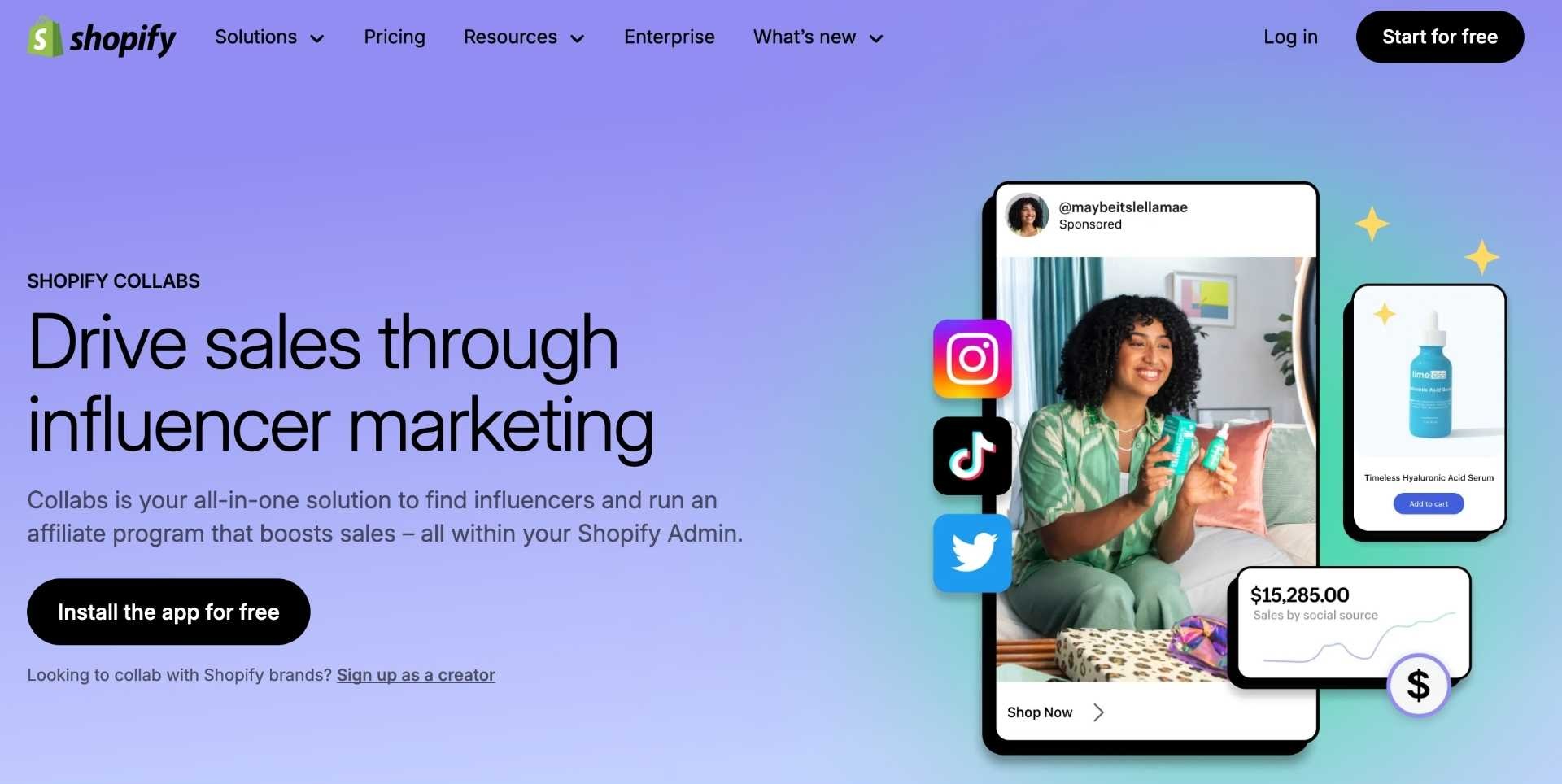
Shopify Collabs is Shopify’s native creator and affiliate marketing app for merchants. It lets brands recruit creators through an application page, invite them directly, or activate an open-access affiliate program so approved creators can generate links and drive tracked sales from inside the Shopify ecosystem.
Key features:
- Creator recruitment: Brands can collect creator applications through a branded Collabs page and review applicants inside Shopify admin.
- Open access affiliate program: Merchants can set product- or collection-level commission rates so eligible creators can instantly generate affiliate links without manual approval.
- Direct creator invites: Brands can invite creators by email and move them into specific commission programs.
- Automatic commission tracking and payouts: Collabs tracks affiliate-driven sales and pays creators automatically through the merchant’s Shopify bill after the holding period.
- Gifting and discount codes: Merchants can send gifts or discount codes to creators and manage those relationships from the app.
- Workflow automation with Shopify Flow: Teams can automate approvals, creator follow-ups, and exporting accepted creators to Klaviyo.
Pros:
- Built for Shopify: Setup is simpler than third-party tools because creator management, sales attribution, billing, and payouts all sit close to the store.
- Low barrier to entry: There is no extra monthly app fee, which makes it attractive for early-stage Shopify brands testing affiliate or influencer programs.
- Fast to launch: Open-access programs let brands start acquiring creator-driven sales without building a large outbound workflow first.
Cons:
- Lighter feature depth than enterprise platforms: Collabs is strong for affiliate-style creator programs, but it is not as deep on discovery, CRM, outreach automation, or cross-platform campaign management as dedicated influencer suites. This limitation also comes up in forum discussions from merchants comparing it with paid apps.
- Processing fee on payouts: Automatic commission payments carry a 2.9% processing fee.
- Limited availability: Shopify Collabs is available on Shopify plans except Starter and Retail.
Integrations:
- Shopify: Native integration for tracking orders, affiliate sales, gifts, discount codes, and payouts directly from the store.
- Shopify Flow: Automates repetitive tasks like auto-approving applicants, first-sale triggers, and creator follow-ups.
- Klaviyo: Through Flow templates, accepted creators can be exported into Klaviyo for segmented lifecycle or ambassador email campaigns.
- Hyperwallet / Shopify Partner payouts: Supports creator auto-payouts through Shopify’s payout infrastructure, including bank transfer options.
- PayPal: Creators can use supported payout methods tied to Shopify’s payout flow, and older manual payment workflows referenced PayPal before being retired for new commissions.
Why do Shopify brands use it?
Shopify brands use Shopify Collabs because it is the fastest way to launch a native creator affiliate program without buying another platform. The standout advantage is that commissions, creator links, orders, and payouts are all tied back to Shopify, which makes attribution cleaner for smaller teams. It also works well for brands that want to turn customers, ambassadors, and nano creators into a measurable revenue channel. For merchants focused on simplicity over advanced influencer CRM, Collabs is often the easiest starting point.
Pricing:
Low. Shopify Collabs is free to install for eligible Shopify merchants, with no separate monthly app fee, but automatic creator commission payments can incur a 2.9% processing fee. It is best framed as an entry-level or budget-friendly option compared with most influencer platforms.
Reviews:
4.0/5.0 (Shopify App Store)
2. Grin
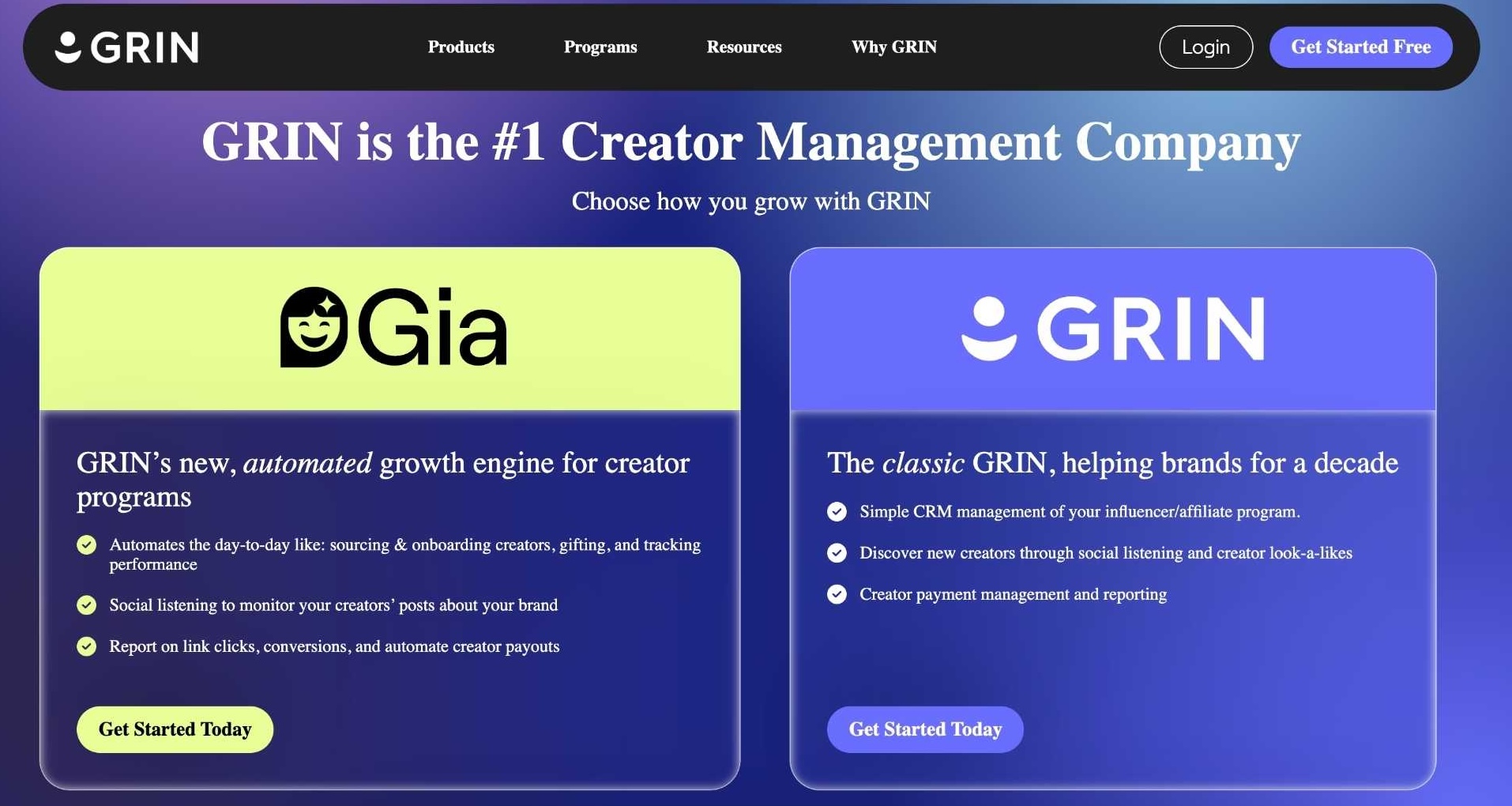
GRIN is an end-to-end creator management platform built heavily around ecommerce workflows. Brands use it to discover creators, run outreach from their own inbox, send products, manage contracts, track affiliate revenue, collect UGC, and measure ROI in one system.
Key features:
- Creator discovery: GRIN offers discovery tools with niche, platform, audience, engagement, and brand-affinity filters, plus AI-assisted search and lookalikes.
- Built-in outreach: Teams can send personalized email campaigns through integrated inboxes and track opens, clicks, and replies in-platform.
- CRM and creator portals: Brands can manage tags, notes, statuses, tasks, contracts, discount codes, and submissions through centralized creator records and personalized portals.
- Product seeding and gifting: GRIN automates gifting workflows, shipping, discount-code creation, and fulfillment through ecommerce integrations.
- Affiliate tracking and payments: The platform tracks creator-driven revenue and commissions, while PayPal integration supports in-platform payouts.
- UGC library and media rights: Creator content is stored in a searchable library, and GRIN includes media rights management as part of its workflow.
- Application pages: Brands can build creator signup pages to collect inbound applications without developer support.
- Gia AI assistant: GRIN’s AI layer helps marketers surface creator suggestions, scoring, and campaign support.
Pros:
- Excellent ecommerce fit: GRIN is especially strong when gifting, affiliate tracking, payments, and revenue attribution need to connect directly to ecommerce operations.
- All-in-one workflow: It covers discovery, outreach, CRM, gifting, payments, content collection, and reporting in one stack, which reduces tool sprawl.
- Strong communication workflows: Users regularly praise the email tools, support, and ability to scale creator programs once the system is configured.
Cons:
- High cost and annual commitment: GRIN is usually positioned for brands with meaningful program scale and budget, not teams just getting started.
- Discovery can be polarizing: Some reviewers notes issues with duplicates or weaker curation, and recent feedback echoes that GRIN is better when you already have creator relationships than when discovery is the main pain point.
- Less transparent pricing: Pricing is custom-built and can feel opaque during evaluation.
Integrations:
- Shopify: Automates gifting, shipping, discount codes, affiliate tracking, and sales attribution for Shopify-based creator programs.
- Klaviyo: Helps brands use creator data and email templates more effectively inside retention and ambassador workflows.
- PayPal: Supports creator payouts and commission payments directly from the platform.
- DocuSign: Simplifies contract execution and agreement workflows with creators.
- Gmail / Outlook / Slack: Centralizes creator communication and internal notifications without forcing teams into a separate inbox workflow.
Why do Shopify brands use it?
Shopify brands use GRIN because it was built around product seeding, gifting, affiliate revenue, and creator relationship management rather than just influencer search. Its biggest strength is operational depth: once a creator is in the system, GRIN can handle outreach, contracts, fulfillment, commission tracking, and UGC collection with much less manual work. That makes it especially attractive to mature DTC teams with large catalogs, repeat seeding programs, and a need to tie creator activity back to revenue. It is less of a lightweight discovery tool and more of a creator operations platform.
Pricing:
High. GRIN pricing is custom-built, starts from around $2,500/month and going up significantly based on features and scale, typically with a 12-month commitment. There is no clear public free trial, so buyers should expect a sales-led process and enterprise-style pricing.
Reviews:
4.5/5.0 (G2)
3. Influencer Hero

Influencer Hero is an all-in-one influencer marketing platform centered on CRM automation and campaign orchestration. It helps brands discover creators, run personalized email sequences, manage seeding and affiliate programs, collect UGC, and track ROI across multiple social platforms.
Key features:
- Influencer discovery: Advanced filters, fake-follower detection, lookalike recommendations, and a Chrome extension help brands source creators efficiently.
- Outreach automation: Brands can send one-to-one or bulk emails with AI-personalized templates and multi-step drip sequences.
- Campaign-centric CRM: Structured boards, bulk actions, follow-ups, and stage-based workflows make it easier to manage large creator pipelines.
- Reporting and ROI tracking: Real-time dashboards track influencer ROI, affiliate sales, clicks, and content performance.
- Gifting and seeding: Shopify and WooCommerce integrations support product seeding and shipping visibility inside the platform.
- UGC collection: The platform automatically gathers creator posts and helps teams tag top-performing assets for ad reuse.
- Affiliate and payments: Custom links, codes, commission tracking, and automated payouts are built into the system.
- Application pages and storefronts: Branded signup pages and creator storefronts support inbound creator recruitment.
- AI workflows: AI assists with creator recommendations, personalized outreach messages, and campaign insights to improve performance and reduce manual work.
Pros:
- Strong CRM automation: Its biggest differentiator is how well it handles high-volume outreach and campaign management with bulk actions and automated flows.
- Good value for growing DTC brands: Compared with larger enterprise tools, it packages a lot of functionality into more accessible pricing tiers.
- Broad creator-program coverage: Discovery, outreach, seeding, affiliate, UGC, and reporting are all covered in one product, which reduces operational complexity.
- AI-powered UGC search: With AI and UGC search, brands can quickly find influencer-generated content based on keywords, visuals, captions, or campaign context. This helps teams reuse high-performing UGC, identify top creators, and streamline content discovery for paid ads, social media, and ecommerce use cases.
Cons:
- Learning curve — Teams new to full‑stack influencer marketing platforms may experience a steeper learning curve.
Integrations:
Influencer Hero integrates with several tools across eCommerce, communication, affiliate tracking, and automation workflows:
- Shopify: Enables product gifting, order tracking, and revenue attribution from influencer campaigns.
- Amazon: Supports influencer campaigns tied to Amazon storefronts and affiliate performance tracking.
- DocuSign: Allows brands to send influencer contracts and agreements for electronic signature directly from campaign workflows.
- Klaviyo: Helps brands sync influencer campaigns with email marketing flows and customer segmentation.
- Slack: Enables internal campaign notifications and collaboration across marketing teams.
- Zapier: Allows brands to automate workflows and connect Influencer Hero with hundreds of other marketing tools.
- Brevo: Supports additional email marketing and automation workflows.
- Gmail: Allows teams to manage influencer outreach and communication directly from connected Gmail accounts.
- Microsoft Outlook: Supports influencer outreach for teams using Microsoft email environments.
Why do Shopify brands use it?
Shopify brands use Influencer Hero because it provides a structured system to manage influencer marketing programs at scale while staying closely connected to their store data. Through its integration with Shopify, brands can easily handle product gifting, track influencer-driven sales, and measure campaign ROI directly from their store.
One of Influencer Hero’s standout features is its CRM-driven workflow, which allows brands to manage large creator pipelines, organize outreach stages, and maintain long-term relationships with influencers. This is particularly useful for Shopify brands running ongoing ambassador, affiliate, or product seeding programs.The platform also helps Shopify teams streamline operations with AI-powered outreach automation, built-in affiliate tracking, and automated UGC collection. Instead of using multiple tools for discovery, communication, campaign management, and reporting, brands can manage the entire influencer workflow in one place.
For growing Shopify brands, Influencer Hero simplifies influencer marketing by connecting creator management, product fulfillment, and revenue tracking, making it easier to scale partnerships while keeping campaigns organized and measurable.
Pricing:
Low-to-mid. Influencer Hero offers flexible pricing plans starting at $649/month for the Standard plan, which supports up to 1,000 reach outs / month. $1,049/month for the Pro plan, which supports up to 5,000 reach outs / month, and Business plan up to $2,490/month for the Business plan, which includes up to 10,000 reach outs. Custom pricing is available for agencies and larger teams, and you can have unlimited creators in your CRM with Influencer Hero.
Reviews:
5.0/5.0 (Capterra)
4. Upfluence
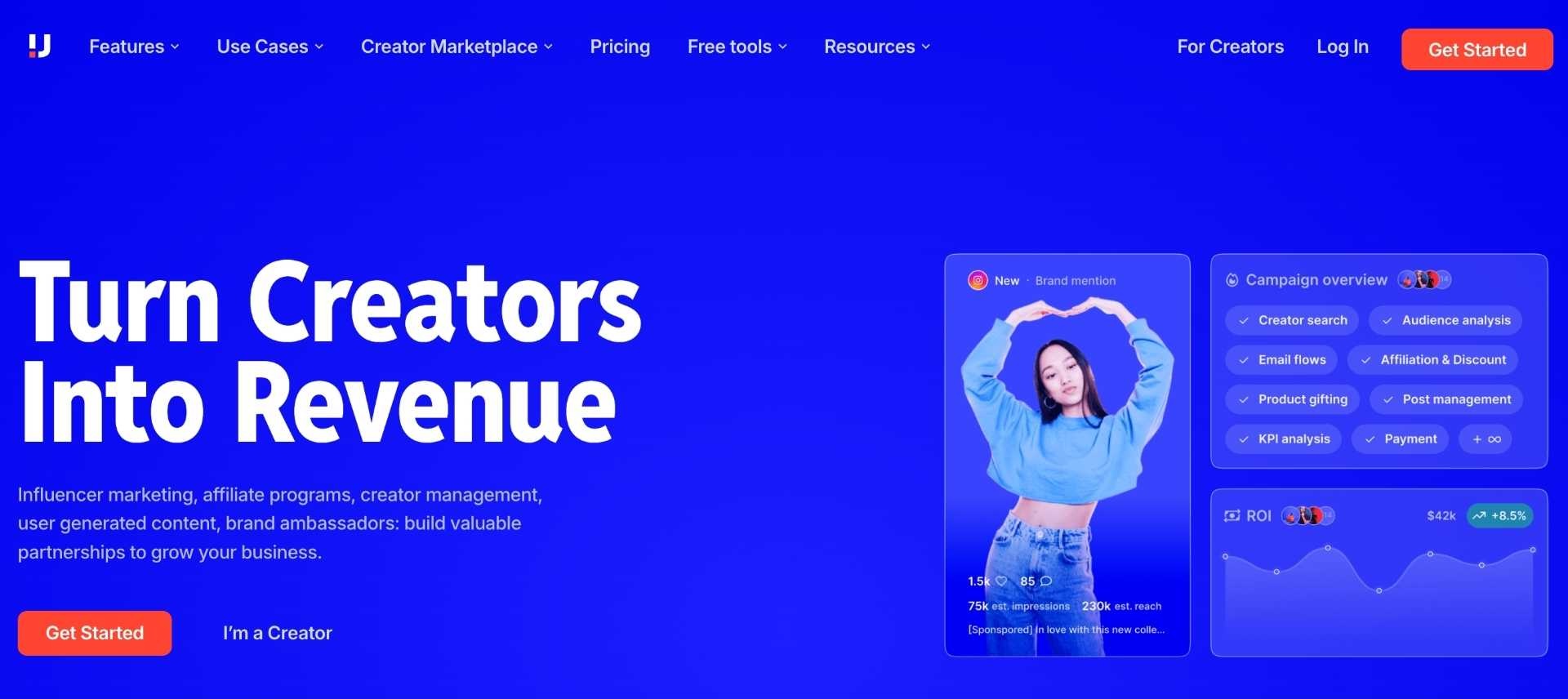
Upfluence is a full-suite influencer and affiliate marketing platform that combines creator discovery, outreach, campaign management, affiliate tracking, and payments. It is particularly strong for ecommerce brands because it connects directly to Shopify and Amazon, making it easier to identify creator-customers, gift products, run affiliate programs, and attribute revenue back to influencer activity.
Key features:
- Large creator database: Upfluence gives brands access to a database of 12M+ influencers with filters for niche, geography, audience, and engagement.
- AI-powered outreach: Bulk email, automated follow-up flows, and the Jaice AI assistant help teams move faster on creator prospecting and campaign setup.
- CRM and campaign management: Brands can manage outreach, communications, affiliate codes, and compensation models from inside the platform.
- Social listening: Teams can monitor which posts and creators are generating engagement around topics or competitors.
- Shopify integration: Upfluence can identify influential customers, manage gifting, commissions, referrals, and affiliate campaigns directly through Shopify.
- Amazon integration: For brands selling on Amazon, the platform tracks sales and affiliate performance there as well.
- Campaign analytics: The platform tracks sales, likes, reach, impressions, engagement, clicks, and conversions inside campaigns.
- Creator payouts: Secure bulk payments are built into the workflow.
Pros:
- Very strong Shopify/Amazon fit: Few platforms are as focused on linking influencer activity directly to ecommerce revenue across both stores and marketplaces.
- Great for discovery-led teams: Recent Reddit comparisons consistently describe Upfluence as stronger than GRIN when granular creator search is the main decision driver.
Cons:
- Annual commitment and higher cost for smaller brands: Upfluence is not the cheapest option and tends to require a more serious budget commitment.
- Steeper learning curve: Setup complexity for new users.
Integrations:
- Shopify: Identifies influencer-customers, manages product gifting, referrals, promo codes, and affiliate revenue tracking.
- Amazon: Tracks influencer-attributed sales and affiliate links for brands that sell on Amazon as well as Shopify.
- Klaviyo: Lets brands connect influencer and customer data into retention or ambassador email flows.
- Gmail / Outlook: Enables synced creator outreach from the inbox teams already use day to day.
Why do Shopify brands use it?
Shopify brands use Upfluence because it is one of the clearest bridges between influencer marketing and ecommerce attribution. Its standout features are influencer discovery depth, creator-customer identification, native Shopify workflows for gifting and affiliate links, and the ability to centralize payments and reporting. That makes it especially attractive for DTC brands that want to scale a measurable influencer program rather than just run one-off gifting campaigns.
If your team cares most about finding niche-fit creators and tying them to revenue, Upfluence is one of the stronger options in this category.
Pricing:
Mid-to-high. On average plans start around $2,000/month ($24,000 yearly) with no free trial and a relatively inflexible annual commitment.
Reviews:
4.3 / 5.0 (Capterra)
5. Afluencer

Afluencer is an influencer marketing platform designed primarily for brands looking to work with micro and nano influencers. Brands create collaboration opportunities ("Collabs"), define their target criteria, and receive applications from active creators, while built-in messaging and profile analytics help manage partnerships from discovery to execution.
Key features
- Influencer marketplace: Access a network of active creators across Instagram, TikTok, and YouTube rather than a static database.
- Collab listings: Brands can publish campaign opportunities and allow influencers to apply directly.
- Advanced filtering: Search creators by niche, demographics, platform, audience location, and follower size.
- Micro and nano influencer discovery: Strong focus on smaller creators with higher engagement and authenticity.
- Verified engagement data: Profiles include follower counts and engagement metrics to help evaluate creators.
- In-platform messaging: Brands and influencers can communicate without relying on email or social DMs.
- UGC sourcing: Brands can recruit creators specifically for user-generated content campaigns.
- Campaign management tools: Centralized collaboration workflow simplifies managing multiple creators.
- Shopify integration: Shopify merchants can connect Afluencer with their ecommerce store.
- Free entry plan: Brands can start using the platform before upgrading to premium plans.
Pros
- Strong Micro-Influencer Network: Afluencer specializes in micro and nano influencers, making it easier for brands to run authentic, engagement-driven campaigns.
- Active Creator Marketplace: Since creators voluntarily join the platform, brands interact with influencers who are actively seeking partnerships.
- Good for UGC Campaigns: Brands can efficiently source user-generated content creators for product seeding and content production.
- Flexible Entry Point: A free plan and monthly subscriptions allow brands to test influencer marketing without committing to long-term contracts.
Cons
- Limited Creator Coverage: Some industries and geographic regions may have fewer influencers available compared to larger platforms.
- Basic Search Capabilities: Filtering and discovery tools are less advanced than those offered by enterprise influencer marketing platforms.
- Occasional Inactive Creators: Brands may need to manually vet applicants, as some creators are not consistently active or responsive.
Integrations
- Shopify: Enables ecommerce brands to connect their store and streamline influencer collaborations directly from Shopify.
- Instagram for Business: Allows brands to evaluate creators and collaborate with Instagram influencers.
- TikTok: Supports discovering and recruiting TikTok creators for short-form content campaigns.
- YouTube: Helps brands work with creators producing long-form reviews and videos.
- Email and messaging tools: Brands can coordinate campaigns and communicate with influencers through integrated messaging capabilities.
Why do Shopify brands use it?
Shopify brands use Afluencer because it provides an affordable way to scale influencer and UGC campaigns without requiring enterprise software. Its focus on micro and nano influencers aligns well with DTC brands, which often benefit from higher engagement and stronger trust from smaller creators. Rather than manually searching Instagram or TikTok, merchants can publish collaboration opportunities and receive applications from creators already interested in working with ecommerce brands. Community discussions around influencer marketing frequently point to micro influencers delivering better cost efficiency and conversion rates, making platforms like Afluencer particularly attractive for growing Shopify stores.
Pricing
- Free plan available – Brands can create an account and begin posting collaboration opportunities at no cost
- Paid plans start at approximately $49/month.
- Pricing follows a monthly subscription model, making it accessible to small businesses and startups.
- No lengthy contracts are required, allowing brands to upgrade as campaigns scale.
Pricing benchmark: Low-cost compared with most influencer marketing platforms, especially enterprise solutions.
Reviews
4.6/5.0 (G2)


6. Aspire

Aspire is an end-to-end influencer marketing platform that helps brands discover creators, recruit applicants, manage campaigns, handle gifting, approve content, and track sales in one workflow. It is especially strong for ecommerce brands because it combines creator discovery, inbound applications, Shopify-based gifting, and affiliate tracking with robust client support.
Key features:
- Creator discovery: Search creators by channel, keyword, engagement, and audience demographics, with lookalike recommendations to expand your shortlist.
- First-party platform data: Aspire uses first-party data from Meta, TikTok, and Pinterest rather than relying only on scraped third-party estimates, which can improve confidence in audience metrics.
- Application pages: Brands can launch custom landing pages where creators apply directly, helping reduce manual outbound sourcing.
- Inbound creator marketplace: Aspire says roughly 1–1.2 million creators are actively applying through its marketplace, giving brands another acquisition channel beyond cold outreach.
- Workflow automation: Teams can run invite, contract, brief, content approval, and post-tracking workflows with bulk actions and automated follow-ups.
- Shopify gifting: Creators can shop approved products from a connected catalog, while brands track fulfillment without bouncing back into Shopify admin.
- Sales tracking and commissions: Aspire supports discount codes, creator stores, clicks, conversions, sales, and commission reporting.
- Content library and reporting: All posts and usage rights live in one place, with exportable campaign and sales reports.
- Email sync: Gmail conversations can be synced into Aspire so outreach and creator communication stay centralized.
Pros:
- Excellent ecommerce workflow: Aspire is one of the better tools for connecting discovery, gifting, content approvals, and sales attribution in one place.
- Great for brands that want inbound creator demand: The marketplace and application pages can reduce dependence on cold outreach alone.
Cons:
- Manual work still exists in some workflows: Even brands that like Aspire sometimes say it does not eliminate all operational work, especially as programs scale.
- Not the broadest platform coverage: Some reviewers emphasize Instagram, TikTok, and YouTube most heavily, so teams needing deeper support for less common channels may need to confirm fit.
Integrations:
- Shopify: Connects product catalogs, gifting, fulfillment tracking, discount codes, and sales attribution for creator campaigns.
- Shopify Plus: Supports larger Shopify merchants with the same core gifting and attribution workflow at greater scale.
- Gmail: Syncs creator email conversations into Aspire so outreach and relationship history stay centralized.
- Salesforce Sales Cloud: Helps larger teams connect creator activity with broader CRM and revenue workflows.
- Awin: Useful for brands that want to connect influencer work with broader affiliate infrastructure.
Why do Shopify brands use it?
Shopify brands use Aspire because it is one of the more operationally complete platforms for running gifting, affiliate, and creator-content workflows without stitching together multiple apps. Its standout strengths are first-party social data, a large inbound creator marketplace, strong Shopify gifting flows, and polished campaign management.
For brands that want both influencer discovery and structured execution, Aspire offers a more “managed system” feel than lighter tools. It is especially appealing for teams that care about approvals, creator applications, and customer support as much as raw discovery volume.
Pricing:
High. Plans usually start at $2,000/month, with annual agreements.
Reviews:
4.0 /5.0 (Capterra)
7. Captiv8
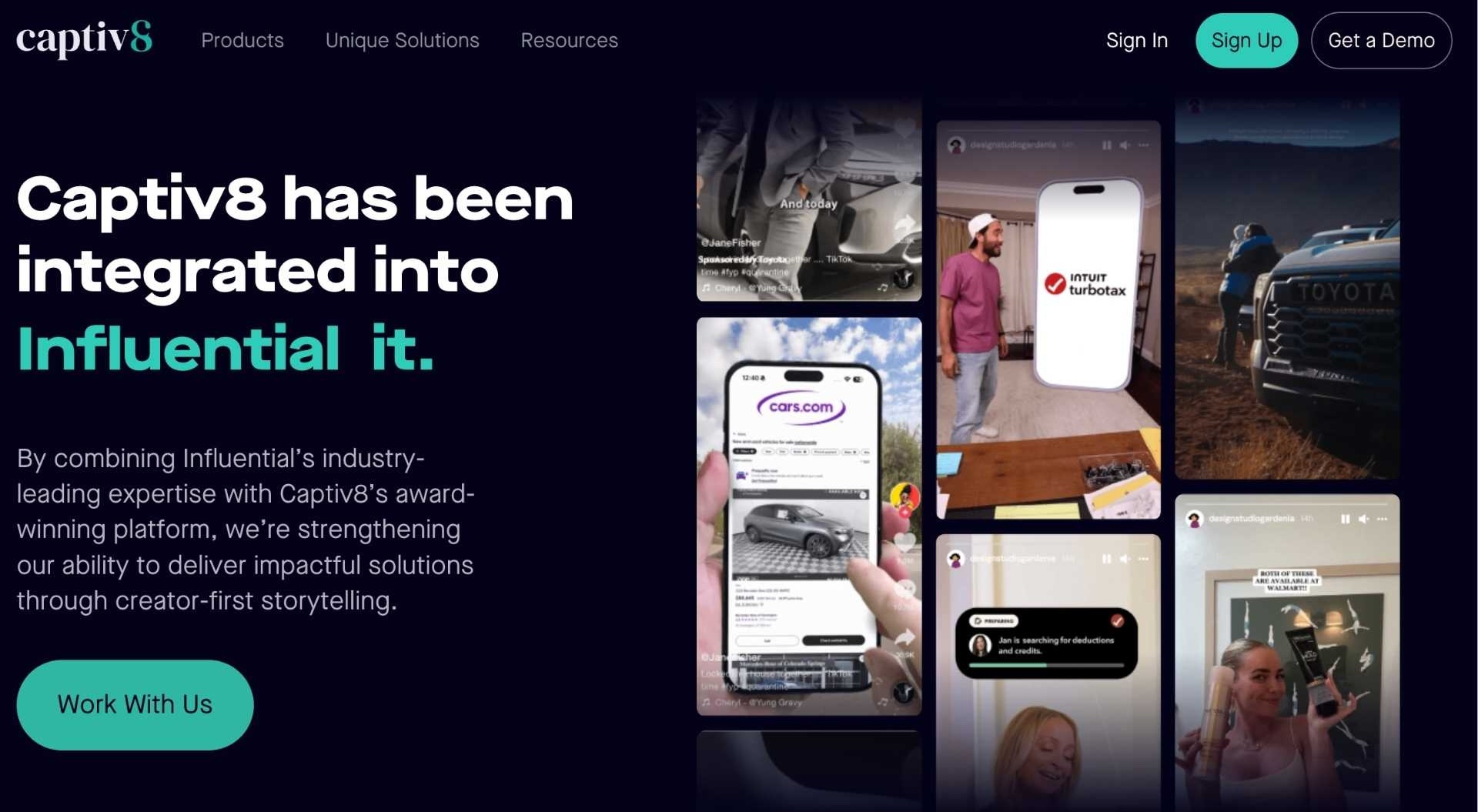
Captiv8 is an enterprise-focused influencer marketing platform built around creator discovery, campaign collaboration, deep measurement, affiliate workflows, and social commerce. It helps brands search creators and posts, manage approvals and creator chats, track performance against custom KPIs, and connect campaigns to revenue through commerce and payments.
Key features:
- Creator and post discovery: Captiv8 lets brands filter across creators, posts, and audiences using detailed demographic, interest, safety, and content filters.
- Competitive intelligence: Teams can find creators mentioning competitors or category keywords across captions, hashtags, and visuals.
- Safety score and sentiment analysis: Brands can screen for sensitive topics and analyze creator or post sentiment before activating partnerships.
- Collaborative campaign workflows: Multiple team members can approve or reject creators, import talent, and collaborate inside creator profiles.
- In-platform creator chat: Captiv8 includes creator messaging and internal collaboration within campaign workflows.
- Deep performance tracking: The platform tracks sales, ROAS, EMV, engagement, saves, shares, impressions, clicks, and more, with customizable reporting dashboards.
- Report customization: Teams can drag and drop metrics, filter reports by recipient, and share public report links without requiring a Captiv8 license for viewers.
Pros:
- Very strong measurement depth: Captiv8 is one of the more analytics-heavy options for brands that want custom KPI reporting and commerce visibility.
- Good for larger teams: It supports multi-campaign collaboration, creator approvals, and enterprise-style reporting.
- Useful for enterprise commerce programs: The Shopify App Store listing positions Captiv8 around social listening, affiliate marketing, commerce, and payments rather than only creator search.
Cons:
- Forum complaints around service and payments: Some reviewers mention payment issues and slow or unresponsive support
- Enterprise skew: Captiv8 is better suited to larger organizations than smaller founder-led Shopify brands.
- Less transparent than self-serve tools: Public pricing is limited, and the free Shopify app listing appears to refer to install/access rather than the full enterprise platform.
Integrations:
- Shopify: Connects influencer campaigns to affiliate, commerce, and payment workflows for Shopify brands.
- Refersion: Supports affiliate tracking and partner commerce workflows alongside influencer campaigns.
- Google Analytics: Sends creator and campaign data into broader ecommerce analytics reporting.
- Looker Studio: Lets teams extend Captiv8 reporting into customizable BI dashboards.
- Instagram DMs / email workflows: Captiv8 supports sending posting requirements and templates through email and Instagram DMs, which helps operationalize creator communication even if these are lighter integrations than the others.
Why do Shopify brands use it?
Shopify brands use Captiv8 when they need a more enterprise-grade system for discovery, collaboration, commerce, and measurement. Its standout value is not just finding creators, but tying them to paid media, affiliate, and reporting workflows in a way that suits larger teams and bigger budgets.
For brands running complex programs with multiple stakeholders and strict KPI reporting, Captiv8 can be powerful. For smaller Shopify merchants, though, the cost and rigidity will often be hard to justify.
Pricing:
High. Starts from $2000 / month
Reviews:
4.7 / 5.0 (G2)
8. Traackr
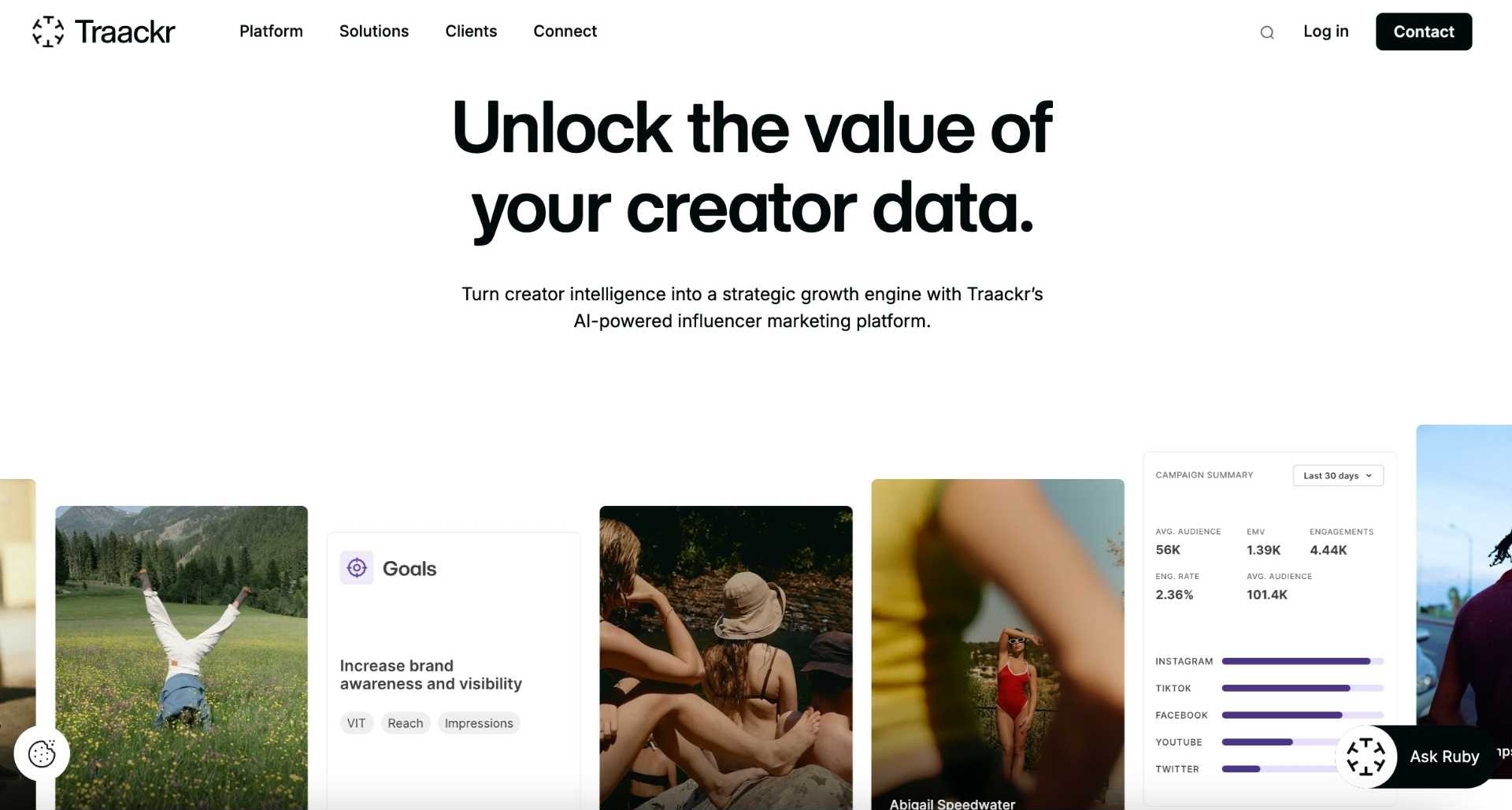
Traackr is a performance-driven influencer marketing platform built for brands that want stronger benchmarking, budget optimization, and executive-grade reporting. It covers creator discovery, outreach, CRM, gifting, affiliate tracking, payouts, and campaign analytics, but its biggest differentiation is how deeply it focuses on spend efficiency and brand performance measurement.
Key features:
- Influencer discovery: Search more than 6 million influencers using filters for engagement, audience, past brand work, and performance history.
- Personalized outreach: Supports templates, automated follow-ups, and branded recruitment pages to streamline creator communications.
- Dedicated influencer CRM: Teams can track relationships with tags, notes, status labels, and shared workflows.
- Granular reporting: Reports include CPC, CPE, CPV, reach, engagement rate, ROI, and historical comparisons for budget and performance analysis.
- Product seeding: Supports physical gifting workflows, shipping visibility, and post-gift performance tracking.
- UGC tracking: Captures creator content and helps teams identify assets worth repurposing for paid or owned channels.
- Affiliate links and payouts: Handles affiliate links, commission tracking, and creator payments from the same system.
- Brand Vitality Score: Traackr’s proprietary metric combines visibility, influence, and trust into a brand benchmark versus competitors, which is unusually useful for executive reporting.
Pros:
- Best-in-class benchmarking: Traackr’s Brand Vitality Score and cost-per dashboards make it especially strong for brands that need to justify creator spend internally.
- Strong fit for mature brands: It is built for performance and governance, not just creator sourcing, which makes it attractive to larger programs and global teams.
- Positive G2 sentiment overall: Recent G2 summaries highlight Traackr’s insights and decision-support strengths, even though some reviewers mention speed or navigation issues.
- Useful Shopify seeding workflow: Traackr’s Shopify integration lets creators select products directly and allows brands to track order status from Traackr.
Cons:
- Can feel heavy for small teams: The platform is better suited to strategic and global programs than lean startup teams doing lightweight gifting.
- Some users report navigation and tracking friction: Delayed content tracking, export issues, and some confusion in navigation, particularly in smaller markets or with specific data assumptions.
- Forum skepticism around demographic precision exists: Some Reddit discussions challenge the accuracy of audience demographic estimates across platforms in this category, which is worth keeping in mind when evaluating any influencer dataset.
Integrations:
- Shopify: Supports product seeding, creator product selection, order tracking, and ecommerce-linked campaign workflows.
- Email: Traackr integrates email workflows so teams can send personalized creator outreach and keep communication visible across the team.
- Payments: The platform supports direct creator payouts, including local-currency global payments.
- SSO: Useful for larger organizations that need secure access control and enterprise IT compatibility.
- Data lake / BI workflows: Traackr highlights broader data integrations, which is helpful for companies wanting to pipe influencer performance into wider reporting ecosystems.
Why do Shopify brands use it?
Shopify brands use Traackr when they want more than campaign execution and need serious benchmarking, budget planning, and reporting discipline. Its standout strengths are Brand Vitality Score, cost-efficiency analytics, and stronger executive-level visibility into how creator programs affect brand health and ROI. That makes it especially appealing to larger DTC brands or portfolio brands with multiple markets and stakeholders.
For smaller Shopify merchants, it can feel more powerful than necessary, but for mature teams it is one of the clearest “strategy plus measurement” options in the category.
Pricing:
High. Starts at $32,500/year for the Standard plan, with custom modules on top and custom-built packages.
Reviews:
4.3/5.0 (G2)
9. Modash
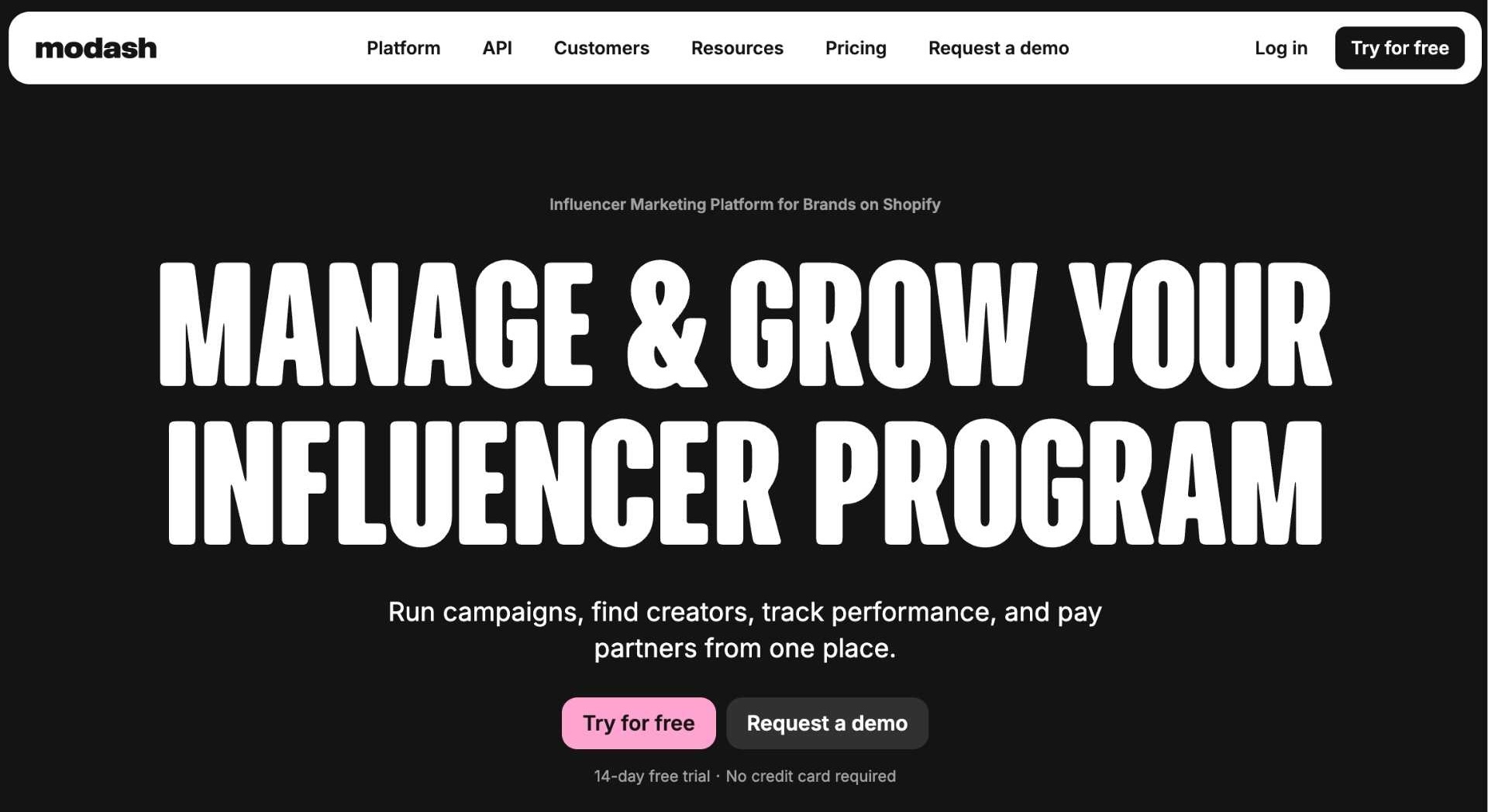
Modash is a Shopify-friendly influencer marketing platform focused on discovery, outreach, tracking, gifting, affiliate workflows, and payments. It is designed to help brands run influencer programs in one operating system, with particular emphasis on Shopify integration and a large public creator database.
Key features:
- Large public creator database: Modash says its search engine covers hundreds of millions of public creator profiles, giving brands broad discovery without opt-in limitations.
- Powerful discovery filters: Brands can search by niche topics, hashtags, captions, audience location, gender, age, platform, engagement rate, and more.
- AI discovery: Users can describe an ideal creator in natural language or upload an aesthetic image to find creators with similar content style.
- Lookalike and fan discovery: Modash can surface lookalike creators and identify influencers who already follow or engage with your brand.
- Bulk outreach: The platform supports email templates, one-to-one or bulk outreach, and inbox organization around campaign stages.
- Shopify gifting and affiliate tracking: Brands can send gifting links, auto-tag orders, create discount codes, track redemptions, and manage affiliate revenue through Shopify.
- Payments: Modash supports monthly payouts and creator earnings dashboards, with fees varying by plan.
- Content tracking: Automatically collects campaign content and performance data across supported channels.
Pros:
- Excellent Shopify fit: Modash is one of the clearest options for Shopify brands that want gifting, affiliate links, discount codes, outreach, and tracking in one place.
- Transparent pricing: Unlike many competitors, Modash publishes pricing and offers both monthly and annual billing.
Cons:
- Limited ecommerce depth beyond Shopify: Shopify is the main ecommerce integration, which is perfect for Shopify brands but less useful for multi-platform sellers.
- No built-in content licensing tool: UGC reuse rights still need to be handled manually in creator contracts.
- No native whitelisting/paid ads workflow: The platform does not directly support whitelisting or creator-content boosting in-platform.
Integrations:
- Shopify: Handles gifting, discount codes, affiliate links, click tracking, and sales attribution from inside Modash.
- Gmail: Two-way sync lets teams manage outreach inside Modash while still using their normal inbox.
- Outlook: Offers the same inbox-sync workflow for Microsoft-based teams.
- Payments rails: Modash supports creator payouts globally, with payout fee structures that vary by plan.
- API: Modash publicly offers an API, which can be useful for brands that want to extend creator data into other systems.
Why do Shopify brands use it?
Shopify brands use Modash because it does the core jobs that matter most — discovery, outreach, gifting, affiliate tracking, and payments — without burying teams in enterprise complexity. The standout features are its strong Shopify integration, AI and filter-based discovery, transparent pricing, and simple inbox workflows. For DTC brands with lean teams, Modash often feels like a practical middle ground between lightweight affiliate apps and expensive enterprise platforms.
It is especially good for brands treating influencer marketing as an ongoing growth channel rather than a one-off experiment.
Pricing:
Low-to-mid. Modash publicly lists Essentials at $199/month billed yearly ($299 monthly), Performance at $499/month billed yearly ($599 monthly), and Enterprise from $14,700/year, with a 14-day free trial and both monthly and annual billing options. That makes it one of the more transparent and flexible options in the category.
Reviews:
4.9/5.0 (Capterra)
10. Influencity

Influencity is an all-in-one influencer marketing platform that covers discovery, outreach, CRM, campaign execution, analytics, and reporting using public creator data rather than an opt-in-only network. It also integrates with Shopify for gifting and affiliate tracking, which makes it relevant for ecommerce brands that want broad discovery and structured campaign management at a lower price point than many enterprise tools.
Key features:
- Public-data creator discovery: Influencity uses public data and includes profiles beyond opt-in-only networks, helping brands search a broader creator pool.
- AI keyword matching and lookalikes: Discovery supports AI keyword matching, hashtags, filters, and lookalike creator recommendations.
- Visual CRM: Brands can organize creators by lists, country, theme, or campaign type inside a structured CRM.
- Campaign boards: The campaign workflow uses a Trello-like board for tasks, deadlines, and approvals.
- Email outreach: Supports automated outreach, templates, and performance tracking for opens, clicks, and replies.
- Shopify gifting and affiliate support: Brands can assign discount codes, manage gifting, and view influencer-level sales attribution through Shopify data.
- Manual and automated tracking: Reports can rely on manual input or add-on auto-tracking depending on plan and workflow needs.
- Application pages: Brands can create branded recruitment pages for inbound creator applications.
Pros:
- Good value relative to feature depth: Influencity covers discovery, CRM, outreach, reporting, and Shopify workflows at a price that is lower than many major competitors.
- Broad creator access: Because it is not limited to opt-in creators, it can be useful for brands that want wider discovery coverage.
- Useful for structured but not fully enterprise teams: It gives brands a full campaign workflow without immediately pushing them into enterprise-level pricing.
Cons:
- Email and messaging limitations: Negotiation is not fully native and some follow-ups still rely on your own email environment.
- Shopify is the only ecommerce integration mentioned: That is fine for Shopify-first merchants, but limiting for omnichannel or multi-cart brands.
- Auto-tracking costs extra: Some reporting automation sits behind a paid add-on rather than being included by default.
Integrations:
- Shopify: Supports gifting programs, discount codes, sales attribution, and affiliate tracking through your store.
- Outlook / Office 365: Influencity supports linking certain Outlook and Office-based inboxes for 1:1 creator communication.
- Yahoo via IMAP: Can be connected for inbox-based creator communication.
Why do Shopify brands use it?
Shopify brands use Influencity because it offers a broad set of influencer marketing features without the price tag of enterprise suites. Its standout strengths are public-data discovery, a solid CRM and campaign board, exportable reporting, and direct Shopify workflows for gifting and affiliate tracking. That makes it appealing to DTC teams that need more structure than Shopify Collabs but still want to stay cost-conscious.
It is especially well-suited to teams that care about discovery breadth and campaign organization more than white-glove services.
Pricing:
Low-to-mid.
- Professional Plan: $318/month or $3,816/year
- Business Plan: $798/month or $9,576/year
- Enterprise Plan: Custom pricing
- Auto-Tracker Add-On: $660/year (for 50 influencers)
Reviews:
4.3 / 5.0 (G2)
Final Thoughts on 10 Best Influencer Marketing Platforms for Shopify Brands
Choosing the right influencer marketing platform can significantly impact how efficiently Shopify brands discover creators, manage partnerships, and track revenue from influencer campaigns. Tools like Shopify Collabs and Modash offer accessible entry points for smaller DTC teams, while platforms such as GRIN, Aspire, and Traackr provide deeper CRM, analytics, and campaign management capabilities for brands scaling their creator programs. Ultimately, the best choice depends on factors like budget, campaign complexity, and whether your focus is discovery, automation, or performance tracking. By selecting a platform that integrates well with Shopify and aligns with your growth strategy, brands can turn influencer collaborations into a predictable and scalable acquisition channel.

.png)


.jpg)