

10 Best Modern 3PL Fulfillment Centres for D2C Brands
For D2C brands, choosing the right 3PL is not just a logistics decision - it’s a foundational growth lever that can make or break your business.
With global ecommerce sales reaching around $6 trillion and customer expectations for fast, reliable delivery rising every year, fulfillment performance directly impacts retention, profitability, and brand reputation (Statista, 2026).
For brand owners, founders and operators a strong tech-enabled 3PL means scalable operations, accurate inventory visibility, and predictable customer experience, while the wrong partner can create operational bottlenecks that slow growth and erode margins.
Best Modern 3PL Fulfillment Centres
| TOOL | REVIEWS | BEST FOR | TRIAL INFO | PRICING | ||
|---|---|---|---|---|---|---|
1 |

|
⭐ | D2C ecommerce fulfillment | Book Demo | Pricing | Website |
2 |

|
⭐ | Ecommerce fulfillment services | Book Demo | Pricing | Website |
3 |

|
⭐ | Enterprise fulfillment networks | Book Demo | Pricing | Website |
4 |

|
⭐ | Distributed fulfillment | Book Demo | Pricing | Website |
5 |

|
⭐ | On-demand warehousing | Book Demo | Pricing | Website |
6 |

|
⭐ | Enterprise retail fulfillment | Book Demo | Pricing | Website |
7 |

|
⭐ | High-growth ecommerce brands | Book Demo | Pricing | Website |
8 |

|
⭐ | Small ecommerce fulfillment brands | Book Demo | Pricing | Website |
9 |

|
⭐ | Ecommerce logistics | Book Demo | Pricing | Website |
10 |

|
⭐ | European ecommerce fulfillment | Book Demo | Pricing | Website |
1. ShipBob
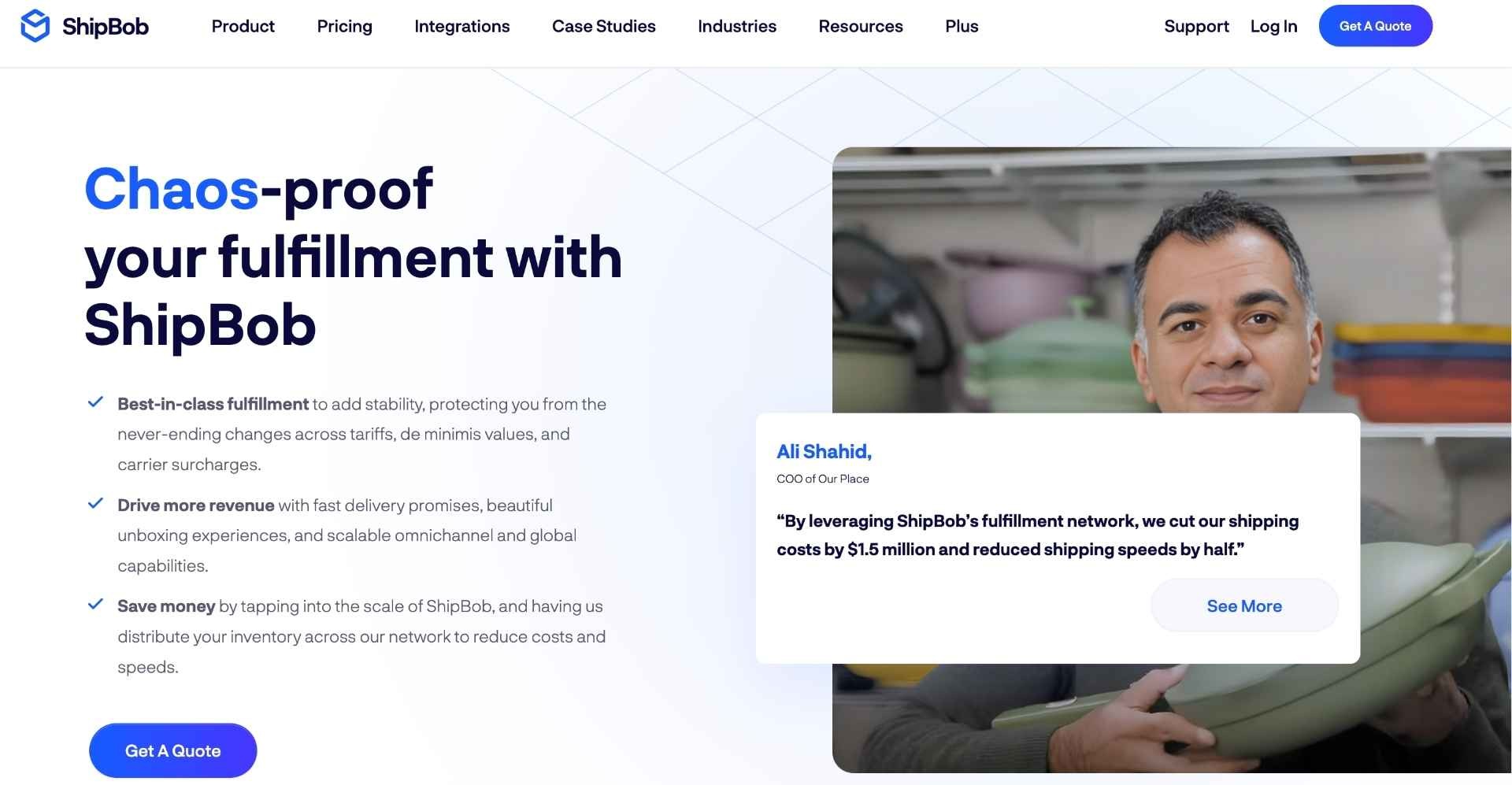
ShipBob is a tech-enabled 3PL built for D2C and omnichannel brands that want fast shipping via a distributed fulfillment network plus a self-serve dashboard for inventory, orders, and analytics.
Employees, size, founding year & history
- Employees: LinkedIn lists 501–1,000 employees.
- Founded: 2014 (Chicago HQ).
- Company snapshot: One of the most “productized” D2C-focused 3PLs, pairing fulfillment services with a strong software layer and broad integrations.
Number of warehouses & footprint
- Warehouses / locations: 60+ global locations (ShipBob markets “ship from 60+ global locations”).
- Network coverage: US + international fulfillment across Canada, Europe, and Australia (with named hubs like Toronto/Vancouver and Sydney/Melbourne).
Warehouse locations
- United States: Nationwide network across major regions and metros (ShipBob provides extensive US city/state coverage).
- Canada: Toronto / Ontario / Vancouver (plus broader Canadian service coverage).
- Europe & UK: Serves Europe/UK via international fulfillment offerings.
- Australia: Sydney + Melbourne.
Software UX score: 8/10 (D2C Stack editorial)
A highly self-serve merchant dashboard (IMS/OMS-style visibility) with strong order routing + tracking workflows; brands generally like the “single pane of glass,” but support/account management consistency comes up in community feedback.
Pros
- Strong integrations breadth across ecommerce platforms/marketplaces (Shopify, BigCommerce, WooCommerce, Amazon, Walmart, Influencer Hero etc.).
- Distributed network helps improve delivery speed and reduce zone shipping costs through inventory splitting.
- Good software layer (visibility, tracking, analytics) relative to many traditional 3PLs.
Cons
- Support / “personal touch” concerns show up repeatedly on Reddit (communication and account ownership being common pain points).
- Quote-based pricing + add-on fees can feel complex versus smaller boutique 3PLs (common buyer complaint theme).
Integrations
- CMS: Shopify, Shopify Plus, WooCommerce, Adobe Commerce (Magento), BigCommerce, Squarespace, Wix — auto-sync orders, inventory, tracking updates two-ways.
- Influencer Hero: sent products to influencers through the Influencer Hero CRM
- Amazon: fulfill marketplace orders while keeping inventory + tracking aligned.
- Walmart Marketplace: connect to import orders and sync fulfillment status/tracking.
Pricing
- Structure: Generally quote-based (depends on order volume, storage, pick/pack, shipping, etc.).
- Free trial: No traditional free trial (this is a logistics service; you typically onboard after contracting).
- Benchmark: Mid (often competitive at scale, but can feel pricey with surcharges/add-ons depending on SKU profile).
Reviews
G2: 3.7/5.0
2. ShipMonk
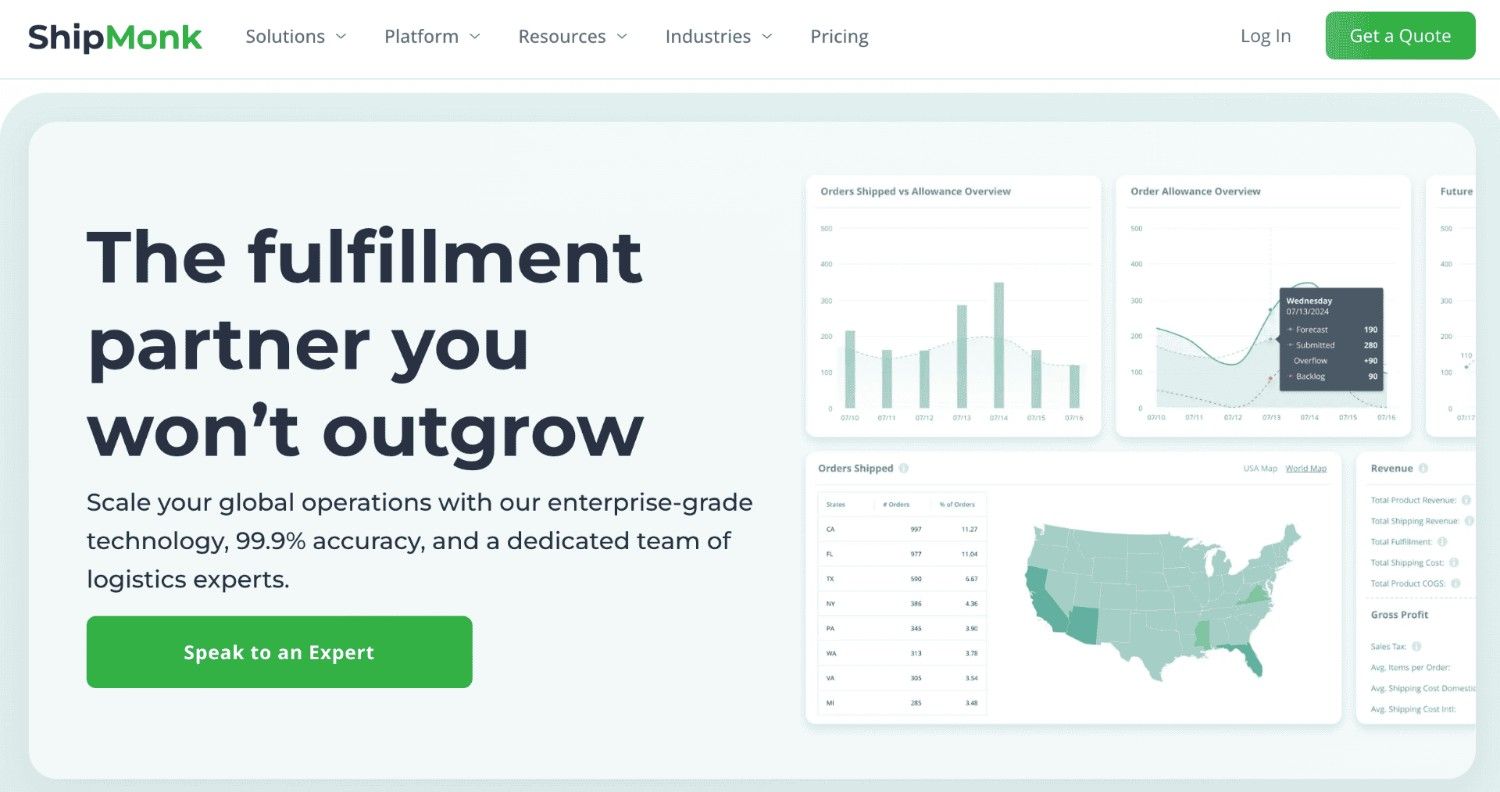
ShipMonk is a tech-forward fulfillment provider for ecommerce/D2C brands, positioning itself around a modern platform (OMS/WMS/IMS capabilities) and an owned-and-operated facility model.
Employees, size, founding year & history
- Employees: ShipMonk states 2,000+ team members on its LinkedIn profile.
- Founded: 2014 (per LinkedIn).
- Company snapshot: Scale player for SMB-to-midmarket ecommerce with multi-country footprint and deep ecommerce integrations.
Number of warehouses & footprint
- Warehouses: 11 owned and operated fulfillment centers across the US, Canada, the UK, and Mainland Europe.
- Footprint: Emphasizes fast delivery coverage via strategically placed nodes and multi-location inventory.
Warehouse locations
- US: Fort Lauderdale (HQ), San Bernardino/Los Angeles area, Las Vegas & North Las Vegas, Fort Worth (Dallas–Fort Worth), Pittston PA (2 sites), Louisville KY
- Canada: Brampton, Ontario
- Europe/UK: Cheb (Czech Republic), Coalville (UK), plus Prague office
Software UX score: 8/10 (D2C Stack editorial)
Strong “command center” feel (self-serve workflows, lots of integrations, clear inventory/order visibility); merchants tend to love usability when things run smoothly, but community feedback frequently calls out support and fulfillment-time variability depending on situation/volume.
Pros
- Owned/operated network (vs purely outsourced nodes) + clear published location list.
- Ecommerce-friendly integrations (Shopify + returns tools and more).
- Good platform positioning for brands that want software + operations bundled.
Cons
- Customer service concerns are a recurring theme in Reddit threads (worth validating with references).
- Pricing can feel high for smaller brands depending on receiving, storage, and handling profile (common buyer sentiment).
Integrations
- CMS: Shopify, Shopify Plus, WooCommerce, Adobe Commerce (Magento), BigCommerce, Squarespace, Wix — sync orders/inventory; run fulfillment from ShipMonk with CMS-connected workflows.
- Amazon: connect a marketplace channel for order flow into fulfillment.
- Loop Returns: coordinate returns workflows alongside fulfillment operations.
- Influencer Hero: sent products to influencers through the Influencer Hero CRM
- eBay: bring marketplace orders into the same fulfillment workflow.
Pricing
- Structure: Operational pricing (pick/pack, storage, shipping, etc.); generally quote-based for a full program, with public hints via channel listings.
- Free trial: No classic trial, but ShipMonk explicitly notes account setup is free until you start shipping.
- Benchmark: Mid (can swing mid→high depending on SKU complexity, kitting, and receiving/storage needs).
Reviews
G2: 3.3/5.0
3. Stord

Stord positions itself as a “commerce enablement” platform combining fulfillment network capacity with a software suite (OMS/WMS/visibility) aimed at high-growth omnichannel brands.
Employees, size, founding year & history
- Employees: LinkedIn lists 1,001–5,000 employees.
- Founded: 2015 (per LinkedIn).
- Company snapshot: Built around a core network + an expanded partner network model to scale coverage.
Number of warehouses & footprint
- Warehouses / nodes: “Strategically-placed facilities in eleven key nodes” plus access to an expanded network of 1,000+ partner facilities (per Stord).
Warehouse locations
- Atlanta, GA; Dallas, TX; North Haven, CT; Nevada; Hebron, KY; Ogden, UT; Ferndale, WA; Portland, TN; British Columbia (CA); Ontario (CA); London (UK); Peterborough (UK); Limburg (NL)
Software UX score: 8/10 (D2C Stack editorial)
Stord’s story is “software + network,” and its UX is generally perceived as modern for visibility and orchestration; some operators (esp. in logistics forums) question consistency across a hybrid network depending on fit and complexity.
Pros
- Hybrid scale model (core nodes + large partner network) can be attractive for fast expansion and peak planning.
- Modern platform narrative (visibility + orchestration) compared to traditional 3PLs.
- Shopify presence (listed in Shopify App Store).
Cons
- Not one-size-fits-all: logistics community feedback suggests fit matters a lot (SKU profile, value, operational needs).
- Pricing transparency is limited (typically custom quotes).
Integrations
- CMS: Shopify, Shopify Plus, WooCommerce, Adobe Commerce (Magento), BigCommerce, Salesforce Commerce Cloud — connect storefront/order flows into Stord-enabled delivery experience.
- NetSuite: sync inventory, orders, and financial data between your ERP and Stord’s fulfillment network for unified operational visibility.
- SAP: connect enterprise resource planning workflows with fulfillment execution and inventory management.
- Microsoft Dynamics 365: integrate order and inventory data from ERP into Stord’s logistics and fulfillment operations.
- Orderful (EDI): automate EDI transactions with retailers and trading partners for B2B and wholesale fulfillment workflows.
Pricing
- Structure: Custom/quote-based pricing (not publicly rate-carded).
- Free trial: Not typical; generally sales-led onboarding.
- Benchmark: High (more enterprise-leaning, especially if using broader platform + network services).
Reviews
G2: 4.3/5.0
4. Flowspace
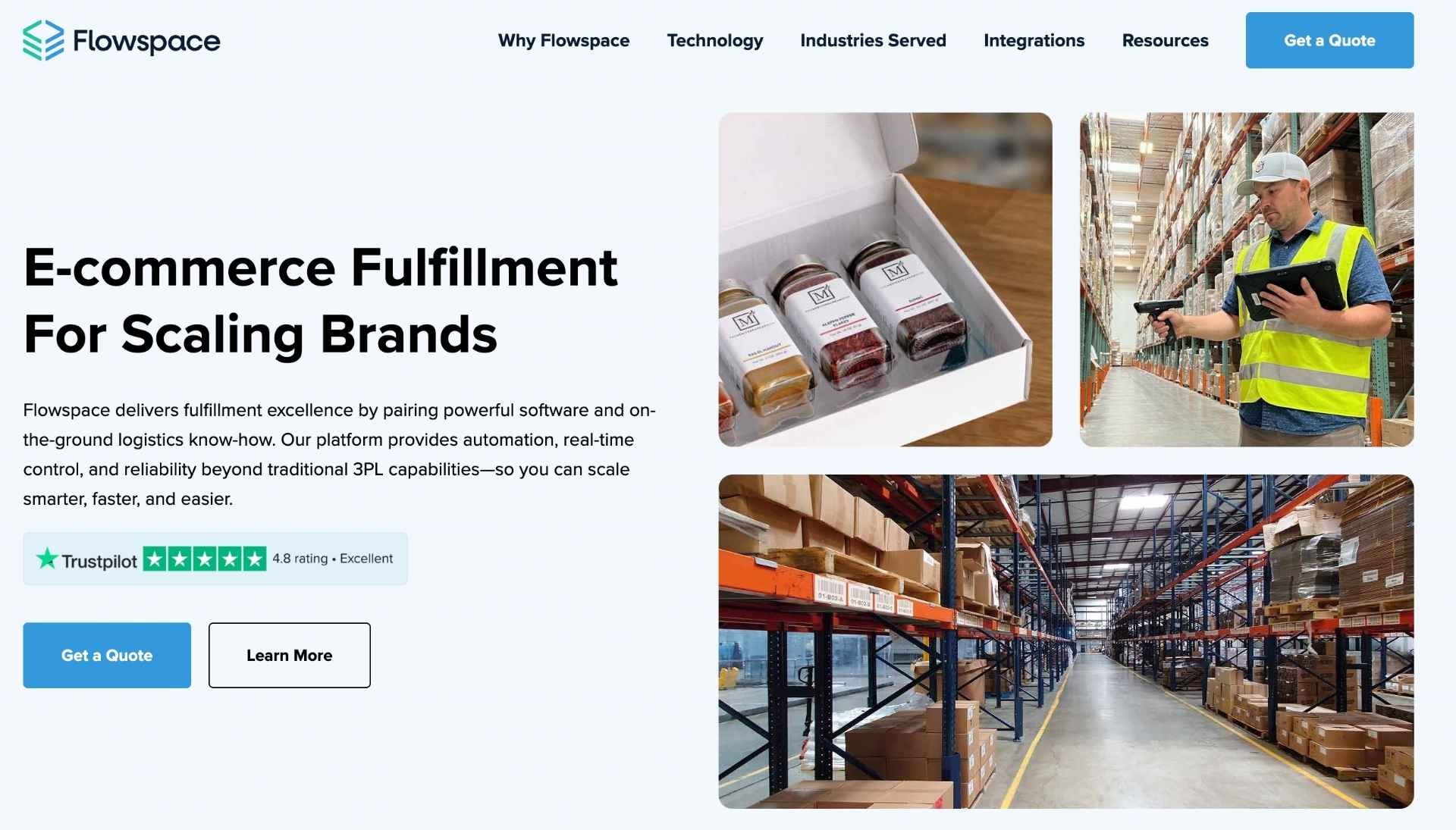
Flowspace is an omnichannel fulfillment platform + network model, emphasizing a “control tower” experience and flexible capacity across a large distributed footprint.
Employees, size, founding year & history
- Employees: LinkedIn lists 51–200 employees.
- Founded: 2017 (per LinkedIn).
- Company snapshot: Software-led fulfillment orchestration with a large network layer.
Number of warehouses & footprint
- Warehouses / locations: Flowspace markets 150+ fulfillment centers in its network running Flowspace software across the US.
Warehouse locations
- US-wide distributed network (coverage near major metro areas; inventory positioned based on demand patterns).
Software UX score: 7/10 (D2C Stack editorial)
Solid “control tower” experience with strong channel connectivity; review summaries highlight ease of use + support, while some buyers want deeper reporting/custom analytics and more predictable fees.
Pros
- Large network footprint (good for flexible scaling and positioning inventory).
- Integrations-first message (Shopify, Amazon, TikTok mentioned by Flowspace).
- Support often praised in review summaries (G2).
Cons
- Reporting depth is a recurring limitation noted in review summaries.
- Pricing surprises / monthly fees show up in some Capterra reviews (worth diligence in contracting).
Integrations
- CMS: Shopify, Shopify Plus, WooCommerce, Adobe Commerce (Magento), BigCommerce, Squarespace — connect your store for automated order flow + fulfillment visibility.
- Amazon: support marketplace order routing and fulfillment workflows.
- TikTok: connect commerce channel operations into the same fulfillment layer.
- Influencer Hero: sent products to influencers through the Influencer Hero CRM
Pricing
- Structure: Generally quote-based; some reviews reference platform fees (varies by contract and program).
- Free trial: Not typical for fulfillment services (implementation + operations required).
- Benchmark: Mid (but validate platform fees + overage logic carefully in MSA/SOW).
Reviews
G2: 4.0/5.0
5. Flexe
Flexe provides “flexible warehousing infrastructure,” connecting brands to capacity via a single integration model—best known for on-demand warehousing and network agility rather than a classic SMB 3PL playbook.
Employees, size, founding year & history
- Employees: LinkedIn lists 51–200 employees.
- Founded: 2013 (Seattle HQ).
- Company snapshot: Infrastructure + software layer focused on capacity, agility, and enterprise-grade network optimization.
Number of warehouses & footprint
- Warehouses / operators: “A single technology integration opens access to 800+ warehouse operators across the U.S. and Canada.”
- Footprint: North America-focused flexible network capacity.
Warehouse locations
- U.S. + Canada via 800+ operators (coverage across major markets; exact sites depend on the operator network and your program).
Software UX score: 7/10 (D2C Stack editorial)
Enterprise-leaning UX: more “network/integration infrastructure” than a Shopify-native SMB dashboard; strongest value is in integration-once, scale-many network access and capacity orchestration.
Pros
- Massive flexible network access with a single integration concept.
- Great fit for variable demand / peak and network optimization use cases.
- Enterprise-grade positioning (useful if you’re beyond “one 3PL warehouse” operations).
Cons
- Less “plug-and-play SMB D2C” than ShipBob/ShipMonk; typically more solutioning required.
- Pricing is not transparent (custom quotes; depends on capacity, seasonality, services).
Integrations
- E-commerce CMS: Shopify, WooCommerce, Adobe Commerce (Magento), BigCommerce, Salesforce Commerce Cloud - Automatic order fulfillment through CMS integration
- NetSuite: centralize inventory and financial workflows between ERP and warehouse operations.
- Klaviyo: use fulfillment events to trigger lifecycle emails like shipping notifications and delivery flows.
- Gorgias: surface order and shipping data inside customer support workflows for faster resolution times.
- AfterShip: improve tracking visibility and branded post-purchase tracking experiences.
- ShipStation: coordinate parcel carrier selection and label management across flexible warehouse locations.
Pricing
- Structure: Custom quote-based; depends heavily on services and capacity model.
- Free trial: Not typical.
- Benchmark: High (more enterprise infrastructure than SMB 3PL pricing).
Reviews
No reviews


6. Radial
Radial is a large-scale ecommerce fulfillment provider focused on enterprise and omnichannel brands, combining warehousing, transportation management, order management, and returns into one integrated solution. It is commonly chosen by brands that need retail-level operational complexity rather than lightweight D2C fulfillment.
Employees, size, founding year & history
- Employees: ~7,000+ globally (enterprise-level operation).
- Founded: 1986 (originating from eBay Enterprise before becoming Radial).
- Company snapshot: Established enterprise fulfillment provider serving large retail and ecommerce brands with sophisticated fulfillment, fraud, and customer operations.
Number of warehouses & footprint
- 30+ fulfillment centers globally.
- Strong North American coverage designed for high-volume omnichannel fulfillment and peak season scalability.
Warehouse locations
- United States: Nationwide network across major logistics hubs
- Canada: Toronto region operations
- Europe: Selected EU locations via partner infrastructure
Software UX score: 6/10
Radial’s software layer is powerful but enterprise-oriented, focusing on OMS, routing logic, and large-scale automation rather than a simple D2C self-service UX. Operators appreciate the functionality, but smaller D2C teams may find it less intuitive compared to modern startup-style 3PL dashboards.
Pros
- Strong enterprise-scale fulfillment infrastructure
- Integrated order management and returns capabilities
- Reliable for high-volume and omnichannel complexity
- Mature operational processes and SLAs
Cons
- Less D2C-native user experience
- Longer onboarding and implementation cycles
- Better suited for larger brands versus mid-market merchants
Integrations
- CMS: Shopify, Adobe Commerce (Magento), Salesforce Commerce Cloud, BigCommerce, WooCommerce — sync ecommerce orders and inventory for unified fulfillment and tracking updates.
- Amazon Marketplace: fulfill marketplace orders through Radial while syncing fulfillment status.
- Walmart Marketplace: consolidate Walmart orders into Radial’s omnichannel fulfillment system.
Pricing
- Pricing is fully enterprise quote-based, structured around volume, channels, and operational complexity.
- No free trials; onboarding happens through customized contracts and implementation projects.
- Benchmark: High (enterprise-level pricing model).
Reviews
No reviews.
7. Shipfusion
Shipfusion is a North America–focused 3PL offering tech-enabled fulfillment for ecommerce brands that want strong visibility and controlled logistics operations. It focuses heavily on warehouse accuracy and ecommerce integrations for scaling D2C merchants.
Employees, size, founding year & history
- Employees: ~50–200 (mid-sized fulfillment company).
- Founded: 2014.
- Company snapshot: Built to serve ecommerce brands scaling beyond basic fulfillment with better reporting and operational control.
Number of warehouses & footprint
- 4+ core fulfillment centers across North America.
- Focus on strategic US and Canadian locations for 2–3 day shipping coverage.
Warehouse locations
- Chicago, IL
- Los Angeles, CA
- Toronto, Canada
- Additional North American coverage via partner expansion
Software UX score: 7/10
Shipfusion’s dashboard is considered clean and functional with good order and inventory visibility; operators appreciate transparency but it lacks some advanced automation seen in newer SaaS-first fulfillment platforms.
Pros
- Strong inventory accuracy reputation
- Good reporting visibility for merchants
- Reliable North America-focused shipping coverage
- Ecommerce-friendly onboarding
Cons
- Smaller warehouse footprint vs larger networks
- Less advanced automation than top tech-first 3PLs
- Limited global expansion options
Integrations
- CMS: Shopify, WooCommerce, Adobe Commerce (Magento), BigCommerce — sync orders, inventory, and shipping updates automatically.
- Amazon Seller Central: Fulfill marketplace orders with centralized inventory.
- Recharge: manage subscription orders seamlessly through fulfillment workflows.
Pricing
- Quote-based pricing depending on storage, pick & pack, and shipping volumes.
- No free trial; fulfillment onboarding required.
- Benchmark: Mid.
Reviews
G2: 4.4/5.0
8. Fulfillrite
Fulfillrite is a fulfillment provider focused on small-to-mid-sized ecommerce, subscription, and crowdfunding brands that value reliability and simplicity. It is widely known for strong customer service and accuracy rather than complex automation.
Employees, size, founding year & history
- Employees: ~10–50 employees.
- Founded: 2010.
- Company snapshot: Long-running fulfillment partner for SMB ecommerce and Kickstarter-style businesses.
Number of warehouses & footprint
- 2 primary fulfillment centers.
- US-based operation focused on efficient domestic shipping.
Warehouse locations
- New Jersey (East Coast)
- Utah (West Coast)
Software UX score: 6/10
The software is straightforward and functional but intentionally simple; suitable for smaller merchants but less advanced compared to modern 3PL control towers.
Pros
- High fulfillment accuracy
- Very strong customer support reputation
- Good for lightweight ecommerce operations
- Reliable for crowdfunding and subscription brands
Cons
- Limited warehouse network
- Less advanced software tooling
- Not ideal for rapid international scaling
Integrations
- CMS: Shopify, WooCommerce, Adobe Commerce (Magento), BigCommerce, Squarespace — auto-sync store orders and send tracking updates
- Amazon: fulfill Amazon orders with synchronized inventory levels.
- Etsy: import Etsy orders for centralized fulfillment management.
Pricing
- Transparent operational pricing model (storage + pick/pack + shipping).
- No free trial; shipping starts after onboarding.
- Benchmark: Low–Mid (often attractive for smaller brands).
Reviews
G2: 4.9/5.0
9. Fulfyld
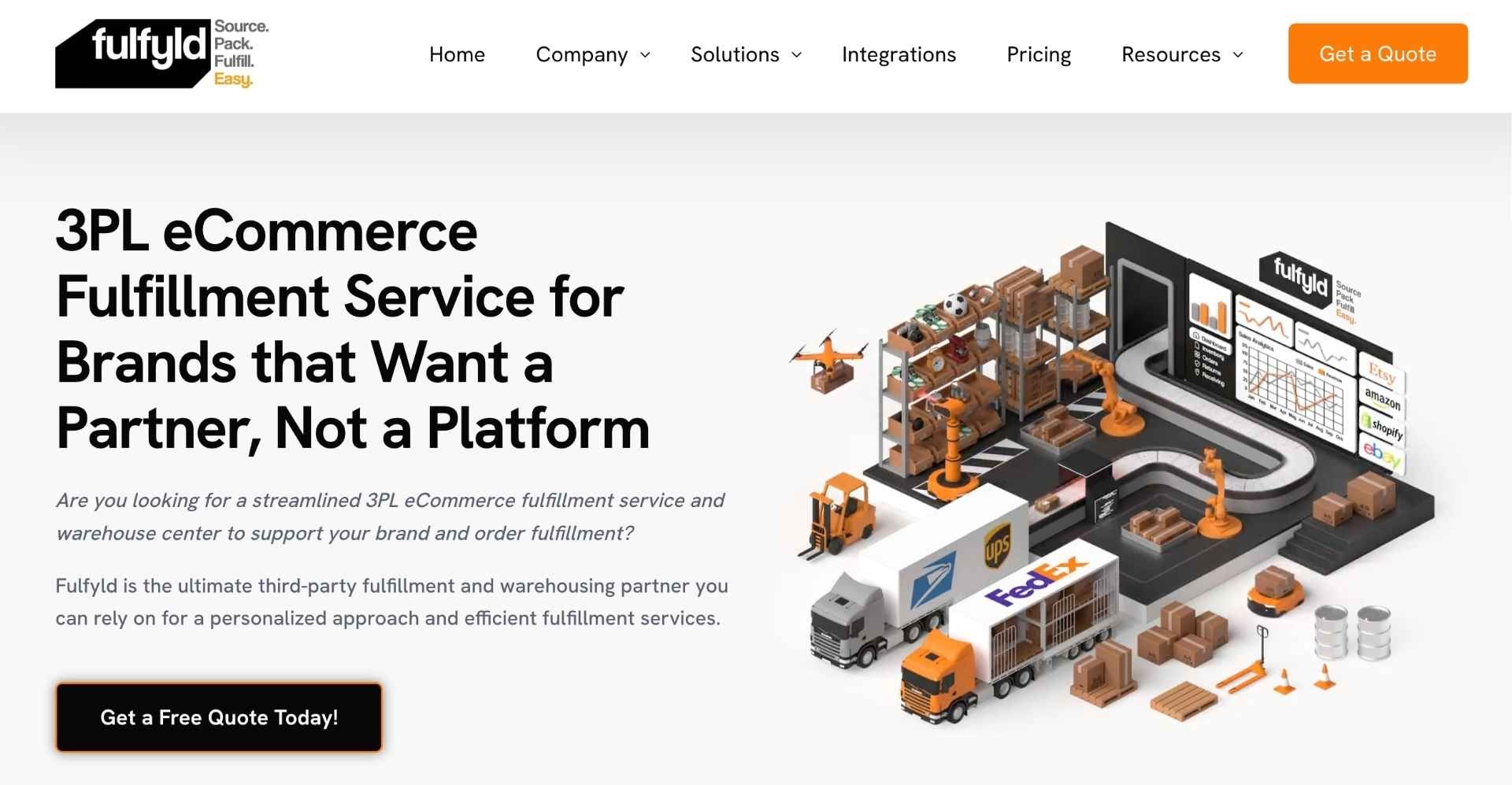
Fulfyld is a modern ecommerce-focused 3PL positioning itself around faster onboarding, flexible contracts, and strong D2C merchant visibility. It targets growing ecommerce brands that want a more tech-forward alternative to traditional regional 3PLs.
Employees, size, founding year & history
- Employees: ~50–200.
- Founded: 2020.
- Company snapshot: New-generation fulfillment provider emphasizing ecommerce-first workflows and modern service delivery.
Number of warehouses & footprint
- Multiple fulfillment centers across the US.
- Designed to support distributed fulfillment strategies for improved shipping speeds.
Warehouse locations
- East Coast US
- Midwest US
- West Coast US
Software UX score: 7.5/10
The merchant dashboard is clean and modern with strong visibility into orders and inventory; positioned as a more startup-style UX compared to legacy fulfillment providers.
Pros
- Modern onboarding process
- D2C-first positioning
- Flexible contract structures
- Good merchant visibility tools
Cons
- Smaller brand recognition compared to incumbents
- Less proven at very large scale
- Network not as large as top-tier providers
Integrations
- CMS: Shopify, WooCommerce, Adobe Commerce (Magento), BigCommerce — automate order sync and fulfillment tracking.
- Amazon Seller Central — unify Amazon orders with D2C inventory.
- TikTok Shop — fulfill social commerce orders alongside ecommerce channels.
Pricing
- Quote-based pricing depending on SKU count, volume, and storage profile.
- No free trial; onboarding required.
- Benchmark: Mid.
Reviews
Trust pilot: 4.7/5.0
10. Byrd
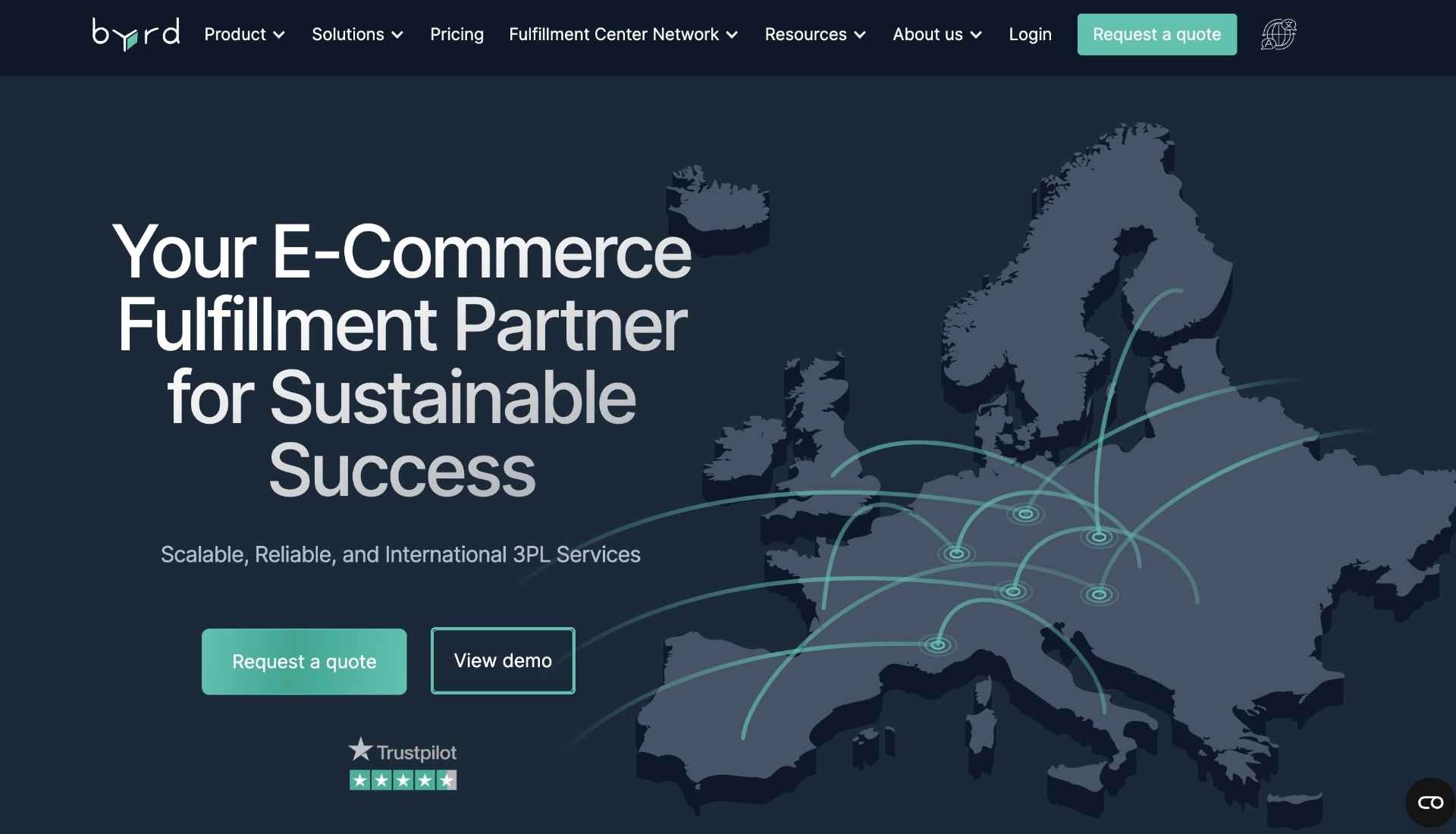
byrd is a European tech-enabled fulfillment company focused on helping ecommerce brands scale internationally across Europe with a unified logistics platform and distributed warehouse network.
Employees, size, founding year & history
- Employees: ~200–500.
- Founded: 2016 (Austria).
- Company snapshot: Built as a cross-border ecommerce fulfillment solution with strong European market focus.
Number of warehouses & footprint
- 20+ fulfillment locations across Europe through owned and partner facilities.
- Designed for pan-European shipping optimization.
Warehouse locations
- Germany
- Austria
- France
- Netherlands
- Spain
- Italy
- UK
Software UX score: 8/10
Strong merchant dashboard with clear inventory visibility, cross-border order management, and intuitive UX designed specifically for ecommerce operators scaling across European markets.
Pros
- Excellent European fulfillment coverage
- Strong tech platform for cross-border logistics
- Fast onboarding for ecommerce brands
- Real-time inventory visibility
Cons
- Less relevant for US-only brands
- Smaller global footprint vs US-focused giants
- Some advanced enterprise features limited
Integrations
- CMS: Shopify, WooCommerce, Adobe Commerce (Magento), Shopware, PrestaShop, BigCommerce — automate European fulfillment for Shopify stores with synced tracking and inventory.
- Influencer Hero — sent products to influencers through the Influencer Hero CRM
- Amazon — fulfill European marketplace orders via centralized inventory.
- Klaviyo — sync fulfillment status to trigger post-purchase and delivery email automations.
- Billbee — connect multi-channel ecommerce operations into byrd’s fulfillment system.
Pricing
- Usage-based pricing (storage, pick/pack, shipping) depending on location and order volume.
- No free trial; onboarding through merchant setup.
- Benchmark: Mid.
Reviews
G2: 4.5/5.0
Final thoughts on the most modern and best 3PL fulfillment centres for D2C brands
Choosing the right 3PL is one of the most important operational decisions a D2C brand can make, as fulfillment directly influences customer experience, shipping costs, and the ability to scale efficiently. The best providers combine reliable warehouse operations with modern software, strong integrations, and real-time visibility — giving founders and growth teams the infrastructure needed to grow without operational bottlenecks. Ultimately, there is no one-size-fits-all solution; the ideal 3PL depends on your brand’s stage, geography, and complexity, but selecting a tech-enabled partner can be a major competitive advantage as you scale.

.png)


.jpg)