


10 Best Shopify Collabs Alternatives for Influencer Marketing
Creator signups to Shopify Collabs are paused, with no confirmed date for reopening. That single fact reframes the whole tool. The pitch was always that creators would find you through the network and apply, and with the front door closed the inbound half of the product stops working, leaving merchants to invite creators manually at a cap of 100 a week with a 30-day expiry on each invitation.
The rest still functions and it costs almost nothing: free to install on most plans, 2.9% on each automatic commission payment, links and codes issued per creator, and payouts settled through your regular Shopify bill. For a brand running its first affiliate program on Shopify, that is a sensible place to start. It also has hard edges. Creators must live in the US, Canada or the UK, your store needs $10,000 in trailing twelve-month sales to appear in network discovery at all, and there is no CRM, no bulk outreach, no creator vetting and no attribution beyond last-click. In this article, we’ll compare the 10 best Shopify Collabs alternatives, including Influencer Hero, CreatorIQ, Upfluence, Afluencer, Aspire, NeoReach, Klear, Traackr, Social Cat and Heepsy.
Key Criteria for Evaluating Influencer Marketing Platforms
Core Features
Count what the tool does outside of paying people. Issuing a code and settling a commission is the easy end of the job; sourcing creators, screening their audiences, running the conversation and collecting the content is where the hours go, and dedicated influencer CRM tools exist because native affiliate features stop well short of that.
Pricing & Flexibility
Price the labour alongside the licence. A tool at zero that needs a coordinator sending invitations by hand is more expensive than a $649 subscription that automates the same work, once you cost the hours honestly. Model both at the program size you are aiming for, not the one you have this quarter.
Customer Reviews & Satisfaction
Read the distribution, not the average. A 4.1 built from 53% five-star and 21% one-star reviews is not a mediocre product, it is a product that works very well for one kind of merchant and fails for another, and the reviews tell you which one you are. Averages hide exactly the information you need.
Pros & Cons
Look for the ceilings before the features. Weekly invitation caps, creator geography limits, sales thresholds for discovery and single-platform attribution are all things you will not notice in month one and will hit hard in month six. Ask what the tool stops you doing, not what it lets you do.
Integrations
Ask what happens if you add a second sales channel. A native app is perfectly integrated with one store platform and completely absent from every other, so a WooCommerce site, a wholesale channel or a marketplace listing sits outside the program entirely. Platform-agnostic tracking is worth paying for the moment a second channel exists.
Shopify Collabs Overview
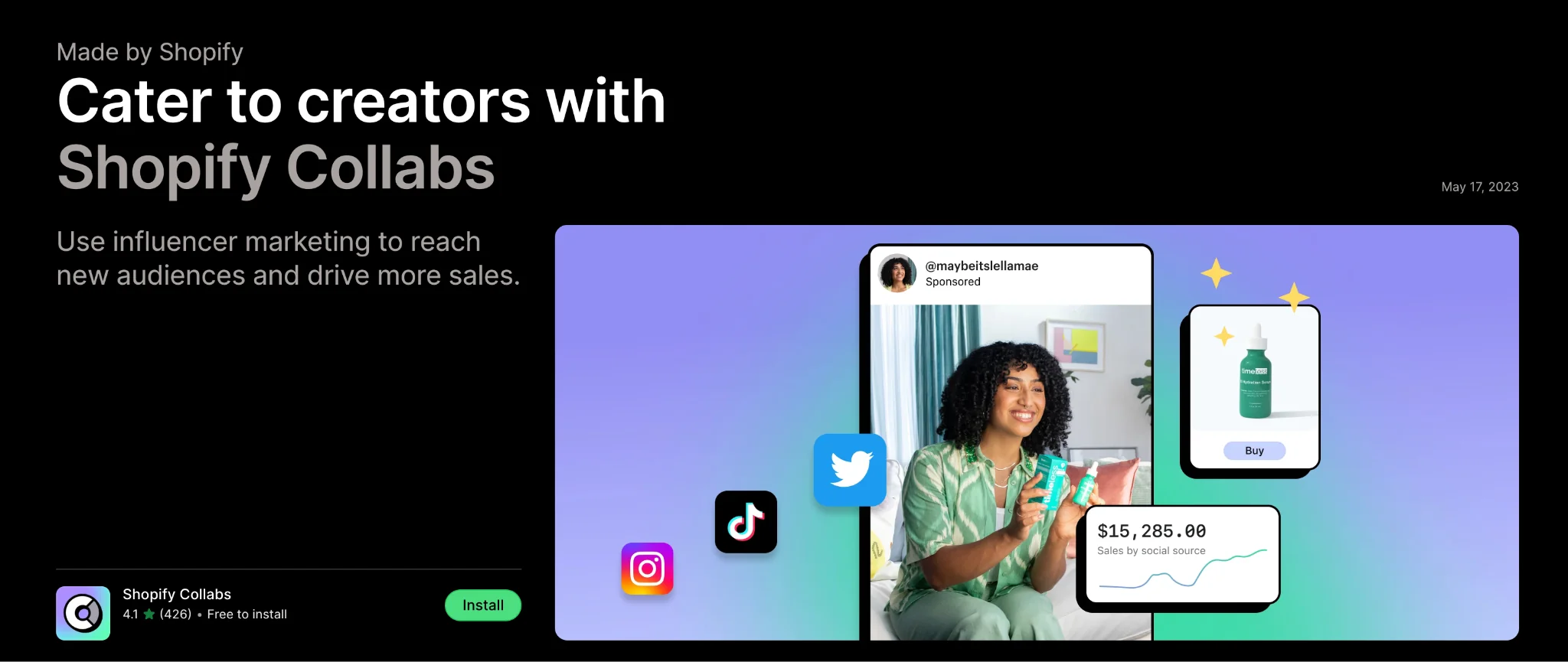
Shopify Collabs is Shopify’s built-in influencer and affiliate marketing platform, allowing brands to discover and recruit creators, send gifts and product samples, create affiliate links and discount codes, track sales and commissions, and automate creator payouts—all directly within Shopify. It’s particularly suited to brands looking to build and manage an affiliate program without adding a separate platform to their tech stack.
Key Features
- Creator network access: Over a million creators in the Collabs network, browsable by merchants whose stores meet the sales threshold.
- Affiliate links and codes: Unique discount codes and referral links generated per creator, tracked natively inside Shopify admin.
- Application pages: A custom-branded page where creators apply to join your program without leaving your site.
- Gift orders: Product send-outs created and tracked as Shopify orders rather than in a separate system.
- Automated commission payments: Payouts calculated automatically and settled twice monthly through your Shopify bill.
Pricing
- Free to install on most Shopify plans, excluding Starter and Retail. There is no subscription tier.
- A 2.9% processing fee applies to every automatic commission payment, so a 10% commission on a $100 order costs about 29 cents in fees on top of the $10 paid out.
- Currency conversion fees can apply where your billing currency or the creator’s payout currency is not USD.
- Commissions default to a 30-day holding period, with a $25 minimum payout threshold per creator.
- Merchants need at least $10,000 in sales over the trailing twelve months to appear in Collabs Network discovery.
Reviews
4.1/5.0 (Shopify App Store, 388 reviews). The distribution is the story: 53% of reviewers give five stars and 21% give one, which is a sharply split product rather than an average one. Positive reviews centre on the native Shopify integration, the clean interface and automated payouts. Negative reviews cluster around low creator engagement, thin filtering when managing creator lists, and no visibility into whether an invitation was ever opened.
Integrations
- Shopify Checkout: Native attribution for codes and links with no third-party tracking script.
- Shopify Flow: Trigger automations off Collabs events inside the Shopify ecosystem.
- Klaviyo: Creator data available to lifecycle email flows.
- Instagram and YouTube: Social profile data on creator applications.
- Yotpo and Subscriptions: Reviews and recurring order apps that read Collabs activity.
Every one of those runs through Shopify. There is no path for a WooCommerce store, a Magento build, a wholesale channel or a marketplace listing, and no bulk email automation, which is why merchants running creator outreach at any real volume end up managing it in a separate tool and reconciling by hand.
Pros
- Effectively free to run: No subscription and a 2.9% fee only on money actually paid out.
- Zero setup friction: Codes, links and payouts live inside the admin you already use every day.
- Gifting as real orders: Product send-outs go through normal Shopify fulfilment and inventory.
Common Drawbacks of Shopify Collabs
Creator signups are paused
New creators cannot join, with no reopening date announced, which narrows the inbound supply the network was built on.
Three countries only
Creators must be resident in the US, Canada or the UK, so international programs are out of scope.
No vetting or relationship management
No engagement verification, no follower quality screening, no bulk email, no conversation tracking and no delivery guarantees.
Locked to one platform
Attribution, gifting and payouts all depend on Shopify, so nothing carries over if you add another channel or replatform.
Best Shopify Collabs Alternatives
| TOOL | REVIEWS | BEST FOR | TRIAL INFO | PRICING | ||
|---|---|---|---|---|---|---|
1 |

|
⭐ | Influencer CRM & automation | Book Demo | Pricing | Website |
2 |

|
⭐ | Enterprise influencer marketing | Book Demo | Pricing | Website |
3 |

|
⭐ | Influencer discovery | Book Demo | Pricing | Website |
4 |

|
⭐ | Influencer marketplace campaigns | Book Demo | Pricing | Website |
5 |

|
⭐ | Influencer partnerships | Book Demo | Pricing | Website |
6 |

|
⭐ | Influencer campaigns & data analytics | Book Demo | Pricing | Website |
7 |

|
⭐ | Influencer analytics | Book Demo | Pricing | Website |
8 |

|
⭐ | Enterprise influencer analytics | Book Demo | Pricing | Website |
9 |

|
⭐ | Micro-Influencer Campaigns | Book Demo | Pricing | Website |
10 |

|
⭐ | Influencer discovery | Book Demo | Pricing | Website |
Influencer Hero
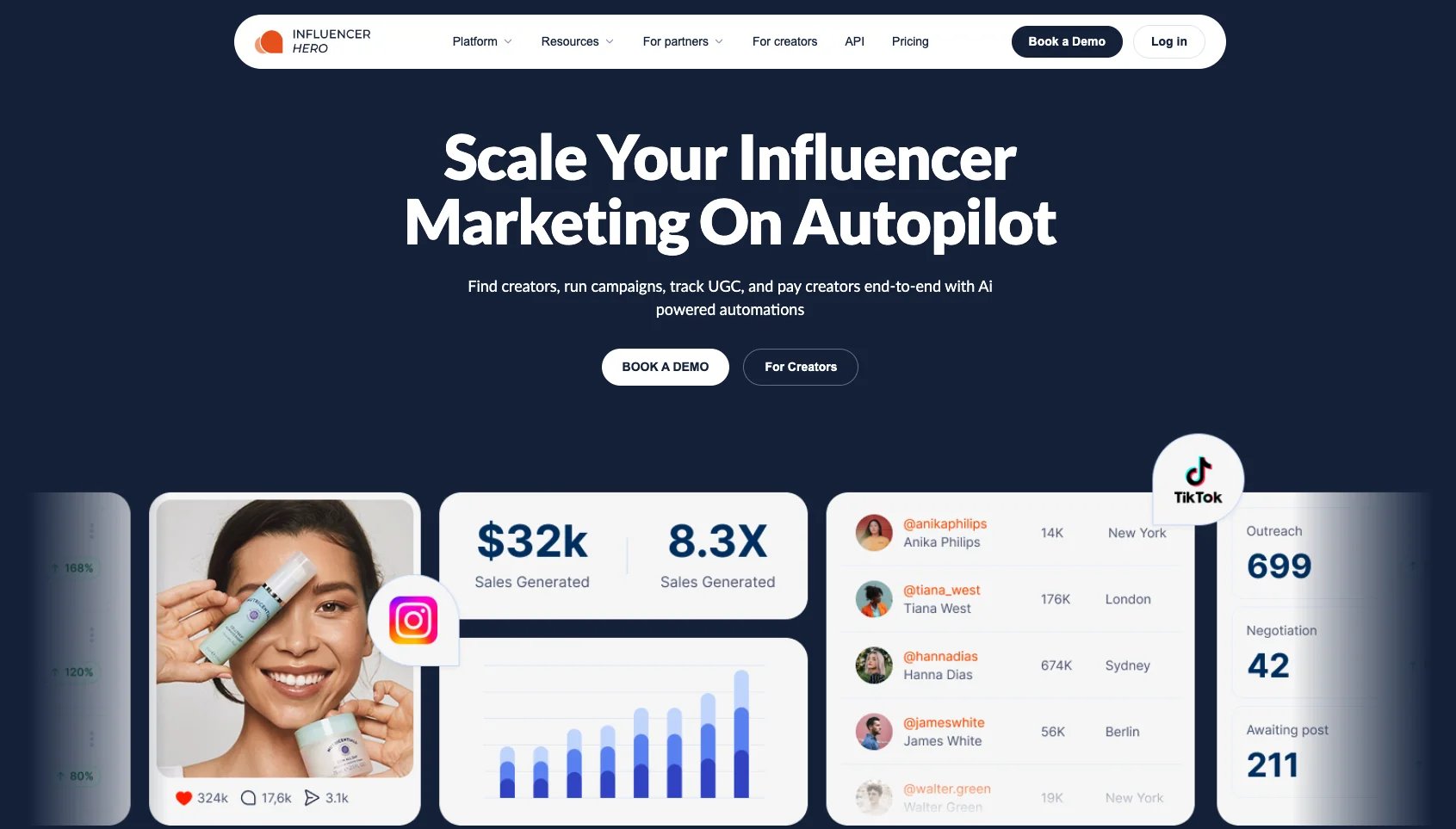
Influencer Hero is an all-in-one influencer marketing platform for D2C and eCommerce teams, covering discovery, outreach, CRM, gifting, affiliate tracking, UGC collection and reporting in a single system. It works across eight social networks and connects to Shopify, WooCommerce and custom stores through an embedded script. It is the natural next step for a brand that has proved the channel on Collabs and hit its ceilings.
Key Features
- Creator discovery: Search Instagram, TikTok, YouTube, Facebook, Pinterest, Snapchat, X and Twitch with filters for location, audience demographics, niche, engagement rate and follower quality.
- Fake follower detection: Screen audience authenticity before a creator enters the program, which Collabs does not do at all.
- Lookalike search: Find creators resembling the ones already converting for you, rather than starting each recruitment round cold.
- Brand follower identification: Surface creators who already follow or buy from you, replacing the inbound applications the paused Collabs signups removed.
- Outreach automation: Bulk and one-to-one email with AI personalisation, drip sequences, reply tracking and spam scoring, from your own domain.
- Affiliate management and payouts: Links, codes and commission tracking with influencer payment tools running at a 0.4% payout fee against the 5–8% common elsewhere.
- Chrome extension: Live creator stats while browsing social platforms, with one-click import into a campaign.
- Storefronts and application pages: Creator storefronts plus branded pages that collect inbound applications on your own terms.
Pricing
- Standard: $649 a month, up to 1,000 creators.
- Pro: $1,049 a month, up to 5,000 creators.
- Business: $2,490 a month, up to 10,000 creators.
- Custom and agency pricing available, with every tier listed publicly rather than gated behind a demo.
Reviews
5.0/5.0 (Capterra)
Pros
- No platform lock-in: Shopify, WooCommerce and custom builds via script, so a replatform does not end the program.
- No geographic limit on creators: Discovery runs globally rather than across three countries.
- Cheap payouts: A 0.4% payout fee against 2.9% on every automatic commission payment elsewhere.
Cons
- No free trial: Evaluation happens through a demo, not hands-on access.
- A real monthly cost: $649 a month against a tool that costs nothing to install.
- Learning curve: More surface area than a native app, and it takes time to work through.
Integrations
- Shopify, WooCommerce and Magento for attribution, with script support for custom stores.
- GoAffPro for affiliate tracking and DocuSign for creator contracts.
- Klaviyo for lifecycle email and Slack for internal notifications.
- Gmail, Outlook and Zapier across the wider stack.
- A documented API for pulling creator data into internal systems.
Shopify Collabs vs Influencer Hero
Run the payout maths first, because it is the one direct comparison. Collabs charges 2.9% on every automatic commission payment; Influencer Hero charges 0.4%. On $30,000 of monthly commission paid out to creators that is $870 a month against $120, which covers a meaningful share of the subscription on its own. The rest of the fee difference is the part most brands never model.
Everything else is a difference of scope. Collabs issues codes, tracks orders and pays people, all inside Shopify and all within three creator countries. Influencer Hero handles the parts before and after that: finding creators across eight networks, screening their audiences for fake followers, running automated outreach that replaces the inbound applications Collabs no longer generates, collecting UGC and reporting per creator. And because tracking runs through a script rather than a native app, the program survives a move to WooCommerce or a custom build.
CreatorIQ
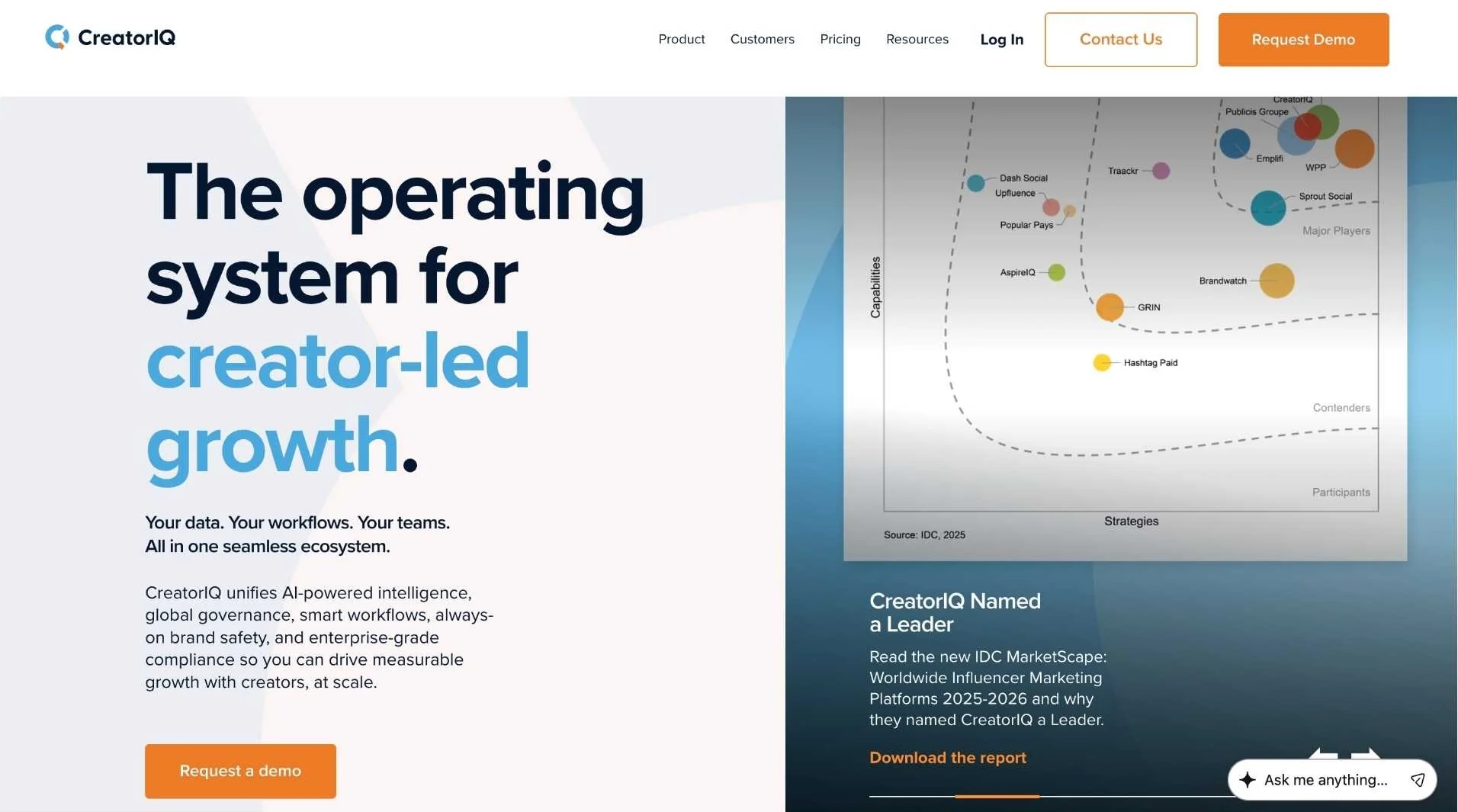
CreatorIQ is enterprise influencer marketing software built for large brands and agencies that need first-party creator data, brand safety controls and audit-grade reporting. It is designed to sit across every creator channel a business runs, including affiliate networks, and to consolidate them into one set of numbers. It is a governance purchase as much as a marketing one.
Key Features
- First-party creator data: Pulled through official platform partnerships rather than estimated from public pages.
- SafeIQ brand safety: Text, image, video and audio scanning with per-brand rules.
- BenchmarkIQ: Your program measured against category peers rather than against last quarter.
- In-platform global payments: Creator payouts handled across markets and currencies.
- Data export API: A dedicated product for pushing creator and campaign data into your own warehouse.
Pricing
- Quote-based, with a booking form instead of published tiers.
- Third-party listings report entry around $36,000 a year, with buyer medians near $39,000.
- Annual contracts, no free trial and no free version.
Reviews
4.6/5.0 (G2, 581 reviews) and 4.5/5.0 (Capterra, 17 reviews).
Pros
- Deep review evidence: Nearly 600 software buyer reviews, and a far more consistent distribution than a split 4.1.
- Affiliate network coverage: CJ, Awin, Impact, Rakuten and Partnerize reporting alongside owned creator activity.
- Real creator vetting: Brand safety scanning across every asset format, where Collabs does none.
Cons
- A $36,000 floor: An enormous jump from free, and unjustifiable below a certain program size.
- Nothing published: Budget planning starts with a sales call.
- Shopify only: Ironically it shares the same store limitation, with no WooCommerce path.
Integrations
- Shopify, Google Analytics and Tableau for commerce and reporting.
- Salesforce, DocuSign and Sprinklr for enterprise workflow.
- CJ, Awin, Impact, Rakuten and Partnerize for affiliate attribution.
- Single sign-on for enterprise identity management.
- An export API for internal data pipelines.
Shopify Collabs vs CreatorIQ
These are not competing for the same buyer and pretending otherwise wastes everyone’s time. Collabs is the free starting point for a single Shopify store; CreatorIQ is a five-figure annual commitment for a brand running creator activity across regions, agencies and affiliate networks that need consolidated reporting.
The useful question is what triggers the move. Usually it is either compliance, once legal wants brand safety scanning and documented rights, or measurement, once nobody can answer what total creator spend returned across every channel. Neither of those is a problem Collabs was built to have.
Upfluence

Upfluence is a creator marketing platform whose signature capability is finding influencers inside a brand’s existing customer list and website traffic. It sells as modules, so brands enable discovery, outreach, gifting or payments as needed, and it commits publicly to charging no commission on creator-driven sales. It fits brands with enough traffic and order history to mine.
Key Features
- Live Capture: Detects creators among your existing customers and site visitors.
- Jaice AI co-pilot: Builds shortlists and drafts outreach for approval.
- Order triggering: Creates and ships gifting orders from your own store.
- Multi-currency payments: Creator payouts across international markets.
- Creator marketplace: Inbound applications against briefs you publish.
Pricing
- Quote-based and modular, priced on the modules you switch on.
- A fixed platform fee with no commission on creator-driven sales, stated by the vendor.
- No setup fee, with a 12 month minimum on annual plans.
- Buyer-reported medians around $15,000 a year.
Reviews
4.6/5.0 (G2, 140 reviews) and 4.4/5.0 (Capterra, 44 reviews).
Pros
- Customers as creators: Live Capture recruits from people who already bought, which beats cold invitations on response rate.
- Four store platforms: Shopify, WooCommerce, Magento and BigCommerce.
- No sales commission: A fixed fee with nothing taken from creator-driven revenue.
Cons
- A twelve month minimum: A serious commitment next to a free app you can uninstall.
- Cost grows with modules: Payments and automation add to the quote.
- No published pricing: Nothing to budget against before a call.
Integrations
- Shopify, WooCommerce, Magento and BigCommerce for commerce data.
- Klaviyo and Hootsuite across the marketing stack.
- Amazon Attribution and Refersion for tracking beyond your storefront.
- Zapier for internal tooling.
- Gmail and Outlook for outreach.
Shopify Collabs vs Upfluence
Collabs solved creator supply with a network, and with signups paused that solution is doing less than it used to. Upfluence solves the same problem without a network at all: Live Capture identifies creators inside your customer list and site traffic, which is a pool that grows with your business rather than one controlled by a third party’s registration policy.
The other structural difference is reach beyond Shopify. Upfluence tracks across Shopify, WooCommerce, Magento and BigCommerce, plus Amazon Attribution, so a brand selling in more than one place keeps a single view of creator revenue. The trade-off is a twelve month term and a quote you cannot look up.
Afluencer
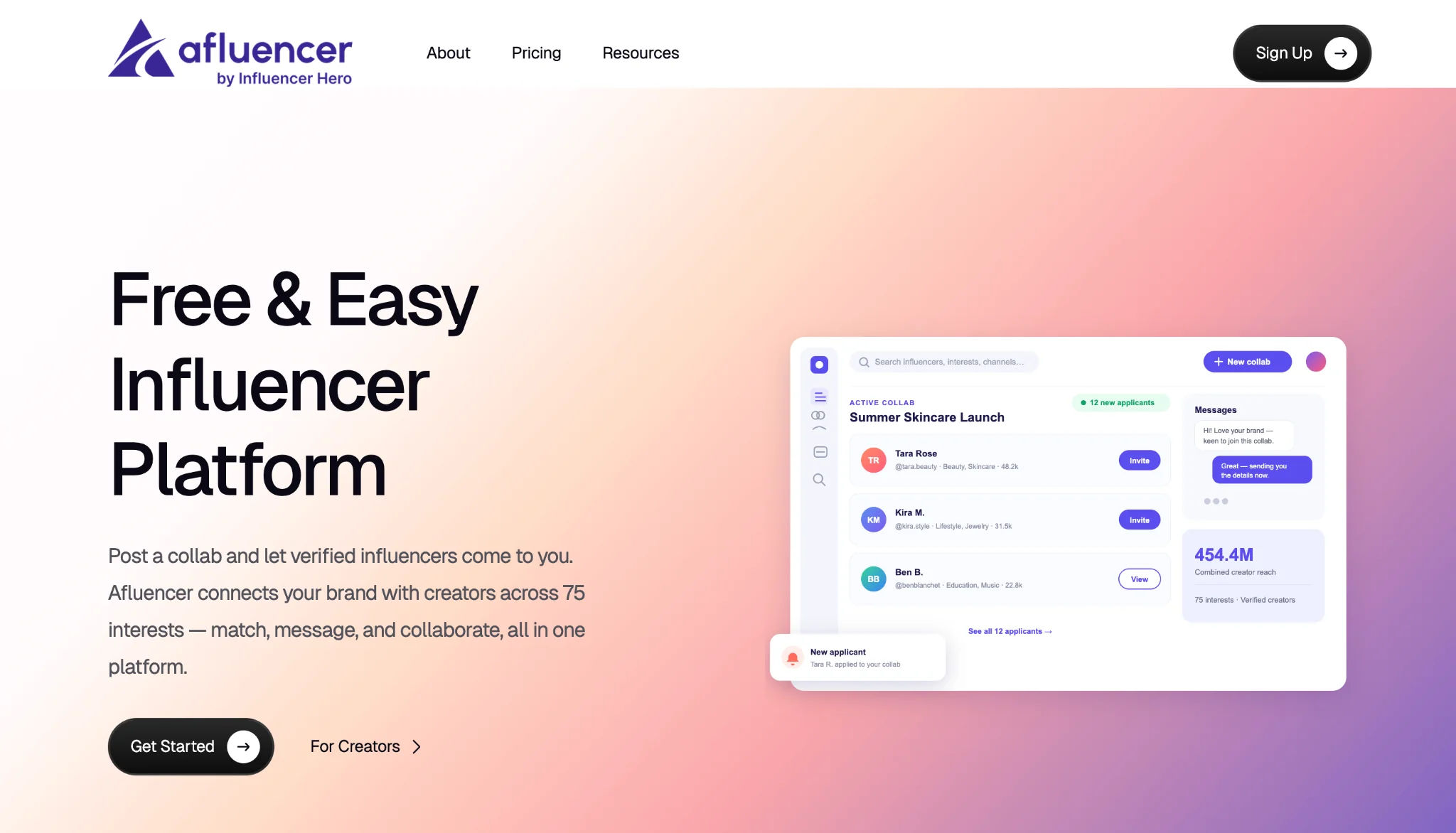
Afluencer is a creator marketplace built on inbound applications: brands post campaign listings and creators apply to them. Pricing is published from $49 a month and the platform takes no percentage of what creators are paid. It is the most direct answer to the specific problem of a network whose creator signups have stopped.
Key Features
- Campaign listings: Publish a brief and collect applications from creators who chose it.
- Premium filters: Screen applicants by niche, audience size and social network.
- In-app messaging: Agree rates and deliverables directly with each creator.
- Send-outs and payments: Product delivery and creator payment on higher tiers.
- AI matching: Applicants ranked against your brief automatically, with approval left to you.
Pricing
- Marketplace: $49 a month with 60 invitation credits and premium filters.
- Standard: $649 a month with 1,000 reach-outs, product send-outs and payments.
- Pro: $1,049 a month with 5,000 reach-outs and a dedicated account manager.
- Creators join and apply free, and every tier is published.
Reviews
4.6/5.0 (Shopify App Store, 36 reviews).
Pros
- Creator registration is open: New creators keep joining, which is precisely what stalled elsewhere.
- Low published entry: $49 a month, with no cut of creator earnings.
- Applications not invitations: No weekly cap and no 30-day expiry on outbound invites.
Cons
- Marketplace-bound: You reach creators registered with Afluencer, not the open web.
- Credit ceiling: 60 invitations on the entry tier goes quickly.
- Lighter attribution: Reporting is thinner than native Shopify order tracking.
Integrations
- Shopify for gifting and collaboration workflow.
- Instagram, TikTok and YouTube for reviewing applicants.
- Native in-platform messaging.
- Creator payments handled in-platform on higher tiers.
- Email alerts for new applications on live briefs.
Shopify Collabs vs Afluencer
Both run on creators applying to brands rather than brands chasing creators, which is the model most merchants actually want. The difference right now is that one of them still accepts new creators. With Collabs signups paused indefinitely, the inbound flow depends entirely on creators who joined before the door closed, while Afluencer keeps registering new ones.
Afluencer also drops the geography rule. Collabs restricts creators to the US, Canada and the UK, so a brand shipping to Europe or Australia cannot recruit locally through it at all. At $49 a month, testing whether that broader pool converts is a very cheap experiment.
Aspire
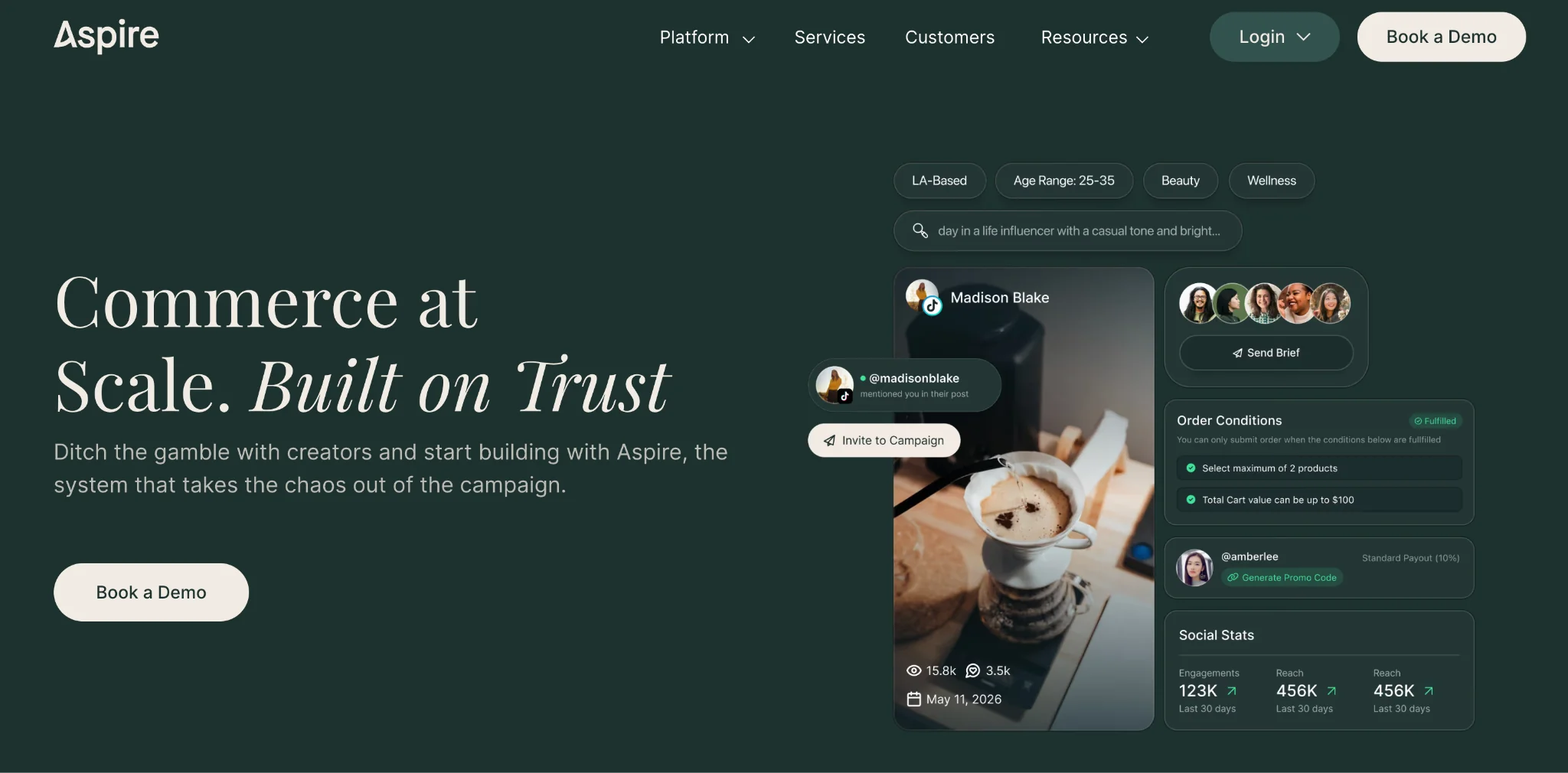
Aspire is a creator marketing platform for D2C brands running gifting, affiliate and paid amplification through one workflow. Creators apply to briefs you publish, you set commission rates per creator, and approved content can be run as paid media from the creator’s own handle. It is a full program tool priced at the enterprise end of the market.
Key Features
- Creator marketplace: Applications collected against briefs you publish.
- Promo codes and affiliate links: Issued per creator at rates you configure.
- Whitelisting: Creator content run as paid ads through Meta Ads Manager from the creator’s handle.
- Content approval and rights: Review rounds with usage licensing attached to each asset.
- Attribution dashboards: Creator activity tied to Shopify revenue.
Pricing
- Quote-based, with no published pricing page.
- A 2% handling fee on creator fee budget payments, disclosed in the vendor’s terms.
- Buyer-reported medians near $15,600 a year on annual contracts.
- No free trial.
Reviews
4.6/5.0 (G2, 146 reviews) and 3.5/5.0 (Capterra, 6 reviews, low volume and polarised).
Pros
- Rights handled properly: Usage licensing sits inside the approval flow instead of in email threads.
- Whitelisting: Vetted Meta, TikTok and Pinterest partnerships for amplifying creator content.
- A lower fee on payouts: 2% on creator fee budget against 2.9% on every automatic commission payment.
Cons
- Enterprise-level cost: Around $15,600 a year reported, against free.
- Shopify only: Same single-platform constraint you may be trying to escape.
- Thin Capterra sample: Six reviews at 3.5 against 146 at 4.6 on G2.
Integrations
- Shopify for revenue attribution and product send-outs.
- CJ, Impact and ShareASale for affiliate tracking.
- Klaviyo for lifecycle marketing.
- PayPal for creator payments.
- Gmail and Outlook for outreach.
Shopify Collabs vs Aspire
The clearest gain is content rights. Collabs gets a creator to post and sends them a commission; it does not manage usage licensing, so running that content as an ad afterwards is a separate conversation you have to remember to have. Aspire attaches rights to the approval step and then lets you whitelist the post as paid media from the creator’s handle, which is where most of the return on a good asset actually comes from.
Gifting is the other difference worth pricing. Both create product send-outs, but Aspire wraps them in briefs, approvals and content delivery rather than an untracked order, which matters given that unfulfilled gifting is one of the recurring complaints in Collabs reviews. It is worth comparing against dedicated gifting platforms before assuming the native option is sufficient.


NeoReach
NeoReach combines a very large creator index with managed campaign execution, aimed at brands that would rather buy a team than operate software. It sells platform access and services separately or together, and covers Twitch alongside the mainstream networks. It suits merchants with budget but no internal creator resource.
Key Features
- Large creator index: Reported at 250 million plus profiles with 400 plus data points each and fraud detection.
- Managed execution: Strategists sourcing, briefing, negotiating and reporting on your behalf.
- Seeding logistics: Gifting and fulfilment run operationally rather than by your team.
- Commissioned UGC: Content production as a standalone deliverable.
- API access: Creator data and reporting pushed into internal systems.
Pricing
- Quote-based through an inquiry form, sold individually or bundled.
- A third-party listing reports platform access from around $399 per user per month.
- Managed service retainers are quoted separately and unpublished.
- No free trial.
Reviews
4.5/5.0 (G2, 11 reviews, very low volume), with an empty Capterra listing.
Pros
- Solves the labour problem: Manual invitations and follow-ups become someone else’s job.
- Twitch and gaming coverage: Networks a Shopify-native tool does not touch.
- Fraud detection built in: 400 plus data points per creator before activation.
Cons
- No published store connectors: Attribution has to be built rather than switched on.
- Eleven G2 reviews: Not enough evidence to lean on.
- Retainer economics: A fixed service cost regardless of what campaigns return.
Integrations
- An API for moving creator data into internal reporting.
- Instagram, TikTok and YouTube for performance data.
- Twitch for gaming campaigns.
- Exports into business intelligence dashboards.
- Single sign-on for larger teams.
Shopify Collabs vs NeoReach
The real cost of Collabs is not the 2.9% fee, it is the person sending 100 invitations a week and chasing the ones that expire. NeoReach removes that entirely by putting strategists on the account, backed by an index of 250 million plus profiles with fraud detection, which is a different answer to the same bottleneck.
What you give up is the thing Collabs does best. There are no published store connectors, so the clean native attribution that makes Collabs worth using in the first place has to be rebuilt somewhere else. For most Shopify merchants that is a step backwards, which is why NeoReach tends to sit alongside a tracking tool rather than replace one.
Klear

Klear is Meltwater’s influencer marketing product, pairing a large creator database with audience authenticity screening and compliant international creator payouts. It is sold within the Meltwater suite, arriving with social listening and PR data and enterprise contract terms. Its strongest case is international reach and payment compliance.
Key Features
- Creator database: Over 30 million profiles with AI matching on brand and audience fit.
- True Reach: Bot detection and dormancy analysis that discounts inactive followers.
- Estimated Media Value: Reported alongside engagement metrics.
- Global coverage: 190 plus countries and dozens of languages.
- Compliant payouts: Tipalti and Gigapay handling creator payments and tax by jurisdiction.
Pricing
- Quote-based through Meltwater across Starter, Pro, Enterprise and Agency tiers, with no figures published.
- Influencer marketing is included only on the Enterprise and Agency tiers.
- A 12 month minimum is typical, with no free trial.
- Implementation fees can apply for custom integrations.
Reviews
4.1/5.0 (G2, 2,638 reviews), a suite-wide score across all Meltwater products rather than the influencer module alone.
Pros
- Genuinely global: 190 plus countries against a three-country creator restriction.
- Tax-compliant payouts: Named providers handling jurisdiction-level obligations.
- Authenticity screening: Bot and dormancy analysis you can inspect per creator.
Cons
- Enterprise gating: Influencer marketing only on the top two tiers.
- Same headline score: 4.1, and it covers the entire suite rather than this module.
- Twelve month term: No trial and no short-term option.
Integrations
- Shopify and WooCommerce for discount codes and tracking links.
- A tracking pixel for stores on other platforms.
- Tipalti and Gigapay for international payouts with tax compliance.
- The wider Meltwater suite for social listening and PR data.
- Single sign-on and enterprise identity management.
Shopify Collabs vs Klear
If your creator program has to work outside the US, Canada and the UK, this is the specific fix. Klear covers 190 plus countries and routes payouts through Tipalti and Gigapay with tax handling by jurisdiction, which is the operational blocker that stops most merchants recruiting internationally on their own.
It is also a completely different commitment. Influencer marketing sits behind the Enterprise and Agency tiers, nothing is published, and twelve months is standard. A brand going from a free app to an unpublished enterprise contract should be sure the international creators are worth it before starting the conversation.
Traackr
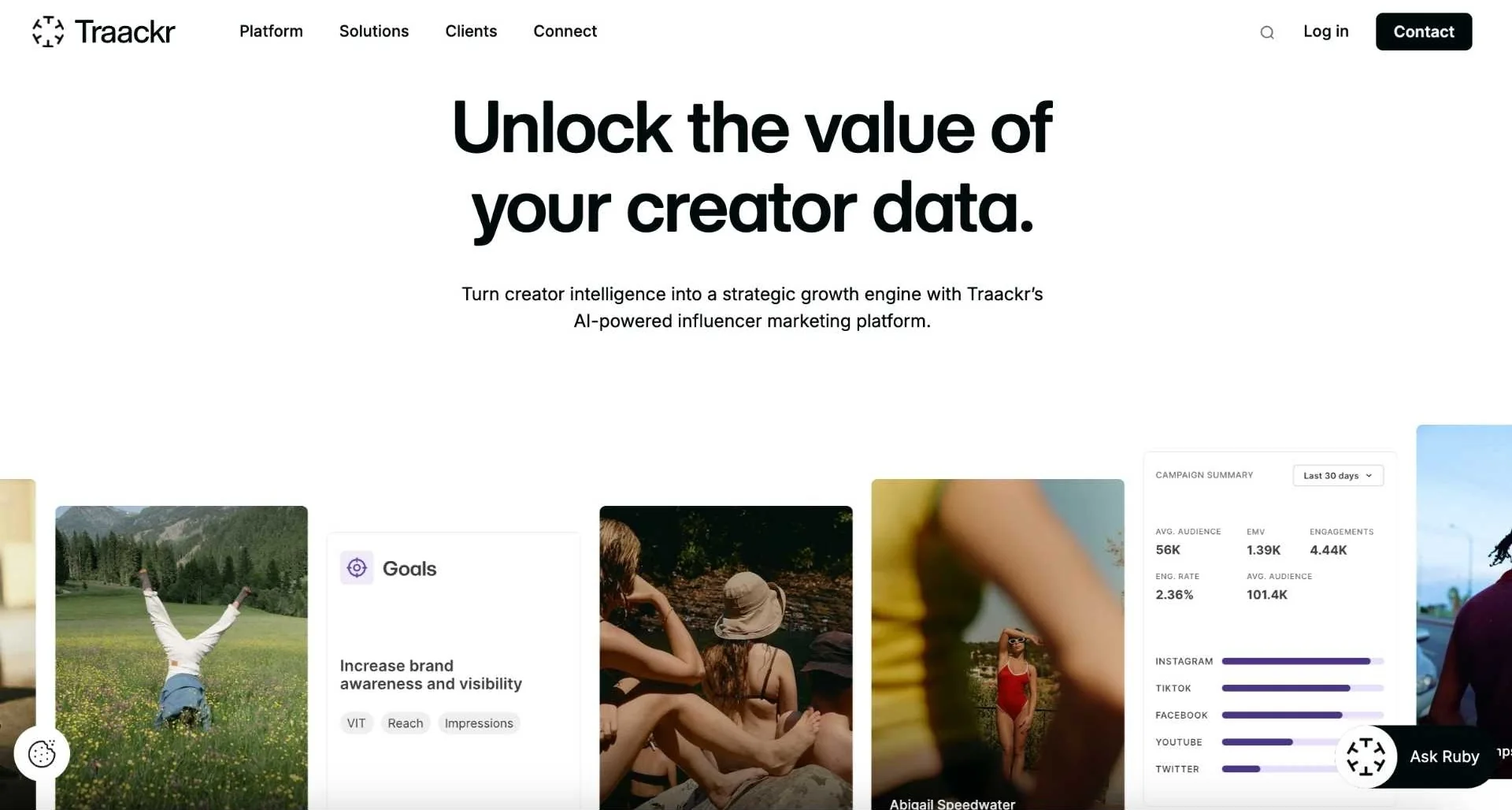
Traackr is a measurement-led influencer marketing platform for brands running continuous creator programs rather than one-off pushes, with heavy adoption in beauty and CPG. It splits the work into planning, activation and measurement, and benchmarks spend efficiency against named competitors. You buy it for the reporting.
Key Features
- Plan, Activate and Measure: Three modules covering an always-on program.
- Shopify seeding app: Inventory-synced ordering so creators pick their own products.
- Revenue tracking: Conversions attributed to individual creator links and codes.
- Local currency payments: Creator payouts made in market.
- Brand vitality benchmarking: The dataset behind its published category rankings.
Pricing
- Quote-based, with a pricing page that offers only a call.
- No credible third-party figure exists and buyer-benchmark databases hold no entry.
- No free trial and no free tier.
- Annual contracts are standard.
Reviews
4.3/5.0 (G2, 377 reviews) and 4.6/5.0 (Capterra, 32 reviews).
Pros
- Competitive benchmarking: Spend efficiency compared against named rivals rather than your own baseline.
- Better seeding mechanics: Inventory-synced Shopify ordering, chosen by the creator.
- Consistent review base: Over 400 reviews across two sources.
Cons
- No pricing signal anywhere: Even third-party benchmark data has nothing.
- Shopify only: No WooCommerce and a short integration list.
- Built for always-on: Overweight for a merchant running a straightforward affiliate program.
Integrations
- A free Shopify app for inventory-synced seeding.
- Single sign-on for enterprise identity management.
- A data lake connection for pushing campaign data into your warehouse.
- Instagram, TikTok and YouTube for creator performance data.
- Local payment rails for creator payouts by market.
Shopify Collabs vs Traackr
Collabs answers one question well: which orders came from which creator code. Traackr answers the questions that come after it, including how efficiently you are spending compared with named competitors and what the program returned across every channel, then pushes the data into your warehouse.
Its Shopify seeding app is also a straight upgrade on native gifting. Creators order preselected products themselves against synced inventory, which removes the manual send-out step and the guesswork about whether anything arrived. Everything else about the purchase, including a price nobody publishes, sits at the opposite end from a free app.
Social Cat
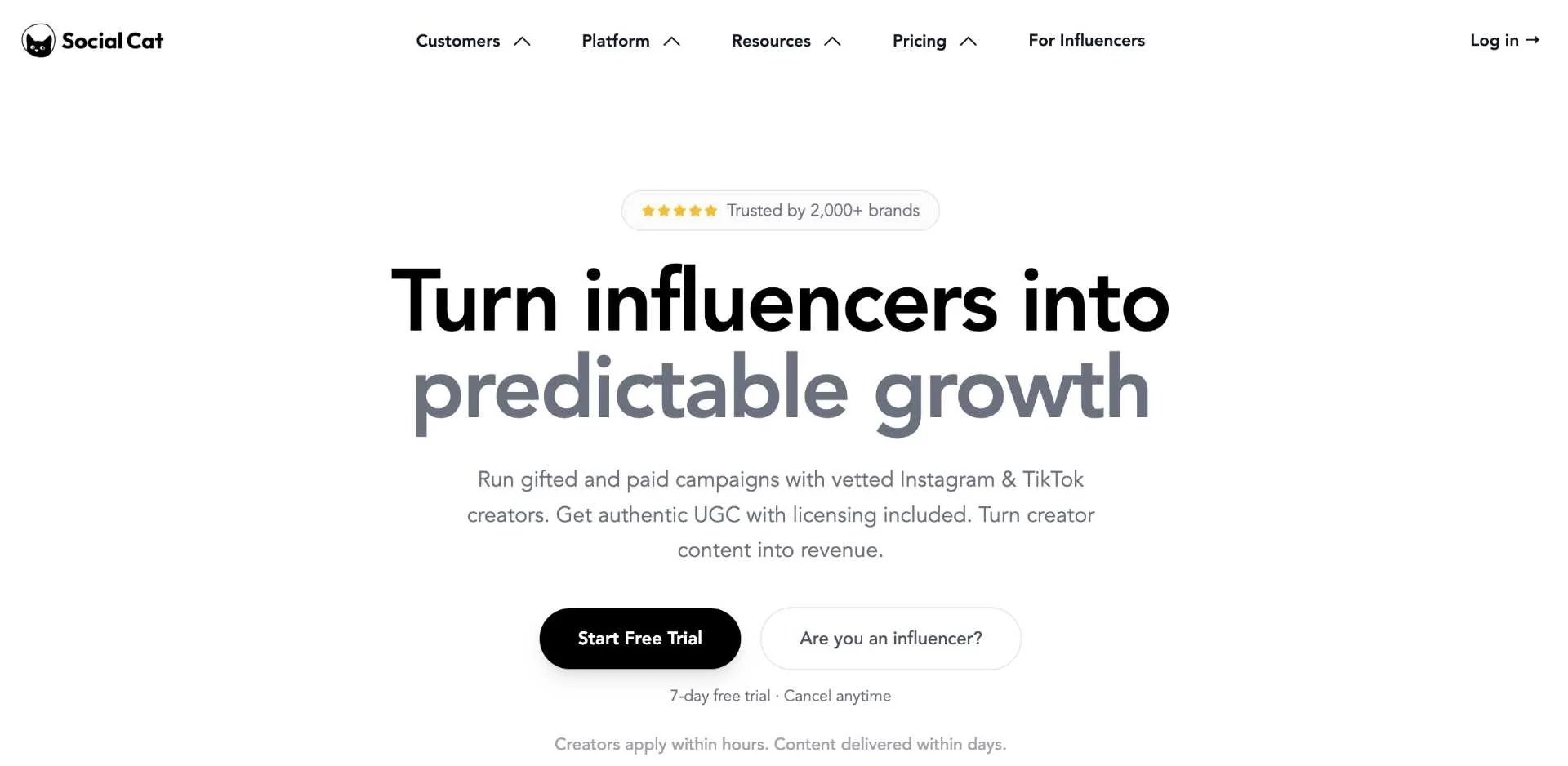
Social Cat is a micro-influencer marketplace for small and mid-sized brands, connecting them with Instagram and TikTok creators for gifted and paid collaborations. Contracts and usage rights are included at every tier and all pricing is published. It is aimed squarely at brands that want more than a native app without an enterprise contract.
Key Features
- Vetted micro network: Over 500,000 creators filterable by niche, location and engagement.
- Gifted and paid collaborations: Both handled in the same workspace.
- Contracts and licensing: Included on every plan, not sold separately.
- Invitation-based matching: 1,000 to 5,000 creator invitations a month by plan.
- Content library: Delivered assets organised, reviewed and downloadable in one place.
Pricing
- Essentials: $99 a month, up to 5 collaborations, 1,000 invitations, 1 campaign, 1 seat.
- Performance: $199 a month, up to 15 collaborations, 2,500 invitations, 3 campaigns, 5 seats.
- Pro: $299 a month, up to 30 collaborations, 5,000 invitations, unlimited campaigns, 10 seats.
- A free trial is available and product costs sit outside the subscription.
Reviews
4.7/5.0 (Reviews.co.uk, 2,772 reviews). This is a two-sided marketplace page mixing creator and brand feedback rather than a verified software buyer rating, and the G2 listing carries no reviews.
Pros
- Invitation volume: 1,000 a month on the entry plan against 100 a week natively.
- Rights and contracts included: On every tier, including the $99 one.
- A free trial: You can inspect the creator pool before committing.
Cons
- Hard collaboration caps: 30 a month at the top tier, whatever your budget.
- Two networks only: Instagram and TikTok.
- No store connector: Attribution is manual, where Collabs handles it natively.
Integrations
- Meta for Instagram and Facebook performance data.
- TikTok for collaboration metrics.
- An internal content library with no storefront connection.
- In-platform messaging for creator conversations.
- Contract signature handled natively.
Shopify Collabs vs Social Cat
This is the cheapest way to fix the supply problem. Collabs caps you at 100 invitations a week and those invitations expire after 30 days; Social Cat gives you 1,000 a month on a $99 plan, drawn from a pool where registration is open, with contracts and usage rights included at every tier.
Attribution is where it gives ground. There is no store connector, so revenue tracking moves back to spreadsheets while Collabs does it natively and free. A number of brands run both, using one for sourcing and content and the other for codes and payouts, which is cheaper than it sounds at $99 a month.
Heepsy

Heepsy is a creator discovery and outreach tool built around audience quality analysis, letting brands search and screen profiles before committing to anyone. It has a free tier and published European pricing, making it the lowest-cost entry in this comparison. It handles the front half of a program and none of the commercial back end.
Key Features
- Four search modes: AI search, text match, lookalike and direct handle lookup.
- Authenticity analysis: Follower growth curves and engagement quality rather than a single score.
- Bulk outreach: 300 to 6,000 emails a month depending on tier.
- Campaign marketplace: Publish briefs and collect inbound applications.
- Campaign pipelines: With a media gallery for delivered content.
Pricing
- Free: 500 results and 10 advanced creator profiles a month.
- Starter: €69 a month, 5,000 results, 100 advanced profiles, 300 outreach emails.
- Plus: €149 a month, 25,000 results, 500 advanced profiles, 1,200 emails, AI email compose and creator payments.
- Advanced: €229 a month, 50,000 results, 1,000 advanced profiles, 6,000 emails and priority support.
Reviews
4.5/5.0 (G2, 41 reviews) and 4.5/5.0 (Capterra, 72 reviews), consistent across roughly 113 reviews.
Pros
- Bulk email that Collabs lacks: Up to 6,000 outreach emails a month with templates and sequences.
- Screening before spending: Follower authenticity checked before a creator enters your program.
- Free to start: A real free tier and €69 a month after that.
Cons
- No commercial layer: No affiliate links, codes, attribution or payouts.
- Hard metering: 100 advanced profile views a month on the entry plan.
- One store integration: Shopify, and only on higher tiers.
Integrations
- Shopify on higher tiers for sales visibility.
- Instagram, TikTok, YouTube and LinkedIn for search and profile analysis.
- In-platform outreach with email templates.
- Creator payments on the Plus tier and above.
- CSV export for moving shortlists into other tools.
Shopify Collabs vs Heepsy
These complement each other rather than compete, and pairing them is a common and cheap fix. Collabs does codes, order attribution and payouts natively and free but gives you no way to find or contact creators at scale; Heepsy does global search across four networks, follower authenticity analysis and up to 6,000 outreach emails a month from €69.
Together they cover most of what a paid all-in-one does, at a fraction of the price, with the joins done manually. The limits are the ones you already have: creators still need to be in the US, Canada or the UK to be paid through Collabs, and revenue still only tracks on Shopify.
Final Thoughts on Shopify Collabs Alternatives
Check what you are actually hitting before you buy anything, because the ceilings here are specific and each has a different answer. If creators have dried up, the cause is paused signups and a 100-a-week invitation cap, and Afluencer at $49 a month or Social Cat at $99 with 1,000 monthly invitations fixes it cheaply.
If the blocker is geography, Collabs pays creators in three countries and Klear covers 190 plus with tax-compliant routing. If it is the fee, 2.9% on every automatic commission payment becomes real money at volume, and $30,000 of monthly payouts costs $870 there against $120 at a 0.4% rate.
And if the issue is that codes and orders are all you get, no vetting, no bulk outreach, no CRM and nothing that works off Shopify, that is the case for a full platform: Influencer Hero covers discovery across eight networks, fake-follower screening, automated outreach, gifting, UGC and affiliate payouts on published plans from $649 a month, with tracking that follows you to WooCommerce or a custom build. Free is the right answer for a first program and a poor one for a program that is working.

.png)


.jpg)










