


Zuberance Pricing and Review: Features, Pros, Cons & Costs
The influencers in a Zuberance programme are your own customers. The platform is built to find the people who already buy from you, enrol them as advocates, and ask them to write reviews, record content and refer friends.
That is a different proposition from hiring creators, and it comes with a different cost structure. No pricing is published anywhere, the product is sold as software or as a fully managed service, and the rewards advocates earn are funded by you.
This review sets out what the platform does, what determines the size of the quote, and where advocacy stops being a substitute for creator marketing.
Zuberance Overview
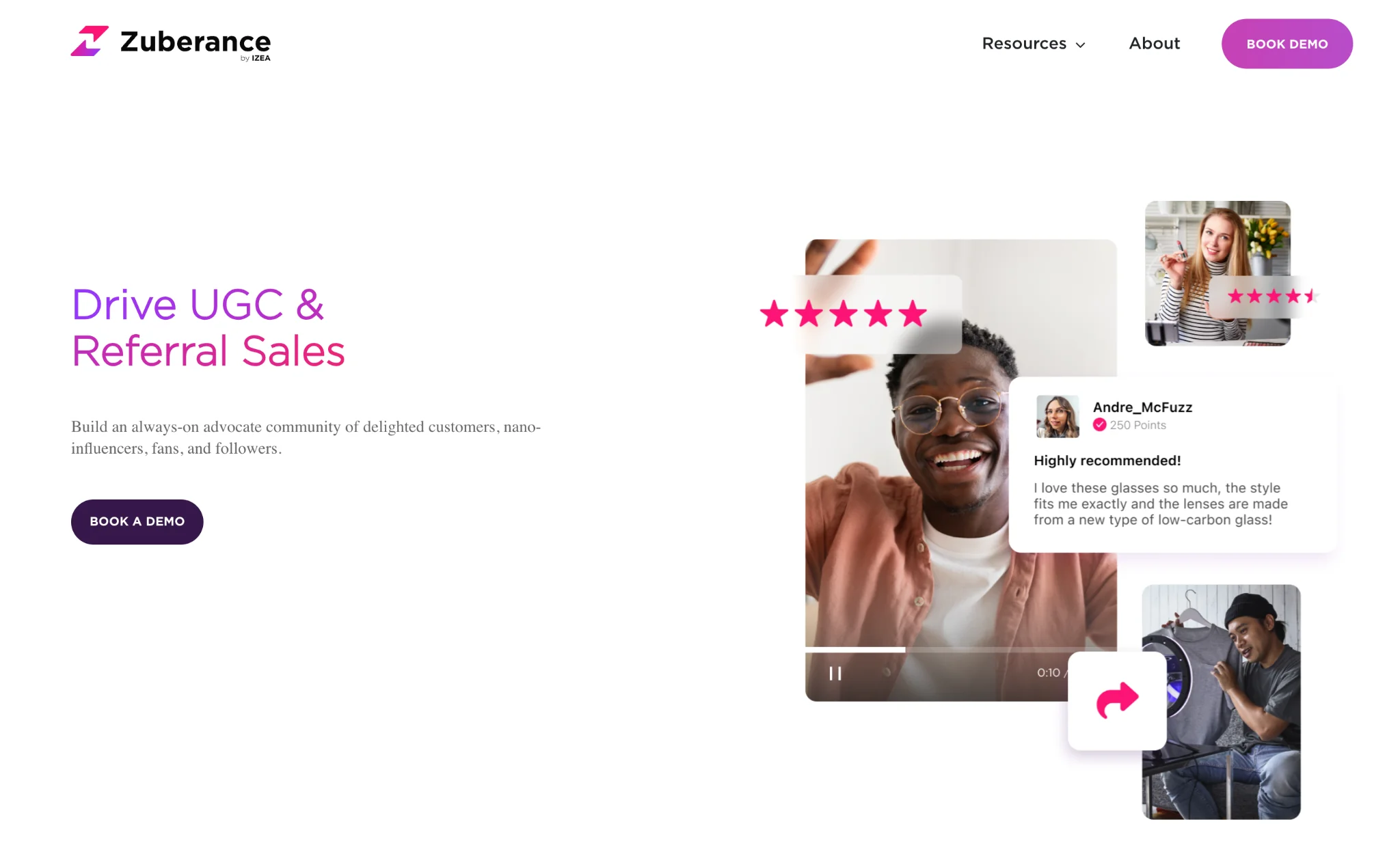
Zuberance is an advocate marketing platform. Its purpose is to build what the company describes as an always-on community of delighted customers, nano-influencers, fans and followers, then to keep that community producing content and referrals.
The mechanism runs in stages. Customers are invited to join through email, social channels, communities, account portals, in-product prompts and SMS. Those who enrol receive access to a portal branded for your business, where they are given tasks: leave a review, record a testimonial, share an offer, refer someone. Completed tasks earn points, and points are redeemed from a rewards catalogue.
The output is social proof at volume rather than reach from strangers. Content produced this way feeds your UGC content library and your product pages, and the company sells both the software on its own and a service in which its team designs and runs the programme.
Who Should Use Zuberance
The platform suits businesses with an established customer base rather than those seeking new reach:
- Brands with satisfied repeat customers: The programme depends on having people who already like the product.
- Teams that need reviews at volume: Review generation is the most reliable output of an advocacy programme.
- Businesses with long sales cycles: Referrals and testimonials carry weight where purchases involve research.
- Brands wanting content without hiring creators: Customers produce photos, videos and stories under the same programme.
- Companies without an in-house programme owner: The managed service exists precisely for this situation.
- Marketers under pressure on acquisition costs: Advocacy is positioned as a way to reduce paid spend over time.
Key Features
Advocate Recruitment
Customers are identified and invited through several channels at once, including email, social media, online communities, account portals, in-product placements and text messages. Breadth matters here, because enrolment rates from any single channel are usually modest.
Branded Advocate Portal
Enrolled advocates work inside a portal customised for your brand rather than a generic third-party interface. This is where tasks are presented and where content is created, and it is the part of the product that most affects participation.
Review and Testimonial Generation
Advocates are prompted to write reviews, record video testimonials and share stories about the product. For most brands this is the primary return, since review volume affects conversion directly on product pages and in search results.
Referral Management
The platform tracks referrals made by advocates and attributes the resulting activity. Referral and review generation are handled in the same programme, which avoids running two separate systems for what is effectively one audience.
Amplification Widgets
Custom widgets allow advocates to publish their content to social channels and third-party sites, and allow the brand to embed that content on its own website. The company positions the embedded content as a contributor to search visibility and conversion, which is a reasonable claim for review content specifically.
Rewards Catalogue
Points earned from completing challenges are redeemed against a catalogue the company states holds more than 1,000 options, including digital gift cards, prepaid cards and charitable donations, alongside custom rewards defined by the brand. The catalogue is a strength operationally and a cost to plan for financially.
Re-engagement
The system continues to prompt advocates after their first contribution, encouraging further content, shares and actions. Advocacy programmes decay quickly without this, so automated re-engagement is a genuine requirement rather than a convenience.
Analytics and Reporting
Integrated reporting covers programme activity and results, intended to show which advocates and which actions produce value. Reviewers describe the interface as dense, so allow time to learn where the useful reports sit.
Zuberance Pricing
No pricing is published. There is no pricing page, no plan names and no starting figure, and software directories list the product as contact vendor with no free trial and no free version.
What Determines the Quote
Four variables usually set the price in this category. The size of your customer base, because that determines how many advocates the programme can enrol. The number of channels used for recruitment. Whether you buy the software alone or the managed service. And the degree of customisation applied to the advocate portal.
The Services Layer Is a Separate Decision
The company sells both software and a full-service option in which its team designs, builds and manages the programme. Managed delivery is the more common arrangement for brands without a dedicated programme owner, and it is the more expensive one. Ask for both figures so the cost of the service is visible rather than bundled.
Rewards Are Your Cost, Not Theirs
This is the line most often missed. Gift cards, prepaid cards and donations redeemed by advocates are funded by the brand, not by the platform. Before signing, model the reward cost per completed action and multiply it by the number of actions you expect in a year. A programme producing 2,000 reviews at a $10 reward carries $20,000 of reward spend on top of the subscription.
What to Establish Before Signing
Reviewers consistently describe the platform as expensive, so the questions that matter are practical. Ask what the annual figure covers, whether advocate numbers are capped, what implementation costs, how long onboarding takes, and what happens to the advocate data if you leave. Then set the total against platforms built for Shopify brands, which publish their prices and cover creator recruitment as well as customer advocacy.
Zuberance Reviews
Zuberance holds 4.4/5.0 (G2, 21 reviews). Capterra carries the product with no published reviews, so the G2 sample is the only independent evidence available and it is a modest one.
Reviewers describe the platform as effective at converting customers into a reliable source of reviews and referrals, and they praise the rewards mechanism, the Shopify connection and the consultative quality of the support team. The criticisms are consistent as well: an interface with too many menus and a steep learning curve, missing CRM integrations that limit how advocates can be contacted, a high cost, and the length of time required to build an advocate base large enough to matter.
Integrations
The published integration surface is limited, and reviewers raise this as a constraint:
- Shopify: Cited by reviewers as the connection that makes customer enrolment practical for eCommerce brands.
- Email: Used as the primary recruitment and re-engagement channel.
- SMS: An additional route for reaching customers who ignore email.
- Social networks: Facebook, Instagram, TikTok, X and YouTube for advocate content sharing.
- Website widgets: Embed advocate content and reviews directly into your own pages.
No CRM integration directory is published, and reviewers specifically identify the absence of CRM connections as a limitation. Confirm what connects to your stack before committing.
Pros of Zuberance
The Audience Already Trusts You
Advocates are existing customers, so there is no vetting problem, no fake follower risk and no negotiation over rates. Recommendations from people who actually bought the product are the most credible form of social proof available, and this platform is built entirely around producing them.
Reviews and Referrals in One Programme
Most brands run review requests and referral schemes as separate systems with separate reporting. Combining them means one enrolment, one reward structure and one view of who contributes, which reduces both cost and administrative effort.
A Managed Option That Is Genuinely Managed
The full-service arrangement covers programme design, build and ongoing management. For a marketing team without capacity to run an advocacy programme properly, that is more useful than software nobody has time to configure, and reviewers rate the team’s support highly.
Cons of Zuberance
No Price, and Two Costs to Uncover
This is the principal cost consideration. Nothing is published, the software and the managed service are priced separately, and the rewards advocates redeem are funded by you on top of both. Request all three figures in writing, with the reward cost modelled against your expected volume, before comparing this with anything else.
It Does Not Find Creators
The programme works only with people who already know your brand. There is no external creator database, no audience analysis and no AI creator search, so a brand trying to reach a new audience will need a separate platform for that entirely.
Results Take Time
Reviewers note that building an advocate base large enough to produce meaningful volume is a slow process. Advocacy compounds, which is its advantage, but a brand that needs content or reach this quarter will not get it here.
Interface and Integration Gaps
The recurring criticisms concern a complex interface with too many menus and the absence of CRM integrations. Both increase the effort required from your team, which is a material consideration for a product already described as expensive.


Is Zuberance Worth It?
As an advocacy programme, the approach is sound. Customers are the most credible endorsers a brand has, combining reviews, testimonials, content and referrals into one enrolment is efficient, and the managed option solves the common problem of buying software that nobody has time to operate. A 4.4 rating, albeit on 21 reviews, supports the quality of the delivery.
The reservations are cost visibility and scope. Nothing is published, the rewards budget sits outside the subscription, reviewers describe the platform as expensive and the interface as difficult, and the programme cannot reach anybody who is not already a customer. For most D2C brands this is one component of a creator strategy rather than the strategy itself.
Brands weighing advocacy against wider creator programmes generally consider the following:
- Influencer Hero: Covers creator discovery, outreach automation, influencer gifting, a campaign CRM, affiliate codes and payouts, while also identifying creators who already follow or buy from your brand.
- Afluencer: Sources creators through applications to your listings, with audience statistics attached to each applicant, and is compared with similar tools in its roundup of AI creator tools.
- Social Snowball: Converts customers into affiliates automatically after purchase, with instant payouts and coupon tracking.
- Yotpo: Combines review collection with loyalty and SMS programmes for brands selling direct.
- Skeepers: Pairs product seeding with UGC video collection and review syndication for consumer brands.
Final Thoughts
What changes the answer here is the size of your customer base. A brand with a few thousand buyers will struggle to enrol enough advocates to justify an unpublished enterprise fee plus a rewards budget, and would do better converting those customers into affiliates with a cheaper tool. A brand with a large, satisfied base and a genuine review deficit has the raw material for a programme that compounds, and the managed service removes the main reason these programmes fail. Work out how many advocates you could realistically enrol, price the rewards against that number, and only then ask the Zuberance alternatives to quote against the same brief.

.png)


.jpg)










