


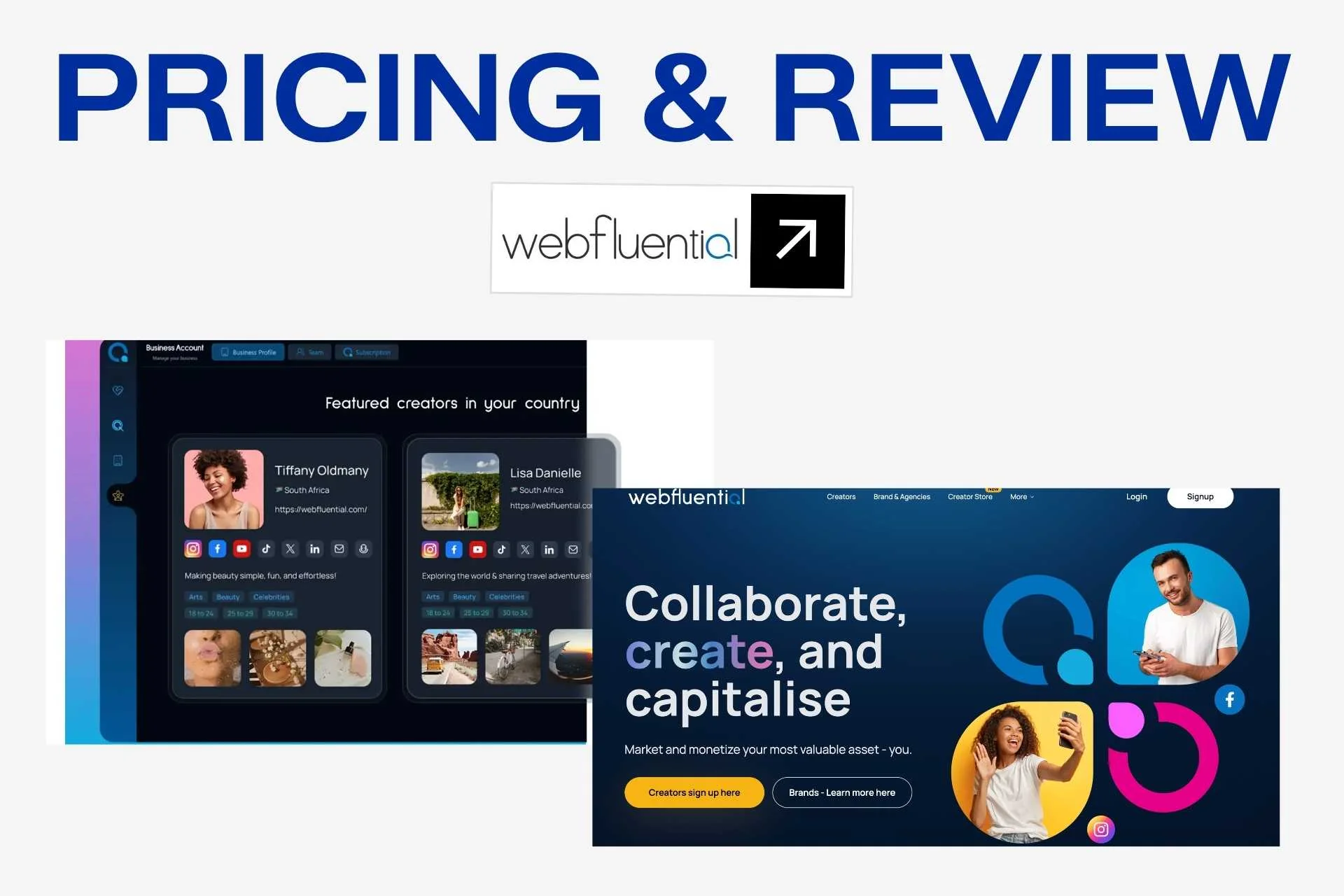
Webfluential Pricing and Review: Features, Pros, Cons & Costs
Webfluential is a vetted creator marketplace with an unusual origin story. It started in South Africa, built a hand-screened network that has booked creators for brands like Coca-Cola, Samsung and P&G, and has since repositioned around creators and agencies more than brand-side campaign management. For a D2C brand, that identity shift is the first thing to weigh.
The pricing reflects the pivot. There is a free tier for brands to get verified and book creators, then paid subscriptions aimed at creators ($59) and agencies ($99), with a $2,500 enterprise tier at the top. What you will not find is a large, self-serve brand campaign suite at a mid-market price.
This review breaks down what Webfluential does, what it costs across its tiers, where its vetted network is a genuine strength, and the gaps that matter for a brand deciding whether it fits.
Webfluential Overview

Webfluential is a marketplace that connects brands and agencies with a curated network of roughly 15,000 vetted creators. Every creator applies and is screened before joining, so the pool is smaller than database-first tools but higher on quality control. Brands search, review creator profiles and media kits, and book collaborations through the platform.
The product has increasingly tilted toward creators and agencies. Its subscription tiers are named for talent management (Creator Agent, Creative Agency), and features like Creator Stores, Wishlists and media-kit generation are built for creators monetizing their audience. Brands sit on the other side of that marketplace, booking from the vetted pool. For relationship management, the platform is lighter than a dedicated brand tool.
Who Should Use Webfluential
Webfluential fits brands and agencies that value a vetted network over a giant database. It suits:
- Brands that want hand-screened creators and are willing to trade database size for quality control.
- Agencies and talent managers who need to manage multiple creators or brands from one dashboard.
- Individual creators building media kits, stores and inbound brand deals.
- Marketing teams working across Webfluential’s established markets, including South Africa, Europe and Asia.
- Brands running occasional campaigns that can start on the free Verified Business tier before paying for anything.
- Enterprises wanting a managed, done-for-you booking layer rather than a purely self-serve tool.
Key Features
Webfluential’s feature set is built around a vetted network, with heavy investment on the creator monetization side.
Vetted Creator Network
Every creator applies and is human-screened before joining, so the roughly 15,000-strong network trades size for quality. For brands burned by fake followers and low-effort creators on open marketplaces, that screening is the core appeal.
Creator Search and Discovery
Filter the network by platform, audience, niche and location to shortlist creators. The pool is smaller than database tools, so discovery is less about volume and more about picking from a pre-vetted set.
Influence Estimator and Pricing Guidance
Webfluential scores creators and suggests pricing, giving brands a reference point for what a collaboration should cost rather than negotiating blind. This is genuinely useful for teams new to influencer rates.
Campaign Management and Collaboration
Brief creators, manage revisions, approve content and track deliverables inside one workflow, with revision tracking that keeps content rounds organized.
Real-Time Analytics and Reporting
Dashboards report campaign performance and reach in real time, though reviewers describe the analytics navigation as clunky. For deeper measurement, compare it against dedicated campaign reporting and analytics.
Creator Stores and Social Commerce
Creators can build stores and wishlists to sell and feature products, tying influence to social commerce. This is more creator-facing than brand-facing, but it shapes how partnerships convert.
Media Kits and Creator Profiles
Creators generate media kits and detailed profiles, so brands get consistent, comparable information when deciding who to book.
Networks
Brands and agencies can organize creators into topic-based networks, useful for running recurring campaigns against the same curated groups.
Webfluential Pricing
Webfluential publishes its plans, and the structure tells you who the product is really for. A free tier lets brands verify and book, while the paid subscriptions target creators and agencies. Here is how the tiers compare.
Verified Business (Free)
- Free tier for brands to get verified, browse the network and book creators.
- No monthly subscription cost to start.
- Best for brands running occasional campaigns without committing to a subscription.
Creator Agent, $59/month
- Aimed at individual creators managing their own brand deals, stores and media kits.
- Adds monetization and collaboration tools on the creator side.
- Best for creators, not for brands running campaigns.
Creative Agency, $99/month
- Built for agencies and talent managers handling multiple creators or brands.
- Adds team members, multiple-brand management and campaign tools.
- Best for agencies coordinating several creators or clients.
Agency Enterprise, $2,500/month
- Top tier for large agencies and enterprise operations, with advanced talent and campaign management.
- Best for high-volume operations that need scale and support.
The Real Cost: What to Confirm
- For a brand, the usable value sits on the free tier, and the next real step up is the $2,500 enterprise plan rather than the creator and agency subscriptions.
- Managed and done-for-you campaign options run well above the self-serve tiers.
- There is no free trial on the paid plans, so confirm exactly what your use case costs, including any booking fees, before committing.
Webfluential Reviews
Webfluential has a thin third-party review footprint, which is itself worth noting.
- 4.2/5.0 (Techjockey, 4 reviews, low volume)
- Editorial reviews rate it around 4.3/5.0 on features and ease of use
It has almost no presence on G2, Capterra or Trustpilot, so there is little large-scale user consensus to lean on. Reviewers who do weigh in praise the vetted network and pricing guidance while criticizing a dated, clunky interface and the small database.
Integrations
Webfluential’s integration surface is narrow, centered on social platforms and payments rather than a broad app ecosystem.
- Instagram, TikTok, YouTube, Facebook and X: native social connections for creator data, publishing and performance tracking.
- Creator Stores and social commerce: built-in tools for creators to sell and feature products.
- In-platform payments: booked deals are paid through Webfluential.
- Media kits and analytics exports: shareable creator data and campaign reporting.
Webfluential does not publish a broad integration directory, so brands that rely on CRM syncs, Slack or Zapier workflows will need heavier outreach automation and workflow tooling elsewhere.
Pros of Webfluential
A Genuinely Vetted Network
Every creator is screened before joining, so brands book from a curated pool rather than sifting an open database full of fake followers. For quality control, that human vetting is Webfluential’s strongest card.
Pricing Guidance Lowers the Learning Curve
The Influence Estimator and creator scoring give brands a reference for fair collaboration pricing, which is genuinely helpful for teams new to influencer rates and negotiating blind.
A Free Entry Point for Brands
Brands can verify and start booking on the free Verified Business tier, so testing the network costs nothing up front, a rarity in a category built on demo gates and minimums.
Cons of Webfluential
The Product Is Tilted Toward Creators and Agencies
For a brand, the value largely stops at booking from the vetted network on the free tier. The paid subscriptions are built for creators and agencies, so brands wanting deep, self-serve campaign software jump straight to the $2,500 enterprise tier. Budget accordingly.
A Small Creator Database
At roughly 15,000 vetted creators, the network is a fraction of the size of discovery-first tools with millions of profiles. Quality control is the trade-off, but brands needing scale or niche depth will feel the ceiling.
A Dated, Clunky Interface
Reviewers repeatedly describe the interface and analytics navigation as unfriendly and cumbersome. For a tool you work in daily, that friction adds up.
A Thin Review Footprint and Regional Roots
Webfluential has very little presence on G2, Capterra or Trustpilot, so there is limited independent consensus to rely on, and its network is strongest in its original markets. Brands in the US may find shallower coverage than on global-first platforms.


Is Webfluential Worth It?
Webfluential is worth it for a brand or agency that prizes a hand-vetted network over raw database size and can work within its markets, or for creators and agencies who want monetization and talent-management tools in one place. For those users, the screening and pricing guidance earn their keep, and the free brand tier makes it low-risk to try.
It is a weaker fit for brands that need a large discovery pool, modern self-serve campaign software at a mid-market price, or deep US coverage. If any of those describe you, compare these five alternatives:
- Influencer Hero is an all-in-one platform with publicly listed pricing (Standard $649/month, Pro $1,049/month, Business $2,490/month) and no revenue share. It pairs discovery across eight platforms with fake-follower detection, lookalike search and brand-follower identification, plus automated outreach, CRM, gifting and affiliate management across Shopify, WooCommerce and custom builds.
- Afluencer starts at $49/month and runs as a marketplace where creators apply to your campaign listings, the right call when creator supply, not software, is the bottleneck.
- Modash is a discovery-first platform with a database of hundreds of millions of creators and content monitoring, the direct answer to Webfluential’s small-network limitation.
- Klear is an analytics-heavy influencer platform for brands and agencies that need rigorous measurement and reporting across campaigns.
- Heepsy is an affordable influencer discovery tool with strong filtering, a good fit for smaller brands that want breadth without an enterprise price.
Final Thoughts
Webfluential is a quality-first marketplace that has drifted toward serving creators and agencies more than brands. Its vetted network and pricing guidance are real strengths, and the free brand tier makes it easy to try. The reservations are structural: the database is small, the interface feels dated, and brands wanting modern self-serve campaign software land at the enterprise tier. Decide based on whether a curated network or a large, modern platform matches your program, and if it is the latter, the Webfluential alternatives above cover the same jobs with more reach and better tooling.

.png)


.jpg)