

Refersion Pricing and Review: Features, Pros, Cons & Costs
Three percent looks small written next to a fifteen percent commission. It is not small. It is a fifth of what you already pay your affiliates, charged again on top, and it is levied on sales rather than on the commission itself.
That single design decision is what makes Refersion cheap to start with and expensive to grow into. The platform is a first-party affiliate tracking and payout system built for eCommerce, used by thousands of D2C brands, with genuinely deep integrations and one of the strongest review records in this category. Plans run from free to $199 a month, with a percentage of affiliate-driven sales stacked on the two paid tiers.
Below is what each plan includes, the exact sales volume where each upgrade pays for itself, the point at which the percentage overtakes a flat-fee platform entirely, and why three separate review sites disagree so sharply about how good this product is.
Refersion Overview
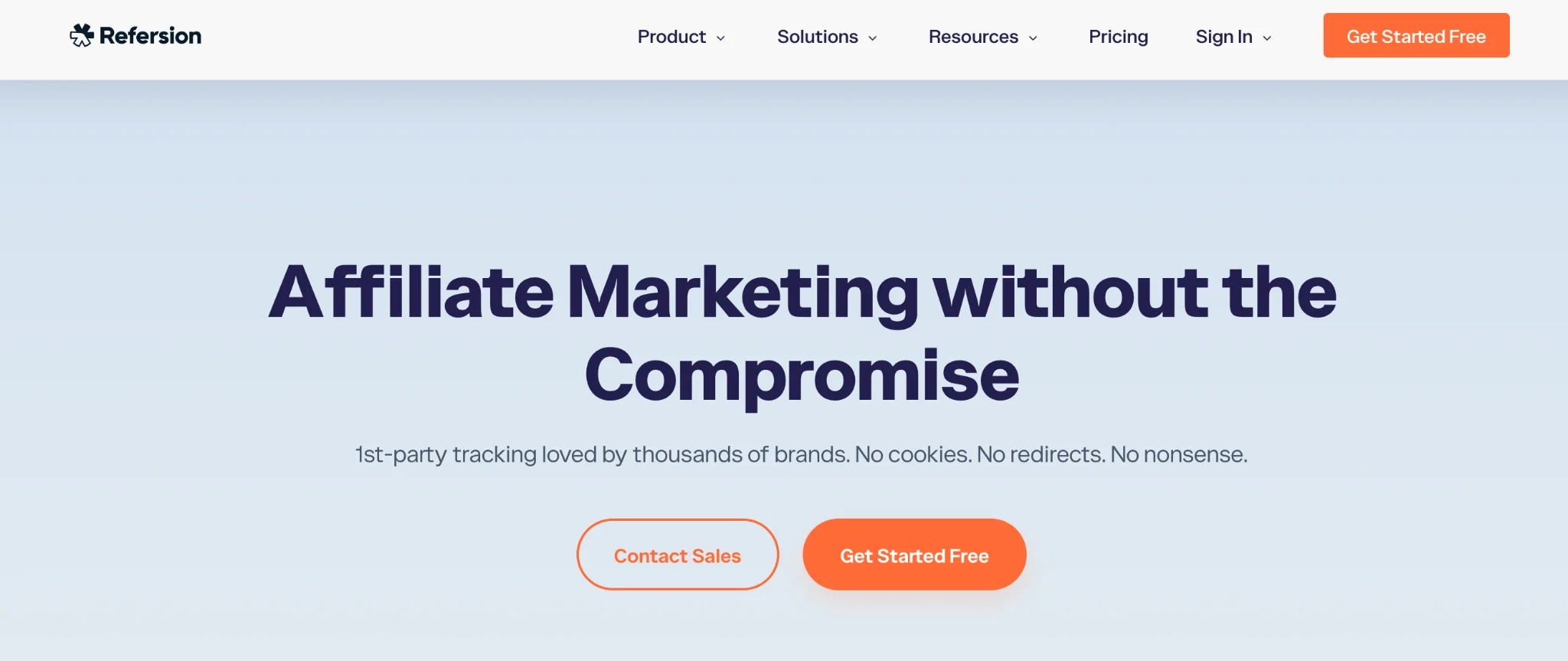
Refersion does one job and does not pretend otherwise. It tracks affiliate-driven sales, calculates commission, and pays affiliates. There is no creator discovery database, no outreach automation and no content management, which keeps the product focused and makes it a component in a stack rather than the stack itself.
The tracking is the technical differentiator. Refersion runs first-party tracking without cookies or redirects, which matters more every year as browsers restrict third-party cookies and as redirect-based attribution keeps breaking. For a brand whose affiliate revenue is material, attribution that survives browser changes is not a feature, it is the entire product working or not working.
Around that sit unlimited affiliates and conversions on every paid plan, one-click payouts with tax form handling, flexible commission structures, and a free Marketplace listing where affiliates can find and apply to your program. The integration surface is unusually wide for a tool this focused, spanning Shopify, WooCommerce and BigCommerce through to Klaviyo, Gorgias and Yotpo, which is why it slots into an existing D2C stack more easily than most influencer marketing platforms built for Shopify manage.
Who Should Use Refersion
The deciding variable is affiliate-driven revenue, because the fee scales with it and nothing else does.
- Brands starting an affiliate program from scratch. $39 a month with unlimited affiliates and a free marketplace listing is a low-risk way to find out whether the channel works for your product.
- Shopify and WooCommerce stores. Native integrations across the main eCommerce platforms mean tracking works without custom development, which is the usual failure point in affiliate setups.
- Teams that already have their creators. There is no discovery here, so this suits a brand with an existing list rather than one that needs to find partners first.
- Brands with subscription products. Recurring commission on subscriptions is supported natively, which a surprising number of affiliate tools handle badly or not at all.
- Multi-store operators. Multi-store management on the Growth tier covers brands running several storefronts under one account.
- Not brands with high affiliate revenue on a tight margin. Above roughly $22,500 a month in affiliate-driven sales, the percentage costs more than a full influencer platform that takes no cut at all.
Key Features
First-Party Tracking Without Cookies or Redirects
Attribution runs first-party, so it does not depend on third-party cookies or on bouncing customers through a redirect. As browser restrictions tighten, redirect-based and cookie-based affiliate tracking degrades quietly, and the brand only notices when affiliate revenue appears to fall for no reason. This is the strongest technical argument for the platform and the reason it survives in a crowded category.
Unlimited Affiliates and Conversions
Every paid plan carries no cap on affiliates, clicks or conversions. That is unusual, and it removes the most common way affiliate software punishes success: charging per partner or per tracked order. Growth here costs you the percentage, not a tier upgrade triggered by volume.
Flexible Commission Structures
Percent-of-sale and subscription commissions come with the entry plan. Growth adds advanced offers, product-level and customer-email tracking, and different rates for new versus returning customers. That last one matters more than it sounds, since paying full commission on a repeat purchase from an existing customer is how affiliate programs quietly lose money.
One-Click Payouts and Tax Handling
Payments go out through PayPal on the entry tier, with Stripe and Trolley available through integrations, and tax form collection is handled in the platform. For a brand paying fifty affiliates variable amounts monthly, this is the administrative saving that justifies software over a spreadsheet, and it is the part reviewers most consistently credit.
The Refersion Marketplace
A free public listing lets affiliates browse your offer and apply, which is the closest thing to recruitment in the product. It is genuinely free and available without a paid plan, so a brand can list an offer and gauge affiliate interest before subscribing to anything. Treat it as a supplementary channel rather than a substitute for influencer storefronts or active outreach.
API Access and 30+ Integrations
Growth unlocks API access alongside a published integration directory covering eCommerce, email, analytics, support and affiliate tooling. For a brand that wants affiliate data in a warehouse or triggering lifecycle flows, this is the tier that makes it possible, and it is a real reason to skip Launch beyond the fee difference.
Affiliate-Side Dashboards and Onboarding
Affiliates get their own dashboard, simplified onboarding and performance visibility. Partner experience is an underrated determinant of program success, because affiliates promote the brands whose links and reporting do not frustrate them, and this side of the product draws consistent praise.
Multi-Store and Multi-Level Management
Growth supports running several stores from one account, and the platform handles multi-level affiliate structures where partners recruit other partners. Both are specialist requirements, and neither is common at this price point.
Refersion Pricing
Four tiers, three of them with published figures, and a 20% discount for annual billing. Refersion also runs a promotional rate at the time of writing, showing Launch at $29 and Growth at $159 against list prices of $39 and $199. Budget against list, since promotions expire and renewals do not.
The percentage is the part to read carefully. It is charged on affiliate-driven sales, not on the commission you pay and not on total store revenue. So a $100 order generated by an affiliate costs you the commission plus 3% of $100 on the Launch plan. At a 15% commission that is 18% of the order gone, and the platform has taken a fifth as much as the affiliate did.
Marketplace Listing
- Free, with no percentage attached.
- A public listing in the Refersion Marketplace where affiliates can view and apply to your offer.
- You publish a percent-of-sale offer and nothing else.
- Useful as a demand test: list the offer, see whether affiliates apply, and only then decide whether the tracking is worth paying for.
Launch
- $39 per month at list, currently promoted at $29, with 20% off annual billing.
- 3% of affiliate-driven sales on top of the subscription.
- Unlimited affiliates, unlimited clicks and conversions, first-party tracking, one-click PayPal payouts, percent-of-sale and subscription commissions.
- No API access, no advanced commission options and no marketing integrations, all of which sit on the tier above.
Growth
- $199 per month at list, currently promoted at $159, with 20% off annual billing.
- 2% of affiliate-driven sales.
- Adds advanced commission options, product and customer email tracking, new versus returning customer commissions, API access, 30+ marketing integrations, multi-store management and chat support.
- Positioned for brands approaching $1 million GMV a year, and the feature jump is larger than the price jump implies.
Scale
- Custom pricing, quoted by sales, aimed at brands above $1 million GMV a year.
- Billed as a flat monthly subscription with no percentage of sales, which is the actual reason this tier exists.
- Adds premium support, white-glove onboarding, a dedicated Slack channel and early access to new features.
- Go in with your own arithmetic. At $1 million of annual affiliate-driven sales, Growth costs roughly $22,400 a year once the 2% is counted, and that figure is your ceiling in the negotiation.
Where Each Upgrade Pays for Itself
- Launch to Growth. $160 more a month at list, saving one percentage point. Break-even lands at $16,000 a month in affiliate-driven sales. At the current promotional rates it falls to about $13,000.
- Growth to Scale. Scale removes the percentage entirely, so the comparison is your flat quote against $199 plus 2% of your sales. At $1 million a year that is roughly $22,400, and any quote above it is worse than staying put.
- A worked example. At $50,000 a month in affiliate-driven sales, Launch costs $1,539 a month and Growth costs $1,199. The more expensive subscription is the cheaper plan by $340 every month.
- Against a flat-fee platform. A full influencer platform at $649 a month with no revenue share costs $7,788 a year. Refersion Growth reaches that same figure at about $270,000 of annual affiliate-driven sales, or $22,500 a month. Past that point you are paying more for less capability.
- Budget on list, not on promotion. The $29 and $159 rates are discounts against $39 and $199. Renewal is where promotional pricing usually stops.
Refersion Reviews
Three sources, three quite different verdicts, and the spread is itself informative.
- 4.8/5.0 (Shopify App Store, 462 reviews)
- 4.2/5.0 (Capterra, 56 reviews)
- 3.6/5.0 (G2, low review volume at 22 reviews)
The Shopify score is the highest-volume signal and it is strong: 462 reviews at 4.8, with 89% at five stars. Merchants there consistently name responsive support, named account contacts and straightforward setup. Capterra at 4.2 across 56 reviews broadly agrees, praising the interface, the tracking and the service team.
G2 is where the picture darkens, and the criticisms are specific enough to weigh even at 22 reviews. Reviewers there call the pricing expensive relative to what the product does, describe the feature set as limited, and say the platform has not evolved much, with one noting it has not changed in years. Reporting draws the most consistent complaint across both G2 and Capterra: bulk-only reports, an unintuitive dashboard, and custom reporting that requires an account manager to pull. Capterra reviewers also flag glitches and, more seriously, that instant registration approval leaves the program exposed to fraudulent affiliate signups. Read the Shopify score as evidence the core job gets done and the G2 score as evidence of where the ceiling is.
Integrations
This is the strongest part of the product and the clearest reason to choose it over a cheaper tracker. The published directory is broad and, unusually, names specific partners rather than gesturing at categories.
- Shopify, Shopify Plus, BigCommerce and WooCommerce. Native eCommerce coverage across the platforms most D2C brands actually run, which is where affiliate tracking usually breaks.
- Stripe and Trolley. Payout rails beyond PayPal, including international payment handling for affiliates outside your market.
- Klaviyo and Attentive. Affiliate and customer data flowing into email and SMS lifecycle flows rather than sitting in a silo.
- Google Analytics, Littledata and We Can Track. Attribution reconciled against your wider analytics stack, which matters when finance questions the numbers.
- Zapier, plus Gorgias, Yotpo, Justuno and headless options including Nacelle. Enough coverage that most existing stacks connect without custom work.
Notably, the directory also lists influencer tools including Cohley, #paid, InfluencerBit and CreatorCommerce, which tells you how the company sees itself: the tracking and payout layer underneath someone else’s creator program rather than a replacement for one.
Pros of Refersion
Tracking That Survives Browser Changes
First-party attribution without cookies or redirects is the reason to pick this over cheaper alternatives, and it becomes more valuable every year rather than less. Affiliate programs usually fail quietly, through attribution decay nobody notices until revenue looks wrong, and paying for tracking that holds up is paying to avoid that.
A Genuine Free Tier and a Cheap Entry Point
A free marketplace listing plus a $39 entry plan with unlimited affiliates makes this one of the least risky ways to start an affiliate program. You can publish an offer, see whether affiliates apply, and only pay once there is something to track. Very little in this category lets you validate demand before spending.
The Deepest Integration Surface in Its Class
Four eCommerce platforms, two payout providers beyond PayPal, email and SMS, analytics, support, headless commerce and Zapier, all named publicly. For a D2C brand with an established stack, this is the difference between affiliate data being useful and affiliate data being another dashboard nobody opens.
Cons of Refersion
The Percentage Is Charged on Sales, Not Commission
This is the cost trap and it is easy to miss. 3% of affiliate-driven sales at a 15% commission means the platform takes a fifth of what the affiliate earns, on every order, forever. At $50,000 a month in affiliate revenue the fee alone is $1,500 on Launch, and the subscription is a rounding error beside it. Any comparison against a flat-fee tool that stops at the monthly price is comparing the wrong number.
Reporting Is the Most Consistent Complaint
Across both G2 and Capterra, reviewers describe bulk-only reports, a dashboard they find unintuitive, and custom reporting that requires contacting an account manager. For a product whose entire purpose is measuring affiliate performance, needing a human to extract a custom report is a real limitation, and it is the thing to test hardest during evaluation.
No Discovery, No Outreach, No Content
Refersion tracks and pays affiliates you already have. It does not find them, does not run creator recruitment and outreach, does not manage briefs or approvals and does not collect content. The Marketplace listing is passive rather than proactive. A brand building a creator program from nothing is buying a second platform alongside this one.
Instant Approval Creates Fraud Exposure
Capterra reviewers flag that affiliate registrations are approved instantly by default, which leaves programs open to fraudulent signups and coupon abuse. Combined with reviewers describing the product as slow to evolve, this is worth raising directly in a sales conversation: ask what manual approval, screening and fraud controls are available and on which tier they sit.


Is Refersion Worth It?
For a brand starting or running a modest affiliate program on Shopify, WooCommerce or BigCommerce, yes, and the evidence supports it. First-party tracking that holds up as browsers change, unlimited affiliates on every paid plan, payouts and tax forms handled, the widest named integration list in its class, a free marketplace listing to test demand, and 4.8 out of 5 across 462 Shopify App Store reviews. Below roughly $16,000 a month in affiliate-driven sales, Launch at $39 is hard to argue with.
Past that, the model works against you. The percentage is charged on sales rather than commission, so it compounds with every successful month, and at about $22,500 a month in affiliate revenue Growth costs more annually than a full influencer platform that takes no cut at all. Add reporting complaints, instant affiliate approval and reviewers describing a product that has not moved in years, and the case weakens exactly as the program succeeds. Brands at that stage should price these:
- Influencer Hero. Discovery across eight social platforms with Instagram, YouTube and TikTok emphasised, plus fake follower screening, CRM boards, gifting through Shopify and WooCommerce, and affiliate codes with payouts at cost. Publicly listed from $649 a month with no percentage of sales.
- Afluencer. A creator marketplace from $49 a month where influencers apply to your listings, well suited to affiliate influencer marketing when the constraint is recruiting partners rather than tracking them.
- Social Snowball. Affiliate and referral management built around single-use codes and automated payouts, aimed at brands whose leakage problem is coupon abuse.
- Tapfiliate. Affiliate tracking with flexible commission rules and a strong API, useful for teams wanting to build custom workflows around the data.
- GoAffPro. A lower-cost affiliate app for Shopify brands, suited to programs where basic tracking and payouts are all that is needed.
Final Thoughts
Work out one number before anything else: your expected affiliate-driven sales twelve months from now, not today. Multiply it by 3% if you are looking at Launch and 2% if you are looking at Growth, add the subscription, and compare that total against what a platform charging no percentage would cost. The crossovers are $16,000 a month between the two paid tiers, and around $22,500 a month before the percentage exceeds a $649 flat fee entirely. If your program stays under those lines, this is a well-built tool with a strong track record and the integrations to prove it. If it clears them, you will be paying an increasing amount for tracking alone, and the Refersion alternatives that bundle recruitment, tracking and payouts into one flat subscription are the comparison worth running before you renew.

.png)


.jpg)