


Publicfast Pricing and Review: Features, Pros, Cons & Costs
Telegram and LinkedIn appear on the supported network list alongside Instagram, TikTok, YouTube, Facebook, Twitch and X. That is eight platforms, and it is not a combination many tools offer at any price, let alone at $99 a month.
Publicfast is a self-serve influencer marketing platform built around a searchable index of more than 20 million creators, with 30-plus filters, three million business contacts, in-platform messaging, campaign management and payments handled through the system rather than around it. One plan, one price, and a seven-day trial.
What the headline numbers do not show is the gap between the creators you can find and the creators you can actually run a campaign with, and that gap is the most useful thing on this page. Below is what the subscription includes, what the pay-on-confirmation model means for a D2C brand, and where the review record raises a flag worth taking seriously.
Publicfast Overview
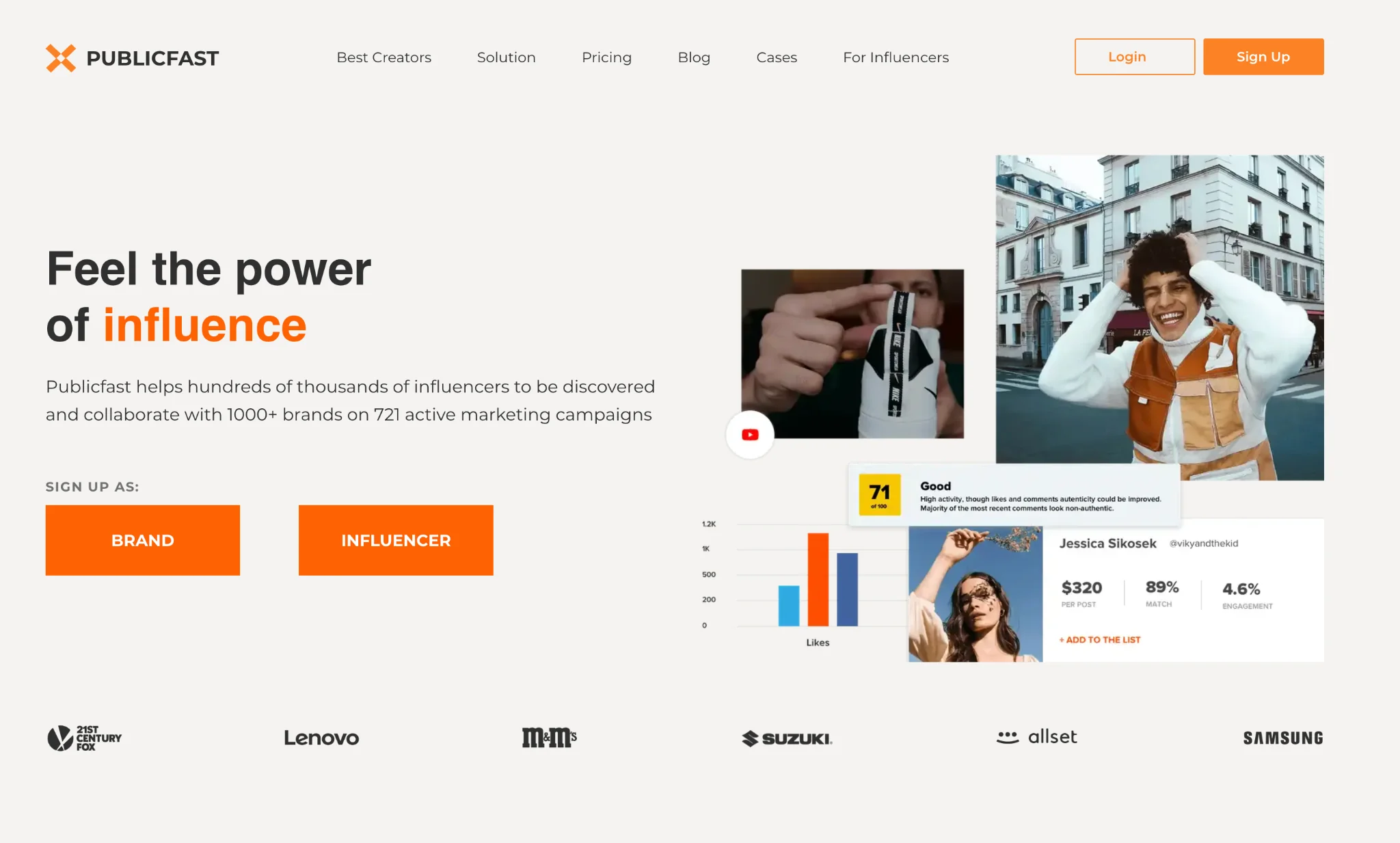
The platform is built as a self-served marketplace rather than a managed service, which shapes both the price and the workload. You search the index yourself, build a shortlist, brief a campaign, message creators directly, approve content and pay through the platform. Nobody is assigned to run it for you at this price, and reviewers who struggled tend to be the ones who expected that.
Coverage is the standout. Eight networks, including two that most competitors skip entirely: LinkedIn, which matters for B2B-adjacent D2C brands, and Telegram, which matters in Eastern European and Central Asian markets where it functions as a primary social channel. Alongside that sit audience demographics, geography, age and language data, plus follower authenticity detection, so vetting is not an afterthought.
The commercial model is the part to understand properly. Creators are paid on confirmation rather than upfront, with barter and product sampling supported as alternatives to cash, and money moves through the platform's own payment processing. That removes the invoicing problem that consumes small teams, and it also means the platform sits between you and the creator when something goes wrong. Brands wanting revenue reconciled against a store will still need creator discovery filters paired with proper commerce attribution elsewhere.
Who Should Use Publicfast
Fit here is about geography and self-sufficiency more than about budget, because the price is low enough to be almost incidental.
- Brands marketing in Eastern Europe or Central Asia. Telegram coverage is genuinely rare and in several markets it is where the audience actually is.
- Companies needing LinkedIn creators. B2B-adjacent D2C brands, finance and professional products have a channel here that most influencer tools ignore.
- Small teams comfortable self-serving. No account manager is included, so this suits someone willing to search, brief and approve without hand-holding.
- Brands doing barter and product seeding. Product sampling is supported natively rather than being a cash workaround, which suits low-budget programs.
- Teams that want payments handled. In-platform processing with pay-on-confirmation removes the invoicing and trust problem on first collaborations.
- Not brands needing niche depth. Reviewers report thin coverage in specialist categories, so confirm your own niche before the trial ends.
Key Features
Eight-Network Coverage Including Telegram and LinkedIn
Facebook, Instagram, YouTube, TikTok, Twitch, X, LinkedIn and Telegram in one search. The two unusual inclusions are the reason to look here at all: no mainstream competitor treats Telegram as a first-class creator channel, and LinkedIn creator marketing is a growing category most influencer platforms have not built for.
20 Million Creators and 30+ Filters
The searchable index runs past 20 million profiles, filterable by category, follower count, platform and audience attributes. At that scale the filters matter more than the raw number, and thirty-plus is a respectable set for a tool at this price, with export to CSV so shortlists leave the platform cleanly.
Three Million Business Contacts
Contact details are available for roughly three million creators in the index, which is the constraint on cold outreach in every discovery tool. Having them included rather than metered per lookup is a meaningful difference from platforms that charge per revealed email.
180,000 Opt-In Creators
Separate from the searchable index sits a pool of creators who have actively opted in to receive campaign offers. This is the number that determines how quickly a campaign fills, and it is the one worth planning around rather than the 20 million headline. Opt-in creators respond; indexed creators have to be persuaded.
Pay-on-Confirmation and In-Platform Payments
Creators are paid once delivery is confirmed, with money moving through the platform's own processing rather than by invoice and bank transfer. For a brand working with creators it has no history with, that sequencing removes the question of who commits first, and it removes a genuine administrative burden at volume.
Barter and Product Sampling
Product-for-post arrangements are supported as a native campaign type rather than something you negotiate around the software. For a D2C brand with margin in the product and little in the budget, seeding is often the whole strategy, and having it built in matters more than it sounds. It is narrower than what dedicated product seeding platforms handle on logistics, but the campaign mechanics are there.
Audience Analytics and Authenticity Detection
Creator profiles carry audience geography, age ranges, language data and engagement rates, with follower authenticity detection to flag inflated accounts. Authenticity screening at a $99 price point is not universal, and it is the single check that most protects a small budget from being wasted.
Campaign Briefs, Messaging and Content Approval
Briefs are created in the platform, creators are messaged directly, and content is approved before it publishes. The approval step is where reviewers report the most friction, describing the process as slow, so test that specific flow during the trial rather than assuming it.
Publicfast Pricing
One paid plan, published openly, with a seven-day free trial and no permanent free tier. That simplicity is welcome after a category full of four-tier ladders, and it means the only real decision is monthly versus annual.
The annual discount is unusually aggressive. At $690 a year against $99 a month, you are paying for seven months and getting twelve, which is a 42% saving and works out at $57.50 a month. Very few tools in this category discount that hard for an annual commitment.
The Free Trial
- Seven days at no cost, with no permanent free plan behind it.
- Reviewers describe trial functionality as limited relative to the paid product, so treat it as a coverage check rather than a full evaluation.
- Use it on one job: search your actual niche across your actual networks and count the usable creators.
- Seven days is short but workable, and considerably better than the two and three-day trials common at the enterprise end of this category.
PLUS, Monthly
- $99 per month with no minimum term described.
- Full discovery across 20 million-plus creators with 30-plus filters, three million business contacts and CSV export.
- Campaign creation across all eight networks, direct messaging, content approval, campaign analytics and in-platform payments.
- Access to the 180,000-plus opt-in creator pool, plus barter and product sampling campaign types.
PLUS, Annual
- $690 per year, which is $57.50 a month and a saving of $498 against paying monthly.
- Identical feature set; the annual commitment buys nothing beyond the discount.
- At 42% off, this is one of the steepest annual discounts in the category and worth taking if the trial goes well.
- The flip side is that the discount is doing the work of a lock-in, so be confident about niche coverage before committing twelve months.
What the Subscription Does Not Cover
- Creator fees sit entirely on top. The $99 buys the tooling. What you pay creators, in cash or product, is the actual program cost and will dwarf the subscription.
- The usable pool is far smaller than 20 million. Roughly 180,000 creators have opted in to receive campaigns, which is under 1% of the index. Everyone else has to be found, contacted and persuaded.
- No account management is included. Reviewers who found creator selection difficult mention leaning on managers; that support is not part of the self-serve price.
- Nothing connects to your store. No published eCommerce integration, so codes, orders and creator activity are reconciled by hand.
- Judge the annual decision on the trial. $690 upfront against $99 monthly is a large saving, but only if the platform covers your niche, which seven days is just enough to establish.
Publicfast Reviews
The review record is thin, and one entry in it deserves more weight than the average does.
- 4.2/5.0 (Capterra, low review volume at 5 reviews)
- 8.9/10 (TrustRadius, very low review volume at 2 reviews)
The positive material is consistent across both sources. Reviewers describe a straightforward interface that makes campaign creation fast, campaign types flexible enough to reach audiences internationally, and support staff who provide useful detail about individual creators. One brand credits the platform with saving both time and money, and another values being able to control and track everything before a campaign launches, which is exactly what a self-serve tool should deliver.
Two criticisms matter. The lesser one is practical: content approval is described as slow, niche categories are thin, and some users found creator selection difficult without help from a manager. The greater one is a single review alleging non-payment for completed content work. That is a creator-side complaint rather than a brand-side one, and one review is not a pattern, but on a platform that holds and releases money it is the kind of allegation a buyer should raise directly. Ask how disputes are handled and what happens to funds held in escrow when a collaboration goes wrong.
Integrations
No integration directory is published, which is common at this price and matters mainly for what it means downstream.
- Social platforms. Facebook, Instagram, YouTube, TikTok, Twitch, X, LinkedIn and Telegram, which is the broadest network list of any tool in this price bracket.
- Payments. Handled natively through the platform’s own processing rather than a named third-party provider.
- Data export. CSV export for creator lists, which is the practical route for getting shortlists into another system.
- eCommerce platforms. None published. No Shopify, WooCommerce or BigCommerce connection appears anywhere.
- API and automation. No public API and no Zapier connector documented.
For a brand running campaigns entirely inside Publicfast and measuring on reach and engagement, that is workable.
Pros of Publicfast
Network Coverage Nothing Else at This Price Matches
Eight platforms including Telegram and LinkedIn is the genuine differentiator. For a brand selling into markets where Telegram carries the audience, or one whose customers are professionals rather than consumers, most influencer platforms simply do not have the creators. This one does, for $99 a month.
An Annual Discount That Is Actually Worth Taking
$690 against $1,188 is 42% off, or seven months paid for twelve months used. Annual discounts in this category typically run 15% to 20%. If the seven-day trial confirms your niche is covered, this is the rare case where committing early is clearly the better arithmetic rather than a mild convenience.
Payments and Vetting Both Included at the Entry Price
Follower authenticity detection, audience demographics, pay-on-confirmation and in-platform payment processing all come with the single plan. Competitors routinely charge several times as much for authenticity screening alone, and handling money natively removes the invoicing burden that makes small creator programs administratively expensive.
Cons of Publicfast
The Usable Pool Is Under 1% of the Headline
Twenty million creators are searchable; roughly 180,000 have opted in to receive campaign offers. That is the number that determines how fast a campaign fills and how many creators actually reply, and it is more than a hundred times smaller than the figure on the homepage. Plan your outreach against 180,000 in your categories, not 20 million, and check during the trial how many of those opt-in creators sit in your niche and your markets.
Niche Coverage Is Thin and Reviewers Say So
Users report limited creator options in specialist categories and difficulty selecting the right creators without assistance. A broad index across eight networks does not guarantee depth in any one of them, and for a D2C brand in a defined vertical, depth is the only thing that matters. This is the specific job the seven-day trial should do.
A Non-Payment Allegation on a Platform That Holds Money
One reviewer states they were not paid for completed content work. A single review is not evidence of a pattern, and creator-side complaints say less about the brand experience than brand-side ones do. But the platform processes payments and releases them on confirmation, which puts it in the middle of that transaction, so ask directly how disputes are resolved, what triggers a release, and what recourse exists on both sides before running anything substantial through it.
No Store Integration and No API
Nothing connects to Shopify, WooCommerce or any other store, there is no discount code generation, no affiliate attribution and no public API. Campaign analytics stop at platform metrics, so proving what a creator sold means exporting a CSV and doing the reconciliation yourself. Brands that need creator CRM boards feeding revenue data will be running a second system.


Is Publicfast Worth It?
For a brand whose audience sits on Telegram or LinkedIn, this is close to the only realistic option at anything like this price, and that alone can settle the decision. More broadly, $99 a month for eight-network discovery, thirty-plus filters, three million contacts, authenticity screening, in-platform payments and native barter campaigns is strong value, and the 42% annual discount makes it stronger.
The reservations come down to depth and evidence. The opt-in pool is under 1% of the advertised index, niche categories are reported as thin, content approval is described as slow, the review base is too small to be conclusive, and one entry alleges non-payment on a platform that holds funds. Nothing connects to a store, so revenue attribution is manual. Brands wanting more depth or more proof should price these:
- Influencer Hero. Influencer discovery across eight social platforms with Instagram, YouTube and TikTok emphasised, plus fake follower screening, CRM boards, gifting through Shopify and WooCommerce, affiliate codes and payouts. Publicly listed from $649 a month.
- Afluencer. A creator marketplace from $49 a month where influencers apply to your listings rather than being cold-contacted, which suits brands whose constraint is response rate.
- inBeat. A curated micro-influencer database with strong filtering, aimed at brands that want a vetted shortlist rather than a large index to sift.
- Creator.co. Marketplace and managed options with an opt-in creator community, useful when campaign fill rate matters more than database size.
- Stack Influence. Micro-influencer campaigns run on product-for-post at scale, suited to brands whose budget is inventory rather than cash.
Final Thoughts
Seven days is enough to answer the only question that matters here, so use them deliberately rather than browsing. Filter to your category, your markets and your networks, then count how many opt-in creators come back, because that figure, not the twenty million, is what your campaigns will draw from. If the answer is healthy, take the annual deal, since 42% off is a genuinely unusual discount and the monthly price is already low. If the answer is thin, no feature on the list compensates, and the Publicfast alternatives with deeper niche coverage or store-level attribution are the better place to spend. Either way, if you plan to move real money through the platform, get the dispute and payment-release process explained in writing first.

.png)


.jpg)










