

Phlanx Pricing and Review: Features, Pros, Cons & Costs
Most people who know Phlanx know exactly one page of it. The free engagement rate calculator has been a bookmark in marketing teams for years: paste a handle, get a percentage, move on. It is genuinely useful and it costs nothing.
The paid platform behind it is a different proposition and much less examined. Phlanx sells an influencer directory, an account auditor, a campaign manager, a contract generator and a set of AI writing tools, priced in tiers that scale on user seats rather than on usage, starting somewhere around $25 a month. It is one of the cheapest influencer tools on the market.
It is also the one where the review record raises the most uncomfortable questions, and they are about billing rather than features. What follows is what each tier includes, what the pricing actually looks like across public listings, what reviewers report about being charged, and where a $25 tool is genuinely the right answer.
Phlanx Overview
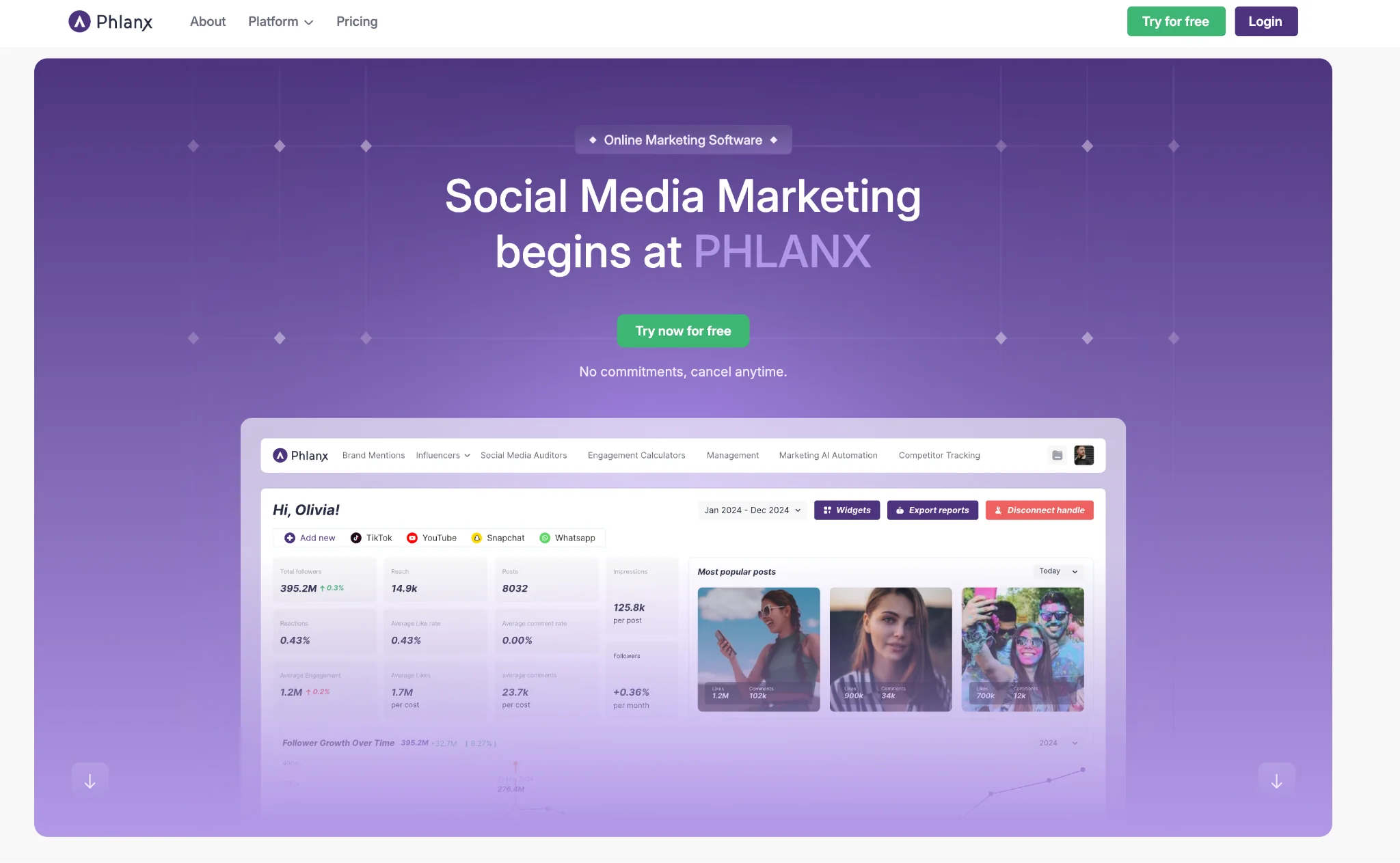
Phlanx is an Australian company selling a broad, shallow toolkit rather than a deep platform. The spread is wide: engagement measurement, influencer search, campaign tracking, contract templates, competitor monitoring and AI content helpers all sit under one login. The depth of any individual piece is modest, and that is the deliberate trade at this price.
The engagement calculator is the front door and explains most of the brand’s visibility. It accepts any public handle across Instagram, TikTok, YouTube, Facebook, X and Pinterest, and returns an engagement rate calculated as average likes plus comments divided by follower count, along with per-post averages. No login is needed for the basic version, and the free tier limits how many searches you can run in a day. That formula is standard rather than proprietary, and it benchmarks against general platform averages instead of your niche, so treat the number as a screening signal rather than a verdict.
Behind the calculator sits the directory, which listings describe at anywhere from 100,000 to 400,000 vetted profiles depending on where you look, filterable by keyword, category, location, brand mentions, hashtags, reach, engagement rate and verification status. That is a small database by category standards. For a brand that wants depth on audience quality rather than breadth of names, comparing against dedicated influencer CRM tools will show the gap quickly.
Who Should Use Phlanx
This is a budget tool, and the honest fit list is short and specific.
- Anyone who just needs an engagement rate. The free calculator does that job well, requires no account, and is the single most-used thing the company makes.
- Small businesses running occasional collaborations. At roughly $25 a month, the paid tier costs less than one hour of a freelancer’s time, which changes the standard it has to meet.
- Solo marketers and freelancers. Tiers scale on user accounts, so a one-person operation pays the entry rate and gets the full toolkit.
- Teams that need contracts more than analytics. The contract generator is a real inclusion at this price and solves a genuine problem for brands working with creators informally.
- Anyone vetting across several networks. Coverage spanning Instagram, TikTok, YouTube, Facebook, X and Pinterest is broader than most cheap tools manage.
- Not brands running a serious creator program. The database is small, the analytics are light, there is no eCommerce integration and no payout capability. Scale will outgrow this quickly.
Key Features
The Engagement Rate Calculator
The best-known thing Phlanx makes and the reason most people arrive. Enter a public handle and get an engagement rate plus average likes and comments per post, across six networks, with no account required. The formula is the conventional one, so the value is convenience rather than insight. Anyone comparing it against other options will find a fuller breakdown in this engagement rate calculator review, including where the free daily search limits bite.
Influencer Auditor
A deeper account analysis covering Instagram, TikTok and YouTube, aimed at checking a creator before you commit budget. It is a step up from the calculator, though it stops well short of the audience demographic breakdowns and fake follower scoring that specialist audit tools provide. Useful as a second screen, not as your only vetting step.
Influencer Directory
A searchable database of vetted creators with filters for keyword, category, location, brand mentions, hashtags, reach, engagement rate and verification status. The filter set is respectable. The database size is the limitation, and it skews toward particular niches including health and fitness, wellness, and marketing, so coverage in your specific category is the thing to test before paying.
Campaign Manager
Basic campaign oversight for tracking collaborations in progress. It handles the fundamentals of knowing who is doing what and when, without the deliverable workflows, approval stages or content libraries a full platform provides. For a brand running three collaborations a quarter that is proportionate; for one running thirty it is not.
Contract Generator
Templates for brand and creator agreements, generated in the platform. This is the most quietly valuable inclusion at this price point, because informal creator arrangements are where usage rights and deliverables get lost, and most tools charging ten times as much still leave contracts to you.
Competitor Tracking
Monitoring of competitor accounts and the creators working with them. Seeing which influencers a rival brand is already using is a legitimate shortcut to a shortlist, and it is a sensible thing to bundle with a directory rather than sell separately.
AI Marketing Tools
Caption generators, content improvers and SEO helpers sit alongside the influencer features. These are peripheral to the core job and broadly comparable to what a general AI writing tool does, so they should not carry much weight in the buying decision either way.
Web and Mobile Access
The platform runs on web, Android and iPhone or iPad. Mobile access is uncommon at this price and genuinely helpful for checking a creator’s numbers during a conversation rather than back at a desk.
Phlanx Pricing
Three paid tiers, Basic, Premium and Business, priced on the number of user accounts rather than on searches, campaigns or creators. Public listings put the entry point at around $25 a month for a single user, about $35 for three users and about $55 for eight. A free version and a free trial are both offered.
Two caveats belong with those numbers. Phlanx is an Australian company and several listings quote the entry tier as A$25 rather than US$25, so confirm which currency you will be billed in. And published figures differ between software directories, with some listing a higher entry price than others. Treat the table below as the shape of the pricing rather than a quotation, and confirm the current rate on the vendor’s own pricing page before entering card details. Given what reviewers report about billing, covered further down, that last step matters more here than it would elsewhere.
Free Version
- The engagement rate calculator with no account required.
- A limited number of searches per day, which is the only meaningful restriction.
- Covers Instagram, TikTok, YouTube, Facebook, X and Pinterest.
- For most people evaluating a single creator, this is the whole product and it costs nothing.
Basic
- Listed from around $25 a month for one user account.
- Unlocks the influencer directory, the auditor, campaign management and the contract generator.
- Removes the daily search limits that constrain the free calculator.
- The cheapest realistic entry into a paid influencer tool anywhere in this category.
Premium
- Listed from around $35 a month for three user accounts.
- The same feature set as Basic, extended across a small team.
- Ten dollars for two extra seats is aggressive pricing by any standard.
- Nothing functional is gated behind this tier, so the only reason to upgrade is headcount.
Business
- Listed from around $55 a month for eight user accounts.
- Again the same toolkit, with wider seat access for an agency or larger team.
- Per seat this works out under $7 a month, which is the cheapest per-user rate in the category by a wide margin.
- Capability does not increase with the tier, so an agency needing deeper analytics will not find them here at any price.
What to Confirm Before You Subscribe
- The currency. Several listings quote A$25 rather than US$25. Confirm which one your card will be charged in.
- The current rate. Published figures vary between software directories, so take the price from the vendor’s checkout rather than from a listing, including this one.
- When the trial converts. Reviewers report being charged before a trial ended. Note the exact date and set a reminder.
- Whether you are agreeing to annual billing. At least one reviewer reports being charged for an annual membership they did not knowingly select. Read the billing frequency at checkout carefully.
- How to cancel. Find the cancellation route before you subscribe, not after, given what the review record says about support response times.
Phlanx Reviews
The volume is low and the split is stark, which tells you more than the average does.
- 3.4/5.0 (Capterra, low review volume at 5 reviews)
- 3.4/5.0 (GetApp, low review volume at 5 reviews)
- 5.0/5.0 (SoftwareSuggest, low review volume at 1 review)
Five reviews split three five-star and two one-star, with nothing in between. The positive half praises an intuitive interface, clean presentation, analytics that are easy to read, and contract templates that make partnerships feel professional. Those are consistent with a well-made cheap tool and there is no reason to doubt them.
The negative half is where a buyer should slow down, because the complaints are specific and they concern money. One reviewer reports being charged for an annual membership they did not actively sign up for, requesting a refund, and receiving no response. Another describes trying to reach customer support for over a week with no reply. A third says the service shuts down for days at a time while charging fees for functions competitors offer free. Elsewhere, users report being charged before a trial ended and struggling to obtain refunds. Two one-star reviews is a small sample, but the same theme recurring across independent sources is a pattern rather than an outlier, and at this price the billing risk is a larger share of the total risk than the subscription is of your budget.
Integrations
There is no published integration directory, and for a tool at this price that is expected rather than damning. What matters is which gaps it creates.
- Social platforms. Analysis covers Instagram, TikTok, YouTube, Facebook, X and Pinterest, which is genuinely broad coverage for the money.
- eCommerce platforms. None published. No Shopify, WooCommerce or BigCommerce connection, so orders and creator activity never meet.
- Affiliate and payment tools. None named. There is no discount code generation, no commission tracking and no creator payout capability.
- Email and marketing tools. No Klaviyo, Mailchimp or equivalent, so creator contacts stay inside the platform.
- API and automation. No public API and no Zapier connector documented, so data leaves by export or not at all.
The practical consequence is that Phlanx sits beside your stack rather than inside it. For research and vetting that is fine. For running a program that has to report revenue, it is the ceiling.
Pros of Phlanx
A Free Tool That Genuinely Earns Its Reputation
The engagement calculator requires no account, covers six networks, and answers the single most common question in creator vetting in about ten seconds. Plenty of companies give away a lead magnet; this one gives away something marketers actually keep bookmarked, and that is worth acknowledging before any criticism of the paid product.
The Cheapest Paid Tier in the Category
Around $25 a month for a directory, an auditor, campaign tracking and a contract generator is not slightly cheaper than the alternatives, it is an order of magnitude cheaper. For a small business testing whether influencer marketing works at all, the cost of finding out is close to nothing, and that genuinely lowers the barrier to the channel.
Seat Pricing That Does Not Punish Teams
Three users for roughly $35 and eight for roughly $55 works out under $7 per seat at the top tier. Most platforms treat additional users as the primary lever for growing an account. Here the whole toolkit is available at every tier and only headcount changes, which is an unusually honest structure.
Cons of Phlanx
Billing Complaints Are the Most Serious Finding
Across independent sources reviewers report being charged for an annual membership they did not knowingly select, being charged before a trial ended, and being unable to obtain a refund because support did not respond. That is the pattern to weigh most heavily, and it is unusual to see it stated this consistently in a sample this small. Use a payment method you can dispute, screenshot the checkout page showing the billing frequency, and diarise the trial end date.
Support and Uptime Both Draw Complaints
One reviewer describes over a week without a reply from customer support. Another says the service shuts down for days at a time. Neither is verifiable independently, but both come from paying customers and both compound the billing problem, since a refund request needs someone to answer it. Assume support is best-effort and price that into the decision.
The Database and Analytics Are Both Shallow
Listings put the directory somewhere between 100,000 and 400,000 profiles, which is small, and the coverage skews toward a handful of niches. The auditor stops short of audience demographics and fraud scoring, and the engagement calculation benchmarks against general platform averages rather than your category. Brands that need real audience analysis and fraud detection before paying a creator will be running a second tool alongside this one.
Nothing Connects to Commerce
No eCommerce integration, no discount codes, no affiliate tracking, no payouts and no API. Phlanx can tell you a creator’s engagement rate and hold a contract, but it cannot tell you what a collaboration sold or move money to the person who sold it. For a D2C brand, that means the platform covers research and stops before the part that proves the channel works.


Is Phlanx Worth It?
The free calculator is worth using today and costs nothing, and that recommendation comes with no caveats at all. Six networks, no account, an answer in seconds. If that is what brought you here, take it and stop.
The paid platform is a narrower yes. At around $25 a month it is the cheapest way to get a directory, an auditor, campaign tracking and contract templates in one place, and the seat pricing is fair. But the database is small, the analytics are light, nothing connects to a store, and the review record contains repeated, specific complaints about being charged unexpectedly and not reaching support afterwards. For a solo marketer running occasional collaborations who watches the billing carefully, it can pay for itself. For a brand building a creator program, it is the wrong tool and the alternatives below are worth pricing:
- Influencer Hero. Discovery across eight social platforms with Instagram, YouTube and TikTok emphasised, plus fake follower screening, CRM boards, gifting through Shopify and WooCommerce, affiliate codes and payouts. Publicly listed pricing from $649 a month.
- Afluencer. A creator marketplace from $49 a month where influencers apply to your campaign listings, with AI creator matching narrowing the applicants. The natural step up when the constraint is finding creators.
- Ainfluencer. A free-to-start marketplace with built-in messaging and offer management, aimed at small brands that want to negotiate collaborations directly.
- Favikon. Creator scoring and ranking with strong niche and country breakdowns, useful when the job is identifying who actually matters in a specific category.
- Impulze.ai. Discovery with detailed audience analytics and export tooling, suited to teams that need vetting depth the cheaper tools do not reach.
Final Thoughts
Separate the two products before deciding anything. The free engagement calculator is a good tool, widely used for a reason, and nothing in this review argues against it. The subscription is a different question, and the deciding factor is not the feature list or even the price, which is low enough to be almost incidental. It is whether you are comfortable entering card details with a vendor whose paying customers repeatedly report unexpected charges and unanswered support tickets. If you are, note the currency, screenshot the billing terms, diarise the trial end date and pay with something you can dispute. If you are not, the Phlanx alternatives that publish their pricing and answer their support queue cost more per month and considerably less in aggravation.

.png)


.jpg)