


Motom Pricing and Review: Features, Pros, Cons & Costs
Motom answers the pricing question before you ask it, just not with a number. The named clients are Sephora, Macy’s, Bloomingdale’s, Chewy and American Eagle. The demo form asks which affiliate network you already run on and sorts your creator count into brackets that end at 500 plus. Nothing about that motion is built for a brand with a dozen ambassadors and a Shopify store.
What the company actually sells to brands is Anchor by Motom, a white-label creator storefront platform that puts each creator’s shoppable page on your own domain rather than on a marketplace owned by someone else. That single design choice is the pitch, and it is also what makes the cost harder to pin down than a per-seat SaaS tool.
Below is what Motom publishes about price, what it does not, the cost layers a buyer has to add themselves, and where the platform stops.
Motom Overview
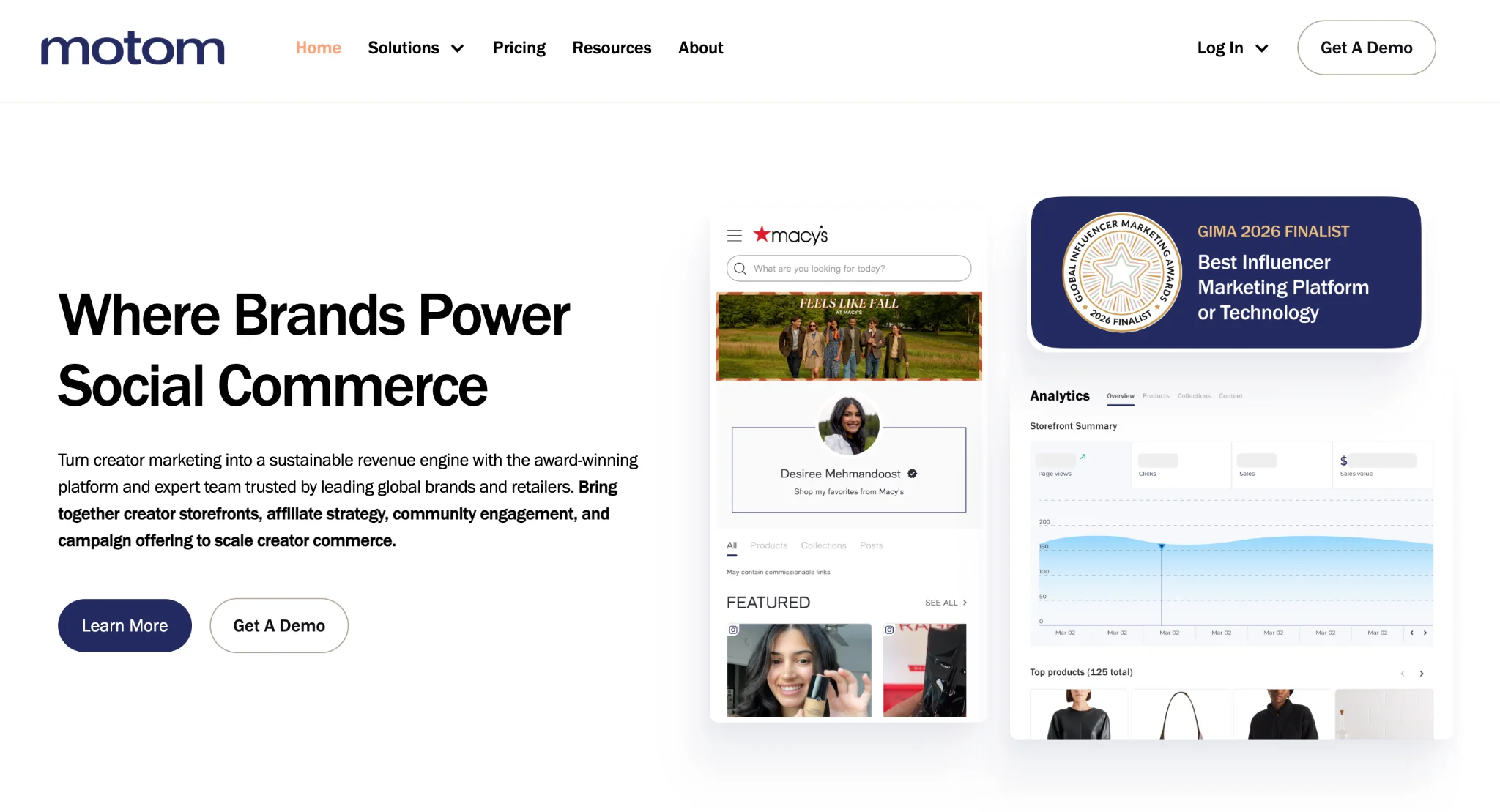
Motom was founded in 2019 in New York by Matt Diamond, Wendy Wildfeuer and Tim Trevathan, a team with a retail and media pedigree going back through Alloy and dELiA*s. It runs two things under one brand, which causes constant confusion. The consumer side, at motom.me, is a social shopping app and creator marketplace where creators earn a 10% commission across partner brands. The business side, Anchor by Motom, is the white-label software and service brands actually buy.
Anchor sits on top of infrastructure you already have. It ingests a product feed, spins up branded storefronts for each of your creators on your domain, and hands attribution off to your existing affiliate network rather than running its own pixel. Deployment is quoted at anywhere from 48 hours to three weeks, with no cap on storefront count.
The company’s most visible proof point is the My Sephora Storefront program launched in late 2025, alongside long-running work with Macy’s Style Crew, which Motom reports at 300 plus creators, 3,300 posts and 57% year over year revenue growth. Those are enterprise retail deployments, not app installs, and they set the tone for everything about how the product is sold.
Who Should Use Motom
Motom fits a specific operational profile, and the mismatch cases are easy to spot.
- Retailers and multi-brand marketplaces running 50 to 500 plus creators. The portal is built around batch invitations, permission tiers and segmentation, which only pay off at roster sizes where manual management has already broken.
- Brands with an affiliate program already live on Rakuten, CJ, Impact, Awin or Partnerize. Motom plugs into that rather than replacing it, so an existing network is closer to a prerequisite than a nice-to-have.
- Fashion, beauty, footwear and lifestyle brands. Every published case study sits in these verticals, and there is no evidence of deployments in CPG, food and beverage, supplements, electronics or home.
- Teams whose priority is owning first-party creator data rather than renting audience on a third-party storefront network.
- Brands that want the program run for them. Motom sells creator sourcing, onboarding, education and community management alongside the software, and that service attachment is a real part of the offer.
- US-based operations. The client base, the creator app and the payout structure are all US-first, and there is no published evidence of multi-currency support or localisation.
Key Features
White-Label Creator Storefronts
Each creator gets a branded microsite hosted under your domain instead of a third-party URL. Storefronts carry separate shopping feeds for curated picks, exclusive drops and general product browsing. There is no limit on how many you create, which matters if you are running an ambassador program in the hundreds rather than a shortlist of paid partners.
First-Party Data Capture
Because the traffic lands on property you own, the shopper data stays with you rather than with a storefront network. That is the strategic argument for the whole product, and it is a real one: brands running on marketplace storefronts typically see a creator’s audience convert without ever learning who those shoppers are.
Attribution Through Your Affiliate Network
Motom does not self-report the sales it gets paid on. Attribution runs through the brand’s affiliate network as a neutral third-party verifier, tracking by creator, product, traffic source, campaign and creator segment. It is an unusually honest architecture and worth noting, since most platforms in this category measure their own performance.
Creator Recruitment Dashboard
Surfaces creators who already follow your brand or post about it, so you can convert existing advocates into storefront owners. Be clear about what this is not: it is a view into your own orbit, not a searchable index of the wider creator market.
Applicant CRM and Custom Application Forms
You build your own creator application form and inbound applicants flow into a CRM with manual or automated communication. This handles the people who come to you. It does nothing for the people who have never heard of you, which is a distinction that matters when you are budgeting for growth.
Brand Portal and Creator Management
Batch creator invitations, announcements, one-to-one direct messaging, campaign briefs, challenges, storefront permission tiers and tag-based creator segmentation. This is the day-to-day operating surface for a program manager, and the batch tooling is what makes a 300-creator roster workable.
Creator Portal and Mobile Experience
Creators get a mobile-optimised dashboard showing views, clicks, sales and earnings, and they curate their storefront from your product feed, raw URLs or brand-seeded collections. Payouts run through PayPal or bank wire with a $25 minimum and standard tax documentation. Note there is no Android app on the consumer side, so Android creators work in a browser.
Content Listening and Off-Social Distribution
Motom monitors creators’ connected TikTok, Instagram and YouTube accounts and tracks brand-dedicated content performance against sales data. Storefront links are also built to travel beyond social feeds, into newsletters, blogs, Reddit threads, email and QR codes, which is a sensible acknowledgement that not all creator traffic comes from a feed.
Motom Pricing
Motom publishes no price of any kind. The site navigation includes an item labelled Pricing; it routes to a demo request form. There are no tiers, no per-storefront fee, no per-creator fee, no revenue share, no setup fee and no published floor. The response time after a demo request is stated at 72 hours.
Two things are documented, and both are commitments rather than costs: contracts run 6 or 12 months, and storefront count is explicitly unlimited, which tells you storefront volume is not the pricing lever. What the lever is remains undisclosed, though the demo form’s segmentation by creator count and affiliate network is a reasonable clue.
The more useful exercise is mapping where money actually leaves the business, because Motom is only one of the bills.
What Motom Publishes
- Contract minimum of 6 or 12 months, stated on both the demo request and contact pages. This is the only hard commercial term available without talking to sales.
- Unlimited storefronts on every engagement, so you are not billed per creator page.
- No free tier, no free trial, no self-serve signup and no monthly rolling option.
- 72 hour response time on demo requests, which shapes how long a competitive evaluation takes.
What Motom Does Not Publish
- Any platform fee, tier, revenue share, take rate or minimum spend.
- Whether managed services are bundled or priced separately from the software.
- Implementation or onboarding fees for the feed and domain setup work.
- Whether a brand without an affiliate network pays extra to have one stood up.
The Cost Layers Underneath
- Affiliate network fees. Because attribution is outsourced, your Rakuten, CJ, Impact, Awin or Partnerize bill sits alongside the Motom bill. Neutral verification is good practice; it is also a second invoice.
- Creator commissions. Set by you and paid on every attributed sale, which makes the true cost of the program scale with its success.
- Implementation effort. There is no one-click install. Product feed configuration and hosting storefronts on your domain is engineering work, whether Motom does it or your team does.
- Opportunity cost of the term. A 6 or 12 month minimum with no trial means a program that underperforms in month two still runs to the end of the contract.
How to Budget Before the Demo
- Add your affiliate network fee and your planned commission rate first, then treat the Motom quote as the increment on top. Evaluating the platform fee in isolation understates the program by a wide margin.
- Ask for the fee structure in writing before the demo, not during it. If pricing scales with creator count or GMV, that changes the model as the program grows.
- Price the 12 month option against the 6, since the shorter term almost always carries a premium and the longer one carries the risk.
- Get implementation scoped as a separate line, including who owns the domain and feed work.
Motom Reviews
This section is short because there is almost nothing to report, and that is itself the finding. For a company founded in 2019 selling enterprise contracts, Motom has no independent B2B review record at all.
- 4.3/5.0 (Apple App Store, 103 ratings) and this covers the consumer shopping app, not the platform brands buy
- No G2 listing
- No Capterra listing
- No Shopify App Store listing
- No TrustRadius listing
A brand evaluating Anchor has no peer signal to work from and has to rely entirely on reference calls. Ask for two: one client at your roster size, and one that has been live for more than a year. The published case studies are all large retailers, so a mid-market reference is the one worth insisting on.
Integrations
The integration surface is unusual. Motom connects deeply to affiliate infrastructure and to social platforms, and not at all to eCommerce platforms.
- Rakuten Advertising. Handles conversion tracking and creator commission attribution as the system of record for sales.
- CJ. Same role, and one of the networks named directly on the demo form as a supported starting point.
- Impact. Supported as the attribution layer, useful for brands already running partnerships programs there.
- Awin and ShareASale. Covers the mid-market end of the affiliate network landscape, with custom network integration available on request.
- TikTok, Instagram and YouTube. Full creator content connection and product tagging, plus a thinner Facebook Page connection. Pinterest is absent, which is a notable gap for the fashion and home verticals Motom targets.
The important omission: Motom names no eCommerce platform integrations at all. There is no Shopify app, no WooCommerce or Magento connector, and no listing in the Shopify partner directory. Catalog ingestion is handled generically through a product feed, so if you are shopping for Shopify-native influencer tools with a one-click install, this is not one of them.
Pros of Motom
The Conversion Happens on Your Domain
Every competing storefront product sends your creators’ audiences to a URL somebody else owns, and the shopper data goes with them. Motom inverts that, and for a brand at scale the compounding value of owning that first-party layer is worth more than any individual feature on the list. It is the one thing here that is genuinely hard to replicate.
Attribution You Did Not Have to Trust the Vendor For
Running sales attribution through the brand’s own affiliate network rather than a proprietary pixel means Motom is not grading its own homework. Very few platforms in creator commerce are built this way, and it removes the most common source of argument at renewal time, which is whether the reported numbers were ever real.
Software and Service in One Engagement
Creator sourcing, onboarding, education, community management and payout handling come with the platform rather than as a separate agency retainer. For a retail team standing up an ambassador program from nothing, that removes the hiring problem, and the Sephora and Macy’s deployments show it works at genuinely large roster sizes.
Cons of Motom
No Price, But a Real Commitment
You cannot budget, shortlist or benchmark Motom without entering a sales cycle, and the first thing you learn once you are in it is that the minimum term is 6 or 12 months. No trial, no monthly option, no self-serve tier. That combination puts the entire commercial risk on the buyer: you commit to a year at a number you could not compare against anything before the first call.
An Affiliate Network Is a Prerequisite
Attribution runs through Rakuten, CJ, Impact, Awin or Partnerize, which means the platform assumes you already pay for one. A brand without an affiliate program is not looking at one bill, it is looking at two, plus the setup work to get the network live before Motom can do anything useful. The demo form allows None as an answer, but the cost consequence of that answer is not documented anywhere.
No eCommerce Integration Path
No Shopify app, no WooCommerce, no Magento, no BigCommerce, no Salesforce Commerce Cloud. Onboarding depends on product feeds and affiliate plumbing, which is slower and more dependent on engineering time than an app install, and it makes implementation cost real but unquantified. Enterprise deployments like Sephora were custom builds, which tells you what a serious integration looks like here.
It Only Covers the Back Half of the Funnel
There is no searchable creator database, no audience quality or fake follower auditing, no cold outreach sequencing and no email or DM campaign tooling. The recruitment dashboard finds creators already connected to your brand and the applicant CRM manages people who apply to you. Everything upstream of that, including creator discovery and outreach at scale, still needs a separate platform, so Motom is an addition to your stack rather than a consolidation of it.


Is Motom Worth It?
If you are a retailer or a large fashion or beauty brand with an affiliate network running, hundreds of creators to manage and a genuine strategic interest in owning shopper data, Motom is doing something the storefront marketplaces structurally cannot. The Sephora and Macy’s deployments are real proof at real scale, and the decision to route attribution through a neutral third party is a mark of a company confident in its numbers.
The problems are commercial rather than technical. You commit to at least six months at an undisclosed price, on top of an affiliate network you also pay for, with no independent reviews to sanity-check the vendor and no eCommerce integration to shorten implementation. And the platform only handles activation and monetisation. Finding creators, vetting their audiences and reaching out to them at volume is somebody else’s software.
Depending on which half of that problem you are actually solving, these are worth evaluating:
- Influencer Hero. Covers the whole funnel in one influencer marketing platform, from discovery across eight social networks with fake follower screening and lookalike search, through automated outreach and CRM, to affiliate links, discount codes, storefronts and payouts. It also supports Shopify, WooCommerce and custom eCommerce builds via script, and its pricing is publicly listed from $649 a month.
- Afluencer. A creator marketplace that matches creators to brands through campaign listings creators apply to, which fixes supply rather than infrastructure. Plans start at $49 a month.
- LoudCrowd. Creator storefronts and ambassador program automation built natively for Shopify, with automated commission and reward tiers based on tagged content.
- ShopMy. A creator-first storefront and commission network with a strong roster in beauty and fashion, useful when creator supply matters more than owning the domain.
- Social Snowball. Affiliate and ambassador management with automated single-use discount codes and instant payouts, aimed at brands where coupon leakage is the actual problem.
Final Thoughts
Motom is a good fit for a narrow buyer and an expensive one for everybody else. If you run a retail creator program in the hundreds, already have an affiliate network, and can defend owning your first-party shopper data as a strategic priority, this is a serious option with serious references behind it. If your roster is under fifty, your store runs on Shopify and you still need help finding creators in the first place, the shape of the product works against you: the term is long, the price is invisible, the integration work is real and half the job stays unsolved. Brands in that position get further comparing Motom alternatives that publish what they cost and cover discovery through payout in a single contract.

.png)


.jpg)










