

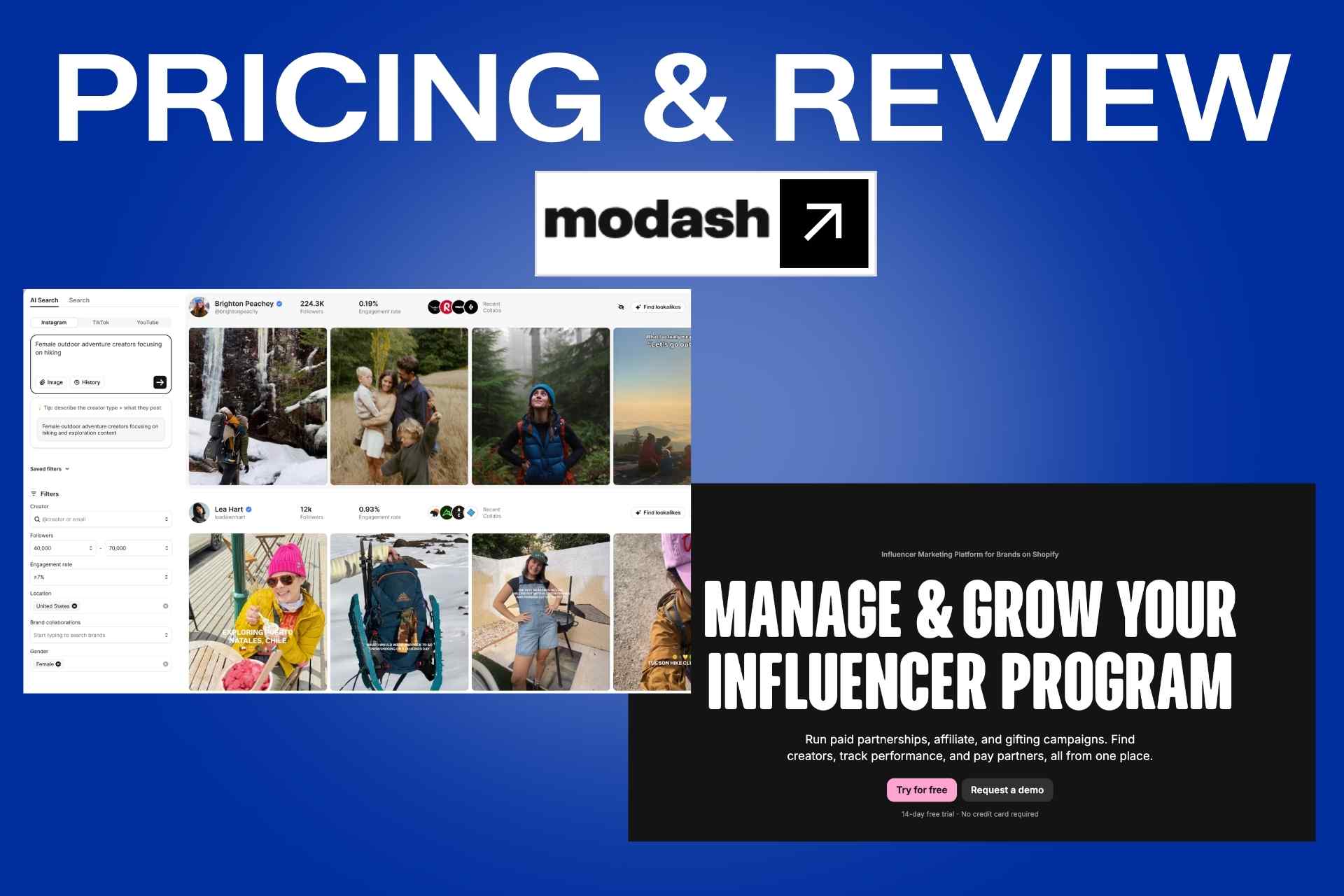
Modash Pricing and Review: Features, Pros, Cons & Costs
Influencer marketing has become one of the most effective growth channels for DTC brands, but scaling creator partnerships requires the right technology and processes. Modash is an influencer marketing software platform designed to help brands discover creators, manage outreach, track campaign performance, and measure revenue from influencer partnerships. With a strong focus on ecommerce and Shopify brands, Modash has gained popularity among marketing teams looking for an alternative to spreadsheets and manual workflows.
In this review, we'll break down Modash pricing, features, pros, cons, customer reviews, and how it compares to leading Modash alternatives to help you determine whether it's the right fit for your brand.
Modash Overview
Modash is an influencer marketing platform built mainly for Shopify brands that want to find creators, manage relationships, track campaign performance, handle gifting, run affiliates, and pay creators from one workflow. It focuses on Instagram, TikTok, and YouTube, with access to a 350M+ public creator database and no creator opt-in requirement.
Who Should Use Modash
Modash is best for D2C, ecommerce, and Shopify-based brands running influencer, gifting, affiliate, or paid creator campaigns. It is especially useful for lean marketing teams that want to move away from spreadsheets and combine creator discovery, outreach, tracking, and payouts in one platform. It is also a strong fit for brands expanding into multiple markets because users can filter creators and audiences by country, language, niche, engagement rate, demographics, and audience quality.
It is less ideal for brands that need deep enterprise workflows, WooCommerce or Magento integrations, built-in content licensing, paid ad whitelisting, or influencer discovery across broader platforms beyond Instagram, TikTok, and YouTube.
Key Features
Influencer Discovery
Modash gives users access to 350M+ creator profiles across Instagram, TikTok, and YouTube. Brands can search by niche, keywords, hashtags, captions, follower count, engagement rate, audience demographics, location, language, and more.
Creator Vetting & Profile Analytics
Each creator profile includes performance metrics such as engagement rate, audience location, audience age and gender, fake follower indicators, popular content, and historical performance signals. This helps brands avoid creators with inflated audiences and shortlist influencers based on real fit.
AI Discovery & Lookalike Search
Modash supports AI-assisted discovery, including the ability to describe a creator style or upload an image to find creators with a similar visual or content “vibe.” Teams can also use lookalike search to find creators similar to profiles that already perform well.
Influencer CRM
Brands can save creators into lists, add notes, track statuses, manage relationships, and move creators through stages such as contacted, negotiating, confirmed, gifted, posted, or paid.
Email Outreach & Inbox
Modash connects with Gmail and Outlook so teams can send personalized outreach, use templates, track replies, and manage creator conversations from a shared inbox.
Bulk Outreach
Teams can email creators from saved lists, use reusable templates, and manage replies inside Modash. This is useful for scaling recruitment without sending every message manually.
Campaign Tracking
Modash automatically collects creator content when campaign keywords, hashtags, or mentions are used. It tracks metrics such as reach, impressions, engagement, clicks, discount code usage, sales, and affiliate performance.
Shopify Gifting
With Shopify connected, brands can send creators product selection links, set budgets, generate gifting flows, track orders, and connect gifting activity back to campaign performance.
Affiliate & Sales Tracking
Modash supports affiliate links, discount codes, sales tracking, and creator-level revenue attribution for Shopify stores.
Creator Payments
Teams can pay creators through Modash, including commission-based payouts. Performance Annual includes 0% fees up to $10,000/year in combined payments and affiliates, then 5% above that limit; Enterprise starts with a higher 0% fee-free payout allowance.
Modash Pricing
Modash offers a 14-day free trial with no credit card required. The trial includes 20 profile views, 6 creator email unlocks, and 10 tracked creators.
- Essentials: Starts at $199/month when paid yearly or $299/month on monthly billing.
- Performance: Starts at $499/month when paid yearly or $599/month on monthly billing.
- Enterprise: Starts at $14,700/year and is customizable for campaigns above 250 creators.
Reviews
4.9/5.0 (Capterra)
Integrations
- Shopify: Manage influencer gifting, discount codes, affiliate links, sales tracking, and creator-level revenue attribution directly from Modash.
- Gmail: Send creator outreach from your own email, sync replies, and manage conversations inside Modash.
- Microsoft Outlook: Connect Outlook for outreach, shared inbox visibility, and two-way email syncing.
- Zapier: Connect Modash with thousands of apps to automate workflows such as moving creator data into other systems.
- Modash API: Use Modash influencer data through APIs for custom discovery, analytics, or internal tooling.
Pros of Modash
Huge non-opt-in creator database
Modash’s 350M+ public profile database gives brands far broader discovery than opt-in marketplaces, especially for niche D2C categories and international campaigns.
Strong Shopify workflow
Gifting, discount codes, affiliate links, sales tracking, and payments can be managed in one place, making it practical for ecommerce teams that care about both awareness and revenue.
AI discovery plus “Find Your Fans”
The platform helps brands find visually similar creators, lookalikes, and influential people already following the brand, which can improve outreach relevance and campaign authenticity.
Cons of Modash
Limited ecommerce integrations
Modash is strongest for Shopify brands. Teams using WooCommerce, Magento, BigCommerce, or custom ecommerce stacks may need workarounds.
Limited integrations compared to competitors
While Modash integrates well with Shopify, Gmail, and Outlook, it lacks the broader marketing stack integrations offered by some competitors. Teams looking to connect influencer marketing with platforms such as Klaviyo, HubSpot, Salesforce, Slack, WooCommerce, BigCommerce, DocuSign, or advanced BI tools may find the ecosystem relatively limited.
Limited platform coverage
Core functionality focuses on Instagram, TikTok, and YouTube, so it may not be enough for brands prioritizing Twitch, Pinterest, Snapchat, LinkedIn, blogs, or X.
No native content licensing or whitelisting
Brands must manage content usage rights, creator licensing agreements, paid ad permissions, and whitelisting workflows outside the platform, which can create additional operational complexity for larger influencer programs.
Some workflow limits remain
Contact details are not always available for every creator, and teams with advanced reporting, inbox, or enterprise collaboration needs may find the platform lighter than more expensive enterprise tools.


Is Modash Worth It?
For most DTC and ecommerce brands, especially those running influencer gifting, affiliate, and creator partnership programs on Shopify, Modash delivers strong value for the price. Its biggest strengths are its massive creator database, intuitive discovery tools, AI-powered search capabilities, influencer CRM, and seamless Shopify integration. The platform is particularly appealing to growing brands that want an end-to-end influencer marketing solution without paying enterprise-level pricing.
However, Modash is not the perfect fit for every business. Brands operating outside the Shopify ecosystem may find its ecommerce capabilities limiting. It also lacks native content licensing management, creator whitelisting tools, and support for a wider range of social platforms compared to some enterprise competitors. Larger organizations with complex workflows, advanced reporting requirements, or global creator programs may eventually outgrow its feature set.
Overall, Modash is one of the strongest influencer marketing platforms for ecommerce brands that prioritize creator discovery, outreach, campaign tracking, and affiliate management while maintaining a relatively affordable budget.
Alternatives to Modash
Depending on your requirements, the following alternatives may be a better fit:
- Influencer Hero – Best for ecommerce brands looking for a more complete all-in-one influencer marketing platform with advanced CRM automation, multi-platform support, gifting, affiliate management, UGC collection, payments, Chrome extension, and support for both Shopify and WooCommerce.
- GRIN – Strong option for larger DTC brands that require extensive ecommerce integrations, advanced creator relationship management, media rights management, and unlimited creator partnerships.
- Aspire – Ideal for brands that value inbound creator applications, workflow automation, and first-party creator data from major social platforms.
- Afluencer – Well-suited for consumer brands that want to connect with creators and launch campaigns through a large influencer marketplace.
- HypeAuditor – A good choice for teams focused heavily on influencer vetting, audience quality analysis, brand safety, and fraud detection.
Final Thoughts
Modash has established itself as one of the leading influencer marketing platforms for ecommerce brands thanks to its massive creator database, powerful discovery tools, Shopify-focused workflows, affiliate tracking capabilities, and user-friendly campaign management features. It offers an excellent balance between functionality and affordability, making it particularly attractive for DTC brands looking to scale influencer programs without investing in expensive enterprise software. That said, its limited ecommerce integrations, lack of built-in content licensing tools, and narrower platform coverage may not suit every business.
If Modash doesn't fully meet your requirements, we've also compiled a comprehensive guide to the best Modash Alternatives, comparing leading platforms to help you find the right fit for your influencer marketing strategy.

.png)


.jpg)