

10 Best Modash Alternatives • Key Criteria • Modash Overview • Best Modash Alternatives • GRIN • Upfluence • CreatorIQ • Influencer Hero • NeoReach • Lefty • Insense • Kolsquare • Skeepers • Creator.co • Final Thoughts • FAQs
10 Best Modash Alternatives for Influencer Marketing
Managing creator partnerships at scale has become a core growth lever for D2C brands, making influencer marketing software essential for handling discovery, outreach, campaign workflows, and performance tracking in one place. Modash has emerged as a popular choice thanks to its large creator database, strong search capabilities, and ease of use, especially for brands running affiliate or gifting campaigns. However, it has some limitations—particularly around deeper CRM workflows, contract management, and reliance on Shopify for advanced commerce features—which leads many teams to explore other options. Whether you're actively looking for Modash alternatives or evaluating influencer marketing software for the first time, understanding how different platforms compare is key to making the right decision.
In this guide, we’ll break down the 10 best Modash alternatives, including GRIN, Upfluence, CreatorIQ, Influencer Hero, NeoReach, Lefty, Insense, Kolsquare, Skeepers, and Creator.co.
Key Criteria for Evaluating Influencer Marketing Platforms
Core Features
Evaluation of essential influencer marketing capabilities, including influencer discovery, outreach, CRM, campaign management, reporting, and content workflows.
Pricing & Flexibility
Comparison of pricing models, subscription plans, and contract terms to match different budgets and growth stages.
Customer Reviews & Satisfaction
Analysis of user feedback from trusted review platforms, focusing on usability, reliability, customer support, and overall performance.
Pros & Cons
Review of each platform’s strengths and limitations to highlight where it performs well and where it may fall short based on different use cases.
Integrations
Review of the most important integrations (e.g., Shopify and other tech tools), highlighting what each integration enables in one sentence.
Modash Overview
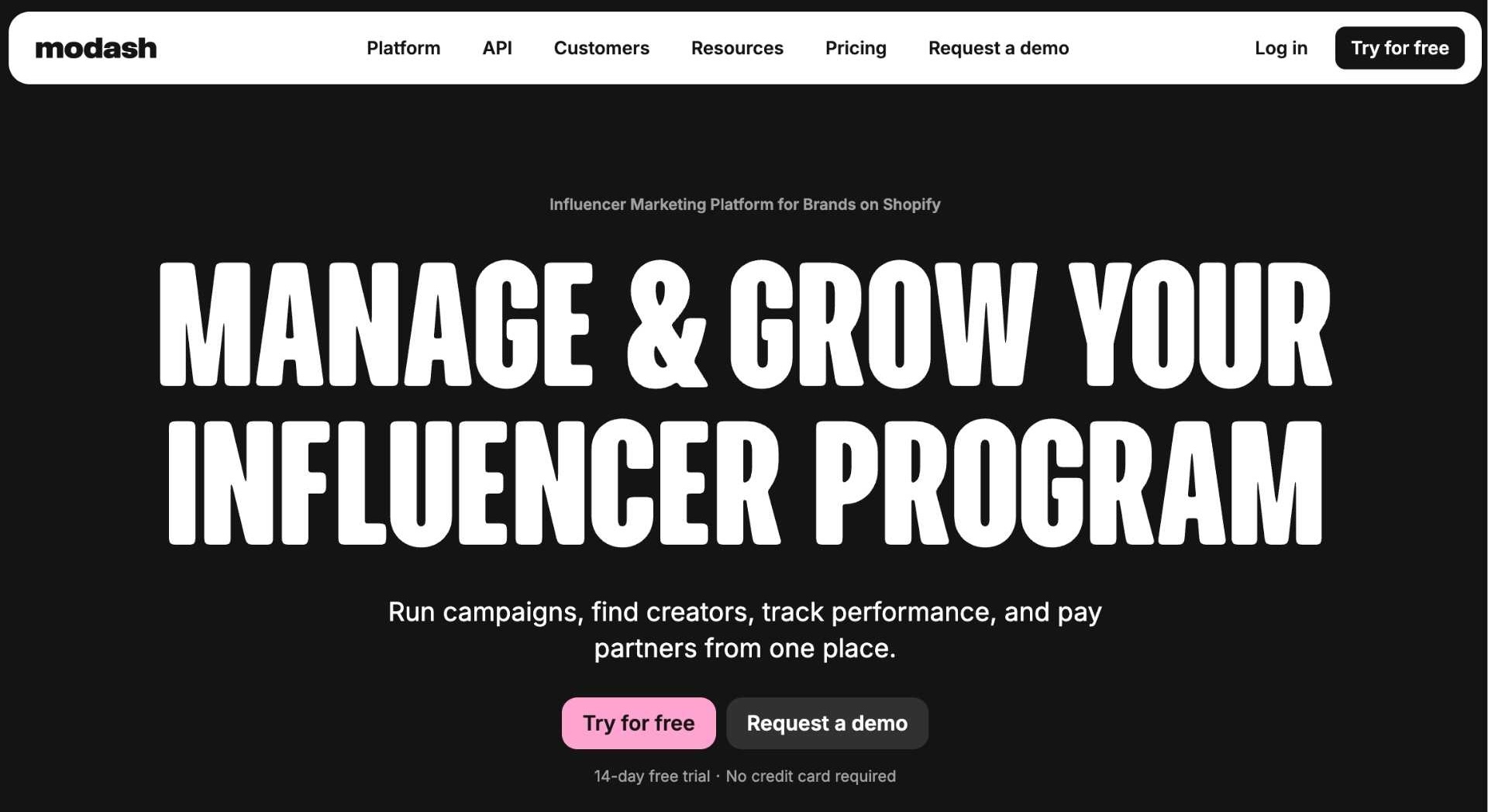
Modash is a self-serve influencer marketing platform built primarily for brands that want to run creator programs from one place instead of stitching together spreadsheets, email, tracking links, and payout tools. Its core workflow covers creator discovery, relationship management, outreach, campaign tracking, and payments, with the strongest commerce functionality tied to Shopify. The platform is especially known for its large creator database, AI-assisted discovery, and strong fit for brands running gifting, affiliate, or performance-focused influencer campaigns.
Key Features
- Large creator database across Instagram, TikTok, and YouTube: Modash says it includes 350M+ public creator profiles with over 1K followers, which makes it useful for brands that need broad discovery instead of relying on an opt-in marketplace.
- Advanced discovery filters: Teams can filter by audience demographics, engagement, location, language, interests, niche, and creator size to narrow down relevant partners faster.
- AI-powered creator search: Modash supports AI search so marketers can describe the kind of creator they want in plain language, which is helpful for visual or hard-to-define creator briefs.
- Lookalike discovery: The platform can surface similar creators based on content topics and audience overlap, which is especially useful once a brand finds one creator profile that already performs well.
- Audience quality and fake follower analysis: Modash provides audience credibility data, fake follower estimates, engagement metrics, growth trends, and demographic breakdowns to help teams vet creators before outreach.
- Influential Fans discovery: On higher tiers, brands can find creators who already follow or engage with their brand, which can improve reply rates and authenticity.
- Built-in creator CRM: Users can save creators to lists, add notes, statuses, documents, and team assignments, and manage influencer pipelines without moving into a separate CRM.
- Inbox and outreach workflows: Modash now connects Gmail or Outlook to a shared creator-focused inbox inside the platform, with templates, email tracking, and conversation management.
- Automatic content and campaign tracking: Modash collects creator content across platforms and tracks campaign metrics like views, engagements, link clicks, promo code redemptions, and more.
- Shopify gifting and affiliate workflows: Brands can connect Shopify to send products, create promo codes, track redemptions, monitor affiliate sales, and automate commission-based payouts.
- Creator payments: Modash supports payouts to creators in many countries and currencies, with invoice handling and payment-status tracking built in.
- API access for custom workflows: Brands and software teams can use the Modash API to plug creator data, analytics, and search into internal systems or custom products.
Pricing
- Essentials: $299 month-to-month, or $199/month billed yearly ($2,388/year). Includes 2 team members, 300 opened profiles/month, 150 unlocked creator emails/month, and 100 tracked creators. Best for smaller programs validating influencer marketing before scaling.
- Performance: $599 month-to-month, or $499/month billed yearly ($5,988/year). Includes 5 team members, 800 opened profiles/month, 400 unlocked creator emails/month, and 250 tracked creators, plus Influential Fans, downloadable content, campaign data exports, payments, and affiliate management.
- Enterprise: Starts at $14,700/year. Includes higher customizable limits, more team members, branded link domains, 0% payout fees up to plan limits, affiliate management, and more hands-on support including strategy calls and migration help.
- Free trial: 14 days, no credit card required, with limited profile views, email unlocks, and creator tracking.
Reviews
4.9/5.0 (Capterra)
Integrations
- Shopify: Connect your store to send gifts, create promo codes, track redemptions and affiliate sales, and keep store data synced inside Modash.
- Gmail: Sync Gmail into Modash Inbox so outreach, templates, replies, and creator context live in the same workspace as discovery and campaign tracking.
- Outlook: Connect Outlook to centralize influencer conversations, email performance, and relationship history without leaving Modash.
- Modash API: Use the API to push creator search, audience analytics, and content data into internal dashboards, custom apps, or proprietary workflows.
- Multi-store Shopify setups: Brands managing multiple storefronts or regions can connect more than one Shopify store so sales tracking and discount-code workflows stay organized by brand or market.
Pros
- Powerful AI-backed discovery engine: Modash’s biggest differentiator is still discovery. Between its 350M+ public creator database, lookalike search, audience-quality scoring, and AI search, it is unusually strong for brands that need to find niche creators fast without being limited to an opt-in marketplace.
- Influential Fans is a standout growth feature: The ability to find creators who already follow or engage with your brand is a strong differentiator because it helps teams recruit warmer, more authentic creators instead of relying only on cold outreach.
- Inbox has made Modash more complete than older “discovery-only” perceptions: The newer Modash Inbox brings Gmail and Outlook directly into the platform, which materially improves the workflow for teams that want search, outreach, relationship tracking, and performance data in one place.
Common Drawbacks of Modash
The best commerce workflows are heavily Shopify-centric
Discovery and management features can still be used without Shopify, but the highest-value commerce features like gifting, promo-code management, affiliate tracking, and automatic sales attribution are most useful for Shopify brands. Teams on WooCommerce, Magento, or custom stacks often look elsewhere for stronger native commerce coverage.
Contracting and content-rights management are still light
Modash is strong in discovery, tracking, and payouts, but it is not as strong in native contract creation, usage-rights workflows, or deeper UGC licensing controls, which means some brands still handle those steps outside the platform.
Lower-tier usage caps can get tight quickly
Teams running larger gifting or always-on seeding programs may outgrow Essentials fast because profile opens, email unlocks, and tracked creators are capped monthly, pushing brands toward an upgrade sooner than expected.
Messaging and performance can still feel uneven at times
Even with the newer inbox experience, some users still mention occasional messaging limitations, loading delays, and minor bugs, which can be frustrating for teams running high-volume creator workflows.
Best Modash Alternatives
| TOOL | REVIEWS | BEST FOR | TRIAL INFO | PRICING | ||
|---|---|---|---|---|---|---|
1 |

|
⭐ | DTC creator management | Book Demo | Pricing | Website |
2 |
|
⭐ | Influencer discovery | Book Demo | Pricing | Website |
3 |

|
⭐ | Enterprise influencer marketing | Book Demo | Pricing | Website |
4 |

|
⭐ | Influencer CRM & automation | Book Demo | Pricing | Website |
5 |
|
⭐ | Influencer campaigns & data analytics | Book Demo | Pricing | Website |
6 |

|
⭐ | Influencer analytics & discovery | Book Demo | Pricing | Website |
7 |

|
⭐ | UGC creators & paid social ads | Book Demo | Pricing | Website |
8 |

|
⭐ | Data-driven influencer discovery & campaign analytics | Book Demo | Pricing | Website |
9 |

|
⭐ | Influencer gifting & UGC campaigns with micro-influencers | Book Demo | Pricing | Website |
10 |
|
⭐ | Influencer campaigns & creator marketplace | Book Demo | Pricing | Website |
1. GRIN
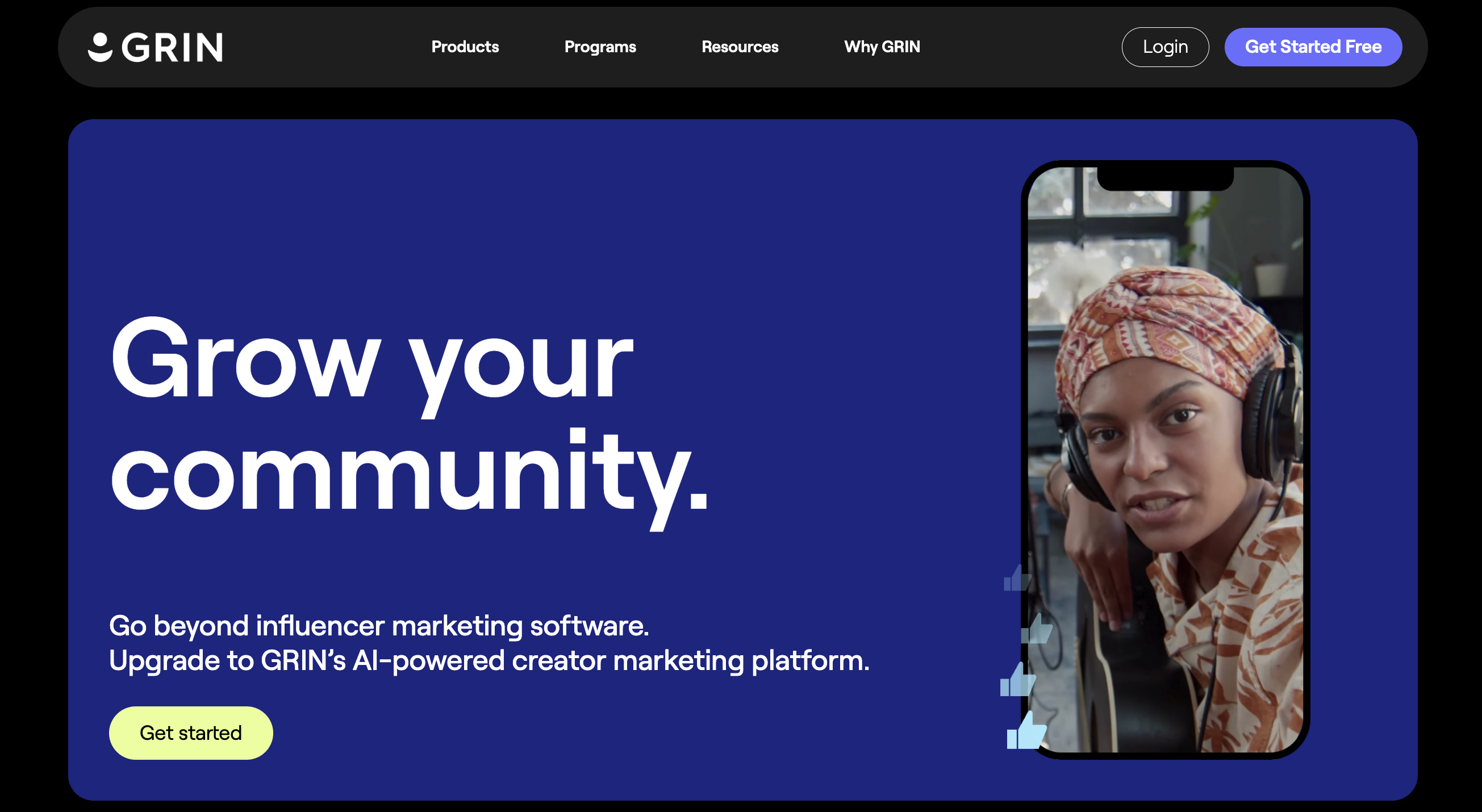
GRIN is an influencer marketing platform built primarily for eCommerce brands that want to manage discovery, outreach, gifting, affiliate tracking, payments, and content workflows in one system. It is especially geared toward brands running ongoing creator programs tied to store operations and revenue attribution rather than one-off influencer campaigns.
Key Features
- Creator discovery and CRM: GRIN combines creator search, AI creator search, tagging, stage management, and CRM import/export so teams can prospect and manage creators in one workflow.
- Integrated email and outreach: Teams can run outreach with built-in email, templates, sequences, and tracking for opens, clicks, and replies.
- Product gifting and affiliate management: GRIN supports gifting, affiliate link creation, deep links, and advanced conversion attribution, making it strong for product-seeding and ambassador programs.
- Creator payments and tax workflows: Automated creator payments and 1099 processing are included on higher tiers, which helps brands keep finance operations inside the platform.
- Content library and approvals: Brands can centralize creator content, manage approvals, and connect content assets to broader campaign reporting.
- Storefront-style affiliate experiences: Through CreatorCommerce, brands can launch co-branded creator landing pages that help turn affiliate traffic into higher-converting shopping experiences.
Pricing
- Official pricing model: GRIN’s current pricing page promotes a 30-day free trial and more flexible packaging than before, including self-serve access.
- Public starting price benchmark: Recent software directories list GRIN from $999/month, though enterprise pricing still appears to scale materially based on features and program size.
- Enterprise benchmark pricing: Recent sales benchmarks and product overviews still place GRIN commonly starts at $25,000/year (approx. $2,050/month), with no discounts for upfront payment. Contracts require a full-year commitment with monthly billing.
Reviews
4.5/5.0 (G2)
Pros
- Flexible self-serve pricing is a major shift: GRIN now offers month-to-month plans and a 30-day free trial, which is a meaningful change from its older enterprise-style annual commitment model.
- Strongest fit for gifting-heavy eCommerce programs: Native support for product seeding, affiliate links, deep links, creator payments, and tax handling makes GRIN especially strong for brands tying creator work to sales operations.
- CreatorCommerce adds a differentiated commerce layer: Co-branded creator landing pages give GRIN a stronger affiliate and conversion angle than many platforms that stop at discount codes and tracking links.
Cons
- Still relatively expensive as programs scale: Although entry pricing is lower than before, the higher-value workflows sit on more expensive tiers.
- Can be complex for smaller teams: GRIN’s depth is useful for established programs, but it can feel heavy for teams that only need basic discovery and outreach.
- Usability issues still come up in reviews: Users still mention manual workflow friction, creator asset handling issues, and occasional platform performance frustrations.
Integrations
- Shopify: Sync products, fulfillment, gifting, discount codes, and store-linked campaign activity directly into creator workflows.
- PayPal: Send creator payouts directly through GRIN and keep payment tracking tied to deliverables.
- DocuSign: Handle creator contracts and content-rights paperwork inside the campaign workflow.
- Slack: Receive campaign and creator notifications in Slack so internal teams can stay aligned in real time.
- Klaviyo: Use Klaviyo-connected templates and lifecycle data to support more personalized creator communications.
Modash vs GRIN
Modash is usually the stronger choice for fast creator discovery and audience vetting, especially for teams that want a lighter workflow and a very large public creator database. GRIN is broader operationally: it goes deeper into gifting, contracts, creator payments, tax handling, content approvals, and eCommerce-linked program management.
For a lean team focused on finding creators and launching campaigns quickly, Modash is typically simpler and more discovery-led. For a brand running structured gifting, ambassador, and affiliate programs tied closely to store operations, GRIN is the more workflow-heavy and commerce-native option. GRIN also now offers more flexible pricing than it used to, but Modash still tends to feel lighter and more focused.
2. Upfluence
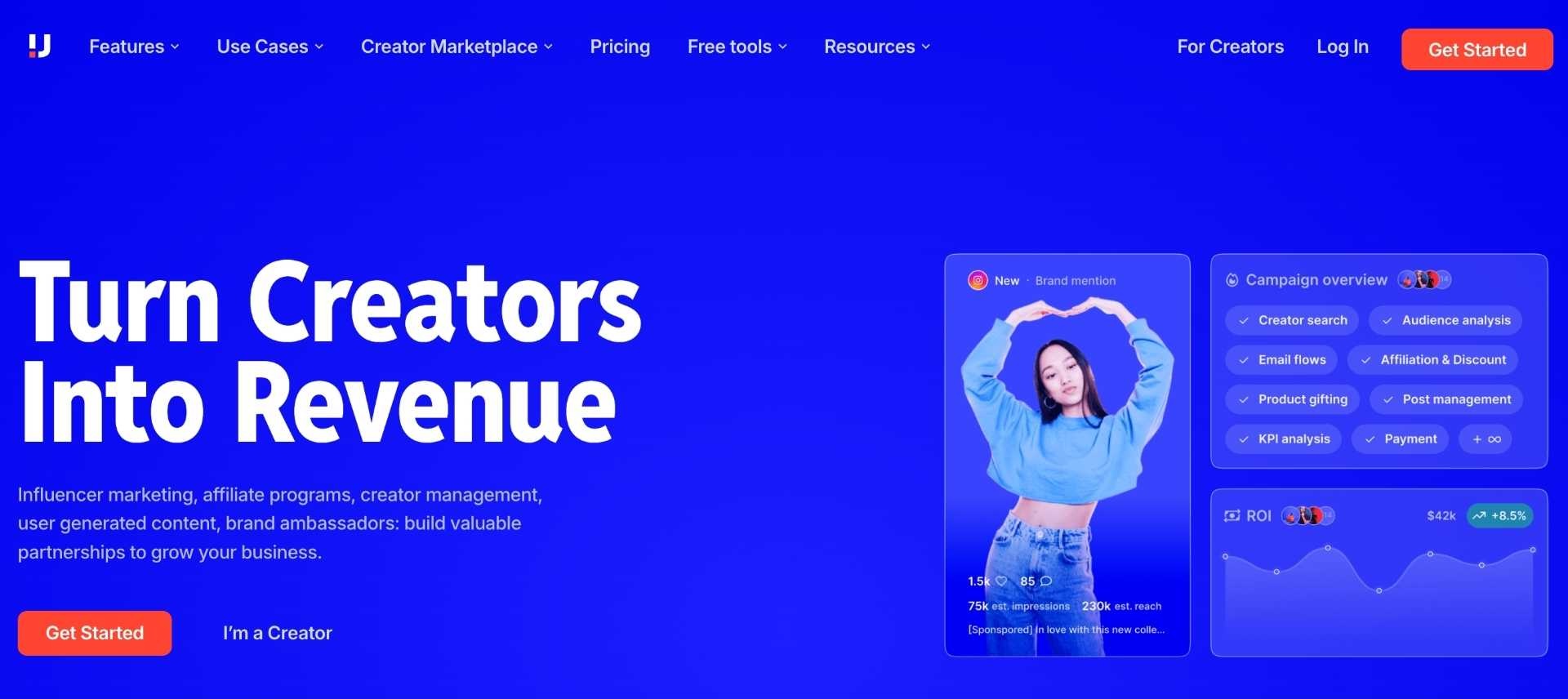
Upfluence is an influencer marketing platform built around creator discovery, outreach, campaign management, and eCommerce integration. It is particularly well known for connecting influencer programs to store and customer data, making it a strong fit for DTC and retail brands that want to identify creators within their own customer base and measure campaign ROI against commerce outcomes.
Key Features
- Large creator database with advanced filters: Upfluence provides discovery across millions of creators with filters for niche, location, audience metrics, engagement, and recent content.
- Customer-to-creator identification: One of Upfluence’s core differentiators is the ability to identify influencers inside customer lists and store data, helping brands recruit existing customers as advocates.
- Bulk outreach and workflow support: The platform supports outreach at scale with templates, email workflows, and AI assistance through Jaice AI.
- Affiliate and promo-code management: Teams can create unique promo codes and affiliate workflows tied to Shopify, WooCommerce, Magento, BigCommerce, and Amazon.
- Campaign tracking and ROI reporting: Upfluence tracks campaign metrics such as reach, clicks, engagement, conversions, and store-linked sales.
- Influencer payments: Secure bulk payments are supported, and Upfluence Pay is powered through Stripe.
Pricing
- Pricing model: Upfluence uses custom pricing rather than a public fixed plan table.
- All plans are custom made. There’s a minimum full year of service you have to commit to with monthly payments. On average plans start around $2,000/month ($24,000 yearly)
Reviews
4.3/5.0 (Capterra)
Pros
- Customer data integration is still its clearest differentiator: Upfluence stands out for turning customer, subscriber, and store data into creator discovery opportunities, which is especially valuable for DTC brands.
- Strongest multi-store commerce coverage in this group: Beyond Shopify, Upfluence supports WooCommerce, Magento, BigCommerce, and Amazon, which gives it broader commerce flexibility than Shopify-centric tools.
- Amazon support is a notable advantage: Its Amazon integration and Amazon Attribution workflows make it more compelling than many competitors for marketplace sellers.
Cons
- Annual contract requirement reduces flexibility: Upfluence still requires a 12-month minimum commitment.
- Some users report a learning curve and clunky workflows: The breadth of features can make setup, navigation, and campaign configuration feel heavier than more focused tools.
- Campaign editing and automation depth can feel limited: Some teams report that certain campaign setup choices are rigid and that email sequencing is not as advanced as they expected.
Integrations
- Shopify: Find influencer-customers, send products, generate codes, and track revenue tied to creator activity.
- Amazon: Run affiliate campaigns for Amazon sellers with attribution and performance tracking.
- Klaviyo: Identify influential subscribers inside email lists and activate them for creator or affiliate campaigns.
- Gmail / Outlook: Sync outreach and creator communication with existing inbox workflows.
- Stripe: Power creator payments and transaction tracking through Upfluence Pay.
Modash vs Upfluence
Modash is the better fit when discovery, audience analytics, and quick execution are the main priorities. Upfluence is more commerce-connected and more CRM-heavy, with deeper integrations across Shopify, WooCommerce, Magento, BigCommerce, Klaviyo, and Amazon.
The biggest difference is strategic emphasis: Modash is more discovery-first, while Upfluence is more store-data-first. Brands that want to find creators fast and manage campaigns in a leaner environment often prefer Modash. Brands that want to turn customers into creators, run affiliate programs across multiple store systems, and connect campaigns tightly to commerce data may find Upfluence more powerful.
3. CreatorIQ

CreatorIQ is an enterprise creator marketing platform built for large brands and agencies that need governance, cross-team workflows, brand safety, payments, and advanced measurement at scale. It is positioned less as a lightweight influencer tool and more as an operating system for creator-led growth with strong emphasis on intelligence, compliance, and enterprise integrations.
Key Features
- AI-powered creator discovery: CreatorIQ supports AI-powered discovery, smart recommendations, and granular filters for content, creator, and audience criteria.
- Private creator CRM: Teams can manage creators with tags, notes, campaign history, questionnaires, aliases, and communication records.
- Campaign execution and approvals: CreatorIQ supports campaign templates, briefs, content-type configuration, approvals, and shareable one-sheet review workflows.
- Enterprise reporting and measurement: Dashboards are customizable, live, and designed for executive visibility across campaign performance, creator performance, EMV, reach, and impressions.
- Payments and tax compliance: CreatorIQ Pay supports creator payments with tax and compliance handling, which is a major benefit for multinational teams.
- Brand safety and governance: Newer product emphasis includes SafeIQ for AI-powered brand safety and stronger governance for enterprise programs.
Pricing
- Basic: $35,000/year for 1,000 creators and 3 seats.
- Standard: $50,000/year for 2,500 creators and 5 seats.
- Professional: $90,000/year for 5,000 creators and 10 seats.
- Enterprise: $200,000/year for 7,500 creators and 20 seats.
- Creator Connect add-on: $15,000/year additional.
- Contract structure: Annual contracts only; creator payout fees apply after the first payment threshold.
Reviews
4.4/5.0 (Capterra)
Pros
- SafeIQ is a strong recent differentiator: CreatorIQ’s newer AI-powered brand-safety layer is meaningful for enterprise teams that need more proactive creator vetting and governance.
- Sprinklr integration expands measurement scope: The newer CreatorIQ + Sprinklr integration helps unify owned, earned, paid, and creator measurement, which is valuable for mature marketing organizations.
- Enterprise-grade data and governance remain its core edge: CreatorIQ’s direct platform relationships, enterprise compliance posture, and executive-ready reporting are still hard to match for global brands.
Cons
- High price point makes it impractical for many DTC teams: CreatorIQ is clearly built for enterprise budgets.
- There is a real learning curve: Its reporting depth and structured workflows can feel complex for day-to-day execution.
- Affiliate tracking is less automated than some commerce-focused rivals: CreatorIQ is stronger in governance and measurement than in lean affiliate execution.
Integrations
- Sprinklr: Connect creator performance into broader social media measurement across owned, earned, paid, and creator channels.
- Meta: Access more reliable platform-linked measurement and creator reporting through CreatorIQ’s integration ecosystem.
- TikTok: Support TikTok-focused creator programs with official partner-level ecosystem connectivity.
- YouTube: Bring YouTube data into live reporting and creator performance dashboards.
- Shopify: Tie gifting and campaign operations to store-linked workflows and reporting.
Modash vs CreatorIQ
Modash and CreatorIQ serve very different buyers. Modash is a leaner, more accessible platform centered on discovery, outreach, and campaign tracking. CreatorIQ is an enterprise operating system built for governance, compliance, advanced reporting, and cross-functional collaboration.
If the priority is speed, usability, and relatively straightforward influencer execution, Modash is usually the better fit. If the priority is enterprise governance, brand safety, measurement across many teams and markets, and large-scale payment/compliance handling, CreatorIQ is the stronger option. CreatorIQ is also far more expensive and structured around annual enterprise procurement.
4. Influencer Hero

Influencer Hero is an all-in-one influencer marketing platform designed for DTC and eCommerce brands that want discovery, outreach, CRM, gifting, affiliate tracking, UGC collection, and ROI reporting in one place. Its strongest positioning is around campaign-centric CRM automation and its close fit with store-linked performance marketing workflows.
Key Features
- Discovery across major social platforms: Influencer Hero supports creator discovery with advanced filters, lookalikes, audience quality checks, and a Chrome extension for importing creators.
- Bulk outreach and automation: The platform supports one-to-one and bulk email, AI-assisted personalization, multi-step drip campaigns, and reply tracking.
- Campaign-centric CRM: Boards, dealflow stages, bulk actions, tags, and automated follow-ups are central to the product and are one of its clearest differentiators.
- Gifting and store-linked tracking: Shopify and WooCommerce integrations support gifting, product delivery tracking, discount codes, and revenue attribution.
- Affiliate and payouts: Brands can generate links and codes, track commissions, provide creators with dashboards, and automate payouts.
- Application pages and storefronts: Influencer Hero supports branded application pages and creator storefronts to help brands scale inbound creator recruitment and recurring affiliate sales.
- Campaign reporting & ROI tracking: Real-time dashboards showing engagement, clicks, conversions, and revenue attribution per influencer
- UGC collection & content library: Automatically captures influencer content and stores it in a searchable library for reuse in ads, social media, and eCommerce
Pricing
Influencer Hero offers flexible pricing based on outreach volume and you can have unlimited creators in your CRM:
- Standard — $649/month (up to 1,000 outreach messages per month)
- Pro — $1,049/month (up to 5,000 outreach messages per month)
- Business — $2,490/month (up to 10,000 outreach messages per month)
- Custom / Agency — Tailored pricing
Custom pricing is available for agencies and larger teams
Reviews
4.9/5.0 (Capterra)
Pros
- Campaign-centric CRM automation is a real differentiator: Influencer Hero is unusually focused on structured workflows, bulk actions, and automated follow-up logic for high-volume creator programs.
- Storefronts are a strong newer commerce feature: Creator storefronts give brands an ongoing affiliate and retention engine rather than a one-time campaign workflow.
- Highly personalized outreach at volume: AI-enhanced email flows and automated follow-ups generate messages that feel tailored and relevant, improving reply rates, conversions, and long-term creator relationships.
Cons
- Advanced setup may still need onboarding help: Teams new to influencer operations may need support to configure workflows and tracking fully.
- No free trial: Makes it harder for teams to evaluate the platform before committing
- Higher pricing for smaller teams: May be less accessible for early-stage brands or those with limited budgets
Integrations
- Shopify: Sync products, gifting, order data, discount codes, and revenue attribution into creator workflows.
- WooCommerce: Run the same gifting and sales-tracking workflows for WooCommerce stores, which is a major differentiator.
- Zapier: Connect Influencer Hero with external apps and spreadsheet-based workflows without custom engineering.
- Google Sheets: Use Zapier-connected workflows to move creator and campaign data into sheets for custom reporting or operations.
- Klaviyo: Connect influencer campaigns with email marketing and customer data to improve retention and lifecycle marketing.
- GoAffPro: Manage affiliate programs, track commissions, and handle payouts tied to influencer performance.
- API access: Access influencer data and campaign workflows programmatically to build custom integrations or internal tools.
Modash vs Influencer Hero
Modash is generally better known for creator discovery, audience analytics, and a lighter day-to-day workflow. Influencer Hero is more operational and more automation-heavy, with stronger CRM structure, broader eCommerce support, and more built-out affiliate/storefront mechanics.
For brands that mainly want to find and vet creators fast, Modash is often the cleaner option. For brands that want a more campaign-centric operating layer with outreach automation, gifting, affiliate tracking, storefronts, and Shopify plus WooCommerce support, Influencer Hero offers a broader execution stack.
5. NeoReach
NeoReach is an enterprise influencer marketing platform and managed-service provider aimed at brands that need scalable campaign execution, advanced analytics, fraud detection, API access, and customizable enterprise support. It combines software, managed services, paid social support, and data infrastructure rather than positioning itself as a lightweight self-serve creator tool.
Key Features
- Enterprise campaign software and managed services: NeoReach offers both self-serve platform software and full-service campaign support, which gives brands flexibility in how hands-on they want to be.
- Influencer search and tracking: The platform supports campaign search, management, tracking, and exportable influencer data for larger programs.
- Fraud detection and audience analytics: NeoReach emphasizes AI-based fraud detection, suspicious follower analysis, and audience targeting depth.
- API and custom data access: NeoReach offers API access and over 400 custom data points for enterprise teams that want to feed influencer data into internal tools or BI systems.
- Paid media support: The company also supports influencer-driven paid social amplification across major social platforms.
- Product seeding and logistics support: NeoReach includes product shipping and distribution support as part of broader campaign services.
Pricing
- Public Pricing NeoReach does not publish transparent dollar-denominated software tiers on its pricing page. Pricing is presented as customizable solutions for both campaign services and platform/API access.
- Software / Platform & API: Custom pricing; includes unlimited searches, lists, campaigns, post-tracking links, unlimited users, exportable influencers, dedicated support, onboarding, and optional API access.
- Managed Services / Influencer Campaigns: Custom pricing; includes campaign strategy, sourcing, negotiation, compliance, payments, and reporting.
Reviews
4.5/5.0 (G2)
Pros
- API and data depth are standout differentiators: NeoReach’s enterprise API positioning and 400+ custom data points make it appealing for brands that want influencer data inside internal systems.
- Broader service model than typical platforms: It combines software, managed services, paid media, shipping/logistics, and fraud detection in one vendor relationship.
- Strong fraud-detection positioning: NeoReach puts unusual emphasis on audience integrity and suspicious engagement analysis, which is valuable for risk-conscious enterprise teams.
Cons
- No transparent Pricing Buyers need to go through sales to understand real costs.
- Best fit is clearly enterprise: Smaller DTC teams may find the product and service model too heavy for their needs.
- Some users mention interface and speed issues: Reviews point to slow loading and less refined search/filtering than expected.
Integrations
- NeoReach API: Push influencer data, audience demographics, and campaign intelligence into internal tools and enterprise systems.
- Paid social platforms: NeoReach supports paid amplification across platforms like Facebook, Instagram, TikTok, and Snapchat as part of campaign services.
- Internal BI / enterprise tools: The platform is designed to integrate custom data into existing business processes and analysis environments.
- Creator payments workflows: NeoReach includes creator payment support inside its broader campaign infrastructure.
- Exportable influencer datasets: Teams can export influencer and audience data for use in external reporting and operational systems.
Modash vs NeoReach
Modash is more approachable for brands that want self-serve discovery, outreach, and campaign tracking with transparent pricing. NeoReach is more enterprise-led, more service-heavy, and more oriented around customizable support, data infrastructure, fraud detection, and API-driven use cases.
In practice, Modash is usually the better fit for hands-on marketing teams that want speed and usability. NeoReach makes more sense for large organizations that want software plus optional managed execution, deeper internal data integration, and enterprise customization. The tradeoff is that NeoReach is less transparent on pricing and likely heavier to buy and deploy.


6. Lefty
Lefty is an influencer marketing platform designed for enterprise brands and agencies, offering a combination of creator discovery, campaign management, paid media amplification, and advanced analytics. It is particularly known for its strong focus on data-driven influencer selection and its ability to integrate influencer marketing with paid social strategies.
Key Features
- Influencer discovery with advanced filters: Search creators using detailed filters such as demographics, engagement, brand affinity, and past collaborations.
- Campaign management workflows: Plan, execute, and manage campaigns with built-in collaboration tools, deliverable tracking, and timelines.
- Paid media amplification: Lefty allows brands to boost influencer content through paid ads, helping extend campaign reach beyond organic audiences.
- Performance analytics and benchmarking: Track campaign KPIs including EMV, reach, engagement, and ROI with customizable dashboards.
- Competitive analysis: Analyze competitor campaigns and identify which influencers are driving results in your industry.
- Content tracking and reporting: Automatically collect influencer posts and track performance across campaigns.
Pricing
- Starting Price: ~€590 per month.
- Pro Plan: ~€990/month, including 2 users, 5 campaigns, and unlimited reports.
- Premium Plan: ~€1,690/month, which adds a dedicated manager.
- Premium+ Plan: ~€3,490/month for 10 users and 25 campaigns.
Reviews
4.7/5.0 (G2)
Pros
- Strong paid media + influencer combination: Lefty stands out by bridging organic influencer campaigns with paid amplification workflows.
- Advanced benchmarking capabilities: Enables brands to compare campaign performance against competitors and industry standards.
- Enterprise-ready analytics: Offers deeper reporting and insights compared to lighter tools.
Cons
- High cost and enterprise positioning: Not ideal for small or mid-sized brands.
- Limited transparency in Pricing Requires sales conversations for cost clarity.
- Can be complex to set up and manage: Especially for teams new to influencer marketing.
Integrations
- Meta Ads: Amplify influencer content directly into paid social campaigns.
- Google Analytics: Track traffic and conversions driven by influencer campaigns.
- Shopify: Connect campaign activity with store performance and revenue attribution.
- TikTok Ads: Boost creator content through TikTok paid campaigns.
- Custom API: Export campaign and influencer data into internal systems.
Modash vs Lefty
Modash and Lefty serve very different ends of the influencer marketing spectrum. Modash is primarily a discovery-first, self-serve platform built for DTC teams that want to quickly find, vet, and activate creators with minimal friction. Its strength lies in its massive creator database, AI-powered search, and lightweight workflow that allows marketers to go from discovery to outreach and tracking in a streamlined way. In contrast, Lefty is built for enterprise teams that prioritize analytics, benchmarking, and paid media integration.
While Modash is more accessible and cost-efficient, Lefty offers a more data-heavy and enterprise-grade approach, making it a stronger fit for brands with larger budgets and more complex campaign structures.
7. Insense
Insense is a creator marketplace platform focused on UGC production and paid social content rather than traditional influencer campaigns. It connects brands with vetted creators who produce ad-ready content, making it especially popular among DTC brands running performance marketing campaigns.
Key Features
- Creator marketplace: Brands can post campaigns and receive applications from vetted creators.
- UGC-focused workflows: Designed for producing ad creatives rather than just influencer posts.
- Paid ads integration: Seamlessly turn creator content into paid ads on Meta and TikTok.
- Content collaboration tools: Manage briefs, revisions, approvals, and deliverables in-platform.
- Creator licensing and usage rights: Built-in agreements for content usage across paid channels.
- Performance tracking: Track ad performance metrics tied to creator-generated content.
Pricing
- Trial: from $650/month, with an option to upgrade to a quarterly plan.
- Brand plan: from $500/month billed quarterly or $400/month billed annually.
- Agency plan: from $800/month billed quarterly or $640/month billed annually.
- Self-serve plans auto-renew every 3 months on quarterly billing, and creator payments are budgeted separately through a marketplace fee model.
Reviews
4.5/5.0 (G2)
Pros
- Best-in-class UGC production workflows: Built specifically for brands creating ad creatives at scale.
- Strong paid social integration: Direct connection with Meta and TikTok Ads makes it highly performance-focused.
- High-quality vetted creators: Marketplace ensures reliable creator quality and faster turnaround.
Cons
- Not a traditional influencer CRM: Limited in relationship management and long-term influencer tracking.
- Smaller discovery scope: Focuses more on marketplace creators than full influencer databases.
- Less suited for affiliate or ambassador programs: Primarily optimized for content creation.
Integrations
- Meta Ads: Launch and manage ad campaigns using creator content directly.
- TikTok Ads: Run TikTok campaigns with UGC content produced on Insense.
- Shopify: Connect product catalog for creator campaigns and gifting.
- Google Drive: Store and manage content assets externally.
- Slack: Receive campaign updates and notifications.
Modash vs Insense
Modash and Insense differ significantly in their core focus within influencer marketing. Modash is built as a full influencer marketing platform, with strong capabilities in creator discovery, outreach, relationship management, and campaign tracking. It is designed for brands that want to build long-term influencer partnerships, run affiliate programs, and manage campaigns end-to-end. Insense, on the other hand, is a UGC-first platform, focused primarily on helping brands source high-quality creator content for paid ads rather than building ongoing influencer relationships.
In short, Modash is the better choice for influencer marketing as a channel, while Insense is optimized for performance marketing through UGC content.
8. Kolsquare

Kolsquare is a European influencer marketing platform that focuses on data-driven influencer discovery, campaign management, and compliance. It is particularly strong in the European market and emphasizes transparency, performance tracking, and regulatory compliance.
Key Features
- Influencer discovery with global database: Access millions of creators with detailed audience insights and engagement metrics.
- Audience quality and fraud detection: Evaluate authenticity and detect fake followers.
- Campaign management tools: Manage influencer relationships, track deliverables, and monitor campaign progress.
- Performance analytics: Track EMV, ROI, reach, and engagement with exportable reports.
- Compliance and transparency tools: Designed to meet European advertising and disclosure regulations.
- Influencer relationship tracking: CRM-style features for managing long-term collaborations.
Pricing
- Discovery: starts at €500/month.
- Listening: custom pricing.
- Enterprise: custom pricing.
- Kolsquare’s pricing is described as flexible and tailor-made, with special pricing for some nonprofits, B Corps, and early-stage companies.
Reviews
4.5/5.0 (G2)
Pros
- Strong compliance and transparency features: Especially valuable for European brands.
- Robust audience analytics: Provides detailed insights into follower quality and demographics.
- Balanced all-in-one functionality: Covers discovery, CRM, and reporting effectively.
Cons
- Limited presence outside Europe: Less adoption in US markets.
- Custom pricing lacks transparency: Requires sales engagement.
- UI can feel less modern compared to newer tools: Some users report usability friction.
Integrations
- Instagram API: Pull real-time influencer data and campaign metrics.
- TikTok API: Track performance and audience insights for TikTok creators.
- Google Analytics: Measure campaign-driven traffic and conversions.
- Slack: Share campaign updates internally.
- Custom API: Export influencer data into internal systems.
Modash vs Kolsquare
Modash and Kolsquare both offer all-in-one influencer marketing capabilities, but they differ in their geographic focus and product emphasis. Modash stands out for its global discovery capabilities, large creator database, and AI-powered search, making it particularly effective for brands looking to scale influencer programs across multiple markets. Kolsquare, by contrast, is more focused on structured campaign management, compliance, and detailed analytics, with a strong presence in European markets and a greater emphasis on regulatory transparency.
In practice, Modash leans toward usability and scale, whereas Kolsquare leans toward control, structure, and data transparency.
9. Skeepers
Skeepers is a customer engagement platform that includes influencer marketing, UGC collection, and review management. It is designed for brands that want to combine influencer campaigns with customer-generated content and social proof across the entire buyer journey.
Key Features
- Influencer and UGC platform: Combine influencer campaigns with customer reviews and user-generated content.
- Creator community access: Connect with micro and nano influencers through a built-in community.
- Content collection and syndication: Gather and distribute UGC across websites, ads, and social channels.
- Review management tools: Collect and display product reviews to boost conversion rates.
- Campaign management: Manage influencer collaborations and track results.
- Performance analytics: Measure engagement, reach, and conversion impact of UGC and influencer campaigns.
Pricing
- Skeepers does not publicly list a detailed pricing table for Influencer Marketing on its main site.
- Capterra lists a starting price of €1,250/month and says no free trial is available.
Reviews
4.3/5.0 (Capterra)
Pros
- Combines influencer marketing with UGC and Reviews Unique full-funnel approach.
- Strong for micro-influencer programs: Built-in creator community simplifies recruitment.
- Content reuse capabilities: Easily repurpose influencer and customer content across channels.
Cons
- Less focused on advanced discovery: Not ideal for large-scale influencer prospecting.
- Platform breadth can feel overwhelming: Multiple modules increase complexity.
- Custom pricing lacks transparency: Hard to estimate costs upfront.
Integrations
- Shopify: Sync product reviews and UGC directly to product pages.
- Magento: Integrate customer content into eCommerce workflows.
- Salesforce Commerce Cloud: Use UGC and reviews within enterprise commerce environments.
- Meta Ads: Use UGC for paid campaigns.
- Google Shopping: Enhance product listings with reviews and content.
Modash vs Skeepers
Modash and Skeepers differ not only in features but in their overall approach to influencer marketing. Modash is a pure-play influencer marketing platform, focused on helping brands discover creators, manage outreach, and track campaign performance efficiently. Skeepers, on the other hand, is a broader customer engagement platform that combines influencer marketing with user-generated content (UGC) and product reviews, making it more of a full-funnel solution for social proof and content-driven conversion.
The key distinction lies in how brands intend to use influencer marketing. Modash is ideal for teams that want a dedicated, performance-focused influencer tool, particularly for running campaigns, affiliate programs, and creator partnerships at scale. Skeepers is better suited for brands that want to integrate influencer marketing into a larger ecosystem of UGC, reviews, and customer feedback, using creator content to enhance product pages, ads, and overall brand trust.
10. Creator.co
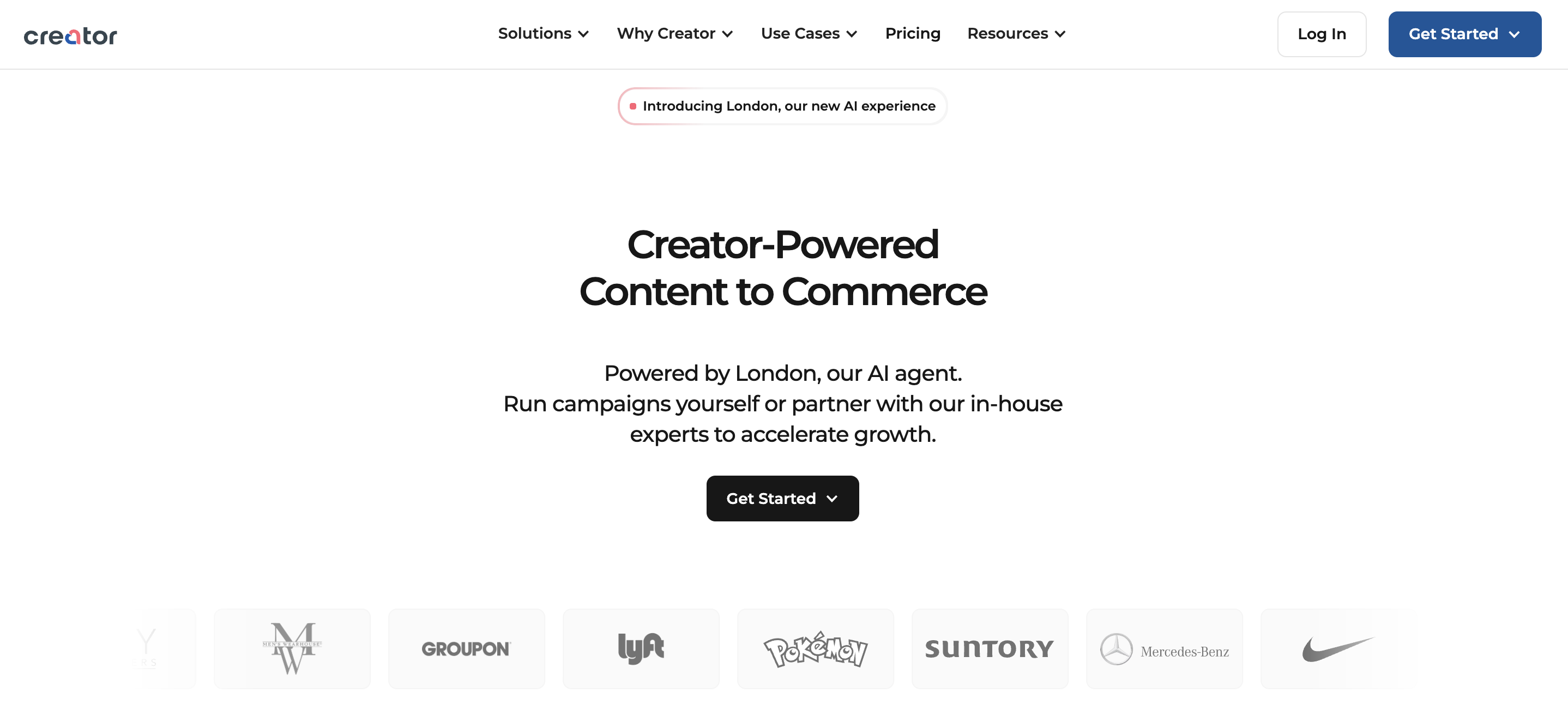
Creator.co is an influencer marketing platform and marketplace that combines influencer discovery, campaign management, and creator applications. It is designed for brands that want both outbound influencer search and inbound creator applications within one platform.
Key Features
- Influencer marketplace: Brands can post campaigns and receive applications from creators.
- Discovery tools: Search creators by niche, audience, engagement, and demographics.
- Campaign management: Manage collaborations, track deliverables, and communicate with creators.
- Automated workflows: Includes templates and automation for outreach and campaign management.
- Content tracking: Monitor influencer posts and performance metrics.
- Affiliate and promo-code tracking: Track conversions and campaign ROI.
Pricing
- Self-Serve: $299/month, with a 3-month minimum commitment.
- Managed: $2,199/month, with a 3-month minimum commitment.
- Enterprise: Custom pricing, with an annual commitment.
- The pricing page also notes that after the initial term, monthly subscriptions move to month-to-month billing, while annual plans renew yearly at a discounted rate.
- Creator.co offers a free trial for Self-Serve.
Reviews
4.6 / 5.0 (G2)
Pros
- Hybrid marketplace + discovery model: Combines outbound search with inbound applications.
- Accessible pricing for mid-sized brands: More affordable than enterprise tools.
- Strong campaign automation: Helps reduce manual work in outreach and management.
Cons
- Smaller database compared to top-tier platforms: Discovery may feel limited.
- Analytics less advanced than enterprise tools: Reporting depth is moderate.
- Not as strong in enterprise workflows: Limited scalability for very large programs.
Integrations
- Shopify: Track influencer-driven sales and manage product gifting.
- Stripe: Manage payments and transactions with creators.
- Google Analytics: Measure traffic and campaign performance.
- Mailchimp: Sync influencer campaigns with email marketing efforts.
Modash vs Creator.co
Modash and Creator.co take different approaches to how brands source and manage influencers. Modash is a discovery-led platform, giving brands access to a vast database of creators and enabling them to proactively find, vet, and reach out to influencers using advanced filters and AI search. Creator.co, by contrast, combines discovery with a marketplace model, allowing creators to apply directly to campaigns, which reduces the need for outbound outreach but also limits control over sourcing.
Overall, Modash is better for scalability and precision, while Creator.co is better for ease of use and campaign accessibility, particularly for mid-sized teams.
Final Thoughts
Modash stands out for its strong discovery engine, ease of use, and suitability for performance-driven influencer campaigns, especially for DTC brands. However, alternatives vary significantly in their strengths—some focus more on eCommerce workflows (GRIN, Upfluence), others on enterprise analytics and governance (CreatorIQ, NeoReach, Lefty), while some specialize in UGC and paid media (Insense) or broader content ecosystems (Skeepers). The right choice ultimately depends on whether the priority is discovery, automation, commerce integration, content production, or enterprise-level control, as each platform approaches influencer marketing from a different angle.

.png)


.jpg)