


Mention Me Pricing and Review: Features, Pros, Cons & Costs
Mention Me will not tell you what it costs until it knows what you earn. The pricing page asks for your annual online revenue first, in bands that run from under £7 million to over £500 million.
That tells you plenty before a single number appears. This is a platform sold to established brands, priced against their revenue, and quoted case by case. There is also a free Shopify app, which very few buyers know about and which does something narrower than the main product.
This review covers what the free app actually gives you, how the paid licence is put together, where the costs sit that nobody quotes, and whether a referral tool of this kind earns its place in a D2C stack.
Mention Me Overview
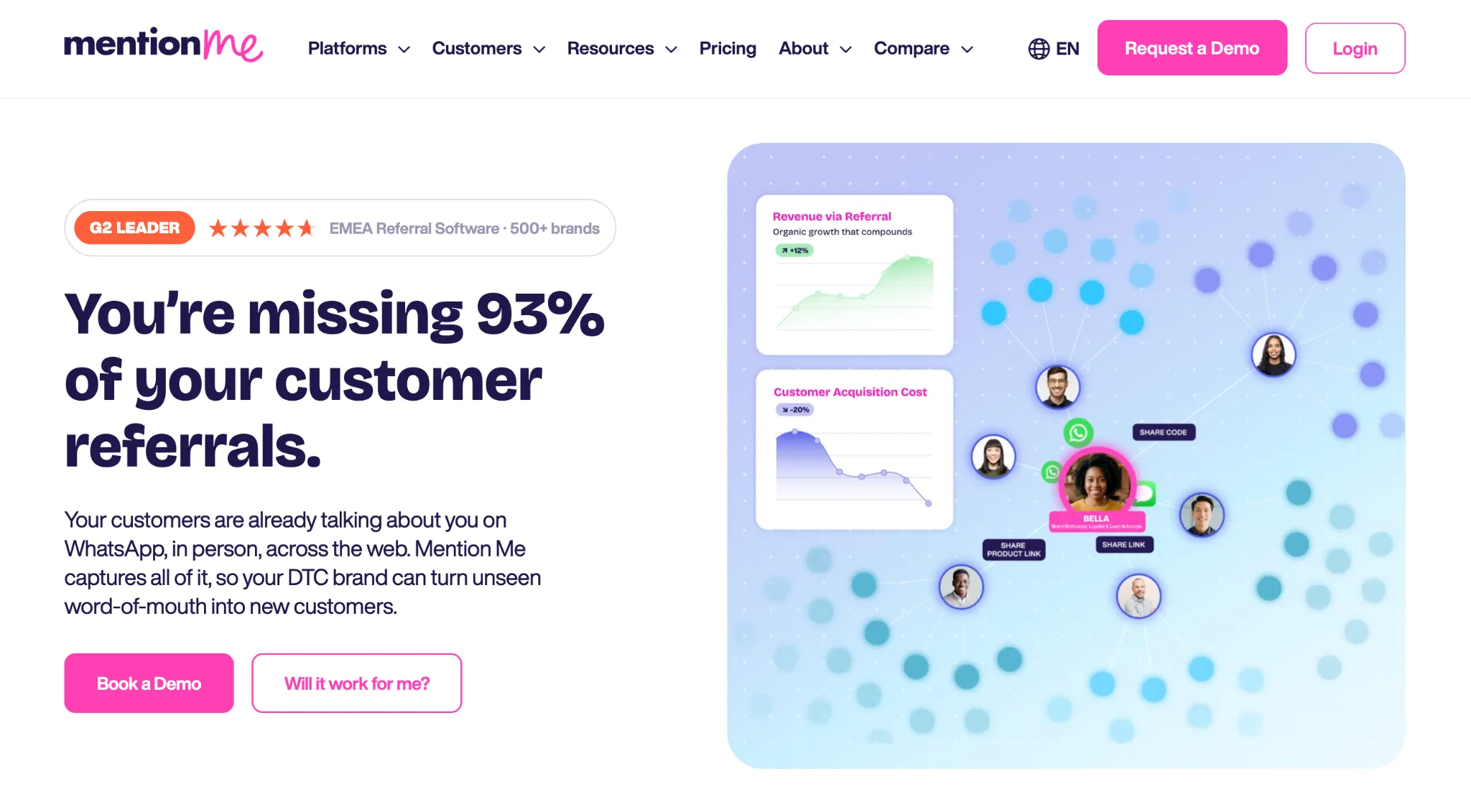
Mention Me is a referral and customer advocacy platform. It sits on your site, spots the customers most likely to recommend you, and gives them an easy way to do it. More than 500 brands use it across fashion, beauty, food and drink, finance and travel.
The idea that sets it apart is NameShare. Most referral tools give a customer a link or a code to pass on. Mention Me lets the friend simply type the referrer's name at checkout instead. No link, no code, nothing to copy. The company reports that NameShare accounts for 34% of all referrals running through the platform, which is a third of the value that a link-only tool would never see.
It is worth being clear about what this is not. Referral marketing rewards your existing customers for bringing friends. It is a different job from paying creators for reach, which is what affiliate marketing tools are built for. Both can grow a D2C brand, but they solve different problems and rarely replace each other.
Who Should Use Mention Me
The revenue bands on the pricing form give the answer away, but the fit is more specific than size alone:
- Established D2C brands past a few million in revenue: The entry band tops out around £7 million, which shows where the product starts to make sense.
- Brands with a repeat customer base: Referral works when people have already bought and liked it. A first-purchase business has nobody to activate.
- Categories where people talk offline: Beauty, fashion and food are full of word of mouth that never touches a link, which is exactly what NameShare catches.
- Teams that want to run their own tests: Testing is built into the product rather than sold as a service, so a marketer can run experiments without help.
- Brands with expensive paid acquisition: If your paid channels are getting more costly, an advocacy channel is a sensible hedge.
- Shopify merchants curious about dark social: The free app measures sharing on WhatsApp and private channels without a contract.
- Early-stage brands under a million in revenue: This is the group it does not suit, because the paid product is priced for a bigger business.
Key Features
NameShare
A friend enters the referrer's name at checkout and the referral is credited. There is nothing to copy, share or remember, so recommendations made in person or over a message still get tracked. This is the feature the whole platform is built around and it is genuinely unusual.
Propensity to Refer
Machine learning scores each customer on how likely they are to recommend you. High scorers see the referral offer and everybody else sees something different, so you are not showing the same prompt to people who will never act on it. It is the same logic as scoring partners inside an influencer CRM, applied to your customer list instead.
Cohort-Based A/B Testing
You can run several tests at once across copy, design, placement and reward. The company reports more than 45,000 tests across its client base, and says testing lifts referral performance by up to four times in the first six months. Tests can conclude in as little as eight weeks.
Predictive Segmentation
The platform forecasts referral behaviour over the next twelve months. That surfaces customers who are about to become advocates, plus the ones who have gone quiet and are worth a nudge. It turns a backward-looking report into a plan.
Sentiment Analysis
NPS feedback is analysed to show what actually drives the recommendation, whether that is price, delivery or product quality. The value here goes beyond referral, because it tells your wider team which part of the experience is doing the selling.
Network Insights
Groups of connected customers are identified inside your base, along with what that whole group is worth. A single advocate looks small on their own and much larger once you can see the cluster around them.
Extended Customer Revenue and Earned Growth
Two metrics measure the value a customer brings in beyond their own spend. Extended Customer Revenue adds the spend of the people they referred. Earned Growth, built with NPS founder Fred Reichheld, measures how much of your growth came from happy customers rather than paid media.
Audience Builder
Referral data is exported to Google, Meta and TikTok to build lookalike audiences from your advocates. Since advocates tend to be your better customers, this is usually a stronger seed list than a general purchaser file.
Mention Me Pricing
There is no published rate card. The pricing page says pricing is built around your revenue and that you only pay for the referrals you generate. To get a figure you fill in a form with your annual online revenue, your timeline and your challenges, and someone calls within a working day.
The revenue bands on that form are the most useful public information about cost. They start at £0 to £7 million and run up past £500 million. Your band sets your package, so the quote is anchored to your size before anybody looks at your programme.
Because the licence is quoted and the rewards come out of your own margin, the total cost arrives from more than one direction. The table below is what to map out before the call.
The Free Shopify App
Mention Me publishes a Shopify app that is free to start and installs in minutes with no developer. It is not the referral programme. What it does is track product sharing across WhatsApp and other private channels, attribute the revenue that comes back, and show you which customers drive it.
Used on its own it is a measurement tool. That is still worth something, because dark social traffic usually lands in your analytics as direct and gets credited to nobody. Treat the app as a way to find out whether you have an advocacy problem worth paying to solve.
The Performance Model
Paying only for referrals generated is the right shape for a referral tool. Your cost tracks your result, and a quiet quarter costs you less than a flat licence would.
The catch is that you cannot model it. Without a published fee per referral, or a published share of referred revenue, you cannot work out your cost per acquisition before the call.
Rewards Come Out of Your Margin
Both sides of a referral usually get something. The referrer earns a reward and the friend gets a discount on their first order. Those two numbers are yours to set, and at scale they are normally larger than the platform fee.
Work out the combined reward cost per referred order and compare it against your blended paid acquisition cost. If referral is not clearly cheaper, the programme is not paying for itself no matter what the licence costs.
Time to Value
Mention Me says a programme can launch in 30 days or less, and that setup needs three tags on specific pages plus a container at checkout. Reviewers report something slower, with implementation nearer two months and payback around twelve. Budget for a year before the programme is clearly in profit.
Mention Me Reviews
4.4/5.0 (G2, 61 reviews). This is the most reliable score available and the sample is large enough to mean something.
4.6/5.0 (Capterra, 11 reviews) and 8/10 (TrustRadius, 3 reviews). Both are positive and both come from small samples, so read them as supporting evidence rather than as independent proof.
5.0/5.0 (Shopify App Store, 3 reviews) for the free app. Three reviews is too thin to treat as a score at all, and it is worth saying so plainly given how good the number looks.
The praise is consistent. Setup is easier than expected, the referral experience looks native to the brand, support responds quickly, and the reporting gives real insight into customer behaviour. Several reviewers name a low cost per acquisition on referred customers.
The complaints are consistent too. The platform takes time to learn, changing codes often means contacting support rather than doing it yourself, some reports are not useful, design options can be restrictive against brand guidelines, and the referrer and referee wording confuses people at first. On cost, reviewers place it at the expensive end of the category, with about twelve months to return on investment.
Integrations
The connection surface is built around marketing and customer data rather than commerce:
- Klaviyo: Referral data flows into email flows and segments, and feeds lookalike audience building.
- Salesforce Marketing Cloud: Advocacy behaviour syncs into enterprise campaign automation.
- Ometria: Referral signals join the customer data platform for targeted campaigns.
- Attentive: Referral prompts and rewards run through SMS and mobile messaging.
- Meta, Google and TikTok: Advocate data exports as seed lists for lookalike audiences on paid social.
Emarsys, Bloomreach and a certified SAP listing are also named, and an API with webhooks covers anything without a direct connector. On Shopify the app installs in minutes, and everywhere else integration means placing three tags plus a checkout container.
Pros of Mention Me
It Catches Referrals Nothing Else Sees
A third of referrals on the platform come through NameShare, where no link or code was ever used. Those recommendations happen in kitchens and group chats, and a link-based tool records none of them. This is the strongest argument for the product by a distance.
Testing Is Part of the Product
More than 45,000 tests sit behind the recommendations you get, and you can run several cohorts at once without engineering help. Most referral tools let you launch a programme and leave you to guess what to change. This one is built to be improved.
You Pay When It Works
Charging on referrals generated puts the vendor on the same side as you. A quiet month costs less, and nobody is billing you a flat fee for a programme that has stalled. The structure is fair even though the rate is not published.
Cons of Mention Me
Your Revenue Sets the Price
The quote is anchored to your revenue band before anyone looks at how your programme might perform. That means two brands with identical referral volumes can pay very different amounts, and the bigger one subsidises nothing in return. You also cannot benchmark the quote against anything, because no competitor figure is published either.
Payback Takes About a Year
Reviewers put implementation near two months and return on investment near twelve. For a channel sold on efficiency, that is a long wait, and it means the decision needs a budget holder who will still be there next year.
Small Changes Need Support
Several reviewers say that editing codes and some programme settings means raising a ticket instead of doing it yourself. On a channel where the whole point is fast iteration, waiting on support slows the testing loop the platform is otherwise good at.
It Does Nothing With Creators
This is a customer advocacy tool, not a creator platform, and the gap is total. There is no creator search, no outreach, no content approvals, no commission engine and no creator payouts. Even the Shopify listing that carries the word influencer tracks customer sharing rather than creator partnerships, so any creator programme needs tools built for creator programmes alongside it.


Is Mention Me Worth It?
For a mid-sized brand with real word of mouth, the case holds up. NameShare captures referrals your current setup is losing entirely, the testing is better than the category norm, and paying on performance means the cost follows the result. A 4.4 across 61 reviews backs that up.
The reservations are about fit and patience. Pricing is quoted against your revenue rather than your programme, payback runs to around a year, and smaller brands are effectively priced out. It also does nothing at all with creators, so it is a second line item rather than a consolidation.
Brands comparing advocacy tools against wider creator platforms usually look at the following:
- Influencer Hero: Issues affiliate codes and links, works out commission in the platform and pays creators at 0.1% to 0.4%, with discovery, influencer outreach, CRM, gifting and UGC in the same system and prices published at $649, $1,049 and $2,490 a month.
- Afluencer: Turns recruitment into an inbound process where creators apply to your listings, which suits a team with no time to search, and it explains the approach in its guide to creator CRM software. Plans start at $49 a month.
- Extole: Enterprise advocacy with deep programme configuration and a heavy focus on multi-programme management. For a brand running referral, loyalty and advocacy side by side, it is worth the call.
- Talkable: Referral built around campaign experimentation and fraud controls, with strong eCommerce templates. If you want to launch and iterate quickly with a small team, it is the closer fit.
- Friendbuy: A lighter referral and loyalty tool with self-serve setup on major eCommerce platforms. For a growing brand that wants a programme live without an enterprise process, it makes more sense.
Final Thoughts
Mention Me is built for one job and does that job unusually well. Catching the referrals that happen by name instead of by link is something most tools in this category simply miss, and a third of the platform's referrals arrive that way. The trade-off is that you cannot price it yourself and reviewers put payback at around a year. That is a reasonable deal at scale and a hard one below it, so be honest about your revenue before you start the conversation. If your growth gap is creators rather than customers, Mention Me alternatives aimed at influencer programmes are the better place to put the budget.

.png)


.jpg)










