

Makeinfluence Pricing and Review: Features, Pros, Cons & Costs
The question with any performance-priced platform is what performance-priced actually excludes. Makeinfluence says you only pay when sales are generated, and the service fee genuinely works that way. The subscription underneath it does not, and it runs from €95 to €1,205 a month whether a single creator posts or not.
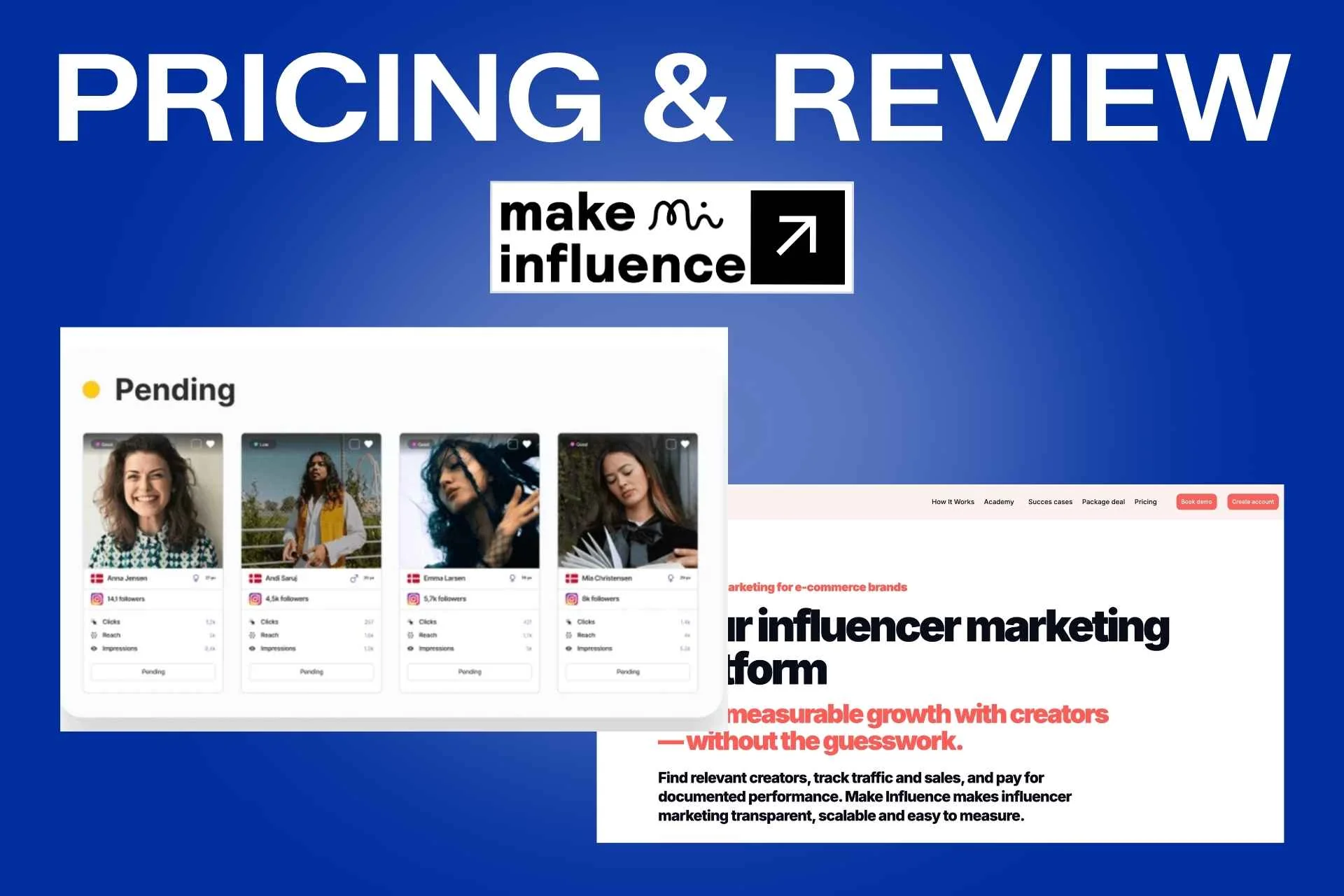
Makeinfluence is a Danish performance marketplace built for eCommerce brands, live since 2020, with a network of around 5,000 verified creators concentrated in Denmark and Sweden. Brands recruit influencers, hand them tracked links, and pay commission only on attributed sales. The platform takes a percentage of that commission on top, ranging from 30% down to 15% depending on tier.
Two things make the pricing worth working through properly. The service fee is charged on the creator’s commission rather than on revenue, which makes 30% far smaller than it sounds. And the tier you need is decided by caps on influencers, markets and campaigns, not by the fee at all.
Makeinfluence Overview

This is affiliate marketing with a creator marketplace attached, rather than influencer marketing with affiliate features bolted on, and the difference shows everywhere in the product. Creators are paid on results, brands see clicks, traffic and sales per creator, and the entire model assumes a webshop with a checkout at the end of the funnel. A brand selling through retail partners has nothing to attribute and nothing to pay against.
The company reports having generated more than €65 million in revenue and 930,000 sales for customers since 2020, which is a substantial track record for a platform of this size. The creator network is around 5,000 verified influencers, which is small by database standards and reflects a curated regional marketplace rather than a scraped global index. Categories are consumer-facing: fashion and beauty, food and beverage, health and lifestyle, home and family.
What sits outside the model is anything that does not end in a tracked sale. There is no product seeding workflow, no content licensing, no UGC library and no gifting logistics of the kind dedicated product seeding platforms provide. Creators here are a paid acquisition channel measured on revenue, which is a clean proposition as long as revenue is genuinely what you want from them.
Who Should Use Makeinfluence
Geography and channel count decide this faster than budget does, because the plan caps bite long before the fee does.
- Nordic eCommerce brands. The creator network is concentrated in Denmark and Sweden, and a curated regional marketplace beats a global database when your customers are in one or two countries.
- Brands that want creators judged on revenue. Commission-only payment with per-creator sales tracking removes the argument about whether a campaign worked, which is worth a lot to a finance team.
- Teams with no influencer marketer. Every paid tier above Entry includes a dedicated customer success manager, and the Full Service tier is explicitly a managed offering.
- Brands testing the channel cheaply. Entry at €95 a month with five creators is a low-commitment way to find out whether creator-driven sales work for your product.
- Single-market operators. Three of the four tiers cover exactly one market. If you sell in one country, that limit costs you nothing.
- Not brands selling in several countries on a budget. Multi-market access appears only at Full Service Pro, €1,205 a month, which is a large jump for what is often a small expansion.
Key Features
Performance-Based Creator Payment
Creators earn commission on attributed sales rather than a flat fee per post. For a brand that has paid four figures for a post that sold nothing, this alignment is the entire appeal, and it removes the hardest negotiation in influencer marketing, which is agreeing what a post is worth before anyone knows.
Tracked Links and Sales Attribution
Each creator gets unique tracked links, with clicks, traffic and sales reported per creator in real time. Attribution runs on a 30-day cookie window, which is generous to the creator and correspondingly expensive for the brand, since a purchase almost a month after a click still carries commission. Brands wanting tighter revenue attribution and reporting control should ask whether that window is negotiable.
Curated Creator Marketplace
Around 5,000 verified influencers across consumer categories, with brands recruiting from within the network rather than searching an open database. The small number is deliberate. Vetting 5,000 creators properly is a different proposition from indexing 300 million, and for a regional program the curated pool is usually the more useful one.
Campaign Management and In-App Messaging
Campaigns are created, briefed and managed in the platform, with communication between brand and creator kept in-app rather than in email threads. Campaign slots are capped by tier, at one, two, four and unlimited, which is a tighter constraint than most brands expect when they sign.
Content Library
Creator content produced through campaigns is collected in one place for review. It is a content library rather than a rights-management system, so treat usage permissions for paid media as a separate conversation with each creator rather than something the platform has settled for you.
Automated Invoicing and Payouts
Commission calculation, invoicing and creator payment run automatically off attributed sales. For a brand paying twenty or fifty creators variable amounts every month, this is the administrative saving that justifies a platform at all, and doing it manually is where affiliate programs usually break down.
Dedicated Customer Success Management
Every tier from Basic upward includes a named customer success manager, and the top tier is a full managed service. Reviewers name support quality as one of the platform’s genuine strengths, though several also report that attention drops noticeably after the sale, which is worth probing before signing.
ROI Calculator and Webshop Integration
A public ROI calculator helps model expected return before committing, and the platform integrates with your webshop or website to capture conversions. The integration is described in general terms rather than as a named list of eCommerce platforms, so confirm your specific stack is supported during the demo rather than assuming it.
Makeinfluence Pricing
Four tiers, all published with real figures, and a 15% discount for annual billing. That transparency is genuinely above average for this category and worth crediting before picking the model apart.
The service fee is the part most comparisons get wrong. It is charged on the creator’s commission, not on your revenue. The platform’s own example: a €100 sale at a 10% creator commission produces €10 of commission, and a 30% service fee on that is €3, for a total cost of €13. At a 10% commission rate, a 30% fee is therefore 3% of revenue, and the 15% fee is 1.5%.
Entry
- €95 per month, or €80 per month billed annually.
- 30% service fee on influencer commission, the highest on the ladder.
- 5 active influencers, 1 market, 1 campaign, and a revenue cap of €6,700.
- Optional onboarding costs €670, which is seven months of subscription at this tier.
- The revenue cap, not the fee, is what defines this plan. It is a trial with a ceiling rather than a plan you grow inside.
Basic
- €535 per month, or €455 per month billed annually, which is €5,460 a year.
- 25% service fee, 20 active influencers, 1 market, 2 campaigns.
- Adds a dedicated customer success manager.
- Optional onboarding at €670. The jump from Entry is €440 a month, which is a substantial step for a brand that has just finished a €95 trial.
Growth
- €805 per month, or €685 per month billed annually, which is €8,220 a year.
- 20% service fee, 50 active influencers, 1 market, 4 campaigns.
- Dedicated customer success manager, optional €670 onboarding.
- Marketed as the most popular tier, and still limited to a single market.
Full Service Pro
- €1,205 per month, or €1,025 per month billed annually, which is €12,300 a year.
- 15% service fee, unlimited influencers, unlimited markets and unlimited campaigns.
- Dedicated customer success manager and a managed service model, optional €670 onboarding.
- This is the only tier that covers more than one country, which makes it the default for any brand selling across the Nordics.
The Fee Almost Never Decides the Tier
- Work in effective terms. At a 10% creator commission, the service fee costs 3% of revenue on Entry, 2.5% on Basic, 2% on Growth and 1.5% on Full Service Pro. Those gaps are half a percentage point each.
- Basic to Growth breaks even at €54,000 a month. Growth costs €270 more and saves half a point, so you need that much monthly attributed revenue before the fee saving covers the subscription.
- Growth to Full Service Pro breaks even at €80,000 a month. Same arithmetic, €400 more for another half point.
- Entry is never beaten on cost inside its own ceiling. On fees alone Basic would only overtake it at €88,000 a month of revenue, and Entry caps out at €6,700. You leave Entry because you hit a wall, not because you did the maths.
- So buy on the caps. Influencer count, market count and campaign slots are what actually force each upgrade. Count the creators and countries you need, pick the tier that holds them, and treat the fee reduction as a rebate rather than a reason.
Makeinfluence Reviews
This is a real review base rather than a handful of entries, which makes the picture more useful than most platforms of this size can offer.
- 3.5/5.0 (Trustpilot, 57 reviews)
The positive half is consistent and comes from both sides of the marketplace. Creators describe the platform as straightforward to navigate. Brands report profitable returns sustained across several years, and the team is repeatedly credited for responsive communication and hands-on guidance during setup. For a performance platform, brands publicly confirming multi-year profitability is about as strong a signal as this category produces.
The negative half clusters on three things and they are worth taking seriously. Some brands report minimal or zero sales despite paying a subscription for extended periods, which is the structural risk of paying monthly for access to a channel that may not fire. Binding contracts and difficulty cancelling come up repeatedly. And attention after the sale is described as dropping off, which sits awkwardly beside a dedicated customer success manager being a headline feature.
Integrations
The integration surface is the least documented part of the product, and for a platform whose entire model depends on tracking sales, that is worth pressing on before you sign.
- Webshop tracking. Integration with your webshop or website is offered, and it is the mechanism the whole product rests on.
- Named eCommerce platforms. None published. Shopify, WooCommerce, Magento and the rest are not listed individually anywhere, so confirm your platform explicitly.
- Payment and invoicing. Handled natively rather than through a named third-party provider, with commission calculation and creator payouts automated.
- Analytics tools. No named connections to Google Analytics or a BI stack, so reporting largely stays inside the platform.
- API and automation. No public API or Zapier connector is published, which limits how far creator data can flow into systems you already run.
None of this means the tracking does not work, and a €65 million attributed revenue figure suggests it does. It does mean the integration question belongs in your first call rather than your first invoice.
Pros of Makeinfluence
Published Prices and an Honest Fee Mechanic
Four tiers with real monthly and annual figures, a stated annual discount, and a service fee explained with a worked example on the pricing page itself. Publishing that a 30% fee means €3 on a €100 sale, rather than letting buyers assume the worst, is more transparency than this category usually manages and it makes the platform genuinely comparable.
Creators Are Paid on Results
Commission-only payment means a creator who sells nothing costs nothing beyond the subscription, and every euro of creator cost is attached to a euro of revenue. For a D2C brand that has been burned paying flat fees for posts with no measurable outcome, that alignment is the reason to be here, and the multi-year profitability reports in the reviews suggest it holds up.
A Curated Regional Network With a Track Record
Five thousand verified creators is small, and in the Nordics that is an advantage rather than a shortfall. The platform reports €65 million in attributed revenue and 930,000 sales since 2020, which is a concrete result rather than a claimed multiple, and a vetted regional pool beats a global index when your customers are in two countries.
Cons of Makeinfluence
You Pay Monthly Whether Anything Sells or Not
The service fee is performance-based; the subscription is not. A brand on Growth pays €8,220 a year before a single sale is attributed, and reviewers specifically report paying for extended periods with minimal or zero results. Add €670 of optional onboarding and the fixed cost of finding out whether this works is substantial. The marketing line that you only pay when sales are generated describes the fee, not the bill.
One Market on Three of the Four Tiers
Entry, Basic and Growth each cover a single market. A Danish brand adding Sweden, which is the most natural expansion this platform’s own network supports, has to move to Full Service Pro at €1,205 a month. That is a 50% increase over Growth for a second country, and it is the single largest hidden step in the pricing.
Binding Contracts Are the Recurring Complaint
Reviewers report mandatory long-term commitments and difficulty cancelling, alongside post-sale attention that fades. Annual billing is discounted 15%, which is a normal incentive, but combine a lock-in with a channel that some brands report producing no sales and the downside case is a year of subscription for nothing. Ask for the minimum term, the notice period and the exit conditions in writing, and weigh the 15% annual discount against the flexibility you are trading for it.
No Seeding, No Content Rights, No Outreach Automation
Everything here is built around a tracked sale, so there is no gifting workflow, no UGC rights management and no outreach automation for recruiting creators outside the network. Brands that want creators producing content for paid media, or want to build relationships before revenue arrives, will need a second platform. The integration list not naming a single eCommerce platform is a further gap to close during evaluation.


Is Makeinfluence Worth It?
For a Nordic eCommerce brand that wants creators measured on revenue, yes, with conditions. Published pricing, a fee mechanic explained honestly, commission-only creator payment, automated invoicing and payouts, a curated network of 5,000 verified creators, and 3.5 out of 5 across 57 Trustpilot reviews with brands reporting multi-year profitability. If you sell in one country and want an affiliate-shaped creator program without building the tracking yourself, this is a reasonable buy.
The conditions are the caps and the contract. Three tiers cover one market only, so a second country means €1,205 a month. The fee reduction between tiers is worth half a percentage point and does not justify an upgrade below €54,000 of monthly attributed revenue. Binding terms and difficulty cancelling are the most repeated complaint, and there is no seeding, no content rights management, no outreach automation and no named eCommerce integration. Brands whose program needs more than tracked sales should compare these:
- Influencer Hero. Discovery across various social platforms with Instagram, YouTube and TikTok emphasised, plus fake follower screening, influencer CRM boards, gifting through Shopify and WooCommerce, affiliate codes and creator payouts in one system. Pricing is publicly listed from $649 a month with no cut of creator commission.
- Afluencer. A creator marketplace from $49 a month where influencers apply to your listings, well suited to affiliate influencer marketing when the constraint is finding creators willing to work on commission.
- Dreaminfluence. A Nordic competitor with a similar regional creator focus and campaign management tooling, worth quoting alongside for a direct like-for-like in the same markets.
- Skeepers. Influencer and UGC campaigns with strong content collection and review syndication, useful when creator content needs to feed product pages as well as social.
- Later Influence. Creator management paired with social publishing and analytics, aimed at teams that want organic content and creator programs in one workflow.
Final Thoughts
Two numbers and one clause decide this. The first number is how many countries you sell in, because one country fits three tiers and two countries costs €1,205 a month. The second is your expected monthly attributed revenue, because below €54,000 the fee difference between tiers is noise and you should buy purely on the influencer and campaign caps. The clause is the contract term, since a lock-in on a channel that some reviewers report produced nothing is the actual downside here, not the percentage. Get the minimum term and notice period in writing, confirm your specific eCommerce platform is supported, and if the answer to any of those is unsatisfying, the Makeinfluence alternatives that combine seeding, content rights and affiliate tracking in one subscription are the comparison to run next.

.png)


.jpg)