


Launchmetrics Pricing and Review: Features, Pros, Cons & Costs
Launchmetrics measures your brand in a currency it invented. Media Impact Value, or MIV, puts a dollar figure on every social post, article and print placement your brand earns, then sorts the sources into five Voices: Celebrities, Influencers, Media, Partners and Owned Media. It is the number the whole platform is organised around, and for a fashion or luxury PR team it is the number that ends up in the board deck.
That framing explains both the appeal and the price. Launchmetrics is not competing on features against creator marketing tools; it is selling a measurement standard to an industry that never had one, alongside the sample tracking and event software that half the fashion calendar already runs on.
What follows is what the platform costs at each tier, what brands are actually paying against the published entry price, and where a D2C team would be buying the wrong category of software.
Launchmetrics Overview
Launchmetrics was formed in January 2016 when Fashion GPS, founded in New York in 2006 around sample tracking, merged with the Paris PR software company Augure. Since then it has bought Visual Box, Style Coalition, IMAXtree, PARKLU and DMR, and in January 2024 the fashion technology group Lectra acquired a majority stake in a deal valuing the business between $200 million and $240 million, with the remaining shares scheduled for purchase in stages through 2030.
The company reports more than 1,700 brands and agencies as clients across roughly 20 countries, with 450 plus employees, and Crunchbase notes it works with around half of the top 100 luxury brands globally. FY2023 revenue was about $45 million, of which more than $40 million was recurring.
The product is sold as the Brand Performance Cloud, a set of modules covering media monitoring, competitive benchmarking, physical sample management, event and guest list management, digital showrooms and, most recently, AI visibility tracking. It is a PR and brand equity platform first. If you are shopping for influencer analytics tools that tie creator activity to revenue, this is a different animal, and the pricing reflects the audience it was built for.
Who Should Use Launchmetrics
Category fit here is unusually decisive. The MIV model is calibrated on fashion, lifestyle and beauty media, so value degrades fast outside those verticals.
- Fashion, luxury and beauty brands. The publication rate cards, the Voice taxonomy and the benchmarking universe are all built on this media landscape. Launchmetrics concedes it serves adjacent sectors but specialises here.
- Brands that ship physical samples to press and stylists. Sample tracking with barcode and RFID scanning is the original Fashion GPS product and still the most praised part of the platform.
- Teams running runway shows or high-touch physical events. Seating charts, RFID check-in and guest list management are capabilities very few competitors offer at all.
- Multi-market brands operating across three or more countries. The vendor names Premium as its most popular package and builds it around three regions, which tells you where the customer base sits.
- Brands with meaningful China exposure. Coverage of Weibo, WeChat, Douyin, RED and BiliBili plus a dedicated China module is genuinely hard to replicate.
- PR and comms teams whose main deliverable is earned media reporting to executives. MIV exists to put a currency figure on work that used to be reported in clippings.
Key Features
Media Impact Value
The proprietary metric that anchors everything. MIV assigns a monetary value to each mention using three inputs: advertising rates drawn from publication rate cards for print and advertising value equivalent calculations for online, source factors covering media type, quality scores across roughly 4,000 top sources and content relevance, and content factors including engagement, format, length and whether an image or video is present. Every placement gets a number, and every number rolls up into Share of Value against competitors.
Discover
Media and social monitoring across more than 200 countries, tracking 8,000 plus print titles, over two million online articles and 1.2 million social accounts daily. Coverage spans Instagram, TikTok, YouTube, X, Facebook and the Chinese platforms most Western tools ignore. Clippings are curated into feeds filterable by brand, product, channel, language or region and sortable by MIV.
Insights and Competitive Benchmarking
Benchmark your brand against named competitors across print, online and social, with Voice Mix analysis showing which of the five Voices actually drives your value. Custom dashboards handle rankings, Share of Value and MIV evolution over time. The module also includes human research services: monthly digests, quarterly benchmark reports and a quarterly consultation with a data analyst.
Samples Management
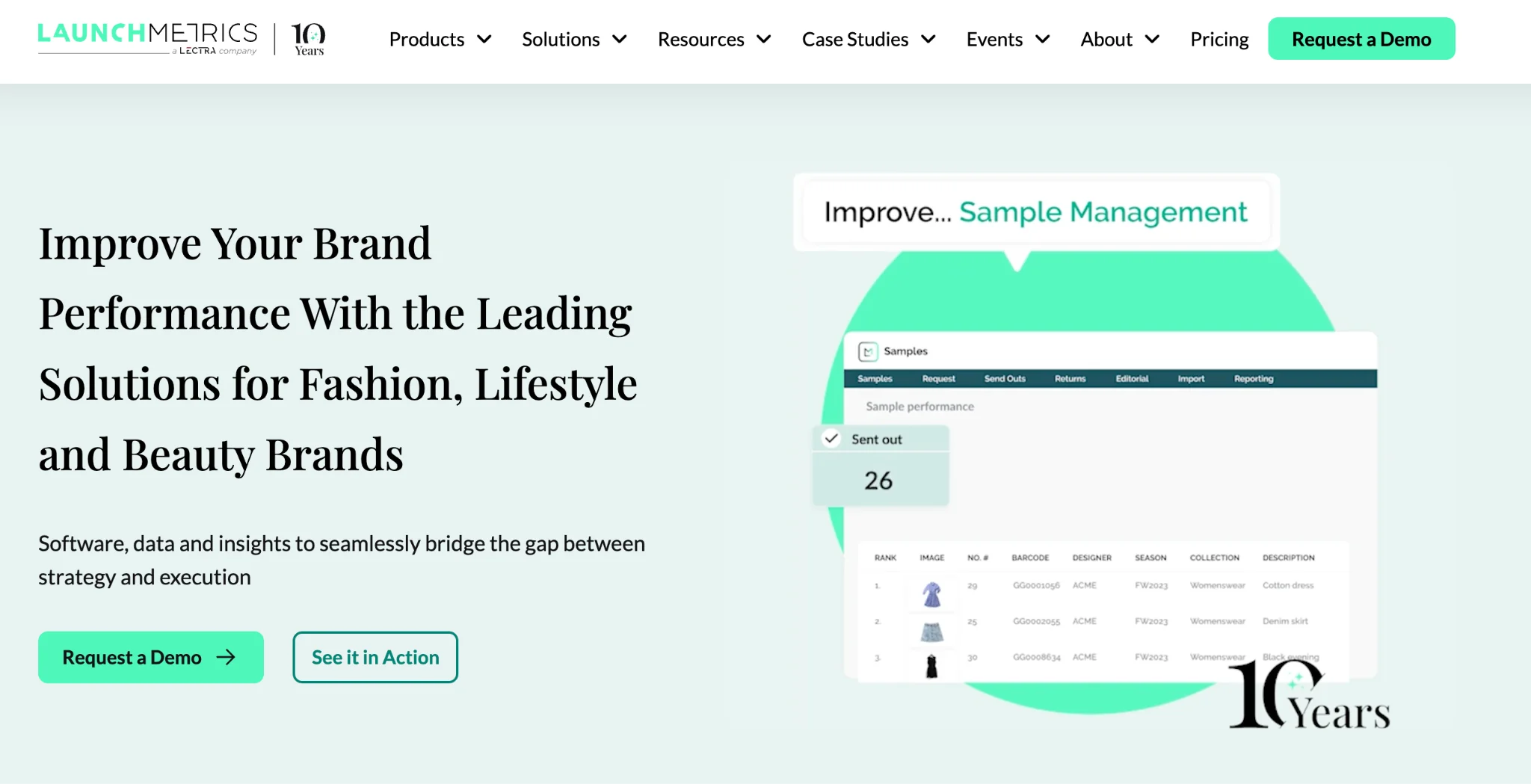
Track the status and location of every physical sample through a mobile app or desktop, with barcode and RFID scanning for check-in and check-out. Handles requests and reservations for shoots, tradeshows and events, generates delivery memos from the app, and keeps an audit trail for lost, unreturned and gifted items. Crucially it ties send-outs back to resulting MIV, so you can see which contacts and products actually converted into coverage.
Events Management
Digital or physical invitations carrying unique barcodes or RFID chips, direct RSVP links with real-time updates, and seating charts with custom layouts and colour-coded invitees. Templates carry over season to season. On the night, a mobile check-in app scans guests, and RFID allows multiple guests to be checked in without scanning at all. Real-time dashboards cover RSVPs, attendance, no-shows and check-in timing.
Marketing in China
A dedicated module integrating Chinese channels and voices, built on the 2020 PARKLU acquisition. For a luxury or beauty brand where a meaningful share of brand heat originates on RED or Douyin, this is the single strongest reason to choose Launchmetrics over a generalist monitoring platform.
Digital Showrooms and Collection Amplification
Showcase collections digitally so editors can request samples directly from the showroom, which feeds straight back into the Samples module. Collections can be amplified to a network Launchmetrics puts at 500 plus top editorial outlets. There is also a centralised contact manager for composing and sending press releases.
AI Visibility Tracking
The newest addition, monitoring how the brand appears in AI and large language model responses. It is early, and Launchmetrics publishes little detail on methodology, but it is a sensible extension of a monitoring product into where discovery is actually moving.
Launchmetrics Pricing
Launchmetrics publishes four tiers and a price for exactly one of them. Starter is listed from €780 a month, which works out to roughly €9,360 a year. Pro and Premium are pricing on request, and Ultimate is fully custom. The tiers are differentiated mainly by how many competitors you can track and how many countries or regions you can monitor.
The detail worth pausing on sits in the vendor’s own FAQ: Premium is described as the most popular package, and Premium is not priced publicly. The number on the page is not the product most customers buy.
Starter
- From €780 per month, roughly €9,360 a year, the only published price on the platform.
- Track up to 5 competitors in 1 country or region.
- Includes the core feature set, positioned at small and emerging brands.
- No API access and no Delta data sharing, so your data stays inside the interface.
Pro
- Pricing on request.
- Up to 8 competitors across 3 countries or regions.
- Adds enhanced collaboration and customisable workflows for larger teams.
- Still no API access, which is the line that matters if you want data in your own warehouse.
Premium
- Pricing on request, and named by Launchmetrics as its most popular package.
- Up to 15 competitors across 3 countries or regions, plus quarterly brand insights.
- Unlocks API access, Delta sharing and RFID capability.
- This is the realistic starting point for any brand with multi-market operations.
Ultimate
- Fully custom pricing, competitors, markets and configuration.
- Aimed at enterprise groups needing full customisation across a brand portfolio.
- No published seat counts or module limits at any tier, and both seats and modules are paid expansion levers.
- No free trial at any tier.
What Brands Actually Pay
- Lectra’s acquisition disclosure gives FY2023 revenue of about $45 million across roughly 1,700 clients, which implies an average of around $26,000 per client per year.
- An independent SaaS revenue estimate for 2024 puts average contract value nearer $51,600, so the realistic band for a real deployment is roughly $26,000 to $52,000 annually.
- That is somewhere between three and six times the published €780 entry point, which is the single most useful thing to know before a first call.
- Buyer data rates cost perception at the top of the five-point scale and reports around four months to implement, with no free trial available.
- Implementation and onboarding fees are not disclosed either way. Ask for them in writing.
Launchmetrics Reviews
Ratings are strong but the sample is thin. Roughly 130 public reviews exist in total for a company with 1,700 clients, which is a limited evidence base in both directions.
- 4.6/5.0 (G2, 89 reviews)
- 4.6/5.0 (Capterra, 37 reviews, and the listing covers Launchmetrics Events rather than the full platform)
- 9/10 (TrustRadius, 1 review, effectively meaningless)
The standout sub-score is support, at 9.7 out of 10 on G2 across 68 reviews, which is exceptional and comes up repeatedly in written feedback. Sample management and event tooling draw specific praise, particularly barcode tracking, seating charts and the on-site mobile check-in experience. Value for money scores 4.5 out of 5 on the Events listing.
The complaints are operational rather than commercial. Reviewers describe an interface complicated by multiple workspaces and a real learning curve, tagging that is manual and error-prone with painful bulk editing, outdated clippings resurfacing in feeds, missing Instagram Stories capture that forces manual uploads, slow report generation, and seating charts that cannot be modified once uploaded. Ease of setup is the weakest sub-score at 8.0, consistent with the four-month implementation timeline.
Integrations
This is the thinnest part of the platform and worth being blunt about. Launchmetrics publishes no integration directory, no public developer documentation and no marketplace. What is verifiable comes down to five things.
- PLM systems via API. Syncs product data and workflow status into Samples, which is the integration that matters for a fashion team running collections through a product lifecycle tool. No named vendor partners.
- CRM via API. Used by Events to unify guest data across departments. Again, no CRM vendors are named anywhere in the documentation.
- API access and Delta sharing. Gated to Premium and Ultimate only, so brands on Starter or Pro cannot move their own data programmatically.
- Single sign-on. Available from the upper packages, standard for enterprise procurement.
- Native mobile apps. Separate iOS apps for Events and for Samples, which handle on-site check-in and warehouse scanning respectively.
There is no verifiable eCommerce integration of any kind. No Shopify app, no WooCommerce, no BigCommerce, no Magento, and no Zapier connector. For a fashion PR team that is irrelevant. For a D2C brand it means MIV can never be reconciled against actual revenue inside the platform.
Pros of Launchmetrics
Sample and Event Tooling With No Real Competitor
Barcode and RFID sample tracking that ties send-outs to resulting coverage, and event software that handles seating charts and scan-free RFID check-in for a runway show, are not capabilities you find elsewhere. Reviewers name both consistently, and one describes replacing spreadsheets and post-it notes with reservations accepted hours before a show. For a brand whose calendar runs on shows and press loans, this is the reason to buy.
China Coverage Almost Nobody Else Has
Monitoring Weibo, WeChat, Douyin, RED and BiliBili alongside Western platforms, with a dedicated China module behind it, closes a gap that costs luxury and beauty brands real visibility. Most monitoring platforms simply do not see that market, and a brand with Chinese consumer demand is otherwise flying blind on half its brand heat.
Support Quality Is the Standout in Reviews
A 9.7 out of 10 support score is rare at any scale, and it is backed by the structure of the offer: dedicated customer success, product workshops during onboarding and quarterly consultations with data analysts on the higher tiers. Given a four-month implementation and a complex interface, that support layer is not a nice extra, it is what makes the platform usable.
Cons of Launchmetrics
The Published Price Is Not the Product You Will Be Sold
Starter sits at €780 a month with one market and five competitors. The vendor names Premium as its most popular package and does not price it. Derived contract values from the company’s own audited revenue put the average client somewhere between $26,000 and $52,000 a year, and buyer sentiment rates cost at the top of the scale. Budgeting from the number on the pricing page will leave you off by a factor of three or more, and there is no trial to check before committing.
MIV Is a Currency You Cannot Take With You
By Launchmetrics’ own description, MIV is built partly on advertising value equivalent calculations, the methodology AMEC, the industry body for communications measurement, has campaigned to eliminate from PR work entirely. Launchmetrics layers quality and engagement factors on top, which is a fair defence, but the weightings are undisclosed, the output cannot be independently audited, and none of your MIV history transfers if you change vendor. A metric only your supplier can calculate is a renewal argument as much as a measurement one.
No Affiliate, Commission or Revenue Connection
There is no affiliate link tracking, no discount code attribution, no commission management and no creator payouts anywhere in the product, and no eCommerce integration to connect coverage to sales. For a D2C brand this is decisive: you would be paying enterprise rates to measure earned media in a proprietary unit while affiliate revenue tracking stays in a different system entirely.
Slow to Deploy and Priced to Expand on Two Axes
Four months to implement, no free trial, and the weakest review sub-score is ease of setup. Once live, cost scales with both the number of modules you use and the number of seats you add, so a growing team gets squeezed from two directions at once. Contract terms, billing frequency and renewal conditions are published nowhere, which leaves the most important commercial questions to the sales call.


Is Launchmetrics Worth It?
For a fashion, luxury or beauty brand with runway shows, press loans and multi-market PR, it is close to unavoidable and the reviews back that up. Half the top 100 luxury brands use it, the sample and event modules have no serious equivalent, the China coverage is a genuine advantage and the support is the best-rated part of the platform. The complaints are about tagging, workspaces and report speed, not about whether the thing works.
For a D2C brand the calculation is different. You would be paying somewhere between $26,000 and $52,000 a year to measure earned media in a proprietary metric, with no route to connect it to revenue, no affiliate or commission tooling, no eCommerce integration, four months of implementation and no trial to test the fit. Outside fashion, lifestyle and beauty the MIV model loses much of its calibration too, so the core number gets less meaningful exactly as the price stays the same.
Brands whose goal is creator-driven revenue rather than earned media valuation should look at these instead:
- Influencer Hero. Built around attributable performance rather than media value, with discovery across eight platforms, brand-follower detection, fake follower screening, automated outreach, creator relationship management, affiliate links and payouts, and gifting through Shopify, WooCommerce or custom stores. Pricing is publicly listed from $649 a month.
- Afluencer. A marketplace where creators apply to your campaign listings, useful when the bottleneck is finding people rather than measuring them, with plans from $49 a month.
- Lefty. Influencer marketing platform built for fashion and luxury specifically, with campaign tracking, EMV reporting and creator management in one place.
- Dash Hudson. Social and creator performance analytics with strong visual content intelligence, aimed at beauty and fashion teams measuring what actually performs.
- CreatorIQ. Enterprise creator management with deep integrations, workflow automation and detailed audience data for large in-house teams.
Final Thoughts
The decision comes back to one number and one question. The number is the gap between €780 a month on the pricing page and the $26,000 to $52,000 a year an average client actually pays, because the tier that fits a real multi-market brand is the one with no price on it. The question is whether earned media value, expressed in a unit only this vendor calculates, is the thing your program is judged on. For a luxury house preparing a show and briefing editors, the answer is usually yes and the money is well spent. For a D2C brand that needs coverage to translate into tracked sales, the honest move is to price the Launchmetrics alternatives that connect creators directly to revenue before you book the demo.

.png)


.jpg)










