

10 Best Influencer Reporting & Analytics Tools
Influencer marketing without proper reporting is essentially guesswork—something most D2C brands can’t afford when every dollar needs to drive measurable growth. Reporting and analytics tools give you a clear view of what’s actually working by tracking campaign performance, attributing revenue to specific creators, and consolidating data across platforms. Instead of juggling spreadsheets and scattered metrics, these tools centralize everything into one dashboard, helping you understand ROI in real time. With deeper insights into engagement, conversions, and audience quality, you can make faster, data-driven decisions that scale what works and cut what doesn’t. In a space where 89% of marketers say influencer marketing ROI is comparable to or better than other channels (Influencer Marketing Hub, 2025), having the right analytics stack is no longer optional—it’s a competitive advantage.
In this article, we’ll explore leading influencer marketing reporting and analytics tools including HypeAuditor, Influencer Hero, GRIN, Upfluence, Captiv8, Influencity, CreatorIQ, SARAL, Klear, and Lefty.
Best Influencer Reporting & Analytics Tools
| TOOL | REVIEWS | BEST FOR | TRIAL INFO | PRICING | ||
|---|---|---|---|---|---|---|
1 |

|
⭐ | Influencer analytics | Book Demo | Pricing | Website |
2 |

|
⭐ | Influencer CRM & automation | Book Demo | Pricing | Website |
3 |

|
⭐ | DTC creator management | Book Demo | Pricing | Website |
4 |

|
⭐ | Influencer discovery | Book Demo | Pricing | Website |
5 |
|
⭐ | Enterprise influencer campaigns | Book Demo | Pricing | Website |
6 |

|
⭐ | Campaign management | Book Demo | Pricing | Website |
7 |

|
⭐ | Enterprise influencer marketing | Book Demo | Pricing | Website |
8 |

|
⭐ | Influencer outreach | Book Demo | Pricing | Website |
9 |
|
⭐ | Influencer analytics | Book Demo | Pricing | Website |
10 |

|
⭐ | Influencer analytics & discovery | Book Demo | Pricing | Website |
1. HypeAuditor

HypeAuditor is a data-first influencer marketing platform built around creator discovery, audience quality analysis, campaign management, and performance reporting. For D2C brands, its strongest value is that it combines fraud detection, influencer vetting, sales tracking, and campaign reporting in one workflow, with ecommerce connections for attribution.
Key features:
- Influencer discovery: Search a database of creators across Instagram, TikTok, YouTube, X, and Twitch using detailed filters for niche, audience, and performance fit.
- Audience quality and fraud detection: Evaluate audience authenticity, engagement quality, and suspicious follower patterns before you commit a budget.
- Influencer analytics reports: Access in-depth reports with 35+ metrics to assess creator quality and campaign suitability.
- Campaign management: Manage creator recruitment, communication, tracking, and performance measurement inside one system.
- Ecommerce sales tracking: Connect ecommerce stores to monitor promo codes, affiliate links, product seeding, and sales performance.
- API access: Pull influencer and campaign data into your own workflows or dashboards through its API.
Pros:
- Strong on creator vetting, especially for brands that care about fake followers, audience quality, and influencer credibility before launch.
- Useful for ecommerce-led reporting because it connects creator activity to sales signals, promo codes, and campaign performance.
- Common user feedback points to time savings in discovery, outreach, and campaign tracking.
Cons:
- Pricing is not especially entry-level once you move beyond the free starting options, particularly for lean teams comparing lower-cost platforms.
- Some brands may find it more analytics-heavy than they need if they want a lighter creator CRM or gifting workflow. This is an inference based on the platform’s positioning around analytics, audit depth, and campaign data.
- Integration depth appears strongest around ecommerce, API, and automation workflows rather than a very broad native martech ecosystem.
Integrations:
- Shopify: Connect your store to track influencer-driven sales, manage product seeding, and issue affiliate links and promo codes.
- WooCommerce: Sync store activity to measure conversions and manage creator commerce workflows inside campaigns.
- Magento: Tie influencer campaigns to store performance, product gifting, and promo tracking.
- Zapier: Push HypeAuditor data into tools like Slack, Google Sheets, Power BI, Looker Studio, Gmail, Mailchimp, and HubSpot through automation.
- API: Export influencer and campaign data into internal BI, reporting, or custom marketing workflows.
Pricing:
HypeAuditor offers a free starting point for media plans and demo versions of some features. In the broader influencer platform market, that places it in the mid-tier for buyers who want analytics depth without immediately moving into fully custom enterprise pricing.
Reviews:
4.8/5.0 (Capterra)
2. Influencer Hero

Influencer Hero is an all-in-one influencer marketing platform that combines creator discovery, outreach, CRM, gifting, affiliate management, payments, and campaign reporting. For D2C brands, the platform is especially built around linking creator activity to ecommerce performance, which makes it useful for tracking revenue attribution, ROI, and ongoing campaign execution from one place.
Key features:
- Influencer discovery: Search creators across Instagram, TikTok, YouTube, and more using advanced filters such as audience demographics, location, niche, engagement rate, and follower quality.
- AI-powered outreach: Influencer Hero combines outreach and relationship management in one workflow. Teams can send bulk or one-to-one emails with AI-personalized messaging, build automated drip sequences, and track replies.
- Influencer CRM: The built-in CRM uses visual boards to manage campaign stages, conversations, deliverables, and approvals, with automation handling follow-ups and task updates for large-scale campaigns.
- Campaign reporting and ROI tracking: Real-time dashboards centralize campaign performance, including engagement, content performance, clicks, affiliate sales, and ROI per influencer.
- Revenue attribution and eCommerce integration: The platform connects directly with Shopify, WooCommerce, and custom eCommerce setups to track creator-driven revenue in real time.
- Affiliate links, discount codes, and payouts: Brands can generate creator-specific links and codes, track commissions and conversions, and automate payouts within the same system. This simplifies performance tracking and reduces the need for external affiliate tools.
- Gifting and product seeding: Streamlines product seeding by automating order creation, shipping tracking, and delivery confirmation. This makes it easier to manage large-scale gifting campaigns without manual coordination.
- UGC collection and content management: The platform automatically captures influencer posts and stores them in a centralized library. Teams can organize, tag, and download content for reuse across paid ads, social media, and eCommerce, extending the value of each collaboration.
- Application pages and storefronts: Branded application pages allow creators to apply directly to campaigns, while customizable storefronts enable influencers to showcase products and drive affiliate sales, supporting both recruitment and conversion.
- AI-powered workflows: AI is integrated across discovery, outreach, and reporting, including creator recommendations, outreach copy generation, and predictive analytics to estimate campaign outcomes and improve decision-making.
Pros:
- Designed to connect influencer activity directly to revenue through gifting, affiliate tracking, and real-time attribution.
- Covers a broad range of workflows in one place, which reduces the need for separate creator CRM, gifting, affiliate, and reporting tools.
- Automation, bulk actions, and CRM workflows make it suitable for managing hundreds or thousands of creators simultaneously.
Cons:
- The platform does not publicly offer a free trial, which can make initial evaluation more difficult.
- While powerful, the breadth of features can take time for teams to fully adopt and integrate into their workflows.
Integrations:
- Shopify: Sync catalog data, generate affiliate links and discount codes, simplify gifting, and track creator-attributed revenue in real time.
- Klaviyo: Identify influencers already inside your audience, sync creator data into Klaviyo, and connect influencer campaigns with retention and LTV analysis.
- WhatsApp: Manage creator communication and keep conversations synced in the platform.
- Mailchimp: Identify influencers among your contacts and export influencer profiles into your email marketing workflows.
- API integrations: Business plans include custom API integrations for brands that need deeper system connectivity.
Pricing:
Influencer Hero offers tiered plans designed for scaling teams, including Standard, Pro, Business, and Custom/Agency options. Pricing starts around $649/month based on outreach volume, with higher tiers supporting larger outreach volumes and more advanced workflows.
Reviews:
5.0/5.0 (Capterra)
3. GRIN
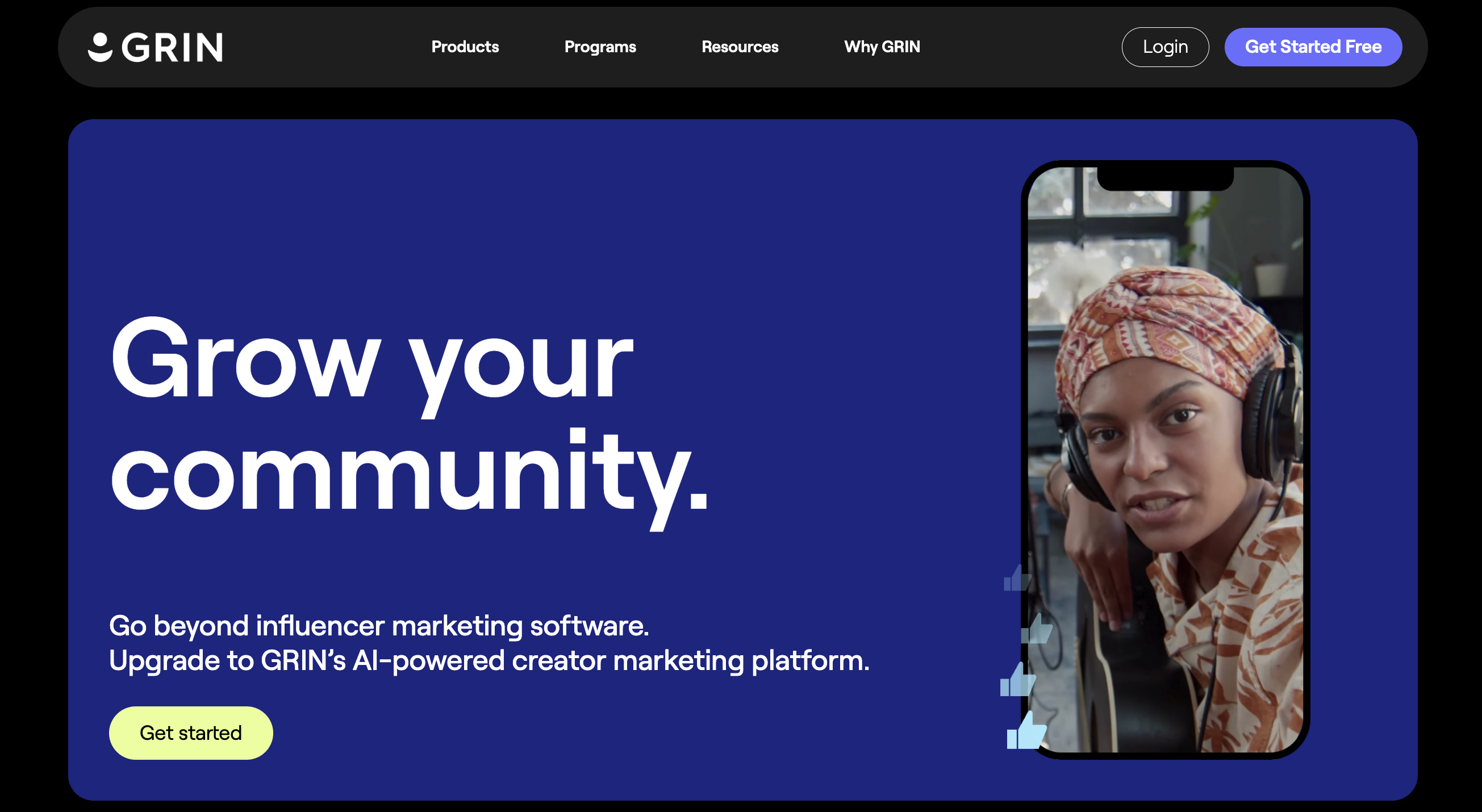
GRIN is a creator management platform designed heavily around ecommerce brands, with workflows for discovery, gifting, affiliate tracking, creator relationships, content management, and reporting. Its positioning is less about one-off influencer campaigns and more about helping D2C teams build scalable creator programs tied to ecommerce operations and ROI tracking.
Key features:
- Creator discovery: Find creators and lookalikes that match your best-performing profiles.
- Influencer relationship management: Store creator details, manage outreach, and track partnerships through a built-in CRM.
- Product gifting and seeding: Let creators pick products, automate fulfillment, and track preferences from one workflow.
- Campaign and activation workflows: Run paid or unpaid creator programs from start to finish inside Activations.
- Sales and ROI tracking: Connect affiliate links, ecommerce activity, and creator outputs to performance reporting.
- Content and asset management: Centralize creator content for reuse across email, social, and website teams.
Pros:
- Built with D2C ecommerce workflows in mind, especially gifting, affiliate tracking, and product-led creator programs.
- Strong user feedback around time savings, replacing spreadsheets, forms, and manual influencer tracking.
- Broad support for scaling long-term creator programs rather than just running one-off reporting dashboards.
Cons:
- Price is a common concern, especially for smaller teams or brands that do not need a full creator management suite.
- Some users want deeper influencer stats or more flexible filtering inside the platform.
- The platform appears more powerful when fully integrated into your ecommerce stack, which can make setup heavier than lighter-weight tools. This is an inference based on its feature set and integration-centered workflow.
Integrations:
- Shopify: Create draft orders, manage product gifting, and connect creator campaigns with store fulfillment and performance.
- WooCommerce: Sync products, shipping, and order settings to support gifting and creator commerce workflows.
- Magento: Connect your ecommerce backend so GRIN can manage creator product and campaign workflows.
- Klaviyo: Personalize and automate creator or customer email flows with synced data.
- Salesforce Commerce Cloud: Track affiliate link conversions connected to creator activity.
Pricing:
Annual pricing starts at $25,000/year (approx. $2,050/month). Relative to the broader influencer marketing platform market, GRIN is generally mid-to-high tier, especially once a brand wants to use it as a central creator operating system.
Reviews:
4.5/5.0 (G2)
4. Upfluence
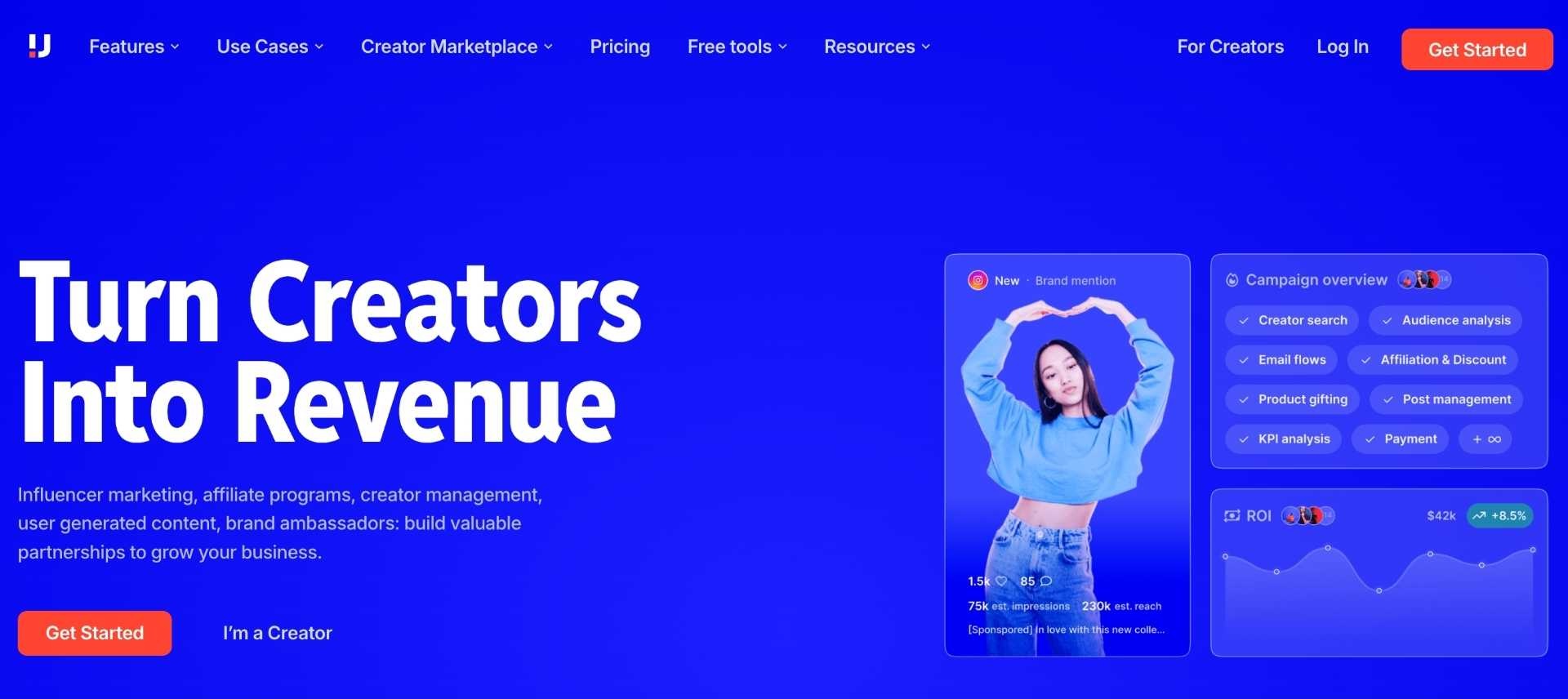
Upfluence is an influencer and affiliate marketing platform aimed at ecommerce brands that want to identify creators, recruit them, manage campaigns, automate gifting, and track sales from one system. A core differentiator is that it connects your existing customer and email databases to surface influential customers already inside your audience.
Key features:
- Creator discovery and lookalikes: Search for creators and similar profiles based on fit, audience, and campaign needs.
- Mass outreach and AI mailing support: Run creator outreach at scale with email tools and automated sequences.
- Campaign analytics: Measure campaign outcomes inside the platform rather than relying on disconnected spreadsheets.
- Affiliate and promo code management: Generate unique promo codes and track creator-driven sales across ecommerce stores.
- Live influencer identification: Match your Shopify, Magento, or Klaviyo data against Upfluence’s creator profiles to find influential customers or subscribers.
- Product gifting: Support one-click product shipment and creator activation within campaigns.
Pros:
- Especially useful for D2C brands that want to turn existing customers, subscribers, and site visitors into creator prospects.
- Good fit for ecommerce teams because its native integrations connect discovery, gifting, codes, and sales tracking in one flow.
- User feedback consistently highlights easy creator discovery, strong filtering, and solid Shopify-linked reporting.
Cons:
- Pricing is not publicly transparent, which can slow down evaluation for smaller brands comparing tools side by side.
- Minimum contract length is 12 months, which is a meaningful commitment for brands that want shorter testing periods.
- Onboarding can take time, especially if you plan to connect multiple systems and operational workflows.
Integrations:
- Shopify: Identify influential customers, simplify gifting, and track sales through a native store connection.
- Magento: Match store data with creator profiles, ship products, and connect campaigns to ecommerce reporting.
- Klaviyo: Find influential subscribers, enrich lifecycle marketing data, and identify creators already in your email database.
- Stripe: Pay creators and track transactions through Upfluence Pay.
- Zapier: Connect Upfluence with thousands of other tools when you need workflows outside its native stack.
Pricing:
Upfluence uses custom pricing and offers a free trial, but it also states that the minimum contract is 12 months. On average plans start around $2,000/month ($24,000 yearly).
In benchmarking terms, that places it in the high tier, particularly for brands comparing self-serve monthly platforms versus longer-contract influencer suites.
Reviews:
4.3 / 5.0 (Capterra)
5. Captiv8
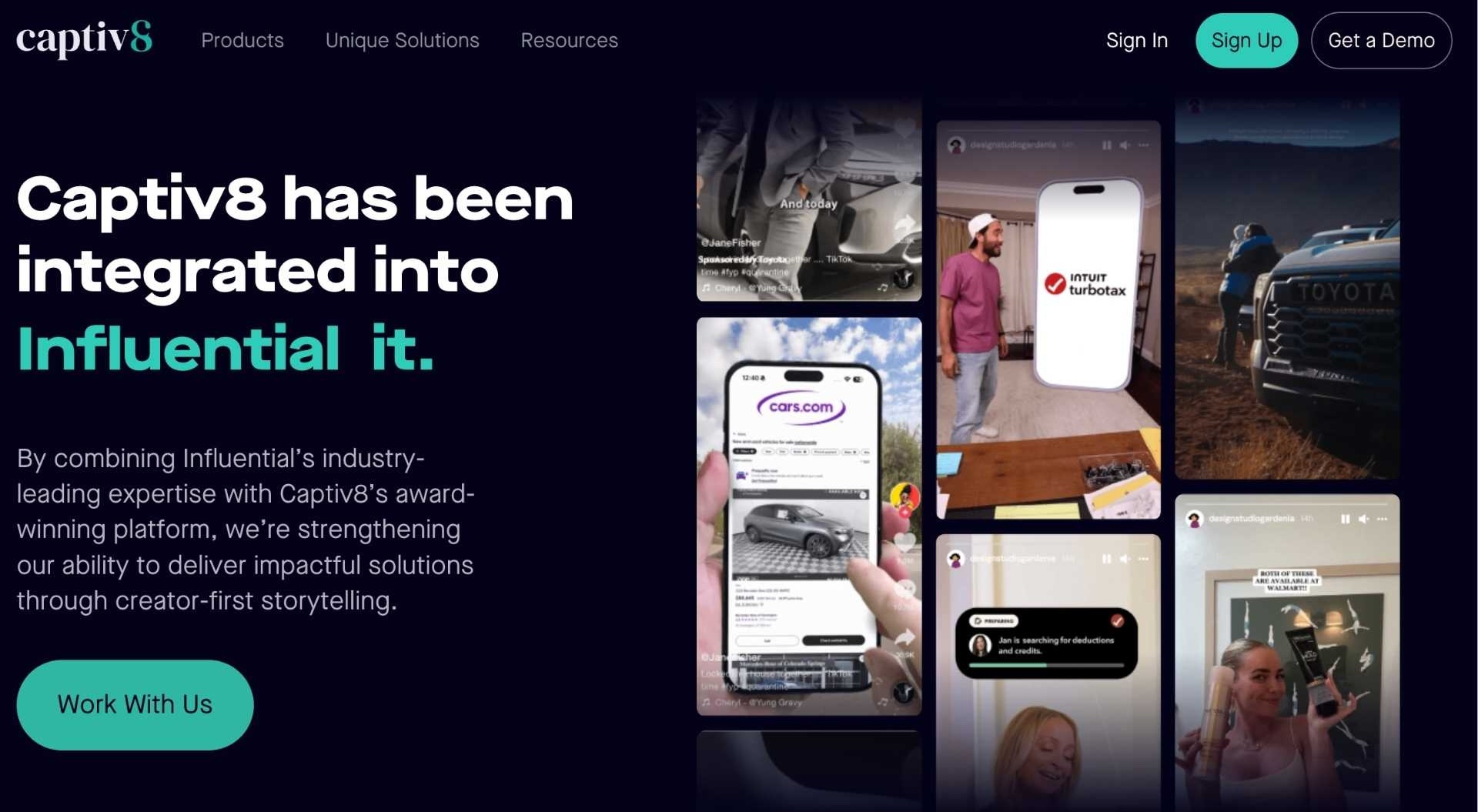
Captiv8 is an enterprise-focused influencer marketing platform for creator discovery, workflow management, commerce, measurement, and API-driven reporting. It is built for brands that want unified paid and organic reporting, custom measurement models, attribution, and deep integration with broader business intelligence workflows.
Key features:
- Unified ROI dashboard: Measure paid and organic performance in one place rather than splitting reporting across teams.
- Advanced measurement: Track sales, EMV, foot traffic, sentiment, and pixel-based conversion metrics.
- Custom reporting and formulas: Build custom measurement logic and share tailored reports across stakeholders.
- Creator commerce and attribution: Support affiliate-style creator commerce with clear attribution tied to outcomes.
- Discovery and workflow management: Find creators, activate campaigns, manage payments, and coordinate internal teams from one platform.
- Open API and BI support: Pull granular influencer campaign data into external BI environments for MMM or executive reporting.
Pros:
- Strongest fit for large brands that need enterprise reporting, custom measurement, and cross-channel visibility.
- Supports both brand storytelling and performance marketing with attribution, commerce, and amplification features in one system.
- User feedback highlights campaign management depth, ease of use, and strong customer support.
Cons:
- Pricing is not publicly disclosed, which usually signals an enterprise sales process rather than easy self-serve comparison.
- Some user feedback points to a learning curve, workflow complexity, and occasional concerns around data accuracy or search efficiency.
- This is likely overbuilt for smaller D2C brands that mainly want lightweight reporting and affiliate attribution rather than enterprise customization. This is an inference based on its product positioning and pricing model.
Integrations:
- Shopify: Find influential customers, activate campaigns, report on outcomes, and pay creators from one connected workflow.
- Google Analytics: Feed influencer data into broader web and performance measurement workflows.
- Looker: Bring campaign data into BI dashboards for more customizable executive reporting.
- Tableau: Connect influencer reporting to wider analytics environments used by data teams.
- Captiv8 Pixel / API: Capture conversion events like cart and checkout abandonment and move granular campaign data into internal reporting systems.
Pricing:
Captiv8 does not publish standard pricing on its site and directs buyers to request a demo, while public review listings show pricing as not provided by the vendor. In practice, this places it in the high / enterprise tier among influencer marketing platforms, and there is no clear public self-serve free trial path.
Reviews:
4.7 / 5.0 (G2)


6. Influencity

Influencity is an all-in-one influencer marketing platform built around discovery, relationship management, campaign execution, and reporting. It is especially useful for brands that want strong analytics, real-time performance tracking, and customizable reports without moving straight into enterprise-only pricing.
Key features:
- Influencer discovery: Search across a database of 200+ million creators using audience, location, niche, and performance filters.
- Audience analysis: Review follower quality, audience demographics, and creator fit before launching campaigns.
- Campaign reporting: Measure campaign results with advanced reporting dashboards and customizable reports.
- Real-time analytics: Monitor campaign and influencer performance as data updates, instead of waiting for manual reporting cycles.
- Influencer CRM: Organize contacts, track conversations, and manage ongoing creator relationships in one place.
- Payments and tracking: Track creator performance, payments, and revenue-related activity inside the same platform.
Pros:
- Strong fit for brands that want deeper analytics and reporting without needing an enterprise-heavy setup.
- Public user feedback frequently highlights ease of use, affordability, and strong customer support.
- Good option for teams managing multiple campaigns that want discovery, CRM, and reporting in one system.
Cons:
- Review scores are solid but not as strong as some of the highest-rated competitors in this category.
- Some users mention an early learning curve around how to use search filters effectively.
- Compared with more commerce-first tools, its ecommerce integration story appears narrower in public materials.
Integrations:
- Shopify: Connect your store to support influencer seeding, track sales, and tie campaigns more directly to ROI.
- WooCommerce: Link store performance to influencer activity so you can measure campaign-driven revenue more clearly.
- API: Export data into your own dashboards, BI tools, or internal reporting workflows.
- Email workflows: Manage outreach and communication tracking within the platform’s communication management layer.
- Custom reporting exports: Move campaign data into external reporting environments when you need stakeholder-ready analysis.
Pricing:
Influencity publicly offers multiple plans, including Professional and Business tiers, while review listings show pricing starting at $318/month with a free trial available. Compared with the broader influencer marketing platform market, that places it in the low-to-mid tier.
Reviews:
4.3 / 5.0 (G2)
7. CreatorIQ

CreatorIQ is an enterprise creator marketing platform designed to help brands discover creators, manage partnerships, centralize workflows, and measure performance at scale. Its positioning is strongest for larger teams that need unified reporting, governance, API connectivity, and advanced creator intelligence across global programs.
Key features:
- Creator discovery: Search and vet influencers across major platforms with audience and performance data.
- Campaign management: Coordinate campaign execution, creator lists, approvals, and reporting from a centralized system.
- Advanced reporting: Build evergreen reports and centralized performance views for always-on creator programs.
- Commerce reporting: Connect creator activity to ecommerce outcomes such as codes, links, and attributed revenue.
- API and data integrations: Use ExchangeIQ and CreatorIQ’s API layer to connect creator data with internal systems and reporting environments.
- First-party platform data: Pull in deeper platform data, including newer YouTube audience insights, for better planning and measurement.
Pros:
- Very strong fit for enterprise brands that need centralized reporting, governance, and scalable workflows.
- User feedback often highlights strong customer support and efficient reporting workflows.
- Well suited for teams that need creator marketing connected to broader business systems rather than treated as a standalone channel.
Cons:
- Discovery and reporting are not universally praised in user reviews, with some reviewers saying those areas could improve.
- Because it is a full-scale platform, there can be a learning curve before teams use it to its full potential.
- Pricing is enterprise-oriented and can be difficult for smaller D2C brands to justify.
Integrations:
- Shopify: Automatically generate creator-specific codes and links while collecting performance data on attributed sales.
- WooCommerce: Connect ecommerce performance to creator campaigns for revenue tracking and ROI measurement.
- Salesforce Commerce / internal CRM systems: Sync creator data into broader customer and revenue workflows through API and integration tooling.
- Google Analytics 4: Link blog or site analytics into the creator data environment to support web performance measurement.
- YouTube Creator API: Access first-party audience data for smarter planning, vetting, and reporting on YouTube partnerships.
Pricing:
CreatorIQ pricing is typically custom, but review listings show a starting point around $35,000 per user/year, and no free trial is listed on that profile. In platform benchmarking terms, it clearly sits in the high / enterprise tier.
Reviews:
4.4 / 5.0 (Capterra)
8. SARAL

SARAL is an influencer marketing platform built for ecommerce brands that want to simplify seeding, outreach, relationship management, affiliate tracking, and performance reporting. Its main appeal is that it aims to replace spreadsheet-heavy influencer workflows with a simpler operating system focused on D2C use cases.
Key features:
- Influencer discovery: Find creators in bulk and identify relevant partners faster than manual sourcing.
- Automated outreach: Send personalized outreach at scale instead of running the entire process manually.
- Relationship management: Track where each creator sits in the funnel with tags, stages, and centralized records.
- Performance reporting: View campaign performance in a more decision-ready format rather than just raw exports.
- Affiliate tracking: Track creator-driven sales and manage affiliate-style workflows inside the platform.
- Payments and ambassador workflows: Manage influencer payments and ambassador programs from the same system.
Pros:
- Strong fit for ecommerce brands that want a simpler, more operationally efficient tool than larger enterprise platforms.
- Multiple customer testimonials emphasize time savings, easier organization, and reduced spreadsheet dependency.
- Public positioning and testimonials consistently frame it as affordable and straightforward for growing D2C teams.
Cons:
- It appears more focused on practical execution than on the deepest analytics layer compared with larger enterprise suites. This is an inference based on its positioning and user language around simplicity and speed.
- Integrations are helpful but narrower than platforms with larger enterprise ecosystems.
- Public third-party review coverage is still lighter than many older, more established competitors.
Integrations:
- Shopify: Connect your store through GoAffPro to support affiliate tracking and ecommerce-linked influencer workflows.
- WooCommerce: Use the same GoAffPro-based connection style to tie store activity back to creator performance.
- Klaviyo: Sync influencers into Klaviyo so you can run nurture campaigns and automate creator communication.
- Sendlane: Connect email marketing workflows for influencer updates and nurture sequences.
- Slack: Bring influencer workflow notifications into Slack for faster team coordination.
Pricing:
SARAL has transparent pricing on its site and says pricing depends mainly on the number of influencers you want to search and save each month. Public pricing pages show plans starting around $3,600/quarter, with a free trial available, which places it in the mid tier, though still more accessible than most enterprise tools.
Reviews:
4.7/5.0 (G2)
9. Klear
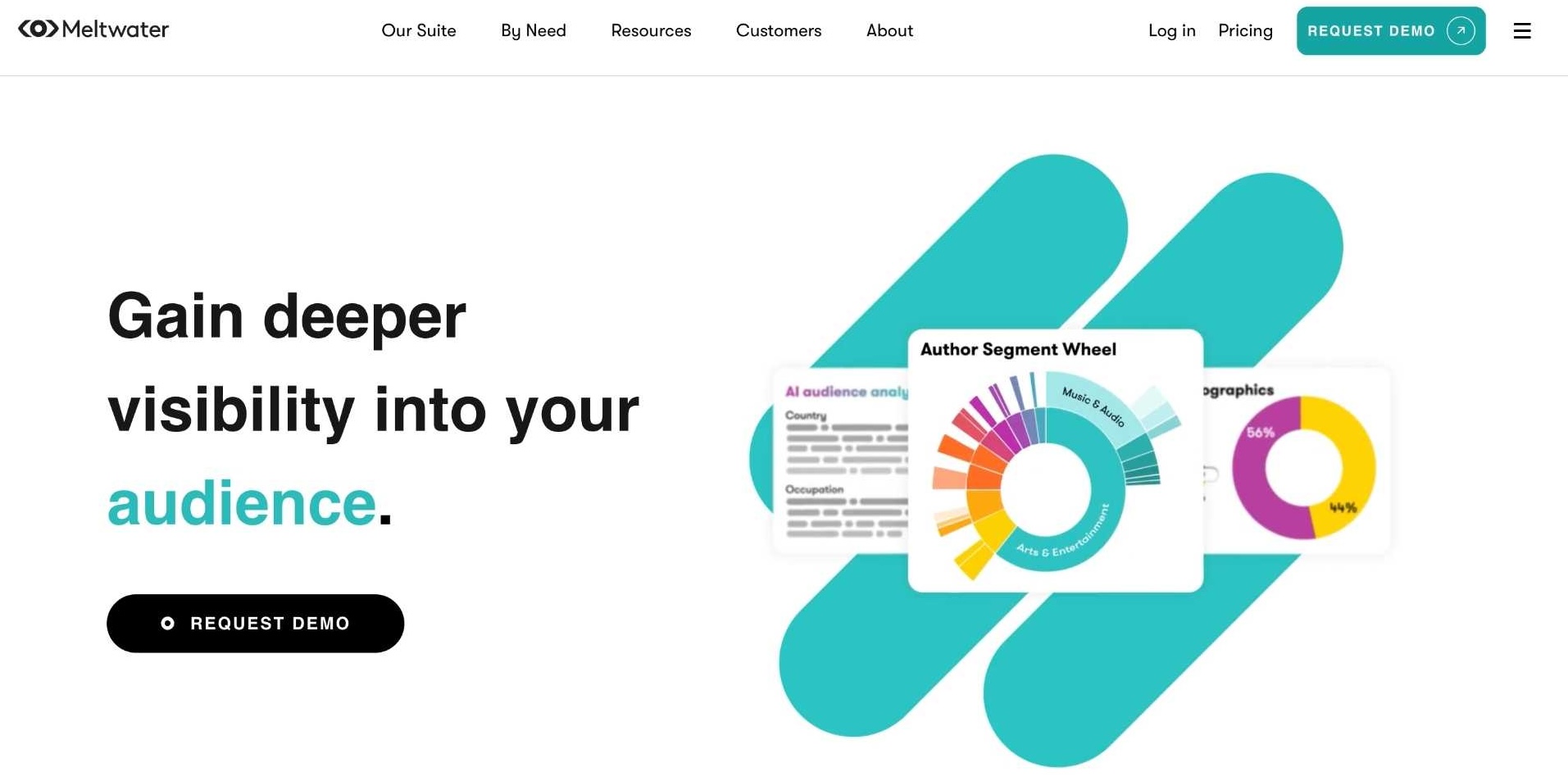
Klear, now part of Meltwater’s influencer marketing suite, helps brands discover creators, manage campaigns, measure ROI, and understand influencer performance through centralized analytics. It is positioned as a full-funnel influencer marketing product with stronger reporting, measurement, and social intelligence than many lighter influencer tools.
Key features:
- Influencer discovery: Search for and vet creators based on relevance, audience, and campaign fit.
- ROI tracking: Measure campaign effectiveness and profitability using centralized dashboards.
- Campaign reporting: Compare creators using standardized metrics like reach, clicks, EMV, and Social ROI.
- CRM and relationship workflows: Manage creator communications, approvals, contracts, and payments from within Klear Connect.
- Ecommerce workflows: Support coupon codes, gifting, affiliate programs, and campaign sales reporting.
- Social intelligence linkage: Benefit from Meltwater’s broader social and media intelligence ecosystem.
Pros:
- Strong reporting and measurement capabilities are one of Klear’s clearest strengths.
- Good fit for brands that want influencer marketing connected to broader social intelligence and monitoring workflows.
- User feedback highlights ease of use and positive support experiences.
Cons:
- Pricing is not publicly transparent and is often described as a meaningful investment.
- Some buyers may find it heavier than necessary if they only need simple creator reporting and affiliate attribution.
- Public review scores are good, but not as standout as the very top-rated platforms in the category.
Integrations:
- Shopify: Identify influential customers, generate coupon codes, and track conversions tied to creator activity.
- Affiliate / ecommerce tracking: Support gifting, affiliate programs, and campaign sales reporting within ecommerce workflows.
- Campaign dashboards: Centralize measurement for executive reporting across campaigns.
- Meltwater analytics ecosystem: Connect influencer reporting with broader media, social, and consumer intelligence.
Pricing:
Start from $2,300/month
Reviews:
4.3 / 5.0 (G2)
10. Lefty
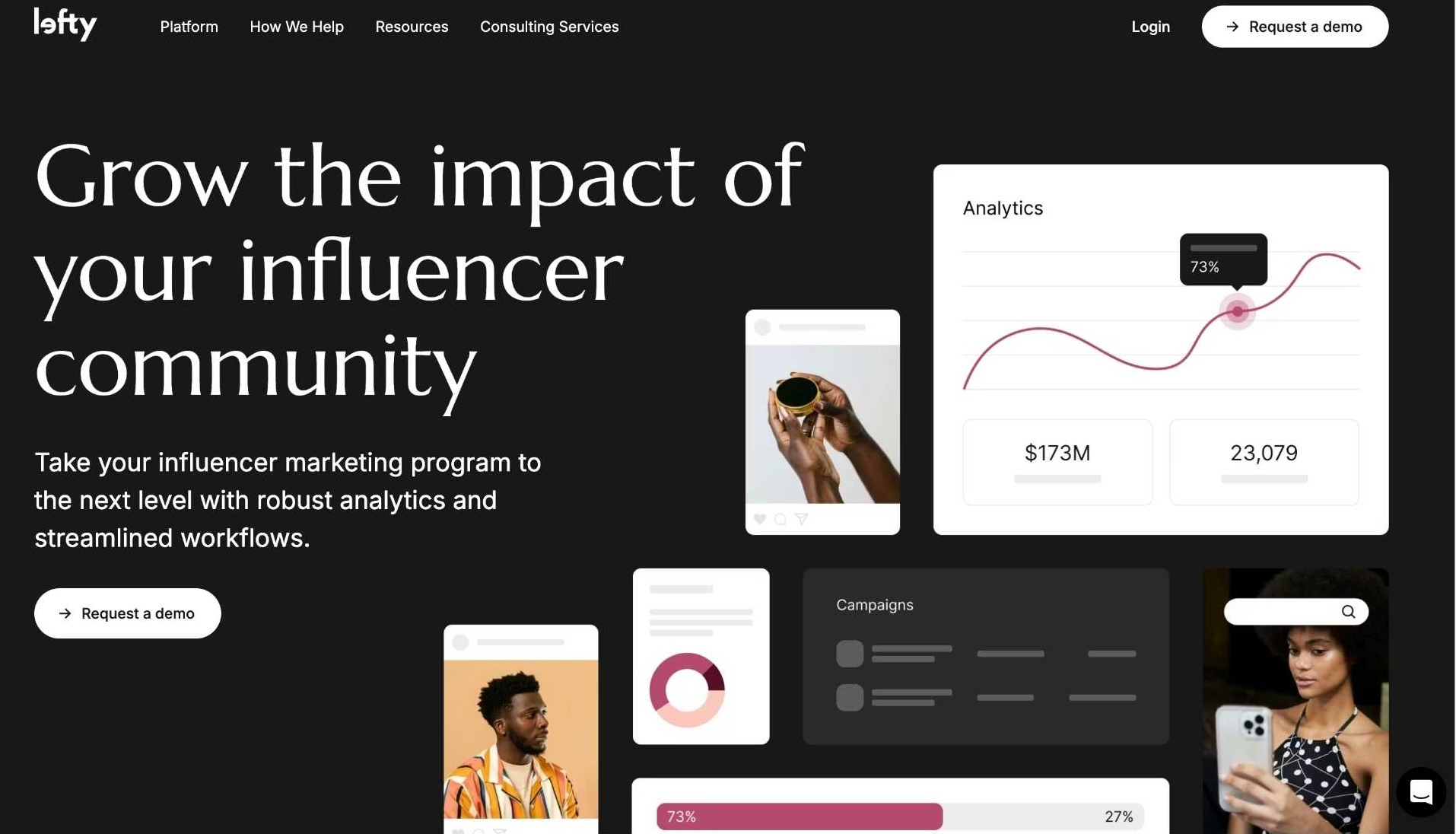
Lefty is an end-to-end influencer marketing platform built especially for lifestyle and fashion-oriented brands, with tools for discovery, outreach, gifting, campaign execution, and analytics. Its core value is combining streamlined workflows with automated campaign reporting and ecommerce-friendly features.
Key features:
- Influencer discovery: Search a large influencer database and filter for the most relevant profiles.
- Relationship management: Manage influencer relations directly in-platform instead of handling communication across scattered tools.
- Automated reporting: Automatically collect campaign content and measure influencer impact.
- ROI tracking: Track campaign results and performance metrics from a central dashboard.
- Product gifting and seeding: Handle gifting and lending workflows while tracking delivery status and costs.
- Content and campaign management: Organize campaign assets, content, and execution in one place.
Pros:
- Strong fit for lifestyle, fashion, and beauty brands that care about polished workflows and streamlined reporting.
- Ecommerce functionality is more developed than many people assume, especially for gifting and affiliation workflows.
- Review scores are strong, though based on a small number of verified public reviews.
Cons:
- Public review volume is still very limited, so buyers should weigh the ratings carefully.
- Pricing is not especially low, particularly for brands comparing against more SMB-focused tools.
- It appears best suited to certain verticals, so some non-lifestyle brands may find other platforms more aligned with their workflows. This is an inference based on brand positioning and customer examples.
Integrations:
- Shopify: Streamline gifting and affiliation operations through Lefty’s Shopify connection.
- Magento: Plug in your store to manage inventory, product requests, and gifting workflows.
- Salesforce: Connect ecommerce operations to campaign execution and product tracking.
- Gmail: Reach out to influencers directly from Lefty and keep communications organized.
- Outlook: Run outreach and track conversations without leaving the platform.
Pricing:
Lefty does not prominently publish standard pricing on its main marketing pages, but verified review listings show pricing from €590/month and note that a free trial is available. Relative to the market, that places it in the mid-to-high tier.
Reviews:
4.7 / 5.0 (G2)
Final Thoughts
Choosing the right influencer marketing reporting and analytics tool ultimately comes down to how deeply you want to connect creator activity to real business outcomes like revenue, ROI, and customer acquisition. While some platforms focus on advanced analytics and enterprise reporting, others are built for D2C brands that need a more practical, ecommerce-driven approach with clear attribution and centralized data. The best tools help you move beyond vanity metrics by giving you real-time insights, performance tracking, and the ability to scale what’s working. As influencer marketing becomes more performance-driven, having the right analytics stack in place is what separates guesswork from predictable growth.

.png)


.jpg)