


Influencers.club Pricing and Review: Features, Pros, Cons & Costs
Most influencer software sells you a workflow. This one sells the database underneath the workflow, and leaves the workflow to you.
Influencers.club is a creator data platform: 340 million profiles across 47 social networks, 200 or so data points each, verified emails and phone numbers, and an API that pushes all of it into whatever system you already run. Plans start at $140 a month for dashboard access and $208 a month once the API is switched on. Every lookup, enrichment and monitored creator is priced in credits.
That credit model is where the real cost sits, and it is not the number on the pricing page. What follows is what each plan includes, what a working program actually burns through in credits, how good the data is according to the people using it, and the four things this platform deliberately does not do.
Influencers.club Overview
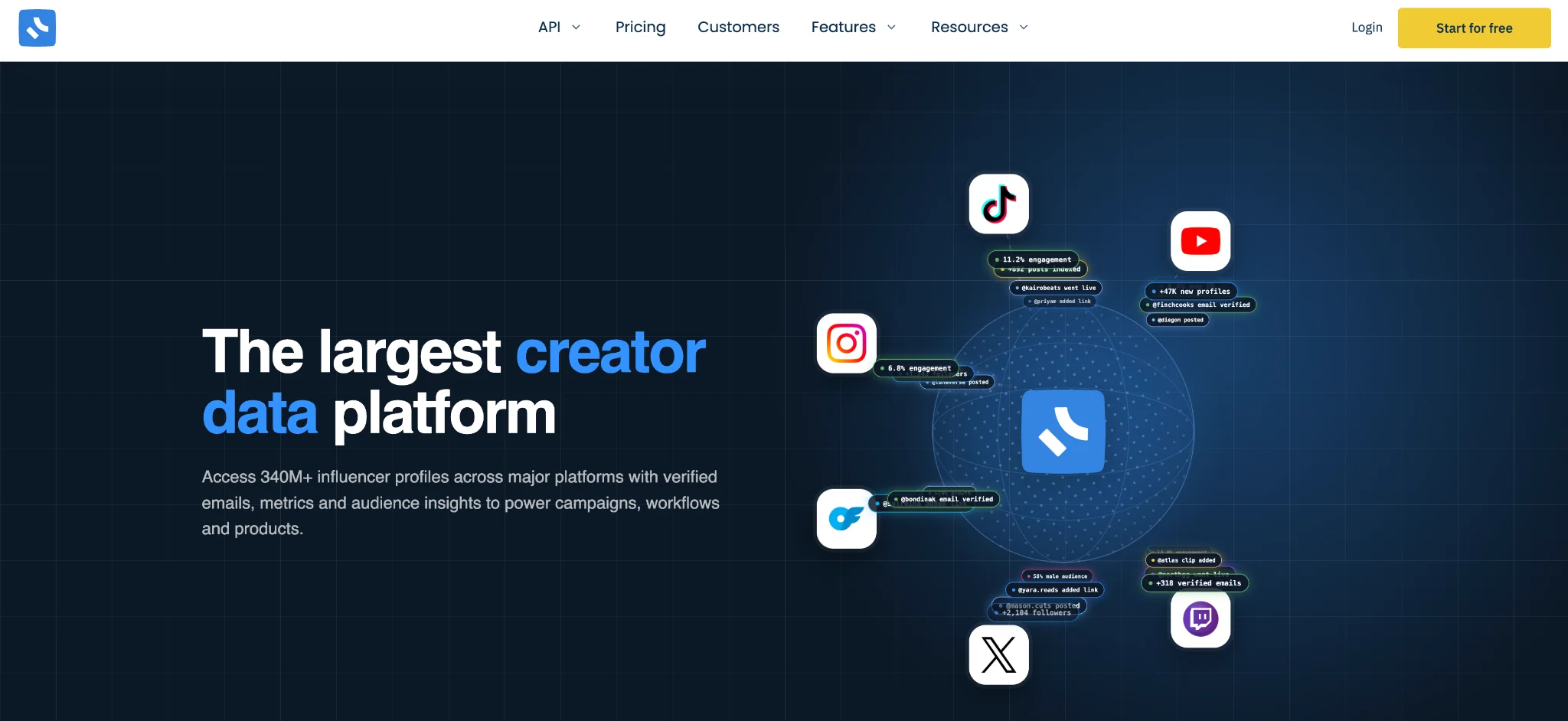
The product is best understood as infrastructure rather than software. You are not buying a place to run campaigns from, you are buying access to creator records and the pipes to move them somewhere else. That framing explains the pricing, the integrations and the customer list, which leans heavily toward agencies, data teams and companies building creator features into their own products.
Coverage is unusually wide. Where most discovery tools stop at Instagram, TikTok and YouTube, this one claims data across 47 platforms including Discord, and it exposes the social graph connecting accounts to each other rather than treating each profile as an island. Contact data is the headline: verified emails and phone numbers at scale, which is the part most databases either lack or guess at.
What it is not is a campaign platform. There are no CRM boards, no creator payouts, no gifting logistics and no affiliate codes. Discovery, enrichment, outreach and monitoring are in scope; everything that happens once a creator says yes is not. Brands looking for the operational layer should be comparing influencer CRM tools instead, and treating this as the source that feeds one.
Who Should Use Influencers.club
The fit question is not budget, it is whether you already have somewhere for this data to go.
- Agencies running discovery across many clients. Unlimited seats on every plan and credits that roll over suit lumpy, project-shaped work far better than per-seat licensing does.
- Teams with an existing CRM they want enriched. Native HubSpot and Salesforce enrichment means creator records land beside the rest of your pipeline rather than in a separate tool nobody opens.
- Companies building creator features into their own product. The API, the Snowflake connection and the raw enrichment endpoints are aimed at engineering teams, not marketers.
- Brands doing outbound at volume. Verified emails and phone numbers are the constraint on cold creator outreach, and this is one of the few sources selling them openly.
- Automation-heavy teams. Clay, n8n, Zapier and MCP support means creator data can trigger workflows without anyone opening a dashboard.
- Not brands wanting one tool to run a program. If you need gifting, codes, payouts and reporting in one place, this is the wrong shape and no plan changes that.
Key Features
340 Million Profiles Across 47 Platforms
The database is the product, and its breadth is the differentiator. Instagram, TikTok and YouTube are covered as standard, but so are another 44 networks including Discord, which almost nothing else in this category indexes. For a brand whose audience lives somewhere other than the big three, that coverage is the reason to look here at all.
Verified Emails and Phone Numbers
Contact data at scale is the headline claim and the hardest thing to source elsewhere. Most discovery tools either give you a public bio link or an inferred address that bounces. Selling verified contact details openly is what makes this useful for cold outreach programs, and it is also the reason the pricing is metered rather than flat.
AI Search and 40+ Filters
Discovery runs on natural-language search backed by more than forty structured filters, with roughly 200 data points held per creator. The depth is real. Reviewers do report that precision drops when several filters are combined at once, so treat complex multi-filter queries as a starting shortlist rather than a finished one.
Audience Data and the Social Graph
Audience demographics and interests are available on the Pro tier, alongside the social graph that links accounts across networks. Knowing that a TikTok creator is the same person as a YouTube channel you already work with is the kind of connection that stops a brand paying twice for one relationship.
The Enrichment API
The API is the reason most technical buyers are here. Endpoints cover enrichment by handle or by email, discovery calls and ongoing monitoring, each metered at a different credit rate. Enrich by Handle in full costs one credit, the raw version costs 0.03, enrichment by email costs 0.05 and the advanced version costs two. Those differences are large enough that endpoint choice is a budgeting decision, not just an engineering one. Brands weighing this against building on an influencer marketing API from a full platform should compare what arrives with the data.
CRM and Automation Integrations
HubSpot, Salesforce, Snowflake, Zapier, Clay, n8n and MCP support are all named on the Pro tier. This is a genuinely strong integration surface for a data product, and the inclusion of Clay and n8n signals who the platform is really built for, which is teams already running enrichment pipelines rather than teams looking for a dashboard.
Creator Monitoring
Creators can be tracked continuously, with performance and campaign metrics updating in real time. Monitoring is billed at 0.3 credits per creator per day, which sounds trivial and is not. Watch the arithmetic in the pricing section below, because this is the line item that quietly dominates a credit budget once a roster reaches any size.
Outreach and Campaign Tracking
There is outreach tooling and campaign monitoring with EMV-style metrics, so the platform is not purely a data tap. What is absent is everything downstream: no approval flows, no deliverable tracking, no content library, no payouts. Reviewers name reporting depth as the weakest part of the product, and the roadmap apparently agrees.
Influencers.club Pricing
Three tiers, two of them with published starting prices, all of them metered in credits. The subscription buys you a credit allowance and a feature set; the credits are what you actually spend as you work.
Credit allowances run from 500 to 8,000 and beyond on both paid tiers, with the unit price falling as volume rises, so the monthly figure moves with the allowance you pick rather than sitting fixed at the entry number. Unused credits roll over on every plan, and seats are unlimited throughout.
Starter, Dashboard Only
- From $140 per month, with credits from 500 up to 8,000 and beyond.
- Credit prices fall to as little as $0.15 at volume.
- Valid email and creator-level data, campaign monitoring, unlimited seats and rollover credits.
- No API access, and no audience data or social graph, both of which sit on the tier above.
Pro, API and Dashboard
- From $208 per month, marketed as the most popular tier.
- Credit prices fall to as little as $0.23 at volume, which is higher per credit than Starter because each credit returns more.
- Everything in Starter plus API access, audience data, the social graph, native CRM enrichment, Zapier, Clay, n8n and MCP integrations, and priority support.
- The $68 gap between tiers is small next to what it unlocks, so a team that will touch the API at all should start here.
Agency
- Custom pricing with volume discounts and resource-based billing.
- Mix-and-match features rather than a fixed tier, plus a dedicated team and early access to new releases.
- Aimed at buyers whose consumption is large enough that per-credit rates matter more than the subscription.
What Credits Actually Cost You
- The published API rates. Enrich by Handle full costs 1 credit, raw costs 0.03, Enrich by Email costs 0.05, the advanced version costs 2, discovery calls cost 0.01 per profile, and monitoring costs 0.3 credits per creator per day.
- Monitoring is the line that bites. Tracking 100 creators for a month is 100 × 30 × 0.3, which is 900 credits. At $0.15 that is $135 a month, and at $0.23 it is $207, on top of the subscription and before a single new creator is discovered.
- Discovery is nearly free, enrichment is not. Searching 10,000 profiles costs 100 credits at the discovery rate. Fully enriching 1,000 of them costs 1,000. Plan your funnel so the expensive call only ever runs on a shortlist.
- Pick the endpoint deliberately. Raw enrichment at 0.03 credits is roughly thirty times cheaper than the full version. If your pipeline only needs core metrics, using the full endpoint by default is a straightforward way to burn a budget.
- Test before committing. New accounts get 10 free credits and access to Pro features, which is enough to check data quality in your specific niche, which is the thing that actually varies.
Influencers.club Reviews
This is the strongest review base of any platform covered in this series recently, and it is worth weighting accordingly.
- 4.6/5.0 (G2, 27 reviews)
Twenty-seven reviews at 4.6 is a real signal rather than a handful of friendly customers. Reviewers consistently name the size and breadth of the database, the quality of the API, the usability of the interface and a support team described as responsive and hands-on. For a data product, support responsiveness matters more than it sounds, because most problems are questions about coverage rather than bugs.
The criticisms are specific and they cluster in one place, which is data accuracy. Reviewers report inconsistent prospect quality, creators filed under the wrong niche by the categorisation algorithm, and search precision degrading when several filters are stacked. Reporting and dashboard analytics are named as thin, with improvements said to be in progress. None of that is disqualifying for a database sold as raw material, but it does mean the vetting step stays yours.
Integrations
For a data platform this is the part that decides whether it is useful, and it is the strongest integration surface in this comparison set by a distance.
- HubSpot and Salesforce. Native enrichment writes creator records straight into the CRM your team already works in.
- Snowflake. Creator data lands in the warehouse alongside commercial data, which is what makes modelling creator performance against revenue possible at all.
- Clay. The clearest signal of intended buyer, since Clay users are running enrichment waterfalls rather than looking for a campaign tool.
- Zapier and n8n. Trigger-based automation for teams that want creator data to start workflows without a person in the loop.
- MCP. Direct access for AI agents, which is an unusual thing to publish and a real advantage for anyone building agentic workflows.
What is missing is the commerce side. No Shopify, no WooCommerce, no affiliate network and no payment provider, which is consistent with the product being a data layer rather than a program layer.
Pros of Influencers.club
Coverage Nothing Else in the Category Matches
Forty-seven platforms against the usual three, 340 million profiles, and verified contact details sold openly rather than inferred. For a brand whose creators are on Discord, or on a network that mainstream discovery tools have never indexed, this is not a marginally better option, it is frequently the only option.
Unlimited Seats and Credits That Roll Over
Cost scales with consumption rather than headcount or calendar. A team of eight pays what a team of one pays, and a quiet month banks its allowance instead of wasting it. For agencies with project-shaped workloads, that combination removes both of the usual ways software billing punishes irregular usage.
It Fits Into Systems You Already Run
Native CRM enrichment, a warehouse connector, Clay and n8n support and an MCP endpoint mean the data does not have to live in yet another dashboard. Most tools in this category assume you will work inside them. This one assumes you will not, and that assumption is correct more often than the alternative.
Cons of Influencers.club
The Credit Meter Is the Real Bill
The $140 and $208 figures are entry points attached to the smallest allowance, and the practical cost climbs with the allowance you need. Monitoring alone runs 900 credits a month for a 100-creator roster, which adds $135 to $207 before any discovery happens. Model your credit consumption per workflow first and pick the plan second, because the headline price answers almost none of the question.
Data Accuracy Is the Consistent Complaint
Reviewers who otherwise rate the product highly name inconsistent prospect quality and creators categorised into the wrong niche. On a 340 million record database that is unsurprising, but it means human vetting stays in the loop and the promise of an automated pipeline is only partly real. Spend the free credits checking accuracy inside your own category rather than in aggregate.
No Campaign Layer of Any Kind
There are no CRM boards, no gifting workflows, no discount codes, no affiliate tracking and no creator payouts. Everything after a creator agrees to work with you happens in another tool, which means a second subscription and a reconciliation problem between the two. A brand that wants discovery and campaign and creator management in one system is buying two products here.
Reporting Is the Weakest Part of the Product
Analytics and dashboard reporting come up repeatedly as thin, by the platform’s own users. For a tool that also sells campaign monitoring, that is an awkward gap: you can track creators but you cannot easily show anyone what the tracking concluded. Teams with a warehouse will route around it through Snowflake. Teams without one will be exporting to spreadsheets.


Is Influencers.club Worth It?
As a data source, yes, and the 4.6 across 27 G2 reviews supports that. Coverage across 47 platforms is genuinely unmatched in this category, verified contact details solve the hardest problem in cold creator outreach, unlimited seats and rollover credits suit agency workloads, and the integration surface means the data reaches systems you already use rather than trapping you in another dashboard. For a team with an existing CRM, a warehouse or an enrichment pipeline, this slots in cleanly.
As the platform a D2C brand runs its creator program on, it is not built for that and does not pretend to be. There is no CRM board, no gifting, no discount codes, no affiliate attribution and no payouts, reporting is the weakest part of the product by user consensus, and data accuracy needs a human check before anyone is contacted. Add credit metering on top and the total is harder to forecast than a flat subscription. Brands wanting the program rather than the raw material should price these:
- Influencer Hero. Discovery across eight social platforms with Instagram, YouTube and TikTok emphasised, plus creator discovery filters, fake follower screening, CRM boards, affiliate codes and payouts. Publicly listed from $649 a month.
- Afluencer. A creator marketplace from $49 a month where influencers apply to your listings, with AI creator matching narrowing applicants. Suits brands whose problem is creator supply rather than data volume.
- HypeAuditor. Audience authenticity analysis and fraud detection with depth on individual creator quality, useful when vetting matters more than list size.
- Influencity. Influencer discovery with audience overlap analysis and campaign management in the same tool, aimed at teams wanting research and execution together.
- Kolsquare. European-focused discovery with strong compliance and reporting features, built for brands running regulated campaigns across multiple markets.
Final Thoughts
The number that decides this is not $140 or $208, it is your monthly credit consumption, and almost nobody estimates it correctly on the first attempt. Write down the three workflows you would actually run, price each at the published rates, and remember that monitoring a hundred creators costs 900 credits a month on its own. If that total looks reasonable and you already have a CRM, a warehouse or a pipeline for the data to flow into, this is a strong buy with a review base to back it. If you were hoping one subscription would also run your campaigns, pay your creators and prove the revenue, that is a different category of product and the Influencers.club alternatives built around the full program are where to look next.

.png)


.jpg)










