

indaHash Pricing and Review: Features, Pros, Cons & Costs
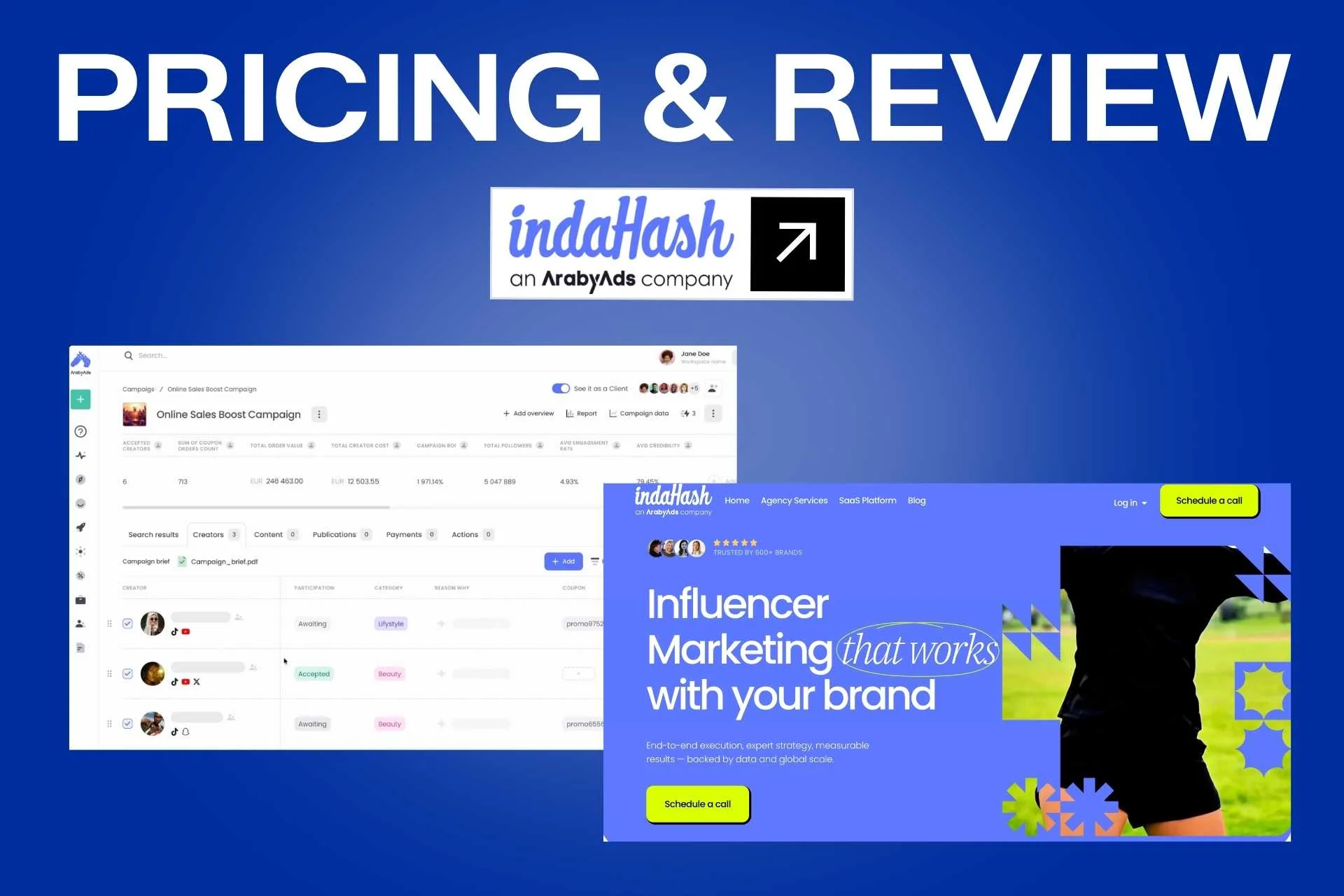
indaHash is a global influencer marketing platform that pairs self-serve software with a full managed-service agency, built for brands running campaigns across many markets at once. It has been used by more than 600 brands and agencies in over 100 countries, and it leans hard on real-time first-party data and brand-safety tooling as its selling points.
The pricing is where it gets murky. indaHash runs a tiered structure from entry-level discovery up to white-label and managed service, but almost all of it is quote-based and gated behind a demo, with only the entry plan carrying a public figure. This review breaks down what indaHash actually costs, what it does well, where it falls short, and which indaHash alternatives make more sense for a growing D2C brand.
indaHash Overview

Founded in 2016, indaHash operates as both a SaaS platform and an influencer marketing agency. Brands can run campaigns themselves through the software, hand the whole thing to indaHash’s managed team, or mix the two. That dual model is the core of its positioning: it wants to be the option whether you have an in-house team or none at all.
The platform covers creator discovery, communication, campaign management and performance monitoring, with API connections to Instagram, TikTok, YouTube and Snapchat for real-time data. Campaigns themselves can run on effectively any social channel. indaHash reports more than 19,000 campaigns executed across its network, with a creator base screened through a multi-level safety process.
Where indaHash tries to stand apart is scale and safety. It is built for multi-market, multi-language campaigns, and it wraps them in brand-security tooling, audience credibility scoring and eCommerce sales tracking. It is less a lean growth tool and more an enterprise-leaning platform for brands that care about global reach and reputation risk.
Who Should Use indaHash
indaHash fits brands and agencies running larger, international campaigns that value brand safety and reporting over a low entry price.
- Global brands running campaigns across multiple countries and languages at once.
- Brands wanting a managed option that would rather hand execution to an agency team than staff it in-house.
- Reputation-sensitive categories that need crisis detection and brand-safety screening built in.
- eCommerce teams that want influencer activity tied to sales and ROI reporting.
- Agencies needing multi-user access and white-label options for client work.
- Data-driven marketers who want real-time first-party metrics rather than estimated figures.
Key Features
AI Image Recognition Search
indaHash discovery includes AI-powered image recognition, so brands can surface creators by the visual content they post rather than keywords alone. For visual categories like beauty, fashion and food, that is a more natural way to find creators whose feed actually fits the brand.
Real-Time First-Party Data
The platform connects directly to Instagram, TikTok, YouTube and Snapchat by API, so search results and reporting run on real-time first-party data rather than scraped estimates. That accuracy is one of indaHash’s core pitches against database-only tools.
Brand Security and Crisis Detection
A brand-security tool with a crisis detection scanner monitors for reputation risk around creators and campaigns. For regulated or image-sensitive brands, having that screening inside the platform is a meaningful differentiator rather than a checkbox.
Audience Credibility and Overlap Analysis
indaHash scores audience credibility and can analyse audience overlap between creators, which helps teams avoid paying twice to reach the same followers and screen out low-quality audiences before booking.
Campaign Management and Templates
Campaigns run end to end inside the platform, with templates, task management and streamlined creator communication. The workflow tooling is built to keep multi-market campaigns organised without a spreadsheet holding it all together.
eCommerce Sales Tracking
The platform tracks eCommerce sales and reports ROI, connecting creator activity to revenue rather than stopping at views and engagement. That is the metric D2C brands actually care about, and it is not universal among reach-focused tools.
Customizable Reporting
Reporting is customizable down to formula-based columns, so teams can build the exact views and metrics their stakeholders want. Real-time dashboards cover the standard performance metrics across connected platforms.
Competitor Check
A competitor-check feature lets brands see which creators competitors are working with and how those campaigns perform, useful for benchmarking and for finding creators already active in the category.
indaHash Pricing
indaHash runs a tiered structure, but cost comes from more than one place: a subscription that is public only at the entry level, and a managed-service option priced separately. Almost everything above the entry plan is quote-based and gated behind a demo, so plan to book a call before you can size it properly.
Creator Discovery
- From $499/year (listed on Capterra)
- Entry-level access to creator discovery and search
- The only tier with a public price point
Discovery & Campaign Management
- Quote-based, demo required
- Adds full campaign management, communication and reporting on top of discovery
- Aimed at in-house teams running their own campaigns
Agency Pack
- Quote-based, demo required
- Multi-user access for up to 50 users
- Built for agencies managing multiple client accounts
Whitelabel / Enterprise
- Quote-based, demo required
- White-label options plus custom integrations at the enterprise level
- For large organisations needing a branded, tailored build
Managed Service
- Quote-based, priced separately from the software
- indaHash’s agency team runs strategy through execution for you
- For brands that want output without staffing a team
What indaHash Actually Costs
- Only the entry Creator Discovery plan carries a public price, from $499/year, and that tier is discovery only.
- Anything with real campaign functionality is quote-based, so the working cost is unknown until you sit through a demo.
- The managed service is a separate line item on top of software, so budget for two costs if you want indaHash to run campaigns rather than just supply the tool.
indaHash Reviews
- 4.7/5.0 (G2, 12 reviews)
The score is strong but the review volume is modest, so treat it as directional rather than settled. Ratings on other directories sit slightly lower across even fewer reviews, which reinforces that public feedback on indaHash is thin.
Integrations
indaHash’s integration surface is narrow and focused on eCommerce and automation rather than a broad martech stack.
- Shopify – Connect a store for eCommerce sales tracking and ROI reporting on creator-driven revenue.
- WooCommerce – Similar store connection for WordPress-based eCommerce brands.
- Zapier – Bridge to other apps through automated workflows where a native integration does not exist.
- Webhook Relay – Webhook-based automation for pushing campaign data into external systems.
Custom integrations are available at the enterprise level, but there is no broad public directory, so brands that want creator activity flowing into a wider stack of influencer CRM tools should confirm what is possible before signing.
Pros of indaHash
Global Reach Across 100+ Markets
indaHash is built for multi-market, multi-language campaigns and has run across more than 100 countries. For brands scaling internationally, that breadth is hard to match with tools built around a single market.
Strong Brand-Safety Tooling
Crisis detection, audience credibility scoring and multi-level creator screening make indaHash a genuinely safety-focused platform. For image-sensitive and regulated brands, that reduces the risk that a creator partnership becomes a reputation problem.
Software and Managed Service in One
The option to run campaigns yourself, hand them to indaHash’s agency team, or blend the two is a real advantage for brands whose in-house capacity changes over time. Most platforms make you choose software or agency, not both from one vendor.
Cons of indaHash
Quote-Only Pricing on Everything That Matters
Only the entry discovery plan has a public price, and it is discovery only. Every tier with real campaign functionality is quote-based and demo-gated, so you cannot size the true cost without a sales call, which makes indaHash hard to compare against transparently priced tools.
Thin Public Review Base
With only around a dozen G2 reviews and a handful elsewhere, there is little independent feedback to validate the platform against. A high score across few reviews is reassuring but not conclusive, and it leaves buyers relying heavily on the sales process.
Narrow Integration Surface
Beyond Shopify, WooCommerce and a couple of automation bridges, native integrations are limited, with anything deeper reserved for enterprise. Brands running a broader stack of email, affiliate and CRM tools may find creator data does not flow where they need it.
Entry Plan Is Discovery Only
The one affordable, public tier does not include campaign management, so the $499/year figure is misleading as a starting cost for running actual campaigns. In practice, using indaHash for real work means moving straight into quote-based territory.


Is indaHash Worth It?
For global brands and agencies, indaHash makes a real case. Reach across 100-plus markets, real-time first-party data, strong brand-safety tooling and the option of a managed service make it well suited to large, international, reputation-sensitive campaigns. A 4.7/5.0 G2 score, though across only 12 reviews, points in the right direction for the teams it targets.
The reservations are cost transparency and fit. Only the discovery-only entry tier has a public price, everything functional is quote-based behind a demo, the integration surface is narrow, and the independent review base is thin. For a growing D2C brand that wants to know what it is paying and get running quickly, that opacity is a real friction.
If indaHash is more opaque, or more enterprise, than your program needs, these alternatives are worth reviewing:
- Influencer Hero – Best for D2C brands that want discovery, fake-follower detection, lookalike search, automated outreach, an influencer CRM, affiliate tracking and campaign reporting in one platform with publicly listed pricing at $649/month for Standard, $1,049/month for Pro and $2,490/month for Business, and no demo needed to see the cost.
- Afluencer – A good fit for smaller brands that want creator supply rather than an enterprise suite. It runs as a marketplace where creators apply to campaign listings, using AI influencer matching, starting at $49/month.
- Aspire – Strong for brands that want marketplace creator supply alongside campaign workflow and content management in one place.
- Traackr – Suited to enterprise teams that need advanced measurement, audience data and governance across multiple markets, similar in ambition to indaHash but measurement-led.
- Heepsy – Worth reviewing for brands that mainly need affordable, fast creator discovery and vetting without a full campaign suite.
Final Thoughts
indaHash is a capable, global platform: real-time data, brand-safety tooling and the flexibility of software plus a managed service make it a solid fit for international brands running reputation-sensitive campaigns at scale. What holds it back for most D2C brands is transparency, since only a discovery-only entry tier is publicly priced and everything functional sits behind a quote and a demo, alongside a thin review base and a narrow integration surface. If that friction gives you pause, weigh the best indaHash alternatives before committing, because several deliver comparable campaign power with pricing you can actually see up front.

.png)


.jpg)