


Ifluenz Pricing and Review: Features, Pros, Cons & Costs
This is built for brands that want to buy Instagram posts without buying software. No subscription, no seat count, no annual licence, no minimum monthly fee. You post a campaign, creators send proposals, you pay for the ones you approve. For a brand doing four collaborations a quarter, that model is hard to argue with.
Ifluenz charges a 15% commission on what you pay creators, which drops to 5% for brands committing to at least $10,000 of annual spend. Run by THE W FACTORY SARL out of Geneva, it has operated as an Instagram-first marketplace with mood boards for creative direction, an algorithm that watches for follower irregularities, and payment handled in-platform.
The question this article answers is where that 15% stops being cheap. Below is what the fee costs at each spend level, the exact point a flat-fee platform overtakes it, what the marketplace does and does not give you, and why the review record deserves a careful read before any money moves.
Ifluenz Overview
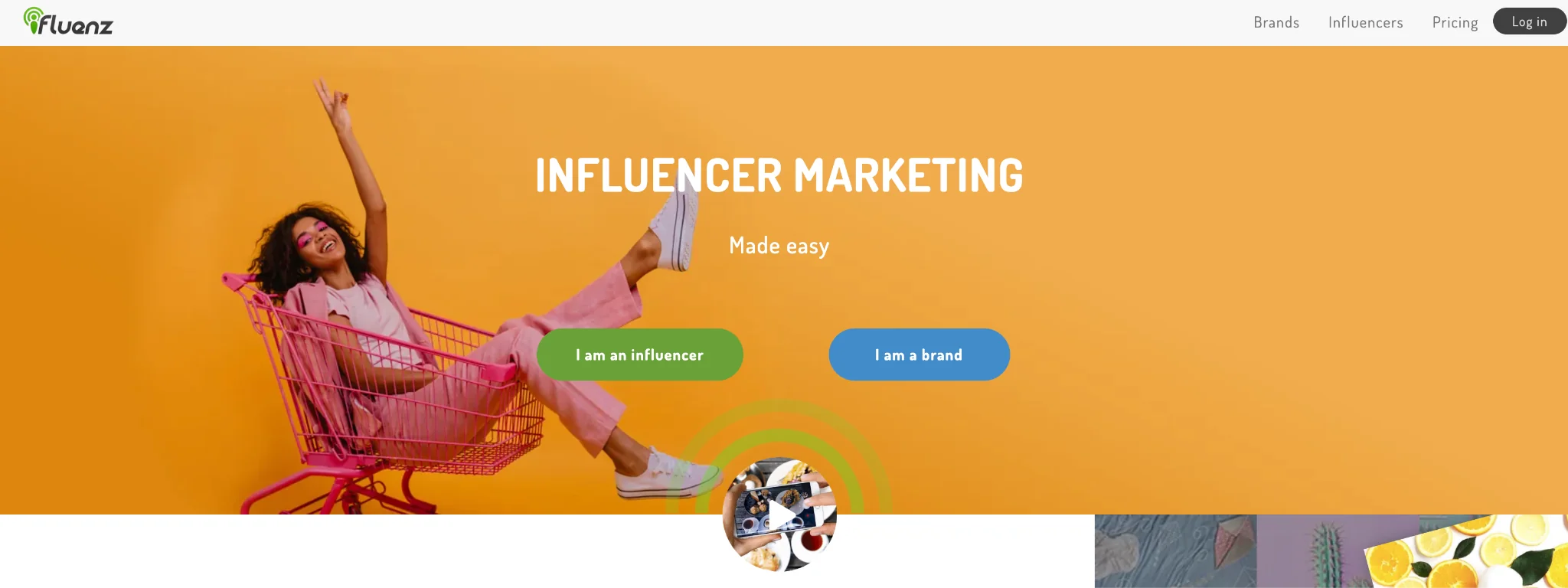
Ifluenz is a two-sided marketplace rather than a management platform. Creators list themselves, brands post campaign briefs, and the matching happens through proposals rather than through database search. That distinction shapes everything else about the product: you are not filtering 200 million profiles, you are reviewing the creators who chose to apply to your brief.
The workflow is deliberately short. Create a campaign with your requirements and budget, receive proposals from matching influencers, negotiate and approve the ones you want, wait for the content to publish, pay through the platform. Mood boards let you upload reference imagery so creators understand the aesthetic before they pitch, and there is a content amplification option for putting an already successful branded post back into circulation.
What is not in the box is the operational layer a D2C brand eventually needs. There is no eCommerce connection, no discount code generation, no affiliate attribution and no gifting logistics of the kind purpose-built product seeding platforms handle. Ifluenz sells access to creators and a payment rail. Everything downstream of the post is your problem.
Who Should Use Ifluenz
The fit test is volume. A percentage fee is generous at low spend and punishing at high spend, so the honest answer depends on how many collaborations you run a year.
- Brands running occasional Instagram collaborations. Four or five paid posts a quarter costs you a few hundred dollars in fees and nothing in subscription, which no licensed platform can match.
- Small businesses testing influencer marketing for the first time. There is no contract to sign and no software to learn, so the cost of finding out whether creators work for your product is close to the cost of the creators themselves.
- Teams with no dedicated influencer marketer. Reviewing inbound proposals is a fundamentally smaller job than running outbound discovery, and it fits into a role that already has other responsibilities.
- Brands whose audience is squarely on Instagram. Coverage is Instagram-centric, so a product that sells on TikTok or YouTube is buying half a strategy here.
- Companies that want fixed costs per campaign. You see the creator’s price before you approve, the fee is a known percentage, and there is no renewal date to defend internally.
- Brands willing to do their own vetting. Audience demographics are not exposed in the platform, so the quality check happens on your side before you approve a proposal.
Key Features
Campaign Briefs and Creator Proposals
You publish requirements, deliverables and budget, and matching influencers respond with proposals and their own rates. It inverts the usual model, where a brand searches a database and sends cold outreach, and it removes the slowest part of small campaigns, which is getting a reply at all. The tradeoff is selection: you review who applied, not who exists.
Mood Boards for Creative Direction
Brands upload reference images that creators can use as a style guide, or in some cases repost directly, with limits on how many creators may repost the same asset so a campaign does not read as a copy-paste job. For a brand with strong visual guidelines but no creative team to brief each creator individually, this does a real amount of work.
Content Amplification
A branded post that performed can be recirculated through other creators rather than commissioning fresh content each time. It is a cheap way to extend the life of an asset you have already paid for, and it suits brands whose bottleneck is production capacity rather than reach.
Continuous Account Vetting
An algorithm monitors creator accounts for irregularities such as sudden follower spikes, which is the crudest but most common signal of a purchased audience. It runs continuously rather than only at signup, so an account that starts buying followers after joining should surface. This is the platform’s main defence against fraud, and it is a screening signal rather than a full authenticity score.
Negotiation and Approval Flow
Terms are agreed inside the platform before content is produced, so deliverables, timing and price are documented rather than scattered across DMs. Approval sits with the brand at both the proposal stage and before payment releases, which gives you a checkpoint on content you have not yet paid for.
In-Platform Payment
Money moves through Ifluenz rather than directly between brand and creator, and the 15% commission is charged here. Pay a creator $100 and the transaction costs you $115. Centralising payment removes the invoicing and bank-detail friction of paying individual creators, which is a genuine administrative saving at low volume.
Country-Level Audience Targeting
Campaigns can be targeted by country. What is not available is city or regional targeting, which matters more than it sounds for a D2C brand with a concentrated delivery footprint or a retail partner in specific markets. Targeting the United States and targeting the Pacific Northwest are different campaigns, and only the first is possible here.
Basic Campaign Reporting
Reporting covers whether content published and how it performed at a surface level. There is no revenue attribution, no per-creator ROI and no reconciliation against store data, so measuring a campaign on anything beyond reach means exporting and rebuilding it yourself. Brands that need proper campaign reporting will be running it in a second system.
Ifluenz Pricing
There are no plans, no tiers and no monthly fee. There is one number: 15% of what you pay influencers through the platform. Commit to at least $10,000 in annual spend and that number becomes 5%.
That is a genuinely simple model, and at low volume it is cheaper than anything with a licence attached. The reason to model it anyway is that 15% of a growing budget grows with the budget, while a flat subscription does not. The table shows where the lines cross.
Pay-As-You-Go at 15%
- 15% commission on every influencer payment processed through the platform.
- No subscription, no seat licences, no setup fee and no minimum monthly commitment.
- A $100 payment to a creator costs $115 in total, and a $1,000 payment costs $1,150.
- Cost is zero in a month where you run no campaigns, which is the single biggest advantage of the model.
The 5% Rate at $10,000 Annual Commitment
- Brands committing to at least $10,000 of annual spend pay 5% instead of 15%.
- At exactly $10,000 that saves $1,000 a year, so the commitment pays for itself the moment you were going to spend the money anyway.
- At $25,000 it saves $2,500 a year, and at $100,000 it saves $10,000.
- The risk is the commitment itself. If you sign for $10,000 and spend $6,000, you have guaranteed a budget to capture a discount worth $600.
Where a Flat Subscription Overtakes the Fee
- Against a $649 a month platform, which is $7,788 a year: the 15% fee reaches that figure at $51,920 of annual creator spend. Below that, pay-as-you-go is genuinely cheaper. Above it, you are paying more and getting less tooling.
- At the 5% rate, the crossover moves out to roughly $155,800 of annual creator spend, which most D2C brands will not reach. On fee alone the 5% tier is competitive at almost any realistic volume.
- The catch is what the fee does not buy. A subscription platform at $7,788 a year includes discovery, outreach automation, CRM, affiliate codes, payouts and store integration. The 15% here buys a marketplace and a payment rail.
- Model the fee against next year. A brand tripling its creator budget triples its fee and gains no capability in return, which is how a cheap model becomes an expensive one without anyone renegotiating anything.
Ifluenz Reviews
The review record is thin and what exists is poor, so treat the score as a flag to investigate rather than a verdict.
- 2.8/5.0 (Trustpilot, very low review volume at 4 reviews, profile unclaimed)
- G2: no listing found.
- Capterra: no listing found.
Four reviews is not a rating in any meaningful statistical sense, and one bad month can produce a page that looks like this. What makes it worth mentioning is the consistency of the themes rather than the score. All four are one star, and the complaints cluster on unanswered support emails, difficulty recovering deposited funds, and creators reporting that product was sent without content being delivered in return.
Wider commentary on the platform is more measured and points at product gaps rather than conduct: limited influencer data with no audience demographics exposed, country-level targeting only, minimal campaign reporting, and slow customer service. The profile being unclaimed also means nobody at the company has responded publicly to any of it, which is a choice buyers are entitled to read something into.
Integrations
There is no published integration directory, and that is the finding rather than an omission on our part. Nothing connects Ifluenz to the rest of a D2C stack.
- eCommerce platforms. No Shopify, WooCommerce, BigCommerce or Magento connection is published, so orders and creator activity never meet.
- Affiliate and commission tools. No named affiliate network or tracking integration, and no discount code generation inside the platform.
- Email and lifecycle tools. No Klaviyo, Mailchimp or equivalent, so creator contacts do not flow into your marketing stack.
- Analytics. No Google Analytics connection and no documented reporting export beyond what the interface shows.
- Automation and API. No Zapier connector and no public API, which rules out building around the gaps yourself.
For a brand running Instagram collaborations as a standalone activity, none of this matters much. For a brand trying to prove creator spend against revenue, all of it does.
Pros of Ifluenz
Cost Tracks Activity Instead of the Calendar
A quiet quarter costs nothing. No licence renews, no seats sit idle and no minimum invoices while the marketing team is busy elsewhere. For seasonal brands and for teams testing the channel before committing to it, this is the correct shape of cost, and it is the reason to take Ifluenz seriously despite everything below.
The Discounted Rate Is Genuinely Cheap
Five percent on creator payments is low for a marketplace, and at $25,000 of annual spend it works out at $1,250 a year, well under a third of what most licensed platforms charge before a single creator is paid. If you are confident of clearing the $10,000 threshold, the arithmetic on fees alone is strongly in the platform’s favour.
Inbound Proposals Suit a Small Team
Reviewing applications is a smaller job than running discovery and cold outreach, and it does not require anyone to learn a database interface. Combined with mood boards that carry creative direction without a briefing call, a one-person marketing function can run a campaign here in an afternoon. That is a real operational advantage, not just a pricing one.
Cons of Ifluenz
15% Is the Highest Standard Rate in the Category
Most marketplaces charging a percentage sit in the 5% to 10% range. At 15%, a brand paying creators $52,000 a year hands over $7,800 in commission, which is what a full-featured platform costs annually with discovery, outreach automation, CRM, affiliate tracking and store integration included. You are paying a platform price for a marketplace product, and the gap widens with every dollar of growth.
Instagram Only
The platform is built around Instagram creators, so TikTok and YouTube programs need a different tool entirely. For a D2C brand in beauty, apparel or food, where short-form video on TikTok is now where discovery happens, a single-network marketplace covers one channel of a strategy that needs at least two. Running Instagram here and TikTok elsewhere also means two fee structures, two content libraries and no combined view of creator performance.
No Audience Data and Country-Level Targeting Only
Influencer profiles do not expose audience demographics, so you cannot confirm that a creator’s followers match your customer before you pay. Targeting stops at the country level, which is too blunt for regional launches or retail-partner campaigns. Together that means selection here rests on follower count and content style, where proper audience demographics and authenticity screening would tell you whether the audience is real and relevant first.


Is Ifluenz Worth It?
For a brand running a handful of Instagram collaborations a year, the model is sound and the maths supports it. No subscription, no contract, no software to learn, a fee that disappears when you are not running campaigns, and mood boards plus proposal review that let one person run a campaign without a specialist skillset. Below roughly $52,000 of annual creator spend, the 15% fee genuinely costs less than a licensed platform.
Past that point, and for any brand treating creators as a growth channel rather than an experiment, the case falls apart. Instagram only, no audience demographics, country-level targeting, no store integration, no discount codes, no affiliate attribution, no API and a four-review Trustpilot page at 2.8 with nobody responding to it. You would be paying platform money for marketplace capability and rebuilding the measurement layer by hand. Brands at that stage should price these:
- Influencer Hero. Discovery across eight social platforms with Instagram, YouTube and TikTok at the core, plus fake follower screening, lookalike search and creator relationship management boards, affiliate codes, payouts and gifting through Shopify, WooCommerce or custom stores. Plans are publicly listed from $649 a month with no percentage taken from creator payments.
- Afluencer. An Instagram creator marketplace from $49 a month where influencers apply to your campaign listings rather than being searched for. The right answer when the constraint is creator supply and the budget is small.
- Upfluence. Discovery paired with eCommerce and email integrations that identify creators already among your customers, which turns your own buyer list into a candidate pool.
- Insense. Creator-generated content at speed with usage rights handled up front, built for brands whose real bottleneck is a supply of ad creative rather than reach.
- Heepsy. Search-led discovery with audience authenticity metrics and demographic filters, useful when the missing piece is knowing who a creator’s followers actually are.
Final Thoughts
The trade-off here is unusually clean, which makes the decision easier than most. You give up audience data, multi-platform coverage, store integration and measurement, and in exchange you pay nothing until you run a campaign. At four collaborations a quarter on Instagram that is a fair swap and probably the cheapest way to test the channel. At $50,000 a year of creator spend it stops being a swap and becomes a subsidy, because the 15% now costs what a full platform costs and buys none of what a full platform does. Work out which side of roughly $52,000 your next twelve months lands on, and if it is the far side, the Ifluenz alternatives with attribution built in are where the comparison should start.

.png)


.jpg)










