


HiveInfluence Pricing and Review: Features, Pros, Cons & Costs
Every plan takes a cut of what you pay creators, and the cut shrinks as the subscription grows. Free takes 25%. Basic takes 10%. Professional takes 5%. Enterprise takes 2%. That ladder, not the feature list, is what decides which tier is cheapest for your brand.
HiveInfluence is a creator discovery and campaign platform built around a database it advertises at 380 million profiles across Instagram, TikTok and YouTube. Around that sit search credits, Kanban boards for tracking outreach, a marketplace where creators submit proposals, and escrow payments that hold funds until content is delivered. Subscriptions run from $0 to $299 a month.
What follows is what each tier actually includes, where the credit limits start to bite, the exact monthly creator spend at which each upgrade pays for itself, and the parts of a D2C program this platform does not touch at any price.
HiveInfluence Overview
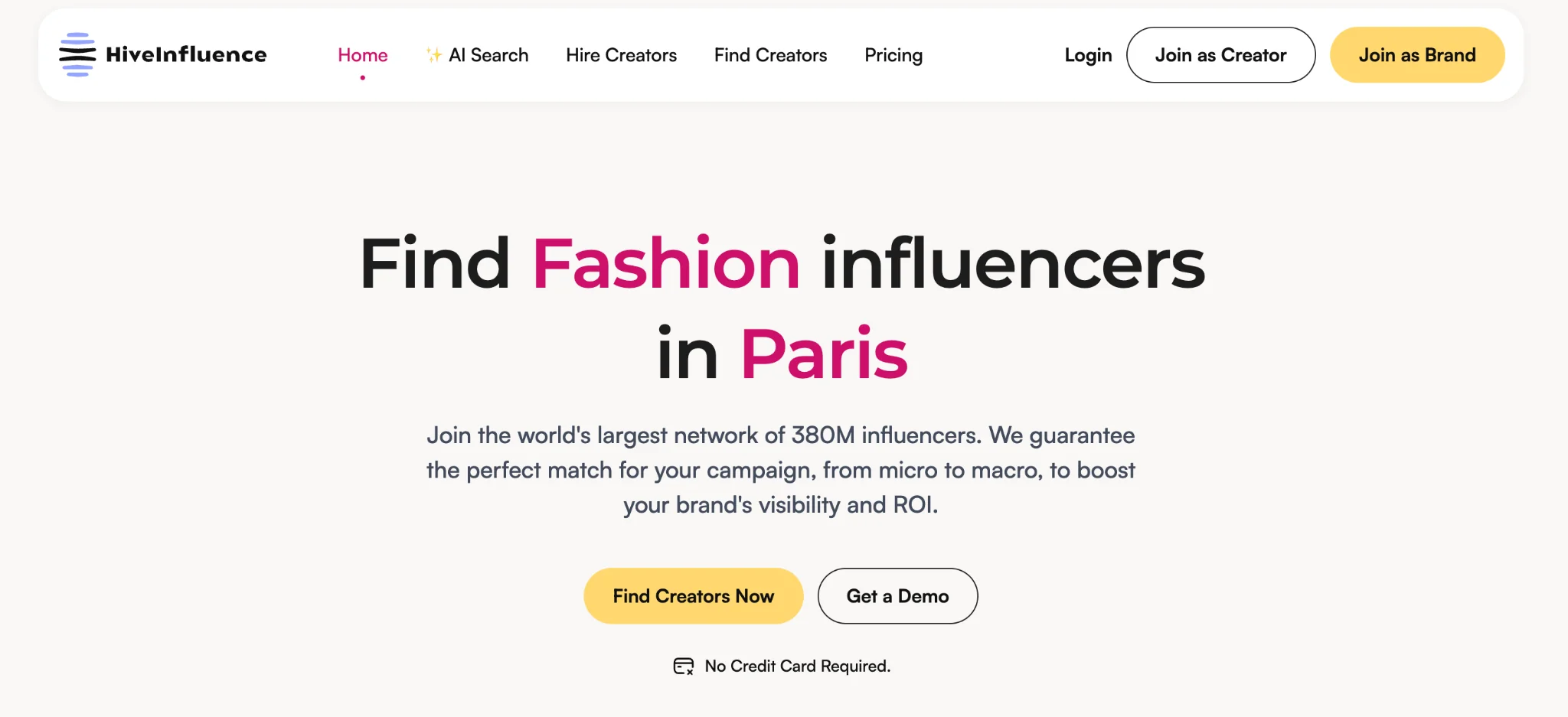
HiveInfluence positions itself as a search-first platform. The pitch is scale of coverage: creators across Instagram, TikTok and YouTube, campaigns across 193 countries, and filtering built to surface micro-influencers rather than only the names a brand could have found on its own. Follower-range filters down to the 10k to 25k band, credibility scoring, growth rate and audience overlap all point at the same buyer, which is a small team trying to build a roster from scratch.
Operationally it works in three moves. You spend discovery credits to open creator profiles and analytics, you organise the ones worth pursuing onto boards, and you either reach out directly or post a brief to the marketplace and let creators send proposals back. Payment runs through escrow, so funds are held until the agreed content goes live. Instant booking sits alongside that for creators who have published a fixed rate.
Who Should Use HiveInfluence
Fit here depends almost entirely on how much you pay creators each month, because that is the number the pricing model is indexed to.
- Brands paying creators in product or small flat fees. A percentage of a small payment is a small number, and the discovery tooling is the part you are really buying.
- Teams building a first creator roster. Credit-based search, credibility scoring and micro-influencer filters are aimed squarely at brands without an existing list, and the free tier lets you test the database before spending anything.
- Agencies running several small clients. Board limits scale with the plan, so a mid tier covers a handful of accounts without an enterprise contract.
- Brands running international campaigns. Coverage across 193 countries and audience language filters matter more here than they do for a single-market D2C brand.
- Teams that want creators to come to them. Marketplace briefs and creator proposals shift the work from outbound searching to inbound reviewing, which suits a one-person marketing function.
- Brands that need funds held until delivery. Escrow is built in rather than bolted on, which is genuinely useful when you are paying creators you have never worked with.
Key Features
Credit-Gated Creator Discovery
Search itself is open, but opening a profile with its analytics spends a discovery credit. Free gives you 5 a month, Basic 250, Professional 600 and Enterprise 1,300. Unused credits roll over, which softens the limit for teams that research in bursts. The practical effect is that discovery has a per-look price attached, so speculative browsing costs you something and shortlisting discipline becomes a budget question rather than a habit.
Fake Follower Detection and Credibility Scoring
Available from the Basic plan up, audience authenticity screening flags accounts with inflated or purchased followings before you pay them. This is the single most valuable thing a discovery database can do for a D2C brand, because the cost of a fake audience is not the fee you paid, it is the campaign you concluded did not work.
Lookalike Search and Growth Rate Filters
Both unlock at Professional. Lookalike search takes a creator who performed and finds others with similar audience composition, which is how you turn one good result into ten candidates. The growth rate filter surfaces accounts climbing rather than plateauing, useful if you want to sign creators before their rates catch up with their reach. Neither is available on Basic, which is a real reason to look past the entry tier.
Kanban Boards for Relationship Management
Creators move across columns as they progress from shortlisted to contacted to contracted to delivered. Board capacity is where the tiers separate hardest: 10 influencers on Free and Basic, 75 across five boards on Professional, 300 across twenty on Enterprise. A brand running a seeding program at any real volume will hit the Basic ceiling in a week, which is why a comparison against dedicated influencer CRM tools is worth doing before committing.
Marketplace Briefs and Creator Proposals
From Professional up you can list a campaign offer and have creators apply with their own proposals and rates, rather than sourcing everyone outbound. Simultaneous campaign limits apply: one on Free and Basic, three on Professional, ten on Enterprise. For a brand running seasonal pushes across product lines, that campaign cap is a harder constraint than the credit count.
Instant Booking
Creators who have published fixed rates can be booked without a negotiation round. It compresses the slowest part of a small campaign, which is the back and forth over price, and it makes budgeting predictable because you see the number before you commit. The tradeoff is that published rates tend to sit above what the same creator would accept in a negotiated gifting deal.
Escrow Payments and Creator Payouts
Funds are held and released against delivery, with creator payments available from the Professional plan. Escrow protects both sides on first collaborations and removes the awkward conversation about who pays first. This is also where the transaction fee is charged, so the payment rail and the pricing model are the same mechanism.
Email Outreach From Your Own Domain
Gmail and Outlook connections let the team contact creators from a company address rather than a platform one, with email templates available from Professional. Reply rates on outreach from a real brand domain are meaningfully better than from a generic sender, so this matters more than it sounds. What is not here is sequencing: no drip flows, no automated follow-ups, no reply tracking of the kind full outreach automation provides, so chasing non-responders stays a manual job.
HiveInfluence Pricing
Four tiers, all published, with a 20% discount for annual billing. That transparency is worth acknowledging in a category where most vendors hide behind a demo form. The complication is that the subscription is only half the price. Every creator payment processed through the platform carries a transaction fee, and that fee ranges from 2% to 25% depending on which tier you are on.
Read the table as two costs, not one. The subscription is what you pay to search. The percentage is what you pay to run the program.
Free
- $0 per month, no card required.
- 5 discovery credits a month, one board holding up to 10 influencers, one campaign at a time.
- Basic instant booking and help centre access.
- A 25% transaction fee on every creator payment, which is the highest rate on the ladder and the reason this tier is a trial rather than a plan.
Basic
- $59 per month, or $49 per month billed annually, which is $588 a year.
- 250 discovery credits a month, still one board capped at 10 influencers, still one simultaneous campaign.
- Search filters, fake follower detection, influencer analytics, exportable results, tags and notes, relationship management and escrow payments.
- 10% transaction fee.
- No lookalike search, no growth rate filter, no email templates, no creator proposals and no creator payments.
Professional
- $144 per month, or $120 per month billed annually, which is $1,440 a year.
- 600 discovery credits, five boards holding 75 influencers in total, three simultaneous campaigns.
- Adds lookalike search, growth rate filtering, campaign approval and chat, email templates, creator proposals, campaign offer listings and creator payments.
- 5% transaction fee.
- This is the first tier where the platform functions as a campaign tool rather than a search tool, and the feature jump is larger than the price jump suggests.
Enterprise
- $299 per month, or $249 per month billed annually, which is $2,988 a year.
- 1,300 discovery credits, twenty boards holding 300 influencers in total, ten simultaneous campaigns.
- All discovery and CRM features, plus priority support with SLA coverage.
- 2% transaction fee, the lowest on the ladder.
- Note that this is published pricing rather than a custom enterprise contract, so the ceiling on what you can buy here is genuinely $299 a month.
Where Each Upgrade Pays for Itself
- Free to Basic: Basic costs $59 more and cuts the fee by 15 points. Break-even lands at $393 a month in creator payments. Pay creators more than that and the free tier is the expensive option.
- Basic to Professional: $85 more a month for a 5 point cut. Break-even is $1,700 a month in creator payments, and you get lookalike search and the marketplace on top.
- Professional to Enterprise: $155 more for a 3 point cut. Break-even is $5,167 a month in creator payments.
- A worked example. A brand paying creators $10,000 a month spends $1,059 on Basic once the 10% fee is added, and $499 on Enterprise at 2%. The cheaper subscription costs twice as much.
- The number to model is next year’s spend. The fee scales with the program, so run the arithmetic at the volume you are aiming for, not the volume you have today.
HiveInfluence Reviews
There is no verifiable third-party review base for this platform, and that is the honest finding rather than a gap to paper over.
- G2: no listing found.
- Capterra: no listing found.
- Trustpilot: no listing found.
- Shopify App Store: no listing, since there is no Shopify app.
The vendor publishes performance claims of its own, including 3x faster brand awareness growth, 40% lower customer acquisition cost and 10x campaign ROI. None of those carry a stated methodology or a named customer, so they are marketing figures rather than evidence.
For a subscription of $59 a month this matters less than it would at $999, and the free tier means you can generate your own evidence in an afternoon. But the absence is a real due-diligence point for anyone planning to route creator payments through the platform’s escrow, because that is a financial relationship with a vendor whose service record is not publicly documented anywhere.
Integrations
The integration surface is narrow, and it is narrow in the direction that matters most to a D2C brand. Only email connections are published.
- Gmail. Send and manage creator outreach from your own company address instead of a platform sender.
- Outlook. The same for Microsoft-based teams, keeping conversations in the inbox the team already works from.
That is the published list. There is no Shopify integration, no WooCommerce, no BigCommerce and no Magento, which means gifting, discount codes and order attribution all sit outside the platform. There is no affiliate network connection, no Klaviyo or other lifecycle tool, no Zapier and no public API. A brand that wants creator activity reconciled against store revenue will be doing that reconciliation in a spreadsheet.
Pros of HiveInfluence
Published Prices and a Free Tier With Real Search In It
Four tiers with actual figures on them, a 20% annual discount stated openly, and a free plan that includes fake follower detection is more transparency than most of this category offers. You can validate whether the database contains creators in your niche before any card details are entered, which removes the worst risk in buying discovery software, which is paying for coverage that turns out to be thin in your category.
Cost Scales With Program Size, Not Team Size
There is no per-seat charge anywhere on the pricing page. A five-person team pays the same subscription as a one-person team, and what scales instead is credits, boards and campaign slots. For a growing brand that keeps adding marketers, this is a meaningfully better shape than per-seat licensing, where the bill quietly doubles as the team does.
Escrow and Creator Payments Are Native
Holding funds until delivery is built into the platform rather than handled over PayPal and trust. On first collaborations with creators you have no history with, that removes the single most common failure point in small campaigns, which is one side going quiet after money or content changes hands. Getting this at a $144 a month tier is genuinely unusual.
Cons of HiveInfluence
The Transaction Fee Is the Real Price
A 25% cut on the free tier and 10% on the $59 plan are not small numbers, and they are charged on creator payments rather than on your subscription, which means the cost grows in direct proportion to how well the program is working. A brand paying creators $10,000 a month on the Basic plan hands over $1,000 in fees, roughly seventeen times the subscription itself. Any comparison that stops at the monthly price is comparing the wrong number.
Board Limits Break Before Credit Limits Do
250 discovery credits on Basic sounds workable until you notice the board holds 10 influencers. A seeding program contacting fifty creators a month cannot be tracked on that tier at all, regardless of how many profiles you are allowed to open. Professional lifts the ceiling to 75 across five boards, which is still tight for an always-on program, and 300 at Enterprise is the effective maximum since there is no tier above it.
No eCommerce Connection, No Codes, No Revenue Attribution
Nothing in the published integration list touches a store. There is no Shopify or WooCommerce connection, no unique discount code generation, no affiliate link tracking and no commission calculation, so the platform can tell you a post went live but not what it sold. A performance-led D2C program needs affiliate links and creator payouts running underneath it, and here that means a second tool and a second bill.
No Public Track Record to Check
No G2 profile, no Capterra listing, no Trustpilot page and no app store presence means there is no independent account of what happens when something goes wrong. Combined with escrow, which asks you to route creator payments through the vendor, that is a due-diligence gap worth taking seriously. Start on the free tier, run one small campaign end to end, and confirm a payout actually clears before you move real budget through it.


Is HiveInfluence Worth It?
As a discovery and booking tool for a brand at the start of its creator program, yes, and the free tier makes that easy to test rather than argue about. Coverage across three platforms and 193 countries, credibility scoring on the entry plan, lookalike search and marketplace briefs from $144 a month, escrow payments built in, and no per-seat charge anywhere. For a small team paying creators in product or modest flat fees, the fee percentage stays small and the tooling earns its money.
As the system of record for a scaling D2C program, the shape works against you. The 10% fee on the entry plan compounds as the program succeeds, board capacity tops out at 300 creators, there is no eCommerce integration of any kind, no discount codes, no affiliate tracking and no way to tie a post to an order. Add the absent review base and the case for routing significant creator spend through it gets thin. Brands weighing this one should also price these:
- Influencer Hero. Influencer discovery across eight social platforms, led by Instagram, YouTube and TikTok, with fake follower screening, lookalike search and brand-follower identification, plus outreach automation, CRM boards, affiliate codes and payouts, and gifting through Shopify, WooCommerce or custom stores. Its publicly listed plans start at $649 a month with no percentage taken from creator payments.
- Afluencer. A creator marketplace from $49 a month where influencers apply to your campaign listings, with AI creator matching to shortlist applicants. The right call when the constraint is creator supply rather than campaign infrastructure.
- Modash. A discovery-led platform with a large creator database and unrestricted profile analytics, useful when credit limits are the thing slowing your research down.
- Aspire. Campaign workflow and creator relationship management with strong gifting and content collection, aimed at brands running always-on programs rather than one-off activations.
- Klear. Audience analysis and reporting depth, with cross-network measurement built for teams that have to defend creator performance to a wider marketing function.
Final Thoughts
Three checks settle this before you subscribe. Run the free tier against your actual niche filters and count how many relevant creators come back, because the coverage claim varies between 200 million and 380 million depending on which vendor page you read. Then take your monthly creator spend and multiply it by the fee on the tier you were planning to buy, since at $393, $1,700 and $5,167 a month the cheapest plan changes. Then decide whether you can live without any connection to your store, because gifting, codes and revenue attribution are absent at every tier and no upgrade fixes that.

.png)


.jpg)










