

Foursixty Pricing and Review: Features, Pros, Cons & Costs
The Foursixty entry plan costs $90 a month and puts Instagram content on your product pages. What it does not do is let you ask anyone for permission to use it.
Rights management starts on the $300 plan, and so do TikTok and Reels. That one gate is what the whole pricing decision turns on, because content you have not cleared is content somebody will eventually ask you about.
This review covers the three plans and what each gate costs in practice, where the company's own pricing page and its app listing disagree, and why a 4.9 from 137 reviews is the most useful number on this page.
Foursixty Overview
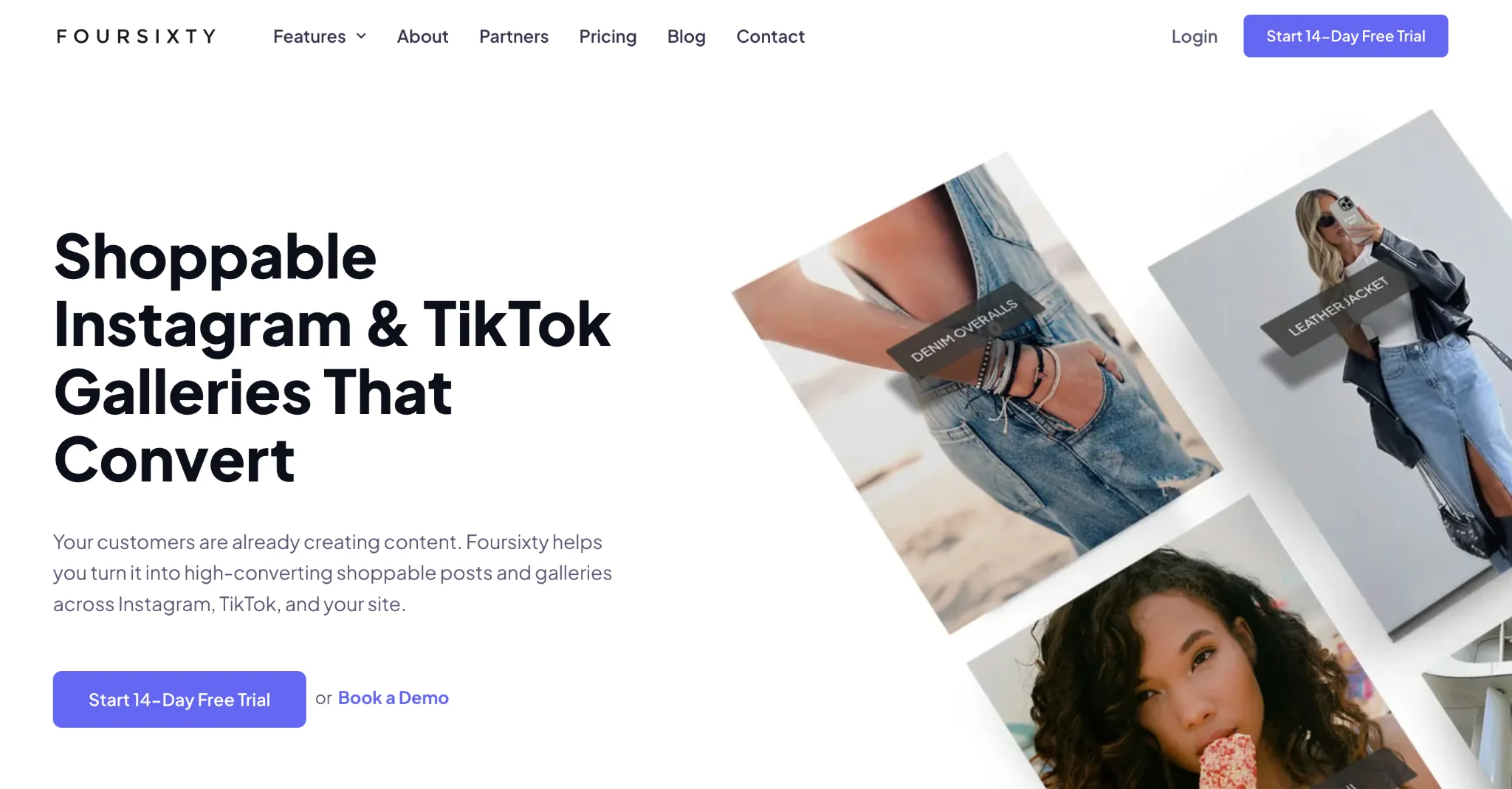
Foursixty turns social content into shoppable galleries for online stores. Customer photos, creator posts and your own Instagram feed become clickable blocks on the homepage, on product pages and inside emails, each one linked to the products it shows.
More than 2,000 brands and agencies use it, and the client list is heavily weighted towards fashion, jewellery and beauty. Pura Vida, Mejuri, Knix, Meshki, Frankies Bikinis and EVEREVE all appear, which is a consistent enough pattern to tell you where the product fits best.
The centre of gravity is Instagram and Shopify. Pinterest and Facebook are supported and TikTok arrives on the middle plan, but the analytics, the scheduler and the entry plan are all built around Instagram first, in much the same way that Instagram creator discovery tools treat that network as the default rather than as one option among several.
Who Should Use Foursixty
The plan structure sorts buyers more clearly than most:
- Fashion, jewellery and beauty brands: The client list clusters here, and these are categories where customers photograph what they bought.
- Shopify and Shopify Plus merchants: The Shop Mini and the deepest integration both sit on Shopify.
- Brands that already have Instagram content: The $90 plan makes sense when the content is yours and no permission is needed.
- Teams reusing customer content: Rights management from the $300 plan is what makes that legal rather than risky.
- Brands running an ambassador programme: Ambassador Shops give each creator a page of their own, on the top plan.
- Merchants on WooCommerce, Magento, BigCommerce, Wix or Squarespace: All are supported, which is wider than most competitors manage.
- Brands needing creator outreach and payouts: This is the group it does not suit, since none of that exists here.
Key Features
Shoppable Galleries
Social posts become grids where each image links to the products in it. The gallery sits on your homepage, a landing page or a collection page, and the job it does is turning a photograph somebody trusts into a route to checkout.
Product Page Galleries
Each product page can carry the posts featuring that specific item. This is where the conversion argument actually lives, because a shopper deciding between two sizes wants to see the product on a real person rather than on a model.
Shopify Shop Mini
Content also appears inside the Shopify Shop app, which is a placement most competitors do not offer. For brands with repeat customers using that app, it puts the gallery in front of people who have already bought.
Instagram Scheduler and Analytics
Posts can be scheduled and published from the platform, with advanced Instagram analytics included from the entry plan. It is a genuine extra at $90, and it is the feature that lets a small team drop a separate scheduling tool.
UGC Collection and Rights Management
From the middle plan, customer and creator content can be collected and permission requested and recorded. Approved content then lands in a UGC content library you can publish from with confidence, which is the difference between content you like and content you can use.
Reels and TikTok Galleries
Video content from Reels and TikTok can be displayed in the same shoppable format. Static grids look increasingly dated next to how these categories actually market themselves, so for most brands this is not optional.
Ambassador Shops
Each ambassador gets their own shoppable page filled with the products they feature. This is the closest the platform comes to influencer marketing proper, and it sits on the top plan only.
Influencer and Campaign Tracking
Content and performance can be tracked by creator and by campaign from the middle plan, with enhanced ambassador tracking on the top tier. It measures what creators produced and what it drove, rather than managing the relationship itself.
Foursixty Pricing
Three plans are published on the app listing at $90, $300 and $500 a month, each with a 14-day free trial. The company's own pricing page takes a different line, describing flexible plans and asking you to contact sales, so the published figures are the more useful ones.
Essential Plan
$90 per month. The plan includes:
- Shoppable Instagram galleries
- Product page galleries
- Shopify Shop Mini
- Gallery metrics
- Advanced Instagram analytics
- Instagram scheduler
- A 14-day free trial
Complete Plan
$300 per month. The plan adds:
- Reels and TikTok galleries
- UGC collection
- Rights management
- Influencer and campaign tracking
- Basic email galleries
Complete Plus Plan
$500 per month. The plan adds:
- Ambassador Shops
- Klaviyo integration
- Abandoned cart email galleries
- Enhanced ambassador tracking
- White glove support
What the $90 Plan Cannot Do
The entry plan displays content. It does not collect it, and it does not request or record permission to use it.
That makes Essential a good fit for one situation and a poor fit for another. If you are displaying your own brand's Instagram feed, $90 a month is well priced and nothing is missing. If your plan is to fill product pages with customer and creator photos, you are displaying other people's work without a permission trail, and the feature that fixes that costs three times more.
The Klaviyo Gap
Basic email galleries arrive at $300, but the Klaviyo integration does not appear until $500. Most brands in these categories run Klaviyo, so the practical position is that email galleries work properly only on the top plan. Check what basic means for your own email tool before assuming the middle plan covers it.
The Two Steps Cost the Same and Buy Very Different Amounts
Moving from Essential to Complete costs $210 more a month. Moving from Complete to Complete Plus costs $200 more. The two steps are almost identical in dollars, and completely different in proportion.
The first step more than triples your bill and unlocks the features most brands actually came for, which are rights and video. The second adds two thirds again and buys ambassador tooling and the Klaviyo connection. If you are going to end up at $300 anyway, the case for going straight to $500 is stronger than the price list makes it look. Annually the three plans work out at $1,080, $3,600 and $6,000, and the scheduler included at every level is worth weighing against what you currently pay for scheduling.
What to Check During the Trial
Fourteen days is enough to answer four questions, so plan for them:
- How the gallery affects page load on a product page with real traffic
- What proportion of rights requests actually come back approved
- Whether the gallery styling matches your theme without developer help
- Whether gallery metrics reconcile with your own analytics
Foursixty Reviews
4.9/5.0 (Shopify App Store, 137 reviews), with 94% of reviewers leaving five stars. That is the strongest review record of any platform in this category, and on a sample large enough to trust.
The number matters more than usual because Shopify app reviews come from merchants who installed and paid, rather than from a directory profile a vendor filled in. It is also recent and continuous rather than a handful of entries from several years ago.
The flip side is that a 94% five-star distribution leaves very little published criticism to learn from. There is no meaningful body of complaints to weigh, which sounds like good news and makes independent research harder. No other major review site carries a listing with comparable volume.
That puts the burden on your trial. Use the 14 days to test the things reviews cannot tell you, above all page speed on product pages and how many rights requests convert into approvals, since a rights workflow nobody responds to produces an empty library.
Integrations
Platform coverage is wider than most tools in this category offer:
- Shopify and Shopify Plus: The deepest integration, including the Shop Mini placement inside the Shopify Shop app.
- BigCommerce: Supported directly for merchants outside the Shopify ecosystem.
- WooCommerce and Magento: Both covered, which keeps larger and self-hosted stores in scope.
- Klaviyo: Email galleries and abandoned cart content, available on the top plan only.
- Squarespace, WordPress and Wix: Lighter website platforms are supported rather than ignored.
Klaviyo is the only named marketing tool in the list. No CRM, analytics platform or affiliate network appears, so the integration story is about where galleries can be displayed rather than what else your stack can do with the data.
Pros of Foursixty
You Can Try It Without Talking to Anyone
A published $90 entry price and a 14-day free trial put this in a different category from most of the platforms a D2C brand evaluates. You can install it, test it on real traffic and cancel, all before anybody would have returned your demo request elsewhere.
The Review Record Is Genuinely Strong
A 4.9 across 137 reviews from paying merchants is the best evidence available in this category. It is not a vendor claim or a handful of directory entries, and it covers the specific thing you are buying.
It Works Beyond Shopify
BigCommerce, WooCommerce, Magento, Squarespace, WordPress and Wix are all supported. Plenty of competitors are Shopify-only, so a brand on a different platform, or one planning a replatform, keeps its options open.
Cons of Foursixty
Rights Management Costs $300
This is the cost trap and it is the most important line in the price list. The entry plan shows other people's content with no way to request or record permission, so the plan that makes a customer-content programme defensible is the middle one. Budget $300 rather than $90 if customer photos are the point.
The Entry Plan Is Instagram Only in Practice
TikTok and Reels galleries start at $300 as well. For categories where short video drives most discovery, that makes Essential a plan for brands still marketing the way they did several years ago.
Klaviyo Sits Behind the Top Plan
Email galleries appear at $300 and the Klaviyo connection at $500. Since Klaviyo is close to standard in fashion and beauty, many brands will find the email feature they paid for at the middle tier only works properly after another $200 a month.
It Displays Creators, It Does Not Manage Them
Ambassador Shops and campaign tracking measure what creators produce. There is no creator search, no outreach, no briefing, no contract, no commission engine and no payouts, so anything upstream of the gallery needs influencer marketing CRM tools running alongside it.


Is Foursixty Worth It?
For what it sets out to do, yes, and it is one of the easier recommendations in this category. Galleries on product pages are a proven conversion lever in fashion and beauty, the pricing is published, the trial is real, the platform coverage is broad, and 137 merchant reviews at 4.9 is evidence almost nobody else here can show.
The caution is about which plan you actually need. Most brands describing what they want are describing the $300 plan or the $500 one, not the $90 one, so compare it against alternatives at that level rather than at the entry price. And it remains a display tool: it shows creator content beautifully and does nothing to find, brief or pay the creators who make it.
Brands weighing a gallery tool against a full creator programme usually consider the following:
- Influencer Hero: Screens creators with 20-plus filters and fake-follower checks before their content ever reaches your product page, then runs influencer outreach, briefs, affiliate codes and payouts, so the gallery is the end of a programme rather than the whole of it.
- Afluencer: Keeps the content pipeline full by letting creators apply to your campaign listings, which suits brands finding micro-influencers without running a search or paying agency fees.
- Loox: Combines photo and video reviews with on-site galleries, built specifically for Shopify merchants. For a brand where reviews and customer photos are the same problem, it is the closer fit.
- Okendo: Pairs reviews and UGC with customer profiling and strong Klaviyo integration. If segmentation and email are where your growth comes from, it is worth the call.
- Nosto: Brings visual UGC into a wider personalisation and merchandising suite for larger stores. For a brand already investing in on-site personalisation, it makes more sense.
Final Thoughts
What changes here is not the product, it is which plan you belong on, and that shifts as you grow. At the start, displaying your own Instagram feed for $90 is a fair deal and nothing is missing. The moment you begin using customer and creator photos, you need rights management and video, and your real price is $300. Once ambassadors and Klaviyo enter the picture, it is $500, which is where most brands in fashion and beauty end up within a year. Price the tier you will be on in twelve months rather than the one you need this week, and if that number looks high next to what a gallery actually does, the Foursixty alternatives that bundle reviews or creator management will give you more for the same money.