

Flowbox Pricing and Review: Features, Pros, Cons & Costs
Most creator platforms treat data rules as a footnote. Flowbox puts them in the product, with GDPR-native workflows, DAC7 reporting, EU data residency and consent templates built for several markets at once.
That is a deliberate position rather than an accident. Flowbox started as a user-generated content platform for European retailers and added influencer marketing on top, so the rights and compliance layer came first and the campaign tools were built onto it.
This review covers what the influencer side actually does, why its network list is shorter than the content side, what reviewers say about the campaign limits, and how much you can work out about cost when the vendor publishes nothing.
Flowbox Overview
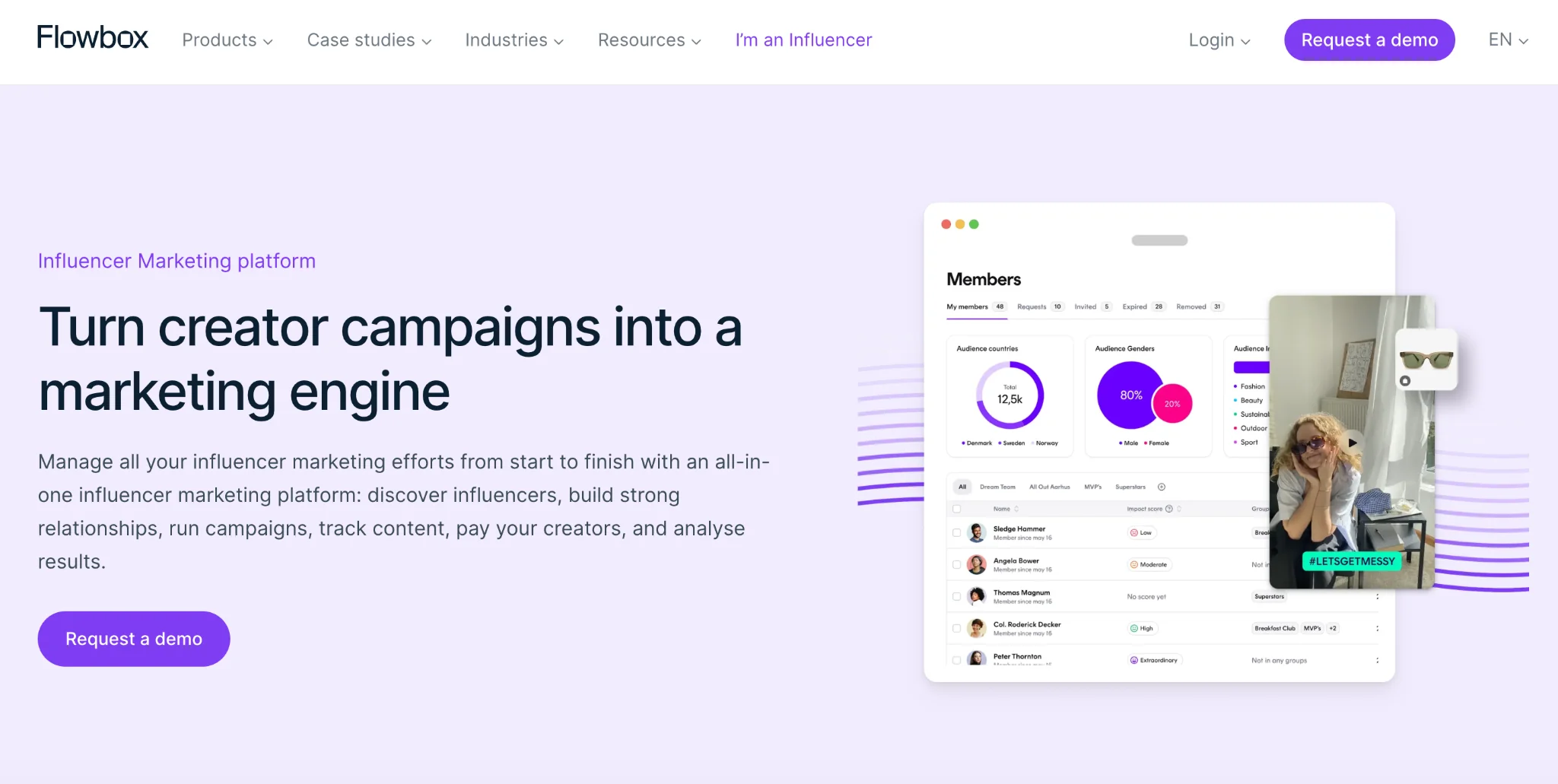
Flowbox is two products sharing one platform. The original half collects customer and creator content, moderates it and publishes it to your site, shop and social channels. The newer half runs influencer campaigns, from finding creators through to briefing, payment and reporting. Groupe SEB, G-Star, Fjällräven, PXP and Peter Larsen Kaffe are among the named clients.
The two halves do not cover the same networks, and the difference matters when you are planning. Content collection pulls from Instagram, TikTok, YouTube, Facebook and Pinterest. Creator briefing covers Instagram and TikTok. So you can gather and republish content from five networks, and run managed campaigns on two of them.
Scale is quoted in two numbers that are easy to confuse. Search runs across roughly 300 million creators globally, and the verified pool sits at more than 18,000. The first figure is an index you can look through; the second is the set you can actually brief and pay through the platform, and it is the one worth planning around. Everything collected along the way lands in a single UGC content library that both halves of the product draw on.
Who Should Use Flowbox
The compliance focus and the integration list point at a fairly specific buyer:
- Brands selling across several EU markets: Multi-market consent templates and EU data residency are built for exactly this situation.
- Teams paying creators in the EU: DAC7 reporting is a legal obligation for platforms facilitating those payments, and it is handled here.
- Brands that run creator content as paid media: Usage rights of 24 months on vetted content make repurposing into ads straightforward.
- Retailers with high content volume: The product was built for collecting and moderating customer photos at scale.
- Shopify, Adobe Commerce and Shopware merchants: All three are named integrations, along with a published partner list.
- Teams wanting content and creators in one contract: Most brands buy these separately and end up moving files between tools.
- Small brands watching every euro: This is the group it does not suit, since reviewers consistently describe the pricing as high.
Key Features
Creator Discovery and AI Matchmaking
Search spans around 300 million creators with filters for location, demographics, interests, content style and past collaborations. Filtering on previous collaborations is the useful one, because a creator who has worked with your category before needs far less explaining.
Creator Network Management
Creators are grouped by status, channel, region or campaign history, which turns a contact list into something you can segment. A brand running several markets can keep its French and German rosters separate without running two systems.
Campaign Briefing
Briefs go directly to creators for Instagram and TikTok with the deliverables spelled out. Clear deliverables at the brief stage is what prevents the slow argument later about what was actually agreed.
Automatic Content Collection
When a creator publishes, the content is collected automatically rather than chased by email. Posts, stories, reels and tagged collaborations all land in the same library, which is the part that saves the most time day to day.
GDPR-Native Rights and Consent
Consent templates cover multiple markets, data is held in the EU, and the rights workflow is built into how content is approved. Vetted creator content carries 24-month usage rights, so you know how long you can run it before you build a campaign around it.
DAC7 Reporting
DAC7 requires platforms to report what sellers and creators earn to EU tax authorities. Handling it inside the tool removes an obligation that otherwise lands on your finance team, and very few creator platforms address it at all.
Payments, Vouchers and Rewards
Creators can be paid digitally, or rewarded with vouchers or custom rewards, all from the platform. Mixing cash and product in one system is genuinely useful for gifting-led programmes, and it sits closer to the market than most creator payment tools that handle cash alone.
Repurposing and Analytics
Approved content flows out to product pages, social feeds, paid ads and email, with performance tracked by creator, market and content format. Reporting by market is the detail that matters for a brand running the same campaign across several countries.
Flowbox Pricing
Nothing is published. There is no plan comparison, no starting price and no self-serve sign-up on the site, and the route in is a demo request.
What the Model Looks Like
The structure is a tiered subscription based on usage and features, with the cost driven by content volume and whatever custom requirements you bring. Annual and custom arrangements are both available.
That tells you what your meter is. You are not paying by seat or by creator, you are paying by how much content flows through the system. A brand collecting heavily from customers will climb tiers faster than one running a handful of creator campaigns, even if the campaign work is the reason you bought it.
Campaign Limits Are Part of the Package
One reviewer describes their package as including three campaigns and raises it directly as a value concern. Treat that as one customer's account rather than a published limit, but do ask what your package includes, because a campaign cap changes the maths completely.
Three campaigns a year is a different product from three a month. If the cap is annual and you plan seasonal activity across several markets, you will hit it in the first quarter and be renegotiating from a weak position.
The Free Trial Question
Sources disagree here and it is worth clearing up on the call. Directory listings show no free trial and no free version, while the Shopify listing describes free installation with a free plan. Those may describe different products, since the app and the full platform are not the same thing. Ask what a free entry point actually gives you and whether creator campaigns are part of it.
What to Settle Before the Demo
Five questions do most of the work:
- What defines your tier, whether that is content volume, page views or markets
- How many campaigns your package includes, and over what period
- Whether the influencer module is priced separately from the content platform
- What happens when you exceed your content volume, and at what rate
- The contract length, the notice period and any implementation fee
If you are comparing this against tools built specifically for storefront campaigns, it is worth putting a couple of influencer marketing platforms for Shopify brands next to it, because several of them publish figures you can check in a minute.
Flowbox Reviews
4.6/5.0 (Capterra, 9 reviews) and 4.3/5.0 (Gartner Peer Insights, 3 reviews). Twelve reviews between them is a thin sample, though the two scores agree with each other, which is worth more than two larger samples that contradict.
5.0/5.0 (Shopify App Store, 1 review). One review is not a score and should not be weighed against anything.
The praise is consistent and specific. Reviewers describe the platform as easy to use for managing content, rate support at the top of the scale for being quick and knowledgeable, and note that it holds up under heavy traffic. Customisation and the integration options come up repeatedly.
The complaints are equally consistent. Advanced features take time to learn, self-serve support material is thin so people contact the team directly, reporting lacks depth in places such as timeline analytics and approval ratios, and pricing is described as high and unsuitable for smaller companies. Two specific limitations are named, which are that YouTube videos do not autoplay in the platform and that the Google Analytics integration has constraints.
Integrations
This is a genuine strength and, unusually for this category, the list is published:
- Shopify: A direct app connection, alongside Adobe Commerce, Shopware, Spryker and Vendre on the commerce side.
- Klaviyo: Creator and customer content flows into email, with Dotdigital, Apsis and Copernica also supported.
- Voyado and Custobar: Marketing automation and CRM connections aimed at Nordic and European retail, along with Spotler and Squeezely.
- Smartly.io and Criteo: Approved content is pushed into paid media rather than exported by hand, with Bannerwise also named.
- Inriver and LoyaltyLion: Product information management and loyalty, which is where content meets the product catalogue.
One small discrepancy is worth noting. The site refers to more than 50 integrations while the partner page names around 31, with the rest of the list made up of agencies and consultancies rather than technical connections. Either way it is a wider and better documented surface than most competitors publish.
Pros of Flowbox
Compliance Is Built In, Not Bolted On
GDPR-native workflows, EU data residency, multi-market consent templates and DAC7 reporting in one platform is rare. For a brand paying creators across European markets, this removes obligations that usually land on legal and finance, and it is the strongest reason to choose this over a US-first competitor.
One Piece of Content, Used Everywhere
Content collected from a campaign can run on product pages, in email, in paid social and on your own channels, with 24-month usage rights attached. Most brands pay to create content and then use it once, so extending its life is a direct saving rather than a soft benefit.
A Published Integration List
Commerce platforms, email tools, CRMs, PIM systems, loyalty and paid media are all named by product. Being able to check whether your stack is supported before you book a demo is a small courtesy that a surprising number of vendors in this space do not extend.
Cons of Flowbox
Nothing Is Priced, and the Meter Is Content Volume
No plans, no starting figure and no self-serve route, with tiers driven by how much content passes through. That means your bill grows with success on the content side even if your creator campaigns stay the same size, and you cannot model any of it before a call.
Campaign Limits Decide the Value
A reviewer describing three campaigns in their package is the clearest warning sign in the public record. If campaign count is capped and the cap is annual, a brand running seasonal activity across markets will exhaust it early and pay to extend at whatever rate is offered then.
The Verified Pool Is Far Smaller Than the Index
Searching 300 million creators sounds enormous next to a verified pool of 18,000. The second number is the one that governs who you can brief and pay inside the platform, so brands that need a much larger vetted set will lean on AI-powered creator search elsewhere and import the results.
Analytics Are the Recurring Complaint
Reviewers ask for timeline analytics and approval ratios, note constraints on the Google Analytics connection, and describe advanced areas of the product as hard to navigate. For a team that reports weekly, that is the part most likely to send you back to a spreadsheet.


Is Flowbox Worth It?
For a European brand running content and creators together, the case is strong. The compliance layer is the best reason to buy it, the integration list is published and wide, support is rated highly by the people using it, and putting collection, rights, briefing and payment in one contract removes a genuine amount of coordination work.
The reservations are about cost and evidence. Nothing is priced, the meter is content volume rather than campaign activity, package limits appear to be where the real negotiation happens, and twelve reviews is not much to go on for a platform at this level. Reviewers are also clear that it is priced for larger companies.
Brands comparing a content-led platform against a full creator programme usually consider the following:
- Influencer Hero: Indexes more than 450 million creators across Instagram, TikTok and YouTube with AI search over your own UGC library, content approval workflows and a Chrome extension that pulls live stats while you browse, then carries the campaign through to affiliate codes and payouts.
- Afluencer: Built around product seeding and campaign listings that creators apply to, which suits a brand whose programme runs on gifting rather than fees, as its roundup of gifting platforms lays out.
- Skeepers: A European suite combining consumer reviews, UGC and influencer campaigns with a large consumer panel. For a brand that wants reviews and creator content from one vendor, it is the closer fit.
- Bazaarvoice: Syndicates ratings, reviews and customer content across a large retailer network. If your products sell through other retailers as well as your own site, it is worth the call.
- Taggbox: Focuses on collecting social content and publishing it into shoppable galleries, displays and campaigns. For a team whose need is display and aggregation rather than creator management, it makes more sense.
Final Thoughts
One number decides this, and it is not the subscription. It is whatever your package sets as the limit, on content volume and on campaign count, because that is what turns a reasonable quote into an expensive one halfway through the year. The compliance work is the real reason to buy Flowbox, and for a brand paying creators across EU markets it removes obligations that are genuinely awkward to handle alone. Get the limits in writing, then work out how many campaigns and how much content you will actually run in twelve months. If the answer clears the cap by March, the Flowbox alternatives that meter on something other than volume will serve you better.