


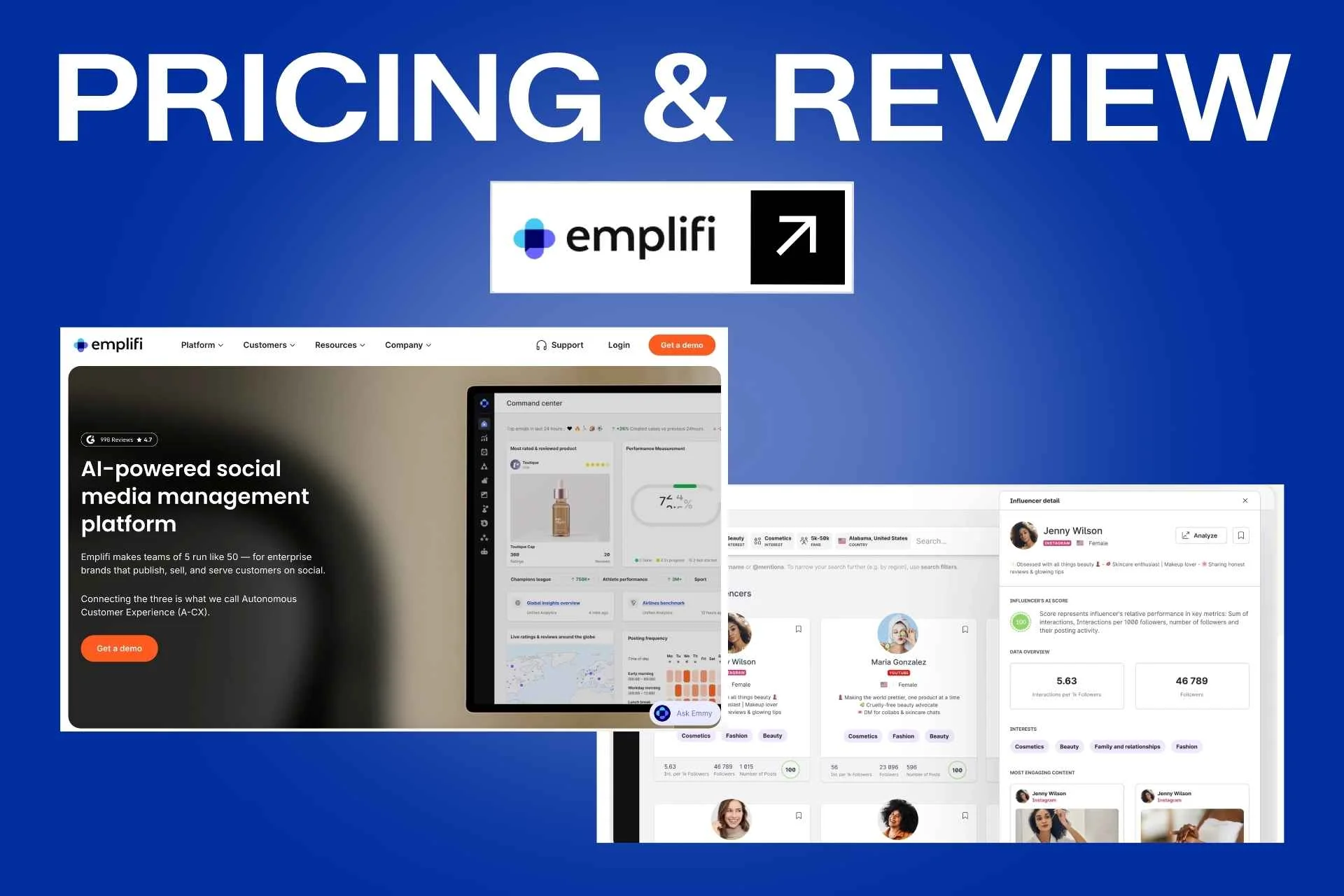
Emplifi Pricing and Review: Features, Pros, Cons & Costs
Thirty million creator profiles across exactly two platforms. That is the headline number Emplifi puts on its influencer product, and the second half of the sentence is the part that decides whether this is the right purchase. Discovery covers Instagram and YouTube. TikTok, where most D2C creator budgets have moved, is not in the influencer database.
The pricing works the same way. Emplifi publishes real figures, starting at $1,249 a month, but those figures are for Social Marketing, the publishing and analytics suite. Influencer management sits underneath Social Commerce as an add-on with no price attached to it at all. A brand shopping specifically for creator software is looking at a published number that does not include the thing it came for.
Here is what each tier costs, what the influencer module actually does, and the arithmetic on what a brand ends up paying for a capability it could buy standalone for a fraction of it.
Emplifi Overview
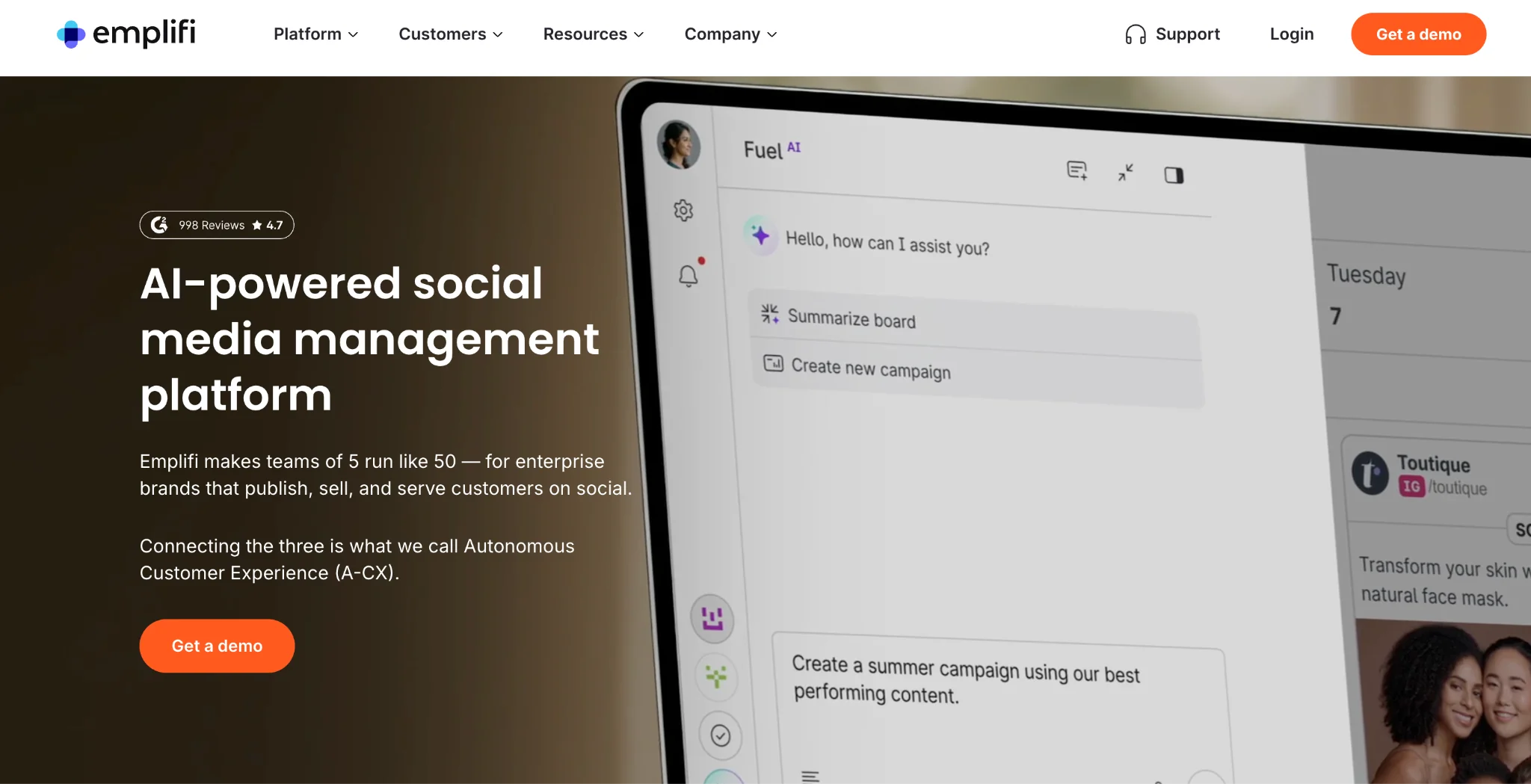
Emplifi was formed in 2020 when Audax Private Equity merged Socialbakers, the Prague social analytics company founded in 2008, with the Ohio customer engagement business Astute Solutions. The combined company rebranded as Emplifi in June 2021, acquired the video shopping business Go Instore that September, and passed a $1 billion valuation in 2022. Headquarters is Columbus, Ohio, headcount was around 750 at the time of the rebrand, and the company was named a Leader in the 2026 Gartner Magic Quadrant for Social Media Management and Listening.
The product is sold as three clouds: Social Marketing for publishing, analytics and listening, Social Care for inbox and service, and Social Commerce for ratings, reviews, UGC, live shopping and influencers. Influencer management is one component of the third cloud rather than a product in its own right, which explains a lot about both the feature depth and the way it is priced.
What the influencer module does well is measurement and content reuse, because it inherits both from the wider suite. Where it is thin is the operational middle of a creator program, the part covered by dedicated influencer CRM tools: pipeline stages, contracts, affiliate codes, commissions and payouts. Emplifi will tell you what a campaign earned. It will not run the campaign for you.
Who Should Use Emplifi
Fit here depends almost entirely on whether you are buying a suite or buying influencer software, and the two answers point in opposite directions.
- Enterprise social teams already consolidating vendors. If publishing, listening, social care and creator work all sit in one budget line, the bundle economics start making sense.
- Brands with large teams, since seats are unlimited. Pricing scales on outcomes and profiles rather than user licences, which is unusually generous for a 30-person marketing department.
- Multi-brand groups managing many social profiles. Unlimited profiles at every tier is a real advantage over per-account pricing models.
- Instagram and YouTube-led brands. The influencer database covers those two platforms and nothing else, so a program built around them loses nothing.
- Teams that need creator content on-site and in email. Content amplification pushes influencer assets onto product pages, apps and abandoned cart flows, which is a commerce capability most creator tools do not attempt.
- Organisations with a social listening mandate. Smart alerts and sentiment monitoring for early crisis detection are enterprise requirements, and they are genuinely strong here.
Key Features
Influencer Discovery
A database of more than 30 million creator profiles with AI-powered filters covering interests, language, hashtags and performance metrics, plus side-by-side comparison. The filtering is competent. The coverage is the constraint: Instagram and YouTube only, with no TikTok, Pinterest, Snapchat, X or Twitch in the discovery index.
Campaign Management
Campaigns are created, briefed, tracked and closed inside the platform, with goals set upfront and progress monitored against them. It is organised around campaign-level reporting rather than creator-level pipeline, which suits a brand running four large campaigns a year better than one running rolling always-on collaborations.
Creator Communication
Direct messaging with conversation history stored against each creator, so collaboration threads live in the platform instead of a shared inbox. There is no bulk outreach engine, no drip sequencing and no automated follow-up, which is the difference between managing relationships and building them at volume.
Gifting Management
An integrated workflow for sending product to creators, monitoring delivery status and tracking the engagement and content that results. Tying send-outs to resulting posts is the right design, and it puts structure around influencer gifting that most brands otherwise run on a spreadsheet.
Performance Analytics and ROI
The strongest part of the module, and the part that benefits most from sitting inside an enterprise analytics suite. Reporting covers engagement rate, reach, impressions, conversions and revenue impact, with published customer results including a 120% lift in average order value and a 105% lift in conversions.
Creator Portal
Creators log in and share their own performance data securely, which solves the perennial problem of chasing screenshots for Stories and private metrics. It also means the numbers in your report come from the creator’s account rather than an estimate.
Content Amplification
Influencer content can be embedded on websites, apps and email, including abandoned cart flows, with clickable links through to product or booking pages. This is where the Social Commerce heritage pays off, and it is a capability dedicated creator platforms rarely offer.
Social Listening and Smart Alerts
Influencer buzz and content sentiment feed into the wider listening product, with AI-powered smart alerts flagging problems early. For a brand where a creator post going wrong is a communications risk rather than just a bad week of ROAS, this integration is a genuine reason to buy the suite.
Emplifi Pricing
Emplifi is more transparent than most enterprise vendors and still leaves the important number blank. Social Marketing carries published monthly prices. Social Care and Social Commerce, which is where influencer management lives, are quote-only across every tier. So the platform tells you what the suite costs but not what the creator capability costs, and the two are bought together.
The pricing model itself is worth crediting: unlimited users and unlimited owned profiles at every tier, with cost scaling on capability and on how many competitor profiles you can benchmark rather than on seats. For a large team that is a materially better deal than per-seat licensing.
Social Marketing Essential
- From $1,249 per month, which is $14,988 a year at the published rate.
- Unlimited users and unlimited owned profiles.
- Basic publishing, engagement and the AI co-pilot.
- Benchmarking limited to 10 public competitor profiles.
- No influencer management. That is a Social Commerce add-on quoted separately.
Social Marketing Advanced
- From $2,499 per month, or $29,988 a year, and marketed as the best-value tier.
- Adds advanced workflows, AI Reply Assistant, AI Image Scoring, AI ReportBuilder and performance prediction.
- Benchmarking rises to 50 public profiles.
- The step up costs an extra $15,000 a year and buys AI tooling plus 40 more competitor profiles, not influencer capability.
Social Marketing Intelligent
- Custom pricing with no figure published.
- Advanced analytics, AI Composer with Brand Voice, enterprise governance and unlimited team controls.
- Benchmarking up to 100 public profiles.
- API access appears only at this tier, so moving your own data out programmatically is an enterprise-only right.
Social Care and Social Commerce
- Every tier is quote-only, with no published entry price at all.
- Social Care Advanced is where the Salesforce CRM integration sits; Social Care Intelligent is listed as a 2026 preview rather than a shipping product.
- Social Commerce covers ratings, reviews, UGC, live commerce and the influencer management platform.
- No contract length, minimum term, onboarding fee or free trial is published anywhere on the pricing page.
What Influencer Marketing Actually Costs Here
- The floor for a brand that wants Emplifi for creators is the suite plus the add-on. At the published entry rate that is $14,988 a year before the influencer module is quoted at all.
- By comparison, a dedicated all-in-one influencer platform runs about $7,788 a year at $649 a month, with the creator functionality included rather than bolted on.
- That means Emplifi’s cheapest published tier costs roughly 1.9 times a full standalone influencer platform, and still does not contain influencer marketing.
- The bundle only pays off if you would have bought the publishing, listening and social care layers anyway. If you would not, you are subsidising a suite to reach one module.
- Ask for the add-on price in writing before the suite quote, not after. Sequencing the conversation the other way is how the number gets anchored.
Emplifi Reviews
The review base is large enough to trust, which is more than most platforms in this category can claim.
- 4.4/5.0 (G2, 382 reviews)
- 4.2/5.0 (Capterra, 38 reviews)
Reviewers consistently praise the interface, the depth and customisability of the analytics dashboards, having every social channel consolidated in one place, and the unlimited seats and profiles model for managing brand portfolios. Support is described as responsive and proactive by most, and the reporting is what people name when asked what they would miss.
The complaints cluster in three places and all three matter for a creator program. Cost comes up repeatedly, particularly from smaller teams and from markets where the pricing does not flex to local economics. Platform gaps come up next: reviewers report glitches with Instagram and TikTok integrations, Instagram Story scheduling failing, and a wish for better TikTok, YouTube, LinkedIn and Pinterest data. The third is packaging. One long-term customer describes the base plan being progressively stripped back with features migrating to higher tiers, and another reports support quality dropping after operations moved out of Prague.
Integrations
Emplifi publishes a short partner list and leans on API access for the rest. The named surface is enterprise infrastructure rather than commerce.
- Salesforce. The deepest named integration, unifying social conversations with CRM records, though it is tied to the Social Care Advanced tier.
- Adobe. Creative and experience workflow connection for teams already standardised on the Adobe stack.
- Tableau. Pushes social and campaign metrics into an existing BI environment, which is how most enterprises actually want to consume this data.
- Okta and OneLogin. Single sign-on for enterprise identity management, standard procurement requirements.
- Dropbox, OneDrive, Google and Bitly. Asset storage, workspace and link shortening for publishing workflows.
Direct API access is offered for anything not on that list, but it sits at the Intelligent tier. What is missing is the commerce layer: no published Shopify, WooCommerce, BigCommerce or Magento integration, and no named affiliate or payment providers. For an enterprise consolidating social tooling that is fine. For a D2C brand that wants creator activity to reconcile against store data, it is a significant hole.
Pros of Emplifi
Unlimited Seats and Profiles at Every Tier
Pricing scales on capability and benchmarking, not headcount. A 40-person social team pays the same as a 4-person one, and a group managing 60 owned profiles pays the same as a brand managing three. In a category where per-seat and per-account pricing quietly triples the bill as a team grows, this is the most commercially generous thing on the pricing page and it is easy to undervalue at signature.
Reporting That Enterprise Stakeholders Actually Accept
The analytics inherit from a Gartner-recognised social suite rather than being built as a creator reporting bolt-on, and it shows. Engagement, reach, impressions, conversions and revenue impact roll into customisable dashboards and AI-generated reports, with creator-supplied data through the portal filling the gaps native APIs leave. It is the strongest part of the influencer module by a distance.
Creator Content Flows Into Commerce, Not Just Reports
Influencer assets can be embedded on product pages, in apps and inside abandoned cart emails with clickable links through to purchase. Most creator platforms stop at collecting the content. Emplifi puts it back into the conversion path, which is a different and more valuable use of the same asset.
Cons of Emplifi
You Pay $14,988 a Year Before Influencer Marketing Is Even Quoted
The published entry price buys Social Marketing. Influencer management is a Social Commerce add-on with no published figure, so the real cost is a suite subscription plus an unknown. A brand that only wants creator software is paying roughly twice the annual cost of a full standalone influencer platform and has not yet bought the influencer part. There is no free trial, no published contract minimum and no onboarding cost disclosed to check any of this against.
The Influencer Database Covers Two Platforms
Discovery is Instagram and YouTube. There is no TikTok in the creator index, no Pinterest, no Snapchat, no X and no Twitch. For most D2C brands TikTok is now where the creator budget goes, so the single most important discovery surface is missing, and reviewers separately report the TikTok data that does exist elsewhere in the suite being glitchy. Thirty million profiles across two platforms is a narrower asset than the number suggests.
No Affiliate Codes, Commissions or Creator Payouts
The module discovers, briefs, messages, gifts and measures. It does not issue unique discount codes or affiliate links, does not calculate commission, does not pay creators and offers no fake follower checks or audience authenticity scoring in discovery. Combined with the absent eCommerce integrations, a performance-led creator program would need a second platform underneath this one to handle the money and the vetting.
Feature Packaging Moves Under You
A long-term customer describes the base plan being progressively stripped back, with capabilities migrating into higher tiers over time. That is a renewal risk you cannot price at signature: the plan you buy is not contractually the plan you keep, and the upgrade from Essential to Advanced costs an extra $15,000 a year. Ask specifically which features are guaranteed at your tier for the contract term, and get the answer in the agreement rather than the deck.


Is Emplifi Worth It?
For an enterprise social team consolidating publishing, listening, service and creator work into one contract, the case is solid. Unlimited seats and profiles is genuinely good value at scale, the analytics are strong enough to survive an executive review, the listening and crisis alerting are enterprise-grade, and 382 G2 reviews at 4.4 is a real evidence base rather than a handful of testimonials. Content amplification into product pages and cart emails is a capability most creator platforms simply do not have.
For a D2C brand buying influencer software, it is the wrong shape. The entry tier costs $14,988 a year and does not include the influencer module, discovery covers two platforms with TikTok absent, and there is no affiliate tracking, no commission management, no creator payouts, no audience authenticity screening and no published eCommerce integration. You would be buying a measurement layer and building the operational program somewhere else.
Brands that want the creator program itself rather than the suite around it should compare these:
- Influencer Hero. Influencer discovery across eight platforms including TikTok, with fake-follower screening, lookalike search and brand-follower identification, plus automated outreach with drip sequences, CRM boards, affiliate links, commissions and payouts, and gifting through Shopify, WooCommerce or custom stores. Publicly listed plans start at $649 a month, with no revenue share and no add-on required to get the creator features.
- Afluencer. A creator collab marketplace where influencers apply to your listings instead of you searching for them, from $49 a month. The right answer when the constraint is creator supply rather than reporting depth.
- Upfluence. Creator discovery with customer-matching against your store data, useful for brands wanting to activate people who already buy from them.
- Later Influence. Campaign workflow and creator management with a social publishing heritage, positioned below enterprise suite pricing.
- Sprout Social. The closest direct comparison if the real requirement is a social management suite with influencer capability attached rather than the other way round.
Final Thoughts
The buyer this fits is specific: a brand or group that was going to purchase enterprise social management anyway and wants creator work reported inside the same dashboards, with enough owned profiles and enough people on the team that unlimited seats turns into real money saved. That brand gets a strong product and a defensible price. Everyone else is looking at $14,988 a year for a suite, an unquoted add-on on top of it, and a creator database that cannot see TikTok. If your program lives on short-form video and runs on codes, commissions and payouts, price the Emplifi alternatives that were built for that job before you take the suite demo.

.png)


.jpg)










