


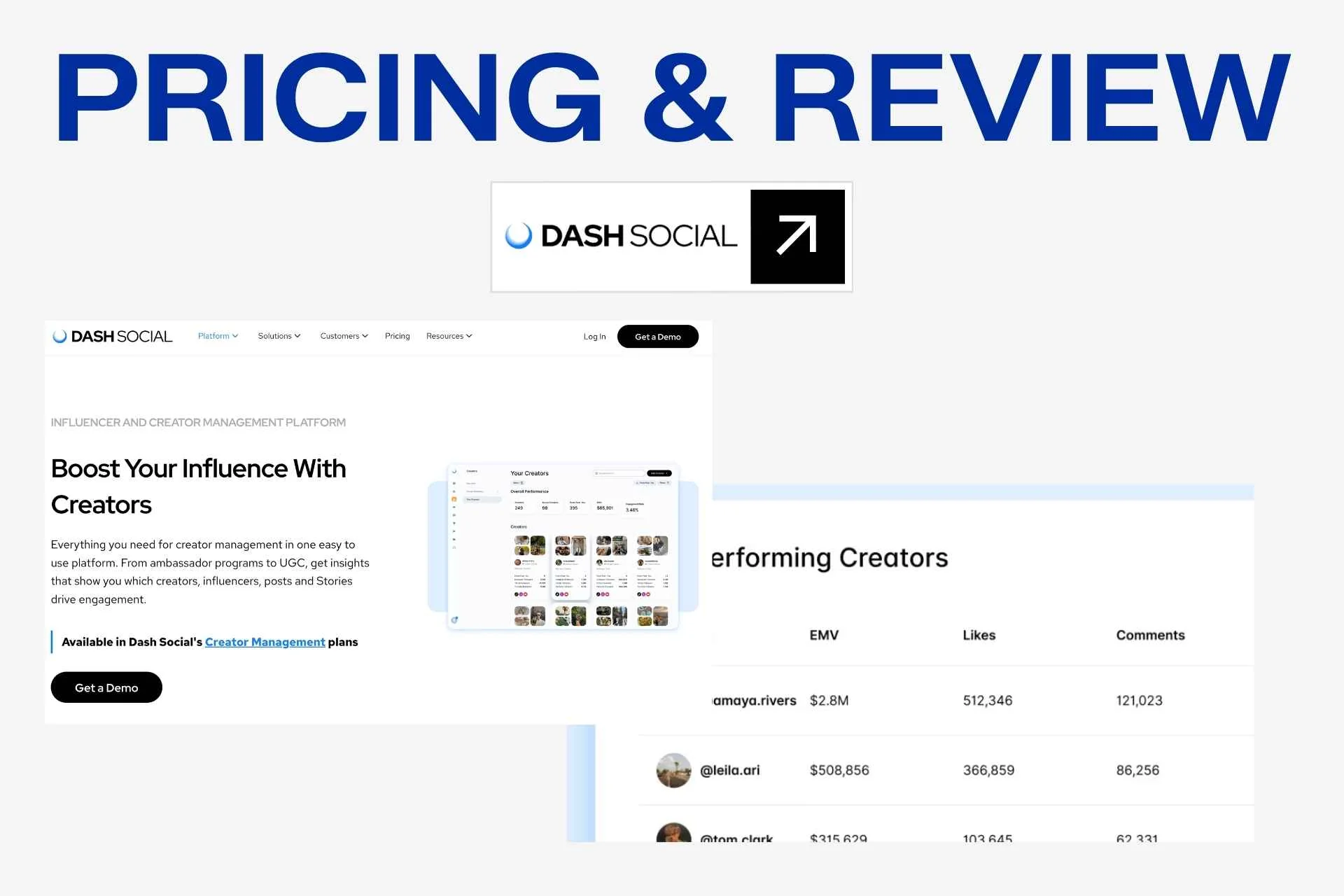
Dash Social Pricing and Review: Features, Pros, Cons & Costs
The number on the pricing page is $999 a month. The median annual contract, according to procurement data collected by Vendr, is $36,000. Both figures describe the same platform, and the distance between them is the first thing to understand before booking a demo.
The second thing is what that spend does and does not include. Dash Social, called Dash Hudson until it rebranded in early 2025, is a social media management platform first. Creator Management launched in 2025 as a separate module the company says took seven figures to build, and it is sold as a paid add-on with no published price on it. So the $999 tier does not include influencer marketing. Neither does the $1,999 tier above it.
What follows is what each plan costs, what the creator module actually does, how the annual maths compares against a dedicated influencer platform, and where Dash Social stops regardless of what you pay.
Dash Social Overview
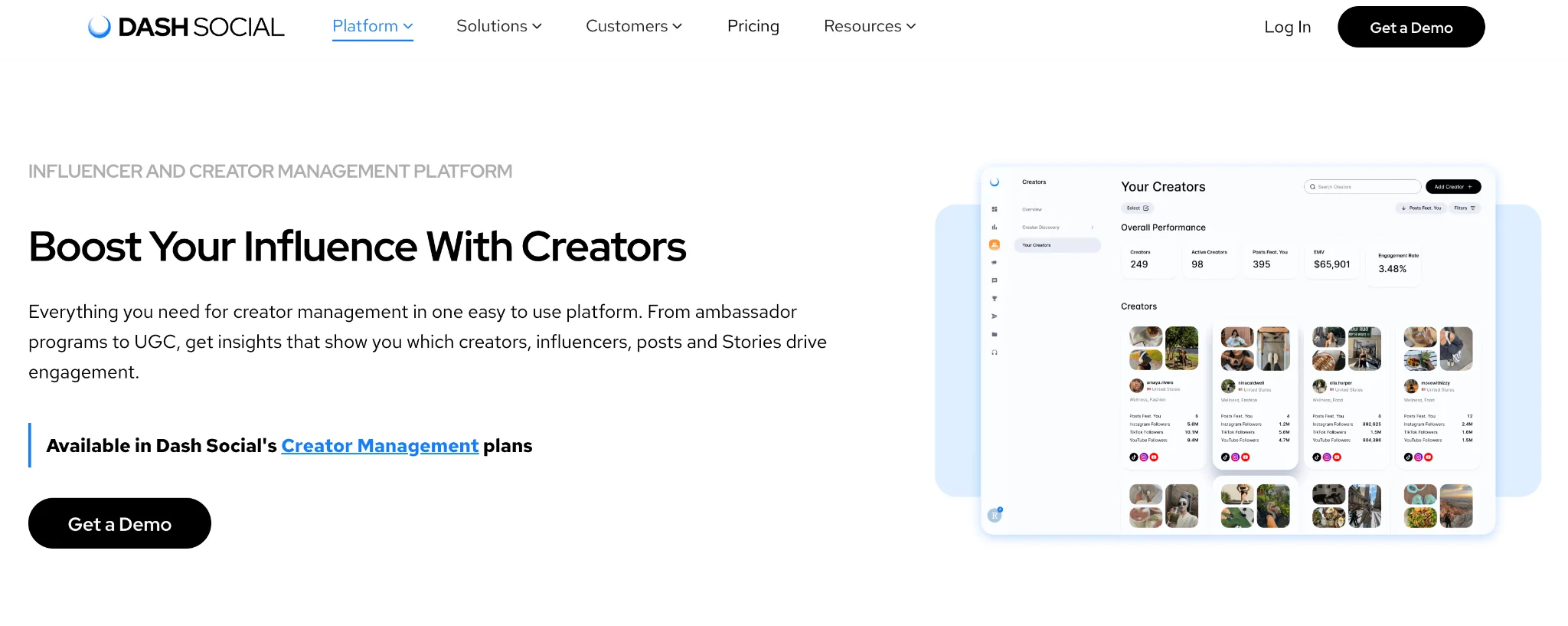
Dash Social was founded in Halifax in 2013 by Thomas Rankin and Tomek Niewiarowski, originally as a mobile shopping app for Instagram. It pivoted to subscription analytics in the mid-2010s, launched its Vision AI computer vision engine in 2017, became a Meta integration partner and TikTok Marketing Partner in 2022, and added Creator Management and a Total Social Impact metric in 2025. Amazon, Estée Lauder and Unilever are named among its customers.
The product covers nine channels: Instagram, Facebook, TikTok, YouTube, Pinterest, LinkedIn, Threads, Snapchat and Bluesky. Publishing, scheduling, community management, competitive benchmarking and analytics are the core, and they are strong enough that the platform ranks 4.7 on G2 across 410 reviews. This is a mature social suite, not a startup product.
Creator work sits on top of that foundation and inherits its logic. Dash Social measures influencer partnerships in Earned Media Value and content performance rather than orders and commission, which tells you who it was built for. A brand and communications team measuring reach and sentiment will find the reporting excellent. A performance team that needs to know which creator produced which sale is looking at a different problem than the one this platform solves.
Who Should Use Dash Social
Fit here comes down to one question: is social media management the main purchase, with creators attached, or the other way round?
- Brand and social teams consolidating publishing, analytics and creators. If those budgets already sit together, one contract across nine channels is a clean answer.
- Large teams, because seats are unlimited on every plan. A twenty-person social department pays the same as a three-person one, which is unusual at this price level.
- Brands that report on reach, sentiment and EMV. Total Social Impact and cross-channel benchmarking are built for that scorecard.
- Teams with a data function. The BI connectors are the best part of the integration surface, and a brand with an analyst will get far more out of them than one without.
- Companies wanting to try before buying. A 14-day free trial at this contract size is rare and worth using properly.
- Enterprises needing governance. User access controls, custom SSO and regional reporting only appear at the Enterprise tier, and they are real procurement requirements.
Key Features
Creator Discovery and Vetting
Search and filtering backed by verified API data rather than scraped estimates, which matters for audience figures a brand is going to defend internally. Coverage follows the wider platform across TikTok, Instagram, Facebook, Pinterest, YouTube, LinkedIn, Threads and Snapchat. What it does not include is audience authenticity scoring or fake follower screening, so vetting here means checking performance, not checking whether the audience is real.
Campaign and Deliverables Tracking
A dashboard tracks contracted and gifted campaign content, monitoring whether posts went live on schedule and how they performed against agreed metrics. It is organised around campaigns rather than around a creator pipeline, which suits a brand running a handful of large activations better than one managing rolling always-on partnerships.
Earned Media Value and Total Social Impact
EMV is the headline creator metric, calculated per partnership so brands can rank who moved the needle and who did not. Total Social Impact, added in 2025, rolls owned and creator activity into a single cross-channel score. Both are useful for board reporting and neither is revenue. If your CFO wants cost per acquired customer, you will be pairing this with campaign reporting and ROI tracking that reconciles against store data.
Vision AI Performance Prediction
The oldest piece of proprietary technology in the product, dating to 2017. Vision AI scores photos and videos against your specific audience and predicts which assets will perform before they are published, including creator content you are deciding whether to repurpose. It is the genuine differentiator and the reason brands stay.
UGC Requests, Rights and Galleries
Unlimited UGC requests and gallery publishing arrive at the Advance tier, letting teams request permission for creator and customer content and push approved assets onto the site. Rights handling being built in rather than run over DM is the difference between a content library and a legal problem discovered later.
Cross-Channel Publishing and Community Management
Scheduling, a drag-and-drop calendar, link in bio and a unified inbox across all nine channels. Reviewers name the calendar more than any other feature. They also name Instagram as the weak point, with Reels auto-posting and Story scheduling drawing repeated complaints tied to API limits.
Competitive Benchmarking and Custom Dashboards
Advance and above unlock competitor benchmarks, custom dashboards and Vision AI trend prediction. Market-level benchmarking is Enterprise only. This is the tier ladder in a nutshell: the entry plan publishes and measures, everything analytical starts one level up.
Gifting Logistics Through Shopify
The Shopify connection handles gifting workflows and creator campaign logistics, so product send-outs and the content that follows sit in the same place. It is a real capability, though narrower than what dedicated gifting and product seeding platforms offer, and Shopify is the only eCommerce platform supported.
Dash Social Pricing
Dash Social publishes real numbers, which puts it ahead of most enterprise social vendors, and then puts the creator module outside those numbers. Engage and Advance carry monthly prices. Enterprise is custom. Creator Management, Premium Analytics and Social Listening are all listed as add-ons with capability descriptions and no figures.
Every plan includes unlimited users and one social set per brand, a social set being the group of profiles you connect for a single brand across platforms. Additional brands are purchased separately, which is the detail that quietly multiplies the bill for anyone managing a portfolio.
Engage
- $999 per month, which is $11,988 a year at the published rate.
- Unlimited users and one social set per brand.
- Social planning and publishing, cross-channel analytics, community management, link in bio, content library and onboarding.
- No custom dashboards, no Vision AI trends, no competitive benchmarks and no third-party integrations.
- Creator Management is not included at this tier or any other. It is a separate add-on.
Advance
- $1,999 per month, or $23,988 a year, and marketed as the most popular plan.
- Everything in Engage plus custom dashboards, Vision AI trends and predictions, competitive benchmarks, unlimited UGC requests, galleries and third-party integrations.
- The step up costs an extra $12,000 a year and buys analytics and content capability, not creator capability.
- Third-party integrations, including the BI connectors that make the data portable, start here. That is worth checking against your requirements before choosing Engage on price.
Enterprise
- Custom pricing with no published figure.
- Adds regional and brand-level reporting, user access governance, market-level benchmarks, premium onboarding, quarterly business reviews and custom SSO.
- This is the tier multi-brand groups land on, since each additional brand needs its own social set.
Add-Ons and Billing Terms
- Creator Management, Premium Analytics and Social Listening are all sold separately, and none of the three carries a published price.
- 14 days of free, no-commitment access, with charges beginning only if you continue. That is a genuinely useful trial length at this contract size.
- Payment by credit card, Bill.com or wire transfer. Annual contracts are standard and annual prepayment is the norm, with multi-year deals typically discounted.
- Onboarding fees, module add-ons and annual price escalations are commonly reported by buyers as costs on top of the base subscription. None appear on the pricing page.
What a Creator Program Actually Costs Here
- The floor for a brand wanting Dash Social for creators is a platform plan plus the add-on: $11,988 a year before Creator Management is quoted at all.
- Procurement data puts the median signed contract at $36,000 a year, with a typical range of roughly $17,800 to $39,400. That is three times the published entry price, and the gap is where add-ons, extra brands and onboarding live.
- A dedicated all-in-one influencer platform runs about $7,788 a year at $649 a month with creator functionality included, not bolted on. Against the median Dash Social contract that is a difference of roughly 4.6 times.
- Buyers negotiating with competitive quotes in hand report averaging around 16% off, so the list price is not the finish line. Bring an alternative quote to the table.
- Ask for the Creator Management figure in writing before the platform quote is anchored. Asking afterwards is how the add-on gets priced against a budget you have already revealed.
Dash Social Reviews
The evidence base is genuinely strong in one place and thin everywhere else, so weight it accordingly.
- 4.7/5.0 (G2, 410 reviews)
- 8.9/10 (TrustRadius, low review volume at 5 reviews)
- 3.0/5.0 (Capterra, low review volume at 2 reviews, still listed under the Dash Hudson name with outdated pricing)
The G2 score is the one that counts, and 410 reviews at 4.7 is a serious result. Reviewers consistently name the interface, the drag-and-drop scheduling calendar, the depth of the analytics and the responsiveness of account managers. Having publishing, analytics, content and collaboration in one place instead of four tools comes up repeatedly as the reason teams consolidated.
The complaints are specific and several of them land on the creator side. Instagram is the recurring problem: Reels auto-posting, Story scheduling and engagement tracking all draw criticism, much of it attributed to platform API limits rather than Dash Social itself. Data accuracy on TikTok analytics and sentiment tracking is questioned by some reviewers. And in a list of feature gaps, users name influencer analytics alongside community management and real-time trend spotting, which is a pointed thing to say about a module the company spent seven figures building.
Integrations
This is the strongest part of the platform for a data-led team, and the weakest for a revenue-led one. The published directory is substantial, but look at what it is weighted toward.
- Shopify. Gifting workflows and creator campaign logistics, and the only eCommerce platform supported anywhere in the product.
- Tableau, Looker, Power BI and BigQuery. The genuine standout. Social and creator data flows into an existing BI environment rather than being trapped in vendor dashboards.
- Salesforce and Zendesk. Routes social conversations into CRM and support workflows, aimed at customer experience teams rather than marketing.
- Klaviyo and Mailchimp. Lead sync and segmentation, so social-sourced contacts land in lifecycle flows.
- Google Analytics and Bitly. Click tracking and attribution connecting social activity back to site traffic.
There is also a public API surface covering dashboards, community and post-level stats, plus an MCP integration for feeding brand data into AI tools. What is absent is the commerce layer beyond Shopify: no WooCommerce, no BigCommerce, no Magento, and no named affiliate network, commission platform or creator payment provider. Remember that third-party integrations start at the Advance tier, so an Engage subscription does not get any of this.
Pros of Dash Social
Published Prices and a Real Free Trial
Two tiers carry actual monthly figures and every plan comes with 14 days of no-commitment access. In a category where the standard move is a revenue-qualified demo form followed by a quote calibrated to what you said you spend, publishing $999 and $1,999 and letting buyers test before signing is a meaningful transparency advantage. It is not the whole price, but it is more than most competitors offer.
Unlimited Users on Every Plan
Cost scales on capability and on how many brands you run, not on headcount. A social team that grows from four people to twenty pays exactly the same subscription. Per-seat pricing is how software bills quietly double over a three-year contract, and removing that variable makes the spend far easier to forecast.
Analytics That Leave the Platform
The BI connector set covering Tableau, Looker, Power BI, BigQuery, AWS S3 and Airtable, alongside a documented API, means your social and creator data can live in the warehouse next to everything else. Most social platforms in this bracket give you dashboards and a CSV export. Being able to model creator performance against your own commercial data is a different class of capability, and the 4.7 G2 score across 410 reviews suggests the analytics underneath it hold up.
Cons of Dash Social
You Reach $11,988 a Year Before Creator Management Is Priced
The published tiers buy social media management. Influencer work is an add-on with no figure attached, which means the entry cost for a creator program is a platform subscription plus an unknown. Procurement data puts the median signed contract at $36,000 a year, three times the headline, and onboarding fees and annual escalations are commonly reported on top. A brand budgeting from the $999 number will not recognise its own quote.
One Social Set Per Brand, and Extra Brands Cost Extra
Unlimited users looks generous until you notice the axis the pricing actually scales on. Each plan covers one brand, and additional brands are purchased separately. A group running four labels is buying four sets of everything, and that multiplication is not published anywhere, which is a large part of why the median contract sits so far above the entry price.
No Affiliate Codes, Commissions or Creator Payouts
The creator module discovers, briefs, tracks deliverables and measures Earned Media Value. It does not issue unique discount codes, does not create affiliate links, does not calculate commission and does not pay creators. There is no fake follower screening in discovery either. A performance-led program needs affiliate links and creator payouts running underneath this, which means a second platform and a second contract.
The Creator Module Is New, and Reviewers Notice
Creator Management shipped in 2025, so it is competing against tools with years of iteration behind them. Users listing feature gaps name influencer analytics specifically, alongside community management and trend spotting. Add the recurring Instagram Reels and Story scheduling complaints and the questions about TikTok data accuracy, and the picture is a very good social suite with a creator product still catching up. Ask for a live walkthrough of the module rather than the platform demo, because they are not the same product.


Is Dash Social Worth It?
As a social media management platform, yes, and the review base backs that up. Nine channels, unlimited seats, a scheduling calendar people actively praise, Vision AI performance prediction that nobody else has, benchmarking that stands up in a board deck, and a BI connector set that lets an analyst take the data anywhere.
As influencer marketing software bought on its own, it is the wrong shape. You pay $11,988 a year minimum for a platform whose creator module is quoted separately, land near a $36,000 median contract, and get discovery without authenticity screening, measurement in EMV rather than revenue, no affiliate codes, no commission tracking, no creator payments and Shopify as the only eCommerce connection. That is a measurement layer for a creator program you would still be operating somewhere else.
Brands buying the creator program itself rather than the suite around it should price these:
- Influencer Hero. Discovery across eight platforms with fake-follower screening, lookalike search and brand-follower identification, automated outreach with drip sequences, creator relationship management boards, affiliate links, commissions and payouts, and gifting through Shopify, WooCommerce or custom stores via script. Publicly listed plans start at $649 a month with no revenue share and no add-on needed to unlock the creator features.
- Afluencer. An Instagram creator marketplace where influencers apply to your campaign listings instead of you searching for them, from $49 a month. The right call when the constraint is creator supply rather than reporting depth.
- CreatorIQ. Enterprise creator management with deep integrations and governance, aimed at the same buyer profile but built around the influencer program rather than around social publishing.
- Lefty. Creator marketing with strong gifting and seeding workflows, popular with beauty and fashion brands running high-volume send-outs.
- Influencity. Discovery and audience analysis with authenticity checks, useful when the priority is vetting creators properly before any money moves.
Final Thoughts
Three numbers decide this one. $999 is what the pricing page says, $11,988 is what a year of the entry plan costs before Creator Management is quoted, and $36,000 is what the median buyer actually signs. If your team was going to purchase enterprise social management regardless, and creator work is one workstream inside a brand and social remit measured on reach and sentiment, those numbers buy a very good product and the add-on is a reasonable extension of it. If creators are the purchase, the arithmetic works against you from the first quote and gets worse with every additional brand. Get the add-on price in writing, run the 14-day trial on the creator module specifically rather than the publishing suite, and put a quote from the Dash Social alternatives built for creator programs next to it before anyone signs an annual prepay.

.png)


.jpg)










