

CrewFire Pricing and Review: Features, Pros, Cons & Costs
The button on CrewFire’s homepage says Get Started For Free. Every software listing that carries its pricing puts the entry plan at $1,000 a month with a $1,000 setup fee attached. Both of those things are currently true, and the distance between them is the first thing to resolve before booking a call.
CrewFire is a brand ambassador platform, founded in 2015 in the US, built on a simple premise: your existing customers will promote you if you give them a reason, a structure and a way to get paid. Points, rewards, referral tracking, UGC campaigns, community boards and payouts by PayPal or ACH all sit under one roof, with Shopify, WooCommerce and Magento connected underneath.
It is also a platform visibly in transition, and that matters more to a buyer than the feature list. Below is what it does, what the published tiers actually cost, why the review record is almost non-existent, and the specific questions to ask so you find out which version of this product you are being sold.
CrewFire Overview

The core product is ambassador program management, and it is built around gamification rather than around discovery. Customers apply through a branded signup form, join a community, complete activities such as sharing content or posting UGC, earn points, and cash out. The design assumes you already have an audience that likes you, which is a very different starting point from a platform that hands you a database of strangers.
Activity types are the substance here. Referral and affiliate tracking rewards ambassadors for driving sales, UGC campaigns mobilise them to create content, Instagram engagement campaigns push likes, comments and views, and content sharing campaigns spread brand posts across their networks. Ambassadors can be tiered into teams for special campaigns, and recruiting links let existing ambassadors bring in new ones and get rewarded for it. Community message boards sit alongside, explicitly pitched as an ambassador community you own rather than one rented from Facebook.
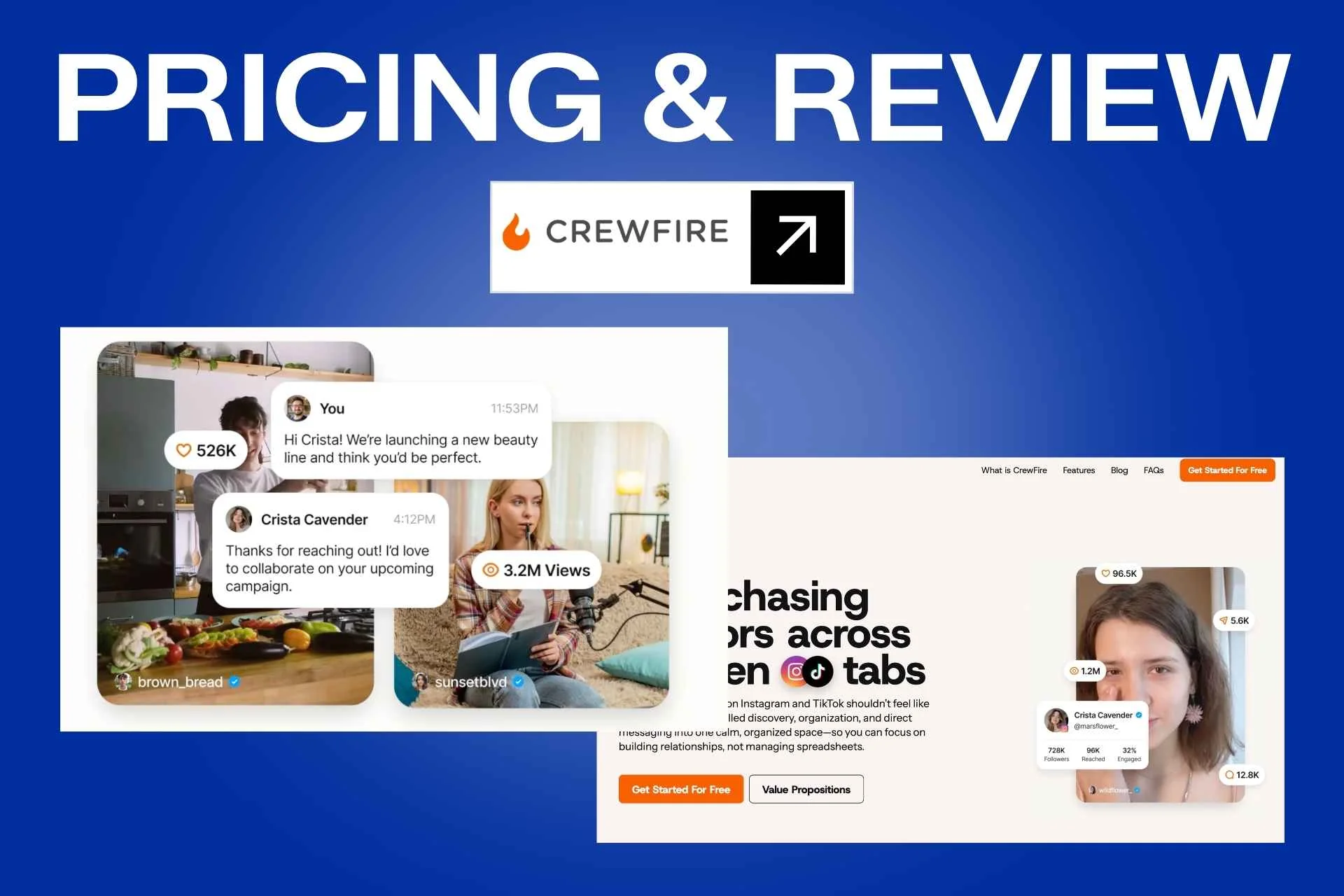
What complicates the evaluation is that CrewFire’s own site now leads with influencer marketplace and recruiting language, describing creator management across Instagram and TikTok with grouping, direct messaging and API access, while its feature pages and every third-party listing describe the ambassador product with Instagram, Facebook and Twitter. Both appear to be live. Treat that as a question for the sales call rather than a contradiction to resolve from outside, and make sure the demo shows the product you actually intend to buy. Brands whose real need is product seeding should compare against dedicated gifting and seeding platforms before assuming this covers it.
Who Should Use CrewFire
The fit is narrow and it depends almost entirely on whether you already have a community worth mobilising.
- Brands with a large, engaged customer base. This converts existing customers into promoters. With no base to convert, the platform has nothing to work with.
- Programs running hundreds or thousands of ambassadors. The tiers start at 500 ambassadors and reach 5,000, and the automation only pays off at volume that breaks a spreadsheet.
- Teams that want a community they control. Owned message boards instead of a Facebook group is a real strategic difference, particularly for brands that have lost reach on rented platforms before.
- Brands rewarding engagement, not just sales. Points for shares, comments and content are unusual; most tools only track a purchase.
- Companies that need ambassadors paid directly. PayPal and ACH payouts run inside the platform rather than through a spreadsheet and a finance request.
- Not brands that need to find creators. There is no discovery database in the ambassador product, so a brand starting from zero is buying the wrong tool.
Key Features
Affiliate and Referral Tracking
Ambassadors get trackable links and codes, and sales attributed to them feed the rewards system. This is the part that makes the program measurable in revenue rather than in activity, and it connects to Shopify, WooCommerce and Magento so attribution happens against real orders rather than self-reported claims.
Points and Rewards
The gamification engine underneath everything. Ambassadors earn points for completing activities and redeem them for cash or perks. Points-based systems sustain participation between campaigns better than one-off payments do, which is the whole argument for running an ambassador program rather than a series of paid collaborations.
UGC Campaigns
Ambassadors are briefed to create and share content, with brand assets distributed through the platform. For a brand whose creative bottleneck is volume rather than quality, a few hundred ambassadors producing content is a genuinely different supply model, though what arrives needs somewhere to live, which a UGC content library normally handles.
Instagram Engagement and Content Sharing Campaigns
Campaigns can target likes, comments and views on brand posts, or push ambassadors to share brand content to their own networks. This is the most double-edged capability in the product. Coordinated engagement can look inorganic to both platforms and audiences, so it wants using with restraint rather than as a default tactic.
Ambassador Teams and Tiers
Ambassadors can be grouped into teams and tiered for specific campaigns, so your fifty best performers can be treated differently from the long tail. Segmentation is what stops a large program becoming a single undifferentiated blast, and it is the feature that makes 5,000 ambassadors manageable rather than theoretical.
Payouts by PayPal and ACH
Ambassadors cash out without leaving the platform, through PayPal or bank transfer. Paying several hundred people small variable amounts is the administrative task that quietly kills ambassador programs run on spreadsheets, and handling it natively is a real operational saving.
Community Message Boards
An owned community space rather than a Facebook group. The pitch is control: your ambassador community is not subject to another platform’s reach algorithm or account policies. For brands that have watched a Facebook group’s organic reach collapse, that argument lands.
Signup Forms, Custom URLs and Recruiting Links
Embeddable application forms, branded domains for the ambassador experience, and referral links that reward existing ambassadors for recruiting new ones. Together these make the program self-serve and self-growing, which is what keeps a 5,000-person roster from requiring a full-time coordinator.
CrewFire Pricing
CrewFire does not publish pricing on its own website. The only cost signal there is a Get Started For Free call to action, and no rate card, tier list or starting figure appears anywhere public on the site.
Software listings do carry figures, and the ones that agree describe three tiers gated by ambassador count and admin seats, at $1,000, $2,000 and $4,000 a month, or $10,000, $20,000 and $40,000 billed annually, with a $1,000 setup fee that is waived when you pay annually. Those listings also state there is no free version, which sits awkwardly beside the free signup button on the site itself. One older listing quotes a much lower starting figure, which appears to predate the current structure.
Read the table as the documented shape of the pricing rather than a quotation, and get the current rate in writing from the vendor before budgeting against it.
Starter
- Listed at $1,000 a month, or $10,000 billed annually, which works out at about $833 a month.
- Up to 500 ambassadors and 2 admin seats.
- Unlimited activities and rewards, email and SMS broadcasts, custom branding.
- Paying annually saves roughly $2,000 a year and waives the $1,000 setup fee, so the effective difference is closer to $3,000.
Growth
- Listed at $2,000 a month, or $20,000 billed annually.
- Up to 1,500 ambassadors and 5 admin seats.
- Adds a custom domain and the ability to connect multiple brand Instagram accounts.
- The jump costs an extra $10,000 a year and buys capacity plus two features, so the ambassador ceiling is what should drive this decision.
Business
- Listed at $4,000 a month, or $40,000 billed annually.
- Up to 5,000 ambassadors and 10 admin seats.
- Adds advanced reporting and advanced integrations.
- Reporting depth sitting on the top tier is worth noting, since analytics are a documented weak point of the product.
What the Numbers Mean Per Ambassador
- Starter works out at $20 per ambassador per year at the full 500, or $24 a year on monthly billing. That is the metric to judge it on, not the monthly figure.
- Growth costs about $13 per ambassador per year at capacity, and Business about $8. The unit economics improve sharply with scale, which is the argument for the larger tiers.
- Running at half capacity doubles the unit cost. A brand with 250 active ambassadors on Starter is paying $40 a head a year, so recruitment is what makes the subscription defensible.
- The setup fee is a real number. $1,000 on top of a $1,000 first month means the monthly route costs $2,000 to begin. Annual billing removes it entirely.
- Budget the rewards separately. Every figure above is software only. Points, cash payouts and product all sit on top, and in a working program they usually exceed the subscription.
CrewFire Reviews
There is almost no independent review base, which for a company founded in 2015 is unusual and worth weighing.
- 4.5/5.0 (G2, very low review volume at 2 reviews)
- 5.0/5.0 (GoodFirms, very low review volume at 2 reviews)
- Capterra and Trustpilot: no listing found.
Four reviews across two sites is not a sample, it is anecdote, and no average calculated from it should carry weight in a five-figure decision. What the reviews do contain is directionally consistent: reviewers praise ease of use, describe the team as responsive and actively adding features, and specifically credit the platform’s ability to manage thousands of ambassadors, which is the claim most worth verifying and the one a reviewer is best placed to confirm.
The criticism is thinner but not absent. One reviewer questions the platform’s trajectory, describing it as gradually falling below par and urging the company to partner with more brands. Another notes minor glitches in a newer version. Elsewhere, the most consistent limitations attributed to the product are the absence of influencer discovery and shallow ambassador analytics. For a platform at this price, ask for customer references directly rather than relying on public reviews, because there are not enough of them to rely on.
Integrations
The integration surface is narrow but pointed at exactly the right place for a D2C brand, which is the store.
- Shopify. Order and referral attribution against real transactions rather than self-reported sales.
- WooCommerce. The same for WordPress-based stores, which many ambassador platforms skip entirely.
- Magento. Rarely supported at this end of the market and useful for larger or older store builds.
- PayPal and ACH. Ambassador payouts handled natively, covering both the fast route and the cheap one.
- Social platforms. Instagram, Facebook and Twitter in the ambassador product, with the newer marketplace positioning describing Instagram and TikTok. Confirm which networks the version you are buying actually supports.
What is absent is the wider marketing stack. No published API in the ambassador product, no Zapier connector, no named email or analytics integrations, so ambassador data does not flow into Klaviyo, a warehouse or a BI tool without manual export. Advanced integrations are listed as a Business tier feature, which is worth pinning down specifically since the term is not defined publicly.
Pros of CrewFire
Built for Volume Other Ambassador Tools Cannot Reach
Five thousand ambassadors, ten admin seats, team tiering and self-serve recruiting links make this one of the few platforms designed for a genuinely large community rather than a curated roster. The reviewers who exist specifically credit managing thousands of ambassadors, and that capacity is the product’s clearest differentiator.
Rewards Engagement, Not Only Sales
Points for shares, comments, views and content mean ambassadors stay active between purchases rather than only when there is a commission to earn. Most tools in adjacent categories only track a sale, which quietly limits the program to people already good at selling rather than people good at advocating.
Store Attribution and Payouts in One Place
Shopify, WooCommerce and Magento connect to referral tracking, and PayPal or ACH pay ambassadors without leaving the platform. That closed loop from activity to attributed order to payment is what separates a real program from a spreadsheet exercise, and it is unusual to find all three sides handled natively.
Cons of CrewFire
Nothing Is Priced on the Site, and the Listed Figures Start at $1,000 a Month
The homepage offers free signup while software listings put the entry tier at $1,000 a month plus a $1,000 setup fee, and describe no free version at all. A buyer cannot reconcile that from outside, which means the first reliable number arrives in a sales conversation. Get the tier, the ambassador cap, the setup fee and the contract term quoted in writing before you disclose a budget, and ask directly what the free signup actually includes.
The Product Positioning Has Shifted and the Materials Have Not Caught Up
The site now leads with influencer marketplace and recruiting across Instagram and TikTok, while the feature pages and every listing describe ambassador program software across Instagram, Facebook and Twitter. That is a meaningful difference in what you would be buying. Insist the demo covers the exact capabilities you need, and confirm in writing which social networks and which modules are included in the quoted tier.
No Discovery and Shallow Analytics
There is no influencer discovery database in the ambassador product, so this manages people who already know you and finds nobody new. Reporting is also a documented weakness, with advanced reporting gated to the top tier. Brands that need to prove program value will want proper campaign reporting and ROI tracking alongside it, which is a second subscription on top of a five-figure one.
Four Public Reviews for a Company Founded in 2015
Two on G2, two on GoodFirms, none on Capterra or Trustpilot. For a decade-old platform asking $10,000 a year minimum, that is a thin evidence base, and it means no independent account exists of how the product performs at scale or how the company handles a program that goes wrong. Ask for three customer references running programs comparable to yours in size, and speak to them.


Is CrewFire Worth It?
For a brand with a large, genuinely engaged customer base and a serious intention to run an ambassador program at scale, the capability is real. Five thousand ambassadors under management, activity types that reward engagement rather than only sales, team tiering, an owned community space, store attribution across Shopify, WooCommerce and Magento, and native payouts. Very little else in this category is built for a roster that size, and at the Business tier the unit cost works out around $8 per ambassador per year.
The reservations are about evidence and clarity rather than capability. Pricing is absent from the vendor’s site while listings start at $1,000 a month plus setup, the product positioning has visibly shifted without the materials aligning, there is no discovery and analytics are thin, and four public reviews is not enough to verify any of it. At this price that combination argues for references and a written scope before a signature. Brands weighing it should also price these:
- Influencer Hero. Discovery across eight social platforms with Instagram, YouTube and TikTok emphasised, plus fake follower screening, creator CRM boards, gifting through Shopify and WooCommerce, affiliate codes and payouts. Publicly listed from $649 a month.
- Afluencer. A creator marketplace from $49 a month where influencers apply to your campaign listings. The right call when the gap is finding people rather than organising the ones you have.
- SocialLadder. Ambassador program management with strong task and reward workflows, built for brands running community-led programs at event and retail scale.
- BrandChamp. Ambassador and affiliate management with published pricing and eCommerce integrations, aimed at brands that want the same job done with a transparent rate card.
- Roster. Community-driven ambassador and UGC management for Shopify brands, suited to teams converting customers into content creators.
Final Thoughts
Two things need settling before cost even enters the conversation. First, which product you are buying, because the site and the documentation currently describe different ones, and the answer determines which social networks and which modules you get. Second, how many customers would actually join and stay active, since every tier prices on ambassador capacity and running at half capacity doubles your real cost per head. Once those are answered, ask for the tier, setup fee, contract term and definition of advanced integrations in writing, and ask for three references running programs the size of yours. If the answers are solid and your community is large enough to fill the tier, this does something few competitors attempt. If your community is still hypothetical, the CrewFire alternatives that help you find creators rather than organise them are the better place to spend the first year.

.png)


.jpg)