


10 Best Social Nature Alternatives for Influencer Marketing
Start with the eligibility rule, because it decides the whole question. Social Nature asks brands to have distribution in at least 300 brick-and-mortar stores that accept manufacturer coupons. If you sell from your own store and a marketplace listing, you do not qualify, whatever the rest of the platform can do.
For the brands that do qualify it is a coherent product. A community of more than a million better-for-you shoppers gets geo-targeted offers near stores that stock you, buys the product, uploads the receipt for cash back and writes a review. The output is retail velocity and verified reviews on retailer sites.
What it never produces is creator content, an affiliate program or a roster you own. The people in that community are shoppers, not creators. Nothing here is filmed, briefed, licensed for paid media or paid a commission, and there is no published price to compare against anything.
Ten alternatives follow in this order: Influencer Hero, CreatorIQ, Upfluence, Aspire, Afluencer, SARAL, IMAI, Brandbassador, Lefty and Insense.
Key Criteria for Evaluating Influencer Marketing Platforms
Core Features
Evaluation of essential influencer marketing capabilities, including influencer discovery, outreach, CRM, campaign management, reporting, and content workflows.
Pricing & Flexibility
Comparison of pricing models, subscription plans, and contract terms to match different budgets and growth stages.
Customer Reviews & Satisfaction
Analysis of user feedback from trusted review platforms, focusing on usability, reliability, customer support, and overall performance.
Pros & Cons
Review of each platform’s strengths and limitations to highlight where it performs well and where it may fall short based on different use cases.
Integrations
Review of the most important integrations (e.g., Shopify and other tech tools), highlighting what each integration enables in one sentence.
Social Nature Overview
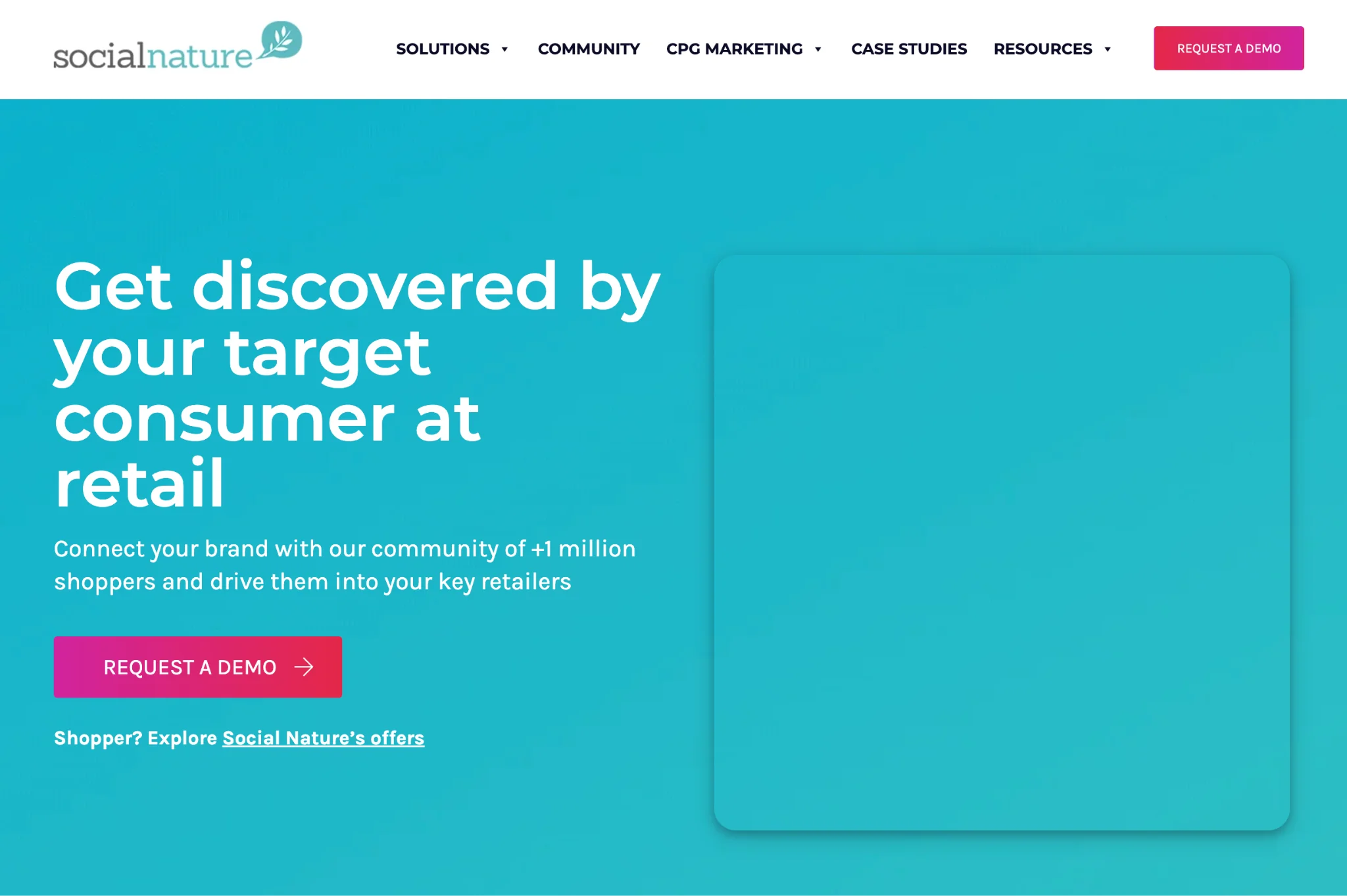
Social Nature is a digital product sampling platform for natural and better-for-you CPG brands. The mechanic is online-to-offline: an offer goes live to its shopper community, targeting is narrowed to people near stores that stock you, the shopper buys in store and uploads a receipt for up to 100% cash back, then writes a review. Brands can also run direct-to-home and eCommerce sampling rather than in-store.
Around that sit two supporting products. A consumer insights dashboard shows redemptions by retailer, region and individual store, with filters to compare your product against competitors. A ratings and reviews layer syndicates the resulting reviews out to retailer sites, Amazon and your own pages. The company states over 1,000 CPG brands served and more than 500 retailers that can be targeted, though a brand that sells mainly online will find the creator database approach a closer fit than a coupon-redemption one.
Key Features
- 1M+ shopper community: Health-minded consumers who opt in to try natural and better-for-you products.
- Geo-targeted offers: Campaigns aimed at shoppers near specific stores across 500-plus retailers.
- Receipt-verified cash back: Shoppers buy in store and upload the receipt for up to full reimbursement.
- Review syndication: Resulting reviews pushed to retailer sites, Amazon and brand pages through API connections.
- Store-level reporting: Redemptions broken out by retailer, region and individual location in real time.
Pricing
Nothing published. There is no rate card, plan list or minimum spend on the site, and campaigns are quoted after a consultation. A partner listing references an annual plan with data and set-up fees, which suggests the structure without giving a figure, so the cost cannot be estimated without a sales conversation.
Reviews
No verifiable brand-side rating. Social Nature appears on G2 as a product but shows no score or review count, and there is no Capterra listing. Its own pages also state the reviews generated to date inconsistently, at 3.7 million in one place and roughly 1.2 million in another.
Integrations
- Retailer accounts: Offers targeted at 500-plus retailers including Whole Foods, Sprouts, Walmart and Target.
- Review platform APIs: Collected reviews syndicated into the major ratings and reviews systems.
- Amazon: Reviews placed against your listings alongside retailer sites.
- Direct-to-home fulfilment: Physical sampling shipped rather than redeemed in store.
- eCommerce platforms: No named Shopify or WooCommerce app, so nothing connects to your own store.
Pros
- Buyers, not browsers: Every participant purchases the product with their own money before being reimbursed.
- Retail velocity is the metric: Reporting speaks the language of a category buyer rather than a social team.
- Reviews at real scale: Verified-purchase reviews syndicated where shoppers actually read them.
Common Drawbacks of Social Nature
The 300-store gate rules most brands out
Brands need distribution in at least 300 physical stores accepting manufacturer coupons. A D2C business selling through its own site cannot use the core product at all, regardless of budget or category fit.
Shoppers are not creators
The community writes reviews and redeems coupons. Nobody is briefed, nobody films to a spec, and no usage rights are licensed, so there is no asset to run behind paid media afterwards.
No price and an annual structure
Nothing is published anywhere. The only public hint is a partner listing mentioning annual plan data and set-up fees, which points to a yearly commitment rather than a campaign you can test once.
Nothing to evidence it independently
There is no rating on G2 or Capterra, and the platform’s own review-volume figures disagree between its pages. For a purchase sold on trust in a community, that is thin ground.
Best Social Nature Alternatives
| TOOL | REVIEWS | BEST FOR | TRIAL INFO | PRICING | ||
|---|---|---|---|---|---|---|
1 |

|
⭐ | Influencer CRM & automation | Book Demo | Pricing | Website |
2 |

|
⭐ | Enterprise influencer marketing | Book Demo | Pricing | Website |
3 |

|
⭐ | Influencer discovery | Book Demo | Pricing | Website |
4 |

|
⭐ | Influencer partnerships | Book Demo | Pricing | Website |
5 |

|
⭐ | Influencer marketplace campaigns | Book Demo | Pricing | Website |
6 |

|
⭐ | Influencer outreach | Book Demo | Pricing | Website |
7 |

|
⭐ | AI influencer discovery & analytics | Book Demo | Pricing | Website |
8 |

|
⭐ | Ambassador Marketing | Book Demo | Pricing | Website |
9 |

|
⭐ | Influencer analytics & discovery | Book Demo | Pricing | Website |
10 |

|
⭐ | UGC creators & paid social ads | Book Demo | Pricing | Website |
Influencer Hero
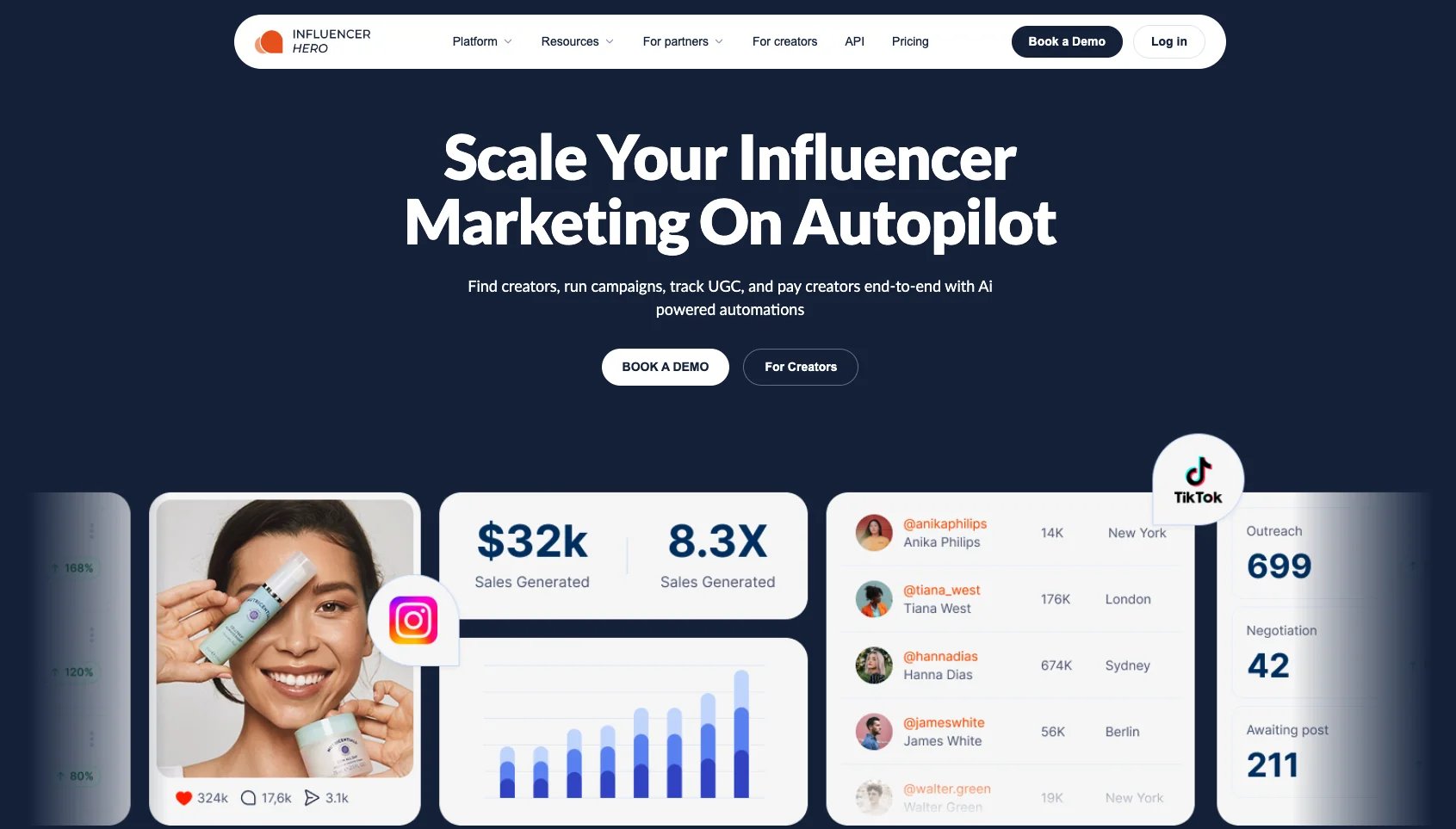
Influencer Hero is an all-in-one influencer marketing platform for D2C and eCommerce brands across 8 social platforms, with Instagram, TikTok and YouTube leading. It handles the full sequence: find creators, contact them, send product from your own store, collect the content, attribute the revenue and pay out. Pricing is published and sized by outreach volume.
Key Features
- Influencer gifting: Product orders raised in Shopify or WooCommerce at $0 value and tracked to delivery.
- Creator discovery: Over 20 filters and AI search across eight networks.
- Fake-follower screening: Audience authenticity checked on any creator before product ships.
- Brand-follower detection: Creators who already follow and buy from you, surfaced automatically.
- Multichannel outreach: Email, Instagram DM and WhatsApp sequences with replies in one inbox.
- Content library: Creator posts captured, scored and held for reuse on paid and organic.
- Affiliate codes and payouts: Commission calculated in-platform and paid at 0.1% to 0.4% with invoices attached.
- Revenue reporting: Sales by creator and product cost against return, compiled automatically.
Pricing
- Standard: $649 a month, up to 1,000 reachouts a month
- Pro: $1,049 a month, up to 5,000 reachouts a month
- Business: $2,490 a month, up to 10,000 reachouts a month
- Custom & Agency: custom pricing
Quarterly billing saves 20% and yearly saves 30%, with every figure published.
Reviews
5.0/5.0 (Capterra)
Pros
- No distribution requirement: Works from your own store, with no shelf presence needed.
- Seeding you control: You pick who receives product rather than a community opting in.
- Content you can reuse: Posts land in a library with rights and revenue attached.
Cons
- No free trial
- Expensive for smaller brands
- Steep learning curve
Integrations
- Shopify: Gifting orders raised and creator sales attributed automatically.
- WooCommerce: The same for WordPress, with scripts covering Magento and custom builds.
- Klaviyo: Creator and customer segments pushed into lifecycle email.
- DocuSign: Creator agreements signed and filed on the deal record.
- Zapier: Over 8,000 further apps for anything not handled natively.
Social Nature vs Influencer Hero
Both put product in people’s hands, and that is where the similarity stops. Social Nature sends a coupon to a shopper who buys your item at Sprouts and leaves a review. Influencer Hero picks a specific creator across eight networks, screens their audience, reaches out by email, Instagram DM or WhatsApp, raises a $0 order in your Shopify or WooCommerce store, tracks the parcel, captures the post into a content library and issues an affiliate code with commission paid at 0.1% to 0.4%. One buys shelf movement, the other builds an owned channel.
The practical difference is who can buy at all. Social Nature requires 300-plus stores of physical distribution and quotes privately on what appears to be an annual plan. Influencer Hero has no distribution requirement and publishes $649, $1,049 and $2,490 a month, with 20% off quarterly and 30% off yearly. For an online-first brand the second is not merely cheaper to evaluate, it is the only one of the two that is actually available.
CreatorIQ
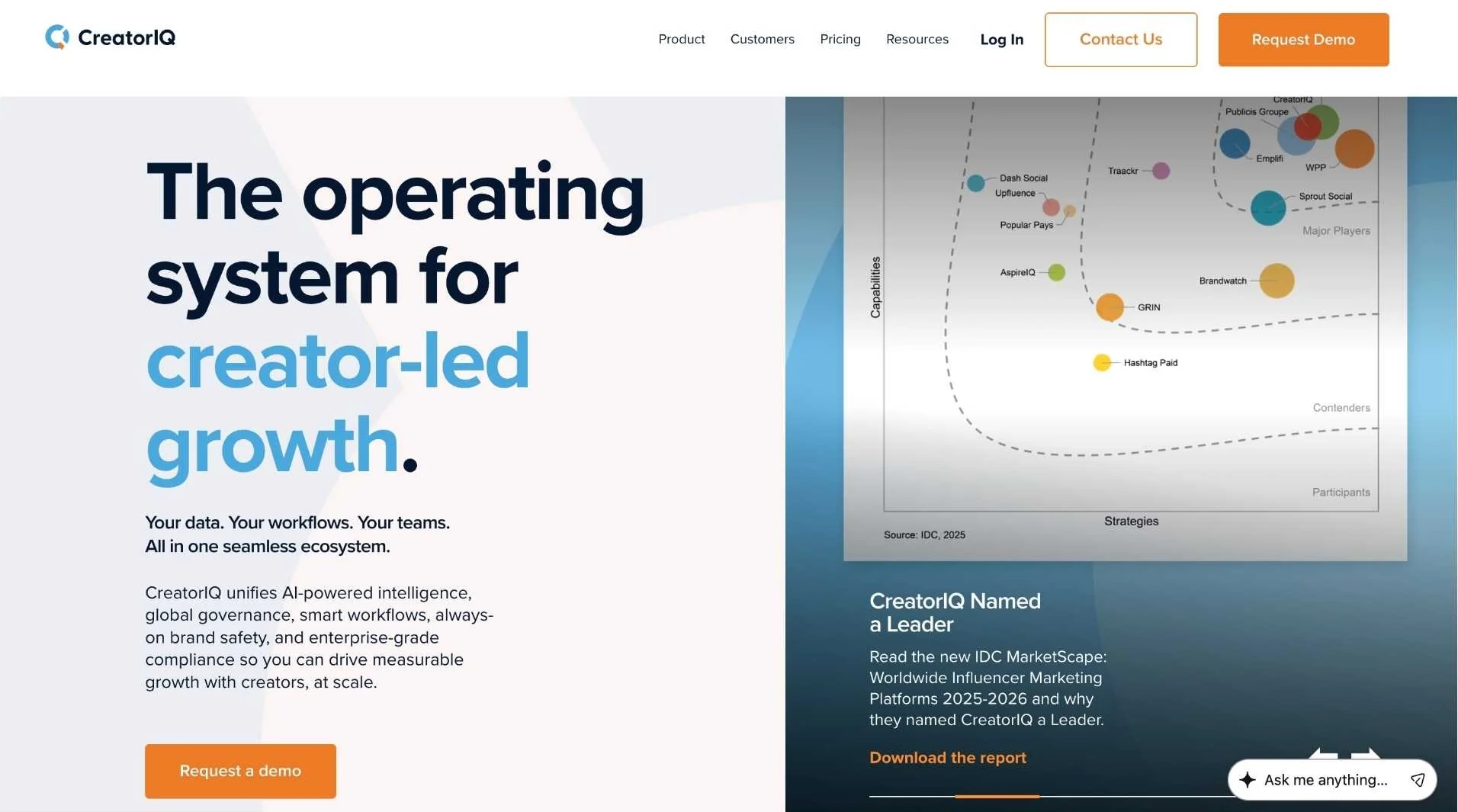
CreatorIQ serves large organisations running creator programs across many brands, markets and agencies under one governance model. Vetting, briefs, approvals, payments and stakeholder reporting all sit in the same system, which suits teams where legal sign-off matters as much as reach.
Key Features
- Creator vetting: Audience and performance data beyond what the native platforms expose.
- Multi-market workflow: Briefs, approvals and deliverables tracked across regions simultaneously.
- Payment processing: Creator payments handled without routing through finance.
- Client one-sheets: Stakeholder summaries generated straight from campaign data.
- Performance analytics: Per-creator reporting at the depth an enterprise review demands.
Pricing
Nothing published. CreatorIQ quotes per engagement on annual enterprise contracts, so there is no benchmark without a sales conversation.
Reviews
4.6/5.0 (G2, 581 reviews).
Pros
- 581 reviews: A deep independent record where Social Nature has none at all.
- Creators under contract: Briefs, approvals and payment rather than a coupon redemption.
- Reporting is the strength: The feature its own users name most often.
Cons
- Also quote-only: The same closed pricing, at a considerably higher figure.
- Discovery gaps reported: Reviewers say relevant creators sometimes fail to surface.
- Busy interface: Users describe it as doing too much at once, with slow loading.
Integrations
- Shopify: Store connection tying creator activity to orders.
- Instagram and TikTok: Creator data and campaign performance pulled in directly.
- YouTube: Long-form results measured alongside short-form.
- Salesforce: Campaign data into enterprise reporting stacks.
- API access: Creator and campaign data available programmatically.
Social Nature vs CreatorIQ
Neither publishes a price and both sell through a conversation, so the evaluation feels similar from the outside. What arrives afterwards is not. Social Nature delivers redemptions, reviews and store-level velocity data. CreatorIQ delivers a managed roster of paid creators with briefs, approvals, contracts and payments recorded against each one.
Use the evidence to break the tie. CreatorIQ carries 581 G2 reviews and is plainly the more expensive of the two, while Social Nature has no independent score at all. If your programme has to survive a procurement review, one of those is far easier to defend.
Upfluence

Upfluence begins with your customer list rather than a community someone else owns. It matches your buyers against creator profiles, activates the ones with real audiences, and carries them through influencer outreach, affiliate tracking and payment, with modules bought separately.
Key Features
- Customer-creator matching: Your own buyers checked against creator profiles and activated.
- Modular purchase: Find, Scale or Autopilot bought separately rather than as a ladder.
- Discovery with demographics: Filters and audience data reviewers rate well for targeting.
- Affiliate commission tracking: Creator revenue attributed through the store connection.
- Workflow to payment: Discovery through to paying the creator inside one platform.
Pricing
Not published. Quoted per engagement based on modules, team size and program volume, on twelve-month annual plans including a dedicated account manager. A free trial follows a consultation call, and the company states it never takes a percentage of creator sales.
Reviews
4.6/5.0 (G2, 140 reviews).
Pros
- Your own audience: Advocates sourced from people who already bought, not a rented community.
- 140 reviews: Independent evidence against none.
- A trial exists: Hands-on access after the first call rather than a quote alone.
Cons
- Twelve-month plans: A full year committed up front.
- Needs a dedicated owner: Reviewers describe the interface as demanding.
- Quote-only too: No published figure to budget against.
Integrations
- Shopify: Customer data mined for creators, with affiliate revenue tracked back.
- WooCommerce: The same coverage for WordPress storefronts.
- Klaviyo: Creator segments moved into email flows.
- PayPal: Creator payments processed inside the workflow.
- API access: Campaign and creator data into your own reporting.
Social Nature vs Upfluence
Both are built on the idea that the right person to advocate for your product is someone who genuinely uses it. They find that person in opposite places. Social Nature rents access to a community of health-minded shoppers and pays them to try you. Upfluence looks at your own order data and works out which existing customers already have an audience.
For an online brand the second route has no eligibility gate, needs no shelf space and produces creators you can brief and pay again, which is why it sits alongside the other platforms built for Shopify brands. Both quote privately and Upfluence wants a year, so neither is a quick test, but only one of them is open to a brand without physical distribution.
Aspire
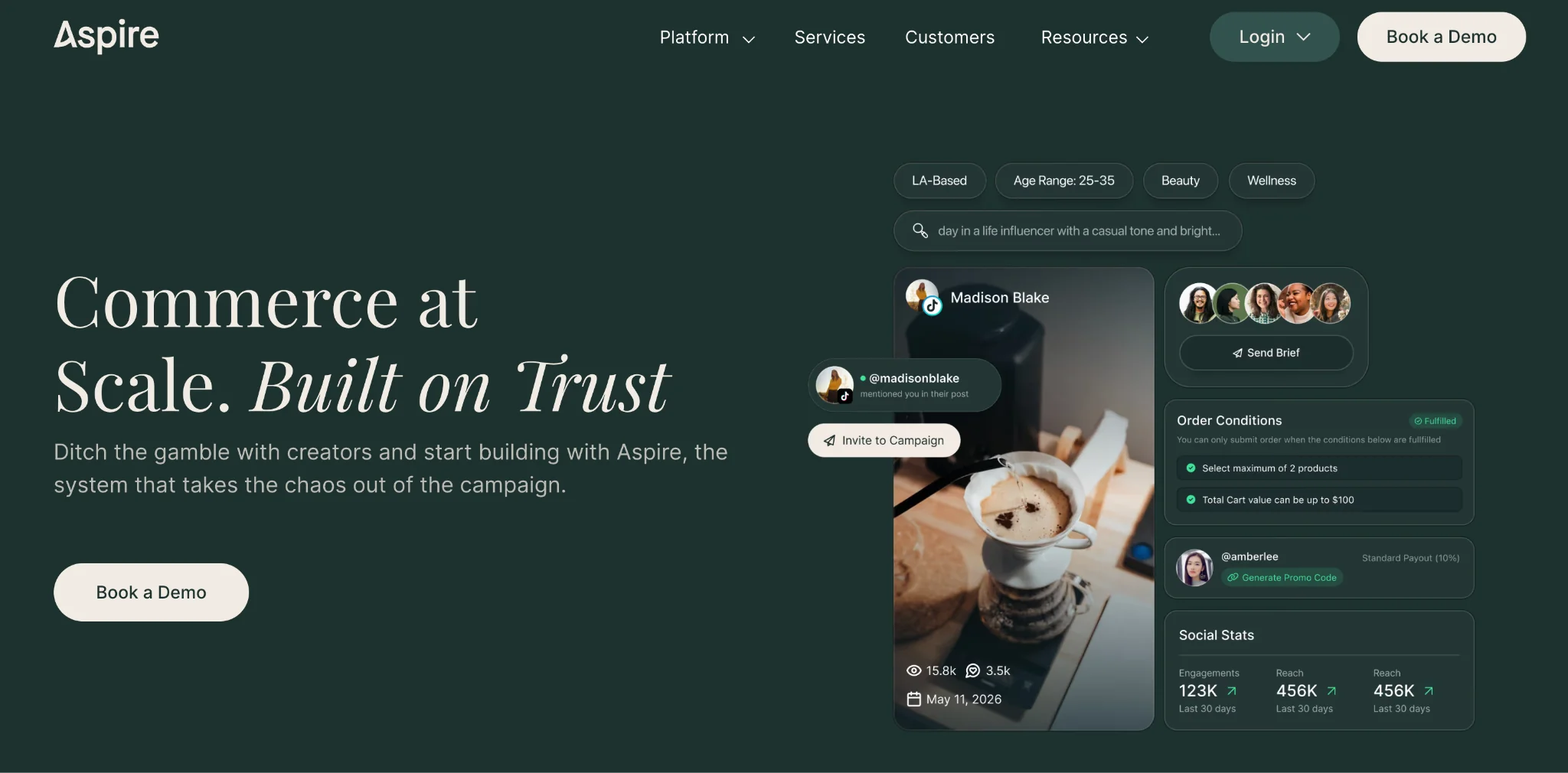
Aspire runs the full brand-side program for companies already at scale. Lookalike discovery feeds seeding at volume, briefs and approvals move content through review, affiliate attribution ties it to orders, and a rights-managed library holds the finished assets.
Key Features
- Lookalike discovery: One creator who performed becomes a shortlist of similar profiles.
- Seeding workflows: Product send-outs run at volume with tracking attached.
- Briefs and approvals: Content requested, reviewed and signed off in the platform.
- Affiliate attribution: Codes and links tying creator activity to real orders.
- Rights-managed library: Approved assets held with usage terms for paid reuse.
Pricing
Not published. Third-party sources report an annual commitment starting around $2,000 a month, with other estimates near $2,499, and they disagree enough that only a quote settles it. There is no free trial.
Reviews
4.6/5.0 (G2, 146 reviews).
Pros
- Seeding at real volume: Hundreds of sends managed without a coupon mechanic.
- 146 reviews: Independent evidence from brands running real programs.
- Assets come back licensed: Usage terms attached before anything goes behind ad spend.
Cons
- No trial and no rate card: A closed evaluation at a reported $2,000-plus a month.
- Annual commitment: A year signed up front.
- Heavier than most need: Built for programs already running at scale.
Integrations
- Shopify: Seeding orders raised and creator revenue attributed.
- WooCommerce: Equivalent coverage for WordPress stores.
- Klaviyo: Creator contacts into email programs.
- Slack: Campaign alerts into team channels.
- Zapier: Wider stack connections where no native option exists.
Social Nature vs Aspire
Sampling is the shared idea and the execution could hardly differ more. Social Nature reimburses a shopper for buying your product in a store you already sell through. Aspire ships product from your own inventory to a creator you chose, against a brief, and gets back content you may licence for paid media.
Aspire is expensive and quotes privately, so it is not the easy answer either. It is, however, available to a brand with no retail footprint, and its output compounds: an asset library and a creator list you keep, rather than a redemption report for a campaign that has ended.
Afluencer
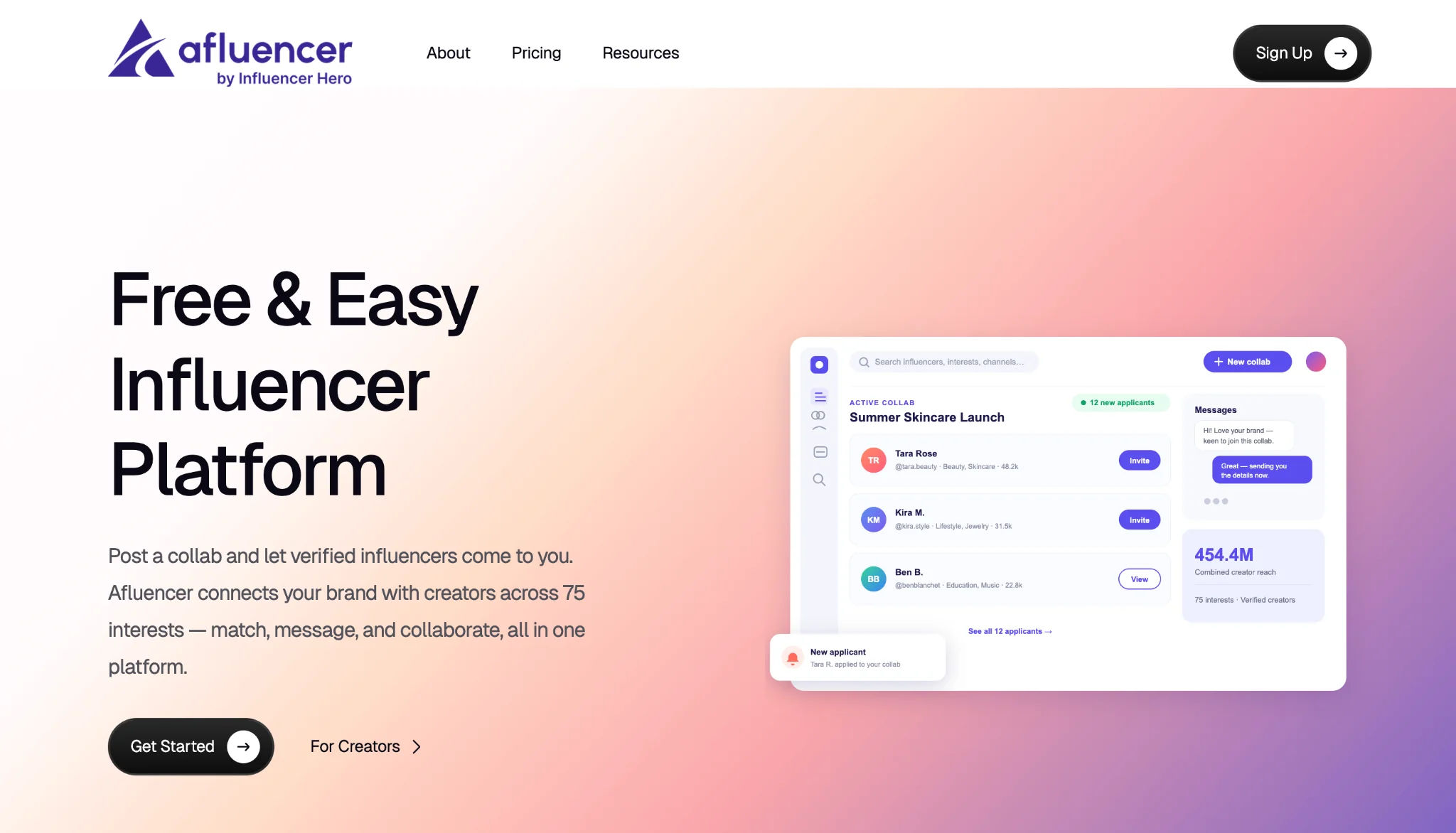
Afluencer runs on applications instead of outbound search. You publish a collaboration, verified creators apply, and AI ranks the queue against your brief before you review it. At $49 a month it is the lowest published entry point on this page.
Key Features
- Inbound applications: Creators come to your listing, so there is no community access to rent.
- Verified members: Accounts registered and checked before anyone can apply.
- CreatorGPT ranking: AI sorts the applicant queue against your brief before review.
- Invite credits: Outbound approaches for the months when applications run thin.
- Store-linked codes: Discount codes and creator fees handled through the storefront connection.
Pricing
- VIP: $49 a month
- Concierge: $99 a month
No minimum term, with creator-side plans billed separately.
Reviews
4.6/5.0 (G2, 738 reviews) and 4.7/5.0 (Shopify App Store, 34 reviews). The G2 pool leans creator-side, so read it beside the Shopify score.
Pros
- Published and monthly: $49 with no annual plan and no eligibility check.
- 738 reviews: The deepest evidence base on this page.
- Right-sized for early brands: A sensible option for smaller brands without shelf distribution.
Cons
- Inbound quality varies: A weak listing brings weak applicants.
- No retail data: Nothing resembling store-level redemption reporting.
- North America weighted: Creator supply thins outside its main markets.
Integrations
- Shopify: Codes, referrals and creator orders tracked from the store.
- BigCommerce: The same connection for BigCommerce merchants.
- Klaviyo: Creator contacts pushed into your email lists.
- DocuSign: Collaboration terms signed inside the flow.
- Slack: Application alerts sent to the team as they arrive.
Social Nature vs Afluencer
Both hand you access to a group of people willing to try your product. Social Nature’s group are shoppers who want the coupon and will leave a review. Afluencer’s are creators who want a collaboration and will post about it, and you brief them directly rather than through a campaign manager.
Then there is the money. Afluencer is $49 a month, published, cancellable, with 738 reviews behind it and no requirement to be on a shelf anywhere. Social Nature will not name a figure, appears to sell annually and has no independent rating. For a brand testing whether advocacy works at all, that is a very easy first step to take.


SARAL
SARAL prices by relationships rather than by campaigns. Plans are sized on active partnerships, outreach runs as drip sequences from your own Gmail, Shopify connects in one click, and a former influencer strategist is attached to the account.
Key Features
- Partnership-based plans: Sized by active partnerships and creators saved per month.
- Email drip sequences: Automated outreach run from your own Gmail rather than a vendor’s system.
- One-click Shopify: Store connection established without development work.
- Unlimited post tracking: Creator content monitored without a cap from Business up.
- Dedicated success manager: Former influencer strategists included in the plan.
Pricing
- Starter: $12,000 a year or $3,600 a quarter, 100 active partnerships, 1 seat
- Business: $15,000 a year or $4,500 a quarter, 500 partnerships, 3 seats
- Professional: $25,000 a year or $7,500 a quarter, 1,000 partnerships, 10 seats
No contracts, cancellation at any time, and a free trial before you pay.
Reviews
4.8/5.0 (G2, 56 reviews).
Pros
- An annual price you can read: Three tiers published, unlike an unnamed annual plan.
- 4.8 across 56 reviews: The strongest satisfaction score here.
- Cancellable: No contract and a trial first, despite the yearly framing.
Cons
- Five figures to start: $12,000 a year is a serious first commitment.
- Bugs are reported: Gmail sync delays and glitches recur in reviews.
- No retail mechanics: Nothing for coupons, receipts or store-level velocity.
Integrations
- Shopify: One-click connection for seeding, codes and creator revenue.
- Gmail: Sequences sent and tracked from your own mailbox.
- Klaviyo: Creator contacts moved into lifecycle email.
- Slack: Support and campaign alerts routed to the team.
- Zapier: Wider stack connections without engineering time.
Social Nature vs SARAL
Both sell on an annual footing, and only one of them tells you what the year costs. SARAL publishes $12,000, $15,000 and $25,000 with the partnership limits behind each, plus a free trial and the right to cancel. Social Nature publishes nothing and confirms the annual shape only through a partner listing.
What you get for the year differs just as much. SARAL builds a partnership roster you contact, brief, track and pay from your own Shopify store. Social Nature builds redemptions and reviews at retailers, which is valuable if you are fighting for shelf velocity and useless if you have no shelf.
IMAI
IMAI is a discovery and analytics platform aimed at agencies as much as brands, with fraud screening in search, client account separation, white-label reporting on higher plans and social listening above the entry tiers.
Key Features
- Hundreds of millions of profiles: Search across a very large creator index.
- Fraud screening in search: Fake-follower detection surfaced with the results.
- Client account separation: Multiple programs run side by side without collision.
- White-label reporting: Agency-branded outputs on the higher plans.
- Social listening: Brand and category monitoring above the entry tiers.
Pricing
Published tiers reported from about $175 a month, through roughly $349 and $499, to $1,200 and up for enterprise and white-label, with report volumes varying by tier. A free trial is offered.
Reviews
4.1/5.0 (GetApp, low review volume at 16 reviews). Sourcing speed and fraud detection draw praise; support and account access draw the criticism.
Pros
- Monthly and published: From around $175 with a free trial, against an unnamed annual figure.
- No eligibility criteria: Any brand can buy it, shelf space or not.
- Agency-ready: Client separation and branded reports included.
Cons
- Support is the complaint: Slow responses and, in one report, lost account access.
- Sixteen reviews: Thin, though it is sixteen more than Social Nature has.
- Research, not fulfilment: No sampling logistics of any kind.
Integrations
- Shopify: Named store connection for creator-driven orders.
- WooCommerce: Coverage for WordPress storefronts.
- Instagram and TikTok: Creator data and campaign performance.
- YouTube: Channel-level analytics alongside short-form.
- Exports: Creator and campaign data out for client reporting.
Social Nature vs IMAI
These are not competitors so much as different departments. IMAI is a research tool: search a very large index, check whether the followers are real, produce a report for a client. Social Nature is a fulfilment operation: get product into hands, verify the purchase, collect the review.
The reason IMAI belongs on this list is availability. It costs around $175 a month, publishes its tiers, offers a free trial and asks nothing about your distribution. For a brand that has just been told it needs 300 stores to qualify elsewhere, that combination matters more than the feature comparison does.
Brandbassador (Club)

Brandbassador turns existing customers into a managed ambassador community and keeps them active through gamified missions, points, leaderboards and commission, with rewards and output tracked per person.
Key Features
- Reward missions: Tasks published to the community and completed for points, product or commission.
- Gamified retention: Leaderboards and tiers keeping ambassadors posting between campaigns.
- Community recruitment: Customers converted into a managed roster at scale.
- Commission tracking: Rewards and payments handled per ambassador.
- Programme analytics: Participation and output measured across the community.
Pricing
Not published, with third-party listings reporting no free trial. Quotes come through the vendor.
Reviews
4.7/5.0 (G2, 107 reviews). Ease of use and support are praised; ambassador search and filtering draw the criticism.
Pros
- A community you own: Built from your customers rather than rented per campaign.
- 107 brand-side reviews: Independent feedback from the people paying for it.
- Four store integrations: Named eCommerce connections and commission tracking.
Cons
- Quote-only and no trial: The same closed evaluation problem.
- Weak ambassador search: Finding the right people is the recurring complaint.
- Needs existing customers: No use for a brand starting from nothing.
Integrations
- Shopify: Discount codes and ambassador sales tracked from the store.
- WooCommerce: The same for WordPress storefronts.
- Adobe Commerce: Enterprise commerce coverage.
- BigCommerce: Additional storefront support.
- Instagram and TikTok: Ambassador content tracked against missions.
Social Nature vs Brandbassador
Both organise a crowd of enthusiastic people around a product, and the ownership question separates them. Social Nature’s crowd belongs to Social Nature. You reach them while a campaign runs and lose them when it stops. Brandbassador’s crowd is drawn from your own customers and stays yours between campaigns.
Neither publishes a price or offers a trial, so both start with a call. The tiebreaker is what remains afterwards: an ambassador roster still posting next quarter, or a redemption report and a set of reviews on a retailer’s site.
Lefty
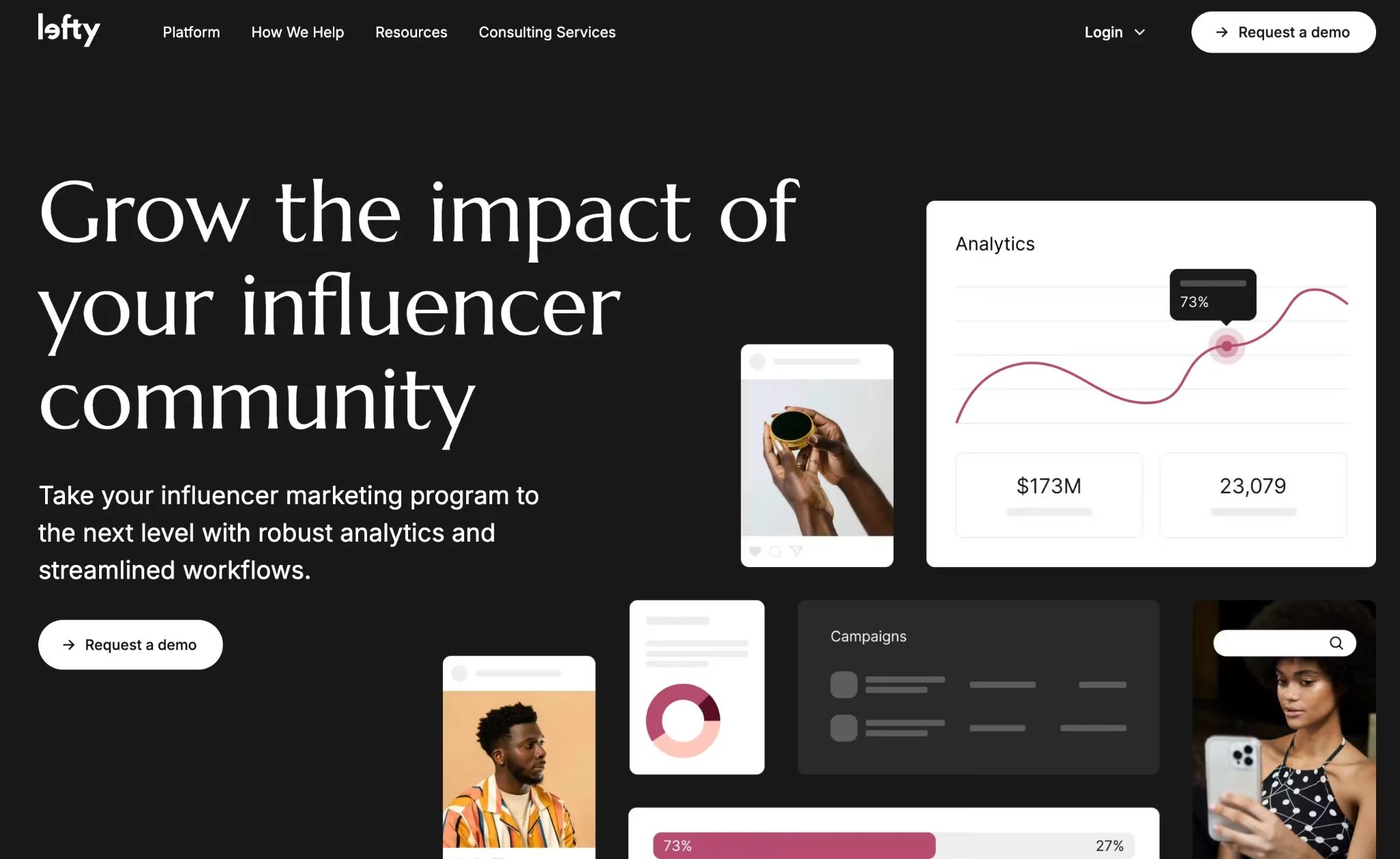
Lefty pairs faceted discovery across a multi-million profile index with campaign management, ROI reporting and social monitoring, plus Android and iOS apps. Its Instagram depth suits beauty, fashion and lifestyle programs particularly well.
Key Features
- Faceted discovery: Layered filters across a multi-million profile index.
- Campaign management: Briefs, deliverables and creator relationships in one place.
- ROI reporting: Campaign returns measured rather than reach alone.
- Social monitoring: Brand mentions tracked alongside campaigns.
- Mobile apps: Android and iOS access, which most brand-side tools skip.
Pricing
Nothing published on the company’s own site. Its Capterra listing shows a starting figure of around €590 a month with a free trial available, so treat that as indicative rather than a rate card.
Reviews
5.0/5.0 (Capterra, very low review volume at 2 reviews). Ease of use scores 5.0, features and value 4.5, and customer service 4.0.
Pros
- A figure exists: Roughly €590 a month on a listing, with a trial attached.
- Monthly rather than annual: Easier to test than a yearly plan you cannot price.
- Campaign tools included: Briefs and deliverables managed after the shortlist.
Cons
- Two reviews: Barely more evidence than none.
- No rate card: The only figure comes from a directory listing.
- Instagram weighted: Less depth on TikTok and YouTube.
Integrations
- Instagram: The deepest connection, powering discovery and reporting.
- TikTok: Creator data and campaign tracking on short-form.
- YouTube: Channel performance alongside the social networks.
- Exports: Campaign and creator data out for reporting.
- Mobile apps: Campaign access from Android and iOS as well as the browser.
Social Nature vs Lefty
Lefty measures what creators produced and what it returned. Social Nature measures what shoppers bought and where. Both call the result ROI, and the two numbers answer different questions for different teams inside the same company.
On buying terms Lefty is the lighter commitment. An indicative €590 a month with a trial is imperfect, but it is a starting point, and it is monthly. The catch is evidence, since two Capterra reviews is not a track record any more than an empty G2 page is.
Insense
Insense is a creative supply line. You post a brief, creators apply, and finished video comes back with usage rights cleared and Meta Partnership Ads ready to run from the creator’s own handle. Product seeding is part of the campaign.
Key Features
- Guaranteed applicants: Five creators on a brief, with delivery in roughly two weeks.
- Content revisions: Up to three feedback rounds built into the brief.
- Whitelisted advertising: Meta Partnership Ads run from the creator’s own handle.
- Seeding included: Product shipped to creators as part of the campaign.
- Cleared usage rights: Paid usage licensed in the deal rather than negotiated later.
Pricing
- Trial: $650 for one month, 1 campaign and 10 creators, 20% marketplace fee
- Brand: $500 a month billed quarterly, or $400 a month annually, 10% fee
- Agency: $800 a month billed quarterly, or $640 a month annually, 7% fee
Campaigns and creators are unlimited on both paid plans, and both numbers are published.
Reviews
4.5/5.0 (G2, 374 reviews).
Pros
- Both costs published: Subscription and marketplace fee stated openly.
- 374 reviews: A large brand-side record to read before buying.
- Seeding without shelf space: Product goes to creators, not through a retailer.
Cons
- A percentage on top: 7% to 20% of creator payments above the plan price.
- Ad creative, not retail: Built for paid social rather than in-store velocity.
- No review syndication: Nothing that pushes ratings to retailer product pages.
Integrations
- Meta: Partnership Ads and whitelisted creator content run directly.
- TikTok: Assets routed into ad formats without re-uploading.
- Shopify: Seeding orders raised from your product catalogue.
- Stripe: Creator payments processed inside the workflow.
- Ad account export: Approved content pushed into live campaigns.
Social Nature vs Insense
Both get product into someone’s hands and expect something back. Social Nature expects a receipt and a review. Insense expects a finished video with usage rights cleared, which you can put behind ad spend the same week it arrives.
Cost is knowable on one side only. Insense publishes $400 to $800 a month plus a 7% to 20% marketplace fee, so a campaign can be modelled before it starts. Social Nature quotes privately on an annual plan, which is a much harder thing to justify for a first test.
Final Thoughts on Social Nature Alternatives
Social Nature is built for a specific brand at a specific moment: a natural CPG product already sitting on 300 or more shelves, needing velocity at Sprouts or Whole Foods and reviews on retailer pages. For that job the coupon mechanic, the shopper community and the store-level reporting are all pointed in the right direction.
Most brands reading this are not that brand. If you sell online, the eligibility rule ends the conversation before pricing does, and pricing is unpublished anyway. Put the same budget into creators you choose, brief and pay, and you end up with content, attribution and creator payment tools that keep working after the campaign closes.

.png)


.jpg)










