


10 Best Publicfast Alternatives for Influencer Marketing
Publicfast is cheap and it reaches networks nothing else at this price touches. It also has seven reviews in total across every site that lists it.
That is the trade. For $99 a month you get eight social networks including Telegram and LinkedIn, follower authenticity checks and creator payments handled in the platform. What you do not get is much independent evidence that any of it works, or any way to connect a creator to an order in your store.
Ten alternatives follow in this order: GRIN, Influencer Hero, Later, Heepsy, Afluencer, Social Cat, Ainfluencer, Insense, The Cirqle and Creator.co.
Key Criteria for Evaluating Influencer Marketing Platforms
Core Features
Evaluation of essential influencer marketing capabilities, including influencer discovery, outreach, CRM, campaign management, reporting, and content workflows.
Pricing & Flexibility
Comparison of pricing models, subscription plans, and contract terms to match different budgets and growth stages.
Customer Reviews & Satisfaction
Analysis of user feedback from trusted review platforms, focusing on usability, reliability, customer support, and overall performance.
Pros & Cons
Review of each platform’s strengths and limitations to highlight where it performs well and where it may fall short based on different use cases.
Integrations
Review of the most important integrations (e.g., Shopify and other tech tools), highlighting what each integration enables in one sentence.
Publicfast Overview
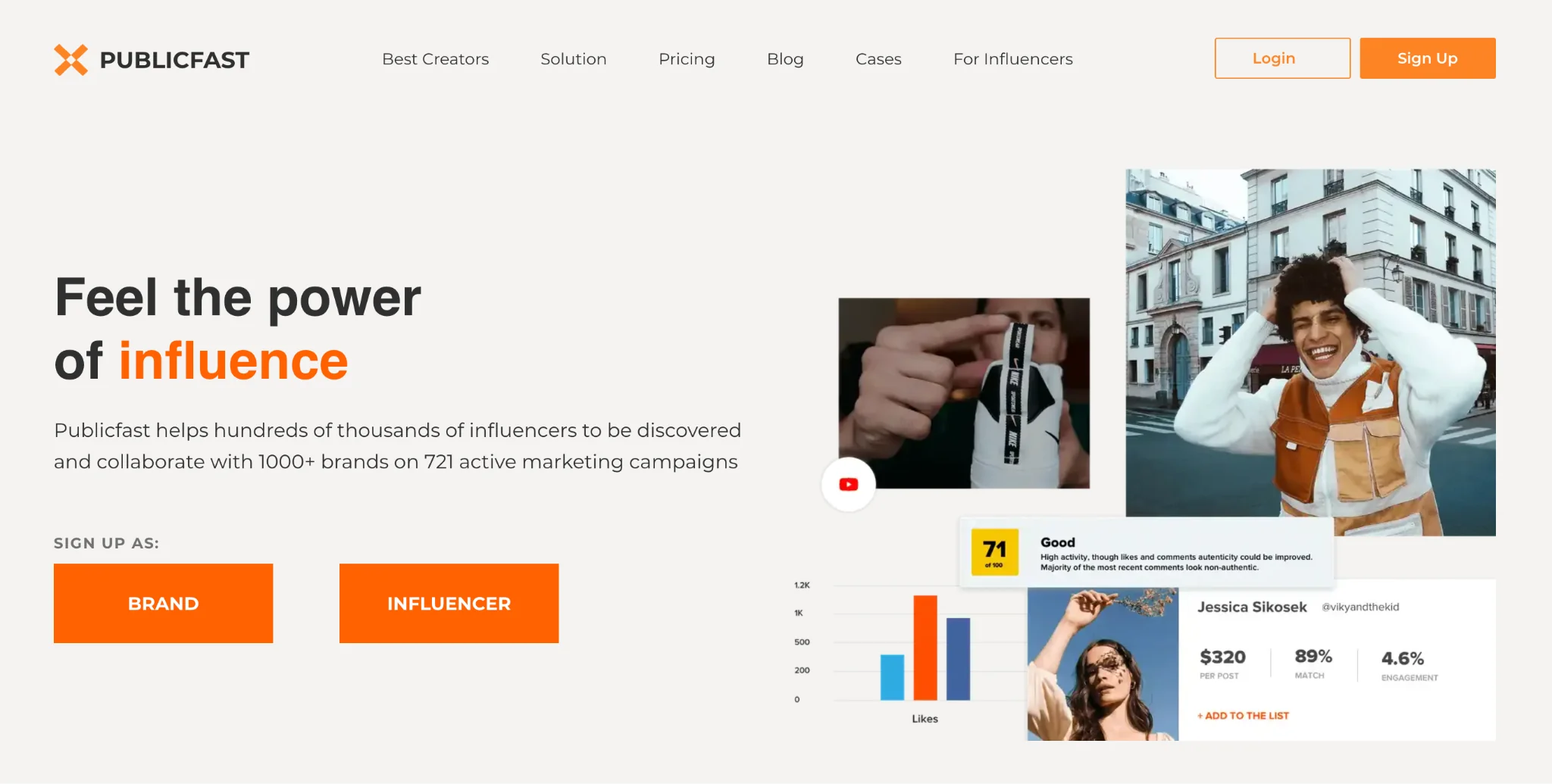
Publicfast is a self-serve influencer marketplace covering eight networks: Facebook, Instagram, YouTube, TikTok, Twitch, X, LinkedIn and Telegram. The searchable index runs past 20 million creators with more than 30 filters, business contacts for around three million of them, and audience data with follower authenticity detection attached. Nobody runs campaigns for you at this price, so you search, brief, message and approve yourself.
Money is the interesting part. Creators are paid on confirmation of delivery rather than upfront, through the platform’s own processing, and barter arrangements are a native campaign type rather than a workaround. That makes it one of the few cheap tools where product seeding and gifting is built in rather than improvised, though nothing connects to a store afterwards.
Key Features
- Eight-network search: Telegram and LinkedIn alongside the usual six, which almost nothing else at this price covers.
- 180,000 opt-in creators: A separate pool who have actively agreed to receive campaign offers and therefore reply.
- Three million business contacts: Contact details included rather than metered per lookup.
- Pay on confirmation: Creator fees released once delivery is confirmed, processed inside the platform.
- Authenticity detection: Inflated follower counts flagged before you spend anything on a creator.
Pricing
One paid plan, Publicfast PLUS, at $99 a month or $690 a year. The annual option works out at $57.50 a month and saves $498, a 42% discount that is unusually steep for this category. A seven-day free trial is offered and there is no permanent free tier.
Creator fees, in cash or product, sit entirely on top and will be the real cost of the program.
Reviews
- 4.2/5.0 (Capterra, low review volume at 5 reviews)
- 8.9/10 (TrustRadius, very low review volume at 2 reviews)
Integrations
- Social platforms: All eight networks connected for search and campaign delivery.
- Payments: Handled natively rather than through a named third-party processor.
- CSV export: The practical route for getting creator lists into another system.
- eCommerce platforms: None published, so orders and creator activity never meet.
- API and automation: No public API and no Zapier connector documented.
Pros
- Networks nothing else covers: Telegram and LinkedIn creators in the same search as Instagram.
- An annual discount worth taking: 42% off, against the 15% to 20% typical elsewhere.
- Payments and vetting at $99: Authenticity checks and in-platform payouts on the entry plan.
Common Drawbacks of Publicfast
The usable pool is under 1% of the headline
Twenty million creators are searchable, but roughly 180,000 have opted in to hear from brands. Plan against the smaller number, because it decides how fast a campaign fills.
Seven reviews across every site
Five on Capterra and two on TrustRadius. Both scores are positive, but that is far too small a sample to tell you how the platform behaves when something goes wrong.
A non-payment allegation on a platform holding money
One reviewer says they were not paid for completed work. One review is not a pattern, but Publicfast sits between you and the creator, so ask how disputes and payment releases are handled.
Nothing reaches your store
No Shopify or WooCommerce connection, no discount codes, no affiliate attribution and no API. Proving what a creator sold is a CSV export and a monthly spreadsheet.
Best Publicfast Alternatives
| TOOL | REVIEWS | BEST FOR | TRIAL INFO | PRICING | ||
|---|---|---|---|---|---|---|
1 |

|
⭐ | DTC creator management | Book Demo | Pricing | Website |
2 |

|
⭐ | Influencer CRM & automation | Book Demo | Pricing | Website |
3 |

|
⭐ | Social media & influencer campaigns | Book Demo | Pricing | Website |
4 |

|
⭐ | Influencer discovery | Book Demo | Pricing | Website |
5 |

|
⭐ | Influencer marketplace campaigns | Book Demo | Pricing | Website |
6 |

|
⭐ | Micro-Influencer Campaigns | Book Demo | Pricing | Website |
7 |
|
⭐ | Influencer discovery & outreach | Book Demo | Pricing | Website |
8 |

|
⭐ | UGC creators & paid social ads | Book Demo | Pricing | Website |
9 |

|
⭐ | Creator Performance Platform | Book Demo | Pricing | Website |
10 |

|
⭐ | Influencer campaigns & creator marketplace | Book Demo | Pricing | Website |
GRIN

GRIN is a creator management platform aimed at eCommerce brands running continuous programs. Years as an enterprise default have given it the largest review base in this comparison. Its plans are now bought self-serve on monthly credit allowances.
Key Features
- Gia AI: AI assistance across discovery, outreach and reporting, included on every plan including the free one.
- Affiliate links and codes: Unique links per creator with revenue tracked back to each.
- Creator payments: Partners paid from inside the platform rather than through finance.
- Free migration: GRIN moves your existing program across rather than making you rebuild it.
- Month-to-month credits: Upgrade, downgrade or leave at the end of any cycle.
Pricing
- Free: $0 a month, 200 credits, no card required
- Starter: $200 a month, 2,000 credits
- Growth: $500 a month, 7,500 credits, 100 active creators
- Scale: $1,000 a month, 20,000 credits, 250 active creators
- Complete: $1,500 a month, 30,000 credits, 500 active creators
Extra credits are $0.10 each, with no sales call at any tier.
Reviews
4.5/5.0 (G2, 483 reviews).
Pros
- 483 reviews against seven: By far the strongest evidence base here.
- Revenue is attributed: Codes and links reconcile against actual store orders.
- A free plan to test on: 200 credits a month rather than a seven-day window.
Cons
- Twice the price to start: $200 a month for the first paid tier.
- Narrower network coverage: No Telegram, no LinkedIn creator search.
- Credits meter usage: Busy months cost $0.10 a credit extra.
Integrations
- Shopify: Orders connected to the creator who drove them.
- WooCommerce: The same coverage for WordPress storefronts.
- Klaviyo: Creator segments into lifecycle email.
- PayPal: Creator payouts handled without an export.
- Zapier: The wider stack connected without engineering time.
Publicfast vs GRIN
Publicfast wins on reach and price. Eight networks including two GRIN does not touch, for $99 a month against $200 for GRIN’s first paid tier.
GRIN wins on everything you can verify. It attributes revenue through Shopify and WooCommerce, pays creators, and has 483 reviews behind it against seven. If your campaigns need to be proven to a finance team rather than described to one, that difference decides it.
Influencer Hero
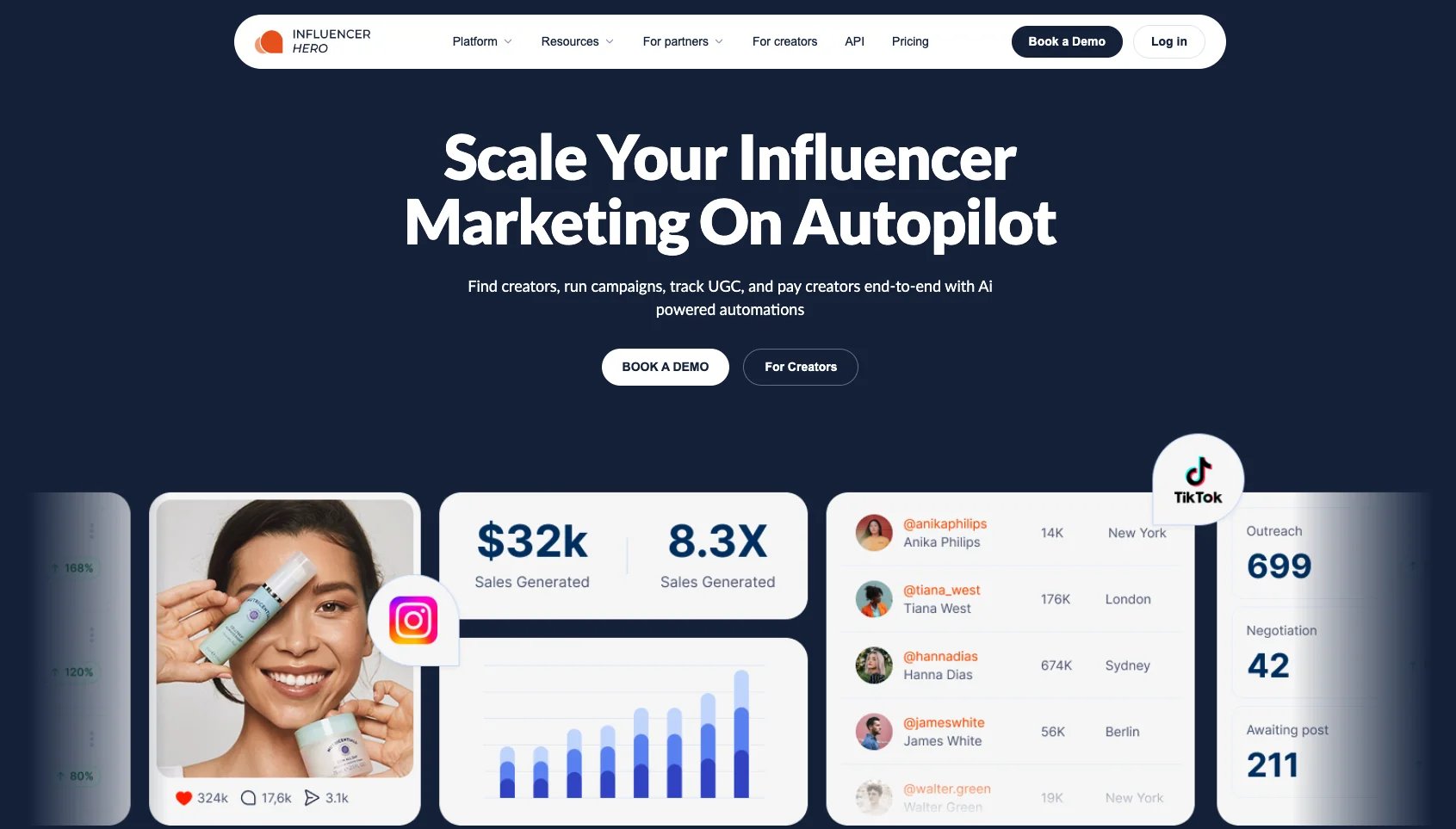
Influencer Hero is an all-in-one influencer marketing platform for D2C and eCommerce brands, spanning 8 social platforms with Instagram, YouTube and TikTok emphasised. Discovery, influencer outreach, gifting, UGC, affiliate tracking and creator payouts all run in one system on one published plan. Brands buy it to hold an entire program rather than one stage of it.
Key Features
- Eight-network discovery: Over 20 filters plus AI search, with global coverage and no separate opt-in pool.
- Fake-follower screening: Audience authenticity checked before a creator receives budget or product.
- Multichannel outreach: Email, Instagram DM and WhatsApp with drip sequences in one shared inbox.
- Chrome extension: Pull creator stats while browsing and add them to a campaign in one click.
- Gifting from your store: Product orders raised in Shopify or WooCommerce and tracked to delivery.
- Coupon leakage prevention: AI watches deal forums and coupon sites, rotates a leaked code and tells the creator.
- Affiliate codes and creator payouts: Commission calculated in-platform and paid by bank debit at 0.1% to 0.4%.
- Automated reporting: ROI, sales by creator and product cost against return compiled without an export.
Pricing
- Standard: $649 a month, up to 1,000 reachouts a month
- Pro: $1,049 a month, up to 5,000 reachouts a month
- Business: $2,490 a month, up to 10,000 reachouts a month
- Custom & Agency: custom pricing
Quarterly billing saves 20% and yearly saves 30%.
Reviews
5.0/5.0 (Capterra)
Pros
- Every creator is reachable: No separate opt-in pool deciding who replies.
- Orders tie back to creators: Codes and store integration rather than a CSV export.
- Margins are protected: Leaked codes get caught and rotated automatically.
Cons
- No free trial
- Expensive for smaller brands
- Steep learning curve
Integrations
- Shopify: Gifting orders raised and creator revenue booked automatically.
- WooCommerce: The same for WordPress, with scripts covering Magento and custom builds.
- DocuSign: Creator agreements signed and filed on the deal record.
- Klaviyo: Creator and customer segments into lifecycle email.
- Zapier: Over 8,000 further apps for anything not native.
Publicfast vs Influencer Hero
Publicfast’s network coverage is real and worth naming: Telegram and LinkedIn creators genuinely are hard to find elsewhere. Influencer Hero covers eight networks too, and every creator in them is reachable rather than sitting behind an opt-in pool of 180,000. On top of discovery it screens fake followers, runs outreach over email, Instagram DM and WhatsApp, raises gifting orders straight from Shopify or WooCommerce, collects and approves UGC, issues affiliate codes with commission worked out in-platform, and pays creators by bank debit at 0.1% to 0.4%. Reporting compiles ROI and sales by creator without a spreadsheet.
The price gap is wide and the value gap is worth measuring against it. Publicfast is $99 a month, or $57.50 annually, and stops at platform metrics. Influencer Hero publishes $649, $1,049 and $2,490 a month with 20% off quarterly and 30% off yearly. The difference buys the thing Publicfast cannot do at any price: connect a creator to an order in your checkout, so the channel can be judged on revenue rather than on reach.
Later

Later began as an Instagram planner and became a full social suite, with a separate influencer product beside it. Its core users are in-house social teams handling publishing and creators together. Mavely, its affiliate network, lets creators earn commission on brand links without a direct agreement.
Key Features
- Social sets: Plans sized by profile groups, from 8 profiles on entry to 48 at the top.
- Scheduling across networks: One calendar covering every connected account.
- Collaboration and approvals: Internal sign-off before publishing, from the Growth plan up.
- Later Influence: The separate creator product for briefs, campaigns and deliverables.
- Mavely: Creator commission on brand links, handled by the network rather than by you.
Pricing
- Starter: $25 a month, or $18.75 billed yearly
- Growth: $50 a month, or $37.50 billed yearly
- Scale: $110 a month, or $82.50 billed yearly
A 14-day trial covers the social plans. Later Influence is quoted rather than published.
Reviews
4.5/5.0 (G2, 469 reviews) for Later Influence and 4.5/5.0 (G2, 384 reviews) for Later Social.
Pros
- 853 reviews in total: More than a hundred times Publicfast’s record.
- Twice the trial: 14 days against seven.
- Cheaper on the social side: $18.75 a month yearly against $57.50.
Cons
- Six networks, not eight: No Telegram, and LinkedIn is not a creator channel here.
- The creator product is quote-only: Later Influence has no published price.
- No creator payments: Paying people happens somewhere else entirely.
Integrations
- Instagram: Scheduling, publishing and creator content in one calendar.
- TikTok: Short-form planning and measurement alongside the rest.
- Shopify: Shoppable posts drawn from your catalogue.
- Canva: Design assets pulled into the planner directly.
- Slack: Approvals and campaign alerts routed to the team.
Publicfast vs Later
Publicfast finds creators and pays them. Later plans and publishes your own content. The overlap is small enough that most teams running both would not consider it duplication.
Where Later helps a Publicfast buyer is confidence. Two products, 853 reviews, a fortnight to test and a published price on the social side. Publicfast has seven reviews and a week. On a $99 decision that matters less than it would on a $999 one, but it is still the safer purchase.
Heepsy

Heepsy searches Instagram, TikTok, YouTube and LinkedIn creators, then lets you email them and pay them from the same product. Small businesses make up 93% of its reviewers. Plans meter search results, profiles and outreach emails rather than charging per user.
Key Features
- Free plan with search: 500 results and 10 full profiles a month before you pay anything.
- Text, AI and lookalike search: Three ways into the index across 30-plus filters.
- Marketplace listings: Publish a campaign so creators find and apply to it.
- Content tracking: Posts from your creators monitored rather than chased manually.
- Creator payments: Partners paid inside the platform from the Plus tier.
Pricing
- Free: $0, 500 search results and 10 advanced profiles a month
- Starter: $69 a month billed annually, 300 outreach emails
- Plus: $149 a month billed annually, 1,200 outreach emails
- Advanced: $229 a month billed annually, 6,000 outreach emails
A 14-day trial runs on a work email with no card.
Reviews
4.5/5.0 (Capterra, 72 reviews).
Pros
- Ten times the review base: 72 reviews against seven.
- A free plan and a longer trial: Two ways to test niche coverage properly.
- LinkedIn creators too: One of Publicfast’s two unusual networks is covered here.
Cons
- No Telegram: The network that makes Publicfast unique in some markets.
- Outreach is capped: 300 emails a month on the entry tier.
- Annual pricing on the sticker: The headline rates assume a yearly commitment.
Integrations
- Shopify: A store connection linking campaigns to sales.
- Instagram: Profile data and content in the search results.
- TikTok: Short-form coverage on the same filter set.
- YouTube: Channel analytics beside the short-form networks.
- LinkedIn: Professional creator search most rivals skip.
Publicfast vs Heepsy
These are the closest match on price and purpose. Both are cheap self-serve discovery tools with outreach and payments attached, and both meter something. Publicfast covers eight networks; Heepsy covers four but adds a free plan, a fortnight to test and a Shopify connection.
Geography usually settles it. If your audience is on Telegram, Heepsy has nothing for you at any price. If it is not, Heepsy gives you a lower entry cost, ten times the review evidence and a store link that Publicfast does not publish.
Afluencer
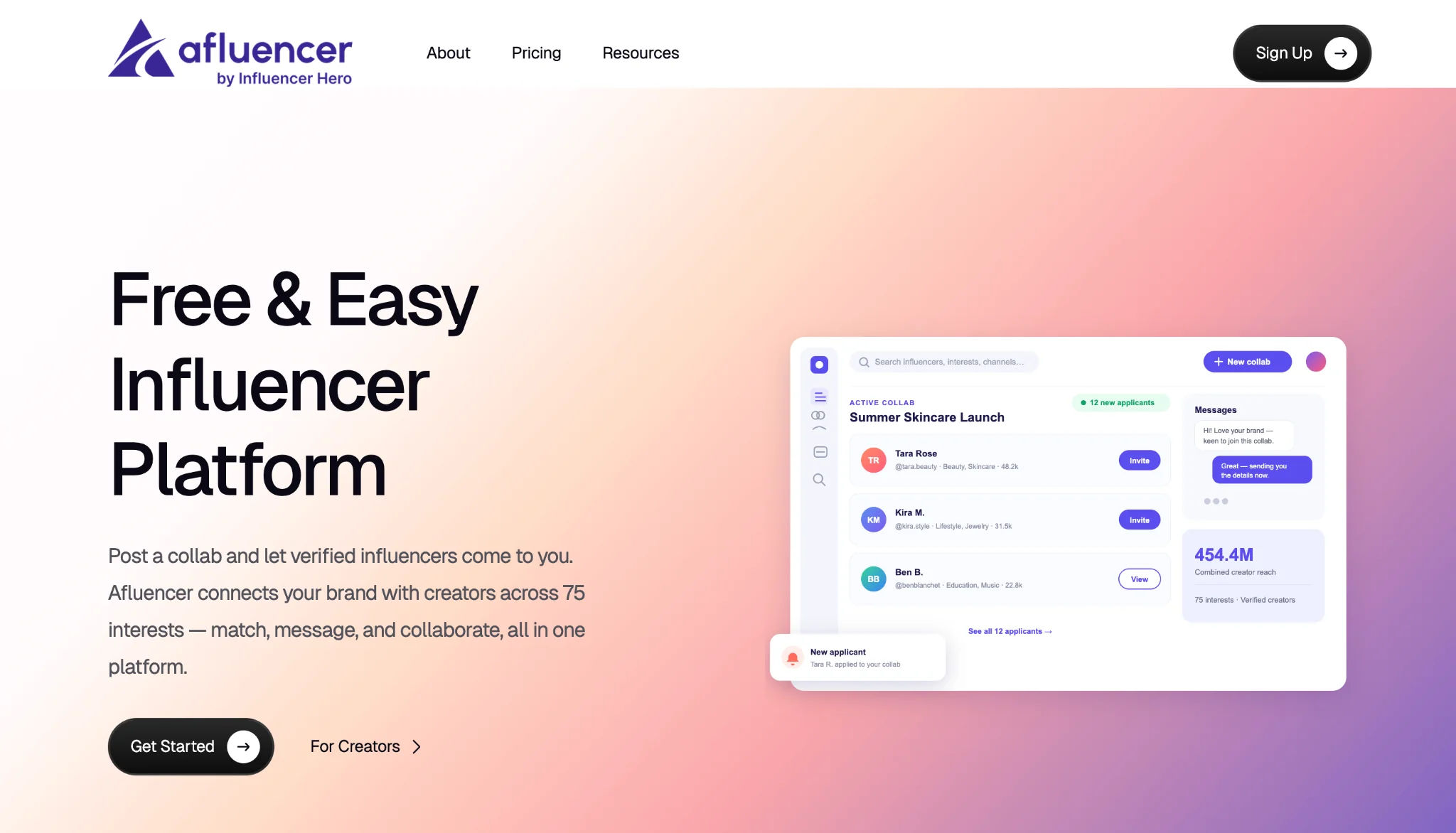
Afluencer inverts the search problem. You publish a collaboration listing, verified creators across Instagram, TikTok, YouTube, Facebook and X apply to it, and you pick from the responses. Shopify merchants and small D2C teams are its core customers, on a published flat fee with no term.
Key Features
- Listing-led recruitment: Creators apply to your brief, so response rate is the mechanism rather than a hope.
- Verified applicants: Members registered and checked before they can respond to anything.
- CreatorGPT: AI ranks the applicant queue against your brief before a person reviews it.
- Invite credits: Outbound approaches for the months when applications run thin.
- Codes through the store: Discount codes and creator fees handled via the storefront connection.
Pricing
- VIP: $49 a month
- Concierge: $99 a month
No minimum term, with creator-side plans billed separately.
Reviews
4.6/5.0 (G2, 738 reviews) and 4.7/5.0 (Shopify App Store, 34 reviews). The G2 pool leans creator-side, so read it beside the Shopify score.
Pros
- Half the price: $49 a month against $99, with no annual commitment needed to get there.
- Everyone in the pool wants work: A useful platform for a small business where response rate is the whole problem.
- 738 reviews: A hundred times Publicfast’s evidence base.
Cons
- Five networks: No Telegram, no Twitch, no LinkedIn creators.
- Inbound quality varies: A weak listing brings weak applicants.
- North America weighted: Thin outside its main markets.
Integrations
- Shopify: Codes, referrals and creator orders tracked from the store.
- BigCommerce: The same connection for BigCommerce merchants.
- Klaviyo: Creator contacts pushed into your email lists.
- DocuSign: Collaboration terms signed inside the flow.
- Slack: New applications announced to the team.
Publicfast vs Afluencer
Both are cheap and both understand that an index is worthless if nobody replies. Publicfast answers it with a 180,000-strong opt-in pool inside a 20 million index. Afluencer answers it by making applications the only mechanism, so every creator you see already wants the work.
At $49 against $99, with 738 reviews against seven and a Shopify connection Publicfast does not have, Afluencer is the safer half of that comparison. The exception is markets Afluencer barely covers, where Telegram or Twitch is where the audience actually sits.


Social Cat
Social Cat connects small brands with micro-influencers for gifted and paid collaborations, and prices its plans by how many collaborations actually complete each month. Content arrives licensed for your own channels. Brands wanting output rather than a search tool are its audience.
Key Features
- Collaborations as the billing unit: You pay for finished work, not for searches, seats or credits.
- Invitations in bulk: From 1,000 creator invites a month on the cheapest plan.
- Creator ratings: Past performance visible before an invitation goes out.
- Contracts in-platform: Terms agreed before any product ships.
- Rights on every tier: Delivered content licensed for your channels from the entry plan.
Pricing
- Essentials: $99 a month, up to 5 collaborations, 1,000 invitations
- Performance: $199 a month, up to 15 collaborations, 2,500 invitations
- Pro: $299 a month, up to 30 collaborations, 5,000 invitations
Every plan comes with a free trial.
Reviews
3.9/5.0 (Trustpilot, 364 reviews). About 80% are five-star and 15% one-star, with support response times the recurring complaint.
Pros
- Same price, guaranteed output: $99 buys five completed collaborations rather than search access.
- 364 reviews: Enough volume to see patterns, including the bad ones.
- Rights included: Content usable in ads without a separate negotiation.
Cons
- The lowest score here: 3.9, with one review in seven a one-star.
- Two networks in practice: Instagram and TikTok, against eight.
- Collaborations are capped: Five a month on the entry plan.
Integrations
- Shopify: Gifted orders raised against the campaign automatically.
- Instagram: Creator profiles and delivered posts pulled in.
- TikTok: The same for short-form deliverables.
- Email: Creator conversations handled from the campaign record.
- Content export: Approved assets downloaded for paid social.
Publicfast vs Social Cat
Same monthly price, entirely different promise. Publicfast gives you eight networks, 20 million searchable profiles and the job of converting them. Social Cat gives you five finished collaborations and does the converting for you.
Social Cat also has 364 reviews to Publicfast’s seven, though its 3.9 average is the lowest on this page and support is the reason. Between a small positive sample and a large mixed one, the large one tells you more.
Ainfluencer

Ainfluencer is a marketplace holding over 25 million creators across Instagram, TikTok and YouTube, free for brands to use. Deals are negotiated in the platform and paid through escrow when content is delivered. Its income comes from a margin on creator payouts rather than a subscription.
Key Features
- Zero subscription: Search, invite and negotiate without a plan or a card.
- Escrow on delivery: Funds held until the agreed content actually lands.
- Filtered AI search: Niche, location and engagement filters across the full pool.
- Three deal types: Gifted, paid and affiliate arrangements from one dashboard.
- Logged negotiation: Offers and counter-offers on the record instead of in email.
Pricing
Free for brands, with no plan at any level. The company deducts a margin from creator payouts instead, so your real spend is the creator fee plus whatever sits inside it.
Reviews
4.7/5.0 (G2, low review volume at 24 reviews).
Pros
- $1,188 a year cheaper: Nothing to pay at all, against $99 a month.
- Escrow is the same protection: Pay-on-delivery, without the subscription.
- More reviews: 24 is thin, but it is more than three times Publicfast’s total.
Cons
- The margin is invisible: Funded from creator payouts rather than shown on an invoice.
- Three networks: No Telegram, LinkedIn, Twitch, X or Facebook.
- No store attribution: The same gap Publicfast has.
Integrations
- Instagram: Creator profiles, engagement data and delivered posts.
- TikTok: Short-form coverage across all deal types.
- YouTube: Channel data for longer-form collaborations.
- Escrow payments: Money handled natively without a separate processor.
- Data export: Campaign and creator records out for your own reporting.
Publicfast vs Ainfluencer
The two work almost identically on the part that matters most to a cautious buyer. Both hold money and release it when content is delivered, so a first collaboration carries the same protection either way. One charges $99 a month for that and one charges nothing.
What the $99 buys is coverage. Five extra networks, including Telegram and LinkedIn, plus 30-plus filters and business contacts for three million creators. If none of those networks matter to you, it is difficult to justify paying for them.
Insense
Insense supplies UGC video for paid social to a repeatable schedule. Vetted creators apply to a brief, deliver in roughly ten business days, and usage rights come with the content. Performance teams buying ad creative are its core market.
Key Features
- Applicant guarantee: Five matching creators respond to your brief or the subscription is refunded.
- Briefs with revisions: Up to three rounds of structured feedback built into the process.
- Whitelisted advertising: Meta Partnership Ads run from the creator’s own handle.
- Seeding built in: Product shipped to creators as part of the campaign.
- Unlimited campaigns: No cap on campaigns or creators on either paid plan.
Pricing
- Trial: $650 for one month, 1 campaign and 10 creators, 20% marketplace fee
- Brand: $500 a month billed quarterly, or $400 a month annually, 10% fee
- Agency: $800 a month billed quarterly, or $640 a month annually, 7% fee
Both figures are published, and the fee falls as the plan rises.
Reviews
4.5/5.0 (G2, 374 reviews).
Pros
- 374 reviews: A record you can actually form a view from.
- Delivery is guaranteed and timed: Five applicants, content in about two weeks.
- Rights are cleared: Paid usage licensed as part of the deal.
Cons
- Four times the price: $400 a month annually against $57.50.
- A percentage on top: 7% to 20% of creator payments above the plan.
- Two networks: Meta and TikTok, against eight.
Integrations
- Meta: Partnership Ads and whitelisted creator content run directly.
- TikTok: Assets routed into ad formats without re-uploading.
- Shopify: Seeding orders raised from your catalogue.
- Stripe: Creator payments processed inside the workflow.
- Ad account export: Approved content pushed into live campaigns.
Publicfast vs Insense
Publicfast sells reach across networks. Insense sells finished video on a deadline. A brand whose paid social is starved of creative gets nothing from Telegram coverage, and a brand marketing in Kazakhstan gets nothing from Meta Partnership Ads.
On money the honest comparison is what each guarantees. Insense costs four times more and commits to five applicants and a delivery window. Publicfast costs less and commits to nothing beyond access, which is reasonable at $99 as long as you know it.
The Cirqle

The Cirqle runs influencer marketing as a measurable revenue channel, scoring creators on historic return from first-party data and automating the campaign around them. Briefs, negotiation, contracts, shipping, approvals and payouts run as one chain, and licensed content can go live as paid ads. Loop Earplugs, ABOUT YOU and Lookfantastic appear among its named customers.
Key Features
- ROAS-based discovery: Creators ranked on measured return rather than follower count.
- Content into ads: Licensed assets published on Meta, TikTok and YouTube from the platform.
- End-to-end automation: Briefs, negotiation, shipping and payouts in a single chain.
- Paid and organic attribution: Both measured in the same dashboard rather than separately.
- Agentic access: Campaign data reachable from Claude, ChatGPT and other MCP clients.
Pricing
Nothing on the company’s own site, which routes you to a demo. Its Shopify App Store listing publishes Base at $999 a month or $9,998 a year and Base Plus at $1,999 a month or $19,999 a year, with per-creator fees negotiated on top.
Reviews
4.8/5.0 (G2, 8 Reviews)
Pros
- Attribution is the whole product: Revenue tracked to creators across paid and organic.
- Content becomes ad spend: Assets go live as ads without a separate licensing step.
- Named enterprise customers: Recognisable brands published openly.
Cons
- Ten times the price: $999 a month before per-creator fees are agreed.
- No reviews at all: Even thinner evidence than Publicfast’s seven.
- No published price on its own site: The figures only appear on an app listing.
Integrations
- Shopify: Orders matched to creators for revenue attribution.
- Meta: Creator content published and measured as paid media.
- TikTok: The same route for short-form creative.
- Northbeam: Results reconciled against your wider attribution stack.
- Impact.com: Affiliate and partnership data connected in.
Publicfast vs The Cirqle
Both are European-facing platforms with a transparency problem, at opposite ends of the price list. Publicfast publishes $99 openly and has seven reviews. The Cirqle publishes nothing on its own site and has none.
What separates them is what happens to the data. The Cirqle connects to Shopify, Northbeam and Impact.com and can prove a creator drove revenue. Publicfast exports a CSV. Brands comparing European enterprise platforms should weigh that against a subscription roughly ten times larger.
Creator.co

Creator.co pairs a 400 million creator index with AI matching, drafted briefs and outreach, sold self-serve or with a team running the program for you. Nike, Oakley and Best Buy appear in its published customer list. Contact credits and insight reports are the metered units rather than seats.
Key Features
- 400 million profiles: Twenty times Publicfast’s index across Instagram, TikTok and YouTube.
- Opt-in creator community: A pool that has agreed to receive campaigns, so fill rate is not guesswork.
- AI matching and briefs: Shortlists scored and AI creator search drafting the outreach.
- Unlimited collaborations: No cap on how many creators you work with on self-serve.
- TikTok Shop tracking: Social commerce revenue attributed natively.
Pricing
- Self-Serve: $299 a month, or $199 a month annually, on a 3-month minimum
- Managed: $2,199 a month, or $1,499 a month annually, on a 6-month minimum
- Enterprise: custom pricing on an annual commitment
Self-Serve includes 100 contact credits and 50 insight reports, with extra credits at $99 per 100.
Reviews
4.6/5.0 (G2, 124 reviews).
Pros
- Twenty times the index: 400 million profiles against 20 million.
- 124 reviews: Enough independent feedback to judge reliability.
- Store attribution included: Shopify and TikTok Shop rather than a CSV.
Cons
- Twice the price: $199 a month annually against $57.50.
- Contacts are rationed: 100 credits a month, then $99 per extra hundred.
- Three networks: No Telegram, LinkedIn, Twitch or X coverage.
Integrations
- Shopify: Creator-driven orders and codes tracked from the store.
- TikTok Shop: Native attribution for social commerce.
- Google Analytics: Campaign traffic joined to on-site behaviour.
- Instagram: Creator profiles and post performance in the campaign view.
- Data exports: Creator and campaign records out for client reporting.
Publicfast vs Creator.co
Both understand that an opt-in creator is worth more than an indexed one, and both build around that. Creator.co runs a much larger index, gives you AI-drafted outreach and attributes orders through Shopify and TikTok Shop, but rations you to 100 contacts a month.
Publicfast has no contact meter and covers five networks Creator.co does not. For a brand selling in Western markets, though, twice the price buys twenty times the index, 124 reviews instead of seven, and the ability to prove what a campaign sold.
Final Thoughts on Publicfast Alternatives
Publicfast is doing something no other cheap tool does. Telegram and LinkedIn creators in the same search as Instagram, with authenticity checks and creator payments included at $99 a month, is genuinely good value if those networks are where your customers are.
Check three things before you commit, and use the seven days to do it. Filter to your own category and count how many of the 180,000 opt-in creators come back. Ask how payment disputes are resolved, since the platform holds the money. And confirm you have somewhere else to reconcile creator activity against orders, because nothing here will do it.

.png)


.jpg)










