


10 Best Phlanx Alternatives for Influencer Marketing
Phlanx is really two products. The free engagement rate calculator is a genuinely good tool that thousands of marketers keep bookmarked, and nothing here argues against it.
The paid platform is the harder sell. Around $25 a month buys a directory of 100,000 to 400,000 profiles, a light auditor, basic campaign tracking and contract templates. It also comes with a review record where paying customers report being charged for annual plans they did not knowingly select and waiting over a week for support that never replied.
Ten alternatives follow, in order: Influencer Hero, NeoReach, Insense, Afluencer, Aspire, Influencity, IMAI, HypeAuditor, Julius and Brandbassador.
Key Criteria for Evaluating Influencer Marketing Platforms
Core Features
Evaluation of essential influencer marketing capabilities, including influencer discovery, outreach, CRM, campaign management, reporting, and content workflows.
Pricing & Flexibility
Comparison of pricing models, subscription plans, and contract terms to match different budgets and growth stages.
Customer Reviews & Satisfaction
Analysis of user feedback from trusted review platforms, focusing on usability, reliability, customer support, and overall performance.
Pros & Cons
Review of each platform’s strengths and limitations to highlight where it performs well and where it may fall short based on different use cases.
Integrations
Review of the most important integrations (e.g., Shopify and other tech tools), highlighting what each integration enables in one sentence.
Phlanx Overview
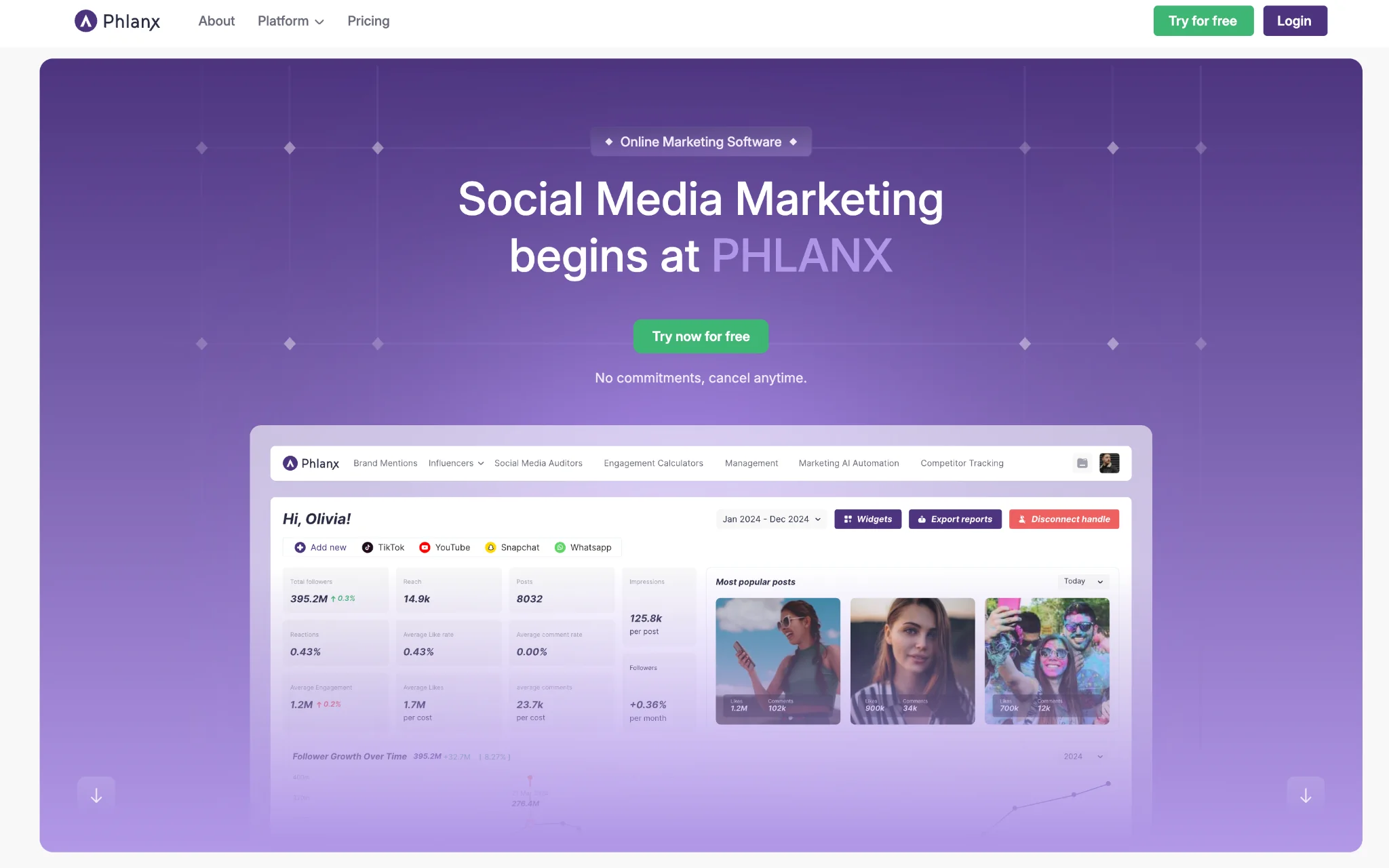
Phlanx is an Australian company selling a wide, shallow toolkit under one cheap login. The free engagement calculator is the front door: paste any public handle across Instagram, TikTok, YouTube, Facebook, X or Pinterest and get an engagement rate with per-post averages, no account required. Behind it sit an influencer directory, an account auditor, a campaign manager, contract templates, competitor tracking and a set of AI writing helpers. The creator database is the weak point, with published figures ranging from 100,000 to 400,000 profiles depending on the source.
Key Features
- Free engagement calculator: Six networks, no login, an answer in seconds, using the standard likes-plus-comments formula.
- Influencer directory: Filters for keyword, category, location, brand mentions, hashtags, reach, engagement and verification.
- Account auditor: Deeper analysis on Instagram, TikTok and YouTube, short of full demographic or fraud scoring.
- Contract generator: Brand and creator agreement templates, unusual to find at this price.
- Competitor tracking: Monitor rival accounts and the creators already working with them.
Pricing
- Free calculator: $0, no account, limited daily searches
- Basic: around $25 a month, 1 user
- Premium: around $35 a month, 3 users
- Business: around $55 a month, 8 users
Tiers scale on seats rather than usage, and the whole toolkit is available at every level. Several listings quote the entry price in Australian dollars, and figures differ between directories, so confirm the rate and currency at checkout.
Reviews
3.4/5.0 (Capterra, low review volume at 5 reviews) and 3.4/5.0 (GetApp, low review volume at 5 reviews). Five reviews split three five-star and two one-star, with nothing in between.
Integrations
- Social platforms: Instagram, TikTok, YouTube, Facebook, X and Pinterest for analysis, which is broad for the money.
- eCommerce platforms: None published, so orders and creator activity never connect.
- Affiliate and payment tools: None named, with no codes, commission tracking or payouts.
- Email and marketing tools: No Klaviyo or equivalent, so creator contacts stay put.
- API and automation: No public API and no Zapier connector documented.
Pros
- A free tool worth keeping: The calculator answers the most common vetting question at no cost.
- The cheapest paid tier anywhere: Around $25 a month for a directory, auditor, campaigns and contracts.
- Seats are not a lever: Eight users for roughly $55 works out under $7 a head.
Common Drawbacks of Phlanx
Billing is the most serious complaint
Reviewers report being charged for annual memberships they did not knowingly select, being charged before a trial ended, and being unable to get a refund because nobody answered. In a five-review sample, that theme recurring is a pattern rather than an outlier.
Support and uptime both draw criticism
One reviewer describes over a week without a reply. Another says the service goes down for days at a time. Neither is independently verifiable, but both compound the billing problem, since a refund needs a human to process it.
The data is thin at both ends
A directory of 100,000 to 400,000 profiles is small, coverage skews to health, fitness, wellness and marketing, and the auditor stops short of audience demographics and fraud scoring.
Nothing reaches commerce
No store integration, no discount codes, no affiliate tracking, no payouts and no API. The platform can price a creator’s engagement and hold a contract, but not tell you what a collaboration sold.
Best Phlanx Alternatives
| TOOL | REVIEWS | BEST FOR | TRIAL INFO | PRICING | ||
|---|---|---|---|---|---|---|
1 |

|
⭐ | Influencer CRM & automation | Book Demo | Pricing | Website |
2 |

|
⭐ | Influencer campaigns & data analytics | Book Demo | Pricing | Website |
3 |

|
⭐ | UGC creators & paid social ads | Book Demo | Pricing | Website |
4 |

|
⭐ | Influencer marketplace campaigns | Book Demo | Pricing | Website |
5 |

|
⭐ | Influencer partnerships | Book Demo | Pricing | Website |
6 |

|
⭐ | Campaign management | Book Demo | Pricing | Website |
7 |

|
⭐ | AI influencer discovery & analytics | Book Demo | Pricing | Website |
8 |

|
⭐ | Influencer analytics | Book Demo | Pricing | Website |
9 |
-1.webp)
|
⭐ | Discovery and campaign platform | Book Demo | Pricing | Website |
10 |

|
⭐ | Ambassador Marketing | Book Demo | Pricing | Website |
Influencer Hero

Influencer Hero is an all-in-one influencer marketing platform for D2C and eCommerce brands, covering 8 social platforms with Instagram, YouTube and TikTok at the core. It runs the full program from finding creators to paying them, with the commerce layer included rather than left to another tool. Pricing is published and tiered by outreach volume.
Key Features
- Discovery at scale: Over 20 filters across eight networks, with a database in the hundreds of millions rather than the hundreds of thousands.
- Fake-follower and fraud detection: Audience authenticity scored properly, not inferred from an engagement percentage.
- Lookalike and brand-follower search: Creators resembling top performers, and people already following your brand.
- Outreach automation: Bulk and one-to-one email with AI personalisation, drip sequences and reply tracking.
- Campaign CRM boards: Pipelines with automations and custom fields per creator.
- Gifting through your store: Product orders raised in Shopify or WooCommerce and tracked to delivery.
- Affiliate codes and commission: Codes and links per creator with commission calculated in-platform.
- Creator payouts: Bulk and scheduled bank-debit payments at 0.1% to 0.4% with invoicing.
Pricing
- Standard: $649 a month, up to 1,000 reachouts a month
- Pro: $1,049 a month, up to 5,000 reachouts a month
- Business: $2,490 a month, up to 10,000 reachouts a month
- Custom & Agency: custom pricing
Quarterly billing saves 20% and yearly saves 30%, with every figure on the public pricing page in one currency.
Reviews
5.0/5.0 (Capterra)
Pros
- Real audience data: Fraud detection and demographics rather than an engagement percentage.
- The program is covered end to end: Discovery, outreach, gifting, codes and payouts in one place.
- Clear billing: Published tiers, stated discounts and no currency ambiguity.
Cons
- No free trial
- Expensive for smaller brands
- Steep learning curve
Integrations
- Shopify: Raises gifting orders and attributes creator revenue automatically.
- WooCommerce: The same for WordPress stores, with scripts for Magento and custom builds.
- Klaviyo: Creator segments into lifecycle email programs.
- DocuSign: Creator agreements signed and filed on the deal record.
- Zapier: 8,000-plus further apps for the rest of the stack.
Phlanx vs Influencer Hero
These are not really competing for the same buyer, and the honest framing is a research tool against an operating platform. Phlanx tells you a creator’s engagement rate and holds a contract template. Influencer Hero covers discovery across eight networks with fake-follower screening and audience demographics, influencer outreach with drip sequences and reply tracking, campaign boards with automations, gifting raised straight from Shopify or WooCommerce, a content library with approvals, affiliate codes with commission worked out in the platform, and creator payouts at 0.1% to 0.4%. The difference is not depth of features, it is that one measures creators and the other runs programs.
Price reflects that, and there is no pretending otherwise. Around $25 a month against $649 is a twenty-six-fold gap, which is exactly the right comparison to make if all you need is an engagement rate. It stops being the right comparison the moment a brand needs to know which creator drove which order, because at that point Phlanx cannot answer at any price and the alternative is a second subscription anyway. Influencer Hero also publishes its tiers in one currency with the annual discount stated, which sounds trivial until you read what Phlanx reviewers say about being billed.
NeoReach
NeoReach pairs its software with a campaign team, and a large share of what it sells is managed activation rather than a licence. Audience analysis and segmentation are what its reviewers rate most highly. Brands and agencies with substantial budgets and no in-house specialist are its buyers.
Key Features
- Run-for-you campaigns: Planning and execution handled by NeoReach staff.
- Deep audience breakdowns: Segmentation detailed enough to plan paid media from.
- Discovery across networks: Creator search with vertical-specific filters.
- Unified campaign dashboards: Every creator’s results in one live view.
- Reporting for stakeholders: Output built for people outside marketing.
Pricing
Not published, and set per engagement rather than per seat, because the service component drives the number.
Reviews
4.5/5.0 (G2, low review volume at 11 reviews).
Pros
- Someone else does the work: The opposite of a self-serve tool with no support.
- Analysis you can defend: Audience data strong enough to justify creator choices.
- Established operator: A longer track record than most of this category.
Cons
- No published price: And the expected figure is orders of magnitude higher.
- Eleven reviews: A thin public record for a managed service.
- Wrong scale for a solo marketer: Built for activation budgets, not $25 subscriptions.
Integrations
- Shopify: Store connection for tracking creator-driven sales.
- Instagram and TikTok: Creator performance pulled into campaign reporting.
- YouTube: Long-form data alongside short-form.
- Google Analytics: Campaign traffic connected to site behaviour.
- Reporting exports: Data out for internal analysis.
Phlanx vs NeoReach
The gap here is about who does the work. Phlanx hands a solo marketer a cheap toolkit and leaves everything to them, which is fine until nobody answers a support ticket. NeoReach supplies a team that runs the campaign.
That makes them incomparable on price and useful to place side by side anyway, because they mark the two ends of the market. Almost every brand sits between them, and the honest question is how much of the work you intend to do yourself.
Insense
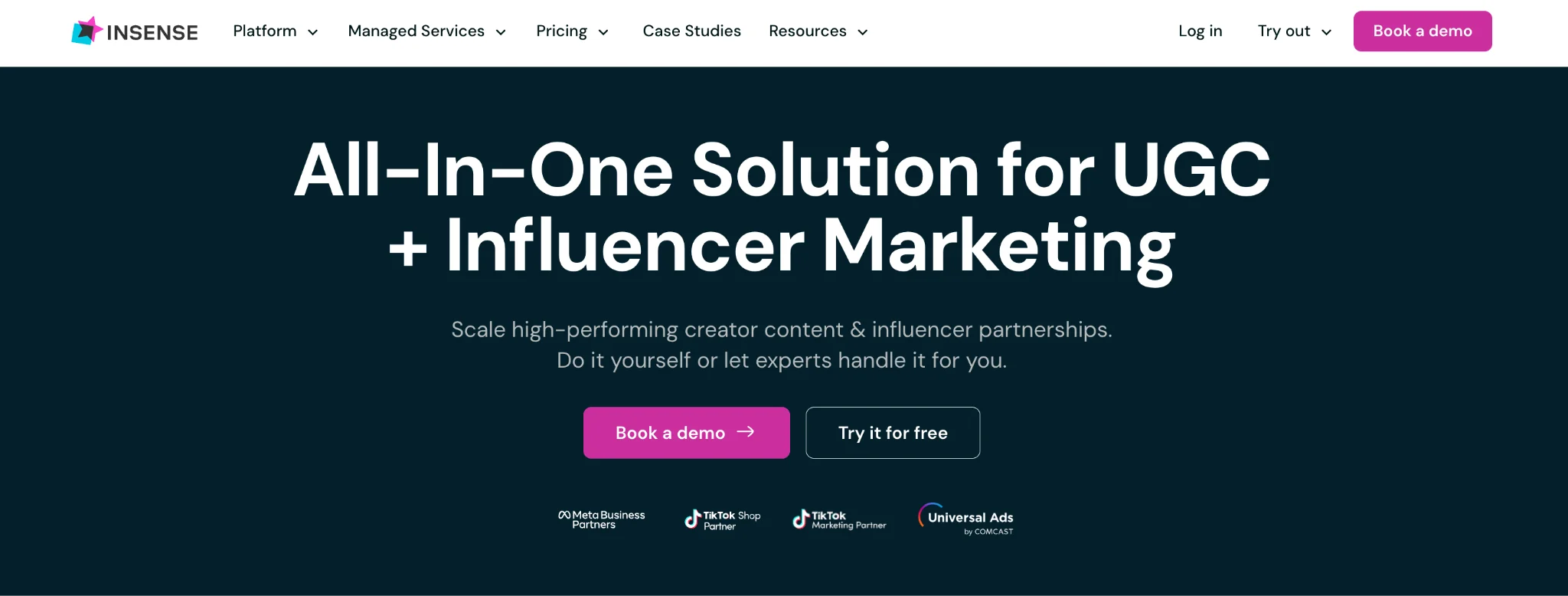
Insense supplies brands with UGC video for paid social. Vetted creators apply to briefs, deliver within roughly ten business days, and contracts, revisions and payment run in the platform with usage rights included. Performance teams that need ad creative regularly are its core users.
Key Features
- Five-applicant guarantee: At least five matching creators per brief, or the subscription is refunded.
- Revision rounds: Up to three passes before you accept a piece of content.
- Seeding included: Product shipped to creators as part of the campaign flow.
- Paid social connection: Creator handles linked for Meta Partnership Ads.
- Usage rights on delivery: Full digital rights granted rather than negotiated per creator.
Pricing
- Trial: $650 for one month, 1 campaign and 10 creators, 20% marketplace fee
- Brand: $500 a month billed quarterly, or $400 a month annually, 10% fee
- Agency: $800 a month billed quarterly, or $640 a month annually, 7% fee
Campaigns and creators are unlimited on both paid plans.
Reviews
4.5/5.0 (G2, 373 reviews).
Pros
- 373 reviews: Seventy times the sample behind a $25 tool.
- Output, not just data: You end the month with usable video rather than a spreadsheet.
- Refund guarantee stated: A written commitment rather than a support queue.
Cons
- A fee on creator payments: 7% to 20% on top of the subscription.
- Twenty times the price: $500 a month against roughly $25.
- No discovery database: You reach the marketplace, not the open market, so an influencer CRM often sits alongside.
Integrations
- Meta: Powers Partnership Ads and whitelisted creator content.
- TikTok: Creator content routed into TikTok ad formats.
- Shopify: Named store connection for seeding and creator orders.
- Stripe: Creator payment processing.
- Content library: Approved assets exported into ad accounts.
Phlanx vs Insense
One prices creators and the other produces content, so the only fair comparison is what a month costs and what you have at the end of it. With Phlanx you have research. With Insense you have video assets and the rights to run them.
For a brand whose real problem is a shortage of ad creative, the twenty-fold price difference resolves quickly. For one that only needs to check an engagement rate before a single collaboration, it does not, and the free calculator remains the cheaper answer.
Afluencer
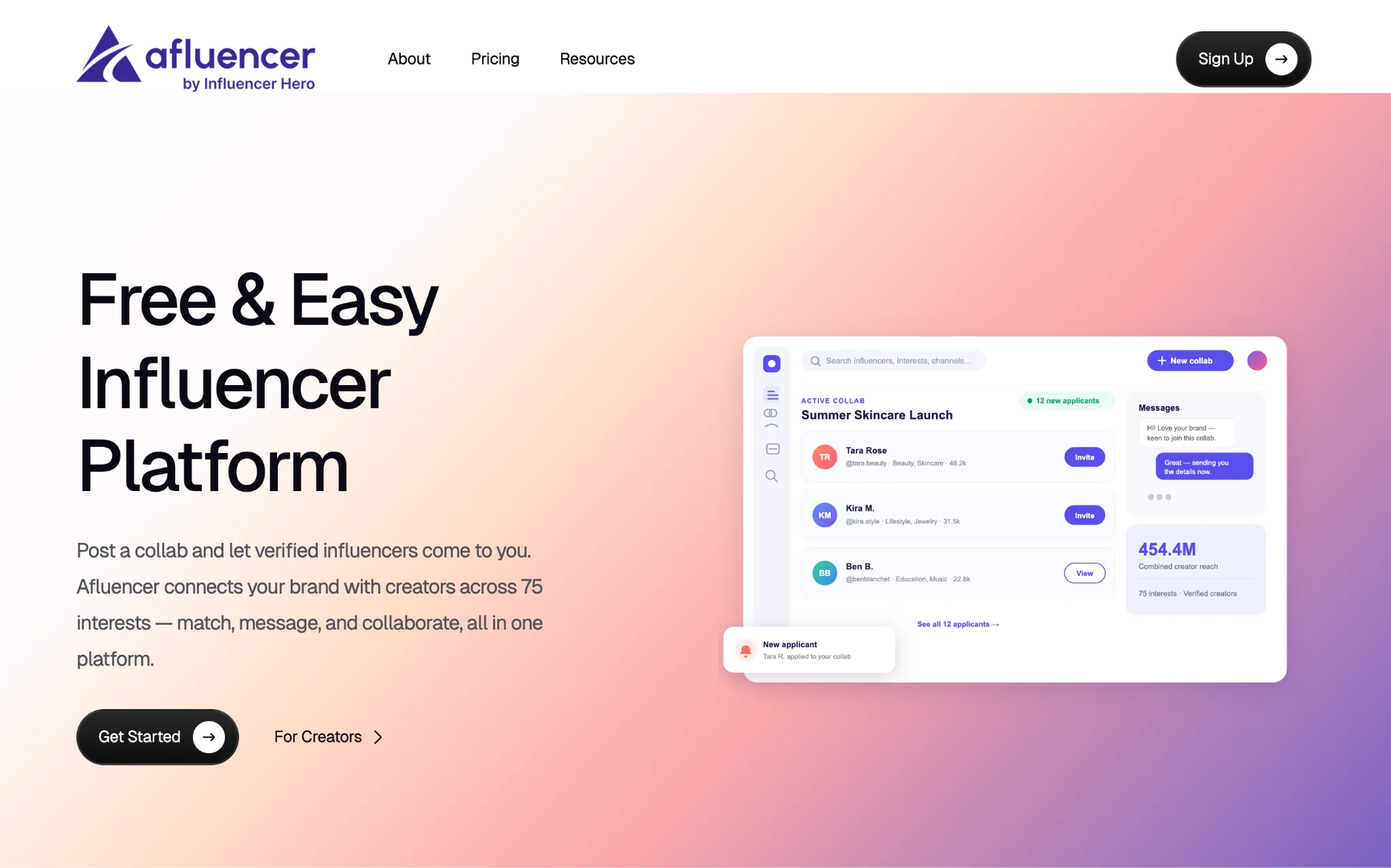
Afluencer is a marketplace built on applications rather than search. Brands post a collaboration listing, verified creators across Instagram, TikTok, YouTube, Facebook and X apply, and the brand picks from who arrives. It targets Shopify merchants and small D2C teams, on a published flat monthly fee.
Key Features
- Inbound listings: Creators apply to you, so a small database is not a limitation.
- Vetted members: Applicants registered and checked rather than scraped from public data.
- CreatorGPT ranking: AI orders applicants against the brief before review.
- Invite credits: Outbound approaches when inbound interest runs thin.
- Codes and payments: Discount codes and creator fees handled through the store link.
Pricing
From $49 a month on the Marketplace plan, with higher tiers for more outbound invites. Creator-side plans are billed separately.
Reviews
4.6/5.0 (G2, 738 reviews) and 4.7/5.0 (Shopify App Store, 34 reviews). The G2 pool leans creator-side, so read it beside the Shopify score.
Pros
- Twice the price, a hundred times the evidence: $49 a month with 738 reviews behind it.
- Database size stops mattering: Creators come to you, which is a different approach to booking influencers.
- Shopify connected: Codes and creator orders tracked against the store.
Cons
- Listing quality decides results: A weak offer attracts weak applicants.
- North America weighted: Coverage thins outside the US and Canada.
- No audience analysis: Campaign-level reporting only.
Integrations
- Shopify: Named connection for codes, referrals and creator orders.
- BigCommerce: The same for BigCommerce merchants.
- Klaviyo: Creator contacts into email campaigns.
- DocuSign: Collaboration terms signed inside the flow.
- Slack: Application alerts to the team.
Phlanx vs Afluencer
This is the closest like-for-like in the list, because both are cheap tools aimed at small teams. The difference is what the money buys. Phlanx sells you a small directory to search; Afluencer sells you visibility so creators apply instead.
For twenty-four dollars more a month you also get a Shopify connection, discount codes, creator payments and 738 reviews rather than five. Given what the Phlanx review record says about billing and support, the extra is cheap insurance.
Aspire
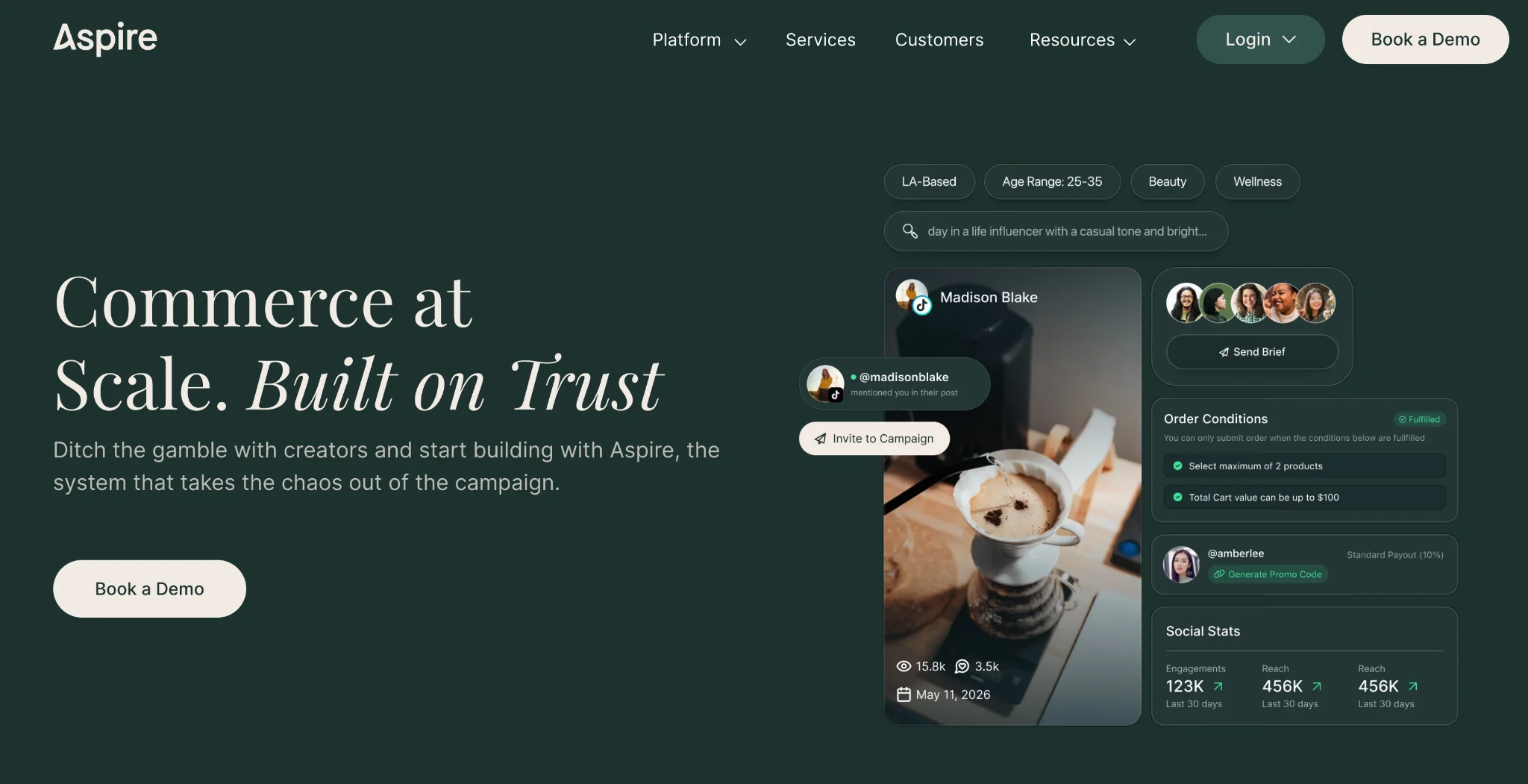
Aspire serves mid-market and enterprise eCommerce brands running continuous creator programs, pairing discovery with campaign workflow, seeding and affiliate tracking. It assumes a roster that grows over years rather than a series of one-off collaborations. Ease of use and influencer management are the strengths reviewers name.
Key Features
- Discovery with similar-creator search: One good partner turns into a shortlist of comparable ones.
- Seeding at volume: Product send-outs managed as a workflow with tracking.
- Brief and approval cycle: Content requested, reviewed and signed off before publication.
- Affiliate attribution: Codes and links resolving creator activity to real orders.
- Rights-managed library: Approved assets stored with usage terms for paid reuse.
Pricing
Not published. Third-party sources report an annual commitment from around $2,000 a month, with other estimates near $2,499, and they disagree enough that only a quote settles it. No free trial.
Reviews
4.6/5.0 (G2, 146 reviews).
Pros
- Proven at scale: 146 reviews and years of iteration behind the product.
- Full program in one place: Discovery, seeding, content and attribution together.
- Enterprise support model: The opposite of an unanswered ticket queue.
Cons
- Eighty times the price: Reported figures near $2,000 a month.
- Quote-only and no trial: Nothing to evaluate independently first.
- Far more platform than a solo marketer needs: Built for teams with staff behind them.
Integrations
- Shopify: Seeding orders and creator revenue attribution.
- WooCommerce: The same for WordPress storefronts.
- Klaviyo: Creator contacts into email programs.
- Slack: Campaign alerts into team channels.
- Zapier: Wider stack coverage where no native option exists.
Phlanx vs Aspire
These sit at opposite ends of the price range in this comparison, and the useful thing is what the eighty-fold difference actually buys. Not eighty times the features, but a real database, seeding logistics, revenue attribution and a support organisation.
Neither is wrong for its buyer. A freelancer checking engagement rates has no use for Aspire, and a brand running two hundred creators a quarter cannot run them on contract templates and a spreadsheet. The mistake is trying to grow a program on the cheaper one.


Influencity

Influencity is a discovery and audience-analysis platform across Instagram, TikTok, YouTube and Twitch, with published tiers and a free trial. Reviewers consistently praise the interface and the support team, which is worth noting in this particular comparison. Plans meter usage rather than charging per seat.
Key Features
- Four networks in one search: Instagram, TikTok, YouTube and Twitch together.
- Genuine audience analysis: Demographics, interests and authenticity rather than an engagement ratio.
- Profile consolidation: A creator’s several accounts linked into one record.
- Campaign tracking: Briefs and monitoring alongside the research tooling.
- Usage-metered plans: Analyses and tracked creators capped per tier.
Pricing
Published from around $318 a month, with annual billing lowering the effective rate and a 7-day free trial on all plans.
Reviews
4.5/5.0 (G2, 282 reviews).
Pros
- Support is a rated strength: Quality of support scores highly against direct competitors.
- 282 reviews: Enough to trust the pattern.
- Audience data done properly: The depth a cheap auditor cannot reach.
Cons
- Twelve times the price: Around $318 a month against roughly $25.
- No payouts or codes: Research and analysis rather than execution.
- Plan limits apply: Heavy research runs into metered caps.
Integrations
- Instagram and TikTok: Creator data and campaign performance.
- YouTube: Channel analytics alongside short-form.
- Twitch: Streaming creator coverage.
- Shopify: Store connection for creator sales tracking.
- Exports: Campaign and creator data for internal reporting.
Phlanx vs Influencity
Both are research tools, which makes this the most direct comparison in the article. They answer the same question, and one answers it much better: real audience demographics and authenticity scoring against an engagement percentage benchmarked to platform averages.
The other difference is the one a buyer should weigh hardest here. Influencity has 282 reviews with support quality among its highest-rated attributes, where Phlanx has five reviews and two of them describe support that never replied.
IMAI

IMAI, also sold as InfluencerMarketing.ai, is a discovery platform built on a very large creator index, adding campaign management and white-label reporting on higher tiers. Agencies running multiple clients make up much of its base. Prices are published and a free trial is offered.
Key Features
- Hundreds of millions of profiles: A database three orders of magnitude larger than a small directory.
- Fraud detection in results: Fake-follower screening surfaced during search.
- Client-separated workspaces: Campaigns and reporting kept apart per account.
- White-label reports: Agency-branded outputs on the higher plans.
- Social listening: Brand and category monitoring above entry level.
Pricing
Published tiers reported from about $175 a month, through roughly $349 and $499, to $1,200 and up for enterprise and white-label, with report volumes varying by tier and a free trial available.
Reviews
4.1/5.0 (GetApp, low review volume at 16 reviews). Sourcing speed and fraud detection draw praise; support and account access draw the criticism.
Pros
- The database gap closed: Hundreds of millions of profiles against a few hundred thousand.
- Trial before payment: Testable without entering a commitment.
- Agency features included: Client separation and branded reporting.
Cons
- Support complaints too: Reviewers report slow help and one lost account.
- Seven times the price: Around $175 a month at entry.
- Sixteen reviews: Larger than five, still small.
Integrations
- Shopify: Named store connection for creator-driven orders.
- WooCommerce: Coverage for WordPress storefronts.
- Instagram and TikTok: Creator data and campaign performance.
- YouTube: Channel-level analytics.
- Exports: Creator and campaign data out for client reporting.
Phlanx vs IMAI
The database is the whole comparison. A directory of a few hundred thousand profiles against an index in the hundreds of millions is not a difference of degree, and at roughly seven times the price IMAI is still the cheaper way to reach a creator who is not already in a small curated list.
Worth noting honestly: support complaints appear in both review records. IMAI has sixteen reviews to Phlanx’s five, so the pattern is better documented, but neither vendor looks strong on that axis.
HypeAuditor
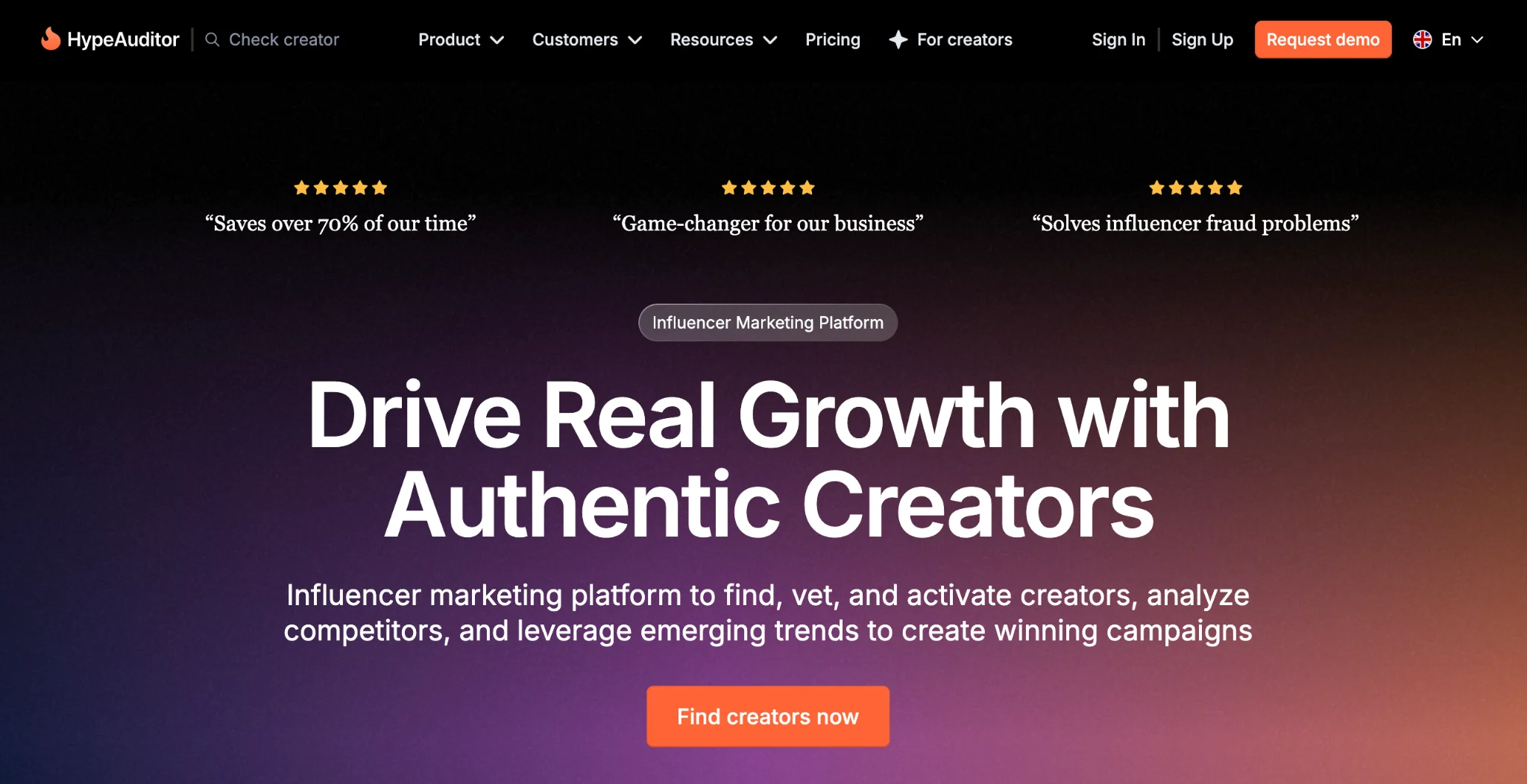
HypeAuditor is built around fraud detection, with audience quality analysis as the core of the product. Discovery, campaign tracking, competitor visibility and market analytics sit around it across the main consumer networks. Teams that vet seriously before committing budget are its buyers.
Key Features
- Fraud and authenticity scoring: The deepest audience quality analysis in this comparison.
- Discovery on verified data: Search filtered by the same authenticity metrics.
- Campaign monitoring: Live post and result tracking against stated goals.
- Competitor creator tracking: Which creators rival brands are working with.
- Free public audit tools: Account checks and calculators without an account.
Pricing
Not published. Quotes come through a demo, with a free entry point covering media plans and limited versions of the paid features.
Reviews
4.6/5.0 (G2, 262 reviews).
Pros
- Free tools too: Public audits that go deeper than an engagement percentage.
- 262 reviews: A dependable evidence base.
- Fraud detection done properly: The thing a cheap auditor only approximates.
Cons
- No published price: The free tier does not remove the sales call.
- No commerce layer: No codes, commission or payouts.
- Analysis, not execution: Light on outreach and campaign operations.
Integrations
- Instagram and TikTok: Creator data and audience analysis.
- YouTube: Channel analytics and audience breakdowns.
- Twitch: Limited streaming coverage.
- API access: Creator data programmatically on higher plans.
- Report exports: Audits shared as files with stakeholders.
Phlanx vs HypeAuditor
Both give something away free, which makes this a fair fight at the entry point. The Phlanx calculator returns an engagement rate; the HypeAuditor free tools return audience quality signals, which is the more useful number when deciding whether to pay a creator.
Past the free tier they diverge sharply. HypeAuditor quotes privately and expects a real budget, but 262 reviews stand behind it. For a marketer who only ever uses the free layer, either is fine and neither costs anything.
Julius
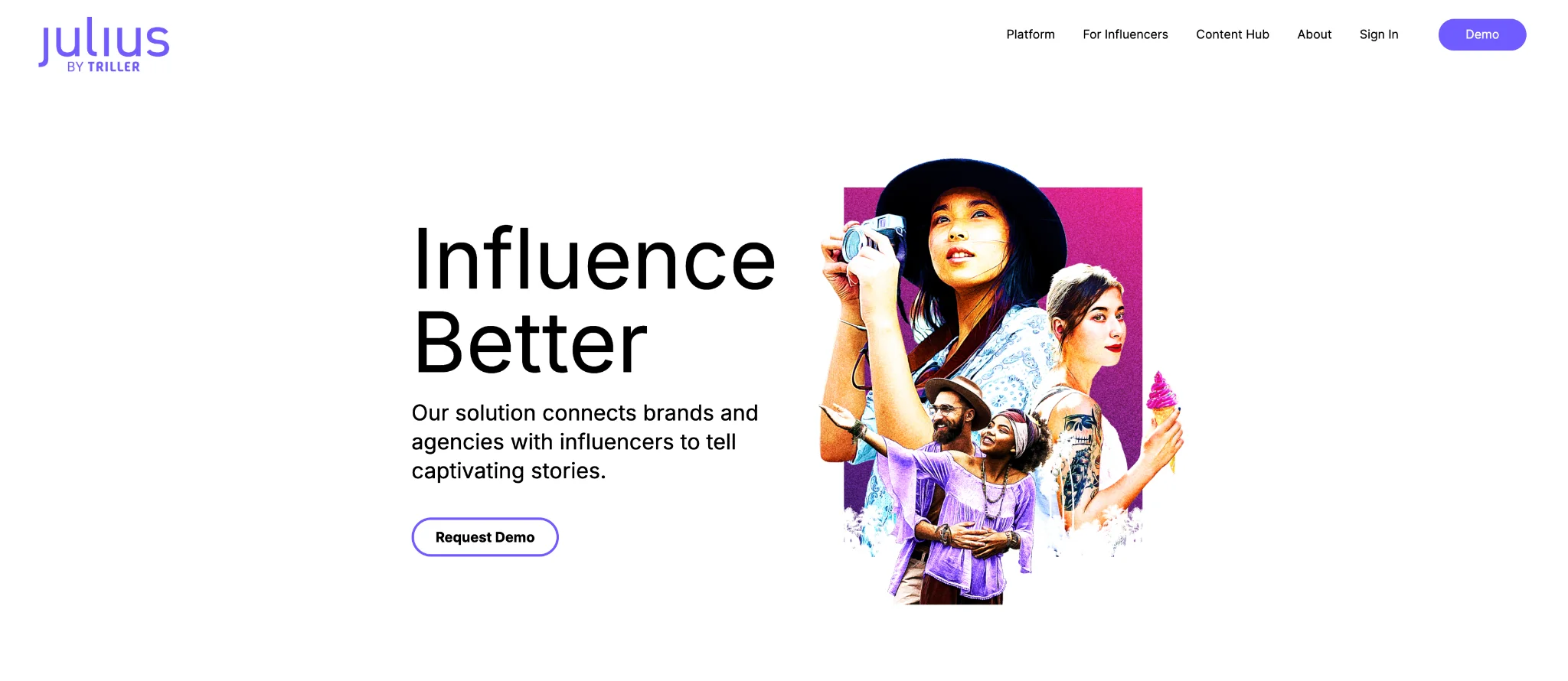
Julius assembles its creator profiles by hand rather than scraping, holding interests, brand affinities and past partnerships in unusual detail. Smaller teams and agencies are its main users, and ease of setup is its most cited strength. It competes on the quality of each record rather than the size of the index.
Key Features
- Researcher-built records: Creator data compiled manually, including previous brand collaborations.
- Search past the obvious filters: Attributes an automated database does not hold.
- Audience analytics: Demographic detail reviewers rate as a strength.
- Campaign management: Briefs and tracking in the same place as discovery.
- Free trial: Hands-on access before any contract, similar to a creator CRM evaluation.
Pricing
Not published and quoted per account, though a free trial is available which softens the missing rate card.
Reviews
4.5/5.0 (G2, 96 reviews).
Pros
- Quality over quantity: A curated record beats a larger index of shallow ones.
- 96 reviews: Nineteen times the sample.
- Trial included: Evaluate before negotiating.
Cons
- No published price: Budgeting waits for a call.
- No payouts or codes: Discovery-focused throughout.
- Smaller index: Curation limits raw scale.
Integrations
- Instagram and TikTok: Creator data and campaign performance.
- YouTube: Channel analytics.
- Twitter/X: Additional creator coverage.
- Email tools: Outreach run from the creator record.
- Exports: Creator lists and reports for client work.
Phlanx vs Julius
Both hold smaller databases than the scraped indexes, and both argue that is a feature rather than a shortfall. The difference is what fills the gap. Julius employs researchers to deepen each profile; Phlanx simply has fewer profiles.
Julius does not publish a price, which is a real disadvantage against a $25 tool. It does offer a trial and carry 96 reviews, so a buyer can form a view before committing, which is more than five reviews and an unanswered support queue allow.
Brandbassador (Club)

Brandbassador, now also sold as Club, builds an ongoing ambassador community from a brand’s existing customers, activated through gamified missions with rewards attached. It presumes people who already like the brand, which makes it closer to loyalty software than to a research tool. The job it does is community management.
Key Features
- Missions and rewards: Tasks published to the community, completed for points, product or commission.
- Gamified retention: Leaderboards and tiers that keep ambassadors active month to month.
- Customer-to-ambassador recruitment: Your own base converted into a managed roster.
- Reward and commission tracking: Payments and incentives handled per ambassador.
- Programme analytics: Participation and content output measured centrally.
Pricing
Not published, with third-party listings reporting no free trial. Quotes come through the vendor.
Reviews
4.7/5.0 (G2, 107 reviews), the highest score in this comparison. Ease of use and support are praised; ambassador search and filtering draw the criticism.
Pros
- Best-rated here: 4.7 across 107 reviews, with support specifically praised.
- Four named store integrations: Against none.
- No discovery needed: The roster comes from your customer base.
Cons
- Quote-only and no trial: Less accessible than a $25 subscription.
- Search is the weak point: The recurring complaint in its reviews.
- Requires an existing base: Nothing to work with otherwise.
Integrations
- Shopify: Discount codes and ambassador sales tracked from the store.
- WooCommerce: The same for WordPress storefronts.
- Adobe Commerce: Enterprise commerce coverage.
- BigCommerce: Additional storefront support.
- Instagram and TikTok: Ambassador content tracked against missions.
Phlanx vs Brandbassador
These solve different halves of a program and neither overlaps much with the other. Phlanx helps you evaluate a creator you have found; Brandbassador organises and pays hundreds of people who already buy from you.
Where the comparison bites is support and evidence. Brandbassador carries 107 reviews with support named as a strength, and connects to four eCommerce platforms. For a brand about to build a program on either, that difference matters more than the monthly figure.
Final Thoughts on Phlanx Alternatives
Keep the two products separate when you decide. The free engagement calculator is good, costs nothing and needs no account, so use it regardless of what else you buy. The subscription is a different question, and the deciding factor is not the feature list or even the low price. It is that paying customers report being charged for plans they did not select and waiting over a week for a reply. If you subscribe anyway, confirm the currency and billing frequency at checkout, screenshot both, diarise the trial end date and pay with a card you can dispute.

.png)


.jpg)










