


10 Best Linkr Alternatives for Influencer Marketing
Linkr’s entry plan does not run campaigns. At €199 a month, Search & Communicate buys unlimited creator search, filters, lists, AI recommendations and a chat window, and that is the whole scope. Campaign management, payments and invoicing arrive at €349. Product seeding, inventory sync, affiliate tracking and commission calculation, which is the part most D2C brands are actually shopping for, sit on the €699 Product & eCommerce tier.
That is worth knowing before the comparison starts, because it moves Linkr out of the affordable-European-option bracket its headline price suggests and into direct competition with platforms that include all of it on their first tier. What Linkr does well is genuinely useful: a curated network of verified creators, automated invoicing that handles regional creator contribution fees, a 7-day trial with no credit card, and monthly cancellation on everything except white label. In this article, we’ll compare the 10 best Linkr alternatives, including Influencer Hero, CreatorIQ, Upfluence, Afluencer, Aspire, NeoReach, Klear, Traackr, Social Cat and Heepsy.
Key Criteria for Evaluating Influencer Marketing Platforms
Core Features
Find the tier that contains the feature you are buying for. Vendors put discovery on the entry plan because it demos well, and push seeding, affiliate tracking and attribution higher up where the margin is, so a quoted starting price often describes a product you would not actually buy. Check how large the searchable creator database is on that tier too, since curated networks trade breadth for vetting.
Pricing & Flexibility
Compare annual totals, not monthly headlines. Discounted annual billing is quoted as a lower monthly figure while committing you for a year, which is a different product to a rolling monthly plan even when the number looks smaller. Work out the twelve-month cost of the tier you need and compare that across vendors.
Customer Reviews & Satisfaction
Insist on a named source and a review count. Vendor-stated averages, aggregator listings with a handful of entries and app store composites all read as ratings without behaving like one, and a platform can look excellent at 4.9 while having almost no independent feedback at all. Thin evidence is a risk to price in, not a reason to disqualify.
Pros & Cons
Match the tool to what you sell. Product seeding, inventory synchronisation and sales attribution are built for physical goods, so a services business or a digital brand ends up paying for a feature set it cannot use. Conversely a physical-goods brand buying a discovery-only tool will rebuild half the workflow in spreadsheets.
Integrations
Check the store platform first and everything else second. eCommerce coverage decides whether attribution works at all, and platforms vary more than you would expect, with Shopify near-universal, WooCommerce common, and Shopware, Magento or custom builds supported by only a handful. Payment rails and contract tools matter, but they are replaceable in a way the store connector is not.
Linkr Overview
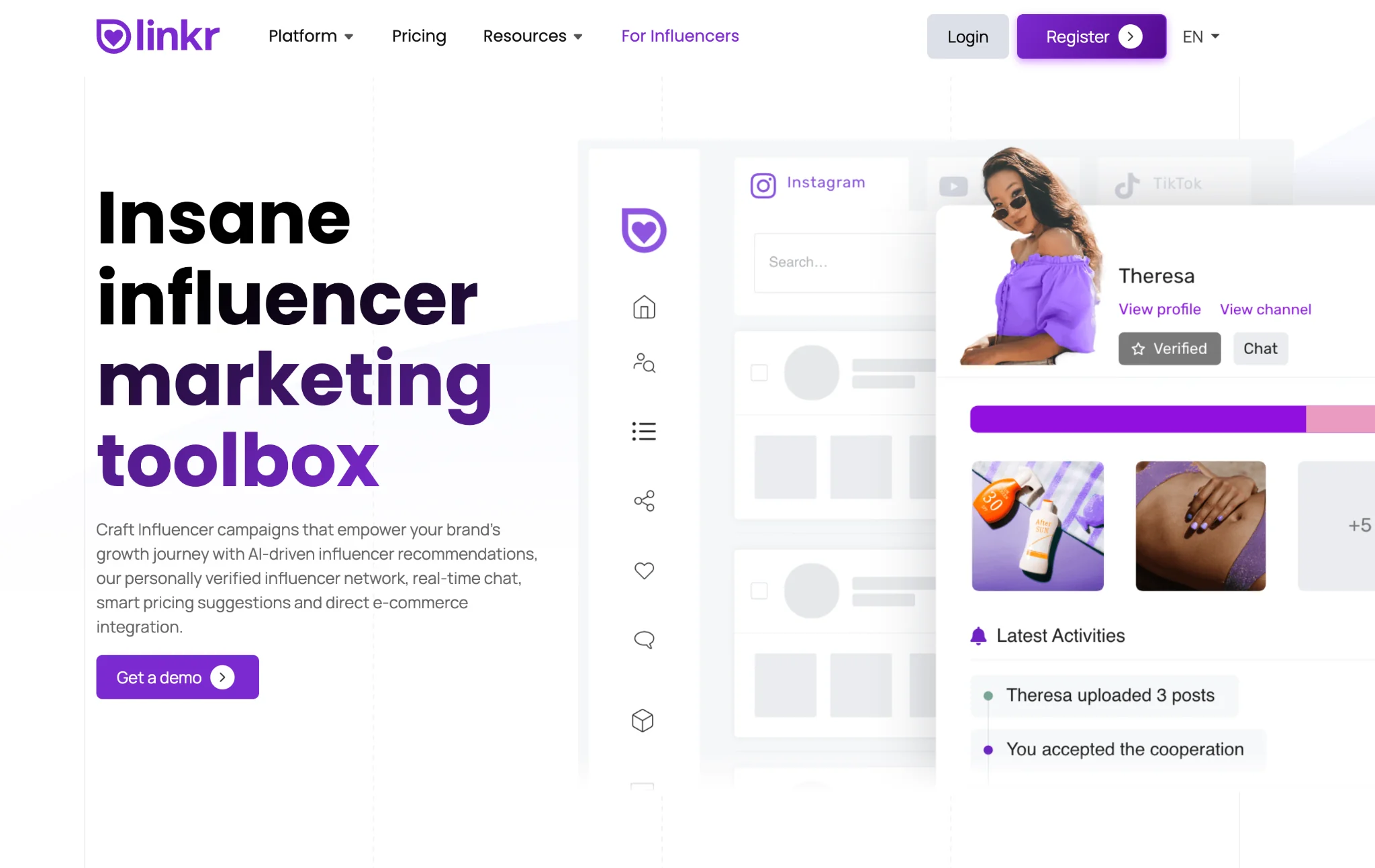
Linkr is an influencer marketing platform that helps brands discover and collaborate with verified creators, manage campaigns, and streamline the entire influencer relationship process. Its features include AI-powered influencer recommendations, campaign management, real-time creator communication, smart compensation, e-commerce and product integrations, payments, and UGC sourcing.
Key Features
- Curated verified network: A vetted creator pool rather than a scraped public database, searchable by industry, demographics, geography, engagement and collaboration history.
- Daily AI recommendations: Creator suggestions refreshed against campaign objectives and past collaboration performance rather than a static filter set.
- Smart pricing suggestions: An estimate of fair collaboration pricing based on reach and engagement, useful as a negotiation anchor for both sides.
- Automated invoicing: Invoice generation with regional compliance handled, including mandatory creator contribution fees calculated automatically where a country requires them.
- Product seeding with inventory sync: Store inventory connected so samples ship against real stock, available on the €699 tier.
Pricing
- Search & Communicate: €199 a month, or €149 a month billed annually at €1,788 a year. Search, filters, lists, notes, AI recommendations and messaging only.
- Influencer Relationship Management: €349 a month, or €289 annually at €3,468. Adds campaign management, pricing suggestions, payments, invoicing and priority support.
- Product & eCommerce Integration: €699 a month, or €559 annually at €6,708. Adds inventory sync, product seeding, affiliate sales tracking, commission calculation and discount codes.
- White Label Enterprise: €1,990 a month, or €1,549 annually at €18,588. Branded platform, API access, private creator database and a dedicated success manager.
- A 7-day free trial with no credit card, and monthly cancellation on every plan except white label.
Reviews
There is no G2 or Capterra listing with meaningful volume. Linkr states 4.8/5.0 across app stores on its own site, and a Crozdesk listing shows 4.9/5.0, but neither is a verified software buyer rating with a published review count you can inspect. That is not evidence of a bad product, it is an absence of evidence, and it stands out in a category where competitors carry hundreds of independent reviews. Treat the scores as directional and weight the free trial accordingly.
Integrations
- Shopify: Catalogue sync, automated seeding, discount code generation and affiliate sales tracking.
- WooCommerce: Inventory management, product send-outs and order tracking against influencer activity.
- Shopware: Supported alongside the two main platforms, which is unusual and useful for European merchants.
- Stripe and PayPal: Creator payouts and invoicing handled through both rails.
- REST API: Connect campaign, creator and reporting data to an existing CRM or ERP.
Shopware support is the standout, since almost nothing else in this comparison covers it. The gap is at the other end: reporting is solid for a mid-market tool but stops short of warehouse exports, competitive benchmarking or the depth of campaign analytics a larger team would expect to hand to a finance director.
Pros
- Fully published pricing: Four tiers with monthly and annual figures on the site, which almost no competitor at this level does.
- Real trial and monthly terms: 7 days without a credit card, then cancel monthly on everything but white label.
- Compliance handled: Automated invoicing that calculates regional creator contribution fees, which is a genuine European operating advantage.
Common Drawbacks of Linkr
The useful tier is €699
Seeding, affiliate tracking and commission calculation are gated three plans up, so the €199 headline understates the real cost for a D2C brand.
Almost no independent reviews
No G2 or Capterra listing with volume, leaving vendor-stated scores as the only signal.
A smaller creator pool
Curation means fewer searchable profiles than platforms indexing tens or hundreds of millions.
Built around physical products
Seeding, inventory sync and sales attribution deliver little for service or digital brands paying the same price.
Best Linkr Alternatives
| TOOL | REVIEWS | BEST FOR | TRIAL INFO | PRICING | ||
|---|---|---|---|---|---|---|
1 |

|
⭐ | Influencer CRM & automation | Book Demo | Pricing | Website |
2 |

|
⭐ | Enterprise influencer marketing | Book Demo | Pricing | Website |
3 |

|
⭐ | Influencer discovery | Book Demo | Pricing | Website |
4 |

|
⭐ | Influencer marketplace campaigns | Book Demo | Pricing | Website |
5 |

|
⭐ | Influencer partnerships | Book Demo | Pricing | Website |
6 |
|
⭐ | Influencer campaigns & data analytics | Book Demo | Pricing | Website |
7 |
|
⭐ | Influencer analytics | Book Demo | Pricing | Website |
8 |

|
⭐ | Enterprise influencer analytics | Book Demo | Pricing | Website |
9 |

|
⭐ | Micro-Influencer Campaigns | Book Demo | Pricing | Website |
10 |

|
⭐ | Influencer discovery | Book Demo | Pricing | Website |
Influencer Hero
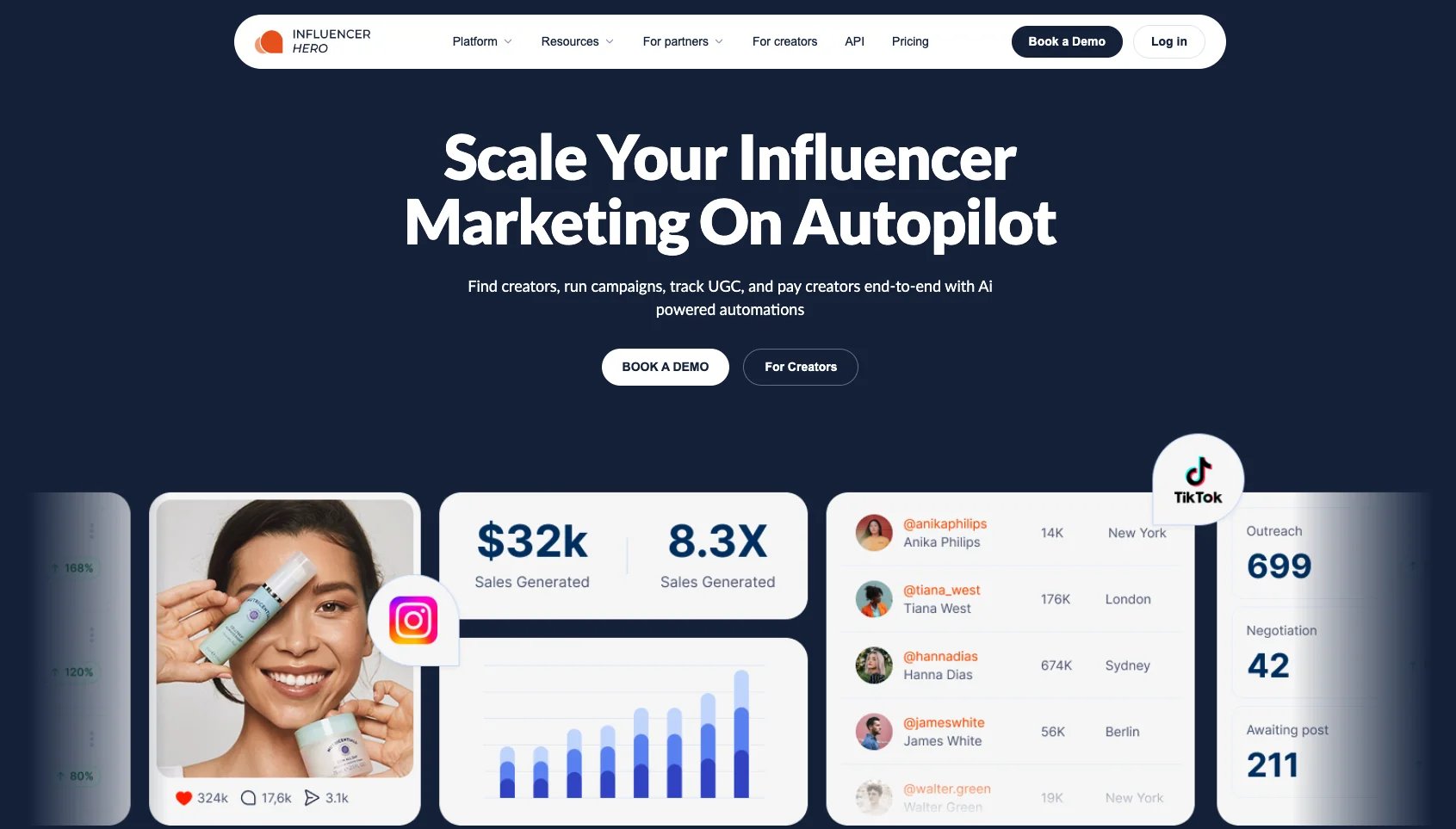
Influencer Hero is an all-in-one influencer marketing platform for D2C and eCommerce teams, running discovery, influencer outreach, CRM, gifting, affiliate tracking, UGC collection and reporting from a single account. It covers eight social networks and connects to Shopify, WooCommerce, Magento and custom stores via script. Its structural difference from a tiered platform is that plans scale on creator volume rather than on which features you unlock.
Key Features
- Creator discovery: Instagram, TikTok, YouTube, Facebook, Pinterest, Snapchat, X and Twitch, filtered by location, audience demographics, niche, engagement rate and follower quality.
- Fake follower detection: Audience authenticity screening included from the entry plan rather than sold as an upgrade.
- Affiliate management: Links, codes, commission tracking and automated payouts available on every tier, not gated behind an eCommerce plan.
- Gifting and product seeding: Fulfilment through Shopify and WooCommerce with script support for Magento and custom builds.
- Creator storefronts: Creator storefronts where influencers feature your catalogue and earn on recurring affiliate sales without new outreach each time.
- Outreach and CRM: Bulk and one-to-one email with AI personalisation, drip sequences, reply tracking and relationship boards by campaign stage.
- Brand follower identification: Surfaces creators already following or buying from you as a warm recruitment pool.
- AI UGC search: Find delivered creator content by keyword, visual or caption and route the best performers into paid social.
Pricing
- Standard: $649 a month, up to 1,000 creators.
- Pro: $1,049 a month, up to 5,000 creators.
- Business: $2,490 a month, up to 10,000 creators.
- Custom and agency pricing available, with all tiers published and the full feature set included at every level.
Reviews
5.0/5.0 (Capterra)
Pros
- Features are not tiered: Seeding, affiliate tracking and UGC come with the entry plan; only creator volume changes.
- Eight networks: Broader coverage than most mid-market European platforms.
- Custom store support: An embedded script means attribution is not limited to the named integrations.
Cons
- No free trial: Evaluation runs through a demo, where Linkr gives you 7 days hands-on.
- Higher entry point: $649 a month against a €199 starting tier, even if the comparable tiers sit closer together.
- Learning curve: A wide platform takes longer to get productive on than a focused one.
Integrations
- Shopify, WooCommerce and Magento for attribution and gifting, with script support for custom stores.
- GoAffPro for affiliate tracking and DocuSign for creator contracts.
- Klaviyo for lifecycle email and Slack for internal alerts.
- Gmail, Outlook and Zapier across the wider stack.
- A documented API for pulling creator data into internal systems.
Linkr vs Influencer Hero
Compare the tiers that actually do the job rather than the entry prices. Linkr’s affiliate tracking, seeding and commission calculation live on the €699 Product & eCommerce plan; Influencer Hero includes all of it on the $649 Standard plan alongside discovery across eight networks and fake-follower screening. The headline gap of €199 against $649 disappears once you line up equivalent functionality.
Each keeps a real advantage. Linkr supports Shopware and handles regional creator contribution fees in its invoicing, both of which matter for European merchants and neither of which Influencer Hero advertises. Influencer Hero counters with wider network coverage, custom store support via script, and hundreds of independent data points on audience quality, plus it does not make you change plan to start an affiliate programme.
CreatorIQ
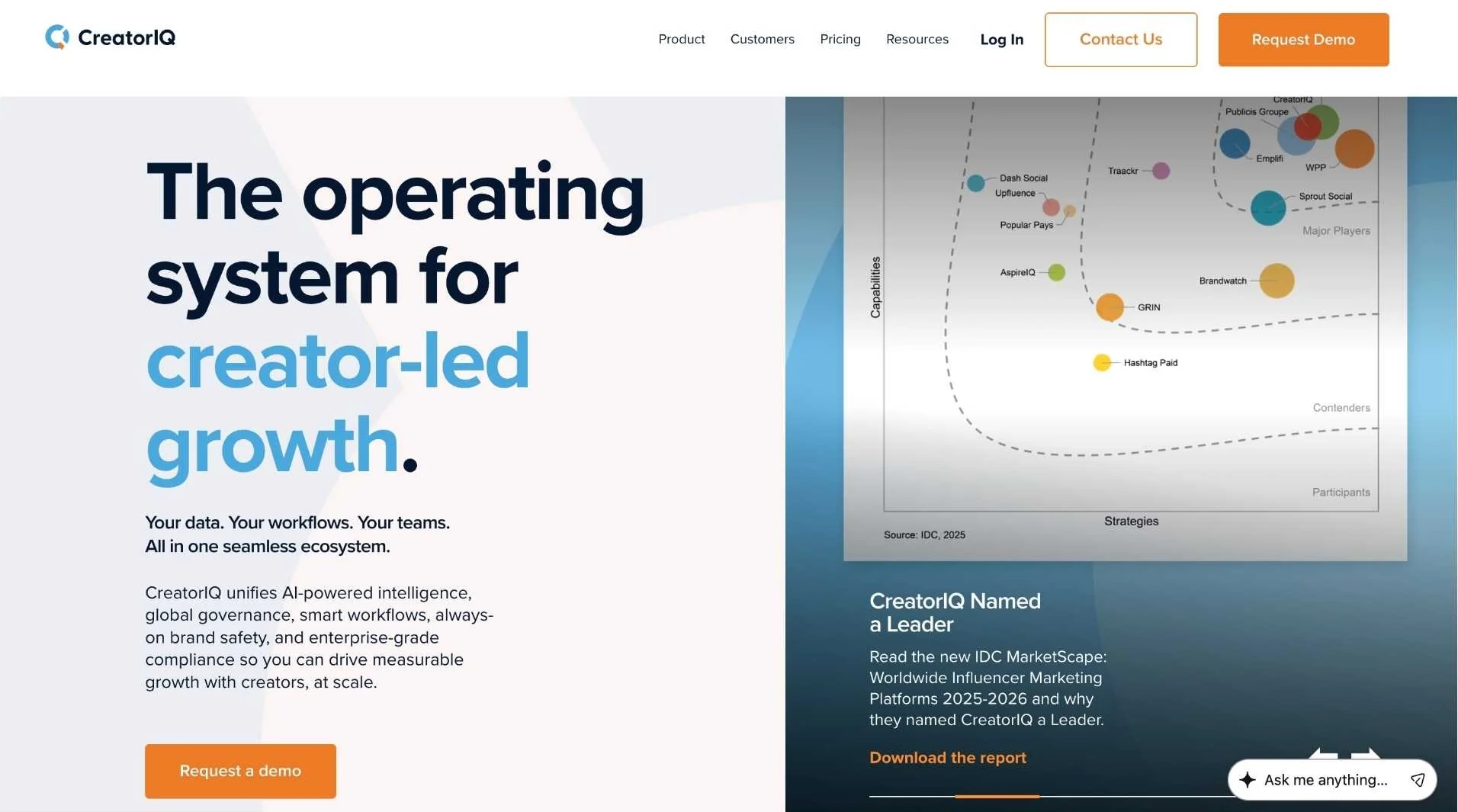
CreatorIQ is enterprise influencer marketing software for large brands and agencies needing first-party creator data, brand safety controls and reporting that survives procurement. It is designed to consolidate creator activity across regions, agencies and affiliate networks into one set of numbers. It sits well above Linkr on both capability and cost.
Key Features
- First-party creator data: Sourced through official platform partnerships rather than inferred from public pages.
- SafeIQ brand safety: Text, image, video and audio scanning with rules configured per brand.
- BenchmarkIQ: Program performance measured against category peers rather than your own baseline.
- Global creator payments: Payouts handled in-platform across markets and currencies.
- Data export API: A dedicated product for moving creator and campaign data into your warehouse.
Pricing
- Quote-based, with a call booking form instead of published tiers.
- Third-party listings report entry around $36,000 a year, with buyer medians near $39,000.
- Annual contracts, no free trial and no free version.
Reviews
4.6/5.0 (G2, 581 reviews) and 4.5/5.0 (Capterra, 17 reviews).
Pros
- Nearly 600 buyer reviews: The independent evidence Linkr entirely lacks.
- Enterprise reporting: Peer benchmarking and warehouse exports rather than in-platform dashboards.
- Affiliate network connections: CJ, Awin, Impact, Rakuten and Partnerize reporting alongside owned activity.
Cons
- Around $36,000 a year: Roughly five times Linkr’s top non-enterprise tier.
- No published pricing: Nothing to plan against, where Linkr publishes all four plans.
- Shopify only: No WooCommerce and no Shopware.
Integrations
- Shopify, Google Analytics and Tableau for commerce and reporting.
- Salesforce, DocuSign and Sprinklr for enterprise workflow.
- CJ, Awin, Impact, Rakuten and Partnerize for affiliate attribution.
- Single sign-on for enterprise identity management.
- An export API for internal data pipelines.
Linkr vs CreatorIQ
This is the upgrade path rather than a like-for-like swap. Linkr’s honest weakness is enterprise analytics, and CreatorIQ is built almost entirely around that gap, with peer benchmarking, an export API pointed at your warehouse and brand safety scanning across every asset format.
The price difference is the whole argument against it. Linkr’s heaviest non-enterprise plan runs €6,708 a year with published figures and monthly cancellation; CreatorIQ reports entry near $36,000 on an annual contract with nothing published. For a brand that outgrew Linkr’s reporting but not its scale, that is a large jump to make in one step.
Upfluence

Upfluence is a creator marketing platform known for finding influencers inside a brand’s own customer and website data rather than in an external roster. It sells modularly, switching on discovery, outreach, gifting or payments as required, and states plainly that it takes no commission on creator-driven sales. Its store coverage is the broadest here.
Key Features
- Live Capture: Identifies creators sitting inside your existing customer list and site traffic.
- Jaice AI co-pilot: Builds shortlists and drafts outreach for approval.
- Order triggering: Creates and ships gifting orders directly from your store.
- Multi-currency payments: Creator payouts handled across international markets.
- Creator marketplace: Inbound applications collected against briefs you publish.
Pricing
- Quote-based and modular, charged on the modules you switch on.
- A fixed platform fee with no commission on creator-driven sales, published by the vendor.
- No setup fee, with a 12 month minimum on annual plans.
- Buyer-reported medians around $15,000 a year.
Reviews
4.6/5.0 (G2, 140 reviews) and 4.4/5.0 (Capterra, 44 reviews).
Pros
- Four store platforms: Shopify, WooCommerce, Magento and BigCommerce, plus Amazon Attribution.
- Customers become creators: A recruitment pool that grows with the business rather than a fixed curated network.
- 184 independent reviews: Across two sources, against effectively none.
Cons
- Twelve month minimum: No monthly cancellation, where Linkr offers it on three of four plans.
- Modular cost creep: The quote grows as payments and automation modules are added.
- No published pricing: Nothing on the site to plan a budget against.
Integrations
- Shopify, WooCommerce, Magento and BigCommerce for commerce data.
- Klaviyo and Hootsuite across the marketing stack.
- Amazon Attribution and Refersion for tracking beyond your storefront.
- Zapier for internal tooling.
- Gmail and Outlook for outreach.
Linkr vs Upfluence
Both are modular, and both make you pay more to get the eCommerce layer, so the difference is what the modules contain. Upfluence reaches four store platforms plus Amazon and finds creators inside your own customer data, which is a fundamentally different sourcing model to a curated network of a few thousand verified profiles.
Linkr wins on terms and transparency. Every plan is published, the trial is real and you can cancel monthly, against a twelve month minimum and a quote you cannot look up. For a brand that wants to test whether the channel works at all before committing a year, that difference outweighs a longer integration list.
Afluencer
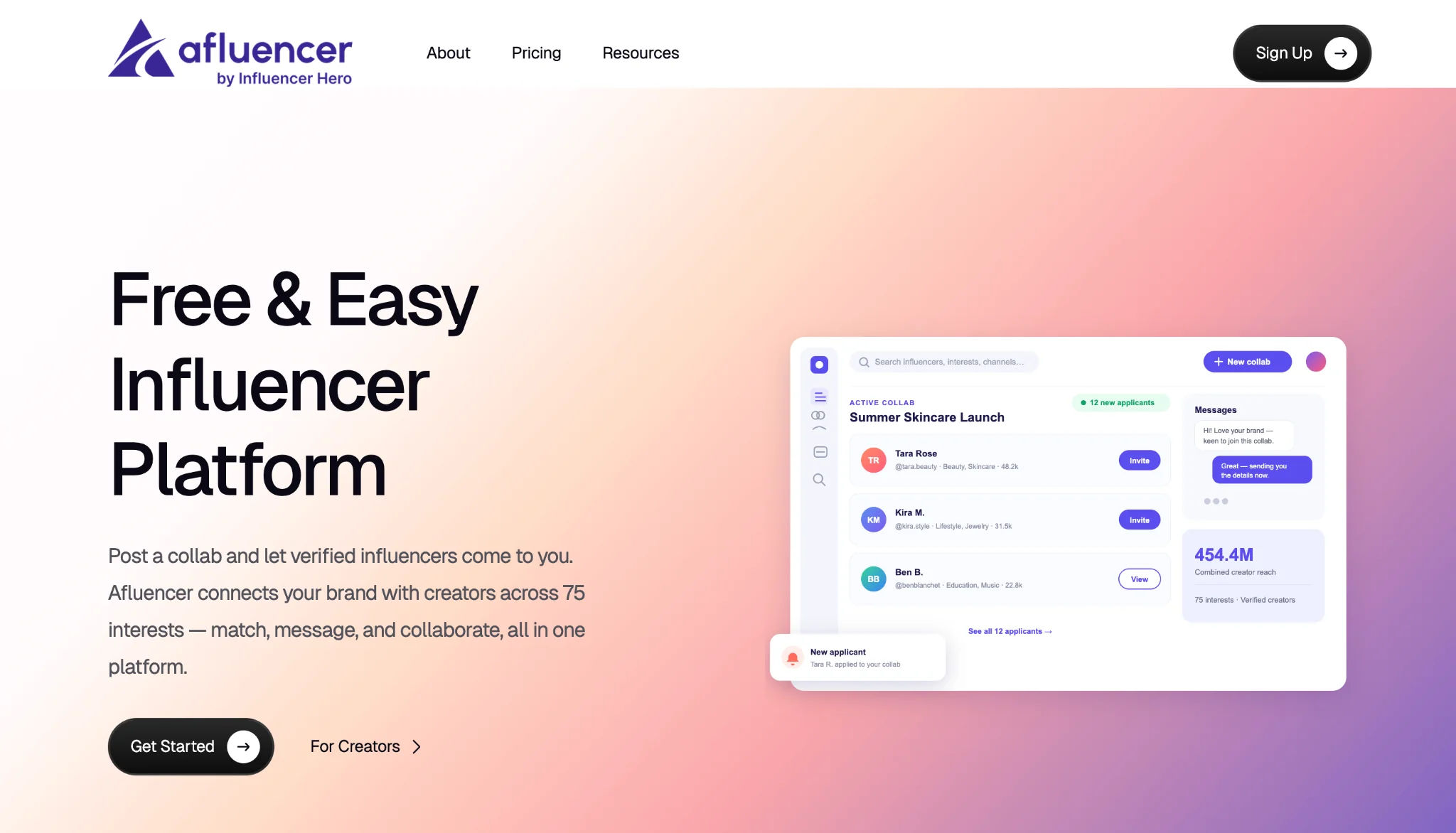
Afluencer is a creator marketplace built on inbound applications, where brands publish campaign listings and creators apply. Pricing starts at a published $49 a month and the platform takes no percentage of what creators are paid. It is by far the cheapest way to get creators in front of a brief.
Key Features
- Campaign listings: Publish a brief and collect applications from creators who selected it.
- Premium filters: Screen applicants by niche, audience size and social network.
- In-app messaging: Negotiate rates and deliverables directly with each creator.
- Send-outs and payments: Product delivery and creator payment on higher tiers.
- AI matching: AI-assisted matching ranks applicants against your brief with approval left to you.
Pricing
- Marketplace: $49 a month with 60 invitation credits and premium filters.
- Standard: $649 a month with 1,000 reach-outs, product send-outs and payments.
- Pro: $1,049 a month with 5,000 reach-outs and a dedicated account manager.
- Creators join and apply free, every tier published, no minimum term.
Reviews
4.6/5.0 (Shopify App Store, 36 reviews).
Pros
- A quarter of the entry price: $49 a month against €199 for search and messaging.
- Verified store listing: 36 Shopify App Store reviews is thin, but it is more independent evidence than the alternative.
- Inbound rather than outbound: Applicants arrive pre-interested instead of being searched for and pitched.
Cons
- Shopify only: No WooCommerce or Shopware path.
- Credit ceiling: 60 invitations on the entry plan disappear quickly.
- No invoicing compliance: Nothing equivalent to automated regional fee handling.
Integrations
- Shopify for gifting and collaboration workflow.
- Instagram, TikTok and YouTube for reviewing applicant profiles.
- Native in-platform messaging.
- Creator payments handled in-platform on higher tiers.
- Email alerts for new applications on live briefs.
Linkr vs Afluencer
Linkr’s entry tier and Afluencer’s entry tier do close to the same job at very different prices. €199 buys unlimited search and messaging against a curated network; $49 buys campaign listings, 60 invitation credits and applicants who came to you. If the first thing you need is simply contact with relevant creators, the cheaper option answers it.
Where Linkr pulls ahead is everything downstream. Afluencer has no inventory sync, no commission calculation and no compliance-aware invoicing, so a brand running structured seeding and affiliate programmes across European markets will outgrow it quickly. The sensible read is that they occupy different stages rather than competing directly.
Aspire
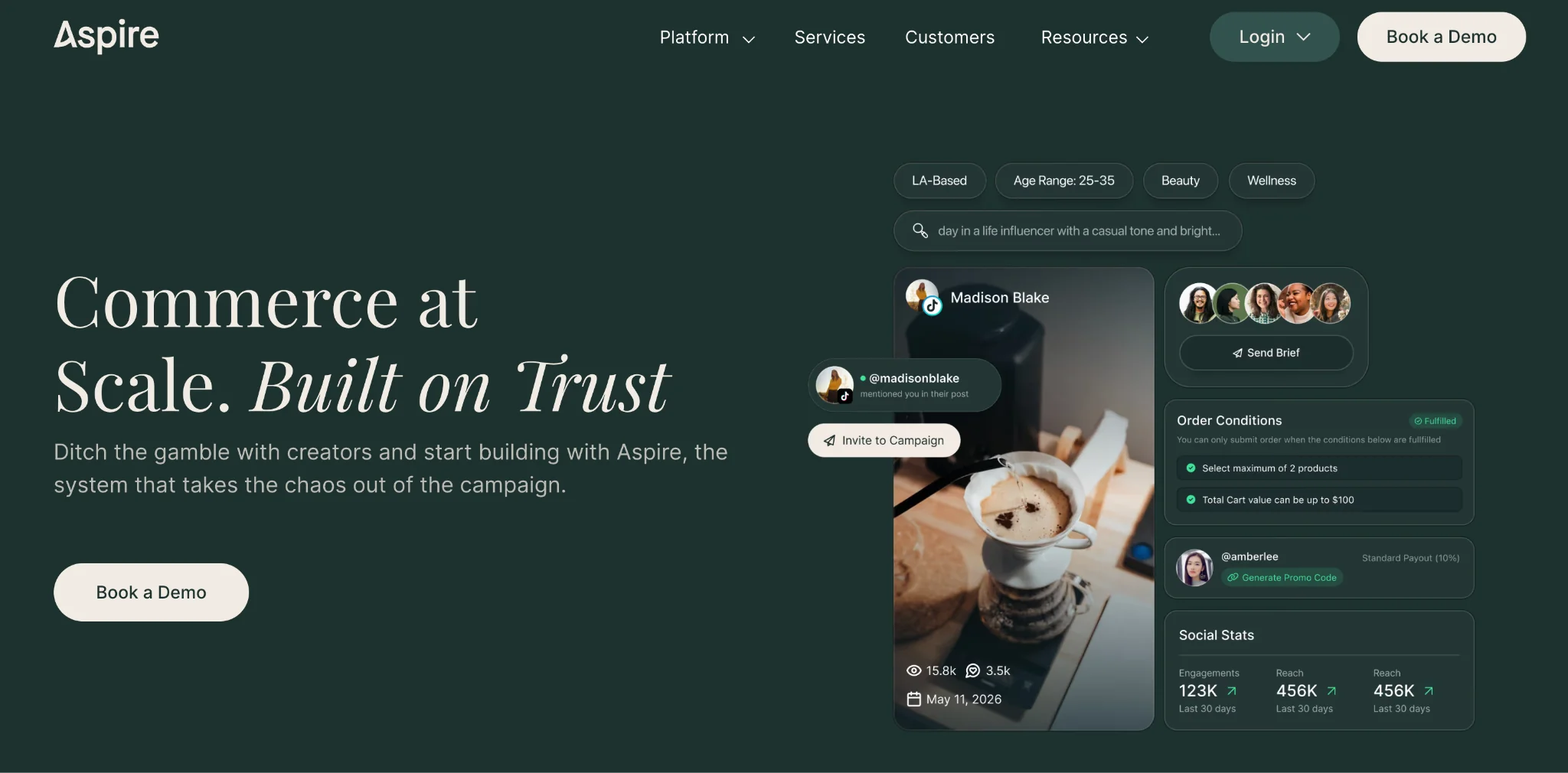
Aspire is a creator marketing platform for D2C brands running gifting, affiliate and paid amplification through one workflow. Creators apply to briefs you publish, you configure commission rates per creator, and approved content can run as paid media from the creator’s handle. It is the strongest option here for turning content into ongoing media.
Key Features
- Creator marketplace: Applications collected against briefs you publish.
- Promo codes and affiliate links: Issued per creator at rates you set.
- Whitelisting: Creator content run as paid ads through Meta Ads Manager from the creator’s own handle.
- Content approval and rights: Review rounds with usage licensing attached to each asset.
- Attribution dashboards: Creator activity tied to Shopify revenue.
Pricing
- Quote-based, with no published pricing page.
- A 2% handling fee on creator fee budget payments, disclosed in the vendor’s terms.
- Buyer-reported medians near $15,600 a year on annual contracts.
- No free trial.
Reviews
4.6/5.0 (G2, 146 reviews) and 3.5/5.0 (Capterra, 6 reviews, low volume and polarised).
Pros
- Whitelisting: Vetted Meta, TikTok and Pinterest partnerships for running creator content as ads.
- Rights inside the workflow: Usage licensing fixed at approval rather than negotiated separately.
- 152 independent reviews: A real evidence base across two sources.
Cons
- A percentage on top: 2% on creator fee budget, where Linkr charges only the subscription.
- Shopify only: No WooCommerce or Shopware.
- No trial and no published price: Both of which Linkr offers.
Integrations
- Shopify for revenue attribution and product send-outs.
- CJ, Impact and ShareASale for affiliate tracking.
- Klaviyo for lifecycle marketing.
- PayPal for creator payments.
- Gmail and Outlook for outreach.
Linkr vs Aspire
Feature for feature these overlap heavily on gifting, affiliate codes and attribution, so the deciding factors are what sits either side. Aspire adds whitelisting and formal content rights management, which extend the life of a single collaboration well past the post itself; Linkr adds Shopware support, compliance-aware invoicing and a published price you can act on without a call.
Cost structure separates them too. Aspire layers a 2% handling fee on creator fee budget on top of a roughly $15,600 annual median, while Linkr charges €6,708 a year for its eCommerce tier and nothing on payments. For a brand paying out substantial creator fees, that percentage is the number to model before anything else.


NeoReach
NeoReach combines a very large creator index with managed campaign execution, for brands that would rather buy a team than operate software. Platform access and services are sold separately or bundled, and Twitch is covered alongside the mainstream networks. It answers a different question to a self-serve subscription.
Key Features
- Large creator index: Reported at 250 million plus profiles with 400 plus data points each, plus fraud detection.
- Managed execution: Strategists sourcing, briefing, negotiating and reporting on your behalf.
- Seeding logistics: Gifting and fulfilment handled operationally.
- Commissioned UGC: Content production as a standalone deliverable.
- API access: Creator data and reporting pushed into internal systems.
Pricing
- Quote-based through an inquiry form, sold individually or bundled.
- A third-party listing reports platform access from around $399 per user per month.
- Managed service retainers are quoted separately and unpublished.
- No free trial.
Reviews
4.5/5.0 (G2, 11 reviews, very low volume), with an empty Capterra listing.
Pros
- Index scale: 250 million plus profiles against a curated network of a few thousand.
- Cheapest self-serve entry here: Reported from around $399 per user per month.
- People, not just software: Managed execution removes the operational load entirely.
Cons
- No published store connectors: No Shopify, WooCommerce or Shopware attribution path.
- Eleven G2 reviews: Evidence as thin as Linkr’s.
- Retainer economics: Managed service cost sits on top and is not published.
Integrations
- An API for moving creator data into internal reporting.
- Instagram, TikTok and YouTube for performance data.
- Twitch for gaming campaigns.
- Exports into business intelligence dashboards.
- Single sign-on for larger teams.
Linkr vs NeoReach
The database philosophies are opposites and both are defensible. Linkr curates, verifying a smaller pool so that anyone you find has been checked; NeoReach indexes 250 million plus profiles and applies fraud detection and 400 data points after the fact so you can reach creators nobody else has contacted.
For a D2C brand the practical decider is usually attribution. Linkr connects to Shopify, WooCommerce and Shopware and calculates commissions automatically, where NeoReach publishes no store connectors at all, so the revenue side has to be assembled elsewhere. NeoReach makes more sense as a services purchase than as a replacement for a self-serve eCommerce platform.
Klear

Klear is Meltwater’s influencer marketing product, pairing a large creator database with authenticity screening and compliant international payouts. It arrives inside the Meltwater suite with social listening and PR data attached, and enterprise contract terms to match. Payment compliance across markets is its strongest argument.
Key Features
- Creator database: Over 30 million profiles with AI matching on brand and audience fit.
- True Reach: Bot detection and dormancy analysis discounting inactive followers.
- Estimated Media Value: Reported alongside standard engagement metrics.
- Global coverage: 190 plus countries and dozens of languages.
- Compliant payouts: Tipalti and Gigapay handling creator payments and tax by jurisdiction.
Pricing
- Quote-based through Meltwater across Starter, Pro, Enterprise and Agency tiers, with no figures published.
- Influencer marketing is included only on the Enterprise and Agency tiers.
- A 12 month minimum is typical, with no free trial.
- Implementation fees can apply for custom integrations.
Reviews
4.1/5.0 (G2, 2,638 reviews), a suite-wide score covering all Meltwater products rather than the influencer module alone.
Pros
- Payout compliance at scale: Tax handling by jurisdiction through named providers across 190 plus countries.
- Thousands of reviews: Even suite-wide, it is an evidence base rather than an assertion.
- Shopify and WooCommerce: Plus a pixel fallback for other platforms.
Cons
- Enterprise gating: Influencer marketing sits on the top two tiers only.
- Twelve month term: No trial and no monthly option.
- Lowest headline score here: 4.1, covering the whole suite rather than the module.
Integrations
- Shopify and WooCommerce for discount codes and tracking links.
- A tracking pixel for stores on other platforms.
- Tipalti and Gigapay for international payouts with tax compliance.
- The wider Meltwater suite for social listening and PR data.
- Single sign-on and enterprise identity management.
Linkr vs Klear
Both take creator payment compliance seriously, which is rarer than it should be. Linkr automates invoicing and calculates mandatory creator contribution fees where a country imposes them; Klear routes payouts through Tipalti and Gigapay with tax handling across 190 plus countries. Linkr is sharper on specific European obligations, Klear is broader geographically.
Everything else favours Linkr on accessibility and Klear on evidence. Linkr publishes four plans, offers a trial and lets you cancel monthly; Klear puts influencer marketing behind the Enterprise and Agency tiers with no published price and a twelve month term, but arrives with 2,638 reviews behind it.
Traackr
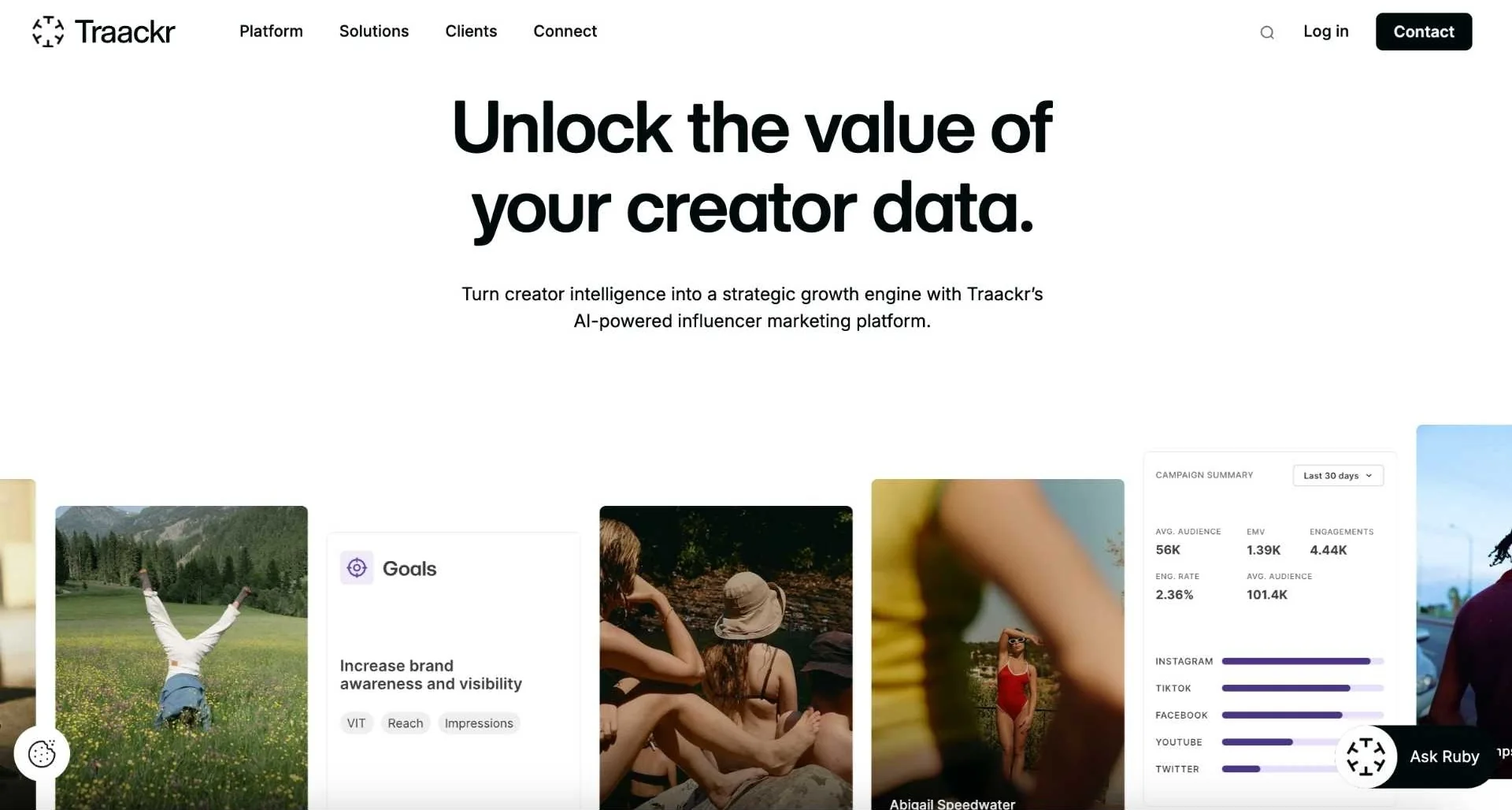
Traackr is a measurement-led influencer marketing platform for brands running continuous programmes rather than campaign bursts, with heavy adoption in beauty and CPG. It structures work into planning, activation and measurement and benchmarks spend efficiency against named competitors. Reporting depth is the reason to buy it.
Key Features
- Plan, Activate and Measure: Three modules covering an always-on programme end to end.
- Shopify seeding app: Inventory-synced ordering so creators select their own products.
- Revenue tracking: Conversions attributed to individual creator links and codes.
- Local currency payments: Creator payouts made in market.
- Brand vitality benchmarking: The dataset behind its published category rankings.
Pricing
- Quote-based, with a pricing page offering only a call.
- No credible third-party figure exists and buyer-benchmark databases hold no entry.
- No free trial and no free tier.
- Annual contracts are standard.
Reviews
4.3/5.0 (G2, 377 reviews) and 4.6/5.0 (Capterra, 32 reviews).
Pros
- Competitive benchmarking: Spend efficiency measured against named rivals, not just your own history.
- Warehouse exports: A data lake connection, which is exactly the reporting depth Linkr lacks.
- Over 400 reviews: Consistent across two independent sources.
Cons
- No pricing signal at all: Not even third-party benchmark databases have a figure.
- Shopify only: No WooCommerce and no Shopware.
- Built for always-on: Heavy for a brand running periodic seeding campaigns.
Integrations
- A free Shopify app for inventory-synced seeding.
- Single sign-on for enterprise identity management.
- A data lake connection for pushing campaign data into your warehouse.
- Instagram, TikTok and YouTube for creator performance data.
- Local payment rails for creator payouts by market.
Linkr vs Traackr
Both run inventory-synced seeding from Shopify, so the interesting comparison is what happens to the data afterwards. Linkr reports inside the platform, which is enough for a marketing team running its own programme. Traackr benchmarks spend efficiency against named competitors and pushes everything into a data lake, which is the version that holds up in a budget defence.
The cost of that is transparency and reach. Traackr publishes no price anywhere, offers no trial and connects only to Shopify, where Linkr publishes all four tiers, gives you a week to try it and supports WooCommerce and Shopware as well. Reporting is the upgrade; everything else is a step back.
Social Cat
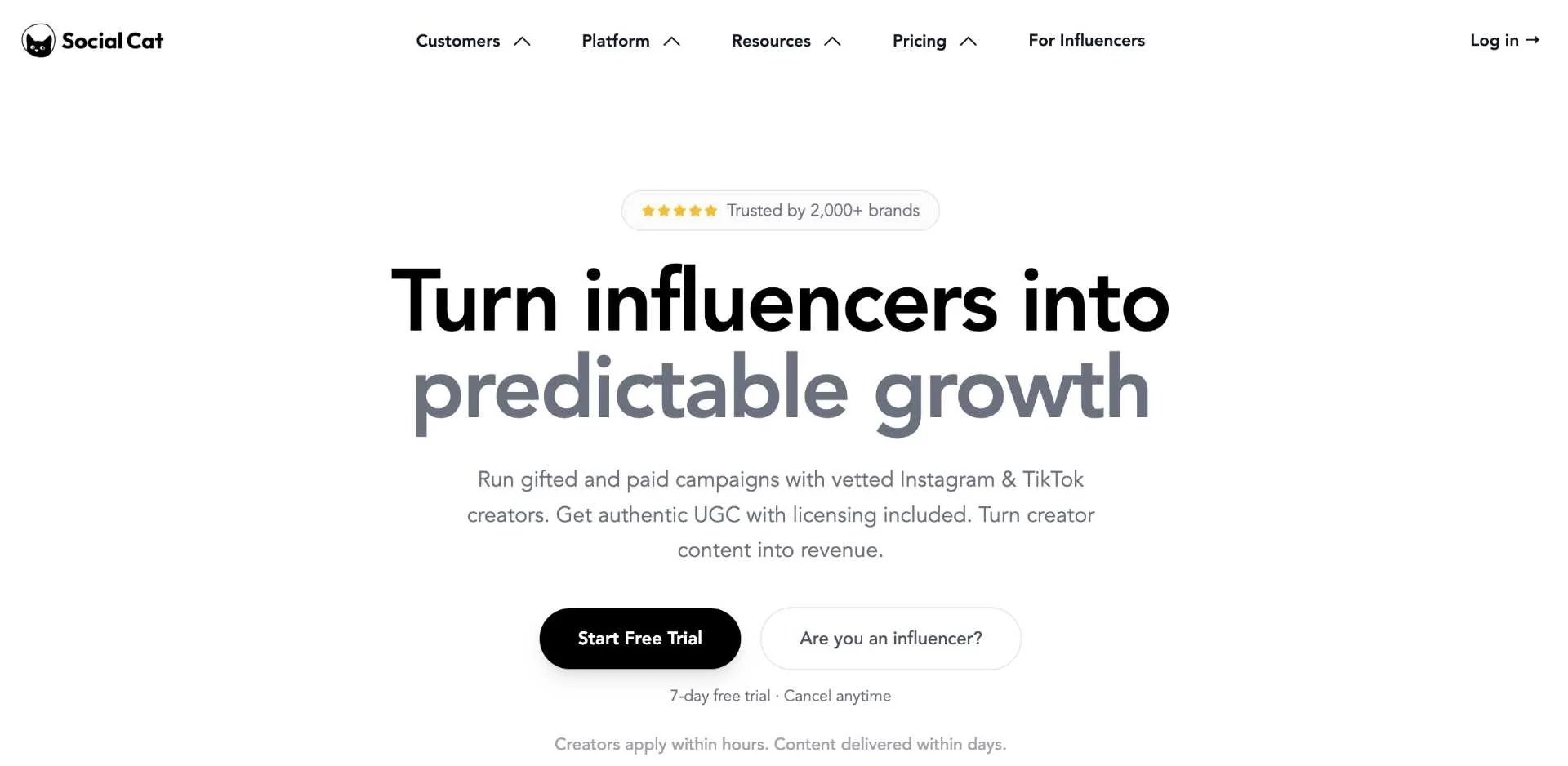
Social Cat is a micro-influencer marketplace for small and mid-sized brands, matching them with Instagram and TikTok creators for gifted and paid collaborations. Contracts and usage rights are included on every tier and pricing is published in full. It is the value option for brands whose programme is content-led rather than revenue-tracked.
Key Features
- Vetted micro network: Over 500,000 creators filterable by niche, location and engagement.
- Gifted and paid collaborations: Both handled in one workspace.
- Contracts and licensing: Included on every plan rather than sold as an upgrade.
- Invitation-based matching: 1,000 to 5,000 creator invitations a month by plan.
- Content library: Delivered assets organised, reviewed and downloadable in one place.
Pricing
- Essentials: $99 a month, up to 5 collaborations, 1,000 invitations, 1 campaign, 1 seat.
- Performance: $199 a month, up to 15 collaborations, 2,500 invitations, 3 campaigns, 5 seats.
- Pro: $299 a month, up to 30 collaborations, 5,000 invitations, unlimited campaigns, 10 seats.
- A free trial is available and product costs sit outside the subscription.
Reviews
4.7/5.0 (Reviews.co.uk, 2,772 reviews). A two-sided marketplace page mixing creator and brand feedback rather than a verified software buyer rating, and the G2 listing carries no reviews.
Pros
- Under half the entry price: $99 a month with collaborations included, against €199 for search alone.
- Rights on every tier: Contracts and usage licensing from the cheapest plan up.
- A free trial: Inspect the creator pool before paying anything.
Cons
- Two networks only: Instagram and TikTok.
- No store connector: No Shopify, WooCommerce or Shopware attribution.
- Hard collaboration caps: 30 a month at the top tier regardless of budget.
Integrations
- Meta for Instagram and Facebook performance data.
- TikTok for collaboration metrics.
- An internal content library with no storefront connection.
- In-platform messaging for creator conversations.
- Contract signature handled natively.
Linkr vs Social Cat
For a brand whose influencer programme is really a content programme, Social Cat does the job for a third of the price. Thirty collaborations a month at $299 with contracts and usage rights included covers gifting, UGC and creator relationships without touching the €699 tier Linkr requires for seeding.
The moment revenue attribution matters, the comparison inverts. Social Cat has no store connector at all, so discount codes and affiliate sales go back to a spreadsheet, while Linkr calculates commissions automatically against Shopify, WooCommerce or Shopware orders. That is the line between the two, and it is worth being clear which side your programme sits on.
Heepsy

Heepsy is a creator discovery and outreach tool built around audience quality analysis, with a free tier and published European pricing. It does search, screening and bulk outreach well and stops before anything commercial. It is the closest direct competitor to Linkr’s entry plan.
Key Features
- Four search modes: AI search, text match, lookalike search and direct handle lookup.
- Authenticity analysis: Follower growth curves and engagement quality rather than a single score.
- Bulk outreach: 300 to 6,000 emails a month depending on tier.
- Campaign marketplace: Publish briefs and collect inbound applications.
- Campaign pipelines: With a media gallery for content delivered against each brief.
Pricing
- Free: 500 results and 10 advanced creator profiles a month.
- Starter: €69 a month, 5,000 results, 100 advanced profiles, 300 outreach emails.
- Plus: €149 a month, 25,000 results, 500 advanced profiles, 1,200 emails, AI email compose and creator payments.
- Advanced: €229 a month, 50,000 results, 1,000 advanced profiles, 6,000 emails and priority support.
Reviews
4.5/5.0 (G2, 41 reviews) and 4.5/5.0 (Capterra, 72 reviews), consistent across roughly 113 reviews.
Pros
- A third of the entry price: €69 a month, or free, against €199 for a comparable scope.
- Bulk email included: Up to 6,000 outreach emails a month with templates and sequences.
- 113 independent reviews: Consistent at 4.5 across G2 and Capterra.
Cons
- No commercial layer: No affiliate tracking, seeding, invoicing or attribution at any tier.
- Hard metering: 100 advanced profile views a month on the entry plan, where Linkr offers unlimited search.
- One store integration: Shopify, and only on higher tiers.
Integrations
- Shopify on higher tiers for sales visibility.
- Instagram, TikTok, YouTube and LinkedIn for search and profile analysis.
- In-platform outreach with email templates.
- Creator payments on the Plus tier and above.
- CSV export for moving shortlists into other tools.
Linkr vs Heepsy
Put Linkr’s €199 entry plan next to Heepsy’s €149 Plus plan and the comparison gets uncomfortable. Both do search, screening and outreach; Heepsy adds 1,200 outreach emails a month, follower authenticity analysis and 113 independent reviews, while Linkr offers unlimited search against a curated network and real-time chat instead of email sequences.
The honest framing is that neither entry tier is a full programme tool, so the question is which stopgap you want and how quickly you will leave it. If the answer is that you need seeding and affiliate tracking within a quarter, paying €199 for search is a detour, and it makes more sense to compare the €699 tier directly against platforms that include the whole workflow.
Final Thoughts on Linkr Alternatives
The number that decides this is €699, not €199. Product seeding, inventory sync, affiliate tracking and commission calculation only appear on Linkr’s third tier, which puts the real cost at €6,708 a year for the version a D2C brand would actually run, and that is the figure to carry into every comparison here. Against it, Influencer Hero includes the same eCommerce workflow plus discovery across eight networks and fake-follower screening on its $649 Standard plan with no feature gating, and Upfluence reaches four store platforms with no commission on creator-driven sales. If the programme is content-led rather than revenue-tracked, Social Cat runs thirty collaborations a month at $299 with rights included, and Heepsy covers search and outreach from €69. Two things genuinely favour Linkr and neither is a small consideration: Shopware support, which almost nothing else in this list offers, and invoicing that calculates regional creator contribution fees automatically, which matters if you pay creators across European markets. Take the 7-day trial, spend it on the tier you would actually buy rather than the entry plan, and weigh the missing independent reviews against how much the compliance handling is worth to you before comparing influencer CRM tools on features alone.

.png)


.jpg)










