


10 Best IQfluence Alternatives for Influencer Marketing
IQfluence indexes 375 million creators. Its entry plan lets you open 200 of them a month. That gap is not a criticism of the data, but it is the thing that decides whether the subscription works for you, because credits rather than coverage set the pace of your research.
The analysis itself is good. Thirty-five-plus metrics per profile, machine-learning fake-follower scoring and audience overlap checks between creators you are considering are real capabilities, and the overlap check in particular is rare. What sits around them is thinner. Outreach costs another $39 to $199 a month, and there is no gifting, no affiliate tracking, no contracts and no creator payouts at any price.
So the question for most brands is not whether the research is sound. It is whether a research tool plus a second subscription plus a manual handoff beats one platform that carries a creator from search to payout.
Ten alternatives follow in this order: Influencer Hero, CreatorIQ, Upfluence, Aspire, Afluencer, SARAL, IMAI, Brandbassador, Lefty and Insense.
Key Criteria for Evaluating Influencer Marketing Platforms
Core Features
Evaluation of essential influencer marketing capabilities, including influencer discovery, outreach, CRM, campaign management, reporting, and content workflows.
Pricing & Flexibility
Comparison of pricing models, subscription plans, and contract terms to match different budgets and growth stages.
Customer Reviews & Satisfaction
Analysis of user feedback from trusted review platforms, focusing on usability, reliability, customer support, and overall performance.
Pros & Cons
Review of each platform’s strengths and limitations to highlight where it performs well and where it may fall short based on different use cases.
Integrations
Review of the most important integrations (e.g., Shopify and other tech tools), highlighting what each integration enables in one sentence.
IQfluence Overview
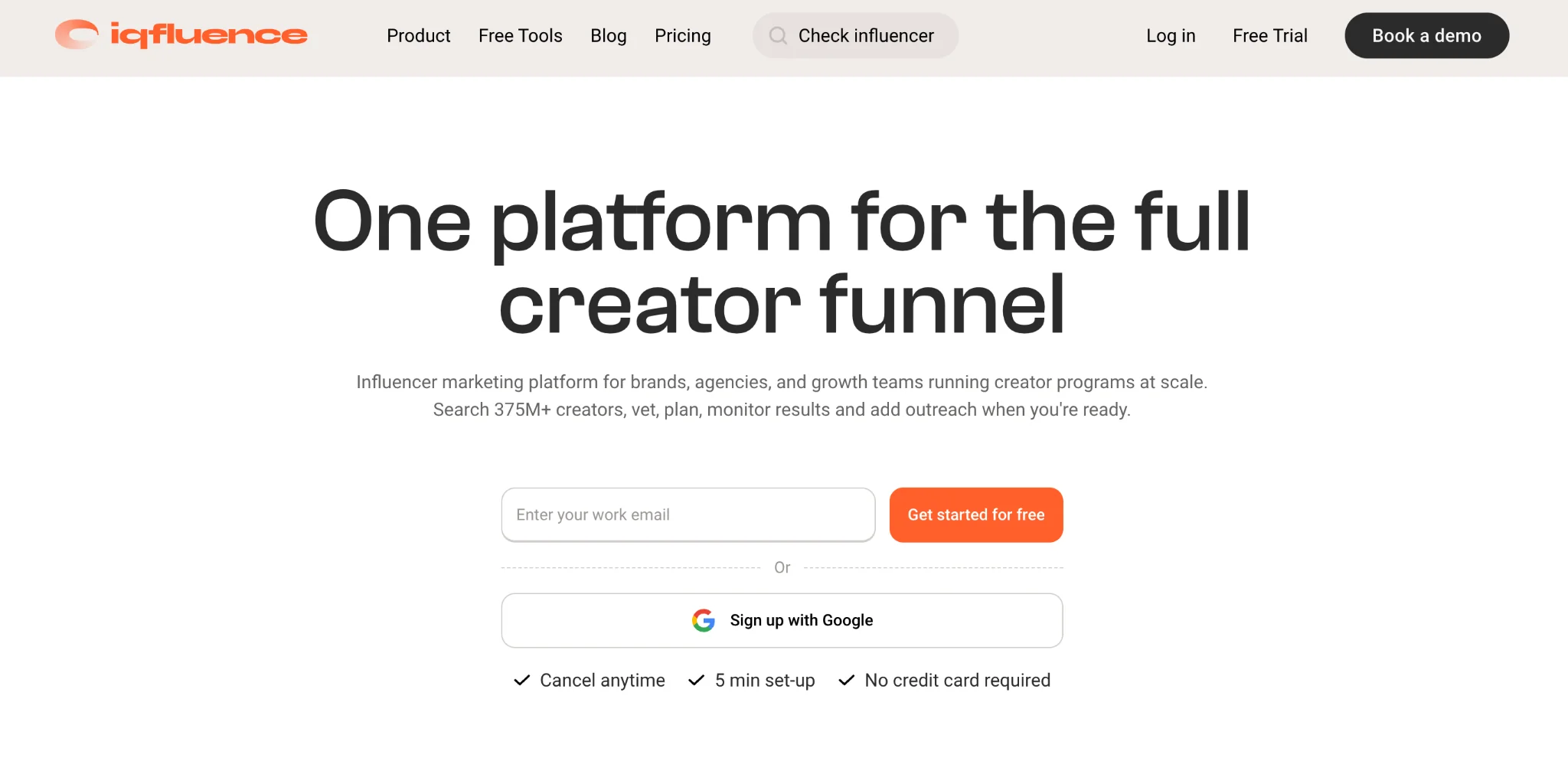
IQfluence is an AI-powered discovery and analytics platform covering Instagram, TikTok and YouTube. You search a very large index with 13-plus filters, run deep analysis on the profiles worth a closer look, compare how much two creators’ audiences share, assemble a media plan and export it, then track live campaigns on reply rate, view rate and cost per click, result or acquisition.
The depth is genuine. Where most tools hand back a follower count and an engagement rate, IQfluence returns 35-plus metrics with machine-learning authenticity scoring behind them. What it does not do is anything after a creator agrees. Contracts, gifting, affiliate codes, rights management and payouts all happen elsewhere, which is why it usually sits beside a set of influencer CRM tools rather than replacing them.
Key Features
- 375M+ creator index: Instagram, TikTok and YouTube coverage filtered by geography, language, demographics and niche.
- Profile analysis with 35+ metrics: Audience composition, engagement quality, growth patterns and authenticity in one report.
- ML fake-follower detection: Models that score how much of a following is likely inflated.
- Audience overlap analysis: A check on how much of two creators’ audiences are the same people.
- Lookalike matching: One creator who performed turned into a shortlist of similar profiles.
Pricing
- Starter: $295 a month, or $236 annually, with 200 analyses, 200 email unlocks and 50 overlap checks
- Advanced: $545 a month, or $436 annually, with 500 analyses, 500 unlocks and 100 overlap checks
- Business: from around $1,300 a month with custom limits
- Outreach add-on: $39, $79 or $199 a month, billed separately
The trial is a paid one at $49 for seven days on reduced limits. API access is billed pay-as-you-go on top.
Reviews
5.0/5.0 (Capterra, very low review volume at 5 reviews), plus 4.6/5.0 in an Influencer Marketing Hub editorial review. Five user reviews is too small a base to read a perfect score from.
Integrations
- Gmail: Outreach sent from your own domain rather than a shared sender.
- Outlook: The same for Microsoft teams, with rotation across connected mailboxes.
- Google Sheets: Media plans and shortlists exported for sharing or client approval.
- API: Pay-as-you-go creator data for teams building internal tooling.
- eCommerce platforms: None, so nothing links creator activity to store orders.
Pros
- Analysis other tools skip: Thirty-five-plus metrics and ML authenticity scoring per profile.
- Overlap checks are rare: Very few platforms tell you two creators reach the same people.
- Limits are published: Credits per plan are stated, so cost per analysis is calculable upfront.
Common Drawbacks of IQfluence
Credits decide throughput, not the index
Two hundred analyses on Starter is a fortnight of proper screening for an active team. The 375 million figure never touches your month. Pick the plan from how many creators you actually need to evaluate.
Outreach lands on a second invoice
Contacting the creators you found adds $39 to $199 a month. A working setup is Starter plus the $79 tier at $374, not the advertised $295.
Nothing exists past first contact
No contracts, no gifting, no affiliate links or codes, no rights management, no payouts. Every step after a yes needs another platform and manual reconciliation between the two.
Estimated data, five reviews
Audience figures are modelled rather than drawn from creators linking their accounts, and reviewers have flagged keyword accuracy. That is uncomfortable ground for a product sold on data quality.
Best IQfluence Alternatives
| TOOL | REVIEWS | BEST FOR | TRIAL INFO | PRICING | ||
|---|---|---|---|---|---|---|
1 |

|
⭐ | Influencer CRM & automation | Book Demo | Pricing | Website |
2 |

|
⭐ | Enterprise influencer marketing | Book Demo | Pricing | Website |
3 |

|
⭐ | Influencer discovery | Book Demo | Pricing | Website |
4 |

|
⭐ | Influencer partnerships | Book Demo | Pricing | Website |
5 |

|
⭐ | Influencer marketplace campaigns | Book Demo | Pricing | Website |
6 |

|
⭐ | Influencer outreach | Book Demo | Pricing | Website |
7 |

|
⭐ | AI influencer discovery & analytics | Book Demo | Pricing | Website |
8 |

|
⭐ | Ambassador Marketing | Book Demo | Pricing | Website |
9 |

|
⭐ | Influencer analytics & discovery | Book Demo | Pricing | Website |
10 |

|
⭐ | UGC creators & paid social ads | Book Demo | Pricing | Website |
Influencer Hero
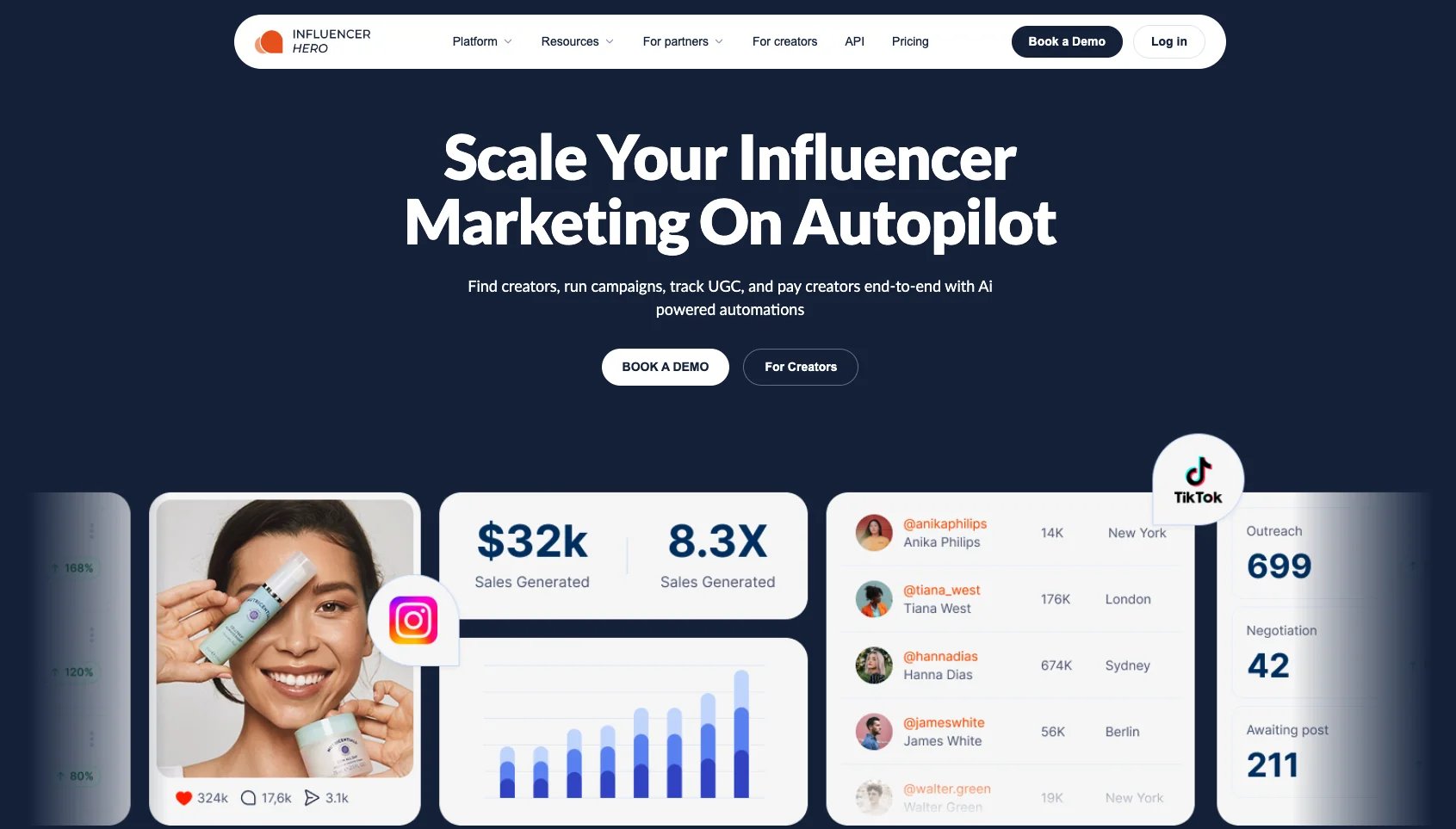
Influencer Hero is an all-in-one influencer marketing platform for D2C and eCommerce brands, covering 8 social platforms with Instagram, TikTok and YouTube emphasised. Discovery is the front door rather than the whole product: the same platform sends the influencer outreach, ships the product, collects the content, issues the codes and pays the creator. Pricing is published and sized by outreach volume.
Key Features
- AI creator search: Natural-language search plus over 20 filters across eight networks.
- Fake-follower screening: Audience authenticity checked on any creator before budget commits.
- Brand-follower detection: Creators who already follow and buy from you, surfaced automatically.
- Multichannel outreach: Email, Instagram DM and WhatsApp sequences with replies in a single inbox.
- Campaign boards: Stage-triggered automations and custom fields for per-creator logic.
- Gifting through your store: Product orders raised in Shopify or WooCommerce and tracked to delivery.
- Affiliate codes and payouts: Commission calculated in-platform and paid at 0.1% to 0.4% with invoices attached.
- Revenue reporting: Sales by creator and product cost against return, compiled without a spreadsheet.
Pricing
- Standard: $649 a month, up to 1,000 reachouts a month
- Pro: $1,049 a month, up to 5,000 reachouts a month
- Business: $2,490 a month, up to 10,000 reachouts a month
- Custom & Agency: custom pricing
Quarterly billing saves 20% and yearly saves 30%, with every figure published.
Reviews
5.0/5.0 (Capterra)
Pros
- One invoice for the whole program: Discovery, outreach, gifting, affiliate and payouts included.
- No metering on research: Screening a creator does not spend a credit you have to ration.
- Orders reach the report: Store integration ties creator activity to revenue.
Cons
- No free trial
- Expensive for smaller brands
- Steep learning curve
Integrations
- Shopify: Gifting orders raised and creator sales attributed automatically.
- WooCommerce: The same for WordPress, with scripts covering Magento and custom builds.
- Klaviyo: Creator and customer segments pushed into lifecycle email.
- DocuSign: Creator agreements signed and filed on the deal record.
- Zapier: Over 8,000 further apps for anything not handled natively.
IQfluence vs Influencer Hero
On research alone the two are closer than the price gap suggests. Both screen fake followers, both find lookalikes, and both cover the three main networks. The divergence starts the moment a creator replies. Influencer Hero runs outreach over email, Instagram DM and WhatsApp, moves each creator through a campaign board, raises gifting orders from Shopify or WooCommerce, collects and approves content, issues affiliate codes with commission calculated in-platform, and pays creators at 0.1% to 0.4%. IQfluence stops at the email unlock, and its outreach is a separate purchase even then.
Compare the working totals rather than the entry prices. IQfluence Advanced with the $79 outreach tier is $624 a month for research and contact only, and everything downstream still needs buying. Influencer Hero Standard is $649 a month for the entire program, dropping to roughly $454 on annual billing, with no credit ceiling on how many creators you screen. The $295 headline only wins the comparison it is not actually competing in.
CreatorIQ
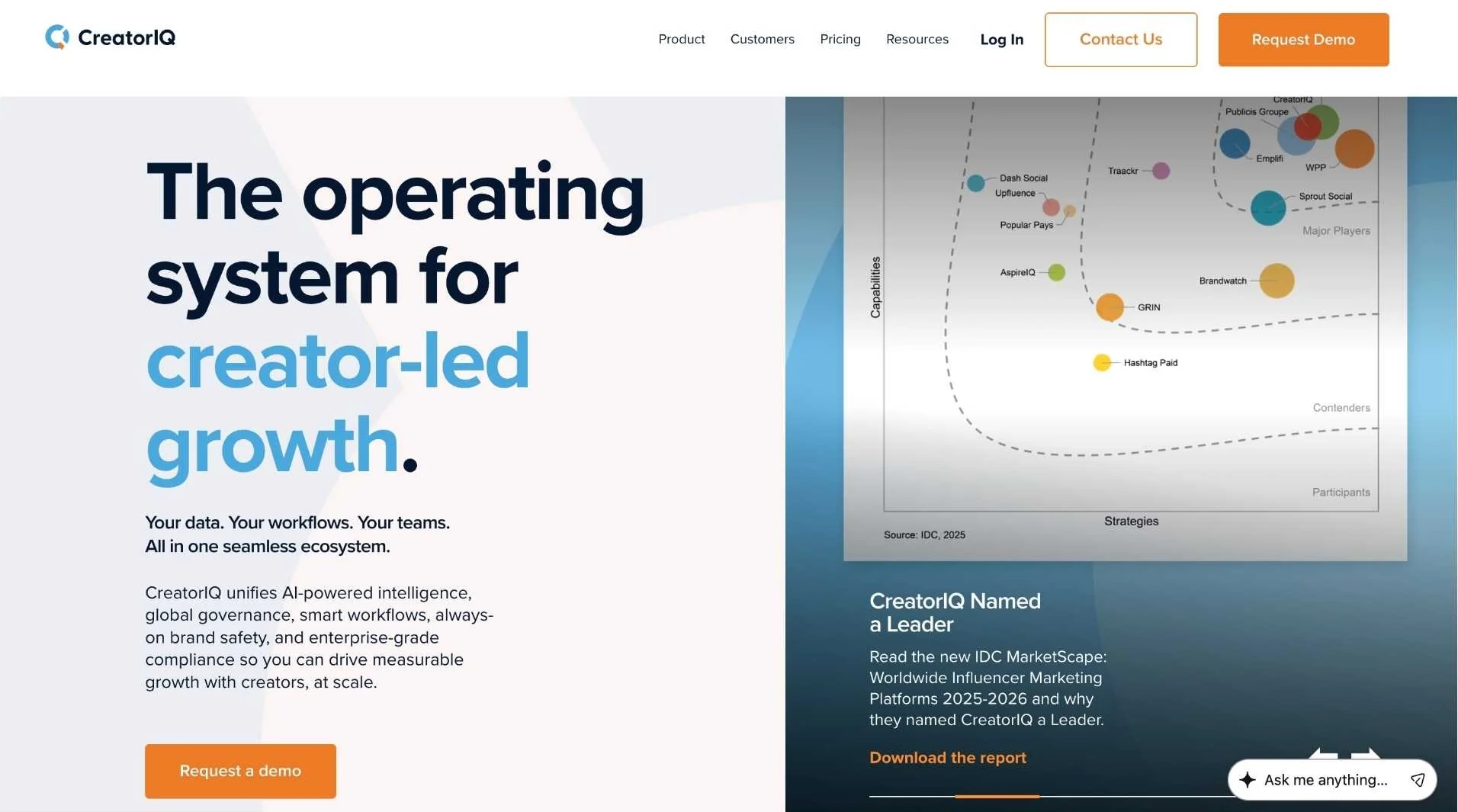
CreatorIQ is the enterprise option, built for teams running many brands, markets and agencies against one set of governance rules. Creator vetting, multi-market approvals, payments and stakeholder reporting all sit in the same system, which is why it turns up on shortlists where compliance matters as much as reach.
Key Features
- Creator vetting: Audience and performance data beyond what the native platforms expose.
- Multi-market workflow: Briefs, approvals and deliverables tracked across regions simultaneously.
- Payment processing: Creator payments handled without routing through finance.
- Client one-sheets: Stakeholder summaries generated straight from campaign data.
- Performance analytics: Per-creator reporting at the depth an enterprise review demands.
Pricing
Nothing published. CreatorIQ quotes per engagement on annual enterprise contracts, so there is no benchmark without a sales conversation.
Reviews
4.6/5.0 (G2, 581 reviews).
Pros
- 581 reviews: A hundred times the evidence base behind IQfluence’s score.
- Vetting plus execution: The analysis leads into contracts, payments and reporting.
- Reporting is the strength: The feature its own users name most often.
Cons
- No published price: Enterprise quotes only, at a figure well above $295.
- Discovery gaps reported: Reviewers say relevant creators sometimes fail to surface.
- Busy interface: Users describe it as doing too much at once, with slow loading.
Integrations
- Shopify: Store connection tying creator activity to orders.
- Instagram and TikTok: Creator data and campaign performance pulled in directly.
- YouTube: Long-form results measured alongside short-form.
- Salesforce: Campaign data into enterprise reporting stacks.
- API access: Creator and campaign data available programmatically.
IQfluence vs CreatorIQ
IQfluence sells analytical depth on a small budget. CreatorIQ sells the same depth wrapped in workflow, governance and payment rails, and charges enterprise money for the wrapper. If your problem is choosing creators well, IQfluence answers it far more cheaply. If your problem is running fifteen markets without losing track of who approved what, no amount of profile analysis solves that.
The evidence gap is worth weighing too. CreatorIQ carries 581 reviews from brands and agencies actually operating it, against five for IQfluence. Neither publishes what you will pay, but only one of them tells you what the credits buy.
Upfluence

Upfluence starts from a different place: your existing customers. It matches your buyer list against creator profiles and activates the people already spending with you, then carries them through outreach, affiliate tracking and payment. Modules are bought separately rather than as a fixed ladder.
Key Features
- Customer-creator matching: Your own buyers checked against creator profiles and activated.
- Modular purchase: Find, Scale or Autopilot bought separately rather than as a ladder.
- Discovery with demographics: Filters and audience data reviewers rate well for targeting.
- Affiliate commission tracking: Creator revenue attributed through the store connection.
- Workflow to payment: Discovery through to paying the creator inside one platform.
Pricing
Not published. Quoted per engagement based on modules, team size and program volume, on twelve-month annual plans including a dedicated account manager. A free trial follows a consultation call, and the company states it never takes a percentage of creator sales.
Reviews
4.6/5.0 (G2, 140 reviews).
Pros
- Customers before strangers: The highest-converting creators are often already on your list.
- Revenue is tracked: Affiliate attribution ties creator work to orders.
- A trial exists: Hands-on access after the first call, where IQfluence charges $49 for seven days.
Cons
- Twelve-month plans: A year committed against a month-to-month subscription.
- Needs a dedicated owner: Reviewers describe the interface as demanding.
- Quote-only: No published figure to budget against.
Integrations
- Shopify: Customer data mined for creators, with affiliate revenue tracked back.
- WooCommerce: The same coverage for WordPress storefronts.
- Klaviyo: Creator segments moved into email flows.
- PayPal: Creator payments processed inside the workflow.
- API access: Campaign and creator data into your own reporting.
IQfluence vs Upfluence
Both are strong at finding people. They disagree about where to look. IQfluence searches an index of 375 million strangers and scores them; Upfluence searches your customer list first, on the theory that someone who already bought converts better than someone who has never heard of you. For a store with meaningful order history, that is a real shortcut past the credit ceiling.
Commercially it is a swap, not an upgrade. Upfluence wants a twelve-month commitment and will not quote publicly, while IQfluence is month-to-month with every limit stated. What Upfluence adds for the money is the half of the job IQfluence leaves out, since affiliate tracking and creator payment happen inside the platform rather than in a spreadsheet next to it.
Aspire
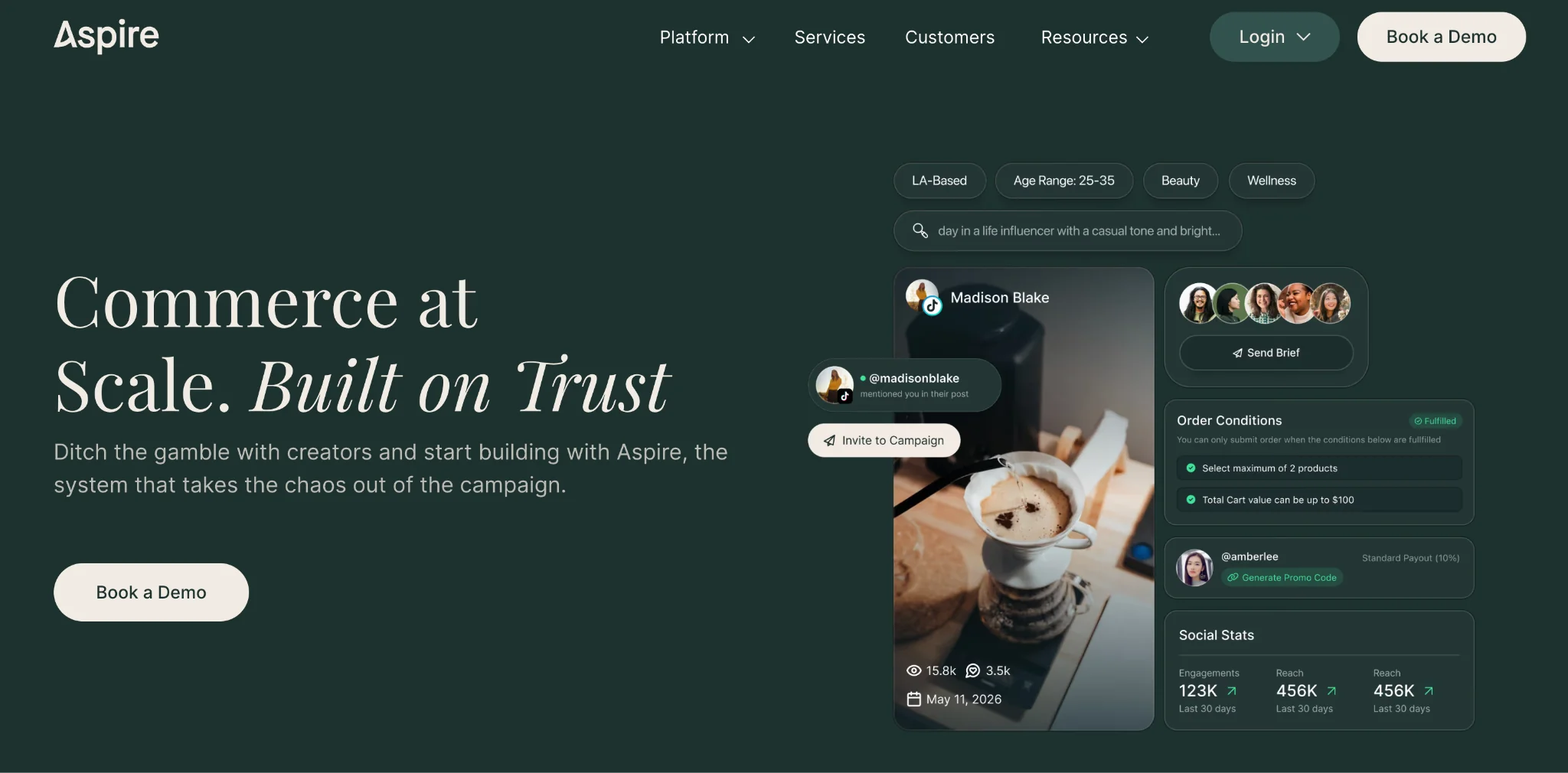
Aspire runs the full brand-side program for companies already operating at scale. Lookalike discovery feeds seeding campaigns, briefs and approvals move content through review, affiliate attribution ties it to orders, and a rights-managed content library holds the assets for paid reuse afterwards.
Key Features
- Lookalike discovery: One creator who performed becomes a shortlist of similar profiles.
- Seeding workflows: Product send-outs run at volume with tracking attached.
- Briefs and approvals: Content requested, reviewed and signed off in the platform.
- Affiliate attribution: Codes and links tying creator activity to real orders.
- Rights-managed library: Approved assets held with usage terms for paid reuse.
Pricing
Not published. Third-party sources report an annual commitment starting around $2,000 a month, with other estimates near $2,499, and they disagree enough that only a quote settles it. There is no free trial.
Reviews
4.6/5.0 (G2, 146 reviews).
Pros
- Lookalikes lead somewhere: The shortlist feeds seeding and attribution rather than a spreadsheet.
- 146 reviews: Independent evidence from brands running real programs.
- Rights handled: Usage terms attached to assets before anyone spends on paid.
Cons
- No trial and no rate card: A closed evaluation at a reported $2,000-plus a month.
- Annual commitment: A year signed up front.
- Heavier than most need: Built for programs already running at scale.
Integrations
- Shopify: Seeding orders raised and creator revenue attributed.
- WooCommerce: Equivalent coverage for WordPress stores.
- Klaviyo: Creator contacts into email programs.
- Slack: Campaign alerts into team channels.
- Zapier: Wider stack connections where no native option exists.
IQfluence vs Aspire
Both do lookalike discovery, and that is roughly where the overlap ends. In IQfluence the lookalike output is a shortlist you export. In Aspire it feeds a seeding campaign, a brief, an approval round, a discount code and a rights-cleared asset library. The research is comparable; what happens to the research is not.
Aspire costs several times more and hides the number, which is a fair objection. The counter is arithmetic: IQfluence Advanced plus outreach is $624 a month for finding and contacting people, and the seeding tool, affiliate platform and rights management still have to be bought. Stack those and the gap narrows faster than the headline prices suggest.
Afluencer
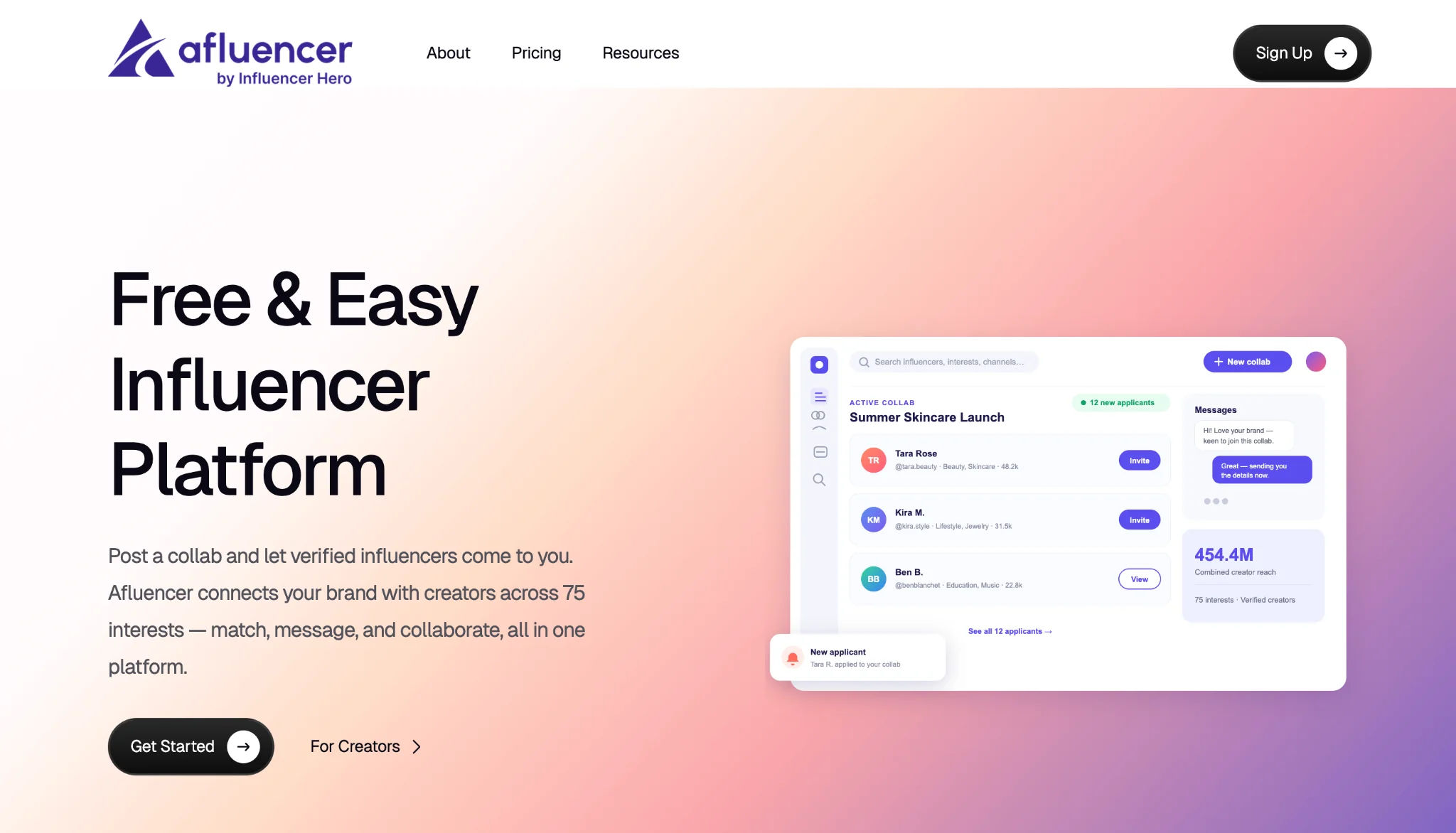
Afluencer inverts the search problem. You post a collaboration, verified creators apply, and AI ranks the queue against your brief. There is no index to meter, because the creators come to you, which makes it the cheapest way onto this page by a wide margin.
Key Features
- Inbound applications: Creators respond to your brief instead of being hunted down one by one.
- Verified members: Accounts registered and checked before anyone can apply.
- CreatorGPT ranking: AI sorts the applicant queue against your brief before review.
- Invite credits: Outbound approaches for the months when applications run thin.
- Store-linked codes: Discount codes and creator fees handled through the storefront connection.
Pricing
- VIP: $49 a month
- Concierge: $99 a month
No minimum term, with creator-side plans billed separately.
Reviews
4.6/5.0 (G2, 738 reviews) and 4.7/5.0 (Shopify App Store, 34 reviews). The G2 pool leans creator-side, so read it beside the Shopify score.
Pros
- $49 a month: A sixth of the IQfluence entry price, published and month-to-month.
- No credit ceiling: Applicant volume is not metered per profile.
- 738 reviews: The deepest evidence base on this page.
Cons
- Inbound quality varies: A weak listing brings weak applicants.
- Shallow analytics: Nothing approaching a 35-metric profile report.
- North America weighted: Creator supply thins outside its main markets.
Integrations
- Shopify: Codes, referrals and creator orders tracked from the store.
- BigCommerce: The same connection for BigCommerce merchants.
- Klaviyo: Creator contacts pushed into your email lists.
- DocuSign: Collaboration terms signed inside the flow.
- Slack: Application alerts sent to the team as they arrive.
IQfluence vs Afluencer
These solve the same problem from opposite directions. IQfluence gives you a huge index and rations how much of it you may open. Afluencer gives you no index at all and sends creators to your listing instead, which means the constraint moves from your credit balance to how attractive your offer is. For a brand chasing volume on a small budget, especially one focused on finding micro-influencers, that trade is usually worth making.
Be honest about what you give up. Afluencer will not tell you the audience overlap between two applicants or score their followers with a machine-learning model. If vetting depth is the reason you were looking at IQfluence, this is a complement at $49 rather than a replacement.


SARAL
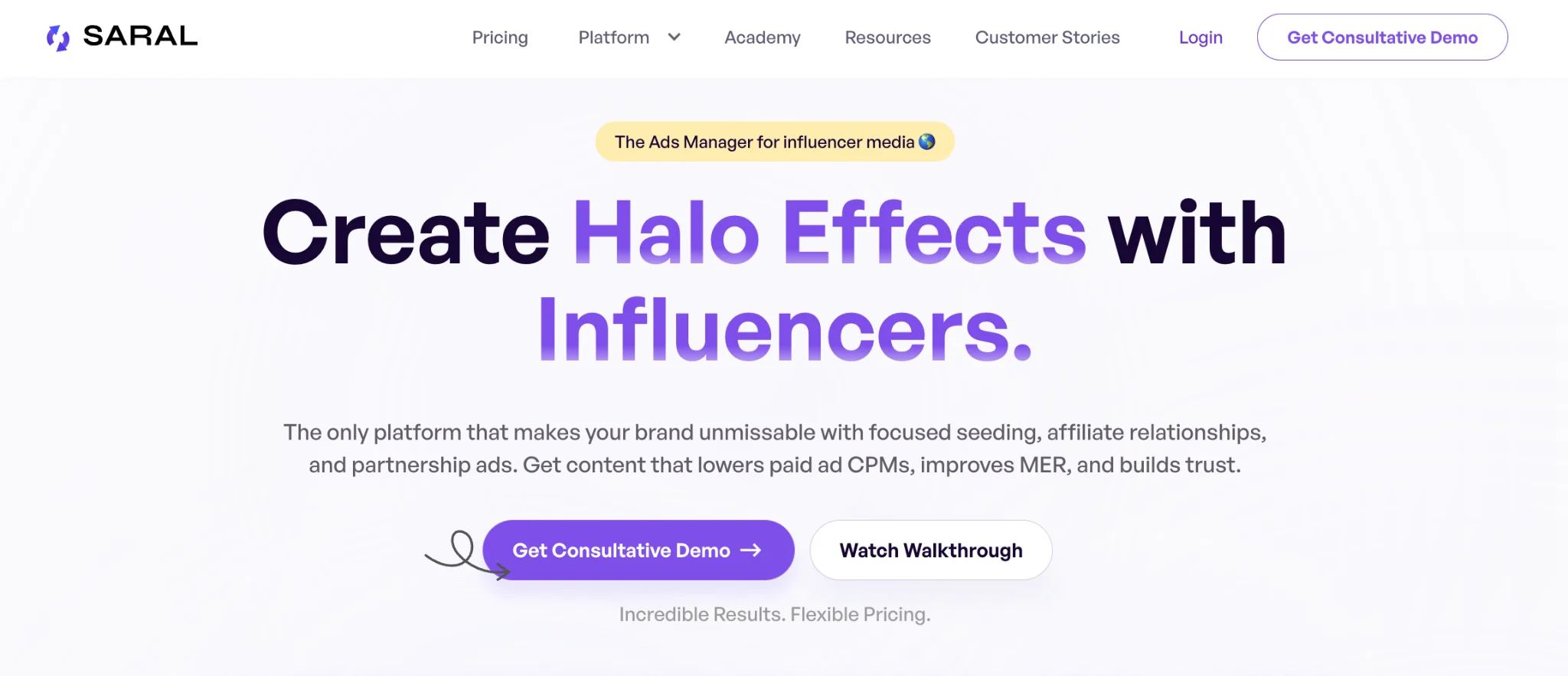
SARAL is priced by relationships rather than by lookups. Plans are sized on active partnerships, outreach runs as drip sequences from your own Gmail, Shopify connects in one click, and a former influencer strategist is attached to the account as a success manager.
Key Features
- Partnership-based plans: Sized by active partnerships and creators saved per month.
- Influencer outreach sequences: Automated drips sent from your own mailbox rather than a vendor’s system.
- One-click Shopify: Store connection established without development work.
- Unlimited post tracking: Creator content monitored without a cap from Business up.
- Dedicated success manager: Former influencer strategists included in the plan.
Pricing
- Starter: $12,000 a year or $3,600 a quarter, 100 active partnerships, 1 seat
- Business: $15,000 a year or $4,500 a quarter, 500 partnerships, 3 seats
- Professional: $25,000 a year or $7,500 a quarter, 1,000 partnerships, 10 seats
No contracts, cancellation at any time, and a free trial before you pay.
Reviews
4.8/5.0 (G2, 56 reviews).
Pros
- Outreach is included: Sequences come with the plan rather than on a second invoice.
- 4.8 across 56 reviews: The strongest satisfaction score here.
- A free trial: Hands-on before payment, where IQfluence charges $49.
Cons
- Five figures to start: $12,000 a year against $2,832 for IQfluence Starter annually.
- Bugs are reported: Gmail sync delays and glitches recur in reviews.
- Thin email analytics: Outreach reporting is a named weakness.
Integrations
- Shopify: One-click connection for seeding, codes and creator revenue.
- Gmail: Sequences sent and tracked from your own mailbox.
- Klaviyo: Creator contacts moved into lifecycle email.
- Slack: Support and campaign alerts routed to the team.
- Zapier: Wider stack connections without engineering time.
IQfluence vs SARAL
The two meter completely different things. IQfluence counts profile analyses and email unlocks, so heavy research is expensive and a long-running partnership is free. SARAL counts active partnerships, so research is unlimited and the hundredth ongoing relationship is what costs you. Which model is cheaper depends entirely on whether your program screens hundreds of creators or works closely with a few dozen.
On transparency they are unusually well matched, since both publish plans, limits and billing options in full. The difference is that SARAL includes outreach, Shopify attribution and a named success manager in its $12,000, while IQfluence adds an outreach subscription to its $2,832 and still leaves seeding, codes and payouts unsolved.
IMAI
IMAI is the closest thing on this list to a like-for-like swap. It is a discovery and analytics platform with fraud screening built into search, client account separation for agencies, white-label reporting on higher plans and social listening above the entry tiers.
Key Features
- Hundreds of millions of profiles: A creator search pool in the same order of magnitude as IQfluence’s.
- Fraud screening in search: Fake-follower detection surfaced with the results.
- Client account separation: Multiple programs run side by side without collision.
- White-label reporting: Agency-branded outputs on the higher plans.
- Social listening: Brand and category monitoring above the entry tiers.
Pricing
Published tiers reported from about $175 a month, through roughly $349 and $499, to $1,200 and up for enterprise and white-label, with report volumes varying by tier. A free trial is offered.
Reviews
4.1/5.0 (GetApp, low review volume at 16 reviews). Sourcing speed and fraud detection draw praise; support and account access draw the criticism.
Pros
- Starts below IQfluence: Around $175 a month against $295, with a free trial attached.
- Agency-ready: Client separation and branded reports included rather than bolted on.
- Named store connections: Shopify and WooCommerce, where IQfluence has none.
Cons
- Support is the complaint: Slow responses and, in one report, lost account access.
- Sixteen reviews: Thin evidence, though three times IQfluence’s base.
- Less analytical depth: No audience overlap analysis between shortlisted creators.
Integrations
- Shopify: Named store connection for creator-driven orders.
- WooCommerce: Coverage for WordPress storefronts.
- Instagram and TikTok: Creator data and campaign performance.
- YouTube: Channel-level analytics alongside short-form.
- Exports: Creator and campaign data out for client reporting.
IQfluence vs IMAI
This is the head-to-head comparison a research-led buyer should actually run. Both index hundreds of millions of profiles, both screen for fraud, both publish tiered pricing, and both are aimed at agencies as much as brands. IMAI starts lower at around $175, offers a genuinely free trial and connects to Shopify and WooCommerce. IQfluence answers with audience overlap analysis and a 35-metric profile report that IMAI does not match.
Neither has much of a review record, at 16 and 5 respectively, so pick on capability rather than on scores. If your work is client-facing and volume-driven, IMAI’s white-label reporting and account separation matter more. If you are defending a specific creator choice with evidence, IQfluence goes deeper per profile.
Brandbassador (Club)

Brandbassador skips discovery altogether. It converts existing customers into a managed ambassador community and keeps them posting through gamified missions, points, leaderboards and commission, with rewards and output tracked per person.
Key Features
- Reward missions: Tasks published to the community and completed for points, product or commission.
- Gamified retention: Leaderboards and tiers keeping ambassadors posting between campaigns.
- Community recruitment: Customers converted into a managed roster at scale.
- Commission tracking: Rewards and payments handled per ambassador.
- Programme analytics: Participation and output measured across the community.
Pricing
Not published, with third-party listings reporting no free trial. Quotes come through the vendor.
Reviews
4.7/5.0 (G2, 107 reviews). Ease of use and support are praised; ambassador search and filtering draw the criticism.
Pros
- No credits to spend: Ambassadors arrive from your customer base, not an index.
- 107 brand-side reviews: Feedback from the people paying for it.
- Four store integrations: Named eCommerce connections against none.
Cons
- Quote-only and no trial: Less open than a $49 seven-day trial with published limits.
- Weak ambassador search: Finding the right people is the recurring complaint.
- Needs existing customers: No use for a brand starting from nothing.
Integrations
- Shopify: Discount codes and ambassador sales tracked from the store.
- WooCommerce: The same for WordPress storefronts.
- Adobe Commerce: Enterprise commerce coverage.
- BigCommerce: Additional storefront support.
- Instagram and TikTok: Ambassador content tracked against missions.
IQfluence vs Brandbassador
One is a magnifying glass, the other is a loyalty program. IQfluence exists to help you choose strangers well. Brandbassador assumes you already have people who like the product and concentrates on keeping them active, which removes the discovery bottleneck rather than optimising it.
Reviewers are consistent that ambassador search is Brandbassador’s weak spot, and that is precisely IQfluence’s strength, so the two are more complementary than competitive. The catch is that Brandbassador publishes no price and offers no trial, which is a harder evaluation than a metered subscription you can cancel monthly.
Lefty
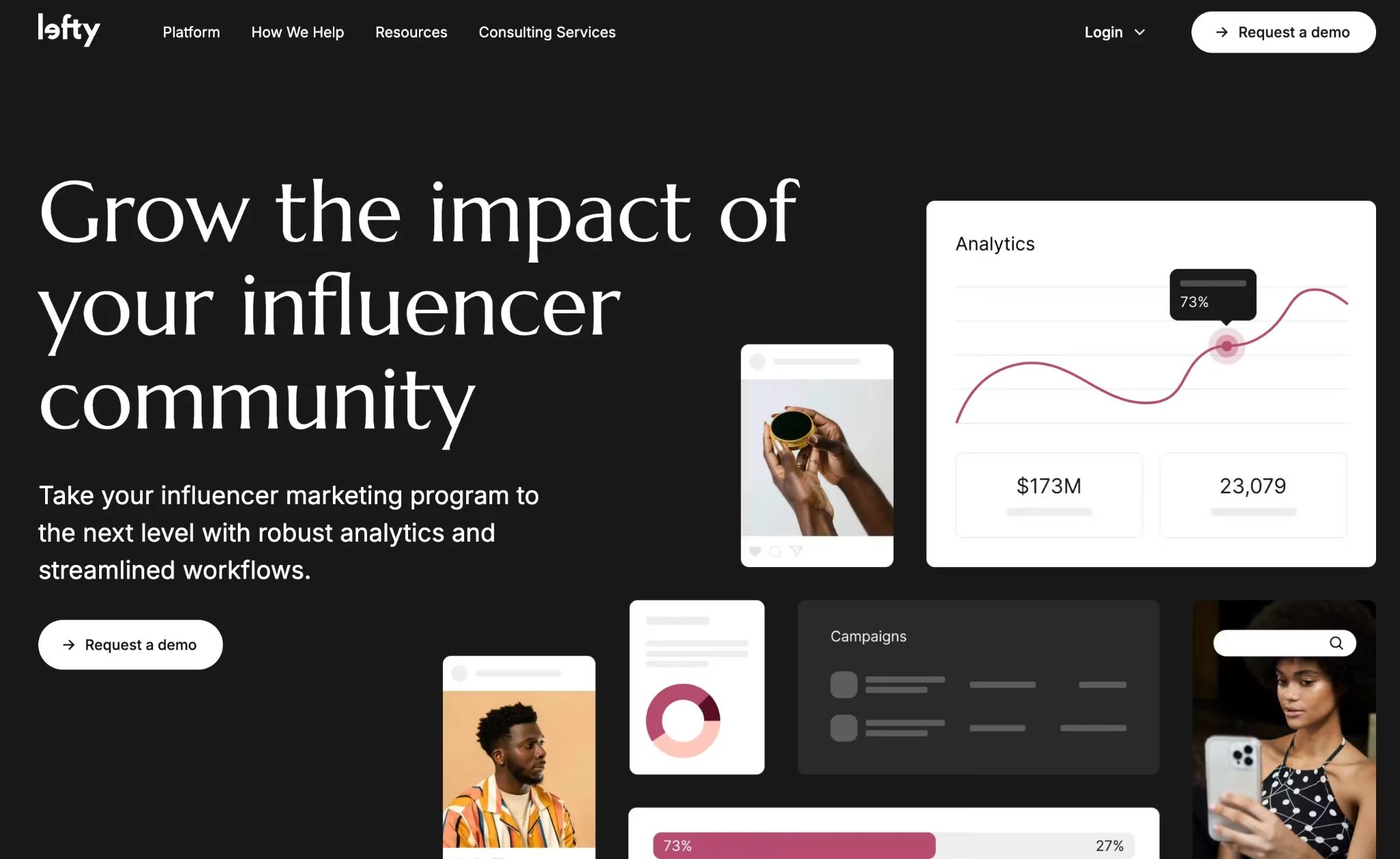
Lefty pairs faceted discovery across a multi-million profile index with campaign management and ROI reporting, plus social monitoring and mobile apps for Android and iOS. It leans Instagram, which suits fashion and beauty programs more than TikTok-first ones.
Key Features
- Faceted discovery: Layered filters across a multi-million profile index.
- Campaign management: Briefs, deliverables and creator relationships in one place.
- ROI reporting: Campaign returns measured rather than reach alone.
- Social monitoring: Brand mentions tracked alongside campaigns.
- Mobile apps: Android and iOS access, which most brand-side tools skip.
Pricing
Nothing published on the company’s own site. Its Capterra listing shows a starting figure of around €590 a month with a free trial available, so treat that as indicative rather than a rate card.
Reviews
5.0/5.0 (Capterra, very low review volume at 2 reviews). Ease of use scores 5.0, features and value 4.5, and customer service 4.0.
Pros
- Campaigns, not just research: Briefs and deliverables managed after the shortlist.
- ROI is reported: Returns measured rather than reach and reply rate alone.
- 24/7 support: Chat and phone cover most vendors in this bracket do not offer.
Cons
- Two reviews: Even thinner evidence than IQfluence’s five.
- No rate card: The only figure comes from a directory listing.
- Instagram weighted: Less depth on TikTok and YouTube.
Integrations
- Instagram: The deepest connection, powering discovery and reporting.
- TikTok: Creator data and campaign tracking on short-form.
- YouTube: Channel performance alongside the social networks.
- Exports: Campaign and creator data out for reporting.
- Mobile apps: Campaign access from Android and iOS as well as the browser.
IQfluence vs Lefty
Lefty carries the work further. Discovery leads into briefs, deliverables and ROI reporting, so a campaign has somewhere to live after the shortlist is built. IQfluence goes deeper on any single profile but hands the campaign itself to another tool.
Both are hard to evidence. Two reviews against five is a rounding error either way, and Lefty’s only public price is a third-party listing at roughly €590 a month. IQfluence at least states its credits and its tiers, which is the more honest starting point even if the workflow is narrower.
Insense
Insense is a creative supply line rather than a research tool. You brief, creators apply, and finished video comes back with usage rights cleared and Meta Partnership Ads ready to run from the creator’s own handle. Seeding is included in the campaign.
Key Features
- Guaranteed applicants: Five creators on a brief, with delivery in roughly two weeks.
- Content revisions: Up to three feedback rounds built into the brief.
- Whitelisted advertising: Meta Partnership Ads run from the creator’s own handle.
- Seeding included: Product shipped to creators as part of the campaign.
- Cleared usage rights: Paid usage licensed in the deal rather than negotiated later.
Pricing
- Trial: $650 for one month, 1 campaign and 10 creators, 20% marketplace fee
- Brand: $500 a month billed quarterly, or $400 a month annually, 10% fee
- Agency: $800 a month billed quarterly, or $640 a month annually, 7% fee
Campaigns and creators are unlimited on both paid plans, and both numbers are published.
Reviews
4.5/5.0 (G2, 374 reviews).
Pros
- 374 reviews: A large, brand-side record to read before buying.
- Output rather than analysis: Finished, rights-cleared video instead of a shortlist.
- Both costs published: Subscription and marketplace fee stated openly.
Cons
- A percentage on top: 7% to 20% of creator payments above the plan price.
- Ad creative, not campaigns: Built for paid social rather than organic reach.
- No deep vetting: Nothing like a 35-metric profile report or overlap analysis.
Integrations
- Meta: Partnership Ads and whitelisted creator content run directly.
- TikTok: Assets routed into ad formats without re-uploading.
- Shopify: Seeding orders raised from your product catalogue.
- Stripe: Creator payments processed inside the workflow.
- Ad account export: Approved content pushed into live campaigns.
IQfluence vs Insense
These two answer different questions. IQfluence tells you which creator to pick. Insense hands you an asset you can put behind ad spend on Monday, with rights cleared and the creator’s handle attached. If your bottleneck is creative volume rather than creator selection, the deep profile report is solving a problem you do not currently have.
Costs are structured differently and both are visible. Insense charges $400 to $800 a month plus 7% to 20% of what creators are paid; IQfluence charges $295 to $545 plus an outreach tier and nothing on creator spend, because it never touches creator payments at all.
Final Thoughts on IQfluence Alternatives
IQfluence does one thing seriously well. The 35-metric profile report, machine-learning authenticity scoring and audience overlap analysis add up to a research instrument most tools on this page cannot match, and $295 a month is fair for that on its own terms.
The trouble is what surrounds it. Credits cap your throughput far below what 375 million implies, outreach is a second subscription, and everything after a creator says yes belongs to some other platform. Before renewing, add up what you are paying across all of those tools and compare that total against one system that carries a creator from search through to payout.

.png)


.jpg)










