


10 Best HiveInfluence Alternatives for Influencer Marketing
HiveInfluence bills you twice. There is a subscription, from free up to $299 a month, and there is a cut of everything you pay creators, from 25% on the free tier down to 2% at the top. The second number is the one that decides your bill.
The discovery side is good for the money, and the free tier lets you test it properly. What no tier fixes is the missing half: no store connection, no discount codes, no affiliate tracking, and no independent reviews anywhere to check the vendor against.
Ten platforms follow that close one or both of those gaps: CreatorIQ, Traackr, Influencer Hero, Klear, Afluencer, SARAL, Lefty, Humanz, Modash and Glewee.
Key Criteria for Evaluating Influencer Marketing Platforms
Core Features
Evaluation of essential influencer marketing capabilities, including influencer discovery, outreach, CRM, campaign management, reporting, and content workflows.
Pricing & Flexibility
Comparison of pricing models, subscription plans, and contract terms to match different budgets and growth stages.
Customer Reviews & Satisfaction
Analysis of user feedback from trusted review platforms, focusing on usability, reliability, customer support, and overall performance.
Pros & Cons
Review of each platform’s strengths and limitations to highlight where it performs well and where it may fall short based on different use cases.
Integrations
Review of the most important integrations (e.g., Shopify and other tech tools), highlighting what each integration enables in one sentence.
HiveInfluence Overview
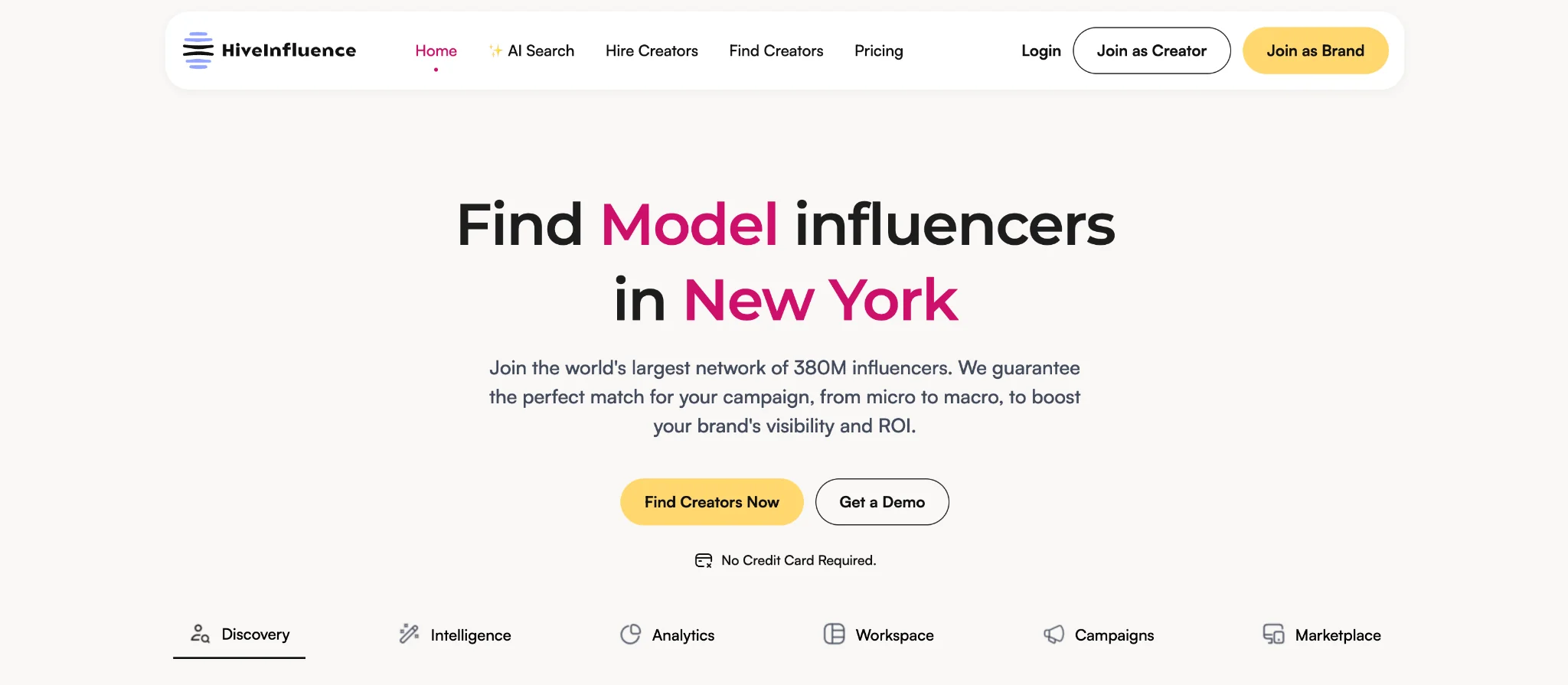
HiveInfluence is a search-first creator platform covering Instagram, TikTok and YouTube, with campaigns available in 193 countries. Opening a creator profile spends a discovery credit, shortlisted creators go onto Kanban boards, and you can either contact them directly or post a brief and let them send proposals back. Payment runs through escrow, so funds sit with the platform until content is delivered. Brands comparing it on search alone should also look at what AI creator search looks like elsewhere, because the coverage claim moves between 200 and 380 million profiles depending on which of the vendor’s own pages you read.
Key Features
- Credit-gated profile opens: Search is free, but seeing a creator’s analytics costs a credit, from 5 a month on Free to 1,300 on Enterprise.
- Fake-follower detection: Audience authenticity screening from the Basic plan up, which is the most useful thing on the entry tier.
- Kanban relationship boards: Creators move from shortlisted to contacted to delivered, capped at 10, 75 or 300 depending on the plan.
- Marketplace briefs: From Professional, list a campaign and let creators apply with their own rates instead of sourcing everyone outbound.
- Escrow and instant booking: Funds held until delivery, and creators with published rates can be booked without a negotiation round.
Pricing
- Free: $0, 5 credits a month, 25% transaction fee
- Basic: $59 a month, 250 credits, 10% transaction fee
- Professional: $144 a month, 600 credits, 5% transaction fee
- Enterprise: $299 a month, 1,300 credits, 2% transaction fee
Annual billing takes 20% off, bringing those to $49, $120 and $249 a month. Upgrades pay for themselves at $393, $1,700 and $5,167 of monthly creator spend, so the cheapest plan depends entirely on how much you pay creators.
Reviews
No verifiable rating. There is no G2, Capterra or Trustpilot listing, and no Shopify app, so nothing independent exists to check the vendor against.
Integrations
- Gmail: Send creator outreach from your own company address rather than a platform sender.
- Outlook: The same for Microsoft teams, keeping replies in the inbox they already use.
That is the entire published list. No Shopify, no WooCommerce, no affiliate network, no Zapier and no public API, which means gifting, discount codes and revenue attribution all happen somewhere else.
Pros
- Four prices on the page: Rare transparency in a category that usually starts with a demo form.
- A free tier with real search in it: Fake-follower detection included, so you can test coverage in your niche before paying.
- Seats are not the meter: A five-person team pays what one person pays, since credits and boards scale instead.
Common Drawbacks of HiveInfluence
The fee grows with the program
A 10% cut on the $59 plan means a brand paying creators $10,000 a month hands over $1,000, roughly seventeen times the subscription. The better the program works, the more the model costs you.
Boards fill before credits do
250 credits sounds generous until you notice Basic holds 10 creators on one board. A seeding program contacting fifty people a month cannot be tracked on that tier at all.
Nothing connects to your store
No Shopify, WooCommerce or affiliate integration at any price, and no discount code generation. The platform can confirm a post went live but never what it sold.
No public track record
No reviews on any major site, on a platform that also asks you to route creator payments through its escrow. Run one small campaign end to end before moving real budget through it.
Best HiveInfluence Alternatives
| TOOL | REVIEWS | BEST FOR | TRIAL INFO | PRICING | ||
|---|---|---|---|---|---|---|
1 |

|
⭐ | Enterprise influencer marketing | Book Demo | Pricing | Website |
2 |

|
⭐ | Enterprise influencer analytics | Book Demo | Pricing | Website |
3 |

|
⭐ | Influencer CRM & automation | Book Demo | Pricing | Website |
4 |
|
⭐ | Influencer analytics | Book Demo | Pricing | Website |
5 |

|
⭐ | Influencer marketplace campaigns | Book Demo | Pricing | Website |
6 |

|
⭐ | Influencer outreach | Book Demo | Pricing | Website |
7 |

|
⭐ | Influencer analytics & discovery | Book Demo | Pricing | Website |
8 |

|
⭐ | Data-led influencer platform | Book Demo | Pricing | Website |
9 |

|
⭐ | Influencer discovery | Book Demo | Pricing | Website |
10 |
|
⭐ | Small brands running influencer and UGC campaigns | Book Demo | Pricing | Website |
CreatorIQ

CreatorIQ runs influencer programs for global brands and the agencies working alongside them. It is built for organisations where creator spend has to be approved, audited and reported outside marketing, so governance features carry as much weight as discovery ones. Its customer base skews to companies operating in many markets at once.
Key Features
- Creator portal onboarding: Creators join through their own account connection, which verifies the numbers a brand later reports.
- Rights and content library: Campaign assets stored with usage terms attached, so reuse never becomes a legal question.
- Commerce and affiliate tracking: Codes and links tied to creators, with orders resolving back to the right person.
- Budget and payment management: Creator fees planned, approved and paid inside the same workflow.
- Competitive benchmarking: Your program measured against named rivals rather than against last quarter.
Pricing
Not published. Procurement data puts entry near $30,000 a year, the median around $39,250 and larger deals near $59,500, on annual contracts only.
Reviews
4.6/5.0 (G2, 581 reviews).
Pros
- The commerce loop is closed: Codes, orders and creator payments live in the same system.
- Evidence you can read: Nearly 600 reviews, against a platform with none at all.
- Built to be audited: Approvals and permissions that survive a finance review.
Cons
- A $30,000 floor: Roughly a hundred times the entry point of a credit-based tool.
- No trial: The commitment is annual and comes before you have run anything.
- Slow to stand up: Onboarding is a project with a timeline, not a signup.
Integrations
- Shopify: Connects orders so creator work is measured in revenue.
- Salesforce: Aligns creator records with the wider commercial system.
- Snowflake: Delivers creator data into the warehouse for internal modelling.
- PayPal: Pays creators without leaving the campaign workflow.
- Google Drive: Keeps briefs and creative attached to each program.
HiveInfluence vs CreatorIQ
These sit at opposite ends of the category. One costs $59 a month and takes a percentage of creator payments; the other costs $30,000 a year and takes nothing. What the money buys is the half HiveInfluence leaves out, namely store integration, affiliate codes, payment management and reporting anyone outside marketing will accept.
The arithmetic only closes at real scale. A brand paying creators $50,000 a month on the Basic plan hands over $5,000 in fees alone, which is $60,000 a year before the subscription. At that volume the enterprise contract is the cheaper option, and it comes with the commerce layer attached.
Traackr

Traackr treats influencer marketing as a budget to be managed rather than a series of campaigns to be run. Its centre of gravity is measurement: consistent scoring, spend tracking and comparison between markets and teams. Beauty and personal care brands are heavily represented among its customers.
Key Features
- Vetting on brand safety: Content history and audience quality checked before a creator is approved for a program.
- Content approval flow: Drafts submitted, reviewed and signed off against the agreed brief.
- Budget allocation by market: Spend planned and tracked per country, per team and per campaign.
- Standardised performance scoring: The same metrics applied everywhere so programs compare honestly.
- Exports and reporting API: Creator and spend data pushed out for teams building their own campaign reporting.
Pricing
Not published. Reported entry figures gather around $25,000 a year with higher tiers past $55,000, and the third-party sources disagree enough that a quote is the only reliable answer.
Reviews
4.3/5.0 (G2, 377 reviews).
Pros
- Spend is actually tracked: Budget pacing and cost per engagement are core features, not exports.
- Comparable across teams: One scoring system means regional programs can be judged side by side.
- Substantial review base: 377 reviews to weigh before committing.
Cons
- Enterprise-only pricing: No published figure and no self-serve entry point.
- Lowest score in this list: 4.3, with the interface the most common complaint.
- Light on commerce: Store attribution is thinner than in eCommerce-first tools.
Integrations
- Shopify: Ties creator activity to orders for revenue reporting.
- Gmail and Outlook: Files creator email against the right record automatically.
- Tableau: Feeds spend and performance into dashboards the business already reads.
- Slack: Surfaces approvals and campaign changes in the team channel.
- Google Drive: Stores briefs and assets where creators and staff can both reach them.
HiveInfluence vs Traackr
Both charge for the ability to find and manage creators, but they meter completely different things. HiveInfluence prices profile opens and takes a share of creator fees. Traackr prices the platform and leaves your creator spend alone.
That matters most to brands with large creator budgets and modest tooling needs, which is exactly the profile a percentage fee punishes. At $25,000 a year Traackr looks expensive next to $59 a month until you multiply the fee by a real budget, at which point the comparison flips.
Influencer Hero

Influencer Hero is an all-in-one influencer marketing platform for D2C and eCommerce brands, working across 8 social platforms with Instagram, YouTube and TikTok at the core. It covers the full sequence from finding creators through to paying them, including the commerce steps most discovery tools leave out. Plans are published on the site and priced by outreach volume.
Key Features
- Brand-follower identification: Find creators already following or buying from you, who convert better than cold prospects.
- Gifting and seeding automation: Product orders raised automatically through Shopify or WooCommerce, with delivery tracked per creator.
- Campaign board automations: Rules that fire when a creator moves between columns, so follow-ups and tasks happen without chasing.
- Custom fields on deal pages: Track tiered commissions, gifting caps or anything else specific to your program.
- Payout manager with invoicing: Bulk and scheduled payments at 0.1% to 0.4%, with invoices requested and approved automatically.
- Bulk actions across campaigns: Email, task or trigger an integration for an entire creator segment at once from one view.
- Free scanning tools: Fake-follower scanners, engagement rate calculators and lookalike tools available without an account.
- Influencer marketing API: Creator data and discovery endpoints for teams building their own tooling on top.
Pricing
- Standard: $649 a month, up to 1,000 reachouts a month
- Pro: $1,049 a month, up to 5,000 reachouts a month
- Business: $2,490 a month, up to 10,000 reachouts a month
- Custom & Agency: custom pricing
Quarterly billing saves 20% and yearly saves 30%. Nothing is taken from what you pay creators.
Reviews
5.0/5.0 (Capterra)
Pros
- Your creator spend stays yours: No percentage skimmed from creator payments at any tier.
- The store is connected: Gifting, codes and revenue attribution run through Shopify, WooCommerce or a script.
- Boards do not cap out: Roster size is not what the plan meters, so growth does not force an upgrade.
Cons
- No free trial
- Expensive for smaller brands
- Steep learning curve
Integrations
- Shopify: Raises gifting orders and attributes creator-driven revenue automatically.
- WooCommerce: The same for WordPress stores, with scripts covering Magento and custom builds.
- Klaviyo: Feeds creator and customer segments into lifecycle email.
- DocuSign: Signs creator agreements and stores them on the deal record.
- Zapier: Reaches 8,000-plus further apps for anything not covered natively.
HiveInfluence vs Influencer Hero
HiveInfluence is a good place to find creators and a poor place to run a program. Discovery, credibility scoring and escrow all work, but boards cap at 300 creators, there is no creator relationship management beyond a Kanban column, and nothing touches your store at any tier. Influencer Hero covers discovery with over 20 filters and fake-follower screening, automated influencer outreach with drip sequences and reply tracking, campaign boards with automations and custom fields, gifting raised straight from Shopify or WooCommerce, a searchable content library with approvals, affiliate codes with commission calculated in-platform, and creator payouts at 0.1% to 0.4% with invoicing attached.
On price the models point in opposite directions. HiveInfluence starts at $59 a month and takes 10% of creator payments on that tier; Influencer Hero starts at $649 a month and takes nothing. The crossover sits near $5,900 of monthly creator spend, and every dollar above that widens the gap. Since the fee is charged on the money going to creators, the HiveInfluence bill rises fastest exactly when the program is working, while a flat published tier stays where it is.
Klear
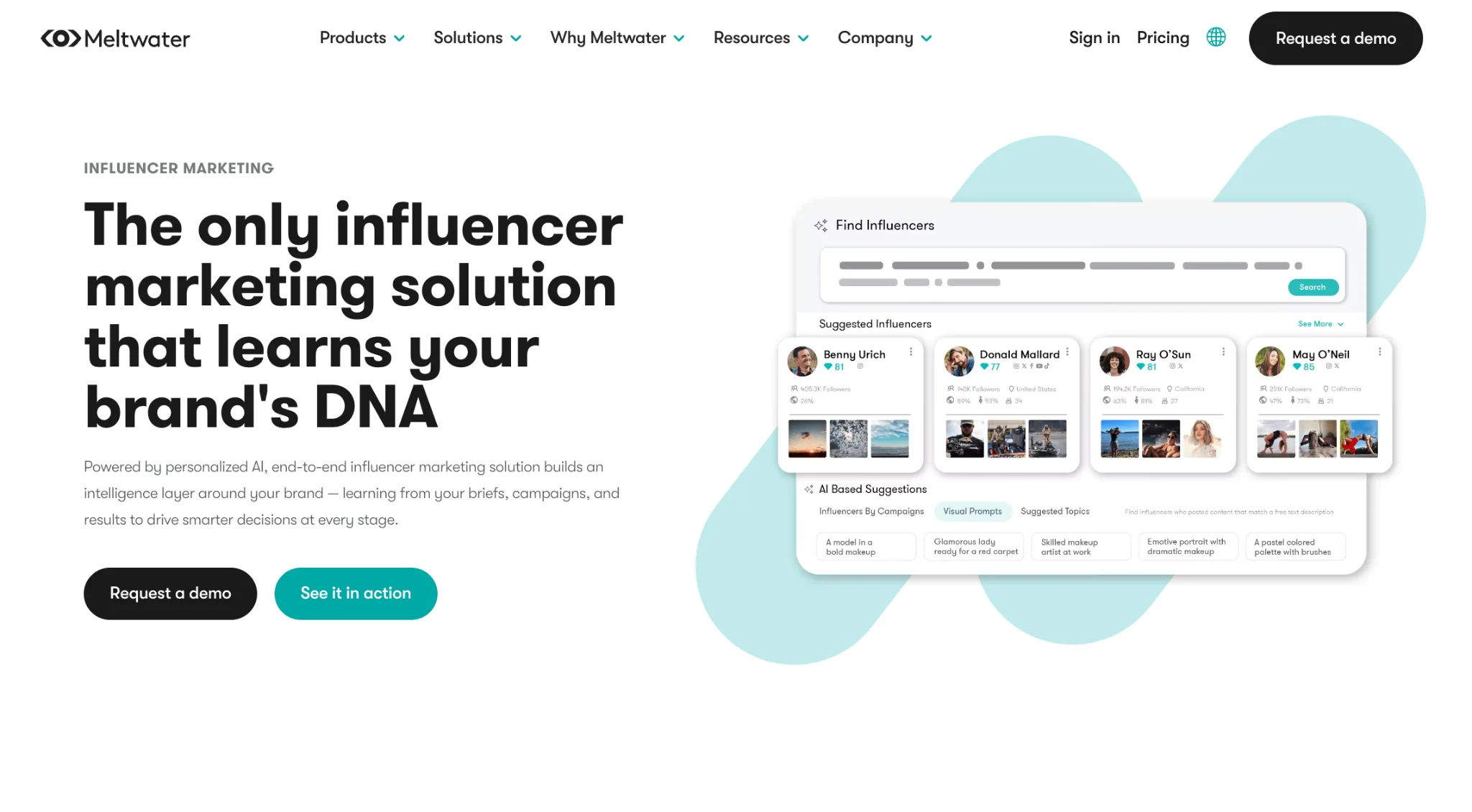
Klear is the influencer product inside Meltwater, absorbed into the wider media intelligence suite after the 2021 acquisition. Audience analysis has always been its strength, with demographic and interest data sitting behind every creator profile. It is bought most often by communications teams who report creator work next to press coverage.
Key Features
- Cross-network creator search: Discovery across the major platforms with filters on topic and true reach.
- Demographic audience filters: Age, gender, location and interest breakdowns per creator before outreach.
- Campaign tracking dashboards: Live post monitoring measured against the goals set at the start.
- Competitor coverage tracking: See which creators are working with rival brands and how that content lands.
- Exportable reporting: Creator and campaign results packaged for the wider marketing report.
Pricing
Not published, and rarely sold alone. Klear is quoted as part of a Meltwater package on an annual contract sized to the whole suite.
Reviews
No standalone listing remains on the major review sites. Meltwater itself scores 4.1/5.0 (G2, 2,640 reviews), which covers the entire suite rather than the creator module.
Pros
- Audience depth: Demographic data good enough to plan with, not just to shortlist with.
- Competitive visibility: Rival creator activity is visible without extra tooling.
- One earned media report: Creator and press results in the same document.
Cons
- Bundled and unpriced: Buying the influencer piece on its own is difficult.
- No commerce layer: Reach and sentiment, not orders and commission.
- Score by proxy: No module-level reviews to judge it on.
Integrations
- Meltwater listening: Category conversation data feeds creator planning.
- Instagram and TikTok: Verified post performance pulled into reports.
- Salesforce: Keeps contacts and coverage aligned with the commercial record.
- Google Analytics: Links campaign traffic to on-site behaviour.
- Slack: Pushes mentions and alerts to the team channel.
HiveInfluence vs Klear
Klear tells you far more about who is actually following a creator, which is the weakest part of a cheap discovery tool. Demographics, interests and competitor activity are all visible before you spend anything.
What you cannot see is the price. Klear arrives inside a Meltwater contract sized to a suite you may not want, and neither platform will connect a creator post to an order. One is unpriced and deep; the other is priced and shallow.
Afluencer
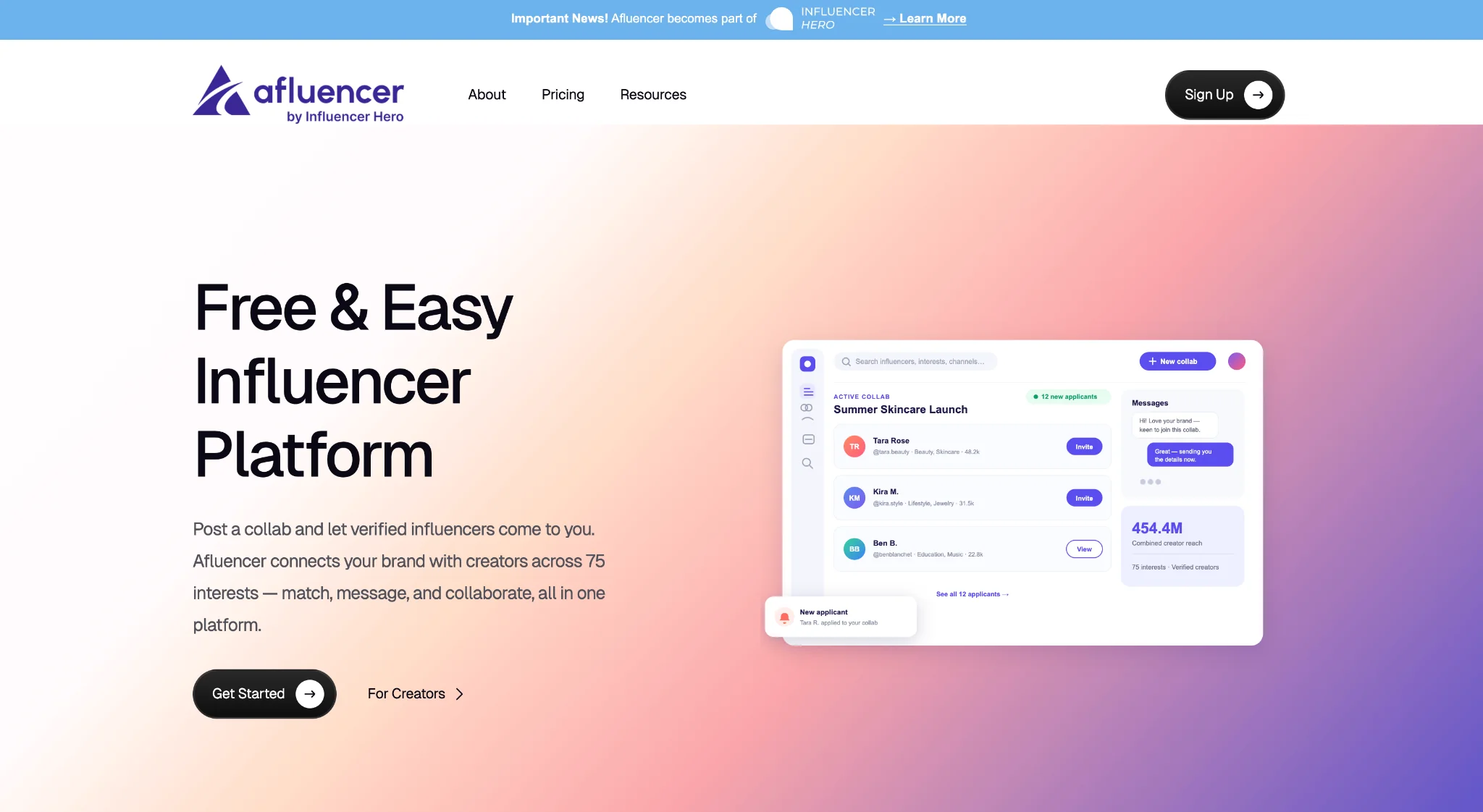
Afluencer works the opposite way round to a database. Brands publish a collaboration listing, verified creators across Instagram, TikTok, YouTube, Facebook and X apply to it, and the brand picks from the applicants. It is built for Shopify merchants and small D2C teams whose bottleneck is creator supply.
Key Features
- Listing distribution: Your campaign is pushed to the creator side of the marketplace rather than waiting to be found.
- Application inbox: Interested creators arrive in one queue with their stats attached.
- Category and niche filters: Narrow applicants by vertical before anyone reads a profile.
- Gifting and product send-outs: Product-only collaborations handled alongside paid ones.
- Shopify app: Store connection for codes and creator orders without development work.
Pricing
From $49 a month on the Marketplace plan, with higher tiers for more outbound invites. Creator-side plans are billed separately.
Reviews
4.6/5.0 (G2, 738 reviews) and 4.7/5.0 (Shopify App Store, 34 reviews). The G2 pool leans creator-side, so weigh it alongside the Shopify score.
Pros
- Cheaper than the entry tier: $49 a month, and no percentage taken from creator fees.
- No research budget needed: Applicants come to you, so nothing is metered per profile.
- Sized for small teams: One of the clearest small-business influencer platforms in the category.
Cons
- Listing quality decides everything: A weak offer attracts weak applicants.
- North America weighted: Creator supply thins outside the US and Canada.
- No audience analytics: Campaign-level reporting only.
Integrations
- Shopify: Runs discount codes, referral tracking and creator orders from the store.
- BigCommerce: The same coverage for BigCommerce merchants.
- Klaviyo: Sends creator contacts into email campaigns.
- DocuSign: Signs collaboration agreements inside the flow.
- Slack: Alerts the team to new applications.
HiveInfluence vs Afluencer
Both are cheap and both are aimed at small teams, so the comparison comes down to how you want to find people. HiveInfluence sells you searches and charges per profile you open. Afluencer sells you visibility and lets creators apply, which costs nothing per look.
Afluencer is also the only one of the two with a store connection and a real review base. At $49 a month against $59, with no cut of creator fees and a Shopify app included, it is difficult to argue the entry tier of a credit-metered tool is better value for a brand just starting out.


SARAL

SARAL is an influencer marketing platform for eCommerce brands running ambassador programs rather than one-off collaborations. Discovery, outreach, affiliate attribution and payment sit in a single flow, and onboarding plus a named success manager come with every plan. DTC founders and small in-house teams make up most of its customers.
Key Features
- Filtered creator discovery: Search and save creators in bulk, with a Chrome extension for adding them mid-browse.
- Automated follow-up sequences: Outreach that keeps chasing non-responders without anyone remembering to.
- Commission and payout management: Rates set per creator, tracked to orders and paid from the platform.
- UGC collection: Campaign content gathered with usage rights recorded as it arrives.
- Shopify-native attribution: Cookieless tracking that ties orders to the creator who drove them.
Pricing
$12,000 a year for Starter, $15,000 for Business and $25,000 for Professional, or $3,600, $4,500 and $7,500 quarterly. Tiers are set by active partnerships rather than by seats, and a trial is available first.
Reviews
No verifiable rating. SARAL does not carry a listing with enough reviews on the main software sites to report a score fairly.
Pros
- Attribution is built in: Orders resolve to creators without a second tool.
- Nothing taken from creator fees: The subscription is the whole cost.
- Guided setup included: A success manager on every tier, not just the top one.
Cons
- $12,000 to start: Two hundred times the entry point of a credit-based tool.
- No independent reviews: The same evidence gap, at a much higher price.
- Three networks: Instagram, TikTok and YouTube only.
Integrations
- Shopify: Powers the affiliate attribution, codes and gifting orders.
- Gmail and Outlook: Sends outreach from your own domain with replies synced.
- Klaviyo: Passes creator contacts into lifecycle flows.
- Slack: Notifies the team when content lands or a creator replies.
- Zapier: Covers whatever the native list does not.
HiveInfluence vs SARAL
SARAL is what the missing half looks like when someone builds it properly. Commission tracking, Shopify attribution, payouts and content rights are all present, and none of them exist in a credit-metered discovery tool at any tier.
The price difference is not subtle. $12,000 a year against $708 for the Basic plan means SARAL only makes sense once creator spend is large enough that a 10% fee outweighs the gap, which happens around $10,000 a month. Below that, you are paying for capability you have not grown into.
Lefty
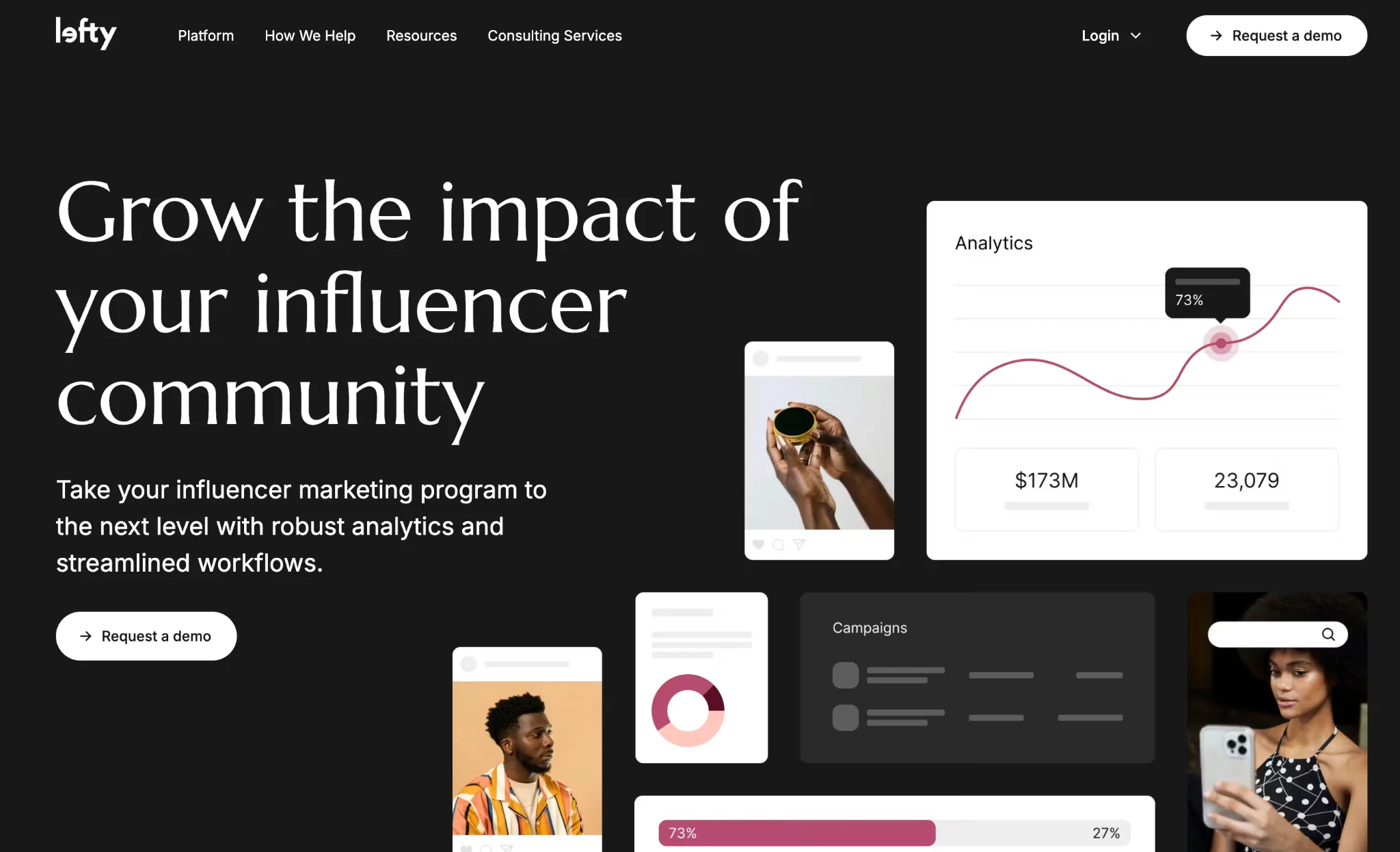
Lefty is used by luxury, fashion and beauty houses including Louis Vuitton, Clarins and Vans. It combines a creator index with campaign tracking, seeding and affiliate management, reports everything in earned media value, and covers Weibo, Douyin and RED alongside the western networks. Its buyers are creator teams inside large consumer brands.
Key Features
- Brand affinity discovery: Find creators already engaging with your brand or your competitors.
- Multi-market campaign tracking: One campaign followed across countries and networks in a single view.
- Share of voice reporting: Your creator presence measured against named rivals by market.
- Seeding logistics: Product send-outs planned and tracked at volume.
- Stripe creator payouts: Commission and flat fees settled inside the platform.
Pricing
Not published. There is no pricing page and a demo request is the only route in.
Reviews
4.7/5.0 (G2, 91 reviews).
Pros
- Payments settled properly: Stripe payouts rather than escrow held by the vendor.
- Markets nothing else reaches: Weibo, Douyin and RED covered as standard.
- Strongest score here: 4.7 across 91 reviews.
Cons
- Expensive by reputation: Reviewers describe paying for capability they never use.
- Tracked-creator caps: Roster limits that larger programs run into.
- Demo-only: No published price and no self-serve signup.
Integrations
- Shopify: Connects the store for affiliate attribution and seeding.
- Magento: Covers Adobe Commerce storefronts.
- Salesforce Commerce Cloud: Enterprise commerce for large retail groups.
- Stripe: Settles commission and flat-fee payments.
- Gmail and Outlook: Keeps creator pitching in the CRM record.
HiveInfluence vs Lefty
Both hold creator funds and release them against delivery, which is unusual, but the resemblance ends at the mechanism. Lefty settles through Stripe with commission calculated per creator, connects to three eCommerce systems, and reports share of voice by market.
Neither publishes what a real program costs. HiveInfluence hides it in a percentage and Lefty hides it behind a demo form, so both need a spreadsheet before a signature. The difference is that Lefty has 91 reviews and a named client list to check.
Humanz
Humanz is a data-led influencer marketing platform whose clients include McDonald’s, L’Oréal and Nestlé. Creators connect their accounts through official APIs, and campaigns run from brief through contract to payment with sales attribution attached. It suits brands that want a campaign judged on revenue rather than reach.
Key Features
- Creator challenges: Campaigns published as briefs that creators opt into, with the platform ranking who fits.
- Contract and payment flow: Terms signed and fees released inside the same workflow.
- Shopify and Amazon revenue tracking: Orders on both attributed back to individual creators.
- ROI forecasting: Expected return modelled before the budget is committed.
- Content boosting: Creator posts amplified as paid media through Meta Ads Manager.
Pricing
On request, charged per campaign as a share of media budget, with the percentage falling as spend rises. There is no subscription.
Reviews
4.8/5.0 (G2, 27 reviews), a strong score on a small sample.
Pros
- Revenue is the metric: Amazon and Shopify orders tied to named creators.
- No standing cost: Quiet months cost nothing at all.
- Verified creator data: Metrics come from connected accounts, not estimates.
Cons
- Percentage of media budget: The same shape of fee, on a bigger base.
- Applicant-led pool: Reviewers note you choose from creators who opted in.
- 27 reviews: A small evidence base for a platform at this level.
Integrations
- Shopify: Attributes store orders to the creator behind them.
- Amazon: Tracks marketplace sales from creator campaigns, which is rare.
- Meta Ads Manager: Turns creator content into paid media directly.
- TikTok: Brings deliverable performance into the campaign view.
- Google Tag Manager: Deploys tracking without developer time.
HiveInfluence vs Humanz
Both charge a percentage rather than a flat fee, so neither lets you fix the cost in advance. The difference is what the percentage is charged on and what it buys. HiveInfluence takes a cut of creator payments and gives you discovery; Humanz takes a share of media budget and gives you contracts, attribution and Amazon tracking.
For a brand that already knows creator work drives sales, the second trade is the better one. For a brand still finding out, the free tier of a discovery tool costs nothing to test and Humanz starts at a campaign budget.
Modash
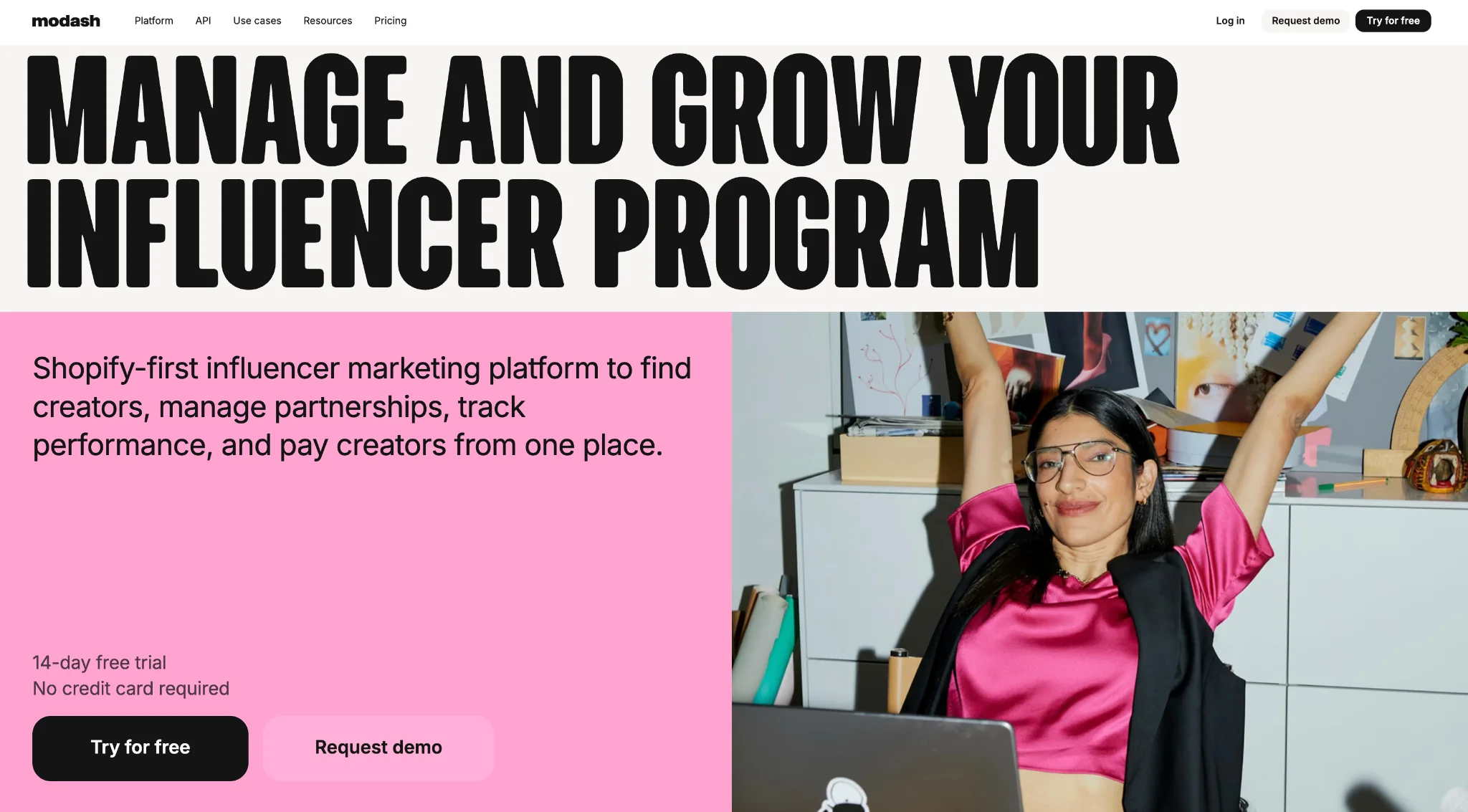
Modash is a discovery-led platform indexing over 380 million creator profiles on Instagram, TikTok and YouTube, with no curation applied. Tracking, creator lists, an email inbox and payments sit around the search, and every price is published with a free trial in front of it. In-house teams at small and mid-market brands are its core users.
Key Features
- Uncurated creator index: Every profile above 1,000 followers, rather than a network you have to be admitted to.
- Unlimited profile analysis: Audience data on any creator without a per-look charge.
- Email finder and inbox: Creator addresses surfaced and outreach handled from your own mailbox.
- Campaign content collection: Posts and Stories captured automatically while a campaign runs.
- Creator payments: Paid in-platform, free up to $10,000 a year and 5% above that.
Pricing
- Essentials: $199 a month, 300 profile opens and 100 tracked creators
- Performance: $499 a month, 800 profile opens and 250 tracked creators
- Enterprise: custom, from $14,700 a year
Both self-serve plans include a 14-day free trial with no card required, and annual billing lowers the monthly rate.
Reviews
4.9/5.0 (G2, low review volume at 19 reviews).
Pros
- A real free trial: Two weeks, no card, against a free tier that allows five profile opens a month.
- Search is the strength: The index and filters are why teams buy it and why they stay.
- Payments cost almost nothing: Free to $10,000 a year, against 10% from the first dollar elsewhere.
Cons
- Caps still apply: Profile opens, email unlocks and tracked creators are all limited per tier.
- Three networks: No coverage beyond Instagram, TikTok and YouTube.
- No campaign layer: Briefs, contracts and approvals happen elsewhere.
Integrations
- Shopify: Connects store data for creator sales and gifting.
- Gmail and Outlook: Runs outreach from your own mailbox with replies synced back.
- Slack: Alerts the team when tracked content goes live.
- Zapier: Bridges to the rest of the stack.
- API: Pulls creator data into internal tools on higher tiers.
HiveInfluence vs Modash
These are the closest comparison in the list, because both sell discovery and both meter it. Modash costs more per month at $199 against $59, and gives you a bigger index, a genuine free trial and creator payments that cost nothing until $10,000 a year.
The fee is where it separates. Paying creators $5,000 a month costs $500 in fees on the HiveInfluence Basic plan and nothing on Modash until the annual total passes $10,000. Over a year that difference is roughly $5,000, which buys the more expensive subscription twice over.
Glewee
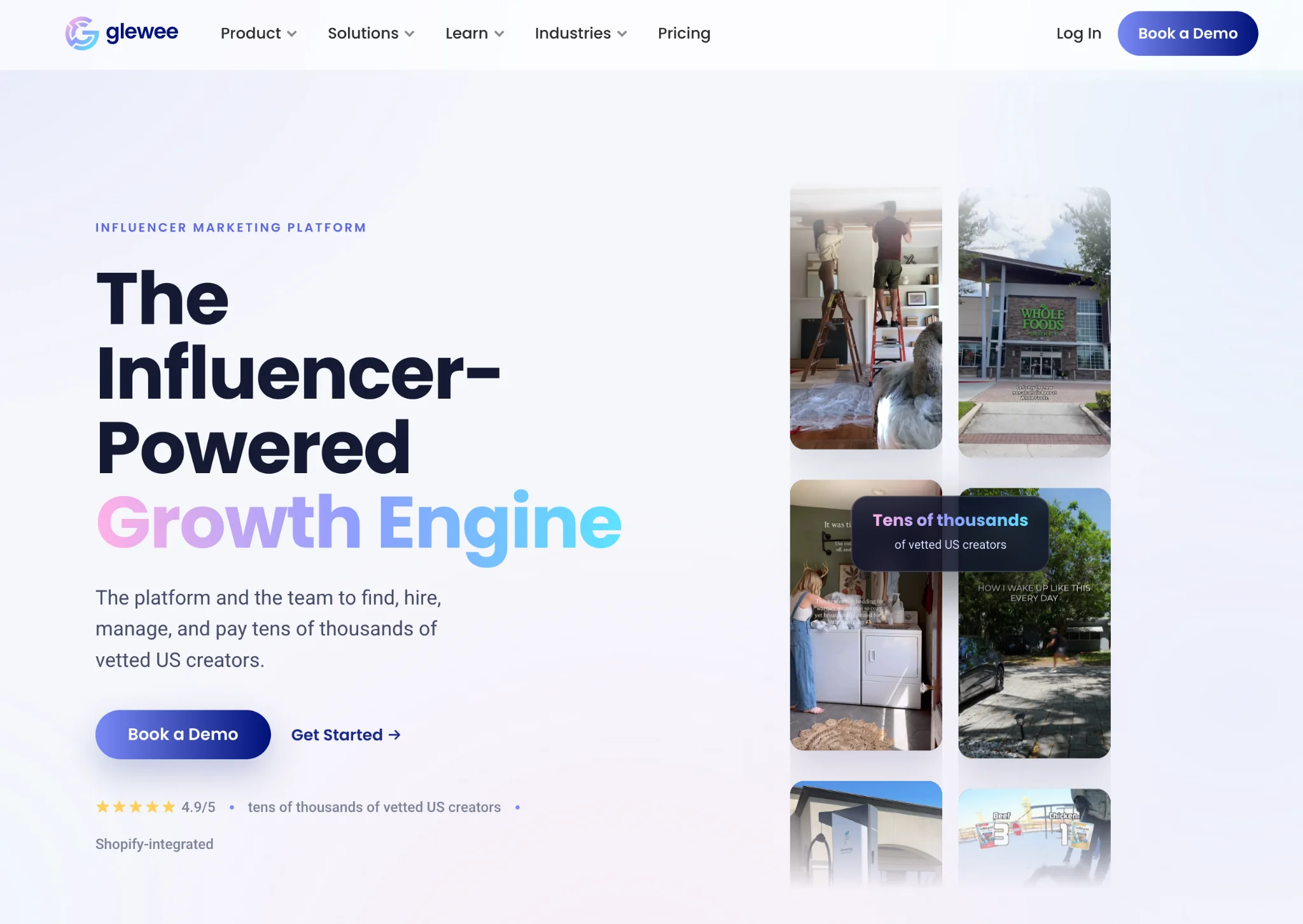
Glewee is a marketplace built on a network of more than 50,000 pre-vetted US creators. Brands publish a campaign, creators opt in, and briefing, contracts, content delivery and payment all happen in the app. Its pricing targets small and mid-market brands, and it takes no cut of what creators are paid.
Key Features
- Campaign brief marketplace: Post a brief and matched creators opt in rather than being searched for.
- Pre-vetted network: 50,000-plus US creators checked before they reach your campaign.
- In-app content delivery: Drafts, approvals and final assets handled in the same thread.
- Gifting campaigns: Product-only collaborations included on both paid tiers, matching what dedicated product seeding platforms offer.
- Stripe payment flow: Brand payment and creator payout handled with no platform fee on the hire.
Pricing
- Build: $199 a month, or $150 a month billed annually, with 3 seats and 10 gifting collaborations a month
- Scale: $499 a month, or $375 a month billed annually, with unlimited seats and gifting
- Full-Service: custom, run by the Glewee team
Both self-serve plans are month to month with no contract, and annual payment saves 25%.
Reviews
4.8/5.0 (G2). Capterra lists the product with no reviews at all, so the sample behind the score is thin.
Pros
- Zero fee on hires: What you agree with a creator is exactly what you pay.
- Vetting already done: Creators are screened before they reach your brief.
- Cancel monthly: No annual commitment on either self-serve plan.
Cons
- US creators only: No use for campaigns outside North America.
- Closed network: You choose from 50,000, not from the open creator market.
- Thin analytics: Delivery reporting rather than audience analysis.
Integrations
- Shopify: Connects the store for creator sales and gifting orders.
- Stripe: Processes brand payments and creator payouts.
- Instagram: Pulls post performance into campaign reporting.
- TikTok: The same tracking for short-form deliverables.
- Meta Business Suite: Routes creator content through for paid use.
HiveInfluence vs Glewee
The headline difference is the fee. Glewee takes nothing from creator hires on either paid plan, where HiveInfluence takes between 2% and 25% depending on your tier. On a $5,000 monthly creator budget that is a $500 gap every month at the Basic rate.
What you trade is reach. Glewee gives you 50,000 vetted US creators and nothing outside North America, while HiveInfluence claims coverage in 193 countries. If your campaigns are American, the network is deep enough and the fee saving pays the subscription several times over.
Final Thoughts on HiveInfluence Alternatives
One calculation settles this. Take what you pay creators in a month, multiply it by the fee on the tier you were planning to buy, and add the subscription. At $10,000 a month the Basic plan costs $1,059, and the discovery tooling you are buying stops at a Kanban board with room for ten people. Below a few thousand dollars of creator spend the model is genuinely cheap and the free tier is worth using. Above it, you are paying platform money for a search tool that cannot see your store, and the arithmetic only gets worse as the program grows.

.png)


.jpg)










