


10 Best CrowdRiff Alternatives for Influencer Marketing
CrowdRiff serves more than 900 destinations. That single fact explains most of what follows. Its customers are tourism boards, hotels, museums, attractions and tour operators, and the product is tuned precisely to what they need: find the photos visitors already posted, get permission to use them, and publish them into galleries on a destination website.
It does that well, and 24 reviewers on G2 say so. The trouble starts when a D2C brand puts it on a UGC shortlist. There is no eCommerce connection, no affiliate code, no creator payout and no way to hire a creator to make something new. It also publishes no price at all, and the third-party listings that quote one disagree with each other.
So the real question is not whether CrowdRiff is good. It is whether you need rights-cleared visitor photos or creator-driven revenue, because those are two different purchases.
Ten alternatives follow in this order: Influencer Hero, CreatorIQ, Upfluence, Aspire, Afluencer, SARAL, IMAI, Brandbassador, Lefty and Insense.
Key Criteria for Evaluating Influencer Marketing Platforms
Core Features
Evaluation of essential influencer marketing capabilities, including influencer discovery, outreach, CRM, campaign management, reporting, and content workflows.
Pricing & Flexibility
Comparison of pricing models, subscription plans, and contract terms to match different budgets and growth stages.
Customer Reviews & Satisfaction
Analysis of user feedback from trusted review platforms, focusing on usability, reliability, customer support, and overall performance.
Pros & Cons
Review of each platform’s strengths and limitations to highlight where it performs well and where it may fall short based on different use cases.
Integrations
Review of the most important integrations (e.g., Shopify and other tech tools), highlighting what each integration enables in one sentence.
CrowdRiff Overview
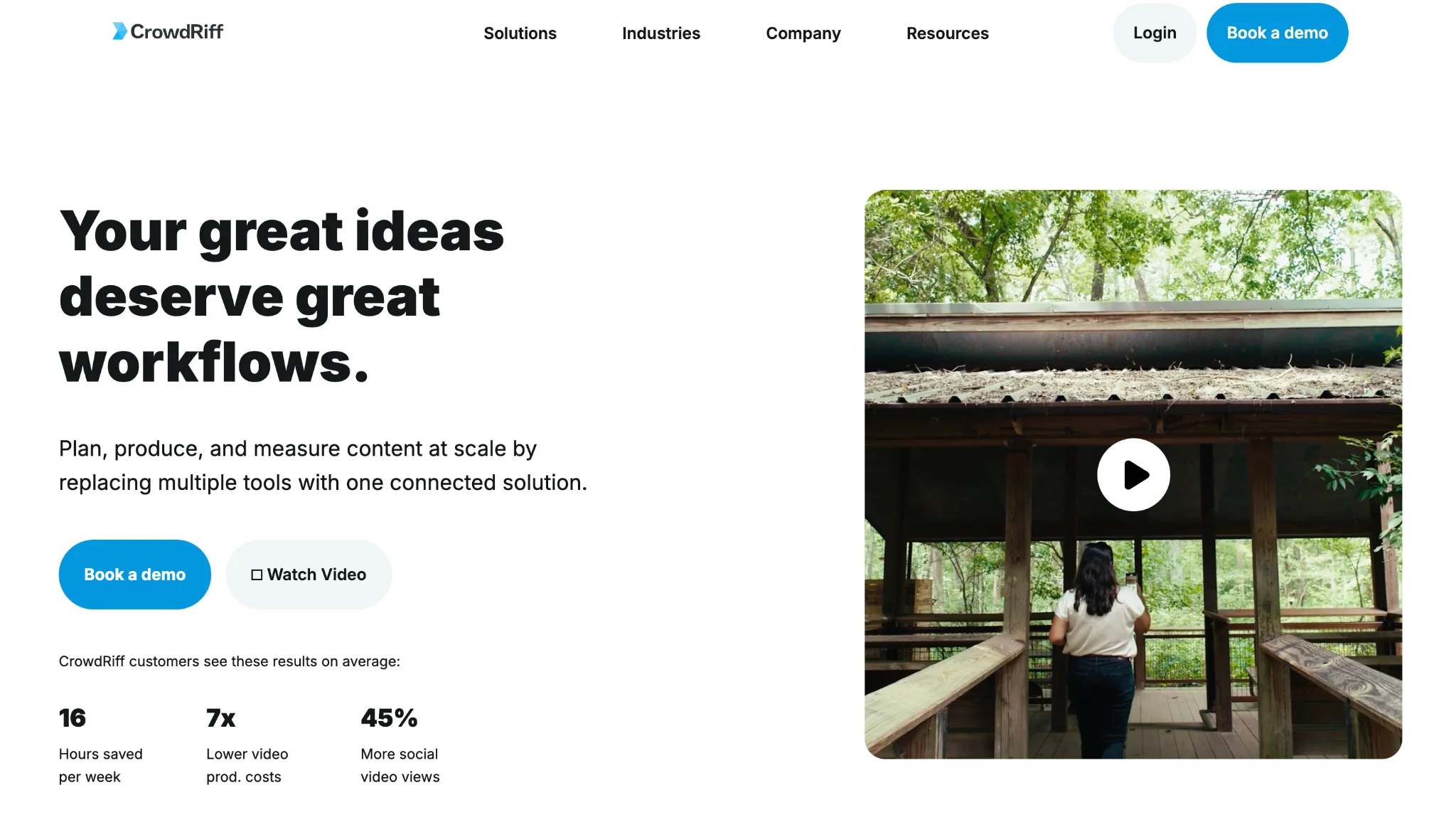
CrowdRiff is a visual content platform built around four products. UGC finds and curates photos and videos posted by visitors and locals, with machine-learning image search on top. A digital asset management library stores that content alongside professional photography and branded assets. A content planner organises what goes out and when. Creators, the newest piece, produces short-form video for Reels, TikTok and Shorts.
Rights management is the part reviewers praise most, and fairly. Requesting and recording permission to reuse someone’s photo is tedious work, and CrowdRiff makes it quick, which matters to any marketer serious about content usage rights. What the platform never does is transact. There is no creator fee, no discount code, no affiliate link and no payout, because destinations do not have a checkout to attribute them to.
Key Features
- UGC discovery: Visitor and local photos surfaced from social, with ML-powered image search.
- Rights management: Permission requested, granted and recorded against each asset.
- Digital asset management: UGC, professional photography and brand assets held in one library.
- Smart galleries: Curated visual galleries embedded on websites and landing pages.
- Creators: Short-form video production aimed at Reels, TikTok and YouTube Shorts.
Pricing
Nothing published. CrowdRiff sells through a demo booking with no rate card, plan list or minimum on its site. Third-party listings quote a starting figure of around $900 a month and disagree on whether a trial exists, with one stating no free trial and another claiming both a trial and a free tier, so none of it is reliable enough to budget against.
Reviews
4.7/5.0 (G2, 24 reviews), 4.5/5.0 (Capterra, very low review volume at 2 reviews) and 7.6/10 (TrustRadius, 7 reviews). Reviewers praise time savings, the rights workflow and support, and criticise the lack of a mobile experience, missing direct publishing and reliance on social platform APIs.
Integrations
- WordPress: Galleries embedded directly into WordPress pages.
- Drupal: The same for destinations running Drupal.
- Buffer: Curated assets scheduled out to social channels.
- Slack: Content alerts and approvals routed to the team.
- eCommerce platforms: None published, so nothing ties visual content to store orders.
Pros
- Rights handled properly: Permission requests and records are the feature users name most.
- Real visual search: ML image recognition finds usable assets faster than keyword tagging.
- A genuine review record: 24 G2 reviews from marketers actually running it.
Common Drawbacks of CrowdRiff
Built for destinations, not stores
Tourism boards, hotels, museums and attractions are the customer base. Their goal is to make a place look worth visiting, not to attribute a sale to a creator, and the product reflects that in every workflow.
No price anywhere
The vendor publishes no plans, no tiers and no minimum. The only public figures come from directory listings that contradict each other on whether a trial exists at all.
Nothing links content to revenue
No Shopify or WooCommerce connection, no discount codes, no affiliate links, no creator payouts. Visual performance is measured in views and engagement, never in orders.
Curating is not commissioning
CrowdRiff finds content that already exists and asks to use it. If you need a specific creator to film a specific product to a specific brief, that is a different tool entirely.
Best CrowdRiff Alternatives
| TOOL | REVIEWS | BEST FOR | TRIAL INFO | PRICING | ||
|---|---|---|---|---|---|---|
1 |

|
⭐ | Influencer CRM & automation | Book Demo | Pricing | Website |
2 |

|
⭐ | Enterprise influencer marketing | Book Demo | Pricing | Website |
3 |

|
⭐ | Influencer discovery | Book Demo | Pricing | Website |
4 |

|
⭐ | Influencer partnerships | Book Demo | Pricing | Website |
5 |

|
⭐ | Influencer marketplace campaigns | Book Demo | Pricing | Website |
6 |

|
⭐ | Influencer outreach | Book Demo | Pricing | Website |
7 |

|
⭐ | AI influencer discovery & analytics | Book Demo | Pricing | Website |
8 |

|
⭐ | Ambassador Marketing | Book Demo | Pricing | Website |
9 |

|
⭐ | Influencer analytics & discovery | Book Demo | Pricing | Website |
10 |

|
⭐ | UGC creators & paid social ads | Book Demo | Pricing | Website |
Influencer Hero
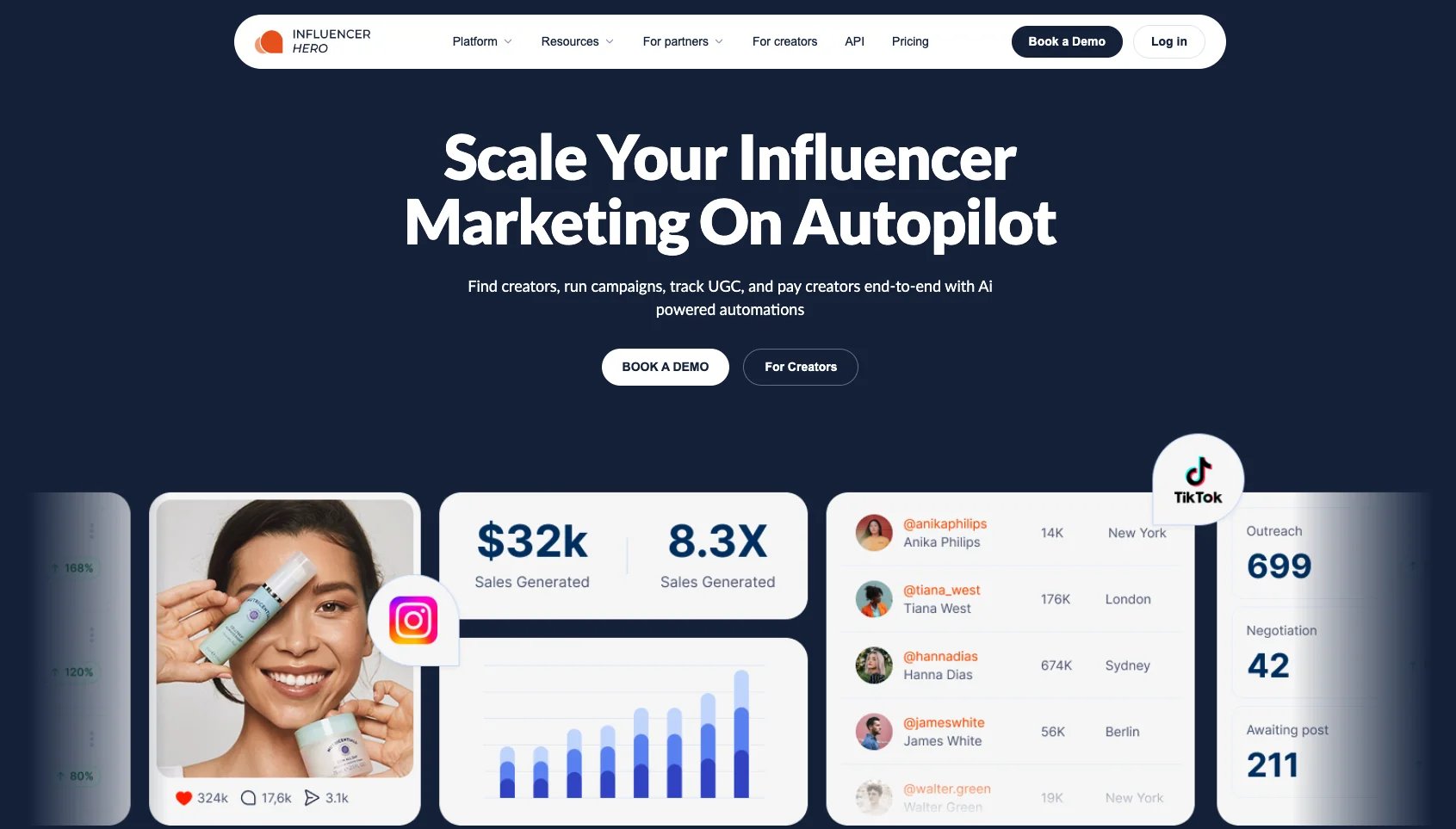
Influencer Hero is an all-in-one influencer marketing platform for D2C and eCommerce brands across 8 social platforms, with Instagram, TikTok and YouTube leading. It finds creators, contacts them, ships product, collects the content, tracks affiliate revenue and pays them, all against published pricing sized by outreach volume.
Key Features
- UGC content library: Creator posts captured automatically, scored and filtered for reuse on paid and organic.
- Creator discovery: Over 20 filters and AI search across eight networks.
- Fake-follower screening: Audience authenticity checked before budget commits.
- Brand-follower detection: Creators who already follow and buy from you, surfaced automatically.
- Multichannel outreach: Email, Instagram DM and WhatsApp sequences with replies in one inbox.
- Gifting through your store: Product orders raised in Shopify or WooCommerce and tracked to delivery.
- Affiliate codes and payouts: Commission calculated in-platform and paid at 0.1% to 0.4% with invoices attached.
- Revenue reporting: Sales by creator and product cost against return, compiled automatically.
Pricing
- Standard: $649 a month, up to 1,000 reachouts a month
- Pro: $1,049 a month, up to 5,000 reachouts a month
- Business: $2,490 a month, up to 10,000 reachouts a month
- Custom & Agency: custom pricing
Quarterly billing saves 20% and yearly saves 30%, with every figure published.
Reviews
5.0/5.0 (Capterra)
Pros
- Content plus commerce: A UGC library that sits next to codes, orders and payouts.
- Creators can be commissioned: Briefs go out to specific people rather than waiting for posts to appear.
- A number you can plan with: Three published tiers instead of a demo booking.
Cons
- No free trial
- Expensive for smaller brands
- Steep learning curve
Integrations
- Shopify: Gifting orders raised and creator sales attributed automatically.
- WooCommerce: The same for WordPress, with scripts covering Magento and custom builds.
- Klaviyo: Creator and customer segments pushed into lifecycle email.
- DocuSign: Creator agreements signed and filed on the deal record.
- Zapier: Over 8,000 further apps for anything not handled natively.
CrowdRiff vs Influencer Hero
Both collect creator content and both handle the rights around it, so on that narrow feature they are comparable. Everything else diverges. CrowdRiff curates what visitors already posted about a place; Influencer Hero finds specific creators across eight networks, screens their audiences, briefs them over email, Instagram DM or WhatsApp, ships product through Shopify or WooCommerce, captures the resulting posts into a scored library, issues affiliate codes and pays the creator at 0.1% to 0.4%. One assembles a gallery, the other runs a program that ends in an order.
The commercial comparison is one-sided by default. CrowdRiff publishes nothing, so the only way to know your cost is a demo and a quote, with directory listings hinting at roughly $900 a month. Influencer Hero publishes $649, $1,049 and $2,490 a month, cuts 20% for quarterly billing and 30% for annual, and takes no percentage of creator spend. For a D2C brand building a budget this quarter, one of those is usable today.
CreatorIQ
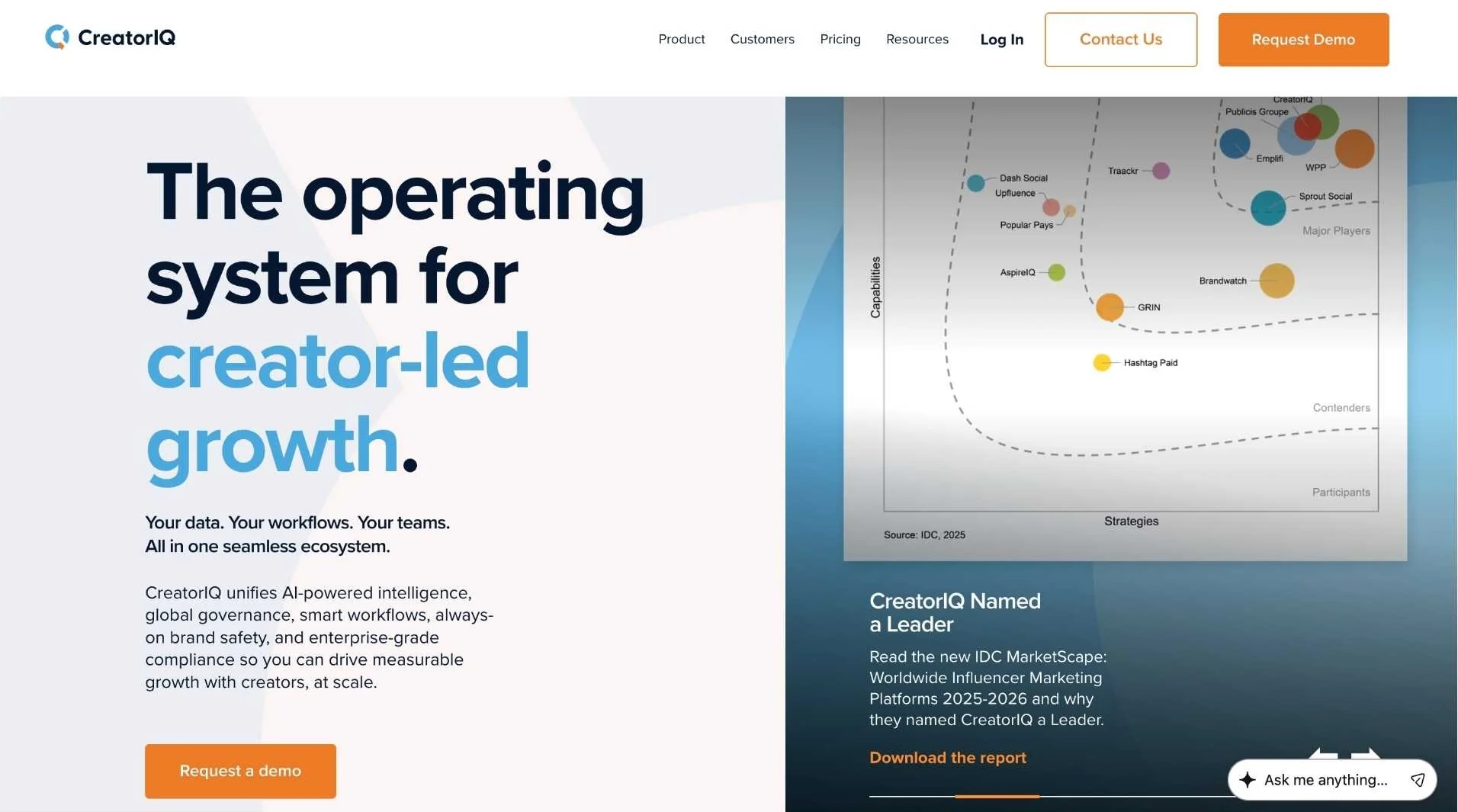
CreatorIQ is built for large organisations running creator programs across many brands and markets at once. Vetting, briefs, approvals, payments and stakeholder reporting all live under one governance model, which is why enterprise teams with legal and compliance sign-off tend to end up here.
Key Features
- Creator vetting: Audience and performance data beyond what the native platforms expose.
- Multi-market workflow: Briefs, approvals and deliverables tracked across regions simultaneously.
- Payment processing: Creator payments handled without routing through finance.
- Client one-sheets: Stakeholder summaries generated straight from campaign data.
- Performance analytics: Per-creator reporting at the depth an enterprise review demands.
Pricing
Nothing published. CreatorIQ quotes per engagement on annual enterprise contracts, so there is no benchmark without a sales conversation.
Reviews
4.6/5.0 (G2, 581 reviews).
Pros
- 581 reviews: More than twenty times CrowdRiff’s G2 base.
- Creators are paid inside it: Payment rails included rather than absent.
- Reporting is the strength: The feature its own users name most often.
Cons
- Also quote-only: The same missing rate card, at a far higher expected figure.
- Discovery gaps reported: Reviewers say relevant creators sometimes fail to surface.
- Busy interface: Users describe it as doing too much at once, with slow loading.
Integrations
- Shopify: Store connection tying creator activity to orders.
- Instagram and TikTok: Creator data and campaign performance pulled in directly.
- YouTube: Long-form results measured alongside short-form.
- Salesforce: Campaign data into enterprise reporting stacks.
- API access: Creator and campaign data available programmatically.
CrowdRiff vs CreatorIQ
Both are sold by demo, both serve larger organisations, and both are strong on reporting. The difference is what they report on. CrowdRiff measures how visual content performs across a destination’s channels. CreatorIQ measures what a roster of paid creators delivered against briefs, budgets and approval chains, then pays them.
Neither publishes a price, so evaluate them on evidence instead. CreatorIQ has 581 reviews to CrowdRiff’s 24, and its cheapest deployment will still cost considerably more. If your programme is a handful of galleries on a website, that is a heavy answer to a light question.
Upfluence

Upfluence looks inside your customer list before it looks anywhere else. It matches buyers against creator profiles, activates the ones with real audiences, and carries them through outreach, affiliate tracking and payment. Modules are purchased separately rather than as a fixed ladder.
Key Features
- Customer-creator matching: Your own buyers checked against creator profiles and activated.
- Modular purchase: Find, Scale or Autopilot bought separately rather than as a ladder.
- Discovery with demographics: Filters and audience data reviewers rate well for targeting.
- Affiliate commission tracking: Creator revenue attributed through the store connection.
- Workflow to payment: Discovery through to paying the creator inside one platform.
Pricing
Not published. Quoted per engagement based on modules, team size and program volume, on twelve-month annual plans including a dedicated account manager. A free trial follows a consultation call, and the company states it never takes a percentage of creator sales.
Reviews
4.6/5.0 (G2, 140 reviews).
Pros
- Customers become creators: The people already buying are the easiest to activate.
- 140 reviews: A deeper brand-side record than CrowdRiff’s.
- A trial exists: Hands-on access after the first call rather than a demo alone.
Cons
- Twelve-month plans: A full year committed up front.
- Needs a dedicated owner: Reviewers describe the interface as demanding.
- Quote-only too: No published figure to budget against.
Integrations
- Shopify: Customer data mined for creators, with affiliate revenue tracked back.
- WooCommerce: The same coverage for WordPress storefronts.
- Klaviyo: Creator segments moved into email flows.
- PayPal: Creator payments processed inside the workflow.
- API access: Campaign and creator data into your own reporting.
CrowdRiff vs Upfluence
CrowdRiff finds content and asks who made it. Upfluence starts with people, specifically the ones on your customer list, and works out which of them have an audience worth activating. For a store with order history, that is a source of advocates CrowdRiff has no way to see, because it reads social posts rather than purchase data.
Both hide their pricing behind a call, so neither wins on transparency. Upfluence at least connects to Shopify and WooCommerce, tracks affiliate commission and pays creators through PayPal, which turns advocacy into a number a finance team recognises.
Aspire

Aspire runs the whole brand-side program for companies operating at scale. Lookalike discovery feeds seeding at volume, briefs and approvals push content through review, affiliate attribution ties it to orders, and a rights-managed library holds the finished assets for paid reuse.
Key Features
- Lookalike discovery: One creator who performed becomes a shortlist of similar profiles.
- Seeding workflows: Product send-outs run the way dedicated product seeding platforms handle them.
- Briefs and approvals: Content requested, reviewed and signed off in the platform.
- Affiliate attribution: Codes and links tying creator activity to real orders.
- Rights-managed library: Approved assets held with usage terms for paid reuse.
Pricing
Not published. Third-party sources report an annual commitment starting around $2,000 a month, with other estimates near $2,499, and they disagree enough that only a quote settles it. There is no free trial.
Reviews
4.6/5.0 (G2, 146 reviews).
Pros
- Rights plus revenue: A usage-managed asset library that also tracks orders.
- 146 reviews: Independent evidence from brands running real programs.
- Content is commissioned: Briefs go out rather than waiting for posts to appear.
Cons
- No trial and no rate card: A closed evaluation at a reported $2,000-plus a month.
- Annual commitment: A year signed up front.
- Heavier than most need: Built for programs already running at scale.
Integrations
- Shopify: Seeding orders raised and creator revenue attributed.
- WooCommerce: Equivalent coverage for WordPress stores.
- Klaviyo: Creator contacts into email programs.
- Slack: Campaign alerts into team channels.
- Zapier: Wider stack connections where no native option exists.
CrowdRiff vs Aspire
This is the closest comparison on the page, because both hold a rights-managed library of creator content. Aspire’s library is fed by campaigns it ran, so every asset arrives with a brief behind it and a discount code attached. CrowdRiff’s is fed by whatever visitors happened to post, cleared afterwards.
Aspire is the more expensive purchase and equally opaque about the number. What the money buys is the half CrowdRiff omits: seeding at volume, order attribution and the ability to ask for content that does not exist yet. For a destination that half is irrelevant, which is exactly why CrowdRiff does not build it.
Afluencer

Afluencer works on applications rather than search. You publish a collaboration, verified creators apply, and AI ranks the queue against your brief before you review it. At $49 a month it is the cheapest published price on this page by a wide margin.
Key Features
- Inbound applications: Creators respond to your brief, so you are choosing rather than hunting.
- Verified members: Accounts registered and checked before anyone can apply.
- CreatorGPT ranking: AI sorts the applicant queue against your brief before review.
- Invite credits: Outbound approaches for the months when applications run thin.
- Store-linked codes: Discount codes and creator fees handled through the storefront connection.
Pricing
- VIP: $49 a month
- Concierge: $99 a month
No minimum term, with creator-side plans billed separately.
Reviews
4.6/5.0 (G2, 738 reviews) and 4.7/5.0 (Shopify App Store, 34 reviews). The G2 pool leans creator-side, so read it beside the Shopify score.
Pros
- A published $49: Visible before you speak to anyone, against no figure at all.
- 738 reviews: The deepest evidence base among these influencer marketing software options.
- Creators come to you: No index to search and no gallery to curate.
Cons
- Inbound quality varies: A weak listing brings weak applicants.
- No asset library: Nothing equivalent to a DAM for professional photography.
- North America weighted: Creator supply thins outside its main markets.
Integrations
- Shopify: Codes, referrals and creator orders tracked from the store.
- BigCommerce: The same connection for BigCommerce merchants.
- Klaviyo: Creator contacts pushed into your email lists.
- DocuSign: Collaboration terms signed inside the flow.
- Slack: Application alerts sent to the team as they arrive.
CrowdRiff vs Afluencer
Both put you in front of people who might make content about you, from opposite directions. CrowdRiff surfaces posts that already exist and helps you licence them. Afluencer publishes your offer so creators apply to make something new, then hands you their details and a discount code to track it.
Price makes the contrast starker. Afluencer is $49 a month, published, month-to-month, with 738 reviews behind it. CrowdRiff is a demo booking with a directory-listed guess of around $900 and 24 G2 reviews. For a small D2C brand testing whether creator content moves anything, that is not a close call.


SARAL

SARAL prices by relationships rather than by assets or seats. Plans are sized on active partnerships, outreach runs as drip sequences from your own Gmail, Shopify connects in one click, and a former influencer strategist comes attached to the account.
Key Features
- Partnership-based plans: Sized by active partnerships and creators saved per month.
- Email drip sequences: Automated outreach run from your own Gmail rather than a vendor’s system.
- One-click Shopify: Store connection established without development work.
- Unlimited post tracking: Creator content monitored without a cap from Business up.
- Dedicated success manager: Former influencer strategists included in the plan.
Pricing
- Starter: $12,000 a year or $3,600 a quarter, 100 active partnerships, 1 seat
- Business: $15,000 a year or $4,500 a quarter, 500 partnerships, 3 seats
- Professional: $25,000 a year or $7,500 a quarter, 1,000 partnerships, 10 seats
No contracts, cancellation at any time, and a free trial before you pay.
Reviews
4.8/5.0 (G2, 56 reviews).
Pros
- Everything is published: Three tiers, both billing options and the trial, stated openly.
- 4.8 across 56 reviews: The strongest satisfaction score here.
- A trial before payment: Hands-on access rather than a scheduled demo.
Cons
- Five figures to start: $12,000 a year is a serious commitment for a first program.
- Bugs are reported: Gmail sync delays and glitches recur in reviews.
- No asset management: Nothing like a DAM for professional photography.
Integrations
- Shopify: One-click connection for seeding, codes and creator revenue.
- Gmail: Sequences sent and tracked from your own mailbox.
- Klaviyo: Creator contacts moved into lifecycle email.
- Slack: Support and campaign alerts routed to the team.
- Zapier: Wider stack connections without engineering time.
CrowdRiff vs SARAL
SARAL is organised around ongoing partnerships, which is a concept CrowdRiff does not really have. Its unit is the asset: a photo found, cleared and published. SARAL’s unit is the person: contacted, briefed, tracked, paid and kept for the next campaign, with the plan priced on how many of those you run at once.
On evaluation SARAL is simply more open. Three tiers, two billing options and a free trial are all published, against a demo form and no figures. The catch is scale, since $12,000 a year assumes a program with something to manage, not a first experiment.
IMAI

IMAI is a discovery and analytics platform aimed at agencies as much as brands, with fraud screening in search, client account separation, white-label reporting on higher plans and social listening above the entry tiers.
Key Features
- Hundreds of millions of profiles: Search across a very large creator index.
- Fraud screening in search: Fake-follower detection surfaced with the results.
- Client account separation: Multiple programs run side by side without collision.
- White-label reporting: Agency-branded outputs on the higher plans.
- Social listening: Brand and category monitoring above the entry tiers.
Pricing
Published tiers reported from about $175 a month, through roughly $349 and $499, to $1,200 and up for enterprise and white-label, with report volumes varying by tier. A free trial is offered.
Reviews
4.1/5.0 (GetApp, low review volume at 16 reviews). Sourcing speed and fraud detection draw praise; support and account access draw the criticism.
Pros
- A price and a trial: Both published, where CrowdRiff offers neither.
- Fraud screening built in: Audience quality checked before you commission anything.
- Agency-ready: Client separation and branded reports included.
Cons
- Support is the complaint: Slow responses and, in one report, lost account access.
- Sixteen reviews: A thinner record than CrowdRiff’s 24 on G2.
- No content library: Discovery and analytics rather than asset management.
Integrations
- Shopify: Named store connection for creator-driven orders.
- WooCommerce: Coverage for WordPress storefronts.
- Instagram and TikTok: Creator data and campaign performance.
- YouTube: Channel-level analytics alongside short-form.
- Exports: Creator and campaign data out for client reporting.
CrowdRiff vs IMAI
These two barely compete. IMAI searches a very large index to find people worth hiring and checks whether their followers are real. CrowdRiff searches social posts to find images worth publishing and checks whether you have permission to use them. Discovery means something different in each.
Where IMAI wins outright is on evaluation terms. Around $175 a month with a free trial lets you test the thing in a week, against a demo booking and a directory guess. Where CrowdRiff wins is asset management, since IMAI has no library, no galleries and no rights workflow at all.
Brandbassador (Club)

Brandbassador converts existing customers into a managed ambassador community and keeps them posting through gamified missions, points, leaderboards and commission, with rewards and output tracked per person.
Key Features
- Reward missions: Tasks published to the community and completed for points, product or commission.
- Gamified retention: Leaderboards and tiers keeping ambassadors posting between campaigns.
- Community recruitment: Customers converted into a managed roster at scale.
- Affiliate links and payouts: Rewards, commission and payments handled per ambassador.
- Programme analytics: Participation and output measured across the community.
Pricing
Not published, with third-party listings reporting no free trial. Quotes come through the vendor.
Reviews
4.7/5.0 (G2, 107 reviews). Ease of use and support are praised; ambassador search and filtering draw the criticism.
Pros
- Content on request: Missions ask for specific posts instead of waiting for them.
- 107 brand-side reviews: Four times CrowdRiff’s G2 base.
- Four store integrations: Named eCommerce connections against none.
Cons
- Quote-only and no trial: The same closed evaluation problem.
- Weak ambassador search: Finding the right people is the recurring complaint.
- Needs existing customers: No use for a brand starting from nothing.
Integrations
- Shopify: Discount codes and ambassador sales tracked from the store.
- WooCommerce: The same for WordPress storefronts.
- Adobe Commerce: Enterprise commerce coverage.
- BigCommerce: Additional storefront support.
- Instagram and TikTok: Ambassador content tracked against missions.
CrowdRiff vs Brandbassador
Both are built on the idea that your best content comes from real people rather than a studio. They differ on what happens next. CrowdRiff licences the post and puts it in a gallery. Brandbassador rewards the person who made it, gives them a code, tracks what it sells and asks for another post next month.
Neither publishes a price and neither offers a trial, so both are demo-first purchases. The tiebreaker for a D2C brand is that Brandbassador connects to four storefronts and pays commission, while CrowdRiff connects to none and pays nobody.
Lefty
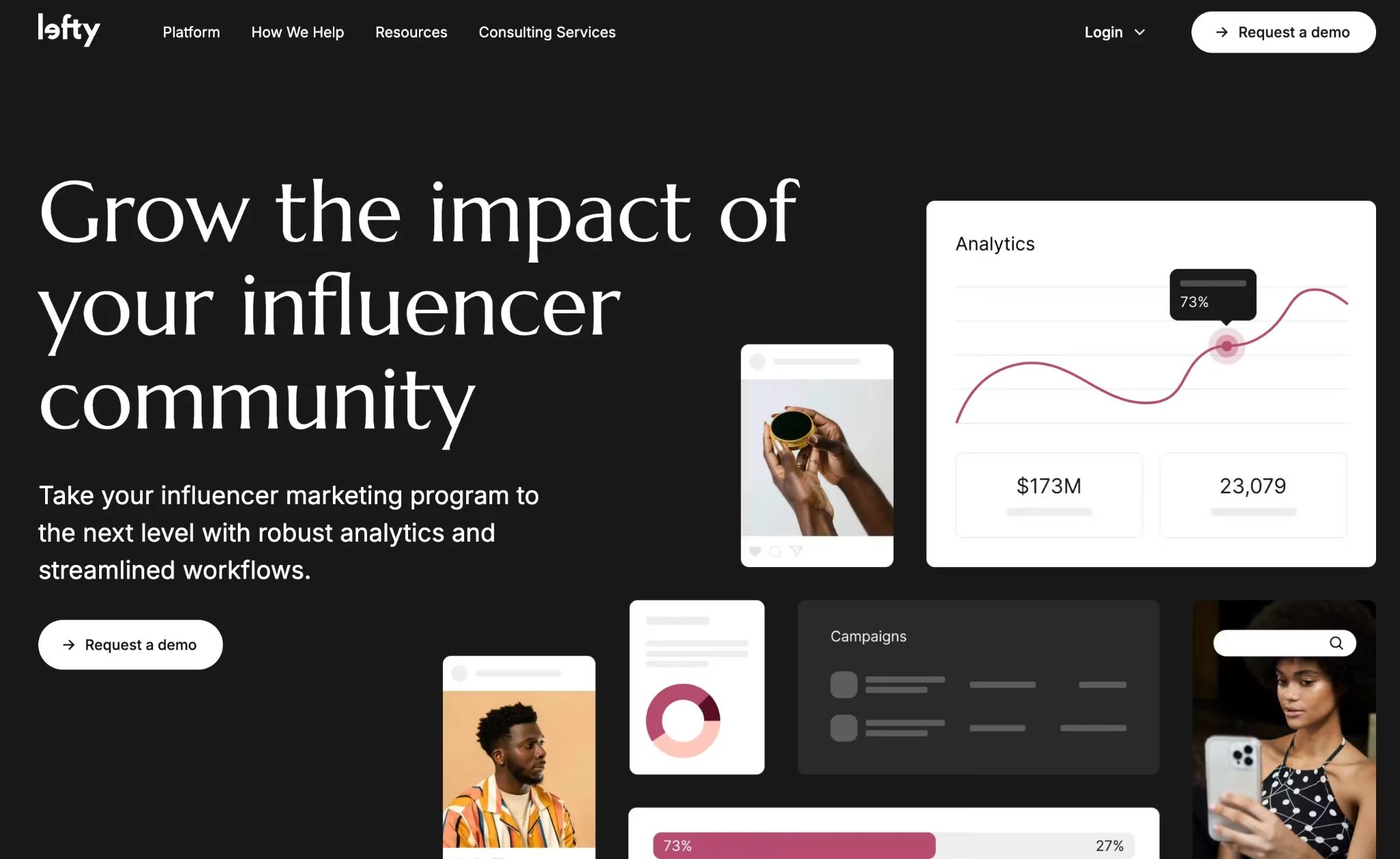
Lefty combines faceted discovery across a multi-million profile index with campaign management, ROI reporting and social monitoring, plus Android and iOS apps. Its Instagram depth suits fashion, beauty and lifestyle programs particularly well.
Key Features
- Faceted discovery: Layered filters across a multi-million profile index.
- Campaign management: Briefs, deliverables and creator relationships in one place.
- ROI reporting: Campaign returns measured rather than reach alone.
- Social monitoring: Brand mentions tracked alongside campaigns.
- Mobile apps: Android and iOS access, which most brand-side tools skip.
Pricing
Nothing published on the company’s own site. Its Capterra listing shows a starting figure of around €590 a month with a free trial available, so treat that as indicative rather than a rate card.
Reviews
5.0/5.0 (Capterra, very low review volume at 2 reviews). Ease of use scores 5.0, features and value 4.5, and customer service 4.0.
Pros
- Mentions plus campaigns: Social monitoring alongside briefs and deliverables.
- Mobile access: Apps for Android and iOS, a gap reviewers flag on CrowdRiff.
- An indicative figure: Around €590 a month on its listing, with a trial attached.
Cons
- Two reviews: A far thinner record than CrowdRiff’s.
- No rate card: The only figure comes from a directory listing.
- Instagram weighted: Less depth on TikTok and YouTube.
Integrations
- Instagram: The deepest connection, powering discovery and reporting.
- TikTok: Creator data and campaign tracking on short-form.
- YouTube: Channel performance alongside the social networks.
- Exports: Campaign and creator data out for reporting.
- Mobile apps: Campaign access from Android and iOS as well as the browser.
CrowdRiff vs Lefty
Social monitoring is the shared ground. Both watch what is being posted about a brand or a place, then do something with it. CrowdRiff turns those posts into a rights-cleared gallery. Lefty turns them into campaign context, sitting beside briefs, deliverables and an ROI figure.
Evidence is thin on both sides, at two Capterra reviews for Lefty and 24 G2 reviews for CrowdRiff. Lefty at least has an indicative €590 a month on a listing and a trial, which is one more data point than a demo booking offers.
Insense
Insense is a creative supply line. You post a brief, creators apply, and finished video comes back with usage rights cleared and Meta Partnership Ads ready to run from the creator’s own handle. Product seeding is included in the campaign.
Key Features
- Guaranteed applicants: Five creators on a brief, with delivery in roughly two weeks.
- Content revisions: Up to three feedback rounds built into the brief.
- Whitelisted advertising: Meta Partnership Ads run from the creator’s own handle.
- Seeding included: Product shipped to creators as part of the campaign.
- Cleared usage rights: Paid usage licensed in the deal rather than negotiated later.
Pricing
- Trial: $650 for one month, 1 campaign and 10 creators, 20% marketplace fee
- Brand: $500 a month billed quarterly, or $400 a month annually, 10% fee
- Agency: $800 a month billed quarterly, or $640 a month annually, 7% fee
Campaigns and creators are unlimited on both paid plans, and both numbers are published.
Reviews
4.5/5.0 (G2, 374 reviews).
Pros
- Rights cleared upfront: Licensed in the deal rather than requested after the fact.
- 374 reviews: A large brand-side record to read before buying.
- Both costs published: Subscription and marketplace fee stated openly.
Cons
- A percentage on top: 7% to 20% of creator payments above the plan price.
- Ad creative, not galleries: Built for paid social rather than website curation.
- No asset management: Nothing equivalent to a DAM for a wider content library.
Integrations
- Meta: Partnership Ads and whitelisted creator content run directly.
- TikTok: Assets routed into ad formats without re-uploading.
- Shopify: Seeding orders raised from your product catalogue.
- Stripe: Creator payments processed inside the workflow.
- Ad account export: Approved content pushed into live campaigns.
CrowdRiff vs Insense
Rights are where these two meet, and where they part. CrowdRiff clears permission for a photo someone already took. Insense licences usage as part of the deal before the video is filmed, so the asset arrives ready for paid media rather than needing a request thread first.
The costs are also visible on one side only. Insense publishes $400 to $800 a month plus a 7% to 20% marketplace fee, so you can model a campaign before starting it. CrowdRiff publishes nothing, and the number a directory quotes is not a number you can put in a plan.
Final Thoughts on CrowdRiff Alternatives
CrowdRiff is not a weak product. Its rights workflow, image search and asset library solve a real problem for the tourism marketers it was built for, and 24 G2 reviewers at 4.7 are not imagining the time it saves them.
It is the wrong shape for eCommerce, though. Nothing connects a photo to an order, no creator gets paid through it, no code is issued, and the price is invisible until you sit through a demo. If your programme has to show revenue at the end of the quarter, buy the tool that was designed to produce it.

.png)


.jpg)










