

Best D2C Tech Stack for Brands • Paid Ads: Triple Whale • Influencer & Affiliate Marketing: Influencer Hero • Email Marketing: Klaviyo • 3PL Fulfillment: ShipMonk • Customer Support: Gorgias • Social Media Management: Hootsuite • Upselling: One Click Upsell • Whatsapp Marketing: Chat Armin • Push Notifications: PushOwl • E-Commerce CMS: Shopify • FAQ
Ultimate 2026 D2C Tech Stack for Brands
As a D2C founder or growth leader, you already know that your tech stack can make or break your margins. The tools you choose determine how efficiently you acquire customers, how well you retain them, and how profitably you fulfill and support them - and in 2025, the gap between brands running a fragmented stack versus an integrated one is widening fast.
The global D2C e-commerce market is projected to reach USD 2.75 trillion by 2033, growing at a CAGR of 17.3% Spocket, meaning the brands that invest in the right infrastructure today are positioning themselves to capture an outsized share of that growth tomorrow.
Best D2C Tech Stack for Brands
In this article, we break down the ten essential tools that make up the ultimate D2C tech stack for brands in 2026:
| TOOL | REVIEWS | BEST FOR | TRIAL INFO | PRICING | ||
|---|---|---|---|---|---|---|
1 |

|
⭐ | Ecommerce analytics | Book Demo | Pricing | Website |
2 |

|
⭐ | Influencer CRM | Book Demo | Pricing | Website |
3 |

|
⭐ | Email & SMS marketing | Book Demo | Pricing | Website |
4 |

|
⭐ | 3PL fulfillment | Book Demo | Pricing | Website |
5 |

|
⭐ | Ecommerce support | Book Demo | Pricing | Website |
6 |

|
⭐ | Social media management | Book Demo | Pricing | Website |
7 |
|
⭐ | Upsell optimization | Book Demo | Pricing | Website |
8 |

|
⭐ | AI chatbot marketing | Book Demo | Pricing | Website |
9 |

|
⭐ | Web push marketing | Book Demo | Pricing | Website |
10 |

|
⭐ | Ecommerce platform | Book Demo | Pricing | Website |
1. Paid Ads: Triple Whale

In a post-iOS 14.5 world, running paid acquisition without first-party attribution is flying blind. Triple Whale centralizes metrics from all your tools into one dashboard, simplifying complex data, keeping you informed with easy-to-digest reports, and eliminating the need to log into multiple platforms. Its proprietary Triple Pixel uses first-party data to provide independent attribution across Meta, Google, TikTok, and Snapchat — giving your media buying team a single source of truth rather than relying on each platform's self-reported (and notoriously inflated) ROAS figures.
Pros:
- First-party Triple Pixel tracks customer behavior independently of ad platforms, giving accurate multi-touch attribution across all paid channels
- Triple Whale has over 10,000 customers and is used by brands earning between $30K and $20M in annual revenue, making it validated across the full D2C growth spectrum
- Creative Cockpit and AI-powered anomaly detection help performance marketers identify winning creatives and spending inefficiencies in real time
- Real-time tracking means ad metrics are updated every 15 minutes, enabling faster decision-making than traditional analytics tools
Cons:
- Triple Whale only supports Shopify — brands on WooCommerce, BigCommerce, or other platforms are excluded entirely
- It's not cost-effective for brands doing less than $1M per year in revenue, and arguably unnecessary unless you're doing over $10M per year
- Pricing scales with revenue, which can make it expensive for rapidly growing brands at the higher tiers
- Some users report that the Creative Cockpit, while useful, is outperformed by dedicated creative analytics tools like Motion for teams where creative analysis is their primary use case
2. Influencer & Affiliate Marketing: Influencer Hero

Influencer marketing has moved from a brand awareness play to a performance channel, and managing it at scale requires purpose-built infrastructure — not spreadsheets. Influencer Hero consolidates influencer discovery, outreach, campaign management, CRM, affiliate tracking, product gifting, and UGC collection into a single intuitive workspace with Shopify integration, allowing D2C growth teams to run high-volume influencer and affiliate programs without needing a large team behind it.
Pros:
- Access to a database of over 200 million creators across Instagram, TikTok, YouTube, and blogs with AI-powered discovery and fake follower detection
- The bulk messaging module supports centralized DM and email outreach with personalization tokens — critical for scaling influencer recruitment efficiently
- Native Shopify integration auto-generates affiliate links and discount codes and attributes revenue directly to each creator, making every campaign performance-trackable
- Kanban-style campaign pipelines and a built-in influencer CRM keep influencer relationships and deal flow organized across your entire roster
Cons:
- The subscription cost is per brand, which makes it expensive for agencies or operators managing multiple brands simultaneously
- Plans start at $649/month for up to 1,000 creator outreaches, making it better suited for brands actively running influencer programs at scale rather than those just testing the channel
3. Email Marketing: Klaviyo
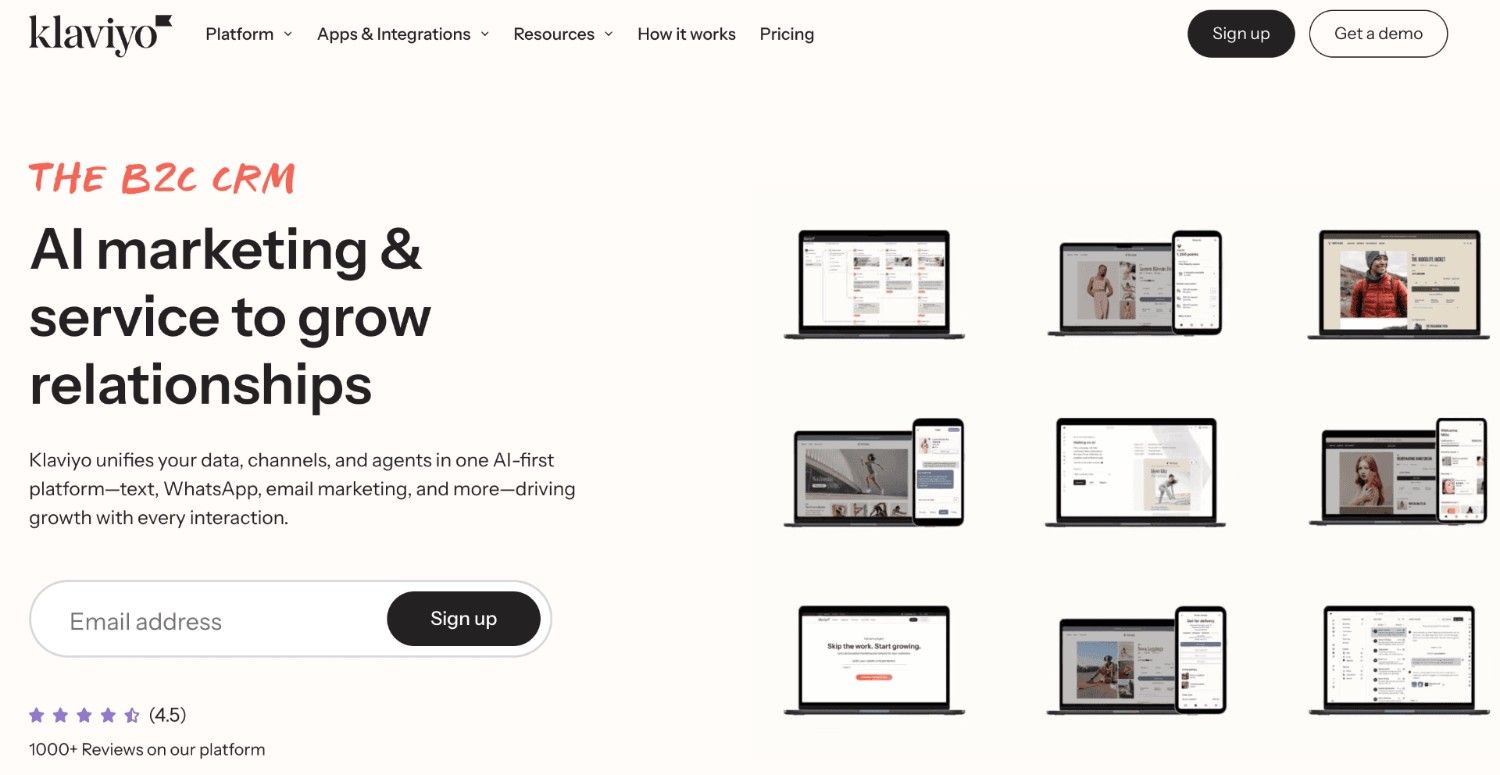
Klaviyo was purpose-built for ecommerce, and that product focus is visible in every feature. Its deep Shopify integration — backed by Shopify's own equity stake — means customer behavioral data syncs in real time, enabling flows and segments that fire based on actual purchase behavior rather than static list logic. Klaviyo is one of the few ecommerce tools that can scale with a business from its first dollar in revenue to $100M+, with advanced features that growing teams want and that enterprise brands also rely on Seventh Triangle.
Pros:
- Over 350+ professionally designed email templates, 80 pre-built flow templates, and open-ended segmentation using AND/OR logic make it the most customizable retention platform available for ecommerce
- Predictive AI tools forecast next purchase date, churn risk, and lifetime value — enabling CMOs and retention teams to build proactive lifecycle programs rather than reactive ones
- Klaviyo's reporting goes beyond opens and clicks, showing revenue and conversion metrics like checkout started and placed order, with customizable charts and deliverability reporting
- Since August 2024, new attribution controls allow brands to filter Apple Mail privacy opens and bot clicks, and retroactively recalculate metrics — a meaningful improvement for accurate reporting
Cons:
- Klaviyo's January 2025 pricing update moved to a contact-based model charging for active profiles, with automatic tier upgrades that have caught many merchants off guard with unexpected bill increases of up to 25%
- Customer support has faced criticism for limited availability — the platform lacks phone support and live chat is not available 24/7, which is problematic for brands needing immediate help during high-traffic periods
- Brands on Magento and WooCommerce report that integrations are weaker than on Shopify, making Klaviyo a more compelling choice specifically for Shopify merchants
- Steep learning curve for teams without a dedicated email marketing operator — extracting its full value requires significant configuration investment upfront
4. 3PL Fulfilment: ShipMonk
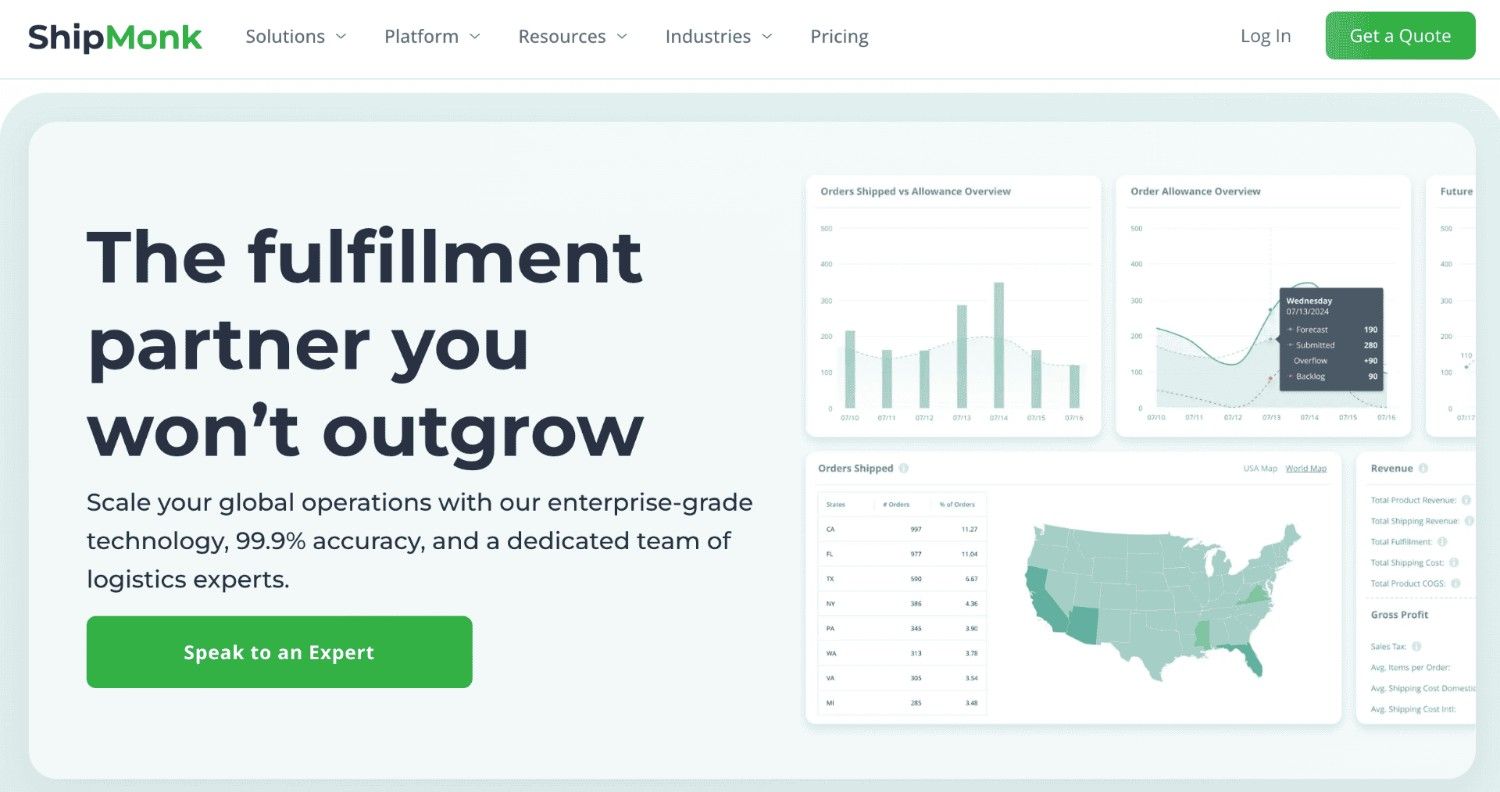
Fulfillment is the most operationally consequential decision a scaling D2C brand makes — a bad 3PL partner doesn't just hurt margins, it destroys customer trust at the exact moment it matters most. ShipMonk operates 12 fulfillment centers across the US, Europe, and Canada, with a Virtual Carrier Network that finds the most affordable shipping rates across carriers, and a 2-day shipping guarantee within the US. Its proprietary warehouse management software gives operations teams real-time inventory visibility, low-stock alerts, and SKU-level analytics, removing the blind spots that cause stockouts and fulfillment errors.
Pros:
- ShipMonk integrates seamlessly with over 100 e-commerce channels including Shopify, Amazon, and WooCommerce, allowing for real-time synchronization of orders and inventory
- Dedicated "Happiness Engineer" support team based directly in fulfillment centers provides contextual, informed help for merchant issues
- Strong fit for subscription box brands, crowdfunding fulfillment, and batch-release product drops that require kitting and custom packaging support
- MonkProtect delivery protection program provides worry-free deliveries and returns, reducing post-purchase support ticket volume for growing brands
Cons:
- Reviews on Capterra and Reddit consistently cite slow response to support tickets and issues going unresolved for extended periods — one of the most common complaints across the merchant community
- ShipMonk has a high pack fee and a number of hidden costs that can ramp up expenses unexpectedly, making it difficult for smaller brands to predict their monthly 3PL spend accurately
- Some users report billing errors, custom projects taking months to complete, and a difficult offboarding process that can take 6+ months if you choose to switch providers
- B2B fulfillment services lag behind D2C offerings, making ShipMonk a stronger fit for pure-play D2C brands than those operating omnichannel retail alongside their direct channel
5. Customer Support: Gorgias
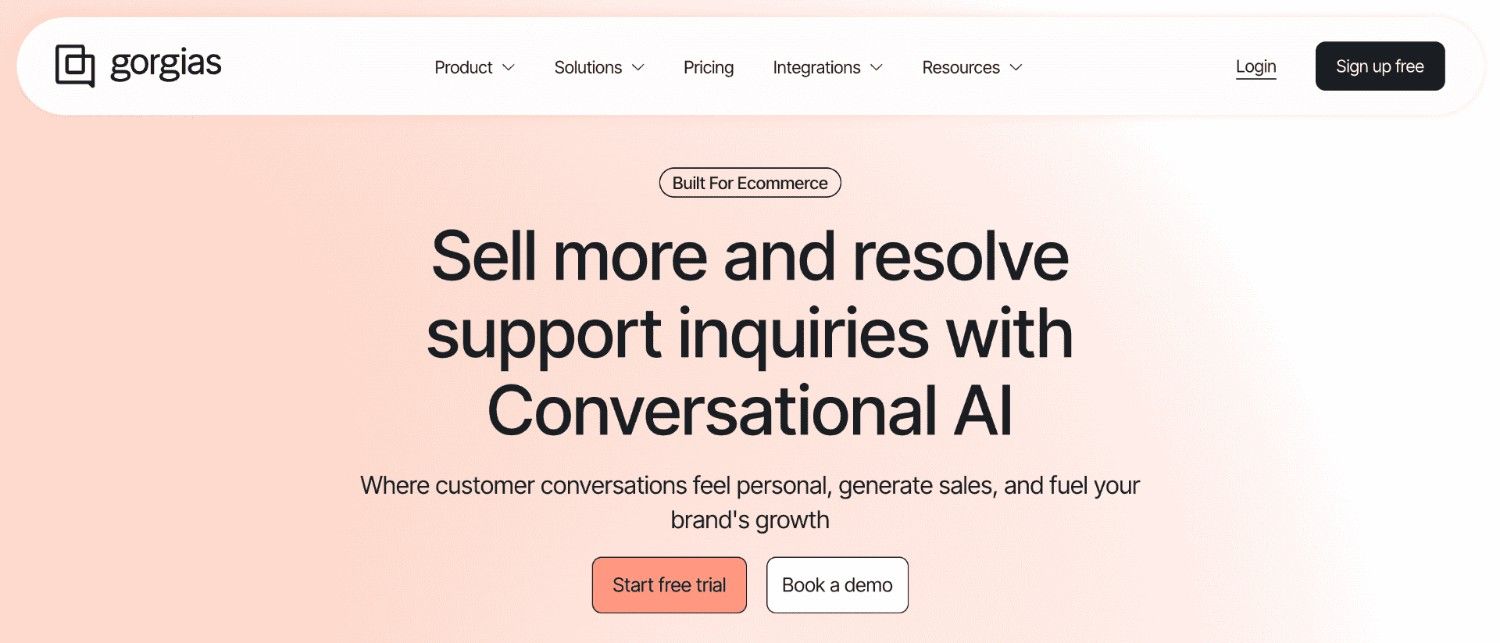
For D2C brands, customer support is a revenue function — not a cost center. Gorgias was built exclusively for ecommerce, and its native Shopify integration allows agents to view order history, issue refunds, edit orders, and cancel subscriptions without leaving the helpdesk. Gorgias automates up to 60% of inquiries through AI-powered responses and rules-based automation, freeing your support team to focus on high-value interactions that drive retention and LTV.
Pros:
- Centralizes email, chat, SMS, WhatsApp, Facebook, Instagram, and TikTok messages into one dashboard — agents never need to switch platforms to manage cross-channel customer conversations
- Customizable macros, rules, and triggers allow brands to build sophisticated automation logic based on ticket content, customer history, sentiment, and custom fields
- AI agent handles routine inquiries — shipping status, order updates, return initiation — with tailored product recommendations available via live chat to convert support interactions into sales moments
- Deep Shopify Plus integration means VIP customers can be automatically routed to senior agents based on order value or customer tier
Cons:
- Gorgias uses a ticket-based pricing model, which keeps the entry point affordable but becomes difficult to predict as support volume increases — seasonal spikes can lead to significant overage charges
- Some merchants report that the platform has lagged in adding features that competitors introduced earlier, including a native knowledge base and certain collaboration tools
- Community feedback consistently surfaces the steep learning curve as a frustration point — truly leveraging Gorgias's automation capabilities requires technical knowledge and ongoing configuration
- Reporting tools have been criticized as too technical for frontline teams, and the mobile app has been flagged as buggy in recent reviews


6. Social Media Management: Hootsuite
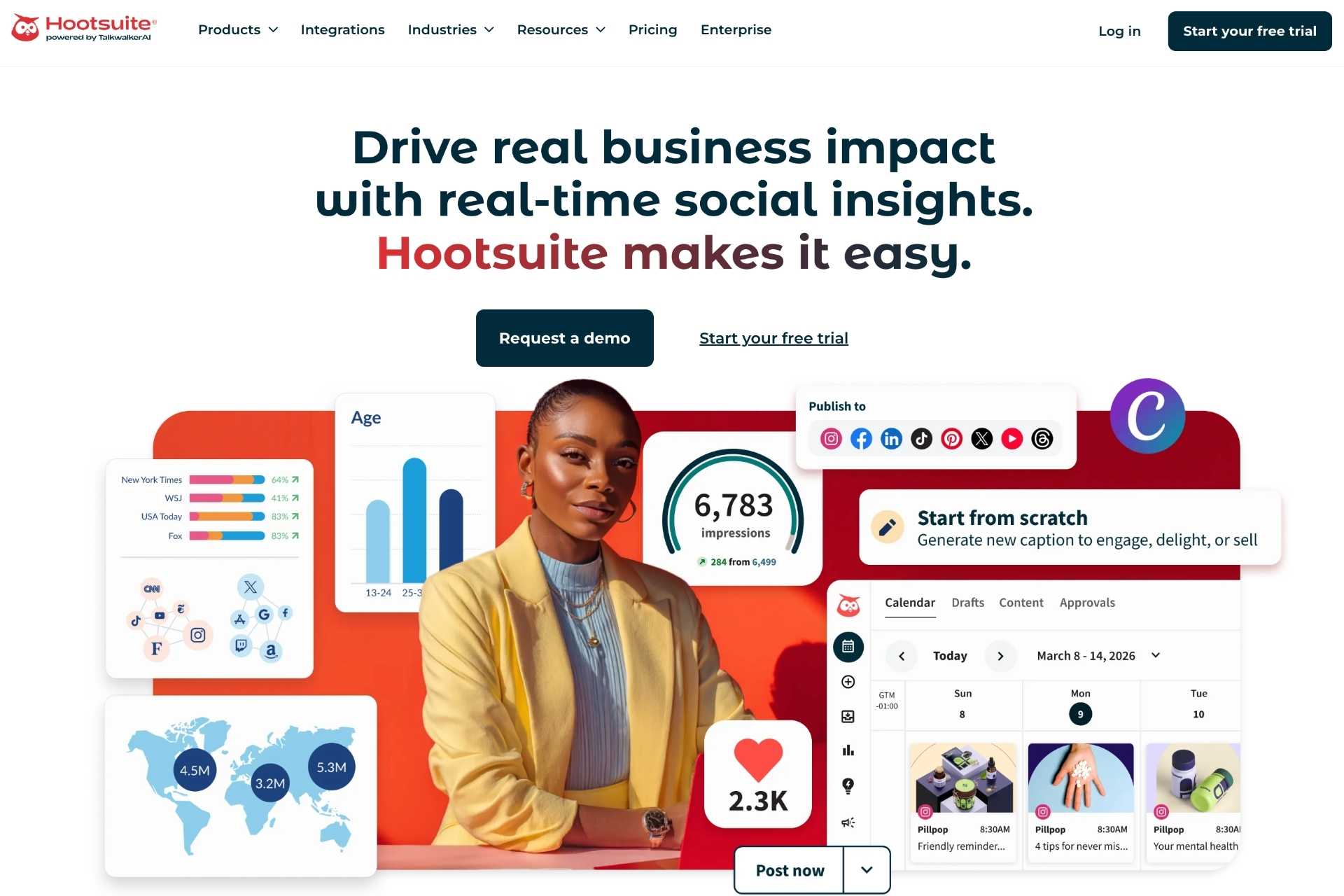
D2C brands live and die by their social presence, and managing content calendars, community engagement, and performance reporting across Instagram, TikTok, Facebook, LinkedIn, and Pinterest without a centralized platform creates operational drag that scales badly. Hootsuite, trusted by over 18 million users globally, gives marketing teams a single dashboard to schedule and publish content, monitor brand mentions, and analyze performance across all channels simultaneously — with team collaboration features built for brands with in-house social teams and multi-stakeholder approval workflows.
Pros:
- Real-time monitoring tools provide instant feedback on post performance, enabling quick adjustments — crucial for brands that need to maintain a dynamic, reactive social presence
- Integrations with over 35 social platforms, including Facebook, Instagram, TikTok, X, LinkedIn, and Pinterest, make it one of the broadest multi-platform tools available
- OwlyWriter AI generates post ideas, repurposes top-performing content, and accelerates content creation for social teams dealing with high publishing cadence demands
- Role-based access controls, content approval workflows, and team assignment features make it particularly strong for brands running social across multiple team members or agency partners
Cons:
- As a multi-platform management tool, Hootsuite is a one-size-fits-all solution that may not completely meet the specific needs of individual users or businesses, and it is more expensive than most competing social media management tools
- Customer support responsiveness has been flagged as a weakness — response times can be slow, which is challenging for brands dealing with urgent social situations
- Despite a strong overall score, Hootsuite rates lower on affordability, and its starting price of $99/month can be hard to justify for smaller D2C teams with leaner marketing budgets
- Stream monitoring is limited to Instagram and Twitter, restricting real-time community management capabilities on other platforms
7. Upselling: One Click Upsell (Zipify OCU)
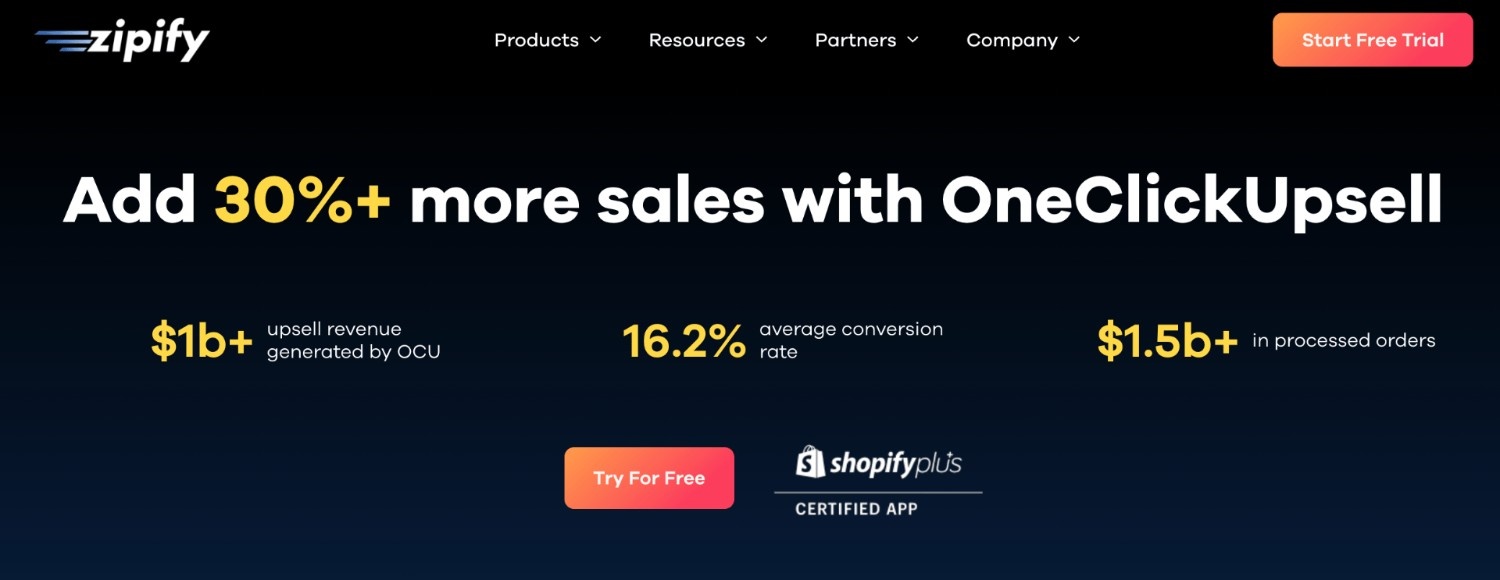
Increasing AOV is the most capital-efficient lever in D2C — it generates more revenue from customers you already paid to acquire, with zero additional ad spend. Zipify's One Click Upsell (OCU), built by 9-figure Shopify merchant Ezra Firestone, covers the entire customer journey: product page pre-purchase upsells, cart-level cross-sells, in-checkout upsells for Shopify Plus merchants, and post-purchase offer pages — with true one-click purchasing that requires no payment re-entry. OCU users add an average of $233K per year in additional revenue, and its revenue-share pricing model means you only pay when upsells actually convert.
Pros:
- OCU charges based on upsell revenue only — you're never charged for orders that don't include an upsell, unlike competitors that charge based on total order volume
- Built-in A/B split testing for every upsell placement allows data-driven funnel optimization without additional tools
- OCU is the first and only upsell app that integrates with Shopify's Shop app, extending upsell reach beyond your own storefront
- AI-powered product recommendations, flexible targeting options, and a drag-and-drop offer builder make it accessible to non-technical marketing teams
Cons:
- Some users experience bugs, particularly with funnel setups, and the interface can be unintuitive and difficult to navigate for new users
- In-checkout upsells — one of OCU's most powerful features — are exclusive to Shopify Plus merchants, making them unavailable to brands on standard Shopify plans
- A revenue-share component (in addition to the monthly fee) means costs scale as your upsell revenue grows, which can become significant for high-volume brands
- AI product recommendations occasionally surface items already in the customer's cart rather than complementary products, requiring manual oversight of recommendation logic
8. WhatsApp Marketing: Chat Armin
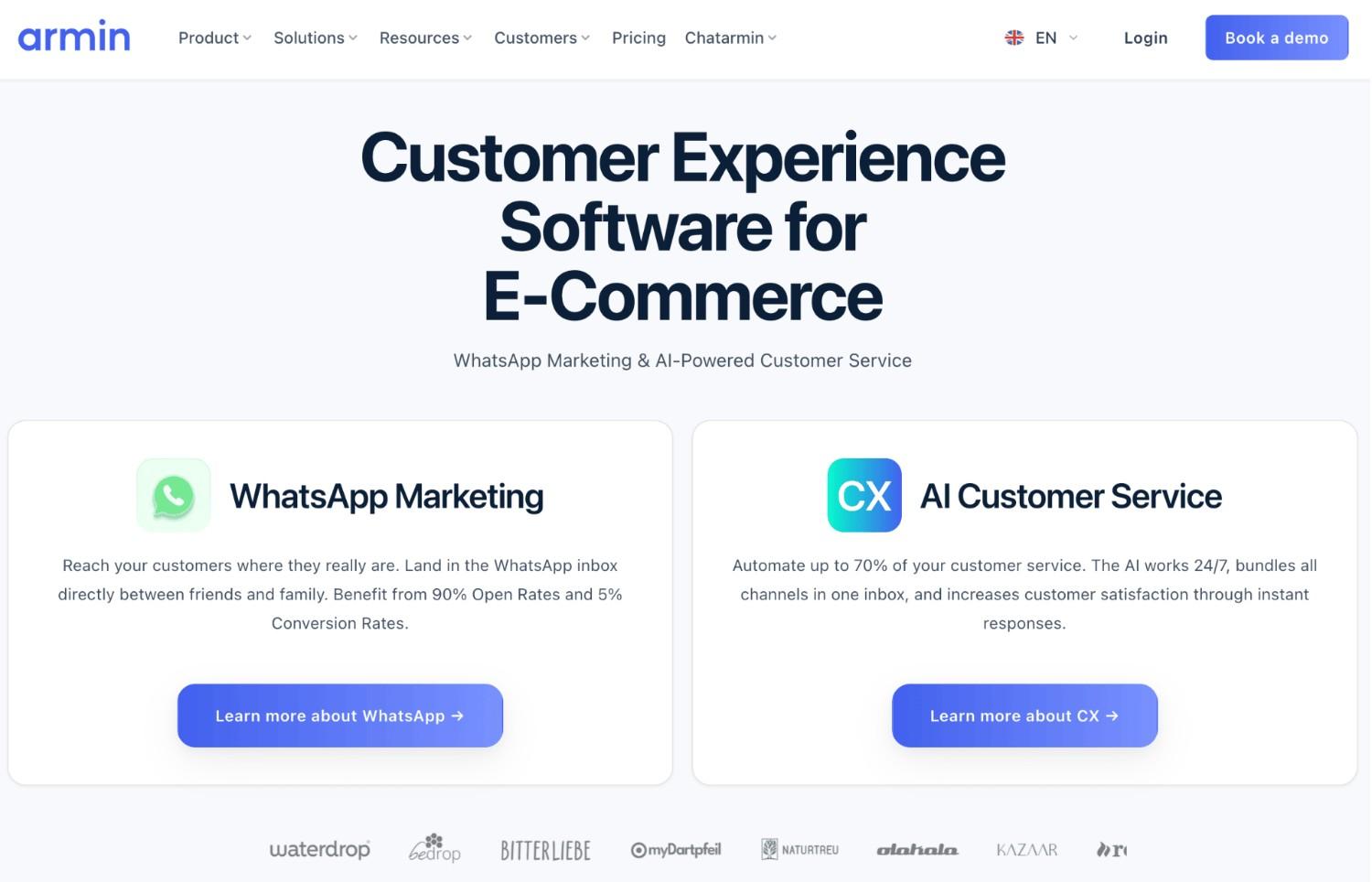
WhatsApp has emerged as one of the highest-engagement direct communication channels for D2C brands — particularly those with customer bases across Europe, the Middle East, Southeast Asia, and Latin America, where WhatsApp is the dominant messaging platform. With open rates that dramatically outperform email and SMS, WhatsApp enables D2C brands to deliver order confirmations, shipping updates, abandoned cart recovery, and personalized promotional messages in a channel where customers are already highly attentive.
Chat Armin provides the dedicated infrastructure to build, automate, and scale WhatsApp marketing programs with deep Shopify integration, contact segmentation, and lifecycle automation flows — bringing the same retention marketing logic used in Klaviyo to a conversational commerce channel that most D2C brands are still underleveraging.
Pros:
- Native Shopify integration enables automated transactional and marketing message flows triggered by customer behavior, purchase history, and cart activity
- WhatsApp's two-way conversational format enables genuine customer relationship-building that email and push notifications cannot replicate
- Broadcast campaigns with deep segmentation allow brands to send targeted promotional messages to specific customer cohorts without list fatigue
- Represents a meaningful retention channel diversification for brands that are over-indexed on email and looking to build redundancy in their customer communication stack
Cons:
- WhatsApp marketing requires customers to opt in via WhatsApp specifically — building a subscriber list takes time, particularly for brands whose existing customers are primarily email-captured
- Regulatory requirements around WhatsApp Business API usage and approved message templates can create friction and slow down campaign deployment
- Effectiveness is highly geography-dependent — brands with a predominantly US-based customer base may see lower WhatsApp adoption rates than those marketing to international audiences
- As a newer entrant to the D2C marketing stack, the platform's feature set and third-party review volume is still maturing compared to more established retention tools
9. Push Notifications: PushOwl
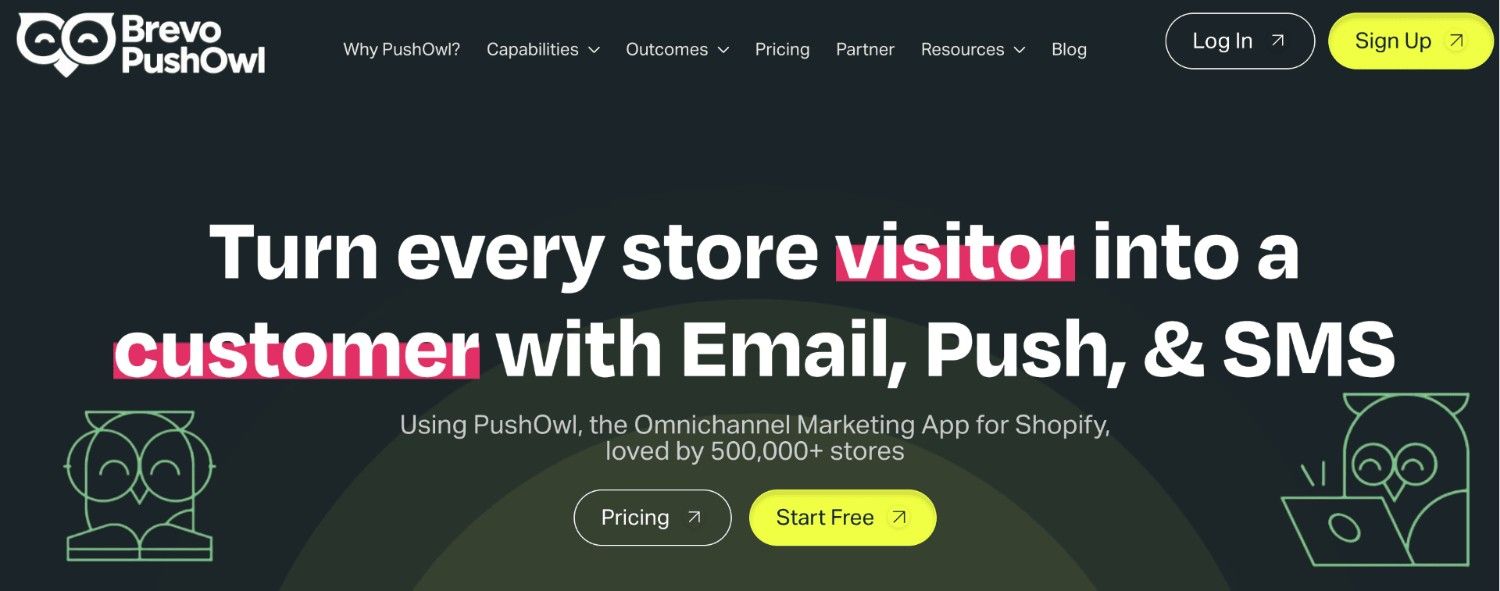
Push notifications are one of the only retention channels that let you re-engage customers without requiring an email address or phone number — subscribers opt in with a single browser click, making it a powerful tool for capturing and converting anonymous visitors who would otherwise leave your store without a trace. PushOwl provides a frictionless, high-return channel for urgent, personalized outreach, with browser-native notifications that deliver click-through rates as high as 28%. Now part of the Brevo ecosystem, PushOwl has evolved into a full retention suite combining web push, email marketing, and SMS from a single platform — making it a strong lower-cost alternative or complement to Klaviyo for brands looking to expand their owned channel mix.
Pros:
- The app has a 5.0 rating on the Shopify App Store with 1,800+ reviews, with merchants consistently praising ease of setup, responsive support, and strong conversion performance from automated flows
- Pre-built automations for abandoned cart recovery, back-in-stock alerts, price-drop notifications, and browse abandonment run on autopilot once configured — requiring minimal ongoing management
- Deep integration with Shopify Flow, advanced segmentation by behavior, location, and device, and GDPR-compliant opt-in architecture, make it a natural fit for brands scaling internationally
- Volume-based pricing starting at a free tier (500 impressions/month) makes it accessible for brands at every stage, with plans scaling affordably as subscriber bases grow
Cons:
- Push notification opt-in rates have declined as browsers have become more restrictive about permission prompts, requiring brands to be more intentional about when and how they surface the opt-in request
- The app is less effective without a substantial customer base or high store traffic — smaller stores may see limited returns until they build meaningful subscriber volume
- Some users report SMS deliverability issues during peak periods, including campaigns failing at critical moments like Black Friday without adequate warning
- Segmentation capabilities, while improving, are not as granular as Klaviyo's — brands with complex behavioral targeting needs may find PushOwl's segmentation insufficient as a standalone retention tool
10. E-commerce CMS: Shopify
Shopify is the default infrastructure choice for D2C brands for good reason — it removes the developer dependency that slows down growth teams, giving founders and operators the agility to launch fast, test quickly, and iterate without engineering bottlenecks. A 2024 Forrester study found that brands switching from Magento to Shopify reduced their total cost of ownership by an average of 35% over three years, driven by lower infrastructure costs and reduced developer dependency, and its 7,000+ app ecosystem means virtually every tool in your stack integrates natively. Whether you're a $500K brand just hitting your stride or a scaling operator on Shopify Plus processing high order volumes, the platform grows with you.
Pros:
- Shopify Plus merchants facilitated over $100 billion in GMV in 2024, making it the most battle-tested infrastructure for high-volume D2C brands
- Checkout extensibility, Shopify Flow, and native integrations with Klaviyo, Gorgias, and Triple Whale make it the hub around which the rest of your stack operates
- Speed and adaptability are critical for managing competitors and trends in D2C — Laird Superfood decreased product launch time by 50% after moving to Shopify, cutting campaigns from weeks to days
- Shopify Payments eliminates third-party transaction fees for merchants on qualifying plans, and Shop Pay drives higher checkout conversion rates
Cons:
- Accessing important functionality often requires paying for additional apps, and user account limits can quickly push merchants onto more expensive plans
- Content management tools lag behind platforms like WordPress, making it a weaker choice for brands running a heavy editorial or content-led strategy
- Shopify Payments isn't available in all countries, forcing international merchants onto third-party gateways and incurring additional transaction fees
- Customization beyond standard themes typically requires Liquid development knowledge or agency support, which adds cost
Conclusion
Building a winning D2C operation in 2026 comes down to one thing: assembling a stack where every tool compounds the performance of the next. Shopify as your foundation, Triple Whale for accurate attribution, Klaviyo for retention, Gorgias for support, and ShipMonk for fulfillment form the operational core — while Hootsuite, PushOwl, and Chat Armin build the owned-channel diversification that reduces your dependence on paid acquisition over time.
On the growth side, the two highest-leverage moves most D2C brands are still underleveraging are maximizing AOV through One Click Upsell and building a performance-driven influencer program with Influencer Hero — the best influencer marketing software for D2C brands, combining discovery, outreach, affiliate tracking, and UGC collection in one revenue-attributable platform. Get these ten tools working in sync, and you have infrastructure built not just for today's targets, but for the complexity that comes with serious scale.

.png)


.jpg)