

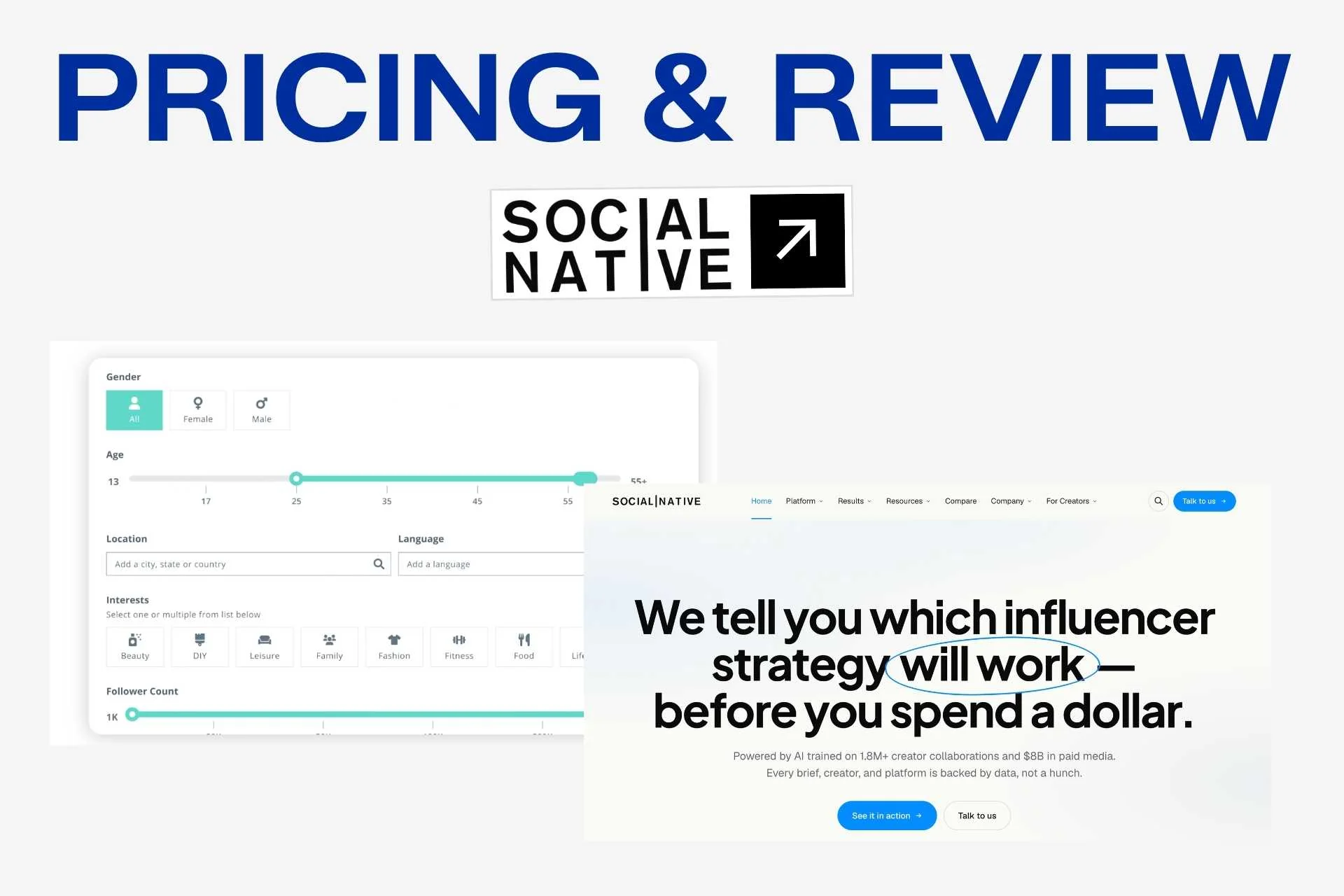
Social Native Pricing and Review: Features, Pros, Cons & Costs
Social Native is an enterprise creator marketing platform built around one promise: predict what will perform before you spend on it. It pairs a large creator network with AI trained on 1.8 million creator collaborations and billions in paid media data, then produces content at scale and pushes it into paid channels. For a D2C brand, it is less a self-serve tool than a full-service content engine.
That positioning shapes everything, including the price. Social Native does not publish pricing, works on custom enterprise contracts with a roughly six-month minimum, and expects a baseline of 15 to 20 creators a month. This is not a platform you try for a month; it is one you commit to.
This review covers what Social Native actually does, how its quote-based pricing works in practice, where the full-service model earns its keep, and the trade-offs that come with an enterprise commitment.
Social Native Overview
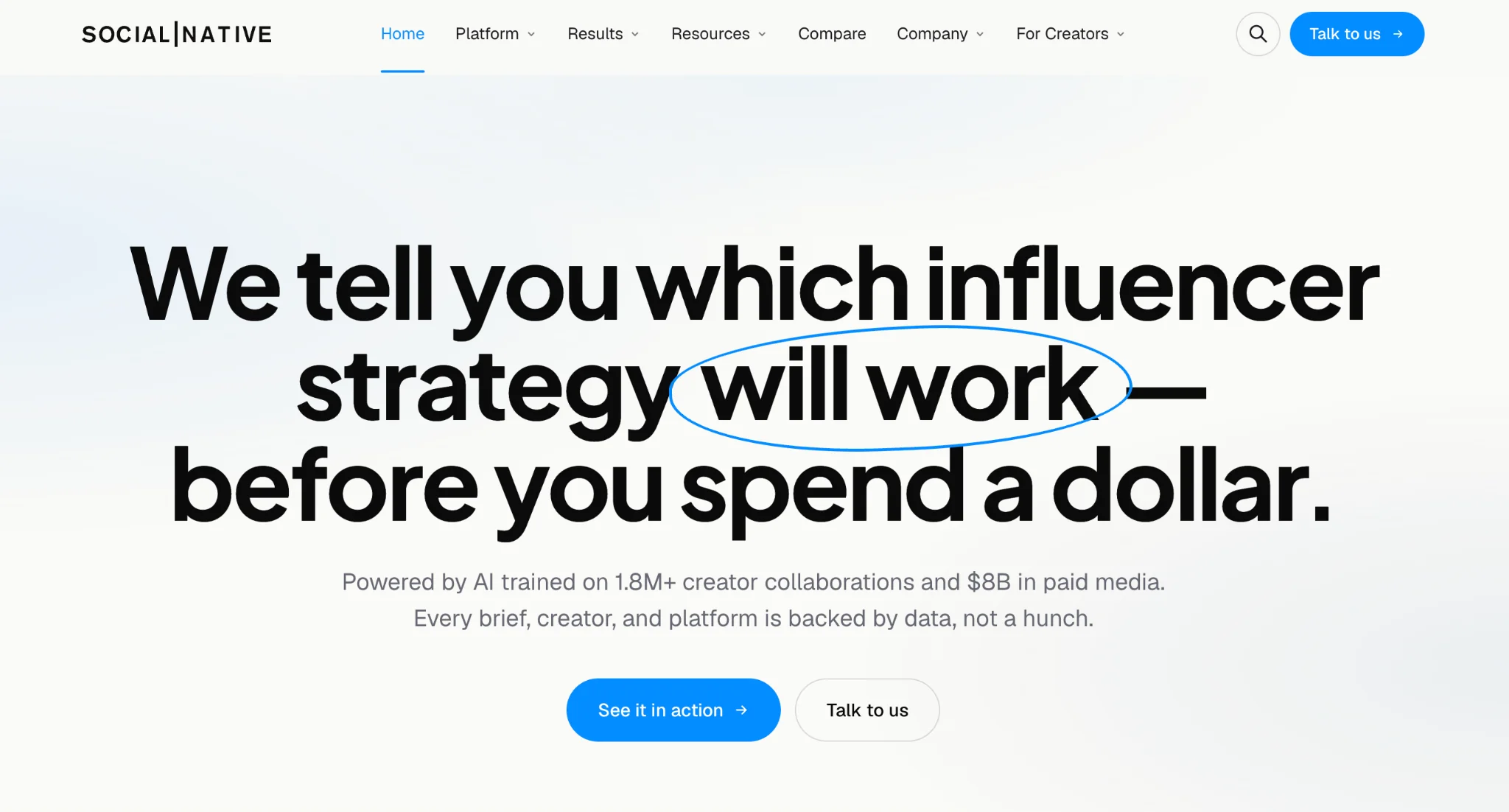
Social Native is a managed UGC and creator marketing platform that combines content production, creator sourcing and paid media distribution. It works in three stages: predict which creators and ideas will perform, create content at scale through its network, and scale that content across Meta, TikTok, YouTube and ecommerce channels.
The core of the product is volume content production with rights management built in. Brands brief a campaign, Social Native sources creators and produces UGC, handles licensing and payments, and delivers assets ready for paid and organic use. It is designed to replace an in-house content operation rather than assist one.
Who Should Use Social Native
Social Native fits enterprise brands with high content needs and the budget to outsource production. It suits:
- Mid-market and enterprise D2C brands in visual categories like beauty, fashion, furniture and consumer goods.
- Teams that need high-volume UGC for paid social and cannot produce it in-house.
- Performance marketers who want content predicted and optimized against paid media data.
- Brands that want rights management, licensing and creator payments handled for them.
- Companies distributing content across many channels, from paid ads to ecommerce to in-store.
- Organizations comfortable with a six-month-plus commitment and enterprise budgets.
Key Features
Social Native’s feature set is built for high-volume, full-service content production, with prediction and distribution wrapped around it.
Predictive AI
The platform’s models are trained on 1.8 million creator collaborations and roughly $8 billion in paid media data, aiming to forecast which creators, ideas and formats will perform before budget is committed. On a program spending heavily on paid social, that prediction is the headline pitch.
Creator Sourcing and Discovery
Social Native sources across UGC creators, influencers and professional content producers, matching them to campaigns rather than leaving a brand to search a database alone.
Content Production at Scale
The platform produces high volumes of content through its creator network, which is the operational heart of the product for brands that need a steady stream of assets.
Automated Rights Management and Licensing
Usage rights, licensing and creator payments are handled inside the workflow, so content arrives cleared for paid and organic use without a separate legal scramble.
Paid Media Activation
Direct integrations with Meta, TikTok and YouTube push produced content into paid campaigns, tying content production to media performance.
Image-to-Video and AI Content Tools
AI curation and image-to-video transformation help repurpose and expand a content library, stretching each asset across more placements.
Performance Insights and Optimization
Real-time reporting tracks how content performs and feeds optimization. For a deeper measurement benchmark, compare it against dedicated campaign reporting and analytics.
Full-Service Managed Support
A managed team runs the operation, from sourcing to distribution, which is what separates Social Native from self-serve platforms and what most of the cost pays for.
Social Native Pricing
Social Native does not publish pricing. It runs on custom enterprise contracts, so the points below describe how deals are typically structured rather than a public rate card.
Custom Enterprise Pricing
- Fully quote-based, with no public tiers, no free plan and no free trial.
- Pricing scales with content volume, creator count and services, so budgets sit at the enterprise level.
- You book a call before you see a number.
Minimums and Commitment
- Contracts typically run a minimum of around six months.
- A baseline of roughly 15 to 20 creators per month is common, so the model assumes steady, high-volume production.
- This suits ongoing programs, not one-off campaigns or short tests.
The Real Cost: Managed Service, Not Software
- You are paying for a managed content operation, not a self-serve tool, so the cost reflects production and services on top of platform access.
- For brands that would otherwise staff an in-house content team, that can be efficient; for those that just want software, it is a heavy commitment.
- Model the total against what in-house or freelance production would cost at the same volume before signing.
Social Native Reviews
Social Native has very little third-party review volume, so read its rating with that caveat.
- 5.0/5.0 (G2, 3 reviews, too small to weight)
A perfect score off three reviews is flattering rather than conclusive. Brands that do weigh in praise the full-service model and the content quality, but there is not enough independent volume to treat the score as a real signal. Judge Social Native on a pilot and references, not the star rating.
Integrations
Social Native’s integrations center on the paid media and commerce channels it distributes content into.
- Meta: a partnership for content distribution and paid activation across Facebook and Instagram.
- TikTok: direct integration for creator content and paid media.
- YouTube: distribution and performance tracking for video content.
- Shopify: connect content to ecommerce for product-linked campaigns.
- Rights and payments: licensing and creator payments handled inside the platform.
The surface is built around distribution rather than a broad app ecosystem, so brands that want self-serve outreach and workflow automation should compare it against tools with deeper outreach automation.
Pros of Social Native
Genuinely Full-Service
Social Native runs the content operation end to end, from sourcing to rights to distribution. For a brand without an in-house content team, that operational lift is the whole value, and it is the thing reviewers consistently point to.
Predictive Data at Real Scale
The AI is trained on 1.8 million collaborations and billions in paid media spend, a data advantage smaller platforms cannot match, and it is aimed squarely at improving paid performance rather than vanity reach.
Rights and Distribution Built In
Licensing, payments and multi-channel activation live in one workflow, so content is ready to run in paid media without the usual rights scramble that stalls UGC programs.
Cons of Social Native
No Pricing Transparency and No Trial
You cannot see a price or test the platform without a sales call, and there is no free plan. For a brand that wants to evaluate quickly, that opacity is a real barrier before anything else.
Minimum Commitments Lock You In
A roughly six-month minimum and a 15-to-20-creator monthly baseline make this a standing commitment, not a flexible tool. Smaller or seasonal programs will pay for volume they do not use.
Enterprise-Focused and Rigid
The platform is built for high-volume enterprise use, so niche or lean campaigns can feel forced into a model that does not bend to them.
Complex for Smaller Teams
Implementation and the full-service workflow carry overhead that only makes sense at scale. A small team will find it heavier than the output justifies.


Is Social Native Worth It?
Social Native is worth it for an enterprise brand in a visual category that needs relentless, high-volume UGC and would rather outsource the entire operation than build it. For that brand, the predictive data, rights management and multi-channel distribution genuinely replace an in-house team. It is a weaker fit for brands that want transparent pricing, flexibility, or a self-serve tool they can run themselves, and the six-month minimum rules out anyone testing the water. If any of that gives you pause, compare these five alternatives:
- Influencer Hero is an all-in-one platform with publicly listed pricing (Standard $649/month, Pro $1,049/month, Business $2,490/month), no minimums and no revenue share. It covers discovery across eight platforms with fake-follower detection, lookalike search and brand-follower identification, plus automated outreach, a full influencer CRM, gifting, UGC collection and affiliate management across Shopify, WooCommerce and custom builds.
- Afluencer starts at $49/month and runs as a marketplace where creators apply to your campaign listings, the right call when creator supply, not managed production, is the bottleneck.
- Insense is a UGC and micro-influencer platform where brands brief creators for content and paid-ready assets, a lighter and more flexible take on the same job.
- Billo is an app-based UGC video service where brands order creator videos on demand, useful for content volume without an enterprise contract.
- #paid is a creator marketing platform that matches brands with vetted creators through a handraise model, strong for branded content at scale.
Final Thoughts
Social Native is a serious, full-service content engine for brands that have outgrown ad-hoc UGC and want the whole operation handled. Its predictive data and rights-to-distribution workflow are real strengths, and for the right enterprise the managed model pays for itself. The reservations are about fit and flexibility rather than quality: the pricing is opaque, the commitment is long, and the model only makes sense at volume. Weigh whether you need a managed operation or a self-serve tool, and if it is the latter, the Social Native alternatives above deliver similar content outcomes with far more flexibility.
.png)


.jpg)