


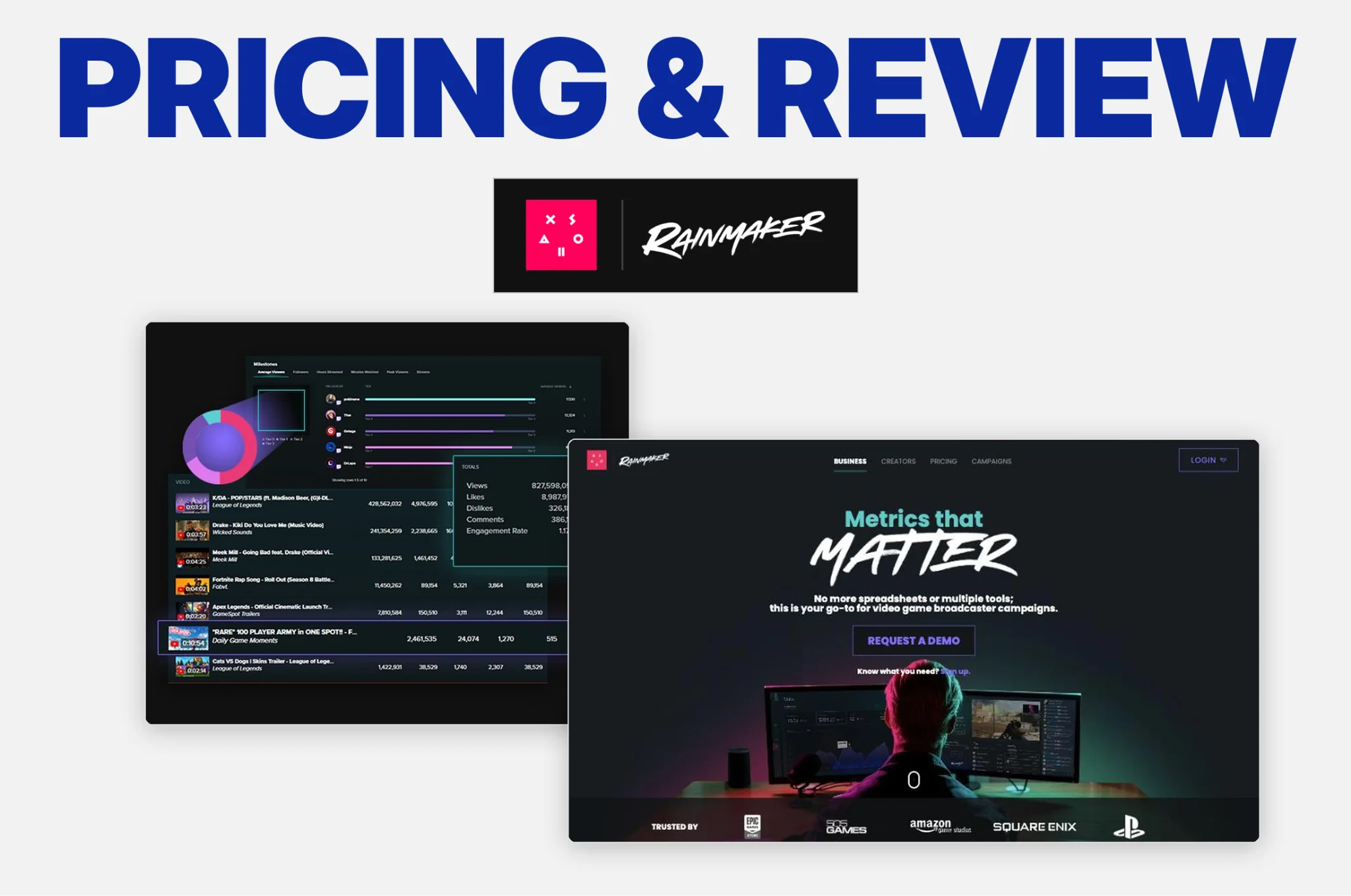
Rainmaker Pricing and Review: Features, Pros, Cons & Costs
The customer list includes PlayStation, Capcom, Epic Games and Square Enix. The entry plan costs $99 a month.
That combination is rare in this category, where enterprise clients usually mean enterprise contracts. Rainmaker publishes its prices, and the lowest paid tier is within reach of a single marketing manager’s budget.
This review covers the four business plans, what each seat and report limit means in practice, the streaming data that makes the platform distinctive, and who should not be considering it at all.
Rainmaker Overview
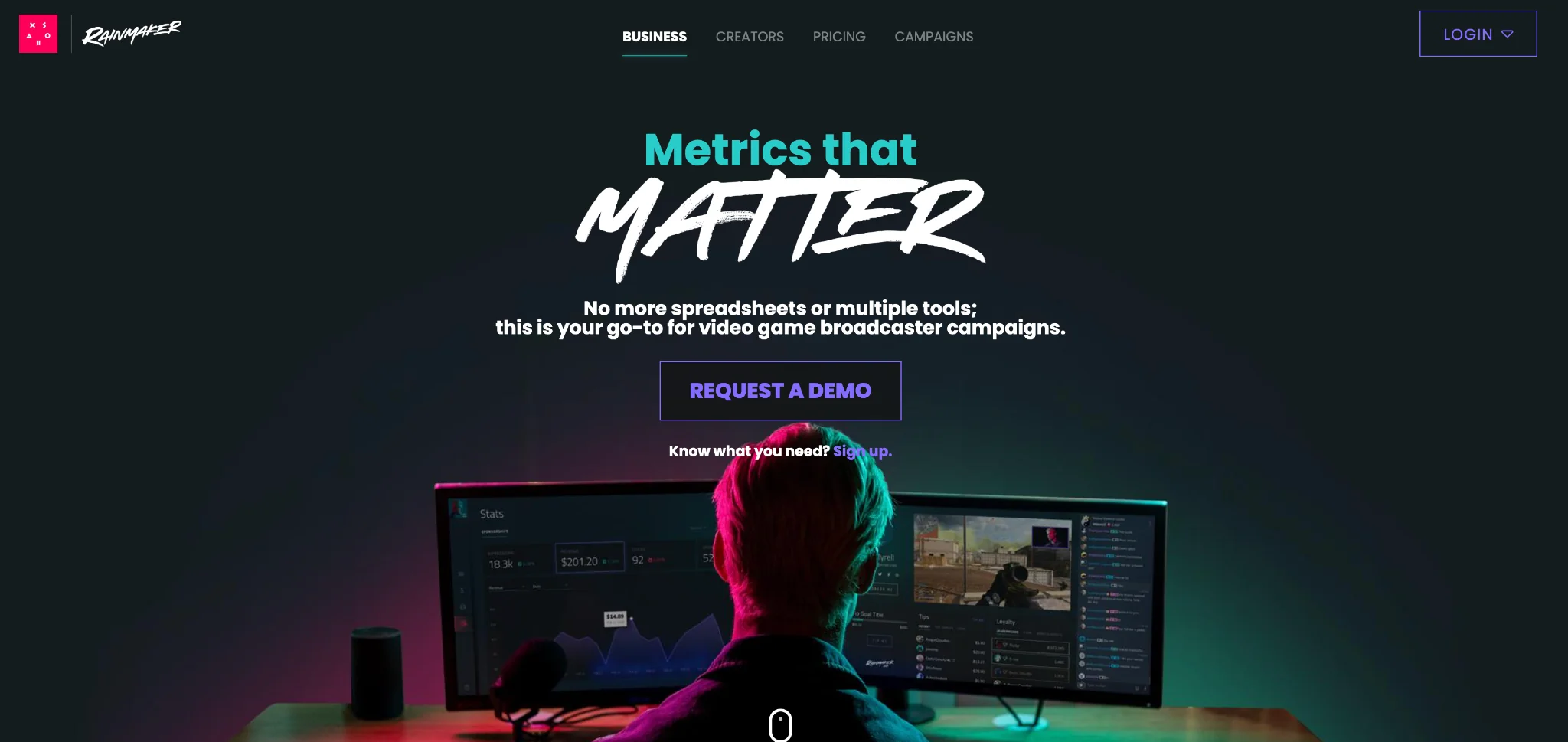
Rainmaker is an influencer marketing platform built specifically for gaming. It consolidates live streaming data, creator discovery, key distribution and campaign reporting into one system, and it works across Twitch, YouTube and Facebook Gaming.
Four functions define the product. Tracking aggregates industry-wide streaming data going back several years. Discovery searches streamer and game statistics with filters. Distribution sends game keys and products to verified creators, with approvals automated against performance criteria. Reporting aggregates campaign metrics without manual collection.
The specialisation is what separates it from general search and discovery tools. Those index far more creators across more networks, but almost none hold historical streaming data by game, which is the information that decides whether a streamer is right for a particular title.
Who Should Use Rainmaker
The fit is defined by the category you sell in rather than by the size of your team:
- Game publishers and studios: The platform is built around game launches, and the client list reflects that.
- Brands targeting gaming audiences: Peripherals, energy drinks, snacks and apparel all reach buyers through streamers.
- Teams distributing keys or product: Automated approvals remove the manual work of vetting key requests.
- Marketers reporting on live content: Streaming metrics are difficult to collect by hand and this does it automatically.
- Agencies running gaming campaigns: Multiple seats and unlimited campaigns are available on the higher tiers.
- Brands with no gaming audience: This is the group it does not suit, since Instagram and TikTok are absent.
Key Features
Live Streaming Data
The platform aggregates streaming data across Twitch, YouTube and Facebook Gaming, with several years of history behind it. Historical depth is what allows a publisher to see how a streamer performed with comparable titles rather than guessing from current viewer counts.
Creator and Game Discovery
Streamer and game statistics can be searched with filters and compared side by side. Searching by game rather than only by creator is the distinguishing capability, because relevance in gaming depends on what somebody actually plays.
Key and Product Distribution
Game keys and physical products are sent to verified creators, with applications approved automatically against performance thresholds. For a launch involving hundreds of key requests, this replaces a process most teams still run through spreadsheets and email, in much the same way that product gifting tools handle send-outs in other categories.
Creator Verification
Creators are verified before they receive keys or products, which addresses the long-standing problem of key requests from accounts that never stream the game. One customer specifically credits the platform with the time saved on this task.
Campaign Management
Campaigns are created and managed in the platform, with three active campaigns on the entry plan and unlimited campaigns above it. Campaign count is the constraint that pushes most teams past the first tier.
Automated Reporting
Metrics are aggregated across platforms into campaign reports, removing the manual collection that gaming campaigns usually require. Report volume is capped on the middle tier, which is worth checking against how often your team reports internally.
Data Export
Every business plan includes data export, so figures can be moved into your own reporting. Given that most publishers maintain their own dashboards, treating export as standard rather than as a premium feature is sensible.
Branded Creator Portals
On the top tier, brands run a fully branded site on their own domain where creators access news, request keys and view reports, with access restricted to an approved list. This suits a publisher operating a permanent creator programme rather than a series of launches.
Rainmaker Pricing
Four business tiers are published alongside a free plan for creators. Annual billing reduces the cost by 16%.
Creator Plan
Free, and aimed at streamers rather than brands. It includes:
- Applications to brand campaigns
- Channel statistics
- A chat bot, overlays and alerts
- Tipping and a creator site
Campaigns Plan
$99 per month. The plan includes:
- One user seat
- Three active campaigns
- Historical streaming data
- Data reports and data export
Indie Plan
$299 per month. The plan adds:
- Two user seats
- Unlimited campaigns
- Five data reports
Team Plan
$999 per month. The plan adds:
- Five user seats
- Unlimited data reports
Brand Portal
Custom pricing, arranged with sales. The tier adds:
- Everything in the Team plan
- A fully branded website on your own domain
- Creator access restricted to an approved list
What the Tiers Actually Buy
Two limits move as you climb, and they move for different reasons. Campaign count is what separates the first tier from the second, so a team running more than three concurrent activations pays $299 rather than $99. Report volume is what separates the second from the third, since five reports a month suits a studio with occasional launches and not an agency reporting weekly.
Seats deserve attention, because the cost per seat rises rather than falls. The entry plan is $99 for one seat, the Indie plan is roughly $150 per seat and the Team plan is about $200. Most software rewards adding people; this does the opposite, so buy the tier for the limit you need rather than for the headcount.
How It Compares on Cost
At $99 a month, the entry tier is inexpensive for specialist data, and annual billing brings it to roughly $83. At $999, the Team plan is priced alongside mid-market creator platforms that cover several networks and add outreach and payments. Brands running a modest programme should weigh it against platforms aimed at small businesses, particularly if gaming is one channel among several rather than the whole strategy.
Rainmaker Reviews
No verifiable rating. Rainmaker does not hold a listing with meaningful review volume on the major software review sites, so there is no score that can be quoted and no independent account of data accuracy or support.
One point will save time for anyone researching it. Review sites carry an unrelated product called Rainmaker Platform, which is website and publishing software for authors. Ratings found under that name do not describe this platform.
What can be verified is the customer list. Epic Games, Capcom, Amazon Game Studios, PlayStation, Square Enix and Humble Games are named, and one published customer comment specifically credits the platform with the time saved verifying and distributing key requests. For a specialist tool, a client list of that quality carries more weight than a handful of anonymous reviews.
Integrations
The connection surface is built around streaming platforms rather than commerce:
- Twitch: Live and historical streaming data, the primary source for the platform.
- YouTube: Streaming and video metrics gathered alongside Twitch.
- Facebook Gaming: Included in the same tracking and discovery.
- Key distribution: Game keys and products issued to verified creators with automated approvals.
- Data export: Campaign and creator figures exported for use in your own reporting.
No eCommerce, CRM, email or affiliate integrations are published, so nothing connects campaign activity to store revenue.
Pros of Rainmaker
Streaming Data Nothing Else Holds
Several years of industry-wide streaming history across three platforms, searchable by game as well as by creator, is genuinely difficult to replicate. For anyone selling into gaming, this answers questions that general creator databases cannot address at all.
Key Distribution Solved Properly
Verification and automated approval against performance criteria removes one of the most tedious tasks in games marketing. It is a narrow feature, and for a publisher handling hundreds of requests per launch it alone can justify the subscription.
Published Prices at a Serious Level
A platform used by PlayStation and Capcom that still publishes a $99 entry tier is unusual. Smaller studios and gaming-adjacent brands can buy the same data as major publishers without entering a procurement process.
Cons of Rainmaker
Seats Get More Expensive as You Grow
This is the principal cost consideration. The cost per seat rises from $99 on the entry plan to roughly $200 on the Team plan, and the additional limits, not the extra people, are what you are paying for. Decide whether campaigns or reports are your constraint, and size the plan on that rather than on team headcount.
Three Platforms, All of Them Streaming
Twitch, YouTube and Facebook Gaming are covered, and Instagram and TikTok are not. Gaming audiences are reached through short-form video as well as live streams, so most brands will need a second platform for the channels this one does not touch.
No Commercial Layer
There are no affiliate links, no discount codes, no commission tracking and no creator payments. Campaign reporting covers viewership and delivery rather than sales, so a brand measuring creator activity on revenue will have to build that measurement separately.
Nothing Independent to Check
There is no meaningful review base anywhere, and a similarly named unrelated product makes searching harder. The client list is reassuring, but it says little about what support looks like for a customer paying $99 a month rather than an enterprise fee.


Is Rainmaker Worth It?
For gaming, the case is strong. Historical streaming data by game, verified key distribution and automated campaign reporting solve problems that general platforms do not attempt, the prices are published, and the customer list demonstrates that the data holds up under serious use.
The reservations concern breadth and evidence. Coverage stops at three streaming platforms, nothing connects campaigns to revenue, seat economics work against growing teams, and there is no independent feedback to weigh. For a brand whose gaming activity is one part of a wider creator programme, this is a second subscription rather than a replacement for the first.
Brands comparing specialist gaming tools against broader platforms generally consider the following:
- Influencer Hero: Covers Instagram, TikTok and YouTube with fake follower screening, influencer outreach automation, a campaign CRM, gifting, affiliate codes and creator payouts in one system.
- Afluencer: Sources creators through applications to your listings, which suits brands recruiting without a search process, as its guide to booking influencers describes.
- Modash: Indexes every creator above 1,000 followers across three networks, with audience credibility checks and content tracking.
- Klear: Provides deep audience profiling and topic-level creator scoring within a wider media intelligence suite.
- NeoReach: Offers managed campaign services and enterprise campaign reporting for brands that prefer the work handled for them.
Final Thoughts
This one fits a clear buyer and excludes everyone else. A studio launching titles, or a brand whose customers watch streams for several hours a week, will find data here that is available nowhere else, and $99 a month is a small price for it. A D2C brand whose audience lives on TikTok and Instagram will find three streaming platforms and no commerce tracking, which is the wrong shape entirely. Establish whether streamers are genuinely where your buyers are, and if the answer is uncertain, the Rainmaker alternatives covering mainstream social networks will serve you better.

.png)


.jpg)










