

Peg Pricing and Review: Features, Pros, Cons & Costs
Peg, at peg.co, is an influencer marketing platform that started life as a matchmaking search engine for YouTube stars and has grown into a quality-first discovery and campaign tool for YouTube and Instagram. Its calling card is brand safety: a curated creator database and vetting features that help careful brands avoid the campaign that goes wrong. It is used by around 1,700 companies and was recently acquired by Current.
On pricing, Peg is enterprise and closed. There is no public rate card; cost is custom and sold on 6 or 12-month agreements, with a one-project test option available at custom rates. That structure suits mid-to-large brands, but the minimum commitment is a real barrier for smaller teams.
This review covers what Peg actually does, how its custom, contract-based pricing works and where the real cost sits, where its safety and quality focus is a genuine strength, and the honest limitations a brand should weigh.
Peg Overview
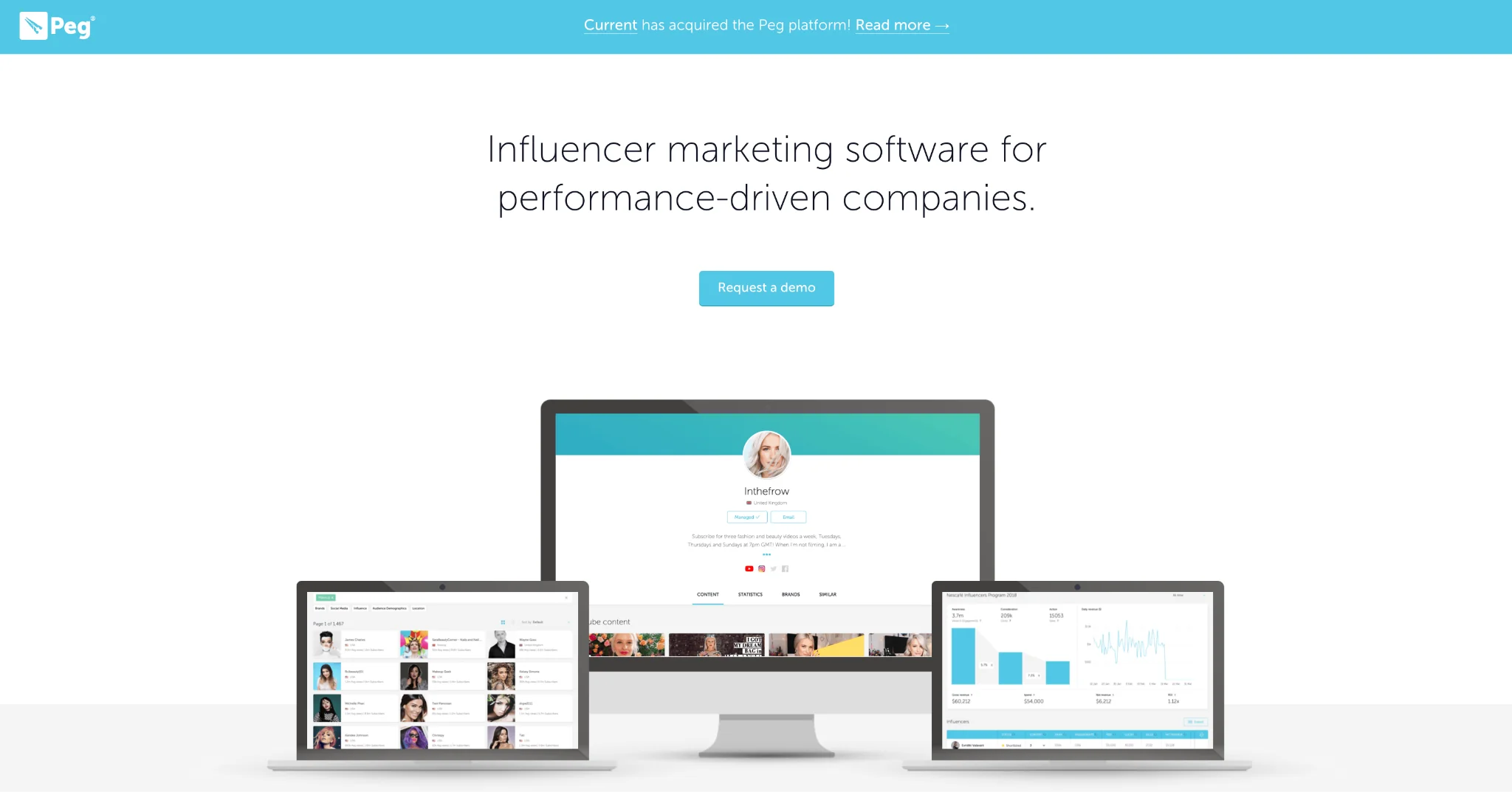
Peg is built around quality over quantity. Its database of roughly 33,000 curated creators, sourced through exclusive talent-agency partnerships and proprietary algorithms, is smaller than the biggest marketplaces on purpose, with vetting baked in. Brands search, shortlist, message and measure from one place.
The standout is brand safety. A Safety Score rates creators on family-friendliness from content analysis, a Backlash Meter tracks public sentiment over time, and conflict tracking shows a creator’s previous brand collaborations. For a brand worried about reputation, that vetting layer is the whole point.
Who Should Use Peg
Peg fits brands that prioritize safety and quality. It suits:
- Mid-to-large brands, that value curated quality over the largest possible database.
- Brands worried about reputation, who want Safety Score and sentiment vetting before they partner.
- YouTube and Instagram programs, the platform’s two channels, with real YouTube depth.
- Teams that collaborate, using shared notes, shortlists and pitch decks across a group.
- Agencies, running vetted campaigns for reputation-sensitive clients.
- Brands comfortable with a commitment, given the 6 or 12-month agreements.
Key Features
Peg’s feature set is built around curated discovery, brand-safety vetting and team collaboration.
YouTube and Instagram Discovery
A curated database of around 33,000 creators, with real YouTube depth, lets brands search and shortlist quality creators rather than wade through an open marketplace.
Safety Score
An algorithmic Safety Score rates creators on family-friendliness from content analysis, the platform’s signature brand-safety feature and its main reason to exist.
Backlash Meter
The Backlash Meter tracks a creator’s public sentiment over time, with drill-down, so brands can spot reputational risk before they commit.
Conflict Tracking
Conflict tracking surfaces a creator’s previous brand collaborations, helping brands avoid clashes and check for competitor overlap.
Advanced Filtering
Filters for keywords, audience demographics, brand affinity and engagement help brands narrow to creators that fit the brief and the audience.
Collaboration Tools
Unified messaging with email integration, shared notes, shortlists and pitch-deck creation make Peg genuinely team-friendly, which reviewers call out as a strength.
Campaign Management and Reporting
Campaign management and performance reporting track results through a program.
Retargeting Tools
Retargeting features help brands extend the reach of creator content, pushing campaigns beyond a single organic post.
Peg Pricing
Peg does not publish pricing. It is an enterprise platform sold on fixed-term agreements, so the points below describe how engagements typically work.
Custom, Not Public
- There is no public rate card; pricing is custom, based on business size and usage.
- Signing up is free, but the platform features require a paid agreement.
- Every evaluation runs through a demo and a quote.
6 or 12-Month Agreements
- Access is sold on 6 or 12-month subscription agreements with full platform access.
- The minimum commitment makes it an enterprise tool rather than a month-to-month test.
- A one-project test option is available at custom rates for brands not ready to commit.
The Real Cost: Commitment and Quote
- Because pricing is opaque and term-based, budget for at least a six-month commitment and press for a full breakdown.
- Weigh the safety and quality features against the lock-in, since that is what you are paying a premium for.
- Compare the quote against flat-priced, self-serve platforms before signing.
Peg Reviews
Peg’s reviews are strong on quality and collaboration, but thin on independent volume.
- 4.7/5.0 (Influencer Marketing Hub editorial review), scoring highest on ease of use, with strong marks for quality curation and collaboration.
- Limited verified user-review volume elsewhere, so there is no large independent sample, and reviewers note occasional glitches and support access issues.
The praise centers on curation, the safety features and team collaboration, while the criticisms are the small database, opaque pricing and support. Treat the editorial score as encouraging rather than a large-sample verdict, and ask for references from brands your size.
Integrations
Peg’s connections center on discovery, collaboration and reporting rather than a broad directory.
- YouTube and Instagram: the two platforms Peg indexes and measures.
- Email integration: unified messaging that ties into email for outreach.
- Collaboration tools: shared notes, shortlists and pitch decks for teams.
- Reporting: campaign performance data inside the platform.
Peg is a curated discovery-and-campaign tool rather than an integration-heavy stack, so its third-party directory is modest. Brands that need lightweight, self-serve creator outreach at scale should compare it against tools with stronger outreach automation.
Pros of Peg
Best-in-Class Brand Safety
The Safety Score, Backlash Meter and conflict tracking give brands a vetting layer few platforms match, which is genuinely valuable for reputation-sensitive campaigns.
Curated Quality and Collaboration
A hand-curated creator database plus strong team tools, shared notes, shortlists and pitch decks, make Peg a quality-first, team-friendly choice.
Real YouTube Depth
Rooted in YouTube from the start, Peg offers genuine depth on the platform many influencer tools treat as an afterthought, useful for long-form video programs.
Cons of Peg
Opaque Pricing and 6-Month Minimum
The biggest hesitation. There is no public rate card, cost is custom, and access is sold on 6 or 12-month agreements, so budgeting is hard and the minimum commitment shuts out smaller brands and short tests.
Small Creator Database
At around 33,000 creators, Peg’s database is deliberately curated but far smaller than the biggest marketplaces, so brands needing sheer breadth or niche coverage may find it limiting.
YouTube and Instagram Only
Peg covers YouTube and Instagram, so brands wanting TikTok, Pinterest or broader multi-platform programs will need another tool alongside it.
Glitches, Support and Thin Reviews
Reviewers report occasional technical glitches and difficult support access, and independent review volume is thin, so brands cannot easily vet Peg through a large sample.


Is Peg Worth It?
Peg is worth it for a mid-to-large brand that runs reputation-sensitive campaigns on YouTube and Instagram and values curated quality and brand-safety vetting over the biggest possible database. For that brand, the Safety Score, Backlash Meter and collaboration tools are a genuine fit. The reservations are the opaque pricing and 6-month minimum, the small database, the two-platform coverage and the support and review gaps, so smaller brands or those wanting breadth and flat pricing should look elsewhere. If those give you pause, compare these five alternatives:
- Influencer Hero is a unified influencer marketing platform that simplifies creator discovery, outreach, campaign management, affiliate marketing, and UGC collection. Built for modern eCommerce brands, it automates repetitive workflows while providing detailed analytics and ROI tracking.
- Afluencer is a marketplace where creators apply to your campaign listings, useful when creator supply, not curated vetting, is the bottleneck.
- HypeAuditor is a discovery and analytics platform strong on audience-quality data and fraud detection.
- Klear is an influencer marketing and analytics platform focused on discovery and audience insights.
- Modash is an influencer discovery platform with a large global creator database and audience-quality checks across the major networks.
Final Thoughts
Peg is a quality-first, safety-focused platform, and for mid-to-large brands that care about reputation on YouTube and Instagram, its Safety Score, sentiment tracking and collaboration tools are a genuine draw. The hesitation is cost and breadth, since pricing is opaque and term-based, the database is small by design, coverage is limited to two platforms, and support and reviews draw caveats.
Decide based on whether brand safety and curated quality are the job you are hiring for. If you need breadth, flat pricing or no lock-in, the Peg alternatives above deliver comparable capability with more flexibility.

.png)


.jpg)