


Miappi Pricing and Review: Features, Pros, Cons & Costs
Miappi publishes two sets of plans and they do not agree with each other. One promises unlimited brand feeds. The other caps you at five.
Neither carries a price. Both end at a demo request, so the only thing you can learn about cost before a call is which limits the company thinks are worth charging for. That turns out to be more revealing than it sounds.
This review covers what those limits are, the refresh interval that quietly separates the tiers, what the platform is genuinely good at, and why a client list including Dove and Heineken tells you something the pricing pages do not.
Miappi Overview
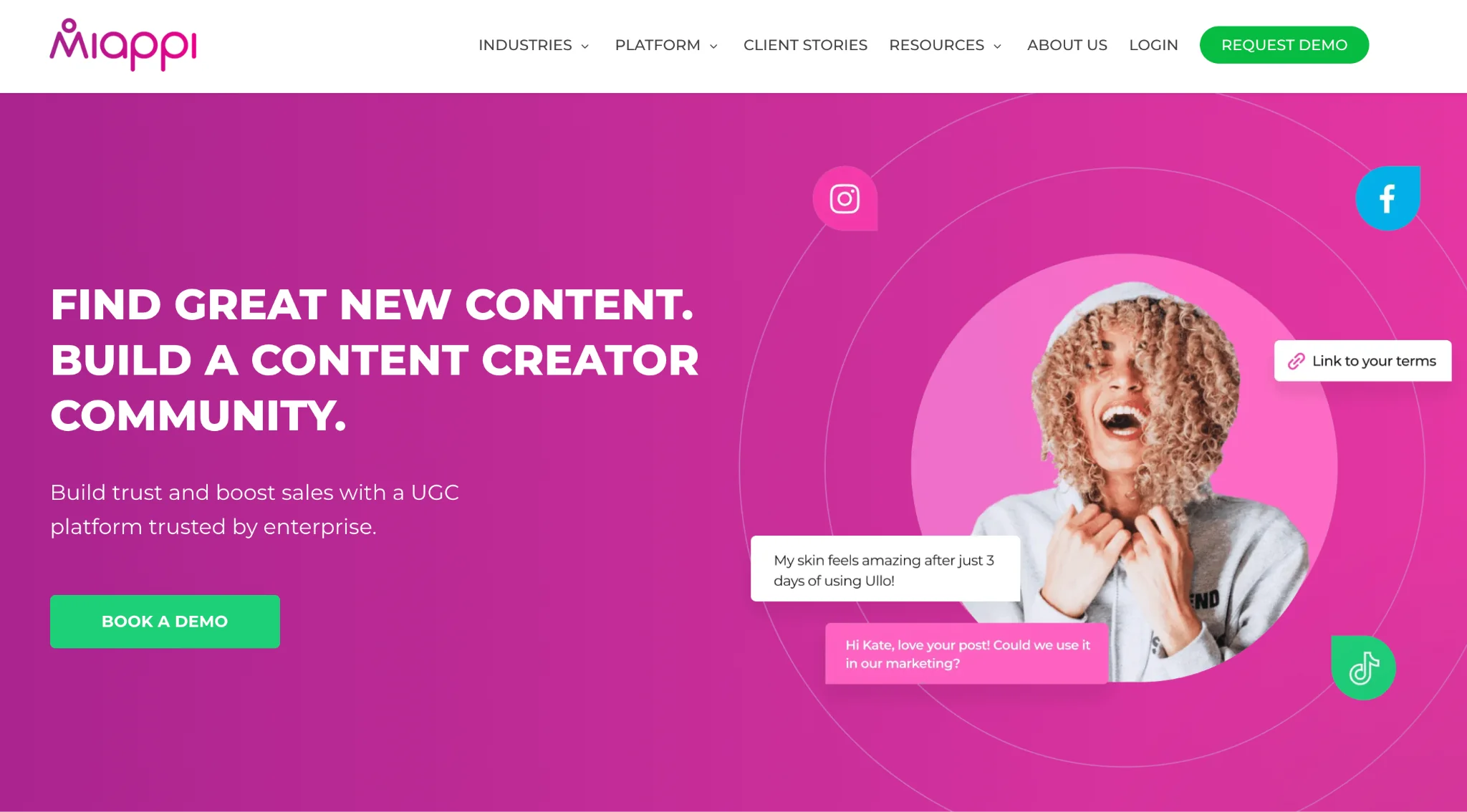
Miappi is an enterprise user-generated content platform. It finds content that customers and fans have already made about a brand, curates it, secures the right to use it, and publishes it wherever the brand needs it. The clients named on the site are large: Dove Men+Care, the Heineken Experience and Camper.
The product spans four sectors it names directly, which are personal care, fashion, fast-moving consumer goods, and travel and tourism. Those are all categories where customers photograph the product without being asked, and where the marketing problem is sorting through that volume rather than generating it.
Three pieces make up the platform. The core handles curation, moderation and publishing. Miappi Commerce turns approved content into shoppable galleries with conversion tracking. Miappi Community is the tier aimed at nurturing the people who post. The whole thing is built for brands that intend to keep using the content, which is why it matters that it handles the licensing step rather than leaving you to sort out permissions before running creator content as paid media.
Who Should Use Miappi
The feature set points at a particular kind of brand rather than a particular size:
- Brands with high customer photo volume: Personal care, fashion and FMCG are all named, and all three generate content without prompting.
- Teams running physical venues or events: Live walls are built for screens in real spaces, which most competitors do not attempt.
- Brands that reuse content in paid media: Licensing is handled in the platform rather than chased afterwards.
- Travel and tourism marketers: Location-based content sourcing fits destinations better than product catalogues do.
- Enterprise teams needing moderation control: Approval workflows and folder structures suit brands with legal sign-off.
- Brands wanting content submitted directly: Custom upload forms collect content from people who never posted it publicly.
- Small brands that need a price today: This is the group it does not suit, since nothing is published on either pricing page.
Key Features
Content Curation at Scale
Content is pulled in from social feeds and custom hashtags, then organised for review. The volume problem is the real one here, because a large brand can generate thousands of tagged posts a week and almost none of them are usable as they stand.
Custom Upload Forms
People can submit content directly through a branded form rather than posting it publicly first. This is the underrated feature in the set, because it reaches customers who take good photos but never tag anyone, and consent can be captured at the point of upload.
Content Licensing
Permission to reuse content is handled inside the platform. Getting that in writing is what separates content you can put in an advert from content you can only admire, and it is worth understanding content usage rights properly before you build a campaign on other people's photographs.
Folders by Product Line
Approved content is filed by product or campaign rather than sitting in one pool. For a brand with fifty products, this is the difference between a library and a pile.
Live Walls
Content displays on screens at events, in stores and in venues, updating as new posts arrive. The Heineken Experience is the obvious example, and it is a genuine differentiator because most UGC tools stop at the website.
Moderation Controls
Nothing publishes without passing approval, with rules and manual review available. Any brand that has accidentally displayed a customer post it should not have will understand why this sits high in the feature list.
Miappi Commerce
Approved content becomes shoppable galleries on product and category pages, with conversion tracking available on the higher tiers. This is the part that connects the content back to revenue rather than to engagement.
Miappi Community
The top tier adds community management tools for nurturing the people who create content for you, along with integrations to Trustpilot and Hootsuite. The logic is sound, since the same customers usually produce content more than once if anybody talks to them.
Miappi Pricing
No figures are published anywhere. What exists instead is two separate plan families, each with three tiers, and the limits they name are the only public signal about cost.
Commerce Plan
Aimed at medium-sized businesses using earned and owned content in campaigns. The plan includes:
- Up to 5 content feeds
- Shoppable UGC galleries
- Up to 3 managers
- Unlimited views
Enterprise Plan
Everything in Commerce, plus:
- Up to 10 feeds and 10 managers
- Miappi API access
- Conversion tracking
Community Plan
Everything in Enterprise, plus:
- Community management tools
- Trustpilot integration
- Hootsuite integration
- Early access to new features
The Other Plan Family
A second set of plans sits elsewhere on the site under the names Business, Enterprise and Custom. Business promises unlimited brand feeds with updates every 30 minutes. Enterprise promises unlimited feeds and hashtags with near real-time updates and advanced eCommerce. Custom adds API access on top.
The two families contradict each other directly. One caps feeds at five and ten, the other calls them unlimited, and the same word Enterprise means different things in each. Ask which set of plans you are actually being quoted, because the answer changes what you get for the money.
The Refresh Interval Is a Tier Gate
Updates every 30 minutes on the lower tier against near real-time above it is the most concrete difference the company publishes. For a website gallery, half an hour is irrelevant. For a live wall at an event, where the whole point is that people see their post appear, it is the entire product.
If live walls are why you are buying this, assume you need the higher tier and price accordingly.
What to Settle Before the Demo
Five questions do the heavy lifting, because none of them are answered publicly:
- Which plan family applies to you, and what the feed limits really are
- What counts as a feed, since a hashtag, an account and a location may each count separately
- Whether licensing requests are unlimited or metered
- What the refresh interval is on the tier you are being sold
- The contract length, the notice period and any setup fee
Brands weighing this against lighter tools often start with a shortlist of Shopify influencer apps, several of which publish their plans openly and can be trialled the same day.
Miappi Reviews
5.0/5.0 (G2, 4 reviews). Four reviews is not a rating, and a perfect score from that sample tells you nothing reliable about the product.
There is a further wrinkle worth knowing. The organic reviews on that listing date from 2022 and 2023, so even the small sample that exists describes the platform as it was a few years ago rather than as it is now. No other major directory carries a usable listing.
What can be verified is the client roster, and it is the strongest evidence available. Dove Men+Care, the Heineken Experience and Camper are all named, and brands at that level do not put customer content on public screens using software that fails.
Given the thin review base, ask for references in your own sector and, specifically, ask a current customer how licensing requests perform in practice. Approval rates on rights requests are the number that decides whether a UGC programme produces anything usable.
Integrations
The published surface is narrow and two of the five sit behind the top tier:
- eCommerce platforms: Shoppable galleries and conversion tracking connect content to product pages and orders.
- Instagram and Facebook: The named social sources, alongside custom hashtag and location sourcing.
- Miappi API: Available from the Enterprise tier for pushing content into your own systems.
- Trustpilot: Reviews and customer content combined, available on the Community tier only.
- Hootsuite: Approved content flows into your social publishing schedule, also Community tier only.
No email service provider, CRM, analytics tool or affiliate platform is named anywhere. For a platform sold to enterprise marketing teams, that is a thinner list than the buyer profile suggests.
Pros of Miappi
Content You Can Actually Use
Custom upload forms collect content directly, with consent captured as part of the submission, and licensing is handled in the platform. Most UGC tools find content and leave the permissions to you, which is how brands end up with a library they are not allowed to publish.
It Works Off the Website
Live walls put customer content on screens in venues, stores and events, updating as posts arrive. Very few competitors handle physical spaces at all, and for a brand with a visitor centre or a stand at a trade show it is the reason to choose this over a purely digital tool.
Proof at Enterprise Scale
Dove Men+Care, Heineken and Camper are demanding clients in three different categories. With only four reviews in public, that roster is doing most of the work of proving the platform holds up, and it does the job convincingly.
Cons of Miappi
Two Pricing Pages That Disagree
One family caps feeds at five and ten, the other calls feeds unlimited, and neither shows a price. You cannot tell which plan you are being quoted, what a feed counts as, or what the gap between tiers costs. That is a poor starting position for a negotiation.
The Useful Integrations Are Top Tier
Trustpilot and Hootsuite are the only named third-party connections and both sit on the Community plan. A brand that wants reviews and social scheduling joined to its content library has to buy the most expensive tier to get them.
Four Reviews, None of Them Recent
A five-star average from four reviews written in 2022 and 2023 is not evidence about the product today. With no other directory carrying a usable listing, there is nothing current to check against the sales pitch.
It Organises Content, It Does Not Find Creators
You can collect, licence and publish what people already post. You cannot search a creator database, run outreach, agree a brief, issue an affiliate code or pay anybody, so this sits alongside a creator programme rather than replacing one.


Is Miappi Worth It?
For a brand with real customer content volume and physical spaces to fill, there is a strong product here. Upload forms and built-in licensing produce content you are allowed to use, live walls cover a use case almost nobody else serves, and the client list settles any question about whether it works at scale.
The reservations are about transparency and evidence. Two contradictory plan families, no price on either, the only named integrations locked to the top tier, and four reviews from several years ago. None of that makes the platform bad, and all of it makes it hard to evaluate without spending an hour on a call.
Brands weighing a content platform against a full creator programme usually consider the following:
- Influencer Hero: Collects and searches UGC with AI, runs content approvals, and then does what a content tool cannot, which is turn the customer who posted into a tracked creator with outreach, an affiliate code and an automated payout.
- Afluencer: Solves supply rather than storage, with creators applying to your campaign listings, and it is aimed at brands finding micro-influencers without running a database search.
- Stackla: Enterprise visual content discovery with AI-driven sentiment and rights workflows, now part of a wider commerce personalisation suite. For a large brand already invested in that stack, it is the closer fit.
- Walls.io: Specialises in social walls for events and screens with quick setup and broad network support. If live displays are the main reason you are buying, it is worth the call.
- Tint: Combines UGC collection with rights management and commerce galleries across a wide integration list. For a brand that wants published plans and an open review record, it makes more sense.
Final Thoughts
Miappi fits a specific brand very well and a general one poorly. If you run venues, events or retail space and your customers already photograph your products, the combination of upload forms, licensing and live walls is unusual and worth paying for. If you are a smaller online brand that wants a shoppable gallery and a price this week, almost nothing here is designed for you, from the demo-only sales process to the enterprise client list. Work out first whether screens in physical spaces are part of your plan, because that is the capability that justifies the process. If they are not, the Miappi alternatives with published plans and a current review record will get you there faster.