


Lurkit Pricing and Review: Features, Pros, Cons & Costs
Creators bid for the work and get paid when they finish it. That inversion is the mechanism the whole platform is built on, and it is why Lurkit looks less like influencer software and more like a marketplace with a delivery guarantee attached.
Lurkit is a creator marketing platform for games, founded in Sweden in 2015, with more than 100,000 manually verified creators across Twitch, YouTube, YouTube Shorts and TikTok. Publishers use it to distribute keys at scale, run paid campaigns it calls Quests, and track what the resulting coverage did. Three tiers exist. None of them carries a published price.
What follows is what each tier includes, the one cost figure the company does publish, how the review record splits between publishers and creators, and the specific reason most D2C brands reading this should stop at the next section.
Lurkit Overview
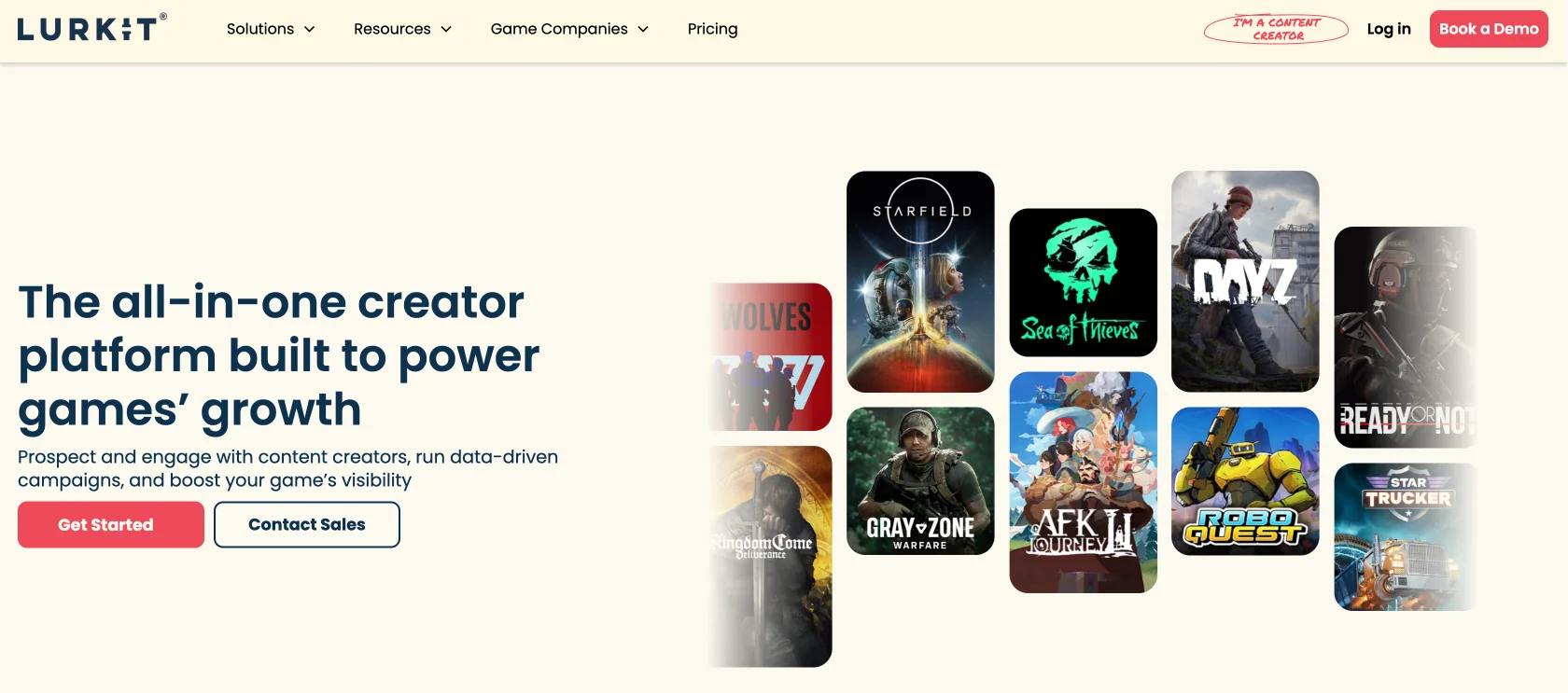
The first thing to establish is scope, because it decides everything else. Lurkit is gaming software. The creator database is gaming creators, the campaign types are built around game launches, the analytics measure streaming hours and viewership, and the customer list is game studios and publishers. A skincare or supplements brand will find nothing here that fits, and no plan changes that. If you sell to gamers, read on. If you do not, the honest answer is that platforms built for eCommerce brands are a different comparison entirely.
For publishers, the product covers three jobs. Key campaigns handle organic distribution, sending review codes and in-game items to creators without money changing hands. Quests handle paid activation, where creators apply, get selected and are paid on completion against KPIs the publisher sets, such as views or hours streamed. A creator CRM sits underneath both, with prospecting, shortlists, collaborative notes and bulk import of creator lists you already hold.
The analytics layer is the part publishers tend to name first. Lurkit Insights covers game performance, viewership trends, competitor benchmarking and creator impact across the four supported networks, and it runs in real time rather than as a post-campaign report. Every creator on the platform is manually verified, which is unusual at 100,000 profiles and is the company’s answer to the fraud problem that discovery databases usually solve with an algorithm.
Who Should Use Lurkit
The filter is narrow and worth applying before anything else, because fit here is categorical rather than a matter of degree.
- Game publishers managing a portfolio. One master account across multiple titles, with creator programs and campaigns separated per game, is the core use case and what the Publisher tier exists for.
- Indie studios launching a first title. The discount program advertises up to 70% off, which makes a platform aimed at publishers reachable for a small team, at least for the first year.
- Teams distributing keys at volume. Automated distribution of keys, codes and in-game items is the strongest single function, and doing it manually past a few hundred creators stops being viable.
- Studios that need coverage on a launch date. Quests pay on completion against defined KPIs, which converts creator interest into contracted delivery in a way organic key drops cannot.
- Publishers who need competitor visibility. Benchmarking a title against comparable games on Twitch and YouTube is a genuine planning input and it is not something general influencer tools provide.
- Not D2C brands outside gaming. No eCommerce integration, no product seeding, no discount codes and no revenue attribution. The fit is the gaming audience, not the software category.
Key Features
Key and Code Distribution
Automated distribution of game keys, codes and exclusive in-game items to creators, with tracking on who claimed what and who published afterwards. This is the function publishers buy the platform for and the one they rate highest. The equivalent job in consumer brands is product gifting automation, and the logic is identical: the manual version collapses somewhere around the two hundredth creator.
Quests, the Paid Campaign Model
Publishers post a paid activation with KPIs attached, creators apply or bid, selected creators complete the work and get paid on delivery. It removes per-creator rate negotiation, which is the slowest part of running a campaign at volume, and it makes budgeting predictable because the KPI is defined before anyone is paid. Quests carry a 20% commission, which is the only cost figure Lurkit publishes anywhere.
Creator CRM and Prospecting
Shortlists, collaborative notes, prospecting and bulk import of existing creator lists by email. For a marketing team that has been running its creator relationships out of a spreadsheet and an inbox, this is the part that changes the working day. It is organised around games rather than around a single brand, which suits a publisher and would frustrate anyone with one product.
Manual Creator Verification
Every creator on the platform is verified by hand rather than screened algorithmically. At 100,000 profiles that is a meaningful operational commitment and it addresses fraud more convincingly than a follower-spike detector. The tradeoff is database size: 100,000 verified gaming creators is a fraction of what general discovery tools list, and that is the intended bargain.
Creator Program Landing Pages
Publishers get branded pages on custom URLs where creators apply to join a game’s program directly. It converts inbound creator interest, which for a game with an existing community is often substantial, into a managed pipeline rather than a flood of DMs. Ongoing programs run from here rather than being rebuilt per campaign.
Missions and Rewards
Campaigns can be structured around customisable KPIs such as views or streaming hours, with rewards tied to hitting them. It is a cleaner incentive design than a flat fee per post, and it is the mechanism that makes Quests measurable. It is also where the most pointed criticism lands, covered in the cons below.
Lurkit Insights
Real-time data on game viewership, category trends, creator impact and competitor performance across Twitch, YouTube, YouTube Shorts and TikTok. Publishers describe this as the reason to stay rather than the reason to sign, and it is the piece with no obvious equivalent in general-purpose influencer platforms.
Team Access and Add-Ons
Up to five team members are included, with more available on request. Beyond the tiers sit paid add-ons including a Launch Pack, a take-over package, community push, highlighted game placement and creator program setup. None of these carries a published price either, so the add-on menu is a second unpriced variable stacked on the first.
Lurkit Pricing
Three tiers, and not one of them shows a number. Indie, Studio and Publisher all say contact for pricing, the add-on menu is unpriced, and the only figure published anywhere on the site is the 20% commission taken on paid Quests.
That is a real finding rather than an inconvenience, and it is worth reading the table below for what is absent as much as for what is present. A brand cannot budget for this platform without a sales conversation, and a sales conversation calibrated to a budget you have already disclosed is a different negotiation from one anchored on a list price.
Indie
- Price not published. Quote required.
- Real-time data on games, viewership, trends and creator impact.
- Creator management, outreach and performance tracking, plus automated distribution of keys, codes and in-game items.
- Paid campaigns included, carrying the 20% Quest commission.
- A discount of up to 70% is advertised for qualifying studios, which is the largest published concession on the site and the reason to ask about it explicitly.
Studio
- Price not published. Quote required.
- Adds the creator CRM, key campaigns, marketing insights and paid Quests at the same 20% commission.
- Expert support from customer success staff plus a named key account manager.
- Add-ons available on top, none of them priced publicly.
Publisher
- Price not published. Quote required.
- The same core feature set as Studio, scaled to a portfolio with one master account across multiple games.
- Up to five team members included, with additional seats through sales.
- Same add-on menu, same 20% Quest commission.
What You Can Actually Budget For
- The one published number is 20%. Every paid Quest carries it, so a $10,000 creator activation costs $12,000 before the subscription is counted.
- The subscription is a complete unknown. No tier, no range and no starting figure appears anywhere on the site, which makes a like-for-like comparison against a platform with listed pricing impossible until you have a quote in hand.
- Add-ons are a second unpriced layer. Launch Packs, take-overs and community pushes are sold separately with no figures attached, and launch moments are exactly when a publisher has least leverage to negotiate.
- Ask for the Quest commission in writing alongside the subscription. Two variable costs quoted separately are how a budget drifts, and the percentage is the one that scales with success.
- Indie studios should lead with the discount. Up to 70% is a large concession and it is advertised rather than hidden, so treat it as the opening position rather than a favour.
Lurkit Reviews
The public review record is poor, and reading it correctly requires separating who is complaining from who is buying.
- 2.2/5.0 (Trustpilot, low review volume at 9 reviews, profile unclaimed)
- G2: no listing found.
- Capterra: no listing found.
All nine Trustpilot reviews are one star, and almost all of them come from creators rather than publishers. The complaints are account suspensions without stated reason, support that did not respond over months, keys promised and not received, difficulty deleting an account, and objections to granting analytics access without compensation. The profile is unclaimed, so none of it has been answered publicly.
That distinction matters both ways. A publisher evaluating the software is not the person filing these reviews, so the score is a poor proxy for whether the tool works for the buyer. But a creator platform with unhappy creators is a supply problem in slow motion, and independent commentary reinforces it: reported drops in content quality between manually recruited creators and platform-sourced ones, guidelines strict enough to suspend certain video formats, and reward structures that encourage creators to hit a time quota rather than genuinely engage with a game. For a publisher, that is the risk to test in a pilot.
Integrations
There is no published integration directory, which is consistent with a closed platform built around one industry rather than a hub connecting to a wider stack.
- Social platforms. Twitch, YouTube, YouTube Shorts and TikTok are the four networks covered for data and campaign tracking.
- Key and code delivery. Distribution runs natively for game keys, codes and in-game items rather than through a third-party fulfilment tool.
- eCommerce platforms. None published. No Shopify, no WooCommerce, no BigCommerce, which is expected for games sold through storefronts rather than a brand’s own site.
- Affiliate and payment tools. None named. Creator payment runs through Quests inside the platform rather than an external provider.
- API and automation. No public API and no Zapier connector published, so data leaves through exports rather than pipelines.
For a publisher whose reporting lives in Lurkit Insights this is workable. For anyone wanting creator performance modelled alongside revenue in a warehouse, the absence of a documented API is the constraint to check before signing.
Pros of Lurkit
Depth in One Industry Instead of Breadth Across All of Them
Viewership trends, streaming hours, competitor benchmarking by title and 100,000 manually verified gaming creators are things a general influencer platform cannot offer, because building them only pays off if gaming is your entire market. For a publisher, that specialisation is the whole argument, and it holds up.
Key Distribution That Scales Past Manual
Automated delivery of keys, codes and in-game items with claim and publication tracking removes the single most tedious job in game marketing. Publishers consistently rate this the strongest function, and the alternative at any real volume is a spreadsheet, a shared inbox and a slow leak of unredeemed codes.
Quests Convert Interest Into Contracted Delivery
Paying on completion against defined KPIs is a better incentive structure than a flat fee per post, and having creators apply rather than negotiating each rate individually compresses the slowest part of campaign setup. For a launch window with a fixed date, knowing what you have actually bought is worth more than a lower unit price.
Cons of Lurkit
Nothing Is Priced, and the Add-Ons Are Not Either
Three tiers with no published figures, an add-on menu with no published figures, and one percentage that scales with spend. That combination makes the platform impossible to evaluate on cost without entering a sales process, and it means the eventual quote is anchored to whatever budget you disclose rather than to a rate card. Get the subscription and the 20% commission quoted together and in writing before discussing add-ons.
Gaming Only, With No Commerce Layer
No eCommerce integration, no discount codes, no affiliate links and no revenue attribution, because games are not sold from the publisher’s own checkout. For a D2C brand that arrived here from a general search, this is disqualifying rather than a limitation to work around. The comparison you want is with tools that connect affiliate tracking and payouts to a store.
The Creator-Side Review Record Is a Supply Risk
Nine one-star Trustpilot reviews on an unclaimed profile, naming suspensions without explanation, unanswered support and undelivered keys. These come from creators, not publishers, so they say little about the software itself. They say a great deal about the health of the creator pool a publisher is paying to access, and independent commentary about content quality and quota-driven participation points the same way. Run a small paid Quest and assess the output yourself before committing to a launch on it.
No API and a Closed Reporting Loop
Insights is strong but it is a destination rather than a source. With no public API, no Zapier connector and no published integration directory, creator performance data does not flow into a warehouse or a BI tool without manual export. A publisher with an analytics function will feel this quickly, and it is worth asking about export formats and data ownership during the sales conversation rather than after.


Is Lurkit Worth It?
For a game publisher, very possibly. Key distribution at scale, Quests that pay on delivery against defined KPIs, 100,000 manually verified gaming creators, and an insights layer covering viewership, trends and competitor titles that no general influencer tool comes close to. If gaming is your market and key distribution is currently a spreadsheet, this solves a real problem and the indie discount makes it reachable for small studios. Run a paid Quest as a pilot and judge the creator output before a launch depends on it.
For a D2C brand outside gaming, no, and not because of price. There is no eCommerce integration, no product seeding, no discount codes, no affiliate attribution and no way to connect a creator to an order, because none of that is what the platform is for. Add unpublished pricing on every tier and a creator-side review record at 2.2 out of 5, and the evaluation ends before cost enters it. Brands running consumer creator programs should be pricing these instead:
- Influencer Hero. Discovery across eight social platforms with Instagram, YouTube and TikTok emphasised, plus fake follower screening, CRM boards, gifting through Shopify and WooCommerce, affiliate codes and payouts. Plans are publicly listed from $649 a month.
- Afluencer. A creator marketplace from $49 a month where influencers apply to campaign listings rather than being recruited outbound. The straightforward option when creator supply is the bottleneck.
- CreatorIQ. Enterprise creator management with deep governance, workflow controls and integrations, built for large teams running programs across many markets.
- Traackr. Relationship intelligence and always-on measurement, aimed at brands tracking creator performance as a long-term portfolio rather than campaign by campaign.
- Social Cat. Micro-influencer matching on a flat monthly fee, suited to smaller brands running gifting-led collaborations without a dedicated marketer.
Final Thoughts
Two questions settle this and the first one is not about money. Do you sell games, or something adjacent enough that gaming creators are your audience? If not, stop here, because everything this platform does well is built on an assumption your business does not meet, and platforms built for eCommerce brands are the comparison that will actually help.
If you do sell games, the second question is what the quote looks like next to the 20% Quest commission, since that percentage is the only figure the company publishes and it grows with every campaign that works. Ask for both numbers together, ask about the indie discount before you disclose a budget, and run one small paid Quest to see what the creator pool produces.

.png)


.jpg)










