


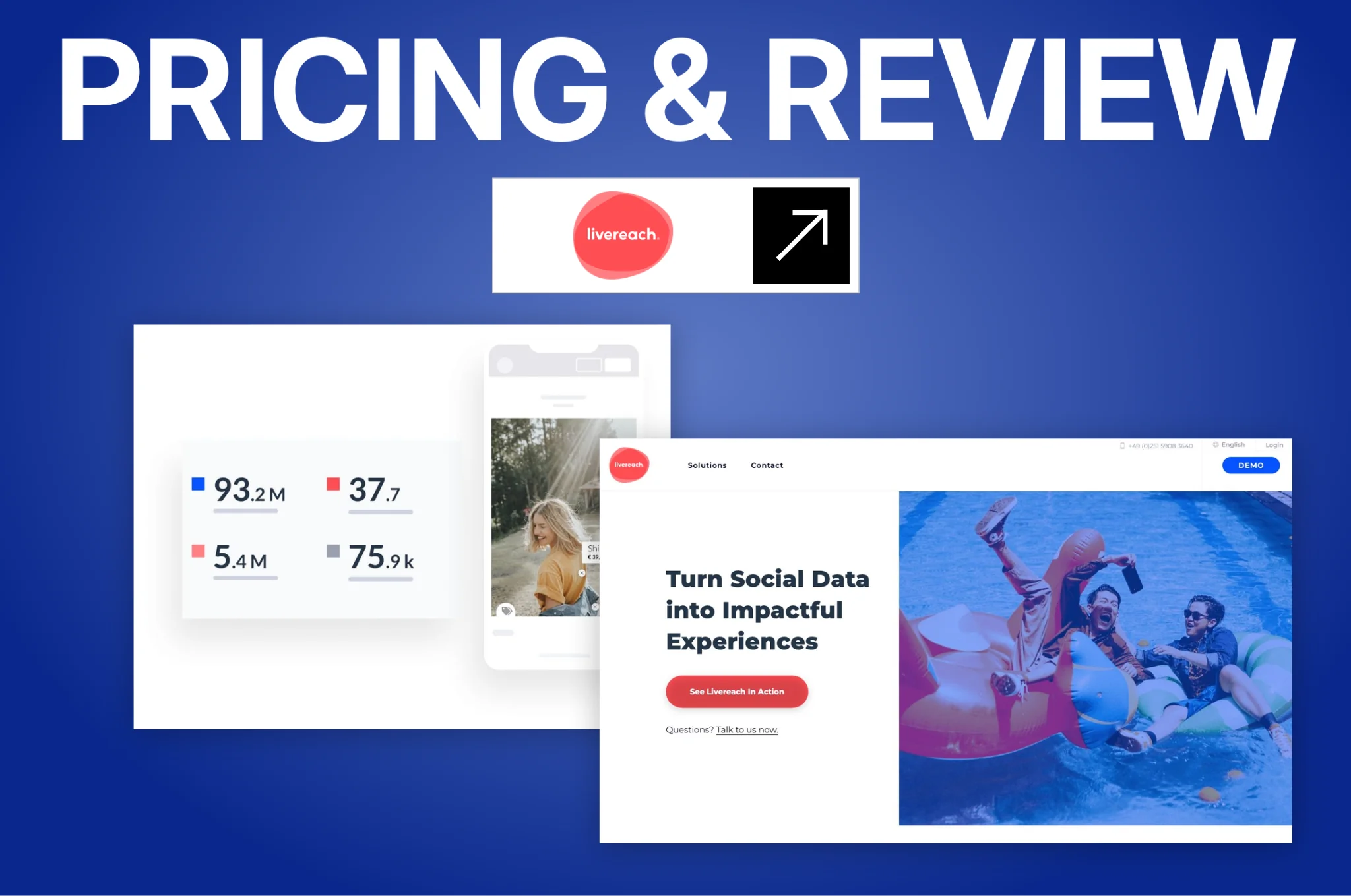
Livereach Pricing and Review: Features, Pros, Cons & Costs
Most reviews of this kind begin with the price. This one has to begin with a list of things Livereach does not publish.
There is no rate card and no plan structure. Only one social network gets named anywhere on the site, and only in passing. Client logos appear without names beside them, and no independent review listing resolves to this company. What you do get is a German phone number and a demo form.
This review covers the three product lines and what each one actually does, the integration list that says more about the intended buyer than the marketing does, and how to put a number on a tool that will not put one on itself.
Livereach Overview

Livereach is a social content and social data platform based in Münster, Germany. Its own description is to turn social data into impactful experiences, which in practice means collecting content from your community and putting it to work across your channels.
The product splits into three clouds. Experience Cloud finds content and publishes it to your site, apps, emails and in-store screens. Visual Commerce Cloud turns that content into shoppable galleries on product and category pages. Insights Cloud is the listening and monitoring side, covering brand mentions, competitors and trends on large displays, mobile and desktop.
It is sold across a whole organisation rather than to one team. Marketing, sales, HR, PR, eCommerce and events are all named as departments it serves. That breadth is worth noticing early, because a suite built for six departments is rarely priced for one, and it is a different proposition from whitelisting creator content for paid social where the job is narrower and the buyer is one person.
Who Should Use Livereach
The integration list and the department list between them describe the buyer fairly precisely:
- Brands on SAP Hybris, Magento, Shopware or Oxid: These are the named out-of-the-box integrations, and they install without development work.
- European enterprise retailers: The commerce stack, the language and the support number all point the same way.
- Brands with heavy customer photo volume: The rights and approval workflow only earns its keep when there is real content coming in.
- Teams running physical retail and online: The same content feeds product pages and in-store screens from one place.
- Events and experiential teams: Live Display is built for screens at events, restaurants and offices.
- Comms teams doing brand monitoring: Insights Cloud covers listening, alerts and competitor tracking in a command centre setup.
- Small D2C brands on Shopify: This is the group it does not suit, since Shopify is not among the named integrations and nothing is priced for a small team.
Key Features
The Content Engine
Content is found through people interacting with your brand on social, plus hashtags, geolocations, keywords and image recognition. Image recognition matters more than it sounds, because plenty of customers post your product without tagging you at all.
Rights Management
The platform runs a full permission workflow with personalised rights request templates, opt-in hashtags and dedicated rights landing pages. Getting written permission before you reuse a customer photo is the step most brands skip and later regret, and it is worth reading up on content usage rights before you build any programme on borrowed images.
Stock-Aware Publishing
Content publishes automatically based on approvals and stock status, so galleries stop showing products you cannot sell. This is a small feature that quietly prevents a common and embarrassing problem on busy product pages.
Shoppable Galleries and Product Tagging
Customer and creator photos are tagged to products and embedded on product and category pages, or as a shoppable Instagram feed anywhere on the site. Instagram is the only network Livereach names anywhere, which is worth remembering when you ask about coverage.
Editorials and Lookbooks
Drag-and-drop templates build editorial pages, content grids, slideshows and microsites from the same content pool. A marketing team can put a campaign page together without a developer, which is usually the bottleneck.
Dynamic Email
Community and creator images drop into newsletters and keep updating after the email has been sent. If a product sells out between the send and the open, the email does not keep promoting it.
Live Display
Digital signage for stores, restaurants and offices, with content rotating automatically. Insights Cloud can also push dashboards to those screens and control them from a phone, which is how the command centre setup is meant to work.
Listening and Competitor Tracking
Insights Cloud monitors social channels, news and the web alongside your own data sources, with real-time alerts, brand monitoring, competitive analysis and topic tracking. Custom dashboard layouts let each team see only what it needs.
Livereach Pricing
No figures are published anywhere on the site. There is no plan comparison, no starting price, no free trial and no self-serve sign-up. The routes offered are a callback request, a demo booking or a phone call.
That is normal for enterprise software and it is not a scandal. It does mean you cannot shortlist this tool on cost, and you cannot check whether a quote is reasonable, because there is no public figure and no independent listing carrying one either.
What the Integration List Tells You
The named out-of-the-box integrations are SAP Hybris, Magento, Shopware and Oxid. That is a European enterprise commerce stack, and those platforms are bought by companies with procurement departments and implementation partners.
Software follows its integrations. A tool that plugs into SAP Hybris is priced for the kind of business that runs SAP Hybris, which is a useful thing to know before you spend an hour on a demo.
Three Clouds Means Three Line Items
Experience Cloud, Visual Commerce Cloud and Insights Cloud are presented as separate products. Assume the quote is modular, that each cloud carries its own fee, and that the demo will be built around whichever one you asked about. Ask for the price of all three even if you only want one, so you can see the shape of the full deal.
What to Settle Before the Demo
Five questions do most of the work, because none of the answers are public:
- Which social networks are actually supported, named one by one
- Whether your eCommerce platform is supported, and what it costs if it is not on the list
- Whether each cloud is licensed separately and what a single cloud costs
- Whether pricing scales on content volume, page views, screens or seats
- The implementation fee, the contract length and the notice period
The Cost of Not Knowing
Treat the missing information as part of the price. Every question above takes a call to answer, and until they are answered you cannot compare this to anything else on your shortlist. That is time, and for a smaller team it is usually the reason a tool like this never gets bought.
Livereach Reviews
No verifiable rating. Livereach does not hold a listing with meaningful review volume on the major software review sites, so there is no score to quote and no independent account of reliability, support or how the platform performs in practice.
One thing will save you time. Review sites carry a product called LiveReach AI, which is a different company working in venue and footfall analytics. Any rating you find under that name describes that product, not this one, and the similarity of the names makes this very easy to get wrong.
The client logos on the site are not labelled either, so there is nobody to look up and no case study to check. In the absence of anything public, ask for two references in your own market and your own size bracket, and ask them specifically about data accuracy and response times.
Integrations
The published list is short, and what is missing from it matters as much as what is on it:
- SAP Hybris: Out-of-the-box connection with no development work required.
- Magento: Supported directly, covering a large share of mid-market European retail.
- Shopware: A German commerce platform and a clear signal of the target market.
- Oxid: Another German enterprise commerce system supported natively.
- Email service providers: Plug-and-play connections for the dynamic email product, though no ESP is named.
Shopify does not appear among the named integrations, and no CRM, analytics or affiliate tool is named either. Content is delivered through the company's own AWS infrastructure and CDN, which helps page speed but does not widen the connection surface.
Pros of Livereach
Rights Are Handled Properly
Request templates, opt-in hashtags and dedicated rights landing pages make permission a real workflow rather than a comment asking somebody if it is okay. For any brand reusing customer photos in ads or on product pages, this is the part that keeps you out of trouble.
Galleries That Follow Your Stock
Publishing tied to approvals and live stock status means your social proof never promotes a sold-out product. It sounds minor until you have watched a best-selling gallery keep driving clicks to an empty page.
One Content Pool, Many Screens
The same approved content runs on product pages, in editorials, inside newsletters and on screens in your stores. Most brands rebuild that content four times for four channels, and collapsing it into one library saves genuine production time.
Cons of Livereach
You Cannot Cost It At All
This is the biggest problem for a buyer. No price, no plans, no trial, no self-serve route and no independent listing carrying a figure. You cannot budget, you cannot shortlist and you cannot tell whether your quote is competitive, because there is nothing to compare it against.
The Named Integrations Skip Shopify
SAP Hybris, Magento, Shopware and Oxid are the platforms named. Shopify is not, which is a significant gap given how much D2C commerce runs on it. It may well be possible through custom work, but custom work is a cost and a timeline you should price before you commit.
Too Little Is Verifiable
Instagram is the only network named anywhere, no client is named and no review sample exists. Every important claim has to be confirmed in a sales conversation, and a similarly named unrelated product makes independent research harder rather than easier.
It Collects Content but Does Not Run Creators
You can find, approve and publish what people post about you. You cannot search for creators, contact them, agree a brief, issue a discount code, track the sale or pay anybody, so a creator programme needs a separate platform to collect and organise creator content alongside the campaign itself.


Is Livereach Worth It?
If you are a European retailer on one of the named commerce platforms, there is a real product here. The rights workflow is thorough, stock-aware publishing solves a problem most tools ignore, and feeding web, email and in-store screens from one approved library is a genuine saving for a team running all three.
Everything else argues for caution. Nothing is priced, almost nothing is named, nothing is independently reviewed, and Shopify is missing from the integration list. For a D2C brand that wants to compare three tools this week, that is a lot of unanswered questions in exchange for a demo.
Brands weighing a content platform against a full creator programme usually look at the following:
- Influencer Hero: Collects creator content into a searchable UGC library with AI search, runs approvals and usage rights, and connects it to discovery, outreach, affiliate codes and payouts across Shopify, WooCommerce and custom builds.
- Afluencer: Lets creators find your brand through campaign listings and apply to work with you, which puts new content in the pipeline rather than only organising what already exists, as its rundown of Shopify influencer apps sets out.
- Yotpo: Combines reviews, loyalty and visual UGC in one suite with wide eCommerce support. For a brand that wants reviews and photos under one contract, it is the closer fit.
- Flowbox: A European visual commerce platform built around shoppable galleries and rights collection. For a team that wants this same workflow from a vendor with an open review record, it is worth the call.
- Pixlee TurnTo: Pairs UGC galleries with ratings, reviews and community question answering. For a brand where the content gap is really a social proof gap, it makes more sense.
Final Thoughts
There is a capable content platform in here, and the rights workflow in particular is better than most. What surrounds it is the problem, because almost nothing a buyer needs is available without a call, from the price to the supported networks. Check one thing before anything else, which is whether your commerce platform appears on the integration list, since the four that do are all European enterprise systems. If yours is not there, the Livereach alternatives that publish their integrations and their prices will get you an answer in ten minutes instead of two weeks.

.png)


.jpg)










