

Kollective Pricing and Review: Features, Pros, Cons & Costs
Kollective does something almost nobody else in this category does, which is publish its prices. Three packages sit openly on the site at 50,000, 100,000 and 200,000 Thai baht.
At current rates that is roughly $1,500, $3,000 and $6,000. Each figure is shown as a discount against a higher normal price, and the discount gets smaller as you move up, which is the opposite of what most buyers expect.
This review covers what each package is for, how the Kolify platform underneath them works, which markets and networks you are actually buying access to, and the one place where the company's own published numbers do not line up.
Kollective Overview
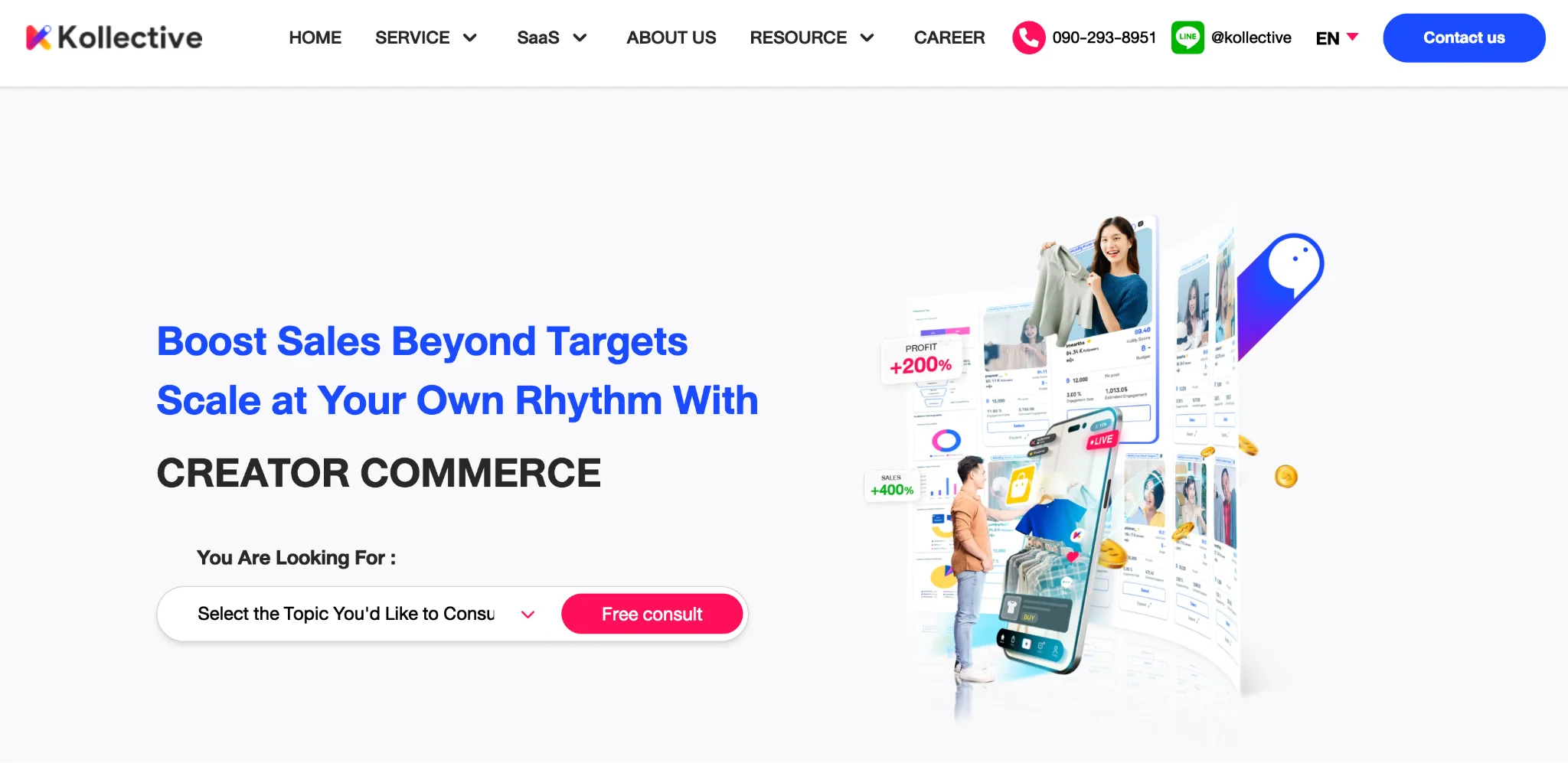
Kollective is a Bangkok-based influencer marketing company founded in 2020, with a team of between 10 and 50 people. It calls itself Thailand's leading influencer marketing solution company and positions itself as an integrated optimiser rather than as software you log into alone.
The service list is broad for a company of that size. Strategy and media management, performance marketing across Facebook, Instagram, TikTok, LINE, SEO and Google Ads, content production, influencer marketing, public relations and live commerce all sit under one roof. That mix tells you it is an agency with a platform rather than a platform with support attached.
The platform is called Kolify and it holds more than 800,000 creators across Asia. Coverage runs across Thailand, China, Vietnam, Indonesia, Malaysia, Laos and Singapore, on Facebook, Instagram, TikTok, YouTube, LINE, Xiaohongshu, Douyin and Dianping. Selling happens on TikTok Shop, Shopee and Lazada as much as on a brand's own site, which is why the affiliate and live commerce work sits closer to creator storefronts than to traditional sponsored posts.
Who Should Use Kollective
The geography does most of the qualifying here:
- Brands entering Southeast Asian markets: Thailand, Vietnam, Indonesia, Malaysia and Singapore are all covered by one team.
- Brands selling on Asian marketplaces: TikTok Shop, Shopee and Lazada are where the affiliate work happens.
- Companies targeting Chinese consumers: Xiaohongshu, Douyin and Dianping are three networks Western platforms rarely touch.
- Teams with no local knowledge: LINE dominates messaging in Thailand and behaves nothing like Western channels.
- Brands wanting live commerce: Live selling is a mainstream sales channel across the region rather than an experiment.
- Buyers who want a price before a call: Three packages are published, which is rare enough to be worth noting.
- D2C brands selling only in Europe or North America: This is the group it does not suit, since the networks and marketplaces do not apply.
Key Features
The Kolify Platform
Creator selection, campaign management and reporting run through a single system rather than through email threads. It performs the job a creator CRM does elsewhere, with the campaign work handled alongside it by the agency team.
The Kolify Score
Each creator carries an AI-generated score assessing cost-effectiveness, audience credibility and past performance. Combining price with credibility in one number is sensible, because the cheapest creator and the most trusted creator are rarely the same person.
Sales Data by Creator
The platform reports actual gross merchandise value delivered by individual creators rather than reach or engagement alone. This is the strongest feature in the set. Most tools tell you how many people saw a post, and very few tell you what that creator has historically sold.
Performance Forecasting
Estimated results are produced before a campaign runs, so budget can be planned against a projection rather than a hope. The forecast is only as good as the underlying sales data, which is why the two features belong together.
Chinese Platform Coverage
Xiaohongshu, Douyin and Dianping are included alongside the global networks. For a brand selling to Chinese consumers, these are the platforms that matter, and almost no Western creator tool indexes them at all.
LINE and Regional Networks
LINE is treated as a first-class channel rather than an afterthought. In Thailand it functions as the default messaging and content platform, so leaving it out would remove a large share of reachable audience.
Affiliate and Live Commerce
Creators sell directly through TikTok Shop, Shopee and Lazada, with tracking and affiliate structures set up by the team. Live selling is ordinary retail behaviour in these markets rather than a novelty format.
A Team Attached to the Software
Strategy, media buying, content production and PR are available alongside the platform, with the top package described as working like in-house staff. For a brand with nobody on the ground in the region, that is often the actual product being bought.
Kollective Pricing
Three packages are published with both a current price and a normal price. Figures are in Thai baht, and the dollar equivalents below use a rate of about 33 baht to the dollar, which moves.
Creator Package
50,000 THB, down from 70,000. The package covers:
- Hiring creators in volume or selecting specific ones
- Creator strategy aimed at social returns
- Campaign management through Kolify
Affiliate Package
100,000 THB, down from 130,000. The package covers:
- Creator strategy built around eCommerce sales
- Selling through TikTok Shop, Shopee and Lazada
- Campaign management and sales tracking
Strategy Package
200,000 THB, down from 250,000. The package covers:
- A marketing plan across all channels
- Both social and eCommerce performance
- A dedicated team described as working like in-house staff
The Discount Shrinks as You Climb
The saving looks bigger at the top and is proportionally smaller. Creator is 28.6% off, Affiliate is 23.1% off and Strategy is 20% off. In cash the saving rises from 20,000 to 50,000 baht, so the top package saves more money and less percentage.
That matters if you are choosing between two tiers. The cheapest package carries the deepest discount, which makes it the better value against its own list price, though not necessarily the better fit.
What the Packages Do Not Say
This is the real gap. None of the three states how many creators you get, how long the campaign runs, how many pieces of content are produced, or whether creator fees are included in the package price or billed on top.
That last question is the important one. In agency work, creator payments are usually separate from the management fee, so a 50,000 baht package may be the cost of running a campaign rather than the cost of the campaign. Establish it in the first email.
The Minimum That Does Not Match
Kollective's own agency profile lists a minimum project size of $5,000 and an hourly rate of $50 to $99. Two of the three published packages sit below that minimum, at roughly $1,500 and $3,000.
There are innocent explanations, including that the packages are entry offers or that the minimum applies to retained work. It still means the published prices and the stated minimum describe different things, and it is worth asking which one applies to you. Brands used to platforms aimed at smaller brands should confirm before assuming the entry package is really available.
Paying in Baht
Prices are set in Thai baht, so a brand paying from outside Thailand carries the exchange rate. On a 200,000 baht package a few percent of currency movement is real money, and international transfer fees sit on top. Ask whether the company will quote and invoice in your own currency.
Kollective Reviews
No verifiable rating. The company maintains an agency profile that has not yet been reviewed, and no listing on the major software review sites resolves to it, so there is no score to quote and no independent account of delivery quality.
What can be verified is the company itself. Bangkok headquarters, founded in 2020, a team of 10 to 50, and a client mix described as half small businesses, roughly a third mid-market and the remainder enterprise. More than 60 brand logos appear on the site, though none are named in text.
For a five-year-old agency, the absence of reviews is not unusual, and it is still a gap. Ask for two references in your own category who ran campaigns in the same market you are targeting, and ask them specifically whether the forecast numbers matched what the campaign delivered.
Integrations
The connection surface follows the region rather than the usual Western stack:
- TikTok Shop: Creator-driven selling and affiliate tracking on the fastest-growing marketplace in the region.
- Shopee: A dominant Southeast Asian marketplace, covered for affiliate campaigns.
- Lazada: The second major regional marketplace, handled alongside Shopee.
- LINE: Thailand's primary messaging and content platform, included in both campaigns and paid media.
- Xiaohongshu, Douyin and Dianping: The Chinese networks, covering discovery, video and local reviews.
No Shopify, WooCommerce or BigCommerce integration is named, and no Western email or CRM tool appears. Campaigns are built to sell on marketplaces rather than to drive traffic to your own store, which is a meaningful difference for a D2C brand.
Pros of Kollective
The Prices Are Actually Published
Three packages with current and normal prices on the site is rare in influencer marketing, where almost everyone hides behind a demo form. You can decide whether to start a conversation without spending an hour on a call first.
Sales Data Rather Than Reach
Reporting historical gross merchandise value by creator, and forecasting results before you commit, puts this ahead of most platforms at any price. Knowing what a creator has sold is a far better predictor than knowing how many people follow them.
Networks Nobody Else Reaches
Xiaohongshu, Douyin, Dianping and LINE are genuinely difficult to access from a Western platform. For a brand entering these markets, that coverage plus a local team is the whole proposition and it is hard to replicate.
Cons of Kollective
The Packages Do Not Say What You Get
Publishing a price is only half the job. No creator count, no campaign duration, no content volume and no statement on whether creator fees are included means the figure is not yet comparable with anything. Two agencies quoting the same number could be offering completely different amounts of work.
The Published Prices Undercut the Stated Minimum
A minimum project size of $5,000 sits on the company's own profile while two packages are listed below it. Someone reading the site could reasonably budget $1,500 and then be told the real entry point is several times that.
It Sells on Marketplaces, Not on Your Site
The integration list is TikTok Shop, Shopee and Lazada. There is no named connection to Shopify or any Western eCommerce platform, so a brand whose revenue runs through its own store gets much less from the affiliate side than a marketplace seller does.
Nothing Independent to Check
A young company with no reviews anywhere means the client logos are all you have.


Is Kollective Worth It?
For a brand going into Southeast Asia or selling to Chinese consumers, this is a serious option. The network coverage is the part you cannot buy elsewhere, the sales data is better than most platforms provide at any price, and publishing three packages puts it ahead of the category on transparency alone.
The reservations are about definition rather than capability. You cannot tell what a package contains, whether creator fees sit inside or outside the price, or which of two contradictory entry points applies to you. Add the absence of any review record and the first conversation has to do a lot of work.
Brands comparing a regional partner against a global platform usually consider the following:
- Influencer Hero: Runs the whole programme in an all-in-one influencer marketing platform you can control, with a creator CRM, automated drip sequences, bulk outreach tools and payouts handled in-platform, at published prices of $649, $1,049 and $2,490 a month.
- Afluencer: Puts your campaign in front of creators who apply to you directly, which removes the search and the negotiation, and its guide to booking creators covers how that process runs.
- Partipost: A Southeast Asian creator marketplace with a large everyday-creator base across Indonesia, Singapore and Taiwan. For a brand wanting regional reach with self-serve campaigns, it is the closer fit.
- AnyMind Group: Combines creator marketing with commerce enablement and logistics across Asia. If your expansion needs fulfilment as well as marketing, it is worth the call.
- Traackr: Global influencer management with strong measurement standards and multi-market reporting. For a brand running Asia as one region among several, it makes more sense.
Final Thoughts
The trade with Kollective is regional depth against everything else. What it offers in Thailand, Vietnam, Indonesia and China is difficult to buy from a Western platform at any price, and the sales-level creator data is genuinely ahead of the market. What you give up is a clearly defined product, a published track record, and any connection to your own online store. If your growth plan runs through Shopee and TikTok Shop, that trade is easy to accept. If it runs through your own checkout in Europe or the United States, the Kollective alternatives built for that will fit far better.