

.jpg)
10 Best Whatsapp Marketing Tools for D2C Brands
WhatsApp has become one of the most powerful channels for conversational commerce and customer engagement for D2C brands, with more than 50 million businesses using WhatsApp Business globally and millions of daily customer interactions—making it indispensable for marketing, support, and revenue growth (WhatsApp Business stats, 2026). With open rates often around 98 % and click-through rates far above email benchmarks, it’s clear why founders and marketers are investing in dedicated WhatsApp marketing tools for Shopify and D2C tech stacks.
Best Whatsapp Marketing Tools
| TOOL | REVIEWS | BEST FOR | TRIAL INFO | PRICING | ||
|---|---|---|---|---|---|---|
1 |

|
⭐ | Shopify WhatsApp sales & automation | Book Demo | Pricing | Website |
2 |

|
⭐ | Simple WhatsApp CRM for SMBs | Book Demo | Pricing | Website |
3 |

|
⭐ | Budget WhatsApp automation | Book Demo | Pricing | Website |
4 |

|
⭐ | Omnichannel support + WhatsApp marketing | Book Demo | Pricing | Website |
5 |

|
⭐ | WhatsApp marketing & revenue automation | Book Demo | Pricing | Website |
6 |

|
⭐ | WhatsApp chatbot & no-code automation | Book Demo | Pricing | Website |
7 |

|
⭐ | WhatsApp marketing & automation for eCommerce | Book Demo | Pricing | Website |
8 |

|
⭐ | WhatsApp cart recovery for Shopify | Book Demo | Pricing | Website |
9 |

|
⭐ | WhatsApp CRM & automation for SMBs | Book Demo | Pricing | Website |
10 |

|
⭐ | Omnichannel messaging & advanced automation | Book Demo | Pricing | Website |
1. Zoko
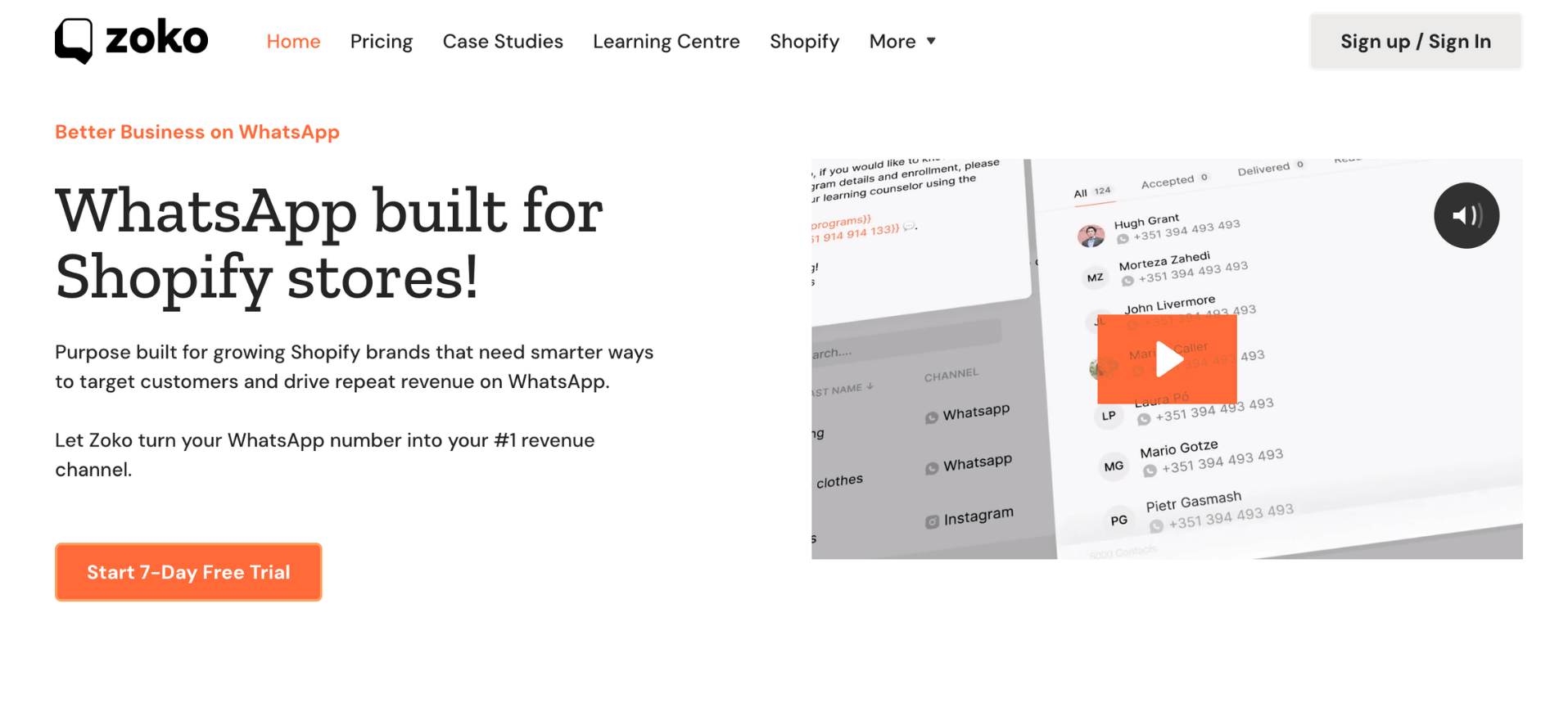
Zoko connects your Shopify store to the WhatsApp Business API so you can run broadcasts, automate lifecycle flows (cart recovery, COD confirmation, post-purchase), and manage sales/support in a shared team inbox.
Key features:
- Abandoned cart recovery flows — Trigger WhatsApp reminders based on Shopify cart/checkout events.
- Broadcast campaigns + segmentation — Send campaigns to targeted segments using tags and customer attributes.
- Shared multi-agent inbox — Route and manage incoming conversations across a team.
- Catalog sync / commerce — Sync your Shopify catalog for product sharing inside WhatsApp.
- Automation / flow builder — Build rule-based journeys (e.g., welcome, reorder, COD verification).
- Quick replies & templates — Speed up support and maintain brand-consistent responses.
Pros:
- Strong Shopify-native foundation for cart recovery + lifecycle messaging.
- Good fit for D2C teams that want marketing + support in one WhatsApp-centric tool.
- Generally praised for ease of setup and support responsiveness (common theme across user feedback).
Cons:
- Can get expensive as you scale (subscription + WhatsApp conversation fees + add-ons).
- Some users mention the UI could be improved (common review feedback theme).
- Requires clean opt-in + compliance processes to avoid deliverability/account issues.
Integrations:
- Shopify — Trigger flows from cart/checkout/order events and personalize messages with order data.
- Judge.me — Automate review requests and post-purchase review follow-ups via WhatsApp.
- Instagram — Manage IG + WhatsApp conversations in a single inbox (useful for social commerce).
- Facebook Messenger — Consolidate Meta messaging channels for faster response handling.
- Zapier — Connect Zoko to tools like Klaviyo/Sheets/CRMs for workflow automation (lead sync, tagging, reporting).
Pricing:
Starts at $49.99/month with a 7-day free trial, plus additional WhatsApp-related usage charges depending on volume/plan. Benchmark: Mid (entry plan), trending High as you add advanced features and scale volume.
Reviews:
- 4.5/5 on G2 (5 reviews)
- 4.8/5 on Shopify App Store (316 reviews)
2. Interakt
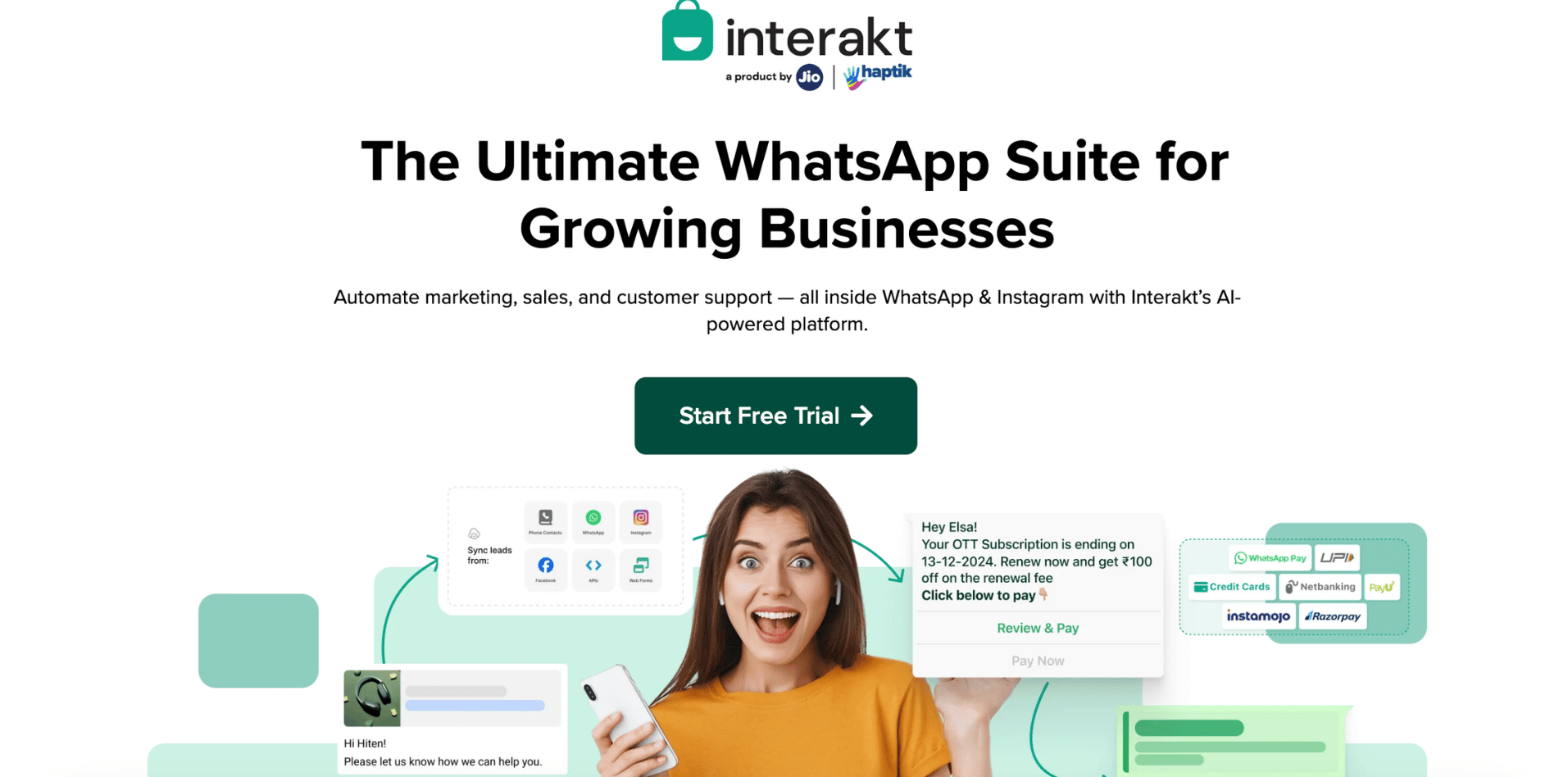
Interakt plugs into Shopify to power WhatsApp campaigns, automated notifications, and a shared team inbox, helping you convert chats into orders and run retention flows from customer events.
Key features:
- Automated WhatsApp notifications — Send order, shipping, and status updates from Shopify events.
- Abandoned cart recovery — Recover carts with automated reminders and incentives.
- Shared team inbox — Centralize inbound conversations and assign to agents.
- Catalog/product sharing — Share products/carts inside WhatsApp to shorten path to purchase.
- Broadcast campaigns + analytics — Run promotional blasts with performance tracking.
- Opt-in widgets/tools — Capture subscribers compliantly on-site and via flows.
Pros:
- Clear fit for Shopify brands that want reliable core WhatsApp flows (cart + post-purchase + broadcasts).
- Popular entry point for WhatsApp marketing in markets where WhatsApp is a dominant channel.
- Good “starter-to-scale” option if you keep your stack simple.
Cons:
- Some users mention design/UX limitations and complexity as you scale teams/workflows (common review feedback theme).
- Depending on your use case, advanced automation depth may feel lighter than specialist platforms.
- WhatsApp fees still apply (and can become meaningful at higher volumes).
Integrations:
- Shopify — Sync catalog and trigger customer/order automations.
- Zapier — Connect to CRMs and other apps for lead routing, tagging, reporting, and ops workflows.
- Meta (WhatsApp Business API) — Messaging infrastructure, templates, and compliance workflows.
- Google Sheets — Lightweight reporting/ops tracking through automation connectors.
- CRM (via Zapier) — Push WhatsApp leads to tools like HubSpot/Pipedrive for pipeline management.
Pricing:
Starts at $21/month with a 14-day free trial, with additional WhatsApp conversation charges; offers annual savings. Benchmark: Low → Mid (entry pricing is accessible vs many WhatsApp tools).
Reviews:
- 4.0/5 on Shopify App Store (196 reviews)
3. Wati
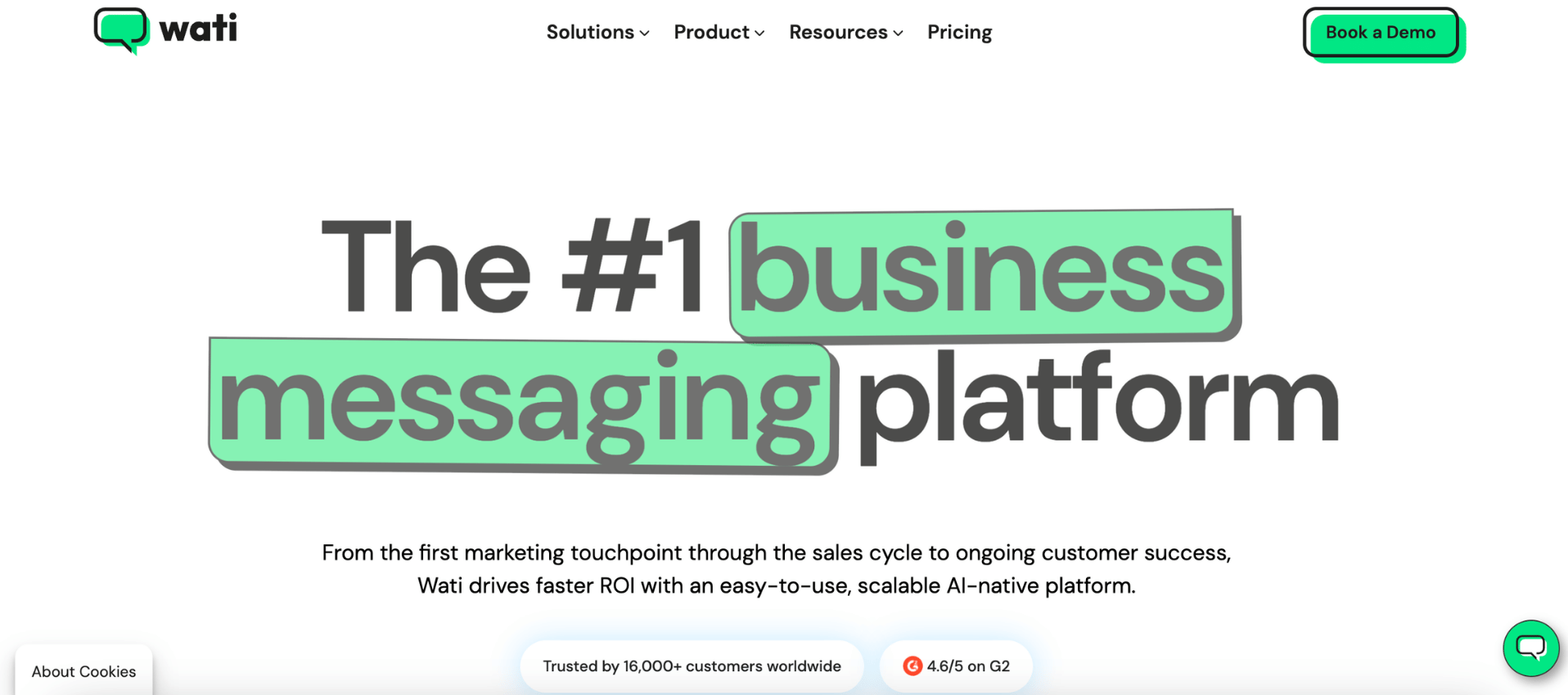
Wati is a WhatsApp Business API platform that combines broadcasts, automation, chatbots, and a team inbox—commonly used for cart recovery, support deflection, and sales assist on Shopify.
Key features:
- Shared team inbox — Manage high inbound volume with assignments and visibility.
- Abandoned cart + browse recovery — Automated nudges tied to commerce actions.
- Broadcast messaging — Segment and send campaigns at scale.
- Chatbots & automation — Build automated qualification, FAQs, and routed conversations.
- Campaign analytics — Track conversions and performance for WhatsApp outreach.
- Template management — Manage approved templates for marketing/utility messaging.
Pros:
- Strong for brands that need multi-agent operations (support + sales) on WhatsApp.
- Good breadth of features (inbox + automation + campaigns + analytics).
- Often adopted by teams looking for a more “platform-like” WhatsApp solution.
Cons:
- Pricing and plan limits can become noticeable for larger teams/automation-heavy setups.
- Some brands mention friction around operational constraints (e.g., messaging limits/ops rules) typical of WhatsApp ecosystems.
- Requires process maturity for opt-in, templates, and compliance.
Integrations:
- Shopify — Automate cart recovery, order updates, and personalize messages with order/customer data.
- Zapier — Connect Wati to thousands of tools for workflows (lead capture → CRM, reporting, tagging).
- HubSpot CRM — Sync leads/conversations to pipeline stages and trigger follow-ups.
- Zoho CRM — Route WhatsApp leads and updates into CRM workflows for sales teams.
- Google Sheets — Export contacts/events for reporting and operational tracking.
Pricing:
Shopify app is free to install, with paid plans shown from $59/month and higher tiers. Wati’s own pricing page also lists $119/month billed annually for a plan including 5 users. Benchmark: Mid → High (depending on plan + user count + usage).
Reviews:
4.6/5 on G2 (458 reviews)
4. DelightChat
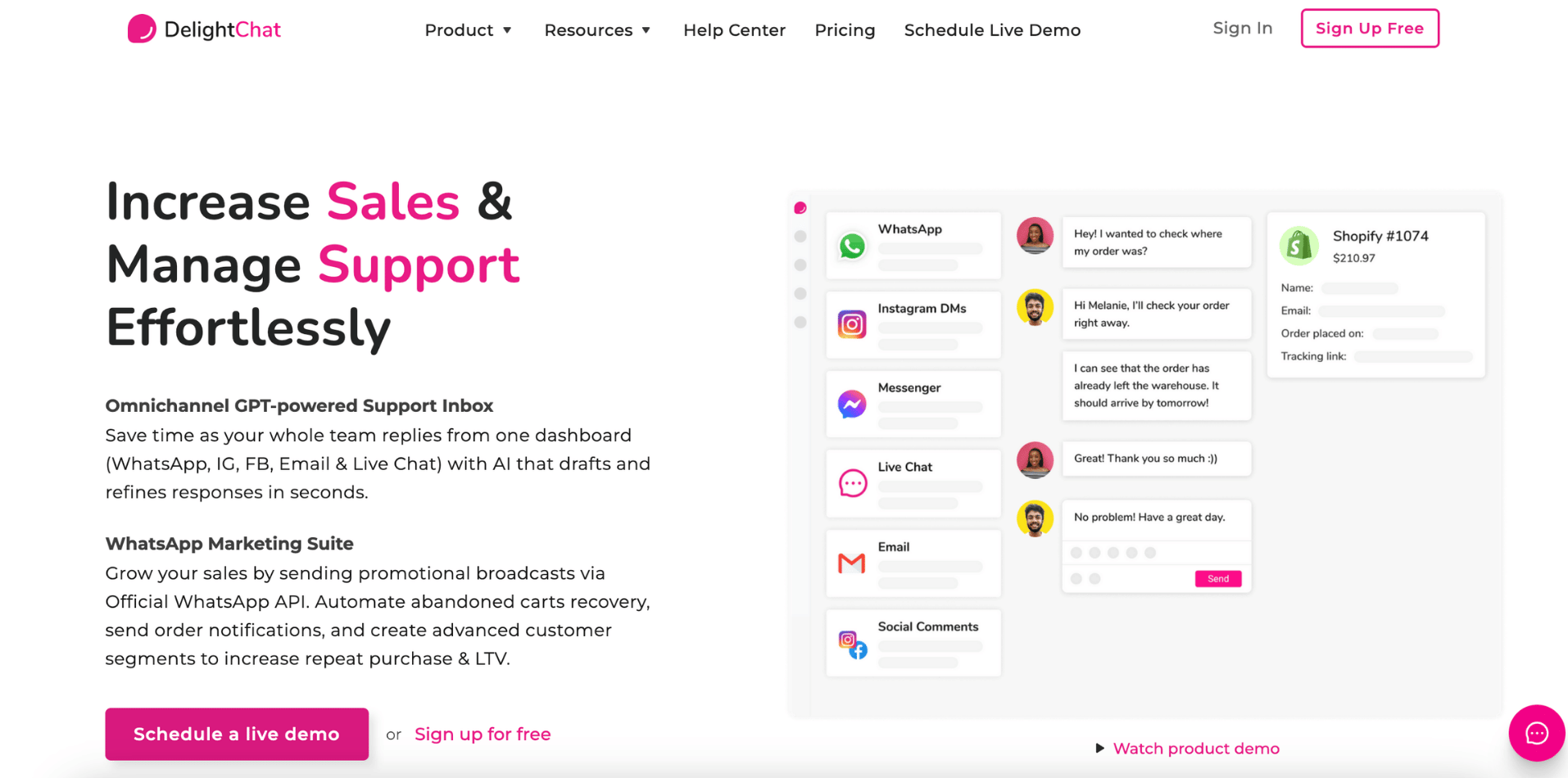
DelightChat is an omnichannel support helpdesk + WhatsApp marketing layer for Shopify brands—so you can run WhatsApp flows (cart recovery, broadcasts) while also managing support across WhatsApp, Instagram, email, and more.
Key features:
- Omnichannel team inbox — Handle WhatsApp + IG + email from one workspace.
- Abandoned cart recovery — Recover carts using WhatsApp automation tied to Shopify.
- Broadcast campaigns — Run segmented WhatsApp marketing blasts for promos and launches.
- Post-purchase journeys — Automate order updates, upsells, and review requests.
- Internal collaboration — Notes, assignments, and workflows for support teams.
- Analytics — Basic performance insights for support + marketing.
Pros:
- Ideal for D2C brands that want WhatsApp marketing + customer support together.
- Often perceived as strong value for teams that need many agents (since plans emphasize team usage).
- Good option if you want one tool to cover both revenue + CX workflows.
Cons:
- If you’re “marketing-only,” you may pay for helpdesk capabilities you don’t need.
- Advanced marketing automation depth may be lighter than WhatsApp-only specialists.
- Omnichannel setups require stronger ops discipline (routing, SLAs, tagging).
Integrations:
- Shopify — Pull order/customer context into support and trigger WhatsApp flows from store events.
- Instagram — Manage IG DMs and WhatsApp in one inbox (useful for social commerce brands).
- Facebook — Centralize Meta inbox channels for faster response and consistent CX.
- Email (Gmail/SMTP workflows) — Consolidate email support and automate key replies.
- WhatsApp Business API — Use official templates and messaging categories for lifecycle communication.
Pricing:
Starts at $29/month on their pricing page with a 14-day free trial. Shopify listing shows tiers including $99/month and $299/month with a 14-day free trial. Benchmark: Low → Mid (entry), trending Mid for teams using higher tiers.
Reviews:
- 4.8/5 on Shopify App Store (207 reviews)
5. BiteSpeed
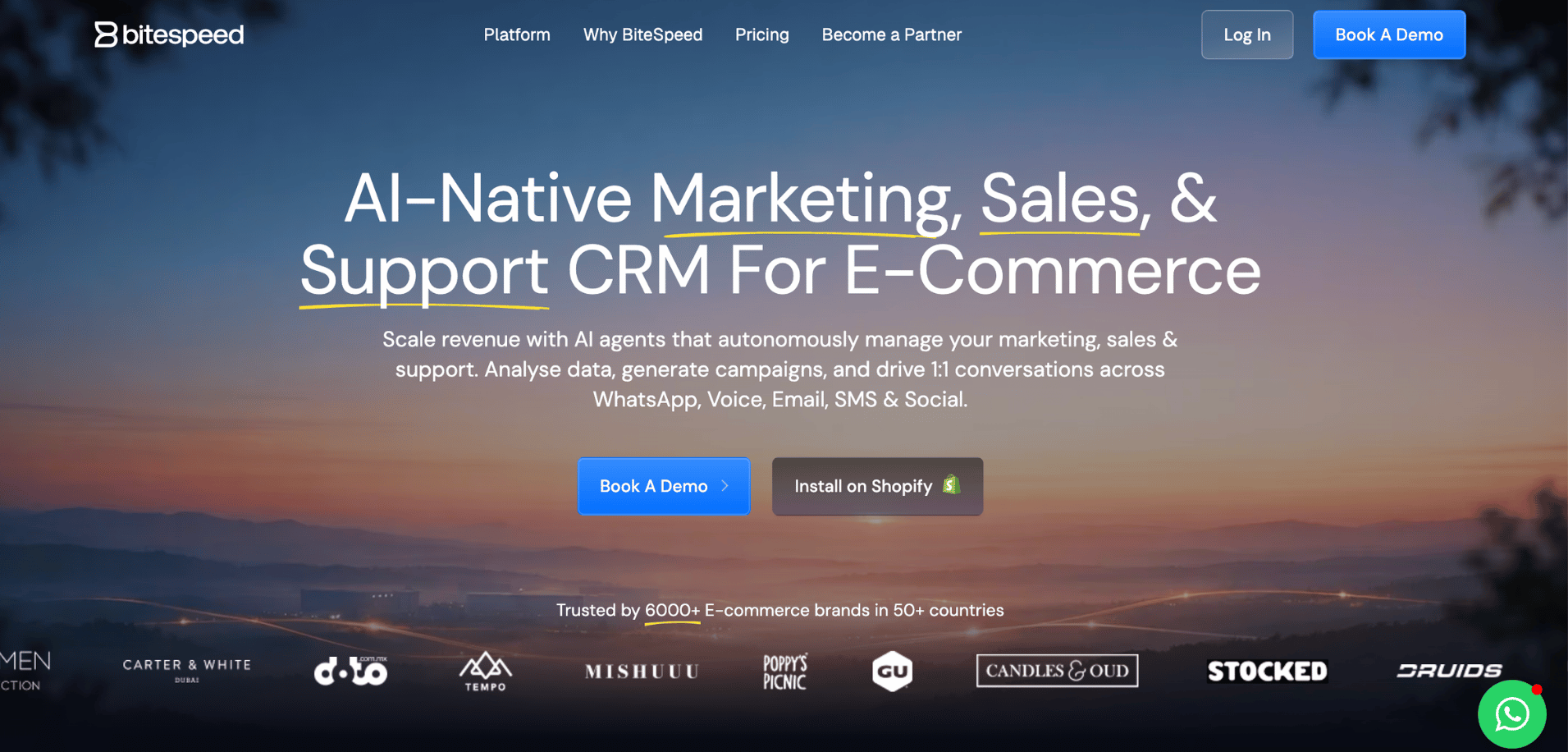
BiteSpeed positions itself as an AI-native marketing + support CRM where WhatsApp is a core channel—commonly used for cart recovery, broadcasts, segmentation, and automation, often alongside other channels.
Key features:
- WhatsApp cart recovery — Automated recovery sequences and follow-ups to lift conversion.
- Broadcast campaigns + segmentation — Target customers based on behavior and purchase history.
- Automation builder — Create journeys that trigger from actions (e.g., abandons, purchases, inquiries).
- Unified inbox — Manage conversations in one place (useful for support + sales assist).
- Campaign measurement — Track outcomes and optimize messaging sequences.
- Support automation — Deflect FAQs and repetitive tickets with automation/AI features.
Pros:
- Strong for brands wanting a modern “CRM-like” layer around WhatsApp marketing.
- Good for lifecycle use cases beyond cart recovery (upsell, reorder, post-purchase).
- Often seen as effective for teams that want WhatsApp to be a real revenue channel, not just support.
Cons:
- Full value tends to show at scale; smaller brands may find premium tiers expensive.
- Some user feedback mentions operational gaps typical of newer “all-in-one” tools (e.g., workflow depth vs specialists).
- You’ll still need disciplined opt-in and messaging governance to avoid fatigue/unsubscribes.
Integrations:
- Shopify — Trigger flows from store actions and personalize messages with order/customer data.
- WhatsApp Business API — Run approved templates for marketing, utility and support journeys.
- Email (lifecycle) — Coordinate cross-channel journeys (WhatsApp + email) from the same platform.
- SMS — Add SMS touches where WhatsApp isn’t ideal for a segment/region.
- Instagram — Consolidate conversational channels for support + social commerce.
Pricing:
Shopify app lists Free. Third-party pricing summaries list paid tiers starting at $249.99/month with higher plans. Benchmark: High (for paid tiers), with a low barrier via free install/free plan.
Reviews:
- 4.7/5 on Shopify App Store (349 reviews)


6. Gallabox

Gallabox is a WhatsApp marketing and automation platform that helps D2C brands run lifecycle messaging flows, abandoned cart recovery, and promotional broadcasts while consolidating conversations into a single team inbox.
Key features:
- Abandoned cart flows — Automatically send WhatsApp reminders when customers leave items in cart.
- Broadcast messaging — Segment customers and send targeted promotional blasts.
- Campaign analytics — View performance metrics like delivery, open and conversion rates.
- Multi-agent inbox — Manage incoming WhatsApp messages with assignments and team workflows.
- Automation sequences — Build lifecycle flows like welcome, post-purchase follow-ups, and re-engagement.
- Template management — Create and manage WhatsApp template messages for marketing and updates.
Pros:
- Simple, WhatsApp-centric automation for recovery and engagement.
- Good for D2C brands that want predictable cart revenue flows without complex setup.
- Useful for centralized team collaboration on WhatsApp responses.
Cons:
- Limited advanced segmentation and analytics compared to some competitors.
- Broadcast limits and operational constraints tied to WhatsApp API may affect large lists.
- Smaller user community and less public long-form review data compared to bigger tools.
Integrations:
- Shopify — Trigger abandoned carts, orders, and customer segments for broadcast messaging.
- WhatsApp Business API — Official messaging infrastructure, templates, and compliance support.
- Zapier — Connect Gallabox to CRM, email tools, spreadsheets, and other operational apps.
- Google Sheets — Sync campaign data for external reporting and ops.
- CRM integrations via Zapier — Move leads and conversations into CRM pipelines.
Pricing:
Gallabox offers tiered plans that generally start in the low-mid pricing range with monthly billing, often including a free trial or demo for evaluation. Exact pricing is usage/seat dependent and slightly Mid compared to other WhatsApp tools.
Reviews:
- 4.5/5 on Shopify App Store (100+ reviews)
7. Dondy
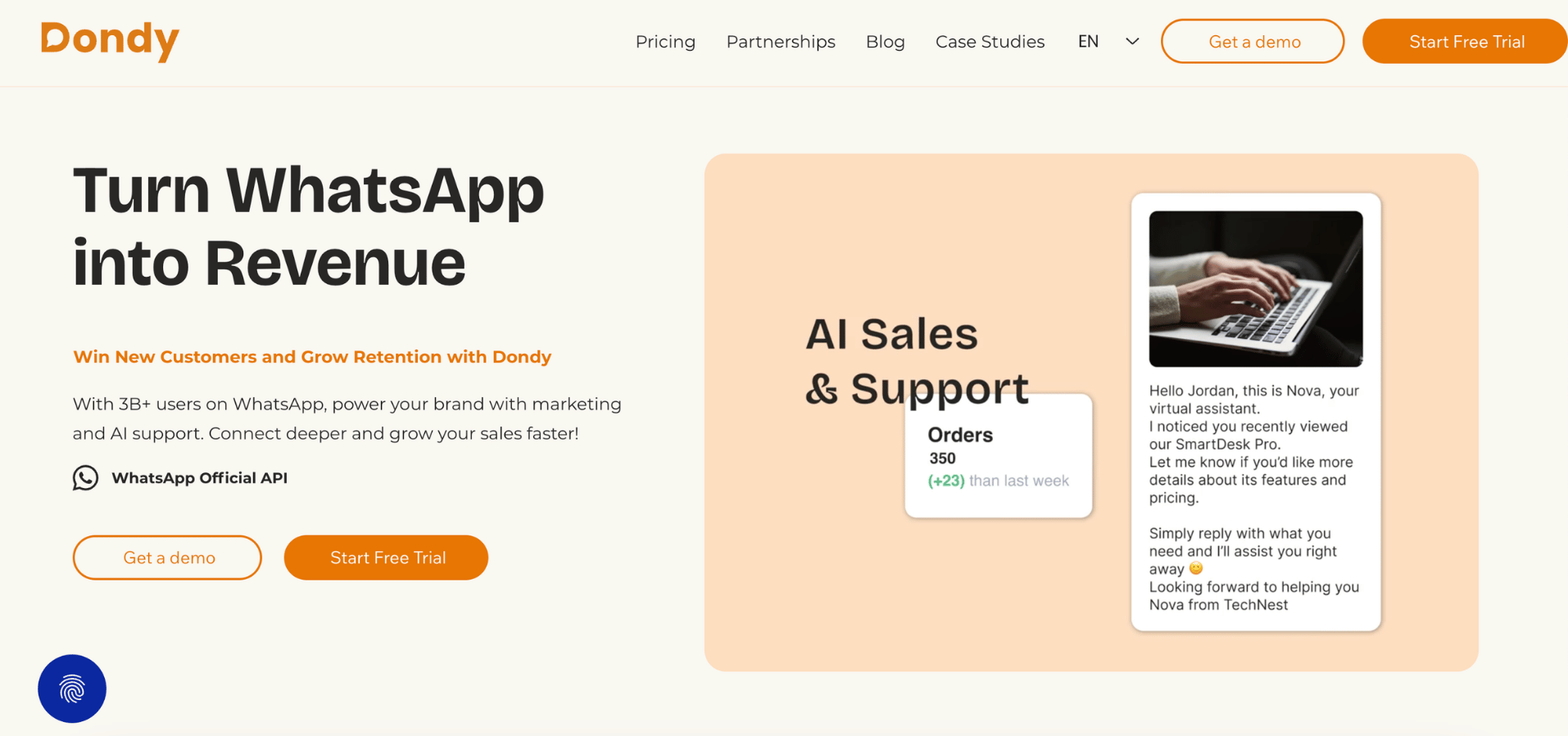
Dondy is a modern WhatsApp marketing platform that leverages AI automation, segmented campaigns, and funnel workflows to help D2C brands capture, engage, and convert customers via conversational journeys tied to Shopify events.
Key features:
- AI-driven automations — Use AI tools to personalize journeys and responses.
- Lifecycle flows — Set up cart recovery, post-purchase, and re-engagement sequences on WhatsApp.
- Broadcast campaigns — Target segmented audiences with promotional messages.
- Advanced segmentation — Filter users based on purchase behavior and activity.
- Performance analytics — Track engagement and conversion metrics across campaigns.
- Template management — Make and manage WhatsApp message templates for approvals and sends.
Pros:
- AI features give an edge for personalization and dynamic messaging.
- Good fit for D2C brands that want beyond basic automation (e.g., behavioral triggers).
- Modern UI and data-driven approach praised in some forums and trial experiences.
Cons:
- Pricing trends toward higher tiers — small shops may find it expensive.
- Some users mention early-stage features still maturing (common for newer tools).
- Being newer, community feedback is smaller compared to legacy platforms.
Integrations:
- Shopify — Trigger flows based on carts, orders, and customer segments.
- WhatsApp Business API — Core messaging infrastructure and template management.
- Klaviyo — Sync segments and lifecycle events for cross-channel journeys.
- Zapier — Connect to CRM and analytics workflows for deeper automation.
- Google Analytics — Measure WhatsApp impact via combined reporting.
Pricing:
Dondy typically offers tiered subscription plans billed monthly or annually with free/demo access for evaluation. Plans fall in the Mid → High range compared to other WhatsApp marketing tools, particularly as AI and segmentation features expand value.
Reviews:
- 4.3/5 on Shopify App Store (20+ reviews)
8. CK: Abandoned cart on WhatsApp (Carthike)
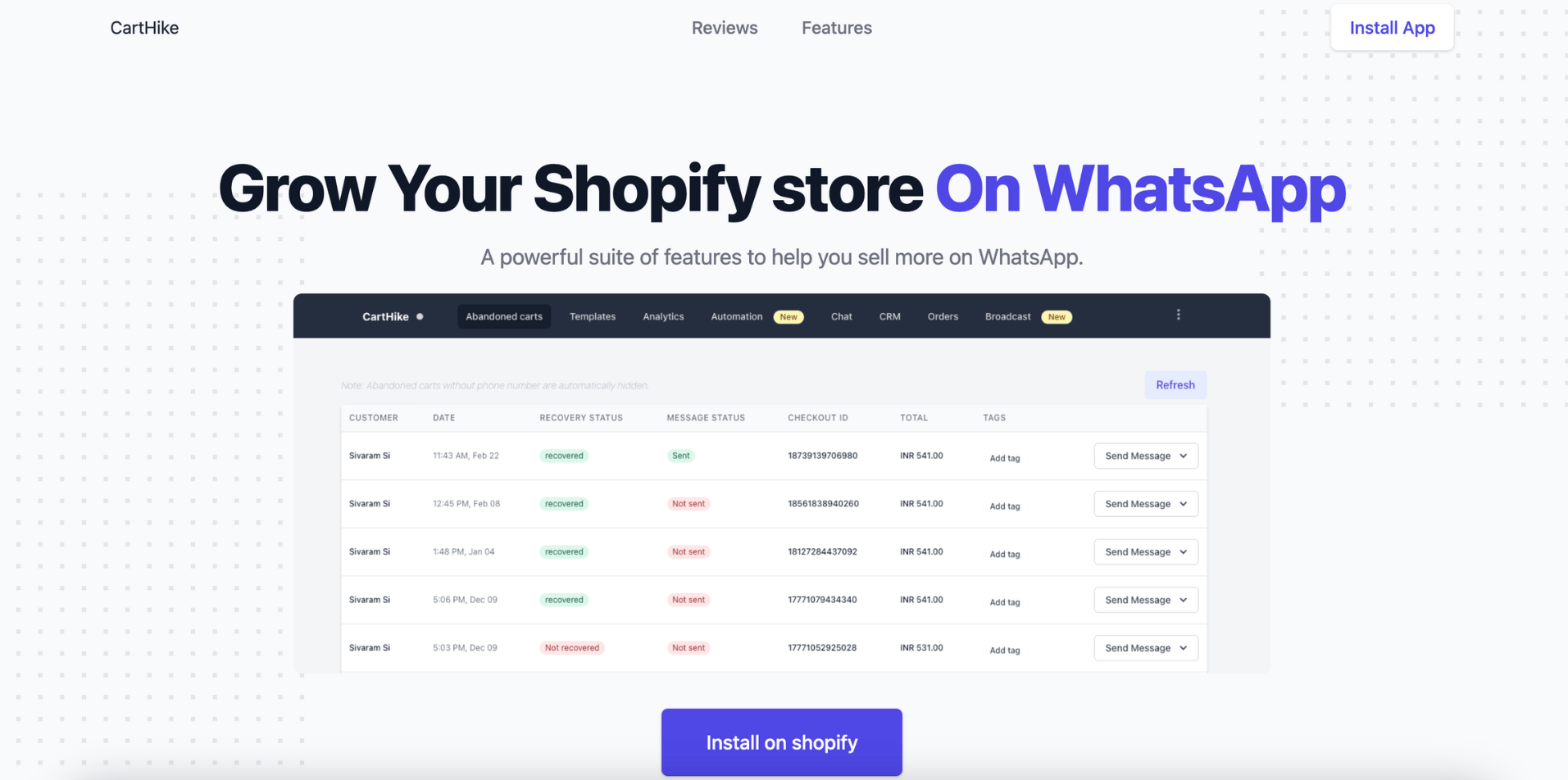
CK (Carthike) focuses specifically on WhatsApp abandoned cart recovery for Shopify stores, using automated WhatsApp messages and recovery sequences to recapture lost revenue.
Key features:
- Automated cart recovery — Send WhatsApp reminders when customers abandon their carts.
- Triggered sequences — Timed follow-ups designed to bring buyers back into purchase flow.
- Message templates — Pre-built templates that follow WhatsApp API rules for compliance.
- Performance tracking — Dashboard view of delivery and recovery results.
- Customer opt-in builds — Tools to capture compliant WhatsApp opt-ins on site.
- Segmentation basics — Basic segmenting to tailor messages by customer groups.
Pros:
- Very focused revenue outcome tool (cart recovery = direct sales impact).
- Lower complexity for merchants who want to start with WhatsApp revenue flows, not full CRM.
- Quick setup relative to more comprehensive platforms.
Cons:
- Narrow feature set — no full inbox or broad marketing workflows.
- Lacks advanced segmentation and lifecycle automation.
- Not ideal if you want omnichannel support or complex campaigns.
Integrations:
- Shopify — Primary integration to trigger cart events and sync abandoned data.
- WhatsApp Business API — Messaging infrastructure and template management.
- Zapier — Optional connection to CRM/analytics if required.
- Google Sheets — Export reporting and metrics externally.
- Email tools (via Zapier) — Combine email + WhatsApp cart nudges if needed.
Pricing:
Pricing is generally Lower compared to full WhatsApp platforms, often with monthly billing and possibly a free trial. Exact pricing tiers vary; benchmarked as a low entry point tool for cart recovery only.
Reviews:
- 4.2/5 on Shopify App Store (40+ reviews)
9. Wava
Wava focuses on WhatsApp automated cart recovery solutions for Shopify brands, with simple workflows that trigger WhatsApp messages when users abandon carts or sessions.
Key features:
- Cart recovery automation — Send WhatsApp reminders for abandoned carts.
- Timed follow-ups — Sequence messages at custom intervals to maximize recovery rate.
- Opt-in tools — Capture WhatsApp numbers compliantly during browsing/checkout.
- Template compliance — Built-in adherence to WhatsApp API template rules.
- Performance tracking — View recovery statistics and revenue attributed.
- Basic segmentation — Segment based on simple customer/cart attributes.
Pros:
- Easy to set up and highly focused on a single, measurable revenue metric.
- Lower learning curve for teams new to WhatsApp marketing.
- Clean interface and simple reporting.
Cons:
- Limited beyond cart recovery — no broadcast, inbox, or lifecycle flows.
- Not suited for brands seeking a full WhatsApp CRM solution.
- Segmentation and automation depth is basic.
Integrations:
- Shopify — Sync cart and customer data to trigger automation.
- WhatsApp Business API — Sends official WhatsApp messages and manages templates.
- Zapier — Optional extension to CRM/analytics workflows.
- Google Sheets — Export data for external monitoring.
- Email tools (via Zapier) — Pair up email + WhatsApp reminders if desired.
Pricing:
Structured in Low → Mid pricing tiers, often billed monthly with free evaluations/demos available. Benchmarks show Wava as economical for cart recovery-focused brands.
Reviews:
- 4.3/5 on Shopify App Store (80+ reviews)
10. respond.io
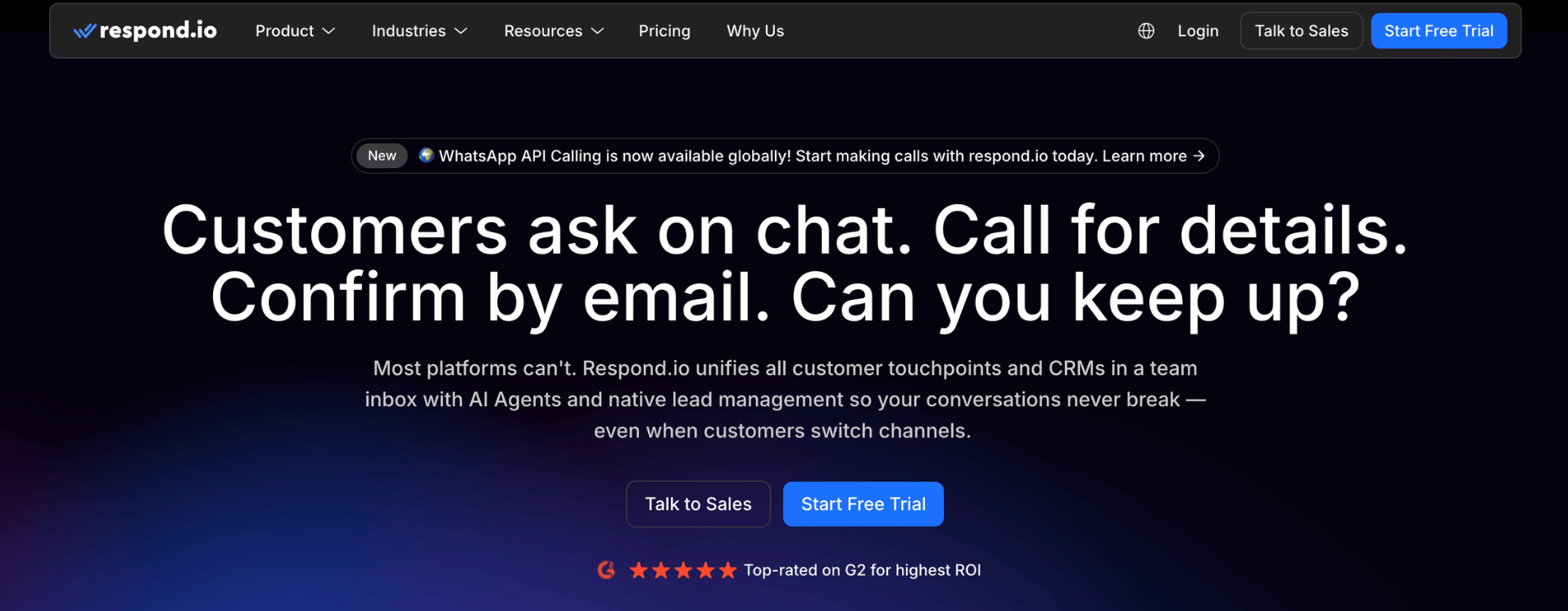
respond.io is a conversational engagement platform that centralizes WhatsApp, Messenger, IG DMs, and other channels into a unified inbox with advanced automation, workflows, and team collaboration—used by D2C brands at scale for support, sales conversations, and automation.
Key features:
- Omnichannel inbox — Consolidate WhatsApp, Messenger, IG, and more for multi-team use.
- Custom workflows & automations — Build rule-based pathways for qualification, routing, and engagement.
- AI assist & bots — Add AI to handle FAQs and support volume spikes.
- Tags & CRM database — Build profiles and segments from conversational data.
- Analytics & reporting — Deep insights into engagement and agent performance.
- Security & governance — Compliance, roles, and audit trails for teams.
Pros:
- Flexible, powerful tool for teams that handle lots of inbound conversations.
- Great for brands where messaging is used for support + sales qualification.
- Scales from startups to enterprise workflows.
Cons:
- Not Shopify-native out of the box (relies on integrations for commerce events).
- Pricing can trend High for smaller teams that don’t need full platform depth.
- Setup and workflow design require more operational investment.
Integrations:
- WhatsApp Business API — Real channel connectivity and approved messaging templates.
- Shopify (via integrations like Zapier) — Trigger commerce events into flows and sync orders/contacts.
- CRM (HubSpot, Salesforce) — Pass conversational data into sales pipelines.
- Email & SMS — Create cross-channel sequences from the same platform.
- Analytics & data warehouses — Export engagement data for analytics.
Pricing:
respond.io pricing starts around Mid → High tier, typically billed monthly or annually with custom enterprise quotes for larger organizations. Free plans may be available for limited users/channels; paid plans scale with usage and team size.
Reviews:
- 4.6/5 on G2 (700+ reviews)
- 4.5/5 on Capterra (200+ reviews)
Final Thoughts on Best Whatsapp Marketing Tools for D2C Brands
WhatsApp has evolved into a high-converting lifecycle and revenue channel for D2C brands, especially when tightly integrated with Shopify for abandoned cart recovery, post-purchase flows, and segmented broadcast campaigns. The right tool ultimately depends on your use case: focused cart recovery apps offer a low-cost entry point, while full WhatsApp CRM platforms combine automation, inbox management, and omnichannel capabilities for scaling brands. For D2C operators in the $5–100M range, success comes down to choosing a platform that balances automation depth, team collaboration, compliance, and cost efficiency—while turning conversations into measurable revenue.

.png)


.jpg)