


5 Best Upselling Software Tools for D2C Brands
For D2C brands operating on platforms like Shopify, increasing Average Order Value (AOV) is often the fastest lever to unlock incremental revenue without raising Customer Acquisition Costs (CAC). According to Shopify, effective upselling and cross-selling strategies can increase revenue by 10–30% when executed properly (Shopify, 2024).
For founders and eCommerce leaders, the right upselling software can materially improve contribution margins, LTV, and overall profitability. In this article, we break down five of the most widely adopted upselling tools used by modern D2C brands.
Best Upselling Software Tools
| TOOL | REVIEWS | BEST FOR | TRIAL INFO | PRICING | ||
|---|---|---|---|---|---|---|
1 |
|
⭐ | AI upsell funnels & post-purchase offers | Book Demo | Pricing | Website |
2 |
|
⭐ | Post-purchase & thank-you page upsells | Book Demo | Pricing | Website |
3 |

|
⭐ | Product bundles & in-cart upsells | Book Demo | Pricing | Website |
4 |

|
⭐ | Simple “frequently bought together” offers | Book Demo | Pricing | Website |
5 |

|
⭐ | Cart drawer upsells & UI customization | Book Demo | Pricing | Website |
1. One Click Upsell – Zipify OCU

One Click Upsell enables Shopify brands to quickly build pre-purchase, in-checkout (Plus), and post-purchase one-click upsell funnels that customers can accept without entering payment details again, helping increase Average Order Value (AOV). It also includes analytics and AI recommendations for optimizing offer performance.
Key features:
- Pre-purchase & post-purchase upsell widgets (product page, cart, thank-you page)
- In-checkout upsells for Shopify Plus stores
- AI-driven recommendations for relevant offers
- Funnel A/B testing and analytics
- Cart drawer upsell blocks for in-cart offers
- Customizable discount and offer rules
Pros:
- Very strong funnel builder across every stage of checkout
- Highly customizable offers with performance insights
- Well-known for reliable merchant support
Cons:
- Can require setup time to maximize incremental revenue
- Pricing scales with generated upsell revenue
- Some merchants report edge-case workflows needing support
Integrations:
- Shopify (native checkout & products) – create offers at all stages
- Recharge – support for upselling subscription products
- Postscript – use upsell data to trigger SMS campaigns
- Klaviyo – sync offer acceptance into email flows
- Page builders (Zipify Pages) – embed offers in landing pages
Pricing:
Starts at approximately $8/month, with pricing scaling based on upsell revenue generation and a 30-day free trial. Mid-to-high pricing tier compared to simple bundle apps.
Reviews:
4.5/5.0 stars (488 reviews) on the Shopify App Store — merchants report significant increases in average order value and strong analytics support.
2. Upsell.com (ReConvert Upsell & Cross Sell)
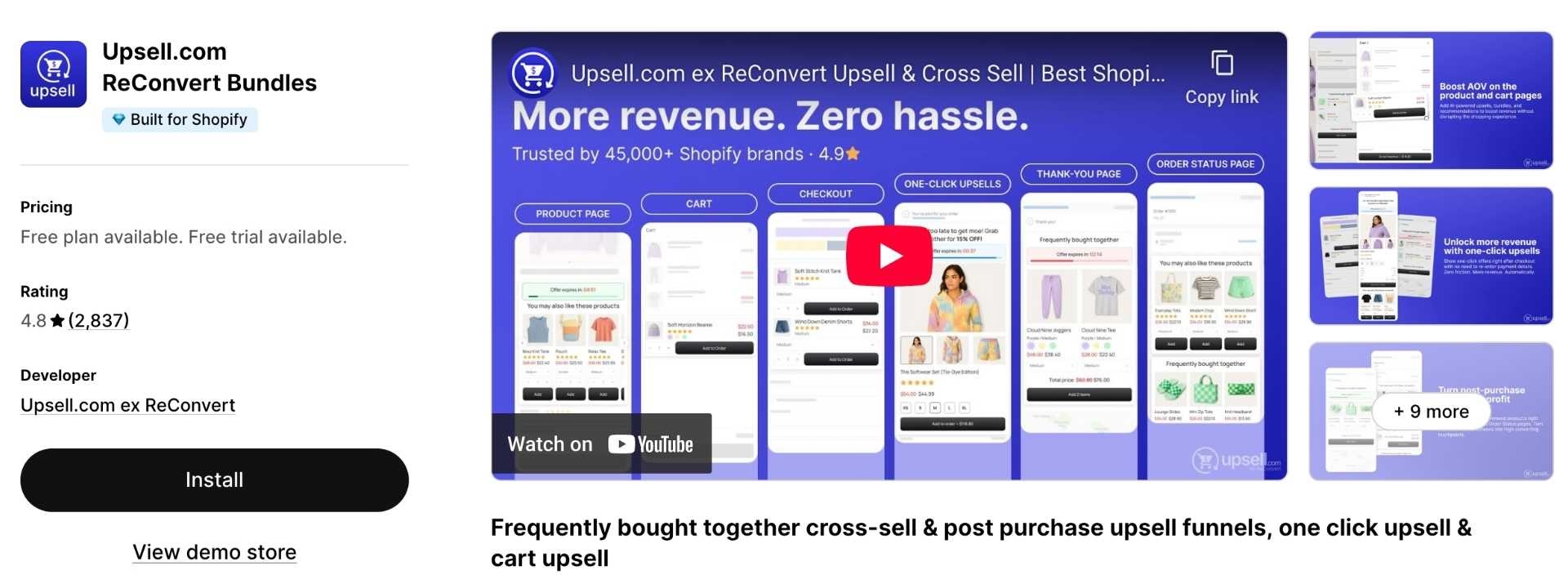
ReConvert (now branded Upsell.com) focuses on maximizing post-purchase revenue via thank-you page customization, cross-sells, surveys, reorder buttons, recommended products, and one-click post-purchase upsells — all designed to boost lifetime value and repeat purchases.
Key features:
- Drag-and-drop thank-you page builder
- Post-purchase upsell & cross-sell offers
- Personalized product recommendations throughout journey
- Surveys, birthday collectors, reorder buttons
- Analytics & performance insights
- Cart & checkout upsell placement options
Pros:
- Strong thank-you page conversion focus with deep customization
- Helps with retention + repeat purchase mechanics
- Intuitive interface makes setup fast
Cons:
- Not as rich in pre-checkout upsells as dedicated funnel apps
- Smaller feature set for Shopify Plus in-checkout offers
- May require complementary tools for full funnel coverage
Integrations:
- Shopify – builds offers across pages
- Klaviyo – use customer profile data in upsell segmentation
- SMS/email platforms – push offer info post-purchase
- Rebuy – enhances personalization layers
- Loyalty programs – tie upsells to loyalty rewards
Pricing:
Free plan available; paid tiers scale based on features and upsell volume. Offers a free trial. Pricing tends toward mid-tier for comprehensive upsell tools.
Reviews:
- 4.8/5.0 stars (2,800+ reviews) on Shopify App Store — merchants frequently highlight immediate AOV gains and simple post-purchase funnels.
3. Upsell & Cross Sell — Selleasy
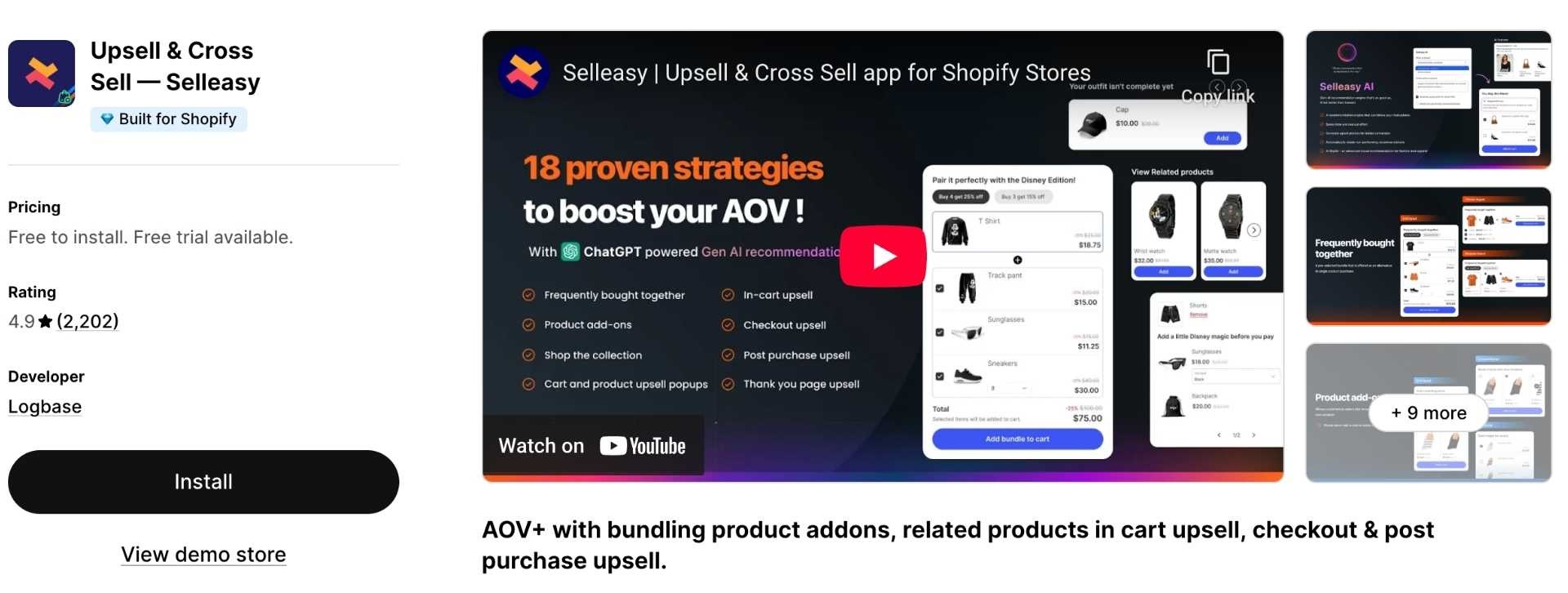
Selleasy adds Amazon-style “frequently bought together” recommendations and cross-sell bundles throughout the product page, cart, and thank-you page to increase order value. It’s often praised for simplicity and ease of use.
Key features:
- Frequently bought together product bundles
- Cart and product page add-on displays
- Post-purchase upsell & thank-you page offers
- Customizable list/grid/carousel recommendations
- Responsive Shopify theme compatibility
Pros:
- Easy setup and straightforward management
- Works well on older themes without manual coding
- Reliable performance and responsive support
Cons:
- Less advanced analytics than full funnel builders
- Doesn’t have heavy-duty automation rules
- Not as deep feature set for complex offer sequencing
Integrations:
- Shopify – product data & offer placement
- Cart drawer tools – works alongside in-cart upsells
- Page builders – embed upsell widgets
- Email/SMS platforms – sync recommendation data
- Loyalty programs – recommend points/incentive offers
Pricing:
Typically free tier available, with paid plans inexpensive relative to larger funnel tools (often low-mid tier category). Free often sufficient for basic upsells.
Reviews:
- 4.9/5.0 stars (2,000+ reviews) on Shopify App Store — merchants commonly cite easy setup and strong boost in conversion rates.


4. Essential Upsell & Cross Sell
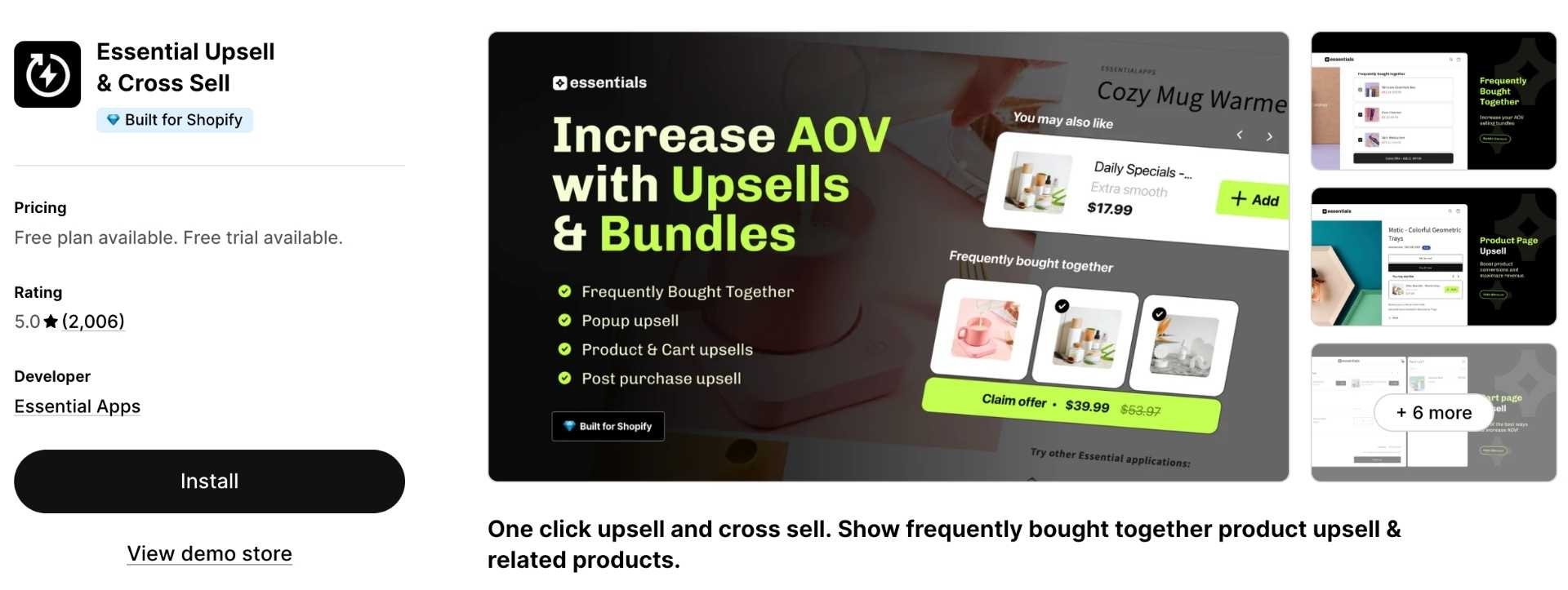
Essential Upsell & Cross Sell helps merchants leverage frequently bought together, related product recommendations, cart add-ons and one-click offers to increase AOV, particularly via intuitive automations and display widgets across product and cart pages.
Key features:
- Frequently bought together & “also like” recommendations
- Cart drawer upsell widgets
- Product bundle deals and add-on promotions
- Automatic discount promotions on upsells
- Post-purchase upsell options
Pros:
- Seamless upsell & cross-sell strategy coverage
- Highly rated for merchant support and reliability
- Integrated discount and bundle options simplify promotions
Cons:
- Not as powerful for deeply customized funnel logic
- Some stores may require manual configuration
- Feature set less suitable for very complex upsell flows
Integrations:
- Shopify – core integration for upsell placement
- Page builders – embed upsell blocks
- Cart tools – enhance cart experience
- Email/SMS platforms – event sync for campaigns
- Subscription apps – upsell into recurring buys
Pricing:
Free plan available and highly rated for covering most essentials without a high cost. Positioned in the low-mid pricing tier for growth merchants.
Reviews:
5.0/5 stars (~1,985 reviews) on Shopify App Store — indicating exceptionally high merchant satisfaction.
5. Upcart / Cart Drawer Upsell

Upcart focuses on cart drawer upsell and cross-sell experiences, letting merchants display add-ons, recommended products, free shipping progress bars, and customized mini-cart upsell offers to boost conversions right before checkout.
Key features:
- Slide cart drawer with upsell widgets
- Free shipping/progress bar triggers
- Product add-ons and upsell sections in cart
- Custom announcements and cart messaging
- Seamless theme integration
Pros:
- Excellent at streamlining the cart + upsell experience
- Very easy to set up
- Good for stores that want focused cart optimization
Cons:
- Not as extensive for post-purchase funnels
- Not designed to manage thank-you page upsells as deeply
- Some theme compatibility edge cases
Integrations:
- Shopify – mini-cart and cart drawer
- Discount engines – progress bar triggers
- Email/SMS marketing platforms – capture cart behavior
- Page builders – embed cart triggers
- Loyalty tools – cart incentives
Pricing:
Free plan available for development stores; paid plans from approx $29.99/month+ with a free trial. Falls in the low-mid pricing tier.
Reviews:
- 4.6/5 stars (~725 reviews) on Shopify App Store — merchants praise easy setup and AOV lift.
Final thoughts on the best upselling apps for D2C brands:
The right upselling software can significantly increase Average Order Value (AOV), improve contribution margins, and unlock incremental revenue without increasing Customer Acquisition Costs (CAC).
Whether you prioritize full-funnel one-click upsells, post-purchase thank-you page optimization, or high-converting cart drawer offers, each of the tools covered serves a distinct growth strategy for scaling D2C brands. For founders and eCommerce leaders, the key is aligning your upsell stack with your checkout flow, subscription model, and retention strategy to maximize long-term LTV—not just short-term AOV.

.png)


.jpg)