

10 Best Traackr Alternatives • Key Criteria • Traackr Overview • Best Traackr Alternatives • GRIN • Upfluence • CreatorIQ • Influencer Hero • NeoReach • Lefty • Insense • Kolsquare • Skeepers • Creator.co • Final Thoughts • FAQs
10 Best Traackr Alternatives for Influencer Marketing
Scaling creator partnerships has become essential for D2C brands, but doing it efficiently requires more than manual processes and scattered tools. Influencer marketing software helps teams centralize creator discovery, streamline outreach, manage campaigns, and accurately track performance and revenue impact. Traackr is a well-established platform known for its strong analytics, benchmarking capabilities, and global reporting, making it a popular choice for larger teams. However, many brands find it expensive, less transparent on pricing, and more complex to use, which is why they start exploring Traackr alternatives that better match their workflows, budgets, and growth stage.
In this guide, we’ll compare the 10 best Traackr alternatives—including GRIN, Upfluence, CreatorIQ, Influencer Hero, NeoReach, Lefty, Insense, Kolsquare, Skeepers, and Creator.co—to help you find the right influencer marketing software for your brand.
Key Criteria for Evaluating Influencer Marketing Platforms
Core Features
Evaluation of essential influencer marketing capabilities, including influencer discovery, outreach, CRM, campaign management, reporting, and content workflows.
Pricing & Flexibility
Comparison of pricing models, subscription plans, and contract terms to match different budgets and growth stages.
Customer Reviews & Satisfaction
Analysis of user feedback from trusted review platforms, focusing on usability, reliability, customer support, and overall performance.
Pros & Cons
Review of each platform’s strengths and limitations to highlight where it performs well and where it may fall short based on different use cases.
Integrations
Review of the most important integrations (e.g., Shopify and other tech tools), highlighting what each integration enables in one sentence.
Traackr Overview
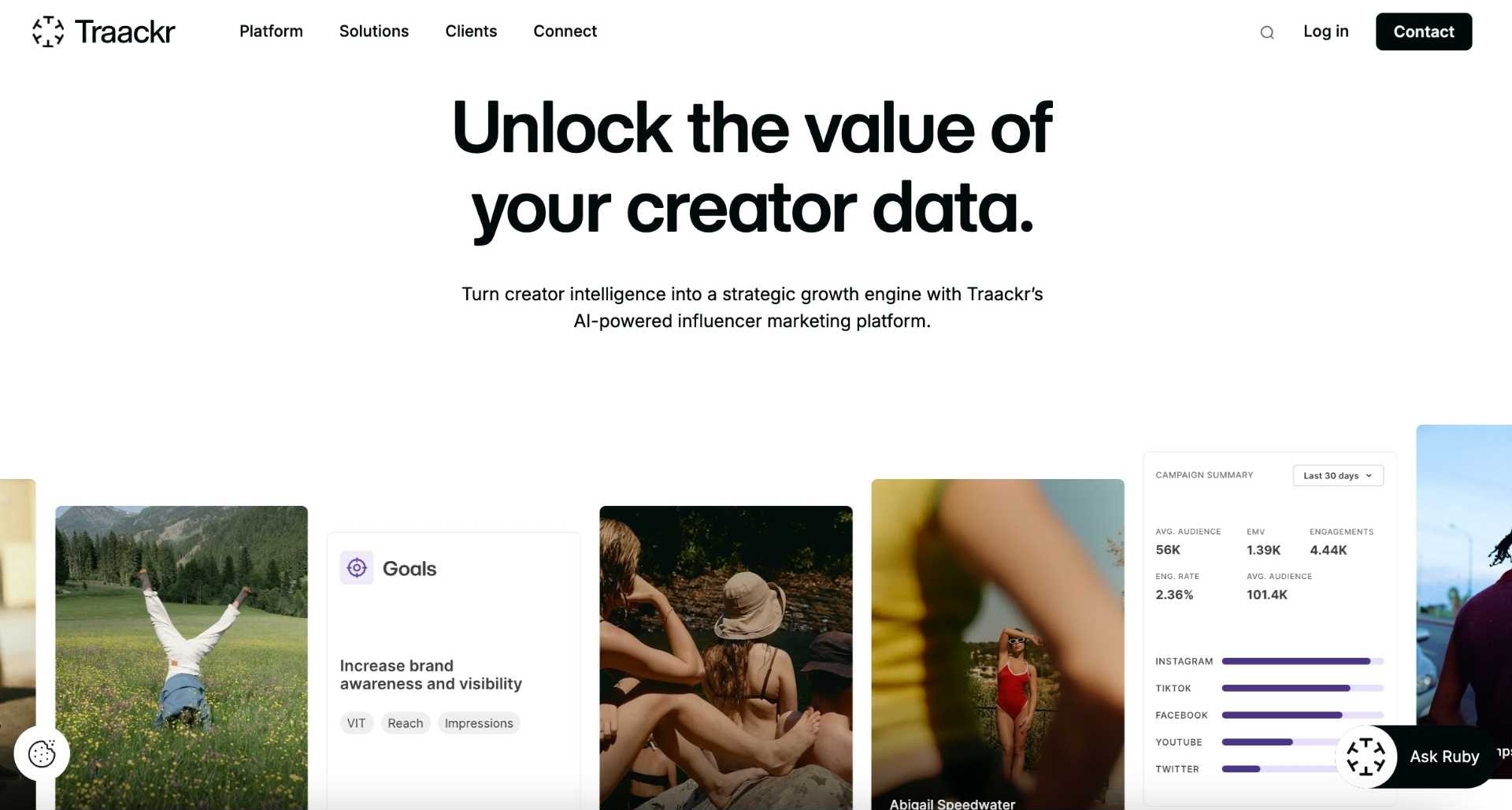
Traackr is an enterprise-focused influencer marketing platform built for brands that want more than creator discovery alone. Its positioning is strongly data-led: the platform combines influencer discovery, relationship management, campaign tracking, benchmarking, and ROI analysis, with a particular emphasis on helping larger teams standardize measurement across markets and justify spend. Traackr’s current messaging also leans heavily into creator intelligence and AI-assisted workflows, making it a strong fit for brands that care about performance visibility, competitive benchmarking, and global program management.
Key Features
- Influencer discovery and vetting: Traackr helps brands find creators using audience, performance, and fit signals rather than relying on follower count alone. Its discovery stack is positioned around AI-assisted search, vetted creator data, and brand-fit evaluation.
- AI Content Summaries: One of Traackr’s newer differentiators is AI Content Summaries, which give teams a fast snapshot of a creator’s voice, tone, topics, sentiment, and brand mentions. That reduces manual vetting time and makes it easier to judge content fit before outreach or spend.
- Influencer relationship management: Traackr is designed to centralize creator records, outreach visibility, and team workflows so brands can manage creators as long-term partners instead of one-off contacts. It is built for structured collaboration across internal teams and regions.
- Campaign tracking and real-time optimization: The platform tracks creator and content KPIs as campaigns run, so teams can monitor what is performing, spot standout posts, and make mid-campaign adjustments instead of waiting until the end.
- ROI and performance reporting: Traackr’s reporting is one of its biggest strengths. It supports analysis across creators, content, platforms, and markets, including clicks, conversions, revenue, engagement, and video-view metrics, with visibility into organic versus paid activations.
- Brand Vitality Score (VIT): Traackr’s proprietary VIT metric is meant to measure creator marketing performance more holistically by combining visibility, engagement, and trust into one score. This is a major part of how Traackr differentiates itself from tools that rely mainly on EMV or surface-level engagement stats.
- Competitive benchmarking: The platform lets brands benchmark performance against competitors and compare different programs in one dashboard. That makes it especially useful for enterprise teams that need category context, budget allocation guidance, and market-by-market reporting.
- Product seeding and commerce tracking: Traackr supports influencer gifting and product seeding through Shopify, while also tracking clicks, conversions, and revenue from creator links and codes across ecommerce environments.
- Creator payments: Traackr also offers in-platform payment workflows so brands can collect payee information and send creator payouts globally without moving that process into a separate finance tool.
Pricing
Traackr does not publish full self-serve pricing on its official pricing page; the company currently asks prospects to request pricing and speak with sales.
Based on recent information, Traackr is sold on an annual contract with tiered enterprise packages:
- Growth: from $25,000/year; from $33,000/year with benchmarking; minimum 3 users
- Standard: from $32,500/year; from $40,500/year with benchmarking; minimum 5 users
- Plus: from $55,000/year; from $63,000/year with benchmarking; minimum 10 users
Because Traackr’s official site does not disclose plan-by-plan pricing publicly, these figures are best treated as market-reported estimates rather than fully transparent list pricing.
Reviews
4.3 / 5.0 (G2)
Integrations
- Shopify: Automates product seeding and fulfillment by letting creators select products while helping brands track gifting performance and resulting content more efficiently.
- Ecommerce platforms (including BigCommerce and Magento-powered stores): Tracks creator-driven clicks, conversions, and revenue across ecommerce environments, not just within a single storefront setup.
- Email systems: Supports personalized one-to-one and bulk creator emails while keeping communication visible across the team.
- Social platform APIs: Traackr emphasizes direct integrations with major social platforms to provide first-party creator data and real-time campaign performance in a compliant way.
- Single Sign-On (SSO): Lets enterprise teams plug Traackr into their organization’s login stack for more secure and easier access management.
Pros
- VIT gives Traackr a sharper measurement story than many rivals: Its Brand Vitality Score is built to show what actually drives creator marketing performance, not just vanity metrics, which makes the platform especially attractive to teams under pressure to prove ROI.
- AI Content Summaries are a meaningful newer addition: This feature helps teams evaluate creator fit much faster by summarizing tone, topics, sentiment, and brand mentions, which is useful when vetting large creator pools across markets.
- Strong benchmarking and budget optimization value for global brands: Traackr stands out for comparing performance across creators, campaigns, markets, and competitors, which is far more strategic than basic post-level reporting.
Common Drawbacks of Traackr
High cost and enterprise-style commitment
Traackr is priced for mature programs, and its annual-contract structure makes it a harder sell for smaller brands, lean teams, or companies that want a lower-risk monthly option.
Pricing transparency is limited
The official pricing page requires a sales conversation rather than showing public package details, which makes it harder to evaluate quickly against more transparent alternatives.
Performance can feel slow in day-to-day use
A recurring complaint is slow loading and general lag, especially when teams want to move quickly between searches, reports, and campaign views.
Data coverage is not always perfectly reliable for every creator
Reviews point to issues such as inaccurate stats, delayed content tracking, and gaps when looking up smaller, newer, or not-yet-surfaced creators, which can limit confidence in some decisions.
Best suited to data-heavy teams, not beginners
Traackr’s depth is a strength, but it can also make the platform feel heavier than necessary for brands that mainly want simple discovery, outreach, and lightweight campaign management. This is one of the clearest reasons teams end up shopping for alternatives.
Best Traackr Alternatives
| TOOL | REVIEWS | BEST FOR | TRIAL INFO | PRICING | ||
|---|---|---|---|---|---|---|
1 |

|
⭐ | DTC creator management | Book Demo | Pricing | Website |
2 |
|
⭐ | Influencer discovery | Book Demo | Pricing | Website |
3 |

|
⭐ | Enterprise influencer marketing | Book Demo | Pricing | Website |
4 |

|
⭐ | Influencer CRM & automation | Book Demo | Pricing | Website |
5 |
|
⭐ | Influencer campaigns & data analytics | Book Demo | Pricing | Website |
6 |

|
⭐ | Influencer analytics & discovery | Book Demo | Pricing | Website |
7 |

|
⭐ | UGC creators & paid social ads | Book Demo | Pricing | Website |
8 |

|
⭐ | Data-driven influencer discovery & campaign analytics | Book Demo | Pricing | Website |
9 |

|
⭐ | Influencer gifting & UGC campaigns with micro-influencers | Book Demo | Pricing | Website |
10 |

|
⭐ | Influencer campaigns & creator marketplace | Book Demo | Pricing | Website |
1. GRIN
GRIN is an influencer marketing platform built primarily for eCommerce brands that want to manage creator relationships, gifting, affiliate tracking, content collection, and reporting in one system. Its current positioning leans heavily into operational execution for DTC teams: connecting influencer workflows directly to store data, creator payments, and campaign performance, rather than focusing mainly on benchmarking and brand-level analytics.
Key Features
- Creator discovery and search: GRIN lets brands discover creators with AI-assisted search and manage them inside a creator CRM built for ongoing programs rather than one-off campaigns.
- Integrated outreach: Teams can send emails from inside GRIN, use templates, automate sequences, and track opens, clicks, and replies without moving communication into separate tools.
- Product seeding and gifting: GRIN connects creator gifting to store operations so brands can ship products, generate discount codes, and manage commissions from the same workflow.
- Affiliate and revenue tracking: The platform supports affiliate links, commission tracking, and revenue attribution, making it useful for programs where creators are expected to drive measurable sales.
- Creator payments and contracts: GRIN supports creator payouts through PayPal and contract workflows through DocuSign, which reduces manual back-and-forth for finance and legal tasks.
- Content library and approvals: Brands can centralize creator content, manage approvals, and keep assets organized for reuse across paid and owned channels.
- Commerce integrations: GRIN is especially strong for store-connected influencer programs, with integrations and workflows centered around ecommerce execution.
Pricing
- Official pricing model: GRIN’s current pricing page promotes a 30-day free trial and more flexible packaging than before, including self-serve access.
- Public starting price benchmark: Recent software directories list GRIN from $999/month, though enterprise pricing still appears to scale materially based on features and program size.
- Enterprise benchmark pricing: Recent sales benchmarks and product overviews still place GRIN commonly starts at $25,000/year (approx. $2,050/month), with no discounts for upfront payment. Contracts require a full-year commitment with monthly billing.
Reviews
4.5/5.0 (G2)
Pros
- New self-serve pricing makes GRIN more accessible than before: GRIN now offers a free trial plus transparent month-to-month plans, which is a notable differentiator for brands that want lower commitment than traditional enterprise influencer tools.
- Strong ecommerce execution layer: Shopify-connected gifting, affiliate tracking, creator payments, and contract workflows make GRIN especially practical for brands that care about operational efficiency and revenue attribution.
- Built for content and program management, not just discovery: The centralized content library, approvals, and CRM-style creator workflows make it a strong fit for brands running ongoing ambassador or seeding programs.
Cons
- Still relatively expensive as programs scale: Even with public pricing, GRIN becomes significantly more expensive as active creator and CRM capacity increase.
- Creator search quality can be uneven: A recurring criticism is that discovery can require extra manual vetting because not every match is equally strong or relevant.
- Usability and performance issues still come up in reviews: Some users still mention bugs, friction around deliverables, and occasional slowdowns.
Integrations
- Shopify: Syncs products, shipping, gifting, and creator-driven revenue into one workflow so influencer activity ties directly to store operations.
- PayPal: Lets brands pay creators directly from GRIN, helping keep payouts inside the campaign workflow.
- DocuSign: Simplifies sending and managing creator contracts without leaving the platform.
- Klaviyo: Helps brands align creator communications with branded email workflows and templates.
- Outlook/Gmail: Keeps creator communications centralized in GRIN while still using your normal email environment.
Traackr vs GRIN
Traackr is more measurement- and benchmarking-oriented, with a strong emphasis on standardized KPIs, AI-assisted creator intelligence, and performance reporting for global teams. GRIN, by contrast, is much more executional and commerce-driven, with stronger native support for gifting, creator payments, affiliate workflows, and direct store operations.
A second major difference is contract structure and buying motion. Traackr still pushes buyers into a request-pricing enterprise sales process, while GRIN now offers transparent self-serve pricing and month-to-month plans. For brands that care most about budgeting, ecommerce operations, and day-to-day creator management, GRIN is usually the more hands-on platform. For brands that prioritize benchmarking, ROI visibility across markets, and analytics consistency, Traackr remains the more strategy-heavy option.
2. Upfluence
Upfluence is an influencer and affiliate marketing platform designed for brands that want to connect creator discovery, outreach, gifting, and ecommerce attribution in one system. Its official positioning is heavily ecommerce-centric, with particular strength for brands selling through Shopify, WooCommerce, Magento, BigCommerce, and Amazon.
Key Features
- Influencer discovery: Upfluence gives brands access to a large creator database with filters for audience, content, niche, and performance so teams can quickly shortlist relevant creators.
- Customer-to-creator matching: A standout capability is its ability to identify influencers already inside your customer or CRM lists, helping brands activate existing advocates.
- Bulk outreach and email automation: Upfluence supports mass outreach, templates, Gmail/Outlook syncing, and automated drip sequences for scaling communication.
- Jaice AI tools: The platform now emphasizes Jaice AI for creator search, campaign creation, and email personalization, which helps reduce manual setup work.
- Affiliate and discount-code workflows: Brands can generate promo codes, track sales, and run affiliate campaigns without fees on tracked sales.
- Product gifting and ecommerce analytics: Upfluence ties product sending and campaign execution to store data so brands can track clicks, conversions, and revenue instead of just engagement.
- Creator payments: Upfluence Pay adds creator payment, compliance, invoicing, and multi-currency payouts for teams that want a more end-to-end workflow.
Pricing
- Pricing model: Upfluence uses custom pricing rather than a public fixed plan table.
- All plans are custom made. There’s a minimum full year of service you have to commit to with monthly payments. On average plans start around $2,000/month ($24,000 yearly)
Reviews
4.3/5.0 (Capterra)
Pros
- Exceptionally strong ecommerce ecosystem support: Upfluence is one of the more commerce-native options in the category, with integrations across Shopify, WooCommerce, Magento, BigCommerce, and Amazon.
- Customer matching is a real differentiator: The platform can surface influential customers and subscribers already in your ecosystem, which makes discovery more efficient and often improves conversion potential.
- Jaice AI is now central to the workflow: AI-assisted creator search, email personalization, and campaign setup are increasingly core to how Upfluence is positioning itself.
Cons
- Pricing is still relatively opaque: The official site no longer makes exact public plan costs easy to compare, which slows down vendor evaluation.
- There is a learning curve for new teams: Reviews often praise the breadth of capability, but that breadth can make onboarding and setup feel heavy at first.
- Campaign and workflow flexibility can feel limited in places: Some users report friction with campaign editing, list management, and workflow configuration once programs are already in motion.
Integrations
- Shopify: Identifies influential customers, powers gifting, and attributes creator-driven revenue back to store data.
- Amazon: Lets brands connect creator campaigns to Amazon sales attribution, a rare native ecommerce advantage in this category.
- WooCommerce: Syncs promotion codes and commerce tracking for brands selling outside Shopify.
- Klaviyo: Helps brands identify influential subscribers and connect creator and email workflows more tightly.
- Gmail / Outlook: Keeps outreach, replies, and creator communications synced with normal inbox workflows.
Traackr vs Upfluence
Traackr is the better fit for brands that care most about benchmarking, normalized reporting, and data-led budget allocation across global programs. Upfluence is more commerce-forward and more activation-oriented, especially for brands that want discovery, outreach, gifting, affiliate management, and store-linked sales attribution in one place.
Another clear difference is ecommerce depth. Traackr supports ecommerce integrations, but Upfluence goes much deeper on Amazon and store-connected creator commerce. If your team values customer matching, promo code automation, and revenue attribution more than benchmarking and VIT-style measurement, Upfluence will usually feel more practical. If your priority is standardized performance reporting across markets and a heavier analytics layer, Traackr is stronger.
3. CreatorIQ

CreatorIQ is an enterprise creator marketing platform built for large brands and agencies running high-volume, cross-functional programs. Its current messaging centers on being an AI-native operating system for creator marketing, with heavy emphasis on governance, compliance, first-party platform partnerships, and unified measurement across paid, owned, earned, commerce, and community.
Key Features
- Creator discovery and intelligence: CreatorIQ uses its Creator Graph and content-first data model to help teams identify, evaluate, and organize creators at enterprise scale.
- AI-native workflows: The platform now explicitly positions itself as AI-native, which shows up in creator intelligence, workflow support, and data organization across the creator lifecycle.
- Enterprise reporting and governance: CreatorIQ is built for teams that need strong approvals, brand safety, permissions, and structured reporting rather than lightweight campaign management.
- Platform-partner data access: CreatorIQ highlights direct partnerships with TikTok, YouTube, Meta, Snapchat, and others, giving brands access to more reliable first-party data flows.
- Creator payments and compliance: CreatorIQ Pay automates creator onboarding, payments, tax collection, and audit-ready records for global teams.
- Cross-team collaboration: The platform is designed for organizations where marketing, legal, finance, and regional teams all need visibility into creator work.
- Integrations and API connectivity: CreatorIQ supports API-based integrations and external system connections for brands that need creator data to feed broader reporting and marketing stacks.
Pricing
There are different plans:
- Basic Plan: Starts at $35,000/year. Includes 1,000 contact creators per month
- Standard Plan: Starts at $50,000/year. Includes 2,500 contact creators per month
- Professional Plan: Starts at $90,000/year. Includes 5,000 contact creators per month
- Enterprise Plan: Starts at $200,000/year. Includes 7,500 contact creators per month
Reviews
4.4/5.0 (Capterra)
Pros
- The “new CreatorIQ” is clearly pushing AI-native positioning: This is one of the most important current changes in the platform’s messaging and product direction, and it aligns well with enterprise teams that want a system of record rather than a tactical outreach tool.
- Recent YouTube and TikTok partnership depth strengthens first-party data access: CreatorIQ continues to differentiate through official platform partnerships rather than purely scraped or estimated data models.
- CreatorIQ Pay is a major operational strength for enterprise programs: Global payment controls, compliance, and finance visibility are stronger here than on most mid-market influencer tools.
Cons
- Pricing is enterprise-level and not transparent: CreatorIQ is built for larger budgets, and the lack of public pricing makes it harder for mid-market teams to evaluate quickly.
- It can feel complex for teams that want speed over control: Reviews regularly describe the product as powerful but less approachable than more execution-focused platforms.
- Best suited to structured organizations, not lightweight DTC teams: Brands that mainly want creator discovery, outreach, and gifting may find it heavier than necessary.
Integrations
- YouTube: Recent expanded integration gives brands richer first-party audience insight for smarter creator evaluation.
- TikTok: CreatorIQ is an official TikTok marketing partner, supporting end-to-end campaign work with stronger native data support.
- Sprinklr: The new CreatorIQ + Sprinklr integration helps teams unify creator, paid, owned, and earned social measurement.
- CreatorIQ Pay / payment rails: Automates global creator onboarding, payout, and tax compliance in one enterprise-ready payment workflow.
- API / business applications: Supports exporting and enriching creator data across internal reporting systems and enterprise stacks.
Traackr vs CreatorIQ
Traackr and CreatorIQ overlap more than most of the other alternatives on this list because both are enterprise-oriented and both put serious weight on measurement, governance, and platform-wide visibility. The biggest difference is that Traackr is more tightly associated with creator benchmarking, standardized KPIs, and VIT-based performance frameworks, while CreatorIQ is leaning harder into AI-native workflows, first-party platform partnerships, and enterprise operating-system positioning.
CreatorIQ also feels more expansive in governance, finance, and cross-functional infrastructure, especially with CreatorIQ Pay and recent platform partnerships. Traackr, on the other hand, is often the clearer choice when the priority is performance measurement, benchmarking, and strategic optimization across influencer programs. If you want a highly structured enterprise system of record, CreatorIQ has the edge. If you want sharper benchmarking and performance analysis, Traackr is typically stronger.
4. Influencer Hero

Influencer Hero is an all-in-one influencer marketing platform aimed at DTC brands, ecommerce teams, and agencies that want discovery, outreach, CRM, gifting, affiliate tracking, content collection, and revenue attribution in one place. Its current positioning is especially strong for brands that want scalable automation without jumping to enterprise-only pricing.
Key Features
- Influencer discovery: Influencer Hero helps teams find creators with search filters, performance signals, lookalikes, and fake-follower checks.
- Bulk outreach and AI workflows: The platform supports personalized bulk outreach, automation rules, drip campaigns, and workflow triggers for scaling communication.
- Influencer CRM: Centralized pipeline to manage creators by campaign stage, track conversations, approvals, and deliverables without relying on spreadsheets
- Product seeding and gifting: Influencer Hero syncs with ecommerce systems so teams can create and track gifting orders and dispatch products without manual spreadsheets.
- Affiliate and revenue tracking: The platform supports affiliate links, discount codes, conversions, commissions, and storefront-style monetization.
- Campaign reporting & ROI tracking: Real-time dashboards showing engagement, clicks, conversions, and revenue attribution per influencer
- Content and UGC library: Captures creator content automatically and stores it for reuse and performance analysis.
- Wide integrations ecosystem: Influencer Hero positions integrations as a major differentiator across ecommerce, email, support, and workflow tools.
- Application pages & creator storefronts: Build branded pages for inbound creator applications and enable influencers to promote products via personalized storefronts
- API & integrations: Flexible API access plus integrations with tools like Klaviyo, Slack, Zapier, and email platforms for custom workflows and automation
Pricing
Influencer Hero offers flexible pricing based on outreach volume and you can have unlimited creators in your CRM:
- Standard — $649/month (up to 1,000 outreach messages per month)
- Pro — $1,049/month (up to 5,000 outreach messages per month)
- Business — $2,490/month (up to 10,000 outreach messages per month)
- Custom / Agency — Tailored pricing
Custom pricing is available for agencies and larger teams
Reviews
4.9/5.0 (Capterra)
Pros
- AI-powered workflow automation is a major differentiator: Influencer Hero is increasingly built around automated outreach, workflow triggers, and campaign orchestration rather than basic CRM tracking.
- Very broad integrations for a non-enterprise-priced tool: Ecommerce, email, support, and automation connections are a notable strength, especially for Shopify- and WooCommerce-led brands.
- Highly personalized outreach at volume: AI-enhanced email flows and automated follow-ups generate messages that feel tailored and relevant, improving reply rates, conversions, and long-term creator relationships.
Cons
- Setup can take planning if you want the full automation layer: The platform is flexible, but that also means brands may need onboarding support to configure workflows well.
- No free trial: Makes it harder for teams to evaluate the platform before committing
Integrations
- Shopify: Syncs product data, gifting orders, discount codes, and creator-attributed revenue into one workflow.
- WooCommerce: Supports store sync, affiliate tracking, and creator-specific performance reporting for WooCommerce brands.
- Klaviyo: Syncs influencer and email data so brands can connect creator performance to email subscribers and revenue.
- Slack: Sends real-time alerts when creators reply, post, or generate sales, which helps teams stay responsive without living inside the platform.
- Zapier: Connects Influencer Hero to broader stacks and automates cross-tool workflows without manual exports.
- GoAffPro: Manage affiliate programs, track commissions, and handle payouts tied to influencer performance.
Traackr vs Influencer Hero
Traackr is stronger as a measurement and benchmarking platform for larger teams that want standardized KPIs, AI-enhanced tracking, and high-level program visibility. Influencer Hero is more execution-focused, with stronger emphasis on automated outreach, ecommerce connectivity, gifting, affiliate tracking, and operational workflow automation.
The pricing model is also very different. Traackr still requires a sales-led pricing conversation, while Influencer Hero offers clearly defined monthly plans and is much easier for a growing DTC brand to evaluate quickly. In short, Traackr is the better choice for analytics-heavy creator strategy; Influencer Hero is the better choice for hands-on campaign execution tied closely to ecommerce revenue.
5. NeoReach
NeoReach is an enterprise influencer marketing platform that combines software, API access, fraud detection, and managed services. Unlike tools that focus mainly on self-serve discovery or CRM, NeoReach positions itself as both a technology platform and a hands-on campaign partner for larger brands that want strategy, paid media amplification, and data infrastructure in the same ecosystem.
Key Features
- Influencer discovery and campaign search: NeoReach provides creator search, campaign management, and tracking across influencer programs.
- API and data access: A major differentiator is NeoReach’s API layer, which exposes 400+ custom data points and 100+ custom endpoints for brands that want to feed creator data into internal dashboards and systems.
- Fraud detection: NeoReach strongly emphasizes fraud and authenticity analysis, including detection of fake followers, likes, and suspicious engagement patterns.
- Managed services: NeoReach offers full-service campaign support covering strategy, recruitment, activation, and performance, not just self-serve tooling.
- Paid media amplification: NeoReach also offers paid ad amplification, giving brands a way to scale creator content into performance media.
- Global automated payments: The platform highlights automated creator payments and enterprise-ready infrastructure for larger programs.
- Product seeding support: NeoReach also supports product seeding and distribution as part of its broader campaign offering.
Pricing
- Pricing model: NeoReach uses custom pricing and its official pricing page routes prospects to sales for both managed campaigns and platform/API access.
- Official public packaging: NeoReach publicly distinguishes Influencer Campaigns (managed service) and Platform & API offerings.
- Starting price (third-party listing): Capterra lists a starting price of $399/user/month, though NeoReach’s own site does not show a public rate card.
Reviews
4.5/5.0 (G2)
Pros
- The API/data layer is one of the strongest in the category: NeoReach’s 400+ custom data points and deep endpoint coverage make it especially attractive for enterprise teams with internal BI or custom workflow needs.
- Fraud detection is a standout specialty: NeoReach makes authenticity and fraud analysis a core selling point rather than a secondary checkbox feature.
- Hybrid software + managed services model is useful for large brands: Teams can use the platform and still lean on NeoReach for strategy, activation, and performance support when they do not want to run everything in-house.
Cons
- Public pricing is not very transparent: The official site pushes custom conversations, while directory pricing references are only partial indicators of total cost.
- Review visibility is limited on major software directories outside smaller review pools: That makes it harder to benchmark user satisfaction than with more widely reviewed competitors.
- The platform appears best suited to larger programs: Its API depth, managed services, and enterprise framing can be more than smaller DTC teams actually need.
Integrations
- NeoReach API: Lets brands pull creator, content, demographic, sponsorship, and trend data into internal dashboards and workflows.
- Internal enterprise applications: NeoReach explicitly positions its API as a way to integrate creator intelligence into in-house systems and reporting environments.
- Payment rails / creator onboarding: Supports automated creator payment workflows and onboarding infrastructure for large-scale programs.
- Paid media channels: NeoReach ties creator campaigns into paid amplification across major ad channels for broader performance use cases.
- Fraud-detection stack: Its fraud-detection layer integrates directly into influencer evaluation, helping teams screen accounts before activation.
Traackr vs NeoReach
Traackr and NeoReach are both more enterprise-oriented than many other alternatives, but they differ in emphasis. Traackr is more focused on creator intelligence, reporting discipline, benchmarking, and standardized KPI measurement. NeoReach is broader operationally: it combines software, API infrastructure, fraud detection, paid amplification, and managed services for brands that want a hybrid platform-and-service partner.
In practical terms, Traackr is usually the better choice for brands that want to improve how they measure and benchmark creator programs. NeoReach makes more sense for brands that want custom data access, deeper authenticity screening, and optional hands-on execution support. If your team wants a platform to think with, Traackr has the edge. If you want a platform plus service muscle plus API depth, NeoReach stands out.


6. Lefty
Lefty is an influencer marketing platform focused on helping brands discover creators, manage campaigns, and track performance across social media. It positions itself as a data-driven platform with a strong emphasis on influencer analytics, campaign reporting, and streamlined workflows for mid-sized to enterprise teams.
Key Features
- Influencer discovery: Lefty provides access to a large creator database with filters for demographics, audience quality, engagement, and content type to help brands find relevant influencers quickly.
- Campaign management: Teams can manage end-to-end campaigns including creator selection, outreach, deliverables, and approvals within a centralized dashboard.
- Performance analytics: Offers detailed reporting on engagement, reach, impressions, and ROI to evaluate campaign success and optimize future efforts.
- Audience insights: Provides deep insights into influencer audiences, including demographics, interests, and authenticity metrics to ensure better brand alignment.
- Content tracking: Tracks influencer posts and content performance in real time, helping brands monitor results as campaigns go live.
- Collaboration tools: Enables team collaboration through shared dashboards, notes, and workflow tracking for multi-user environments.
Pricing
- Starting Price: ~€590 per month.
- Pro Plan: ~€990/month, including 2 users, 5 campaigns, and unlimited reports.
- Premium Plan: ~€1,690/month, which adds a dedicated manager.
- Premium+ Plan: ~€3,490/month for 10 users and 25 campaigns.
Reviews
4.7/5.0 (G2)
Pros
- Strong analytics and reporting focus: Lefty stands out for its detailed campaign performance dashboards and audience insights.
- Clean and intuitive interface: Users often highlight ease of use compared to heavier enterprise platforms.
- Balanced feature set for mid-market teams: Offers a mix of discovery, analytics, and campaign management without being overly complex.
Cons
- Limited pricing transparency: Requires sales engagement to understand costs.
- Fewer ecommerce integrations compared to competitors: Less focused on affiliate and revenue tracking.
- Not as feature-rich for large-scale global programs: May lack depth compared to enterprise tools.
Integrations
- Instagram: Tracks influencer content, engagement, and audience insights directly from the platform.
- YouTube: Enables performance tracking and analytics for long-form video campaigns.
- TikTok: Supports discovery and tracking for short-form content campaigns.
- Google Analytics: Helps connect influencer traffic and campaign impact to website performance.
- CRM tools: Sync influencer data with internal systems for better relationship management.
Traackr vs Lefty
Traackr is significantly more enterprise-focused, with deeper benchmarking tools, proprietary metrics like VIT, and stronger global campaign standardization. Lefty, on the other hand, is more lightweight and easier to adopt, making it suitable for teams that prioritize usability over complex analytics.
While Traackr excels in ROI tracking and competitive benchmarking, Lefty leans more toward straightforward campaign management and influencer analytics. For brands looking for a simpler platform with strong reporting but less complexity, Lefty can be a good fit. However, for data-heavy teams needing advanced measurement frameworks, Traackr remains the stronger option.
7. Insense
Insense is a creator marketing platform designed primarily for brands running UGC and paid social campaigns. It focuses heavily on connecting brands with vetted creators who produce ad-ready content, making it particularly popular among ecommerce and performance marketing teams.
Key Features
- UGC marketplace: Brands can post campaign briefs and receive applications from creators, streamlining the hiring process.
- Creator sourcing: Access to a curated network of creators specializing in producing ad-ready content.
- Content production workflows: Manage briefs, approvals, revisions, and delivery of creative assets within the platform.
- Paid media integration: Supports running influencer-generated content directly as ads on platforms like Meta and TikTok.
- Performance tracking: Tracks engagement and ad performance metrics for content created through campaigns.
- Whitelisting support: Enables brands to run ads from creator accounts for better performance and authenticity.
Pricing
- Trial: from $650/month, with an option to upgrade to a quarterly plan.
- Brand plan: from $500/month billed quarterly or $400/month billed annually.
- Agency plan: from $800/month billed quarterly or $640/month billed annually.
- Self-serve plans auto-renew every 3 months on quarterly billing, and creator payments are budgeted separately through a marketplace fee model.
Reviews
4.5/5.0 (G2)
Pros
- Strong focus on UGC and ad creatives: Ideal for brands running paid social campaigns.
- Fast creator sourcing through marketplace model: Reduces manual outreach.
- Seamless ad integration workflows: Makes it easy to turn influencer content into paid ads.
Cons
- Limited influencer relationship management features: Not ideal for long-term creator programs.
- Less focus on analytics and benchmarking: Compared to enterprise tools.
- Smaller creator database compared to discovery-first platforms: Focused on curated creators.
Integrations
- Meta Ads Manager: Run influencer-generated content directly as paid ads.
- TikTok Ads: Enables ad deployment using creator content.
- Shopify: Connects campaigns to ecommerce performance and product workflows.
- Google Drive: Store and manage creative assets and deliverables.
- Slack: Receive campaign updates and notifications for team collaboration.
Traackr vs Insense
Traackr is built for full-scale influencer marketing programs with a strong emphasis on analytics, benchmarking, and ROI measurement. Insense, by contrast, is highly specialized in UGC creation and paid media workflows.
If your goal is to build long-term influencer relationships and track performance across markets, Traackr is the better choice. However, if your focus is generating high-performing ad creatives quickly, Insense offers a more streamlined and execution-focused solution.
8. Kolsquare

Kolsquare is a European influencer marketing platform designed for brands and agencies looking to manage campaigns with a strong emphasis on data transparency, compliance, and audience quality.
Key Features
- Influencer discovery: Access to millions of influencer profiles with advanced filters for audience demographics, engagement, and niche.
- Audience credibility scoring: Helps brands evaluate influencer authenticity and detect fake followers.
- Campaign management: Manage outreach, collaboration, and performance tracking in one platform.
- Performance analytics: Tracks campaign metrics including engagement, reach, and ROI.
- Compliance tools: Supports regulatory compliance, particularly for European markets.
- Content tracking: Monitors influencer posts and performance across campaigns.
Pricing
- Pricing is custom and quote-based
- Typically structured as annual contracts depending on usage and features
Reviews
- 4.5/5.0 (G2)
Pros
- Strong audience quality and fraud detection tools: Helps ensure authentic influencer partnerships.
- Well-suited for European markets and compliance needs: A differentiator for region-specific campaigns.
- Balanced analytics and usability: Combines data insights with an intuitive interface.
Cons
- Limited transparency on pricing: Requires sales engagement.
- Less focus on ecommerce integrations: Compared to DTC-focused tools.
- Smaller ecosystem compared to global enterprise platforms:
Integrations
- Instagram: Track influencer campaigns and audience metrics.
- TikTok: Analyze performance and discover creators.
- YouTube: Monitor long-form content campaigns.
- Google Analytics: Connect influencer traffic to website metrics.
- CRM tools: Sync influencer data with internal systems.
Traackr vs Kolsquare
Traackr offers deeper benchmarking and ROI-focused analytics, while Kolsquare emphasizes audience authenticity and compliance. Kolsquare is particularly strong in Europe, where regulatory requirements are stricter.
For global brands prioritizing performance measurement and budget optimization, Traackr has the edge. For brands focused on influencer authenticity and compliance in specific markets, Kolsquare is a strong alternative.
9. Skeepers
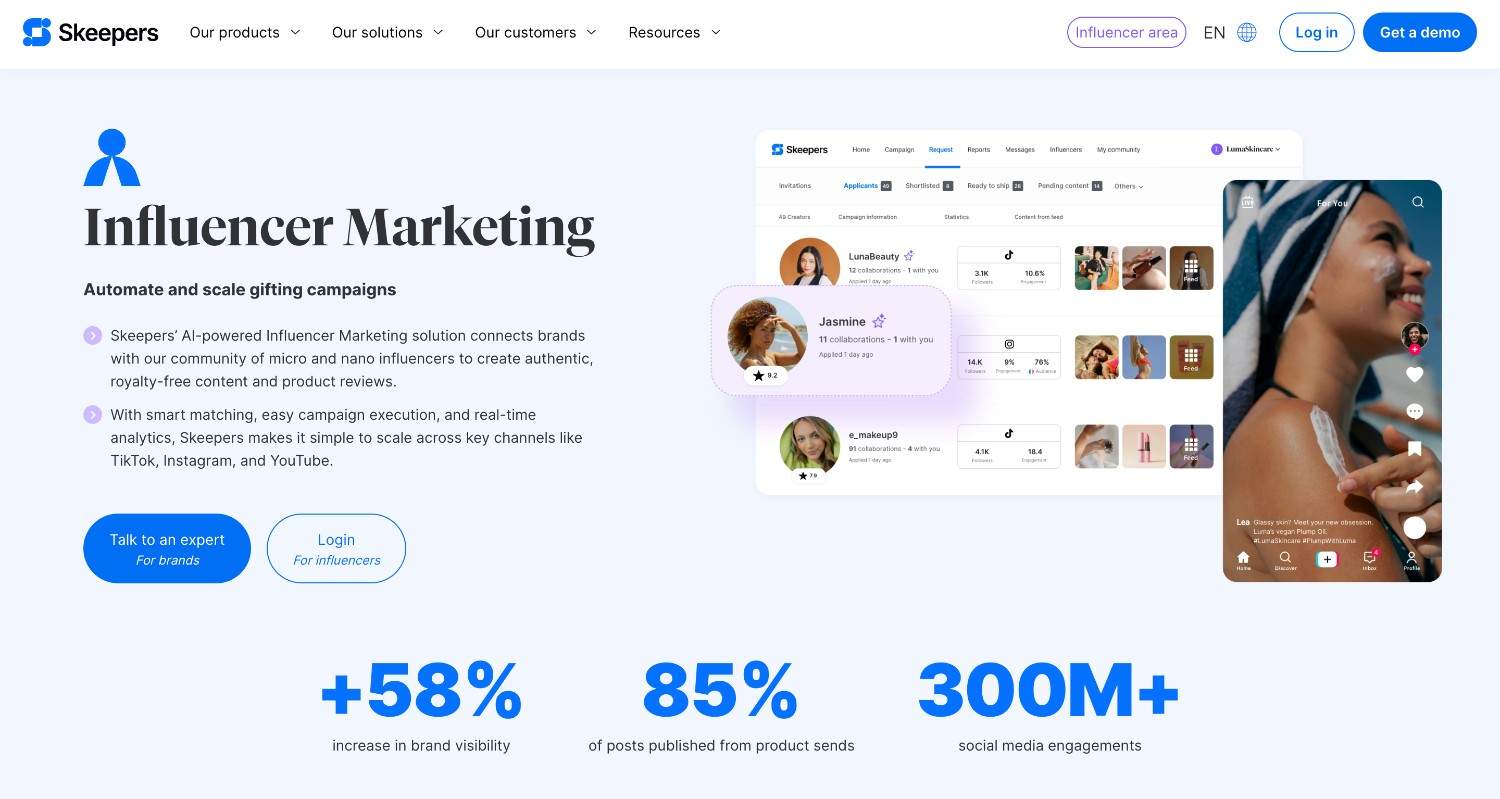
Skeepers is a broader user-generated content and customer engagement platform that includes influencer marketing as one of its modules. It focuses on turning customers and creators into brand advocates while integrating UGC into marketing strategies.
Key Features
- Influencer marketing module: Connect brands with micro and nano influencers for authentic content creation.
- UGC management: Collect, manage, and distribute user-generated content across channels.
- Ratings and reviews integration: Combines influencer marketing with customer reviews and social proof.
- Campaign management: Manage influencer collaborations and track performance.
- Content distribution: Repurpose influencer and customer content across ads, websites, and social media.
- Customer advocacy tools: Turn loyal customers into brand ambassadors.
Pricing
- Skeepers does not publicly list a detailed pricing table for Influencer Marketing on its main site.
- Capterra lists a starting price of €1,250/month and says no free trial is available.
Reviews
4.3/5.0 (Capterra)
Pros
- Unique combination of influencer marketing + UGC + reviews: Creates a full content ecosystem.
- Strong focus on micro-influencers and authenticity: Ideal for brands seeking organic engagement.
- Good for omnichannel content strategies: Combines influencer and customer content.
Cons
- Not a dedicated influencer platform: Some features may feel less advanced than specialized tools.
- Limited enterprise-level analytics: Compared to platforms like Traackr.
- Complex platform due to multiple modules: Can require onboarding.
Integrations
- Shopify: Sync UGC and influencer content with ecommerce stores.
- Magento: Manage product-related content and reviews.
- Salesforce: Integrate influencer data with CRM workflows.
- Google Analytics: Track performance of UGC campaigns.
- Social platforms: Distribute content across Instagram, TikTok, and more.
Traackr vs Skeepers
Traackr is a dedicated influencer marketing platform focused on analytics, benchmarking, and campaign optimization. Skeepers is broader, combining influencer marketing with UGC and customer advocacy tools.
If your goal is to manage influencer campaigns with strong ROI tracking, Traackr is the better fit. If you want to combine influencer content with customer reviews and broader UGC strategies, Skeepers offers a more holistic solution.
10. Creator.co
Creator.co is an influencer marketing platform and marketplace that connects brands with creators through both self-serve tools and managed campaign services. It is designed to simplify influencer marketing for brands of all sizes, particularly those looking for flexible and scalable solutions.
Key Features
- Creator marketplace: Brands can browse and connect with influencers directly or receive applications for campaigns.
- Campaign management: Manage outreach, collaboration, and performance tracking within the platform.
- Managed services: Offers full-service campaign execution for brands that want hands-off support.
- Content creation workflows: Handle briefs, approvals, and deliverables in one place.
- Performance tracking: Tracks engagement and campaign performance metrics.
- Subscription-based access: Allows brands to scale influencer efforts with predictable costs.
Pricing
- Self-Serve: $299/month, with a 3-month minimum commitment.
- Managed: $2,199/month, with a 3-month minimum commitment.
- Enterprise: Custom pricing, with an annual commitment.
- The pricing page also notes that after the initial term, monthly subscriptions move to month-to-month billing, while annual plans renew yearly at a discounted rate.
- Creator.co offers a free trial for Self-Serve.
Reviews
4.6 / 5.0 (G2)
Pros
- Flexible model with self-serve and managed services: Suitable for different team sizes.
- Strong creator marketplace: Makes it easy to find and collaborate with influencers quickly.
- Accessible pricing compared to enterprise tools: Good for growing brands.
Cons
- Limited advanced analytics: Compared to platforms like Traackr.
- Smaller database compared to large discovery platforms:
- Less focus on enterprise workflows:
Integrations
- Shopify: Connect campaigns to ecommerce and track performance.
- Stripe: Manage payments and transactions with creators.
- Instagram: Discover and track influencer campaigns.
- TikTok: Support short-form video campaigns and performance tracking.
- Google Analytics: Measure traffic and campaign performance.
Traackr vs Creator.co
Traackr is designed for enterprise teams that need advanced analytics, benchmarking, and structured workflows. Creator.co is more accessible and flexible, offering both self-serve and managed services for brands at different stages.
While Traackr excels in data depth and ROI tracking, Creator.co focuses on ease of use and campaign execution. For brands just scaling influencer marketing or looking for a marketplace-driven approach, Creator.co is a strong option. For large-scale, data-driven programs, Traackr remains the more robust solution.
Final Thoughts
Traackr stands out as a data-driven, enterprise-focused platform with strong capabilities in benchmarking, ROI measurement, and global campaign standardization. However, the alternatives highlighted in this list show that the influencer marketing landscape is highly diverse, with platforms specializing in different areas such as ecommerce integrations, UGC creation, AI-powered workflows, and creator relationship management. Tools like GRIN, Upfluence, and Influencer Hero lean heavily into ecommerce and execution, while platforms like CreatorIQ and NeoReach focus more on enterprise infrastructure, data access, and scalability.
Ultimately, the right alternative depends on what a brand prioritizes most—whether it’s advanced analytics, ease of use, pricing flexibility, or operational workflows like gifting and affiliate tracking. Some platforms are better suited for large global teams needing deep insights and governance, while others cater to growing DTC brands looking for faster execution and lower barriers to entry. Understanding these trade-offs is key to selecting a platform that aligns with both current needs and long-term influencer marketing strategy.

.png)


.jpg)