

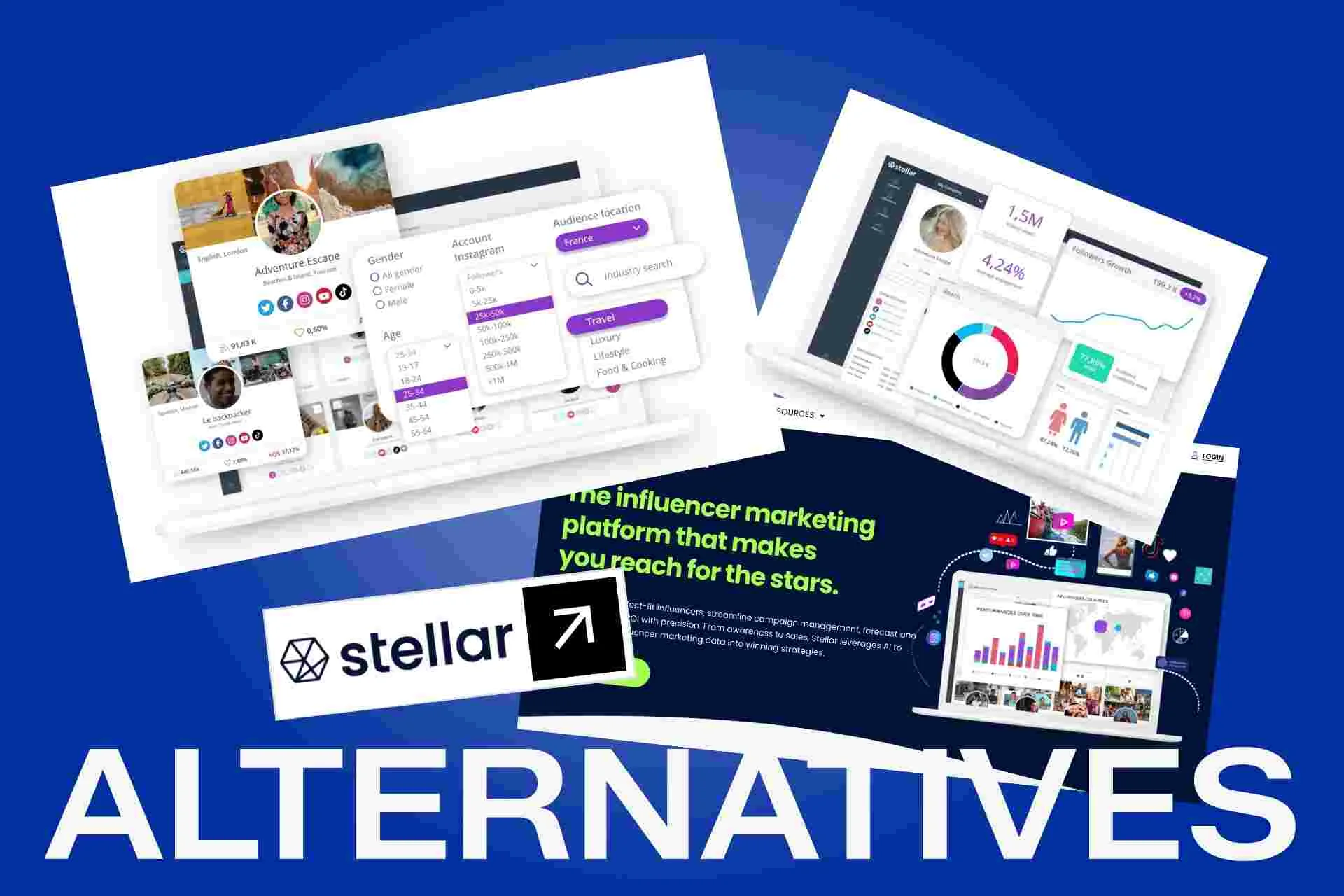
10 Best Stellar Alternatives for Influencer Marketing
Managing influencer marketing today goes far beyond finding creators—it requires the right influencer marketing software to handle discovery, outreach, campaign workflows, and performance tracking in one place. Stellar has emerged as a popular choice for D2C brands thanks to its strong analytics, campaign forecasting, and brand safety features, but it’s not without limitations. Many teams find its pricing difficult to predict, especially with its modular structure, while others note gaps in CRM flexibility, inconsistent discovery in niche markets, and occasional reporting delays. That’s why many brands start exploring Stellar alternatives that better align with their budget, workflow, or growth stage.
In this article, we’ll compare 10 of the best Stellar alternatives—including Upfluence, SARAL, GRIN, Influencer Hero, IZEA, Later, Ainfluencer, indaHash, Influencity, and Modash—to help you find the right fit for your influencer marketing strategy.
Key Criteria for Evaluating Influencer Marketing Platforms
Core Features
Evaluation of essential influencer marketing capabilities, including influencer discovery, outreach, CRM, campaign management, reporting, and content workflows.
Pricing & Flexibility
Comparison of pricing models, subscription plans, and contract terms to match different budgets and growth stages.
Customer Reviews & Satisfaction
Analysis of user feedback from trusted review platforms, focusing on usability, reliability, customer support, and overall performance.
Pros & Cons
Review of each platform’s strengths and limitations to highlight where it performs well and where it may fall short based on different use cases.
Integrations
Review of the most important integrations (e.g., Shopify and other tech tools), highlighting what each integration enables in one sentence.
Stellar Overview
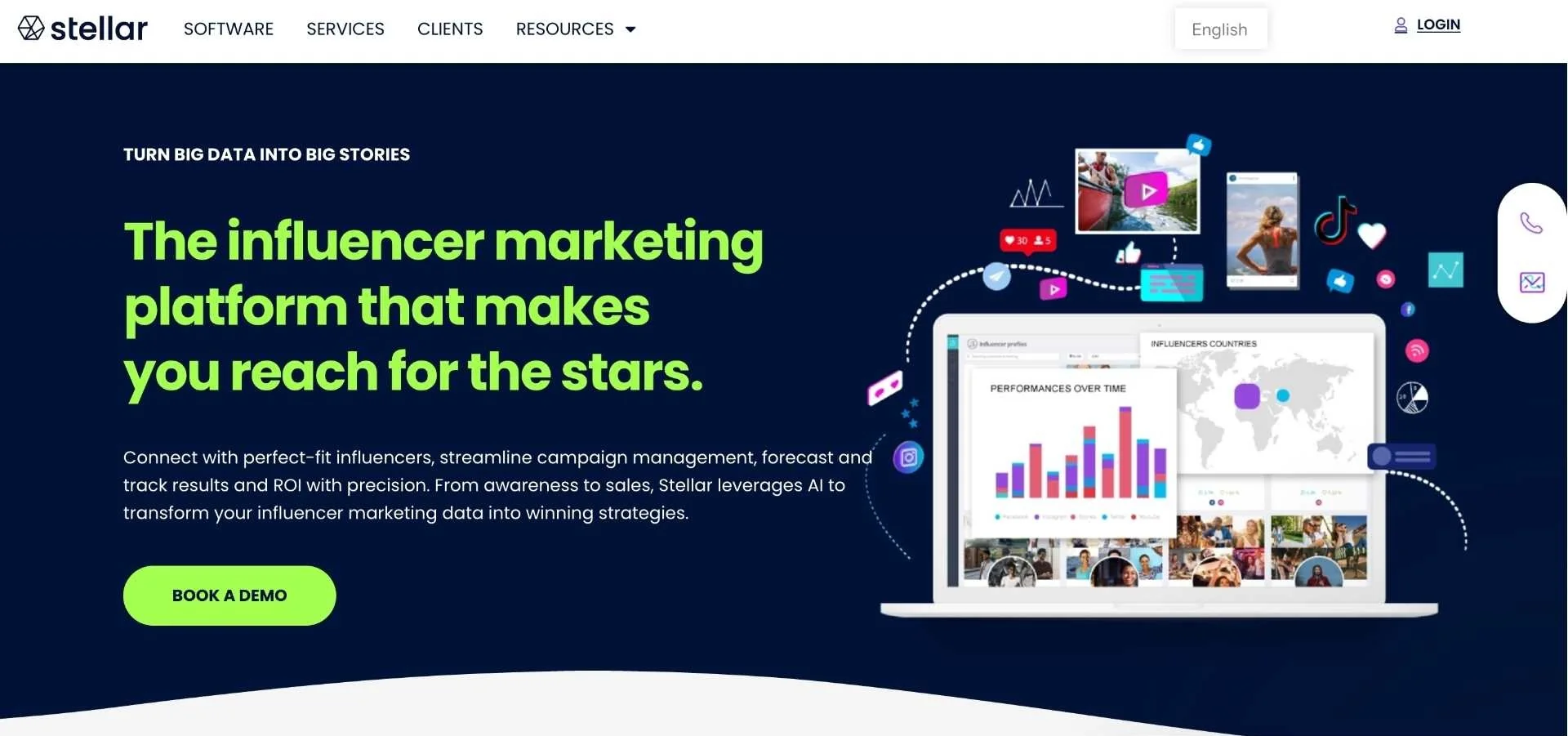
Stellar is an AI-powered influencer marketing platform designed to help brands and agencies manage the entire influencer lifecycle—from discovery and vetting to campaign execution, performance tracking, and ROI analysis. Positioned as a data-driven solution, Stellar combines a large influencer database with predictive analytics, social listening, and qualitative insights (like sentiment and brand safety) to help marketers make more informed decisions. The platform is used by global brands such as LVMH, Spotify, and Nestlé, and is particularly known for its focus on campaign forecasting and advanced analytics.
Key Features
• Extensive Influencer Discovery Engine — Stellar provides access to tens of millions of creator profiles across major platforms like Instagram, TikTok, YouTube, and Twitch. Users can filter influencers by audience demographics, engagement rate, niche, location, and more to find highly relevant partners.
• Advanced Audience & Creator Insights — Each influencer profile includes deep analytics such as audience quality, demographics, brand affinity, past collaborations, and fraud detection—helping teams avoid low-quality partnerships.
• Social Listening & Brand Affinity Tracking — The platform identifies creators already talking about your brand or competitors, making it easier to convert organic fans into long-term ambassadors.
• AI-Powered Campaign Forecasting — One of Stellar’s standout features is its ability to estimate campaign performance before launch, including projected reach, engagement, ROI, EMV, and budget allocation.
• Campaign & Workflow Management — Teams can manage briefs, deliverables, timelines, product seeding, and influencer communication within a centralized project dashboard.
• Automated Content Tracking — Stellar automatically tracks posts, stories, and videos tied to campaigns, eliminating the need for manual collection and ensuring accurate reporting.
• Performance Analytics & ROI Measurement — Detailed reporting includes engagement, impressions, clicks, conversions, EMV, and ROI—broken down by influencer, campaign, and channel.
• Comment & Sentiment Analysis — Beyond surface metrics, Stellar analyzes audience comments, reactions, and emojis to gauge sentiment, product feedback, and purchase intent.
• AI-Based Brand Safety Monitoring — The platform scans influencer content for potential risks, categorizing unsafe or sensitive content across multiple dimensions to protect brand reputation.
• Chrome Extension for Creator Sourcing — A browser extension allows teams to discover and save influencers directly from social platforms into Stellar while browsing.
Pricing
Stellar uses a modular, subscription-based pricing model, meaning costs depend on selected features (e.g., discovery, campaign management, analytics) and the number of influencers tracked.
• Starting price: From approximately €299/month (entry-level access)
• Other public pricing references:
• Discovery tools: from ~€299/month
• Campaign management modules: from ~€899/month
• Some third-party listings show feature-based pricing starting as low as ~€89/month per module
Overall, Stellar’s pricing is flexible but not fully transparent, often requiring a demo or sales conversation to get exact costs.
Reviews
4.6 / 5.0 (G2)
Integrations
• Shopify – Track influencer-driven sales, generate discount codes, and measure conversions directly from campaigns.
• WooCommerce – Attribute revenue and campaign performance to influencers using trackable links and codes.
• Google Chrome (Extension) – Discover and save influencer profiles directly while browsing social platforms.
• Microsoft Excel – Export campaign and influencer data for deeper analysis and reporting.
• Microsoft PowerPoint – Turn campaign performance into presentation-ready reports for stakeholders.
Pros
• Best-in-class pre-campaign forecasting — Stellar’s ability to predict ROI, EMV, and campaign performance before launch gives marketers a major advantage when planning budgets and justifying spend.
• Advanced qualitative analytics (sentiment + comments) — Unlike many platforms focused only on quantitative metrics, Stellar helps brands understand audience perception, product feedback, and purchase intent through comment analysis.
• Strong brand safety and compliance tools — Its AI-powered brand safety feature adds an extra layer of protection by scanning influencer content for potential risks—especially valuable for enterprise and regulated industries.
Common Drawbacks of Stellar
Pricing lacks transparency and can scale quickly
The modular pricing model makes it harder to estimate costs upfront, and adding key features like discovery can significantly increase the total price.
Influencer discovery can be inconsistent in niche or local markets
While the database is large, results may be less reliable in smaller regions or highly specific niches.
CRM and workflow features are not as advanced as competitors
Some teams find the campaign management and relationship tracking tools less flexible compared to more CRM-focused platforms.
Occasional reporting and tracking limitations
Users report delays in data syncing, missing content tracking (especially stories), and occasional discrepancies compared to native platform analytics.
Best Stellar Alternatives
| TOOL | REVIEWS | BEST FOR | TRIAL INFO | PRICING | ||
|---|---|---|---|---|---|---|
1 |

|
⭐ | Influencer discovery | Book Demo | Pricing | Website |
2 |

|
⭐ | UGC creator collaborations | Book Demo | Pricing | Website |
3 |

|
⭐ | DTC creator management | Book Demo | Pricing | Website |
4 |

|
⭐ | Influencer CRM & automation | Book Demo | Pricing | Website |
5 |
|
⭐ | Influencer marketplace | Book Demo | Pricing | Website |
6 |

|
⭐ | Social media & influencer campaigns | Book Demo | Pricing | Website |
7 |

|
⭐ | Influencer discovery & outreach | Book Demo | Pricing | Website |
8 |

|
⭐ | Enterprise creator campaigns | Book Demo | Pricing | Website |
9 |

|
⭐ | Campaign management | Book Demo | Pricing | Website |
10 |

|
⭐ | Influencer discovery | Book Demo | Pricing | Website |
Upfluence

Upfluence is an all-in-one influencer and affiliate marketing platform built primarily for eCommerce and DTC brands. Its positioning is especially strong for companies that want influencer discovery, outreach, affiliate tracking, gifting, and revenue attribution connected directly to their commerce stack rather than managed in separate tools. Upfluence also leans heavily into AI-assisted workflows through Jaice AI and into store-connected influencer discovery, including the ability to identify influential customers inside your own database.
Key Features
• Influencer discovery across major social channels — Upfluence’s “Find Creators” layer includes a 14M+ creator database, unlimited advanced search, creator lookalikes, affiliate filtering, and audience/performance data across Instagram, TikTok, YouTube, Twitch, X, Pinterest, and blogs.
• AI-powered outreach with Jaice AI — The platform uses Jaice AI for personalized email writing, campaign creation, and automation, helping teams send outreach at scale without losing too much personalization.
• CRM and campaign management — Upfluence includes creator CRM, creator marketplace access, recruitment pages, program organization, and campaign execution features that move it beyond discovery-only software.
• Deep eCommerce integrations — Shopify, WooCommerce, Magento, BigCommerce, and Amazon integrations let brands connect product data, customer lists, gifting, affiliate links, and sales attribution in one workflow.
• Customer-to-creator matching — One of Upfluence’s biggest differentiators is its ability to find influencers already inside your CRM or customer base, which is particularly useful for ambassador and affiliate programs.
• Sales analytics and affiliate tracking — The platform supports discount codes, trackable links, sales dashboards, and zero fees on tracked sales according to its pricing page messaging.
• Social listening stream — Higher tiers add social listening so teams can spot creators already mentioning their brand or monitor competitor activity and trends.
• Integrated payouts — Upfluence Pay supports creator payments, multi-currency payouts, and compliance workflows on the highest tier.
Pricing
• Pricing model: Upfluence uses custom pricing rather than a public fixed plan table.
• All plans are custom made. There’s a minimum full year of service you have to commit to with monthly payments. On average plans start around $1,276 - $2,000/month ($24,000 yearly)
Reviews
4.3/5.0 (Capterra)
Pros
• Store-connected influencer discovery is a real differentiator — Upfluence does more than search public creators; it can surface influencers already inside your Shopify data or CRM, which is especially valuable for brands building ambassador and affiliate programs from existing customers.
• Jaice AI adds useful automation beyond simple search — Upfluence now positions Jaice AI as a campaign co-pilot for personalized outreach, campaign creation, and scaled execution, which makes it more automation-driven than many legacy influencer tools.
• Very strong commerce and marketplace fit — Native support for Amazon, Shopify, WooCommerce, Magento, and BigCommerce makes Upfluence one of the more revenue-oriented options for brands that care as much about attributable sales as creator discovery.
Cons
• Pricing is not very transparent — Public-facing pricing is modular and quote-based, which makes it harder to estimate total cost before sales conversations.
• Annual commitment reduces flexibility — Upfluence requires a 12-month minimum contract, which can be a drawback for smaller teams or brands still testing channel fit.
• There can be a learning curve — User feedback repeatedly highlights strong functionality, but also mentions that onboarding and campaign setup can take time to master.
Integrations
• Shopify — Sync store data, identify influential customers, send products, and attribute influencer-driven sales inside Upfluence.
• Amazon — Connect marketplace activity to influencer campaigns and track performance for Amazon-driven programs.
• Klaviyo — Identify influential subscribers from email lists and activate them into creator or affiliate workflows.
• Gmail — Send and manage outreach from your email workflow while keeping communication tied to creator records.
• Outlook — Use Microsoft email accounts for influencer communication without moving outreach outside the platform.
Stellar vs Upfluence
Stellar is the stronger choice for brands that prioritize forecasting, sentiment analysis, benchmark reporting, and brand safety before and during campaigns, while Upfluence is more commerce-native and better suited to teams that want influencer operations tightly tied to store data and attributable revenue. Stellar leans more toward analytics, qualitative insights, and strategic planning; Upfluence leans more toward affiliate execution, customer-to-creator matching, and sales tracking.
Upfluence also has a more explicit eCommerce orientation thanks to Amazon and broader store integrations, while Stellar’s differentiation is stronger in predictive campaign planning, comment analysis, and brand-safety workflows. If the main objective is turning influencer marketing into a measurable commerce engine, Upfluence usually has the edge; if the goal is deeper pre-campaign evaluation and richer qualitative campaign analysis, Stellar feels more strategic.
SARAL
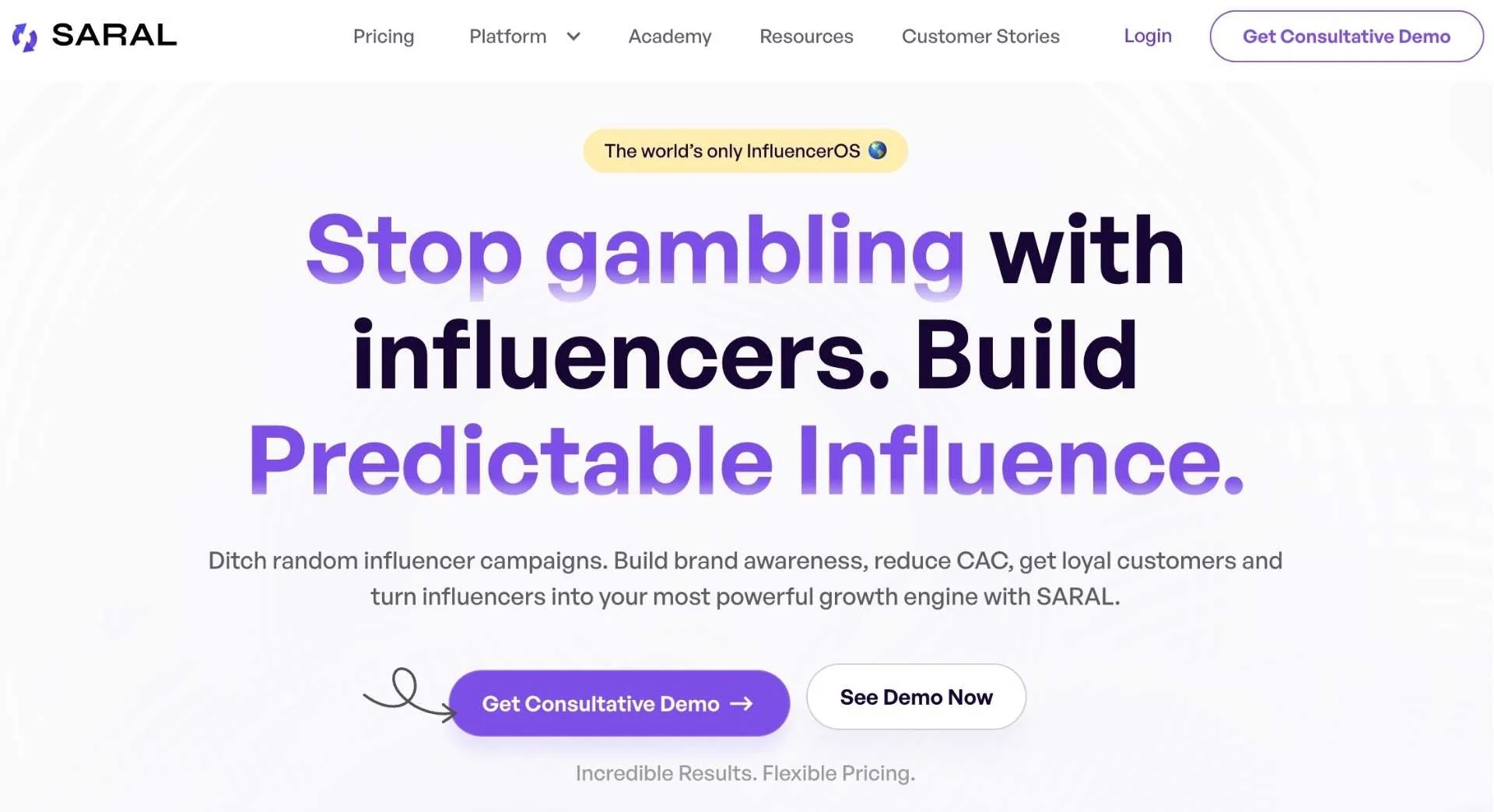
SARAL is an influencer marketing platform built for eCommerce brands that want a simpler, more operator-friendly system for discovery, outreach, relationship management, performance tracking, and payments. The platform positions itself as an “influencer OS” focused on removing spreadsheet-heavy workflows and helping brands run seeding, ambassador, and affiliate programs with less operational overhead.
Key Features
• Influencer discovery across Instagram, TikTok, and YouTube — SARAL’s Discovery product helps brands search by keywords, hashtags, content themes, and filters, and it does not require creators to opt in to be found.
• LookalikesAI recommendations — SARAL’s AI-driven lookalike engine suggests similar creators based on influencers already saved to lists, which is useful for scaling niche discovery fast.
• Automated outreach and inbox management — The platform supports bulk outreach, follow-ups, inbox organization, and centralized communication so teams can keep negotiations and replies in one place.
• SIA AI assistant — SARAL’s built-in AI assistant, SIA, helps with creator discovery, personalized replies, follow-ups, negotiation support, and even faster shipping workflows.
• Relationship management and CRM — Creator relationship management is a core workflow, letting teams track every partnership from first contact through active collaboration and performance.
• Performance and ROI tracking — SARAL tracks campaign performance, affiliate output, and ROI, which is a major reason it appeals to DTC brands running measurable seeding programs.
• Affiliate links and discount codes — Teams can bulk-generate affiliate links and codes for creators, including dynamic discount codes designed to reduce coupon leakage and protect margins.
• Payments inside the workflow — SARAL also supports payments, making it more complete than lightweight outreach-only tools.
Pricing
SARAL offers tiered pricing primarily billed annually or quarterly:
• Starter Plan – $12,000/year or $3,600/quarter Includes 100 active partnerships, 300 new influencers/month, limited post tracking, and 1 user seat.
• Business Plan – $15,000/year or $4,500/quarter Includes 500 active partnerships, 800 new influencers/month, unlimited tracking, and 3 seats.
• Professional Plan – $25,000/year or $7,500/quarter Includes 1,000 active partnerships, 2,000 new influencers/month, full social listening, and 10 seats.
Reviews
4.7/5.0 (G2)
Pros
• SIA is a standout newer differentiator — SARAL’s AI assistant goes beyond copy generation and is positioned as a working copilot for outreach, follow-ups, conversations, discovery, and operational execution.
• Dynamic discount codes are unusually practical for margin protection — SARAL’s dynamic code system helps reduce code leakage while preserving accurate affiliate attribution, which is especially useful for DTC brands running always-on creator programs.
• Simple, all-in-one workflow for smaller and mid-sized eCommerce teams — User feedback consistently highlights ease of use, centralized communication, and reduced spreadsheet work as major advantages.
Cons
• More limited channel coverage than broader enterprise tools — SARAL discovery is centered on Instagram, TikTok, and YouTube rather than a wider set of networks.
• Some users mention bugs and rough edges — Public reviews generally praise the product, but they also mention occasional technical issues and features still improving.
• Advanced users may want more control — A portion of reviewer feedback suggests that brands wanting highly custom processes may occasionally find SARAL opinionated in how workflows are structured.
Integrations
• Shopify — Connect store data and creator commerce workflows through Shopify, including affiliate tracking and order-related use cases.
• GoAffPro — Use GoAffPro with SARAL to power affiliate tracking and store-connected creator revenue attribution.
• Klaviyo — Sync onboarded influencer data into Klaviyo so creators can be managed alongside broader email lifecycle programs.
• Slack — Push delivery notifications and other program updates into Slack to keep internal teams aligned without checking the platform constantly.
• Outlook — Connect Outlook for creator communications so email activity stays inside the influencer workflow.
Stellar vs SARAL
Stellar and SARAL serve different parts of the market. Stellar is more analytics-led, with stronger campaign forecasting, sentiment analysis, and brand-safety tooling, while SARAL is designed to simplify day-to-day influencer operations for eCommerce brands that care about speed, outreach, and relationship management. In other words, Stellar feels more strategic and enterprise-leaning, while SARAL feels more execution-first and operator-friendly.
SARAL also puts more emphasis on practical seeding and affiliate workflows like dynamic discount codes and AI-assisted inbox management, whereas Stellar’s edge is stronger in pre-campaign planning, qualitative analysis, and competitive intelligence. Brands that want a leaner tool for scaling micro-influencer outreach may prefer SARAL; brands that want deeper evaluation and reporting layers may prefer Stellar.
GRIN

GRIN is a creator management platform built primarily for eCommerce brands that want to run influencer programs as a structured revenue channel. It combines creator search, outreach, gifting, affiliate tracking, content collection, payments, and CRM-style relationship management in one system, and it is especially well known for its tight operational fit with product-seeding and commerce workflows.
Key Features
• Creator search and CRM — GRIN includes creator search, AI creator search on Instagram, tagging, stage management, CRM imports, and structured relationship tracking.
• Integrated email and outreach tracking — Teams can manage creator communications through integrated email, templates, and tracked outreach without relying on disconnected inbox workflows.
• Gifting and affiliate management — Even lower tiers include gifting and affiliate management, making GRIN attractive for product-led programs.
• Central content library — GRIN centralizes creator content so brands can keep assets organized and easier to reuse internally.
• Automated creator payments and 1099 processing — Higher tiers add automated payments and tax processing, which reduces manual finance work for brands paying creators at scale.
• Advanced affiliate attribution and deep links — Growth and above add deeper attribution layers for brands tracking full-funnel creator performance.
• API access and advanced reporting — The Complete plan adds API access, advanced reporting, and roles and permissions for more complex creator programs.
• Social listening and report builder — GRIN also includes social listening and advanced dashboarding, especially at higher plan levels.
Pricing
• Official pricing model: GRIN’s current pricing page promotes a 30-day free trial and more flexible packaging than before, including self-serve access.
• Public starting price benchmark: Recent software directories list GRIN from $999/month, though enterprise pricing still appears to scale materially based on features and program size.
• Enterprise benchmark pricing: Recent sales benchmarks and product overviews still place GRIN commonly starts at $25,000/year (approx. $2,050/month), with no discounts for upfront payment. Contracts require a full-year commitment with monthly billing.
Reviews
4.5/5.0 (G2)
Pros
• The new self-serve, month-to-month pricing is a major shift — GRIN used to be associated with more rigid enterprise-style buying; its current pricing model is notably more flexible, with instant sign-up, a free trial, and no long-term lock-in.
• Excellent eCommerce workflow depth — GRIN’s product gifting, affiliate tracking, integrated payments, tax handling, and store-connected operations make it especially strong for brands that run creator programs like a commerce channel.
• Strong stack connectivity for operational teams — Integrations with Gmail, Klaviyo, PayPal, Slack, DocuSign, and API access make GRIN one of the more operations-friendly platforms for teams that want creator marketing tied into the rest of their stack.
Cons
• Creator quality can still be inconsistent — User feedback continues to mention that the database can require extra filtering and manual qualification to find best-fit creators.
• Workflow complexity can increase with scale — Some users still describe GRIN as powerful but somewhat manual or complicated when managing statuses and creator deliverables.
• Costs rise as capacity grows — While entry pricing is much lower than before, scaling to larger creator volumes and more advanced workflows still pushes brands into meaningfully higher tiers.
Integrations
• Shopify — Sync your store for product fulfillment, affiliate links, and real-time campaign performance tracking.
• PayPal — Route creator payments directly through GRIN once deliverables are completed.
• Klaviyo — Connect lifecycle marketing and creator activity more closely through email and customer-data workflows.
• DocuSign — Handle creator contracts and content-rights paperwork inside the program workflow.
• Slack — Receive notifications about creator and campaign activity without constantly checking the platform.
Stellar vs GRIN
Stellar is stronger on analytics-first use cases such as forecasting, sentiment analysis, benchmarking, and brand safety, while GRIN is stronger on creator operations, gifting, payments, and eCommerce-linked workflows. If a team wants to plan and evaluate creator programs more strategically, Stellar has the edge; if it wants to manage a large creator program like an operational pipeline tied to store revenue, GRIN usually goes deeper.
Another major difference is flexibility: GRIN now offers self-serve, month-to-month pricing and a free trial, while Stellar still presents more traditional enterprise-style pricing. For product-led DTC brands, GRIN often feels more execution-ready; for brands focused on campaign intelligence and qualitative insight, Stellar still stands out.
Influencer Hero
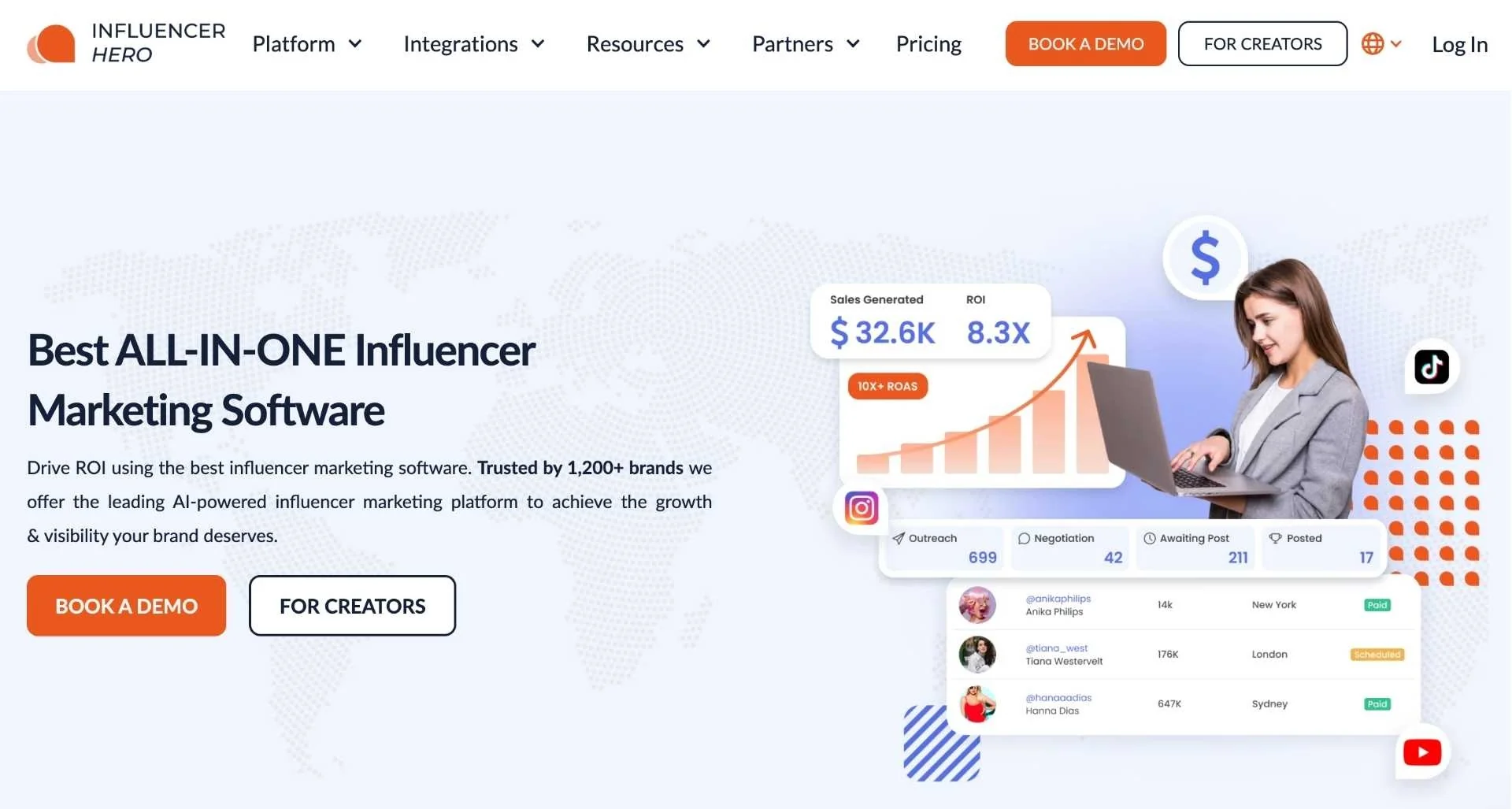
Influencer Hero is an AI-powered all-in-one influencer marketing platform aimed at DTC brands, eCommerce teams, and agencies that want discovery, influencer outreach, CRM, gifting, affiliate tracking, UGC capture, and reporting in one relatively accessible system. The platform positions itself as a lower-cost end-to-end alternative to larger enterprise suites, with heavy emphasis on automation, ROI tracking, and flexible commerce integrations.
Key Features
• Influencer discovery and filtering — Influencer Hero supports creator discovery with detailed filters, multi-platform search, and lookalike-style recommendations.
• Automated outreach and drip campaigns — Brands can run bulk outreach with automated follow-up sequences, including AI-generated personalization based on recent creator content.
• Campaign CRM and workflow boards — The platform uses Trello-like boards and automated triggers to help teams manage outreach, negotiations, gifting, and campaign progress.
• Central influencer deal pages — Each creator can be managed through a central page containing communication, affiliate data, gifting information, content, and relationship notes.
• UGC and content library — Influencer Hero automatically captures creator posts and stores high-resolution content in a downloadable library for reuse.
• Affiliate and payout tracking — The platform tracks clicks, sales, and performance and supports payout-related workflows as campaigns scale.
• AI-supported discovery and campaign automation — Influencer Hero highlights AI as a core layer across creator recommendations, personalization, and workflow optimization.
• Broad DTC integration coverage — Compared with many mid-market tools, Influencer Hero supports a fairly broad list of commerce and ops integrations.
Pricing
Influencer Hero offers flexible pricing based on outreach volume and you can have unlimited creators in your CRM:
• Standard — $649/month (up to 1,000 outreaches per month)
• Pro — $1,049/month (up to 5,000 outreaches per month)
• Business — $2,490/month (up to 10,000 outreaches per month)
• Custom / Agency — Tailored pricing
Custom pricing is available for agencies and larger teams
Reviews
4.9/5.0 (Capterra)
Pros
• Automatic UGC capture is genuinely useful — The platform automatically saves creator posts into a content library, which reduces manual asset collection and makes repurposing easier.
• AI-powered workflows built for scale — Influencer Hero streamlines the full campaign lifecycle—from discovery to outreach—with automation, predictive scoring, and smart campaign suggestions, helping teams reduce manual work without losing control.
• Highly personalized outreach at volume — AI-enhanced email flows and automated follow-ups generate messages that feel tailored and relevant, improving reply rates, conversions, and long-term creator relationships.
Cons
• No free trial — Makes it harder for teams to evaluate the platform before committing
• Higher pricing for smaller teams — May be less accessible for early-stage brands or those with limited budgets
Integrations
• Shopify — Sync product catalogs, create affiliate links and discount codes, run gifting, and attribute revenue by creator.
• WooCommerce — Create unique affiliate links and discount codes and sync clicks and sales back into the CRM.
• Slack — Send campaign updates, approvals, and internal alerts to team channels to keep workflows aligned and moving faster.
• Klaviyo — Connect creator marketing with email and customer lifecycle activity.
• DocuSign — Handle agreement workflows through e-signature rather than managing contracts manually outside the platform.
Stellar vs Influencer Hero
Stellar and Influencer Hero differ most in emphasis. Stellar is more analytics-heavy, with stronger forecasting, sentiment analysis, and brand-safety capabilities, while Influencer Hero is more focused on practical end-to-end execution at a lower price point. For teams that want broad functionality without moving into enterprise-level pricing, Influencer Hero is usually the more accessible option.
Influencer Hero is also more transparent on pricing and leans harder into DTC operations such as gifting, affiliate tracking, and automatic UGC collection. Stellar remains the stronger choice for brands that care more about strategic analysis and qualitative campaign intelligence; Influencer Hero is better for brands that want a more affordable all-in-one operating system.
IZEA
IZEA is one of the longest-standing names in influencer marketing and creator economy software, dating back to 2006. Today, the company combines managed services, its Creator Marketplace, AI tools like FormAI, and IZEA Flex, a campaign platform designed to help brands plan, collaborate, track performance, and optimize influencer marketing programs in one environment.
Key Features
• IZEA Flex campaign management — IZEA Flex is positioned as a central hub for approving creators, reviewing content, and tracking performance for IZEA-run or brand-managed campaigns.
• Creator Marketplace access — Brands can use the marketplace to browse creators, buy listings, or post casting calls to attract pitches from interested creators.
• Performance tracking with commerce data — Flex integrates with Google Analytics and Shopify so marketers can connect creator activity to site behavior, products purchased, revenue, and order-level insights.
• Affordable creator payments — Flex Transactions let marketers pay creators with a flat $2 fee per payment, which is unusually clear and cost-efficient for payout handling.
• Contracts and e-signatures — Power users can create, send, and store contracts in-platform, including multi-party e-signatures and legal templates.
• AI tools inside the platform ecosystem — IZEA now emphasizes AI across its stack, including FormAI, AI briefs, AI brainstorming, and AI-powered storyboarding tools for campaign ideation and content planning.
• Gmail-linked communications — Flex can associate Gmail conversations with creator records, campaigns, payments, and content, making communication more searchable and contextual.
• Flex Portal for stakeholders — Flex Portal gives stakeholders controlled access to follow campaign progress, which is helpful for agencies and larger organizations.
Pricing
• Starter: $130/month on annual billing, or $165/month month to month. Includes core tools like Discover, ContentMine, ShareMonitor, and Tracking Links.
• Power: $500/month on annual billing, or $600/month month to month, for up to three users, with Transactions, unlimited integrations, and expanded usage.
• Free trial: 10 days. Older launch materials also referenced a free tier, but current visible pricing is most clearly centered on Starter and Power.
Reviews
3.9/5.0 (G2)
Pros
• Very broad product ecosystem — IZEA is not just a single dashboard; it combines managed services, Creator Marketplace, Flex, and FormAI, which gives brands multiple ways to source and run creator campaigns.
• Flat-fee creator payments are a strong differentiator — The $2 transaction fee in Flex is unusually straightforward and helps keep payout handling predictable.
• AI has become a bigger part of the product story — FormAI, AI Briefs, AI Brainstorm, and AI-powered storyboarding add more creative planning depth than many older influencer platforms offer.
Cons
• Product structure can feel fragmented — Marketplace, Flex, managed services, and AI tools create more complexity than simpler all-in-one platforms.
• Reviews suggest some interface and reliability friction — Public feedback mentions search issues, unread chat glitches, and session timeouts that can disrupt work.
• Best fit is often agencies or larger programs — While entry pricing exists, IZEA’s broader value proposition tends to make the most sense for brands that want either a marketplace-led workflow or a more structured managed/Flex setup.
Integrations
• Shopify — Connect campaign activity to product purchases and order-level revenue attribution.
• Google Analytics — Pull site and conversion data into Flex so influencer campaigns can be tied to on-site performance and revenue signals.
• Gmail — Associate creator emails with contact records and related campaigns, payments, or content objects.
• PayPal — Creator payments in Flex are supported through long-time payment partners at PayPal, with a flat fee structure for electronic payments.
• Google Sign-In — Flex supports Google-based sign-in, which helps simplify access and user authentication for teams already using Google accounts.
Stellar vs IZEA
Stellar is the more focused influencer intelligence platform, while IZEA is a broader creator ecosystem with marketplace, managed services, campaign software, and AI creative tools. Stellar’s differentiation sits in forecasting, sentiment analysis, and brand safety; IZEA’s sits in breadth, creator sourcing options, contracts, AI creative support, and flexible ways to buy or manage creator work.
If a brand wants a tighter analytics-led influencer platform, Stellar is usually the cleaner fit. If it wants multiple operating models — self-serve marketplace, managed campaigns, and Flex-based workflow management — IZEA offers more ways to run creator programs under one brand umbrella.


Later
Later is a social media management platform that has expanded into influencer marketing through its acquisition of Mavrck. It combines social scheduling, content planning, influencer discovery, and campaign management into one ecosystem, making it especially attractive for brands that want to manage both organic social and influencer programs in a unified workflow.
Key Features
• Influencer discovery and recruitment (Mavrck-powered) — Later provides access to a large creator network and enables brands to discover influencers through filters like audience demographics, engagement, and content themes.
• Influencer campaign management — Manage briefs, approvals, deliverables, and communication workflows within a centralized dashboard.
• Social media scheduling + influencer integration — A unique advantage is combining influencer campaigns with organic social publishing, allowing brands to align creator content with owned channels.
• Affiliate and ambassador programs — Later supports always-on influencer programs with affiliate tracking, referral links, and ambassador management.
• UGC management and rights tracking — Brands can collect, manage, and repurpose influencer-generated content across marketing channels.
• Performance analytics and ROI tracking — Includes campaign-level analytics such as engagement, conversions, and earned media value.
• Creator CRM — Build long-term relationships with influencers through tagging, segmentation, and communication history tracking.
Pricing
Later’s influencer marketing platform (Later Influence) uses custom pricing, and brands need to request a demo for exact costs.
Based on our research, there are different plans:
• Essentials Plan: Starts at $28,500/year. Best for brands starting in influencer marketing.
• Pro Plan: Starts at $42,000/year. Best for data and automation to make your campaigns run faster and achieve better ROI.
• Premier Plan: Starts at $60,000/year. Everything you need for a scaled influencer program.
• All plans come with an additional one-time onboarding fee of $5,000 for all new customers.
Reviews
4.4 / 5.0 (Capterra)
Pros
• Unique combination of social + influencer marketing — Few platforms combine scheduling, content planning, and influencer workflows in one place.
• Strong UGC and content repurposing workflows — Makes it easier to turn influencer content into paid and organic assets.
• Scalable for both SMBs and enterprise teams — Flexible pricing tiers plus enterprise-level influencer tools via Mavrck.
Cons
• Influencer features often locked behind higher tiers — Full influencer functionality typically requires custom or enterprise plans.
• Can feel split between two products — Social scheduling and influencer tools may not feel fully unified.
• Limited advanced analytics compared to specialized platforms — Reporting is solid but less deep than analytics-focused tools.
Integrations
• Shopify — Connect social and influencer campaigns directly to product catalogs and track conversions.
• Instagram — Schedule posts and track influencer content performance natively.
• TikTok — Plan and publish TikTok content while tracking influencer campaigns.
• Google Analytics — Measure traffic and conversions driven by influencer campaigns.
• Linkin.bio — Turn influencer content into shoppable posts with trackable links.
Stellar vs Later
Stellar is more focused on influencer intelligence, offering deeper analytics, forecasting, and sentiment analysis, while Later is a hybrid platform combining social media management with influencer marketing.
Later is better suited for teams that want to unify content scheduling and influencer workflows, whereas Stellar is the stronger choice for brands prioritizing campaign planning, benchmarking, and advanced analytics.
Ainfluencer
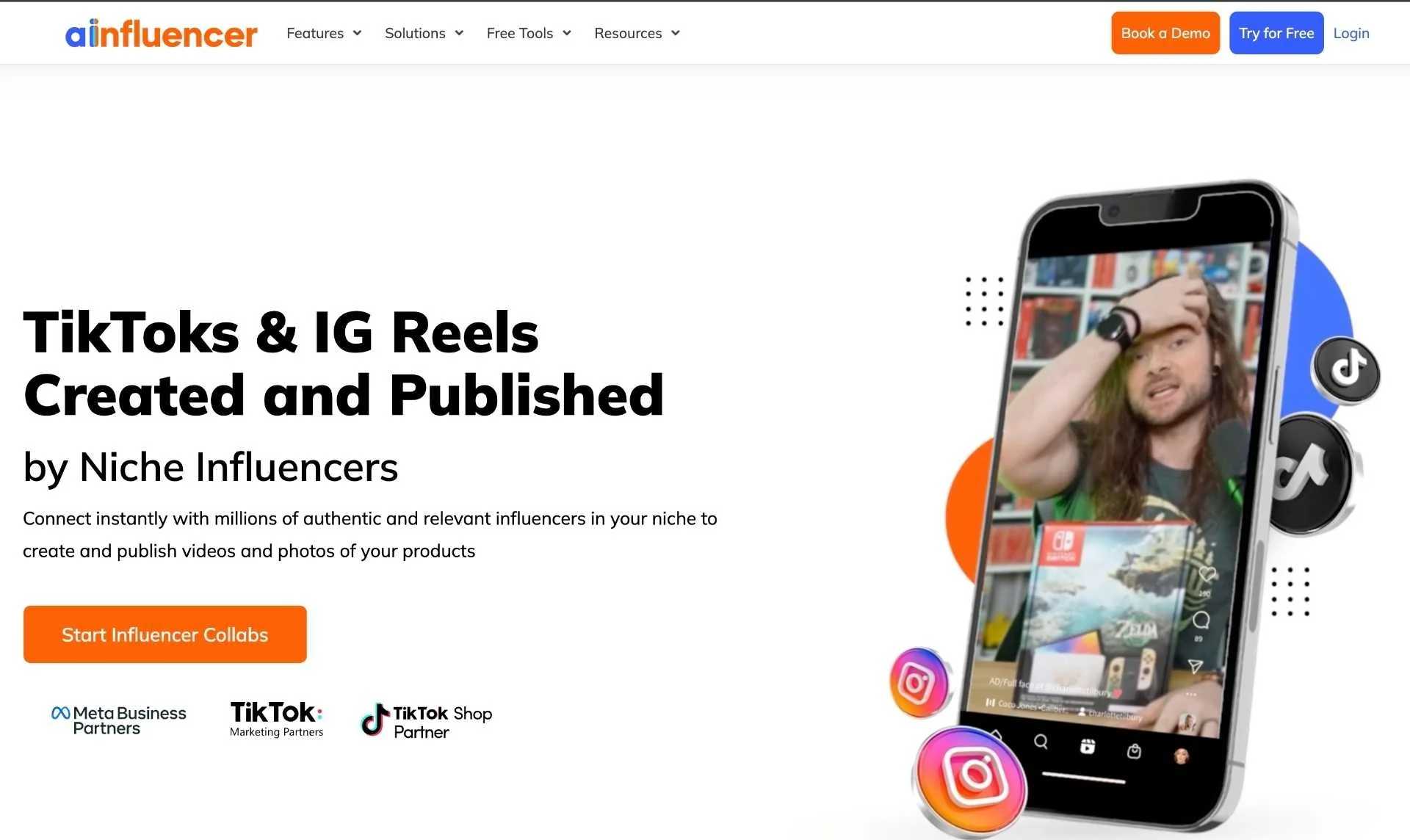
Ainfluencer is a free influencer marketing marketplace that connects brands with creators across Instagram and TikTok. It focuses on simplifying influencer collaboration through a self-service platform with built-in escrow payments, campaign creation, and creator applications—making it particularly appealing for smaller teams or brands new to influencer marketing.
Key Features
• Marketplace of 5M+ influencers — Brands can search and filter creators by location, niche, audience size, and pricing.
• Campaign creation and applications — Brands publish campaigns that influencers can apply to, reducing outbound outreach effort.
• Built-in escrow payments — Payments are held securely and released only after deliverables are completed, reducing risk.
• AI-powered messaging tools — Generate outreach and campaign messages using AI prompts.
• Content library and ownership — All submitted content is stored and owned by the brand for reuse.
• Performance tracking — Basic metrics like views, likes, and comments are tracked per influencer.
• Chrome extension for outreach — Invite creators directly from social platforms.
Pricing
• Free Plan (Core Offering): $0/month
• Commission-Based Model: ~20% service fee deducted from influencer payouts
• Managed Campaign Packages (Optional)
• Viral: $7,999 (1 month)
• Scale: $9,999 (2 months)
• Super Scale: $15,000 (3 months)
• Turbo Viral: $29,999 (4 months)
• Custom pricing available depending on campaign scope
Reviews
4.8 / 5.0 (G2)
Pros
• Completely free to use for self-service — One of the few platforms with no software cost barrier.
• Escrow payment system reduces risk — Ensures brands only pay when deliverables are completed.
• Strong marketplace model for inbound creators — Influencers apply directly, reducing outreach workload.
Cons
• Limited analytics and reporting depth — Only basic engagement metrics are available.
• Limited discovery filters compared to advanced platforms — Search functionality is relatively basic.
• Creator quality and responsiveness can vary — Marketplace model leads to inconsistent engagement.
Integrations
• Shopify (upcoming) — Enables product gifting and fulfillment workflows.
• Instagram — Core platform for influencer campaigns and discovery.
• TikTok — Supports influencer campaigns and content tracking.
• Chrome Extension — Allows direct outreach from social profiles.
• Email/WhatsApp/SMS — Multi-channel communication for campaign management.
Stellar vs Ainfluencer
Stellar is a premium, analytics-driven platform focused on forecasting, brand safety, and ROI insights, while Ainfluencer is a free marketplace focused on simplicity and accessibility.
Ainfluencer is better for small teams or beginners looking for low-cost entry, whereas Stellar is more suitable for brands needing advanced analytics, structured workflows, and enterprise-level campaign management.
indaHash
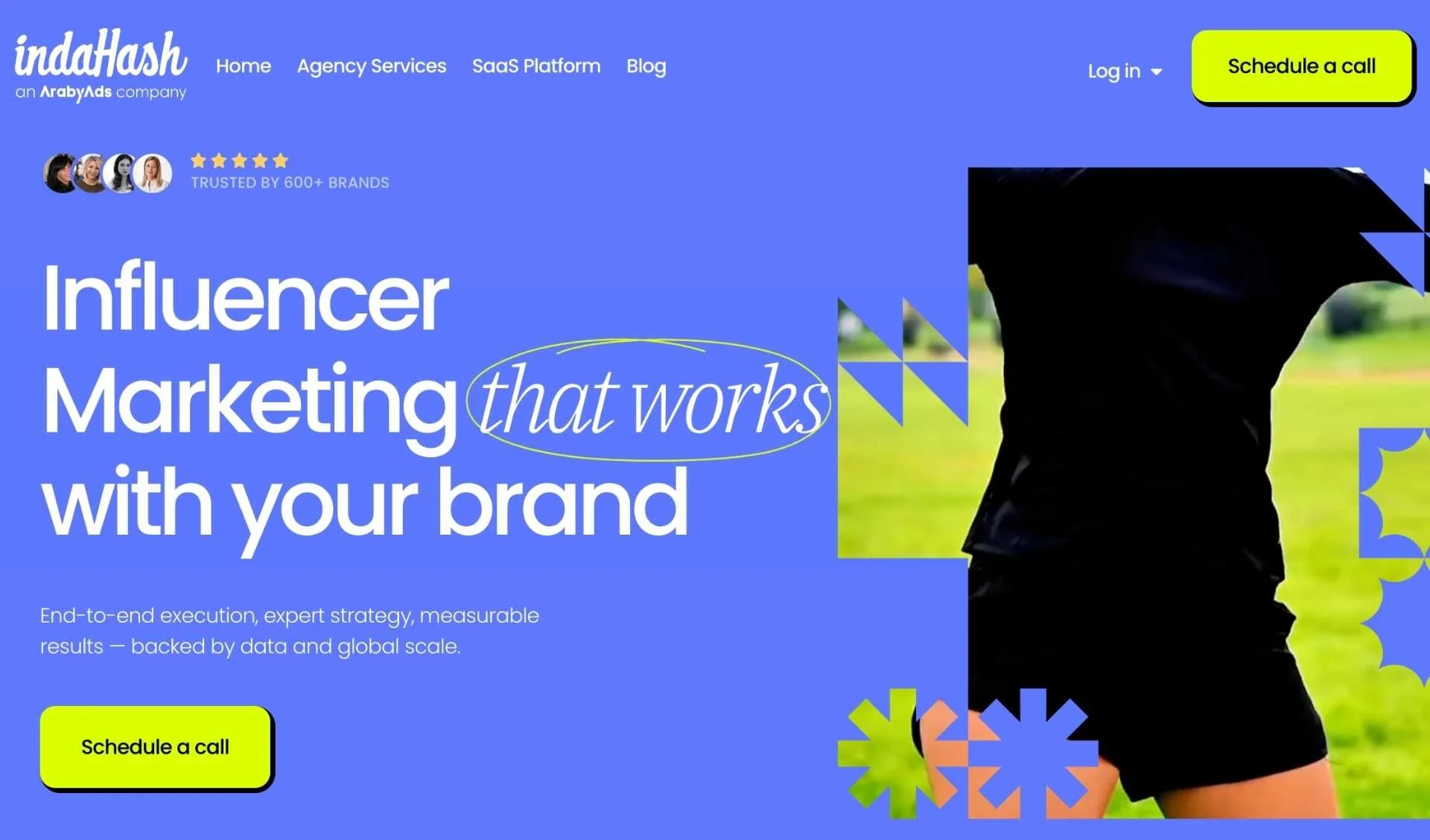
indaHash is a global influencer marketing platform and agency hybrid that combines technology with managed services. It focuses on large-scale campaigns across international markets, offering access to a vetted creator network and strong execution capabilities for brands running multi-market influencer programs.
Key Features
• Global influencer network — indaHash provides access to creators across 100+ markets, making it ideal for international campaigns.
• Managed campaign execution — Unlike self-serve tools, indaHash offers full-service campaign management, from strategy to execution.
• Creator vetting and quality control — Influencers are pre-screened for quality, audience authenticity, and brand safety.
• Campaign performance tracking — Tracks engagement, reach, impressions, and campaign effectiveness across markets.
• Content creation and distribution — Focuses on producing scalable, high-quality influencer content for global brands.
• AI-supported campaign optimization — Uses data insights to optimize campaign performance and creator selection.
Pricing
indaHash does not publicly disclose full pricing on its website, and most plans are offered on a custom or quote-based model. However, publicly listed pricing tiers include:
• Creator Discovery – $499/year
• Discovery & Campaign Management – $999/month
• White Label (Agencies) – $9,990/year
• Enterprise License – $4,999 (one-time)
• Free Trial: Available
Reviews
4.7 / 5.0 (G2)
Pros
• Strong global reach and localization capabilities — Ideal for brands running campaigns across multiple countries.
• Managed service model reduces internal workload — Handles strategy, execution, and reporting.
• High-quality creator network — Focus on vetted influencers improves campaign consistency.
Cons
• Limited self-serve functionality — Less control for teams wanting hands-on campaign management.
• Higher cost compared to SaaS platforms — More aligned with enterprise budgets.
• Less flexibility for smaller campaigns — Designed primarily for large-scale programs.
Integrations
• Instagram — Core platform for influencer campaigns and tracking.
• TikTok — Supports global creator campaigns and content distribution.
• YouTube — Enables long-form influencer content campaigns.
• Facebook — Used for campaign amplification and tracking.
• Custom reporting tools — Export campaign data for enterprise reporting.
Stellar vs indaHash
Stellar is a self-serve SaaS platform focused on analytics and campaign planning, while indaHash operates more as a managed service for large-scale global campaigns.
indaHash is better suited for brands that want execution handled externally, whereas Stellar is better for teams that want control, in-house management, and deeper data insights.
Influencity
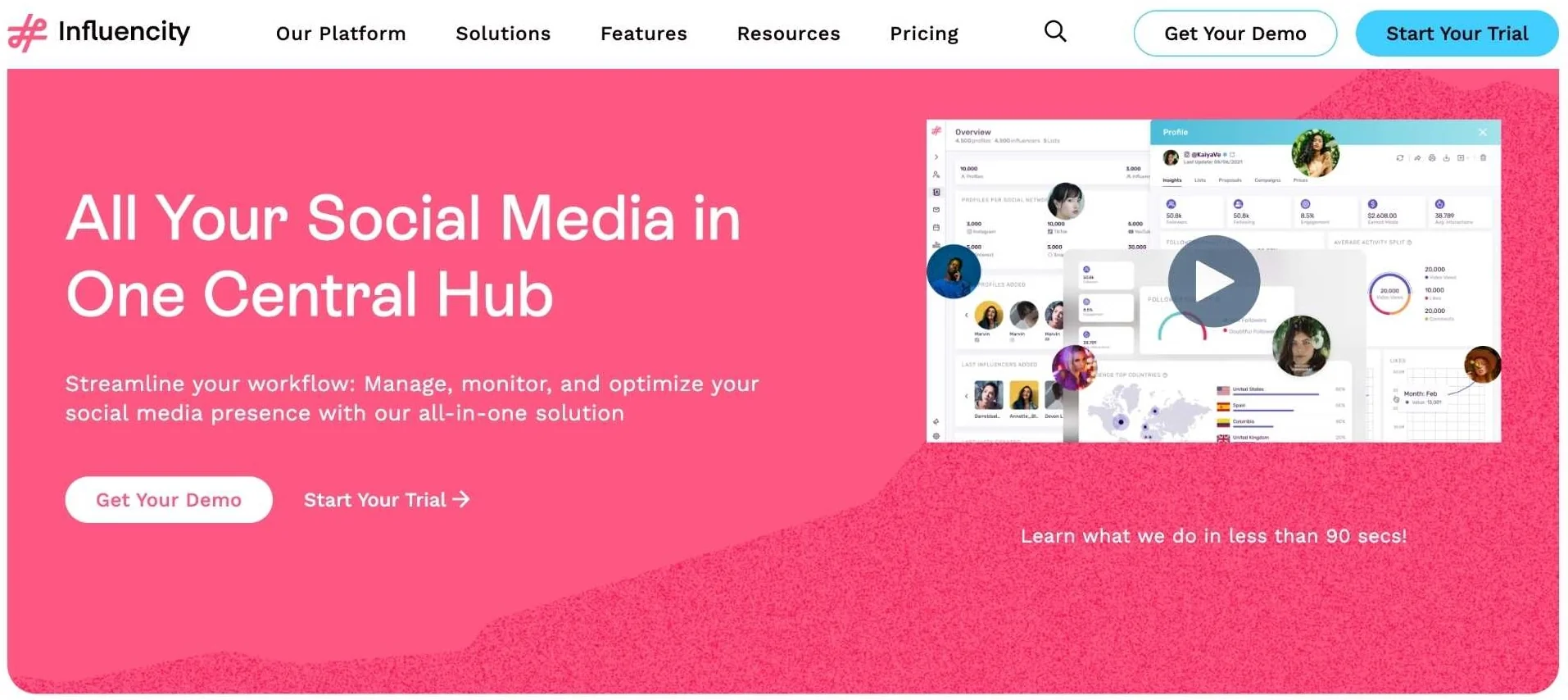
Influencity is an influencer marketing platform focused on data-driven discovery, campaign management, and performance analytics. It positions itself as a flexible solution for brands and agencies that want deep filtering, scalable outreach, and detailed reporting without the complexity of enterprise-only tools.
Key Features
• Massive influencer database (170M+ profiles) — Supports discovery across Instagram, TikTok, and YouTube with detailed filters.
• Advanced filtering and audience insights — Includes audience demographics, interests, authenticity scores, and engagement data.
• Campaign management and CRM — Manage influencer relationships, outreach, and campaign workflows in one place.
• Automated outreach tools — Send bulk emails and manage conversations directly in the platform.
• Performance tracking and ROI analytics — Track engagement, reach, conversions, and campaign effectiveness.
• Fake follower detection — Helps identify low-quality or fraudulent accounts.
• API access and custom reporting — Enables deeper integrations and advanced reporting capabilities.
Pricing
Influencity offers three main pricing tiers, along with add-ons:
• Professional Plan: $318/month or $3,816/year
• Business Plan: $798/month or $9,576/year
• Enterprise Plan: Custom pricing
• Auto-Tracker Add-On: $660/year (for 50 influencers)
Reviews
4.3 / 5.0 (G2)
Pros
• Highly advanced filtering and analytics — One of the strongest platforms for granular audience insights.
• Good balance between price and features — More affordable than many enterprise tools.
• Strong fraud detection capabilities — Helps ensure influencer authenticity.
Cons
• UI can feel complex for new users — Advanced features come with a learning curve.
• Limited built-in automation compared to newer tools — AI capabilities are less prominent.
• Customer support can vary — Some users report inconsistent experiences.
Integrations
• Google Analytics — Track campaign traffic and conversions.
• Shopify — Connect influencer campaigns to eCommerce performance.
• Instagram — Core platform for discovery and tracking.
• TikTok — Supports influencer campaigns and analytics.
• YouTube — Enables video-based influencer campaigns.
Stellar vs Influencity
Stellar focuses more on predictive analytics, sentiment analysis, and brand safety, while Influencity excels in detailed filtering and large-scale influencer discovery.
Influencity is better for teams prioritizing granular data and cost efficiency, whereas Stellar is stronger for strategic planning and qualitative insights.
Modash
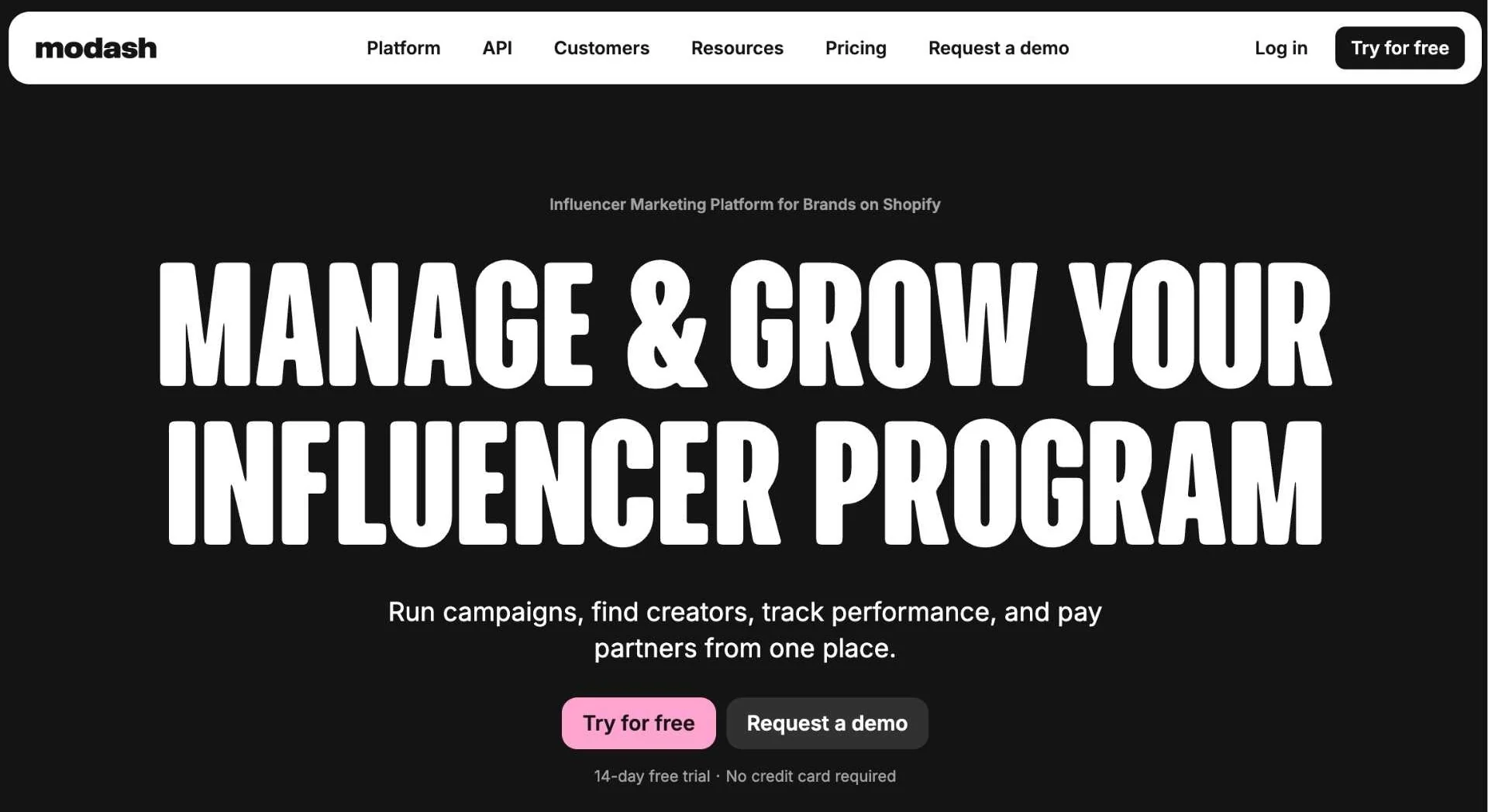
Modash is a creator discovery and analytics platform focused on transparency and real-time data. It provides access to a large global influencer database and emphasizes accurate audience insights, making it popular among brands and agencies looking for reliable data without requiring influencer opt-in.
Key Features
• 250M+ creator database — One of the largest databases, covering Instagram, TikTok, and YouTube.
• Real-time data and analytics — Pulls live data directly from platforms for up-to-date insights.
• Audience demographics and authenticity checks — Includes fraud detection and audience breakdowns.
• Campaign tracking and performance insights — Track influencer content and campaign results.
• Lookalike and keyword search — Find similar creators based on performance and niche.
• API access for custom workflows — Enables integration with internal tools and dashboards.
• No opt-in requirement — Discover any public creator, not just those in a marketplace.
Pricing
• Essentials: ~$199/month (paid annually)
• Performance: ~$499/month (paid annually)
• Enterprise: custom pricing
• Typically billed annually, with scaling based on usage and team size.
Reviews
4.9/5.0 (Capterra)
Pros
• Real-time data accuracy is a major differentiator — Avoids stale or outdated influencer metrics.
• Massive database without opt-in limitations — Enables broader discovery compared to marketplace-based tools.
• Strong API and data flexibility — Ideal for teams building custom workflows.
Cons
• Limited campaign management features — Strong on discovery, weaker on execution.
• No built-in outreach or CRM tools in lower tiers — Requires additional tools for full workflows.
• Less focus on affiliate and commerce tracking — Not as eCommerce-centric as some competitors.
Integrations
• Google Sheets — Export influencer data for custom analysis.
• Slack — Share influencer insights and updates with teams.
• API integrations — Build custom workflows and dashboards.
• Instagram — Real-time influencer analytics and tracking.
• TikTok — Performance tracking for short-form content creators.
Stellar vs Modash
Stellar is a full influencer marketing suite with forecasting, campaign management, and qualitative analytics, while Modash is primarily a discovery and analytics platform.
Modash is better for teams focused on finding and analyzing creators at scale, whereas Stellar is better for managing campaigns end-to-end with deeper strategic insights.
Final Thoughts on Stellar Alternatives
Stellar stands out for its strong focus on predictive analytics, sentiment analysis, and brand safety, but the alternatives highlighted in this article show that the best platform ultimately depends on your priorities. Tools like Upfluence, GRIN, and Influencer Hero lean heavily into eCommerce integrations and revenue tracking, while platforms like Modash and Influencity excel in large-scale influencer discovery and data analysis. Meanwhile, options like SARAL and Ainfluencer prioritize simplicity and accessibility, and solutions like indaHash or IZEA offer more managed or hybrid approaches. For brands, the decision comes down to whether the priority is analytics, execution, scalability, or cost efficiency—each platform brings a different balance of these capabilities.

.png)


.jpg)