


10 Best StarNgage Alternatives for Influencer Marketing
StarNgage does not charge you to look. Signing up is free, browsing the marketplace is free, and money only moves once a campaign does, at which point the charges stack. Self-service campaigns carry a 10% transaction fee, the VIP managed route takes 30%, and StarNgage keeps a 20% commission out of what the creator receives, so a $100 collaboration bills at $120 before the platform fee is added on top. That arrangement is forgiving when a brand is testing three creators and punishing once spend is real, which is the point at which most teams start pricing something else.
The comparison below covers Upfluence, Influencer Hero, Afluencer, Aspire, IZEA, Insense, Later Influence, Influencity, Skeepers and Lefty.
Key Criteria for Evaluating Influencer Marketing Platforms
Core Features
Evaluation of essential influencer marketing capabilities, including influencer discovery, outreach, CRM, campaign management, reporting, and content workflows.
Pricing & Flexibility
Comparison of pricing models, subscription plans, and contract terms to match different budgets and growth stages.
Customer Reviews & Satisfaction
Analysis of user feedback from trusted review platforms, focusing on usability, reliability, customer support, and overall performance.
Pros & Cons
Review of each platform’s strengths and limitations to highlight where it performs well and where it may fall short based on different use cases.
Integrations
Review of the most important integrations (e.g., Shopify and other tech tools), highlighting what each integration enables in one sentence.
StarNgage Overview
StarNgage has run as a marketplace since 2015, and the marketplace shape explains almost everything about it. Brands post a campaign, creators from an index the company puts at more than five million apply or get invited, and StarNgage sits in the middle holding the money in escrow until the work is delivered. Coverage spans Instagram, TikTok, YouTube, Facebook and Threads, with an influencer database that surfaces audience demographics, engagement benchmarks and a fake-follower check before you commit budget. The analytics have real history behind them, since the company has published category rate cards and engagement benchmarks off its own campaign data for years, and the campaign builder is genuinely fast. What it is not is a system of record for a mature program, and the fee model is the reason a growing brand eventually prices the move.
Key Features
- Marketplace campaigns: Post a brief, collect applications and approve creators, with funds held in escrow until deliverables land.
- Creator search and analytics: Filter a five-million-profile index on audience demographics, engagement and category, with machine-learning content analysis behind the numbers.
- Fake follower checker: Screens an account for inauthentic audience before a collaboration is approved.
- Rate card benchmarks: Category-level pricing and engagement baselines drawn from the platform’s own campaign history.
- Live chat and affiliate campaigns: Direct brand-to-creator messaging in-platform, plus sales-driven collaborations tracked through a Shopify app.
Pricing
- Sign-up: Free for brands and agencies, with no charge to browse the marketplace
- Self-service campaigns: 10% transaction fee on campaign spend
- VIP managed service: 30% service fee, covering strategy, talent curation and execution
- Creator commission: StarNgage retains 20% of creator payment, so a $100 collaboration costs the brand $120
- Subscription tiers: Basic, Business and Agency, differing by invitation credits, minimum one month with cancellation any time
The subscription figures are the gap. StarNgage names the three self-service tiers and explains that they differ by invitation credits, but does not publish what any of them cost on the current site, and a legacy plan page still lists one-time payments of $100 and $400 alongside a $490 annual option that does not map to those tiers. Budgeting means asking. What is published clearly is the percentage layer, and that is the part that scales with you.
Reviews
4.6/5.0 (G2, 20 reviews). The score is good and the commentary about speed of shortlisting is consistent, but twenty reviews is a thin evidence base for a platform that has been trading for a decade, and there is no second listing with meaningful volume to cross-check it against.
Integrations
- Shopify: Commerce Intelligence plus a published affiliate app for tracking creator-driven sales.
- Instagram: The primary network for discovery, analytics and campaign delivery.
- TikTok and YouTube: Creator account connections feeding profile metrics and campaign reporting.
- Facebook and Threads: Additional profile coverage for brands running beyond the main two networks.
- iOS and Android apps: Campaign and creator management from mobile for both sides of the marketplace.
The surface stops there. Ecommerce means Shopify and nothing else, there is no published Zapier app, no Slack connection and no email-platform sync, so anything the marketplace does not do itself gets handled by hand.
Pros
- Nothing to pay before a campaign runs: No subscription is required to sign up, search or post a brief, which makes a first test genuinely cheap.
- Escrow protects both sides: Funds sit with the platform until deliverables are approved, which removes the awkward part of paying an unfamiliar creator.
- Benchmarks you can price against: Category rate cards and engagement baselines give a brand a defensible starting number in a negotiation.
Common Drawbacks of StarNgage
The fee grows with the program
Ten percent on self-service, thirty on managed, and a twenty percent commission taken from creator payments. Spend $5,000 with creators and the arrangement costs meaningfully more than a flat subscription that charges the same at $50,000.
Subscription tiers without published prices
Basic, Business and Agency are named and described by invitation credits, but no figure appears on the current site and an older plan page contradicts them. A buyer cannot model the total cost without a sales conversation.
Cross-border payments are the weak point
The most consistent criticism from reviewers is currency conversion and international payment handling, which is an awkward flaw in a marketplace whose creator supply is global by design.
Campaigns lock once published
Reviewers report being unable to edit a campaign after it goes live, so a brief that needs a correction has to be rebuilt. Profile-level demographic data is also patchy in places, which slows vetting.
Best StarNgage Alternatives
| TOOL | REVIEWS | BEST FOR | TRIAL INFO | PRICING | ||
|---|---|---|---|---|---|---|
1 |

|
⭐ | Influencer discovery | Book Demo | Pricing | Website |
2 |

|
⭐ | Influencer CRM & automation | Book Demo | Pricing | Website |
3 |

|
⭐ | Influencer marketplace campaigns | Book Demo | Pricing | Website |
4 |

|
⭐ | Influencer partnerships | Book Demo | Pricing | Website |
5 |
|
⭐ | Influencer marketplace | Book Demo | Pricing | Website |
6 |

|
⭐ | UGC creators & paid social ads | Book Demo | Pricing | Website |
7 |

|
⭐ | Social media & influencer campaigns | Book Demo | Pricing | Website |
8 |

|
⭐ | Campaign management | Book Demo | Pricing | Website |
9 |

|
⭐ | Influencer gifting & UGC campaigns with micro-influencers | Book Demo | Pricing | Website |
10 |

|
⭐ | Influencer analytics & discovery | Book Demo | Pricing | Website |
Upfluence

Upfluence sells the opposite arrangement to a marketplace: a licensed platform on an annual contract, with no cut of what creators are paid. Its core market is ecommerce brands and the agencies serving them, and the capability it is best known for is reading a store’s own customer records to find buyers who already have an audience. An AI layer called Jaice now sits across discovery, outreach and reporting.
Key Features
- Audience-first search: Query a large creator index by demographics and performance rather than by category alone.
- Live customer matching: Scans connected store data to flag existing buyers with a following worth activating.
- Jaice AI assistant: Drafts outreach, suggests creator matches and summarises campaign performance in-product.
- Creator payments: Upfluence Pay settles creator fees globally and ties them to tracked results.
- Campaign workflow: Briefs, approvals and deliverable tracking managed for many creators at once.
Pricing
Quote-based, with no figures published. Cost varies by module, team size and program volume on a twelve-month minimum, with no setup fee and no share of sales. Vendr procurement data from 2025 puts the median annual contract near $15,000, ranging roughly $9,300 to $27,000.
Reviews
4.6/5.0 (G2, 140 reviews) and 4.4/5.0 (Capterra, 44 reviews)
Pros
- Takes no cut of creator spend: The contract is the cost, so scaling collaborations does not raise the platform’s share.
- Finds creators inside your customer list: Store-record matching surfaces partners a marketplace application flow would never reach.
- Nearly 200 reviews to read: A far larger independent sample than a twenty-review listing.
Cons
- Twelve-month commitment: An annual floor against a platform you can use once and walk away from.
- No number until you ask: Pricing is quote-only, so the first step is a sales call.
- Rigid campaign editing: Once a campaign is live it cannot be changed, and an unfinished setup has to be started again.
Integrations
- Shopify: Pulls order and product data in so commissions calculate against real sales.
- Klaviyo: Pushes creator segments into existing email flows without a manual export.
- Amazon Attribution: Ties creator-driven traffic to Amazon orders, which marketplace reporting cannot see at all.
- WooCommerce and BigCommerce: Brings the same order-level tracking to non-Shopify storefronts.
- Zapier: Hands campaign events to the rest of the stack rather than leaving them in the platform.
StarNgage vs Upfluence
This is a percentage against a licence. StarNgage costs nothing until a campaign runs and then takes a slice of every payment; Upfluence costs roughly $15,000 a year whether you run three collaborations or three hundred, and takes nothing from creators.
The crossover is easy to model and worth modelling. A brand paying creators $3,000 a month is handing over a few thousand dollars a year in fees and should stay where it is. A brand paying creators $30,000 a month is past the line, and it also gets store-record prospecting and native payouts that the marketplace has no answer for.
Influencer Hero
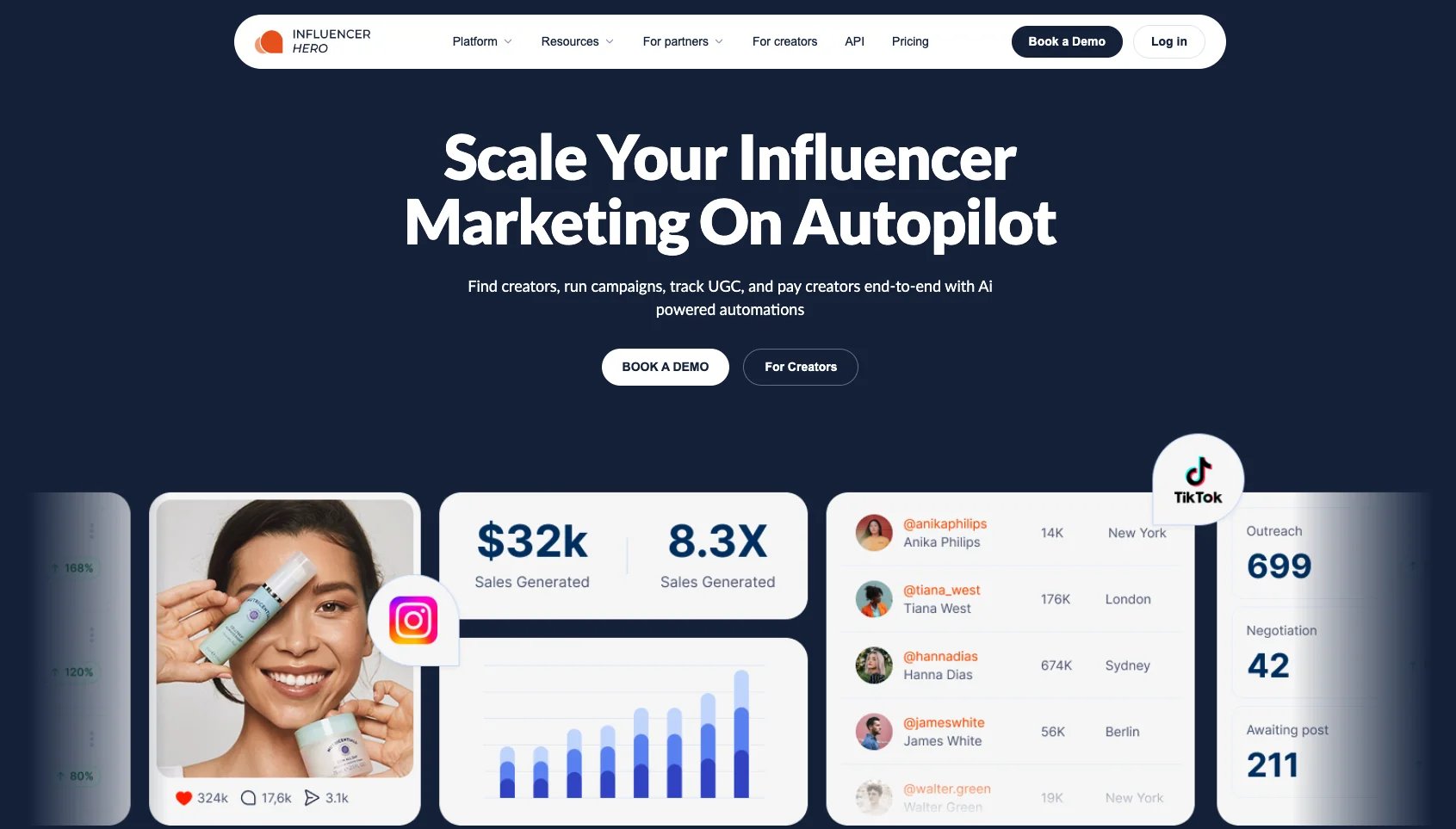
Where StarNgage prices as a share of what you spend, Influencer Hero prices on outreach volume and publishes the figures. It runs discovery, outreach, CRM, gifting, UGC, affiliate tracking and creator payouts across Instagram, TikTok and YouTube, and it is built for D2C and eCommerce teams that want the whole program under one login rather than a marketplace plus four other tools.
Key Features
- Filtered creator search: More than twenty filters across Instagram, TikTok and YouTube covering location, audience make-up, interests, engagement and follower quality.
- Authenticity screening: Fake-follower and fraud checks run before any budget is committed to a creator.
- Chrome extension: Pulls live stats while browsing a profile and imports that creator into a campaign in one click.
- Automated outreach: Bulk and one-to-one email with AI-drafted replies and follow-ups, plus Instagram DM and WhatsApp arriving in the same inbox.
- Payout and invoicing automation: Bulk and scheduled creator payments at 0.1% to 0.4% by bank debit, with invoice requests and approvals attached to each one.
- Coupon leakage prevention: AI monitors coupon sites and deal forums for leaked codes, rotates the compromised code and notifies the creator.
- Multi-platform commerce: Native Shopify and WooCommerce, with script-based tracking for Magento and custom builds.
Pricing
- Standard: $649/month, up to 1,000 reachouts per month
- Pro: $1,049/month, up to 5,000 reachouts per month
- Business: $2,490/month, up to 10,000 reachouts per month
- Custom & Agency: Custom pricing
Quarterly billing saves 20% and yearly billing saves 30%. There is no free trial.
Reviews
5.0/5.0 (Capterra). Volume there is modest, so read it as directional rather than a large sample.
Pros
- No percentage of creator spend: The subscription is the whole cost, and nothing is deducted from what a creator is paid.
- Every tier is on the website: Three published prices with quarterly and yearly discounts, against tiers that are named but not priced.
- Built for paying creators abroad: Bulk and scheduled bank-debit payouts at 0.1% to 0.4% with invoicing attached, aimed squarely at the cross-border problem.
Cons
- No free trial: Evaluation happens through a demo rather than by opening an account and running one campaign.
- Entry price is a real step: $649 a month against a marketplace that costs nothing to join is a serious change in commitment.
- More product to learn: The surface area is wider, so onboarding takes longer than a campaign builder does.
Integrations
- Shopify: Handles gift orders end to end and books affiliate revenue against the right creator.
- WooCommerce: Gives WordPress storefronts the same seeding and attribution path.
- Klaviyo: Keeps creator and customer lists in step with email programs.
- DocuSign: Agreements are signed and filed against the deal rather than in a shared drive.
- Slack and Zapier: Alerts land in team channels, and Zapier opens more than 8,000 further connections.
StarNgage vs Influencer Hero
The main difference is the pricing model and how you run campaigns. StarNgage is built around a creator marketplace, with brands paying a 10% service fee on successful self-service campaigns, while Influencer Hero uses a fixed subscription starting at $649 per month.
The bigger distinction is workflow. StarNgage is well suited to launching individual campaigns, finding creators through its marketplace and managing approvals and payments in one place. Influencer Hero is designed more around ongoing creator management, with influencer CRM, outreach automation, payments, campaign reporting and relationship management. For brands running a consistent influencer program rather than occasional campaigns, the choice comes down to whether you need a creator marketplace or a system for managing the relationships and operations behind a growing roster.
Afluencer
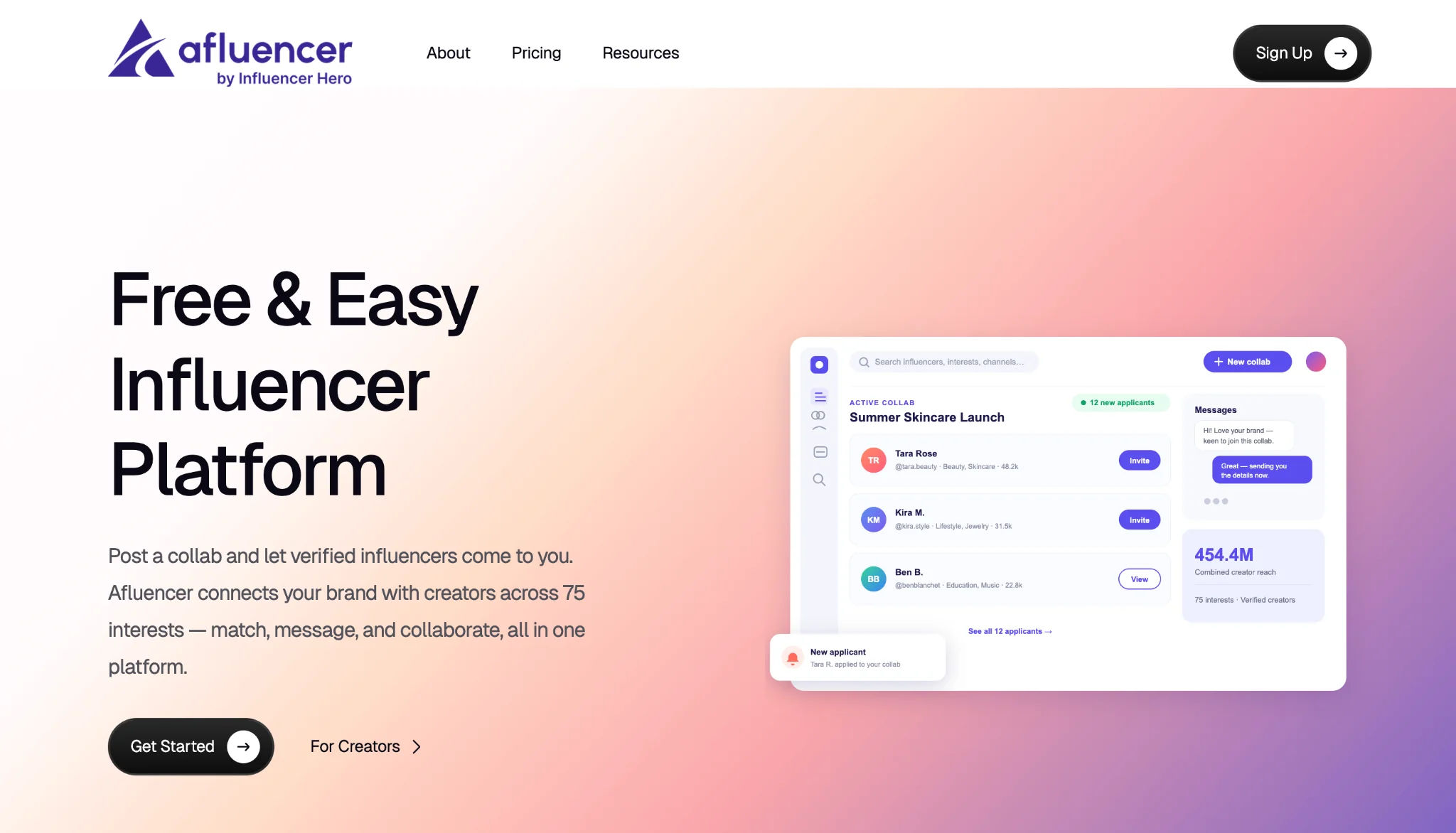
Afluencer solves the same problem StarNgage does, creator supply, at a lower and more predictable price. Brands publish collaboration listings and verified creators apply, across Instagram, TikTok, YouTube, Facebook and X, and the user base skews to Shopify merchants and smaller D2C brands running gifting and affiliate deals.
Key Features
- Inbound applications: Creators come to a published listing rather than being chased one profile at a time.
- Verified opt-in network: Every creator is a registered user who chose to be listed, with profiles checked rather than scraped.
- CreatorGPT shortlisting: AI ranks applicants against the brand’s stated criteria before a human reads them.
- Direct invitations: Tiered credits for reaching out to creators who have not applied.
- Payments and gifting: Creator payments, send-outs and discount codes handled in-platform, with micro-influencer sourcing free to browse before committing.
Pricing
From $49 per month on the Marketplace plan, with higher tiers for more outbound volume and creator-side plans priced separately. A free trial runs through the Shopify listing, though the entry plan is paid.
Reviews
4.6/5.0 (G2, 738 reviews) and 4.7/5.0 (Shopify App Store, 34 reviews). The G2 pool skews creator-side, so it is not directly comparable with brand-side scores elsewhere.
Pros
- Flat $49 instead of a percentage: The cost does not move when campaign spend does, which is the structural difference that matters here.
- Applications without a fee on top: Creator supply is included in the subscription rather than charged per collaboration.
- Hundreds of reviews to check: A far deeper evidence base than twenty listings, even allowing for the creator skew.
Cons
- Listings live or die on the offer: A weak collaboration draws weak applicants, and reviewers report invitations going unanswered.
- Lighter analytics: Nothing comparable to category rate cards or machine-learning content analysis.
- Regional depth: Strongest in the US, with gaps flagged in MENA, the UK and Latin America.
Integrations
- Shopify: Links the storefront so codes, referrals and creator orders track automatically.
- BigCommerce: The same connection for merchants who are not on Shopify.
- Klaviyo: Moves creator contacts into email campaigns without a manual list build.
- DocuSign: Collaboration agreements get signed inside the workflow.
- Slack: New applications appear in a team channel instead of an inbox.
StarNgage vs Afluencer
Both are marketplaces, so the comparison comes down to cost shape and reach. Afluencer is $49 a month flat with no percentage on collaborations; StarNgage costs nothing up front and then takes 10% to 30% plus a creator-side commission, which reverses the advantage the moment spend is meaningful.
StarNgage keeps two things Afluencer does not match: a much larger index with rate-card benchmarking, and escrow protection on payments. For a brand running occasional collaborations in Southeast Asian markets, that combination has real value. For a US or European brand running a steady gifting program, paying a fixed $49 is simply the cheaper way to reach a comparable pool.
Aspire
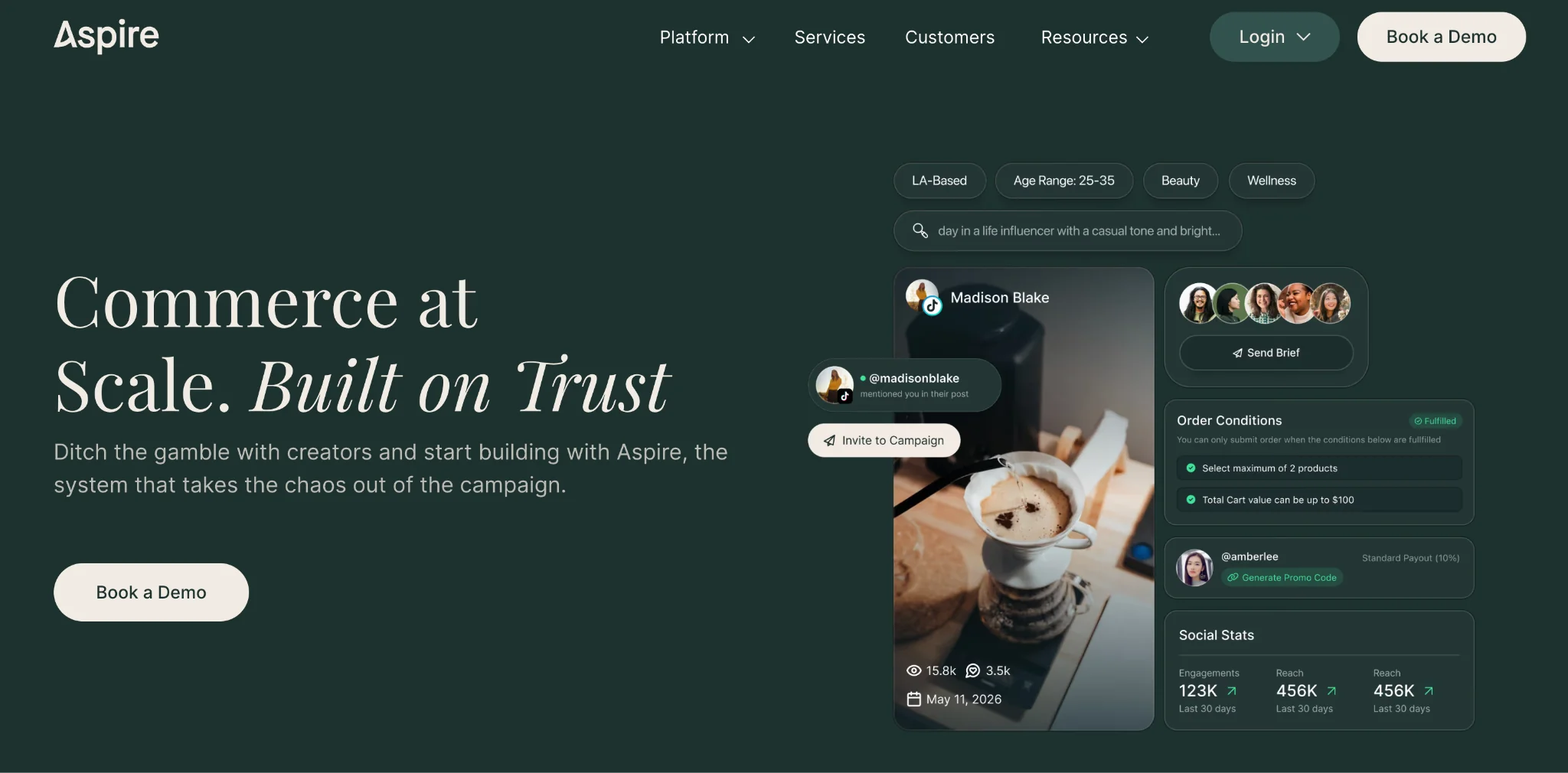
Aspire, formerly AspireIQ, treats influencers, ambassadors, affiliates and product seeding as one program under a word-of-mouth commerce banner. Its customers are mid-market and enterprise ecommerce brands, with Samsung, Keurig and HelloFresh named publicly, and the company reports more than $100M paid out to creators through the platform.
Key Features
- Creator search across types: One search covering influencers, ambassadors and affiliates on any mix of criteria.
- Inbound marketplace: Creators apply directly to your campaigns, which removes the sourcing step entirely.
- Workflow automation: Campaign stages, briefs and deliverables tracked in a CRM the brand configures.
- Promo code and link attribution: Revenue traced back to the individual creator who drove it.
- Content rights management: Usage terms negotiated and stored with the asset rather than agreed by email.
Pricing
No published pricing. The pricing URL returns a 404 and the plans page is a demo form. Vendr procurement data for 2025 places the median annual contract at roughly $15,600, ranging about $11,100 to $36,600.
Reviews
4.6/5.0 (G2, 146 reviews). Its Capterra listing shows 3.5/5.0 from 6 reviews, too small a sample to weigh.
Pros
- Long-term programs are native: Ambassador tiers and ongoing affiliate relationships are built in, where a marketplace is organised around one-off collaborations.
- Rights are handled at the point of agreement: Licensing terms sit with the content, which matters as soon as creator assets run in paid media.
- Attribution down to the creator: Codes and links map revenue to individuals rather than to a campaign total.
Cons
- Ageing interface: Reviewers describe the platform as slow with a dated look.
- Account linking fails: Instagram and TikTok connections drop often enough to slow creator onboarding.
- Enterprise commitment: Roughly $15,600 a year with no published figure and no trial, against a platform that costs nothing to open.
Integrations
- Shopify: Runs seeding orders and attributes affiliate revenue back to campaigns.
- Klaviyo: Aligns creator and customer segments across email and campaign data.
- Impact, CJ and ShareASale: Plugs existing affiliate networks into creator programs.
- Meta, TikTok and Pinterest: Official platform connections behind campaign and profile reporting.
- Gmail and Outlook: Creator threads stay in the platform rather than in a personal inbox.
StarNgage vs Aspire
These sit at opposite ends of program maturity. StarNgage is the cheapest way to buy a handful of collaborations; Aspire is what a brand licenses when creator relationships have become ongoing and need ambassador tiers, licensing and revenue attribution behind them.
The number that decides it is annual creator spend. Below roughly $50,000 a year the percentage model still costs less than a $15,600 licence, and the ambassador machinery is capacity a small program will not use. Above it, the percentage keeps climbing while the licence does not, and the extra functionality stops being theoretical.
IZEA
IZEA has traded in this category since 2006 and is listed on the NASDAQ, which makes it one of the few options here with public accounts. It sells three things at once: managed campaigns run by its own team, software through IZEA Flex, and a self-serve Creator Marketplace whose tiers are published and start lower than anything else in this comparison.
Key Features
- Profile search: Filtering across millions of creator profiles, including a visual search reviewers single out.
- Brand mention monitoring: ShareMonitor tracks hashtags, keywords and mentions across several networks.
- AI content analysis: ContentMine reads campaign content in real time against IZEA’s BrandGraph data.
- Campaign links: A purpose-built shortener that reports performance creator by creator.
- $2 flat-fee payouts: Creator payments processed at a fixed charge per payment instead of a percentage.
Pricing
Creator Marketplace tiers are published: free, then $9, $23, $47 and $129 per month, with 20% off annually. Managed services are quote-only. IZEA Flex tiers appeared on G2 at $130 and $500 per month as of October 2024, but those are no longer on IZEA’s own site and should be treated as dated.
Reviews
3.9/5.0 (G2, 32 reviews). Its Capterra listing carries no reviews, so there is no Capterra score to cite.
Pros
- A flat fee instead of a slice: $2 per creator payment rather than a percentage of the collaboration, which is the cheapest structure among these creator payment tools at volume.
- Published floor of $0: A free tier and paid plans from $9 to $129 make it the lowest-commitment paid option here.
- Buy the execution if you need it: Managed campaigns are available for brands with no internal owner.
Cons
- Performance complaints: Reviewers describe the software as slow and prone to faults.
- Onboarding drag: Several report needing repeated support contact to get moving.
- Two published integrations: Shopify and Google Analytics only, which is thinner still than a marketplace.
Integrations
- Shopify: A published app connecting store data to campaign attribution.
- Google Analytics: Sends campaign traffic and conversions into reporting you already run.
- Instagram and TikTok: Creator account links behind discovery and monitoring.
- YouTube: Channel connection for video creator metrics.
- X, Facebook and Pinterest: Further account linking for tracking and reports.
StarNgage vs IZEA
Both publish real numbers, which puts them in a small minority here, and both give a brand a way in without a contract. The difference is what the number covers.
IZEA charges a subscription from $9 and then $2 to pay a creator, so cost barely moves as spend grows. StarNgage charges nothing up front and then a percentage, so cost moves in direct proportion to it. For a brand paying creators regularly, IZEA is structurally cheaper, and the trade is a 3.9 G2 score and consistent complaints about speed against a 4.6 on a much smaller sample.


Insense
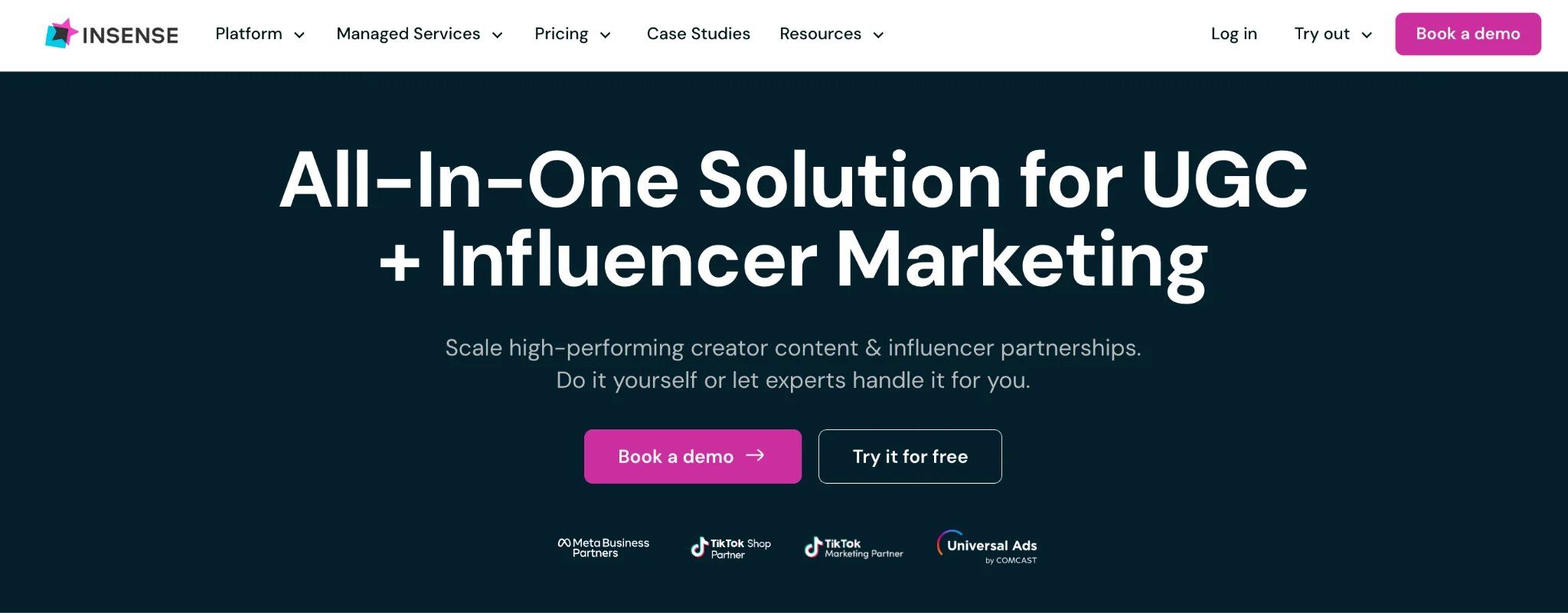
Insense exists to feed paid social. A brand posts a brief, vetted creators apply, licensed assets come back, and those assets run as Meta Partnership Ads or TikTok Spark Ads without leaving the platform. Its buyers are D2C brands, mobile apps and agencies that need creative volume rather than reach.
Key Features
- Creator briefs: A pool of more than 100,000 creators across 35-plus countries responding to a brief, usually within 48 hours.
- Whitelisted Meta ads: Creator handles connect as ad accounts so paid media runs from the creator’s own profile.
- Spark Ads workflow: TikTok spark codes and guided briefs, including TikTok Shop campaigns.
- Product send-outs: Creator orders raised and tracked from the dashboard through Shopify.
- Perpetual content rights: Contracting and payouts automated, with lifetime usage on delivered assets.
Pricing
Fully published. Brand is $500 per month, or $400 billed annually, with unlimited campaigns, 2 seats, 10 Partnership Ads connections and a 10% marketplace fee. Agency is $800 per month, or $640 annually, with 4 seats, 5 brands, unlimited connections and a 7% fee. A one-month trial plan costs $650 with a 20% fee. Creator fees sit outside the subscription.
Reviews
4.5/5.0 (G2, 374 reviews) and 3.7/5.0 (Trustpilot, 187 reviews). The G2 pool leans creator-side, so weigh it accordingly as a brand-buyer signal.
Pros
- Content becomes paid media in one step: Whitelisting from the creator’s own handle is native, with no separate ad workflow.
- Rights are permanent: Lifetime usage on delivered assets rather than a recorded expiry date.
- The fee falls as you commit: 20% on trial, 10% on Brand, 7% on Agency, so the percentage moves in the buyer’s favour.
Cons
- Support is the recurring complaint: Slow replies and limited human contact dominate the negative reviews.
- Seats are capped: Two on Brand and four on Agency, which constrains larger teams.
- Subscription and percentage together: $500 a month plus a marketplace fee, where a marketplace charges only the fee.
Integrations
- Shopify: One-click connection for raising and tracking seeding orders.
- Meta: The whitelisting layer that lets ads run from creator accounts.
- TikTok: Spark codes for promoting creator posts as paid media.
- TikTok Shop: Guided briefs aimed specifically at Shop campaigns.
- Gmail: Keeps creator correspondence inside the workflow.
StarNgage vs Insense
Both take a percentage, which makes this the closest cost comparison in the list. Insense charges 7% to 20% depending on plan and adds a $500 monthly subscription; StarNgage charges 10% self-service with no subscription, plus a 20% creator-side commission that Insense does not levy.
What the extra buys is the paid-social pipeline. If creator content is destined for Meta and TikTok ad accounts, Insense removes the whole handoff and keeps rights in perpetuity. If the goal is organic posts from creators in a specific market, the subscription is dead weight and the marketplace is the better value.
Later Influence
Later Influence is the enterprise creator product Later built out of its Mavrck acquisition, sold beside Later’s social suite and the Mavely affiliate network. It targets enterprise and upper mid-market brands, with Nike, Unilever, Wayfair and Chewy named as customers, and can be bought as software or as a managed engagement.
Key Features
- Best-fit creator matching: Surfaces candidates from brand signals and screens for safety risks before activation.
- Rate benchmarking: Incentive Advisor prices creator offers against observed market rates by channel.
- Predictive scoring: EdgeAI models outcomes using more than 20M analysed creators and $2B in verified influencer-driven purchases.
- Full-funnel reporting: Paid, organic and sales performance in a single view rather than three exports.
- Affiliate link network: Mavely links spanning nine affiliate networks with live conversion and commission data.
Pricing
Only the social management tiers are published, at $18.75, $37.50 and $82.50 per month billed yearly. The influencer product is quote-only and routes to a strategy call, with no free trial. No credible public figure exists for Later Influence.
Reviews
4.5/5.0 (G2, 469 reviews) and 4.6/5.0 (Capterra, 135 reviews), with a 4.8 customer service sub-score on Capterra.
Pros
- Prices the offer before you make it: Rate benchmarking turns creator negotiation into a data question rather than a guess.
- Commission handled across nine networks: The Mavely layer tracks and settles affiliate revenue, which a campaign marketplace does not attempt.
- Around 600 independent reviews: An evidence base thirty times deeper than the alternative.
Cons
- Reliability complaints: Reviewers report a clunky inbox, crashes on large campaigns and tracking gaps.
- Steep navigation: A confusing tab structure slows new teams considerably.
- Enterprise sales cycle: No price, no trial and contract terms reviewers call inflexible.
Integrations
- Instagram, Facebook and Pinterest: Official platform partnerships covering publishing and analytics.
- TikTok and YouTube: Content tracking and performance data on the video networks.
- Impact, Rakuten and AWIN: Affiliate connections feeding conversion and commission figures.
- Bazaarvoice and Yotpo: Sends creator content into on-site reviews and UGC displays.
- Mailchimp and Google: Ties campaign data to email and analytics reporting.
StarNgage vs Later Influence
The gap here is one of category rather than degree. StarNgage sells access to creators; Later sells the infrastructure a large program runs on, including rate benchmarking, brand-safety screening and commission settlement across nine affiliate networks.
The price of that is total opacity. A brand swaps a platform it can open this afternoon and use for a 10% fee for an enterprise procurement process with no figure attached until late on. That is the right trade for a brand running hundreds of creators and a revenue-share program, and clearly the wrong one for a brand running four collaborations a quarter.
Influencity
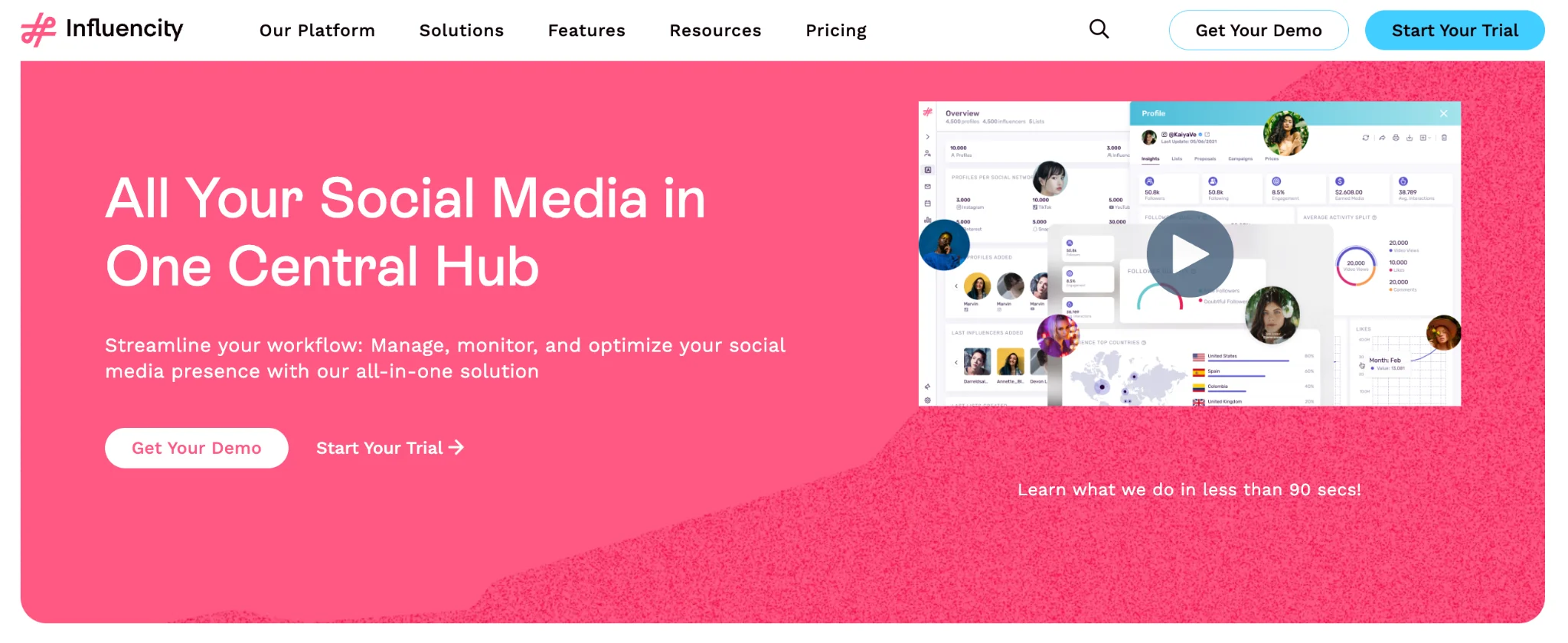
Influencity is self-serve influencer relationship management, covering discovery, IRM, campaigns, reporting and payments, with publishing and listening modules alongside. It works with brands, agencies and ecommerce teams in more than 70 countries, and index depth relative to price is what it competes on.
Key Features
- 200M-profile search: Instagram, TikTok and YouTube filtered by interests, brand affinity and audience make-up.
- Own creator database: Build a proprietary roster with follower-quality metrics and branded recruitment pages.
- Task and cost tracking: Campaign management with creator assignments, budget tracking and seeding built in.
- Exportable reports: Publication performance sent out as PDF, Excel or a shareable public link.
- Multi-currency payouts: Creator payments in more than 180 countries with invoices generated automatically.
Pricing
The public pricing page confirms a 7-day free trial on all plans, monthly and annual billing and usage limits on analyses and tracked creators, but does not render prices. Plans are Basic, Professional, Business and Custom. Software directories report Professional at $398 per month and Business at $998 per month as of August 2026, which should be read as reported rather than vendor-confirmed.
Reviews
4.5/5.0 (G2, 282 reviews) and 4.2/5.0 (Capterra, 5 reviews). The Capterra sample is too small to carry weight.
Pros
- Payouts in 180-plus countries: Multi-currency payments with invoicing, aimed at exactly the cross-border problem reviewers raise elsewhere.
- A roster you own: Creators go into your own database rather than staying inside a marketplace you rent access to.
- Seven days free: A real hands-on trial before any commitment, which most platforms here do not offer.
Cons
- Data accuracy: Reviewers report metric mismatches and filters returning profiles outside their criteria.
- Usage caps: Analyses and tracked creators are both metered, so heavy activity forces a tier change.
- Pricing page renders nothing: The tiers exist but the figures do not appear, and cancellation reportedly requires emailing support.
Integrations
- Shopify: Seeding handled through zero-dollar orders and gift codes.
- Instagram: Discovery, analytics and publishing on the biggest creator base.
- TikTok: Creator discovery with post-level performance data.
- YouTube: Channel discovery and video metrics.
- Social Hub and Social Ads: Native publishing, a unified inbox and paid social in the same suite.
StarNgage vs Influencity
Influencity is the closer answer for a brand that liked StarNgage’s analytics and disliked its payment handling. It searches a far deeper index, pays creators in more than 180 currencies with invoices attached, and lets a brand keep the roster in its own database rather than in someone else’s marketplace.
Neither publishes what a buyer needs to know. StarNgage names its subscription tiers without prices; Influencity renders a pricing page with no figures on it. The difference is that Influencity gives seven days free to find out, which makes it the easier one to evaluate honestly.
Skeepers

Skeepers is a European UGC suite in which influencer campaigns sit alongside verified reviews, consumer feedback and brand communities. The influencer module runs gifting programs through micro and nano creators, and the client list leans to European beauty, fashion and CPG names including Sephora, Dyson and Laneige.
Key Features
- Micro-creator community: More than 400,000 micro-influencers matched to briefs by AI on brand criteria.
- Gifting workflow: Instagram, TikTok and YouTube gifting programs launched and tracked from one interface.
- Rights-cleared assets: Creator photos, videos and reviews delivered with permission for owned and paid reuse.
- Spark and partnership ads: Organic creator content pushed into paid placements without a separate build.
- Verified reviews: Customer reviews collected, AI-moderated, translated and syndicated to retail destinations.
Pricing
Nothing published. There is no pricing page and every route is a demo request. Capterra lists a starting figure near €1,250 per month with no free trial, but that is directory-listed rather than vendor-published.
Reviews
4.4/5.0 (G2, 87 reviews) and 4.3/5.0 (Capterra, 35 reviews)
Pros
- Sourcing is included, not charged: A 400,000-creator community comes with the licence rather than costing a percentage per collaboration.
- European coverage is the strongest here: Depth in EU markets that a Southeast Asia-led marketplace does not match.
- Reviews and creator content together: Social proof and UGC arrive under one contract instead of two.
Cons
- Applicant quality: The dominant G2 complaint is that many applicants behave as product testers rather than creators.
- Bugs and sync delays: Repeat faults, slowness and delayed post syncing come up regularly.
- Demo-only, no trial: Nothing published and no way to try it, against a platform you can open for free.
Integrations
- Shopify: Storefront connection for gifting orders and review collection.
- Magento: The same connection for Adobe Commerce merchants.
- PrestaShop: Ecommerce coverage aimed at European storefronts.
- Salesforce: Pushes review and campaign data into CRM records.
- Zendesk: Routes consumer feedback into support workflows.
StarNgage vs Skeepers
Geography is the honest dividing line. StarNgage’s creator depth is strongest across Southeast Asia; Skeepers is built around European micro-creators and European retail syndication, and a brand selling into France or Spain will find the supply is simply not comparable.
The cost shapes are opposites too. Skeepers is an annual licence reported near €1,250 a month with sourcing included; StarNgage is free until a campaign runs and then takes a percentage of it. For a small European program the marketplace still wins on cost. For a brand running continuous gifting plus reviews, the licence stops being the expensive option fairly quickly.
Lefty
Lefty works with global luxury, fashion and beauty houses including Louis Vuitton, Tommy Hilfiger, Clarins and Vans. It combines a proprietary creator index with CRM, campaign tracking, affiliate management and seeding, reports in earned media value, and covers Weibo, Douyin and RED alongside the western networks, which nothing else in this comparison does.
Key Features
- Multi-market creator index: Eight networks including Weibo, Douyin and RED, filtered on demographics and brand affinity.
- Creator records with health scores: One profile per partner carrying custom fields, bulk labels, impressions and EMV.
- Post capture and EMV: Campaign content collected automatically and valued in earned media terms without manual tracking.
- Affiliate codes and Stripe payouts: Links and promo codes with commission and flat-fee payments settled through Stripe.
- Competitor benchmarking: Share-of-voice measured against named rivals and rolled up by market.
Pricing
Nothing published. There is no pricing page and the only route is a demo request.
Reviews
4.7/5.0 (G2, roughly 91 reviews), a higher score on more than four times the sample size.
Pros
- Chinese platform coverage: Weibo, Douyin and RED are unavailable anywhere else in this list and decisive for brands selling into China.
- Commission settled through Stripe: Affiliate payments run natively rather than being arranged outside the platform.
- Benchmarking as standard: Share-of-voice against named competitors is part of the product, not an add-on.
Cons
- Expensive: Consistently described as costly, with reviewers citing unused capability inflating the bill.
- Tracked-profile caps: Reviewers call the profile limits excessively restrictive for large rosters.
- No published pricing: Demo-only throughout, which rules out any self-serve comparison.
Integrations
- Shopify: Store connection for affiliate attribution and seeding logistics.
- Magento: Commerce integration for Adobe Commerce storefronts.
- Salesforce Commerce Cloud: Enterprise commerce connection for larger retail operations.
- Stripe: Processes creator commission and flat-fee payouts.
- Gmail and Outlook: Creator pitching and follow-up handled inside the CRM.
StarNgage vs Lefty
Both compete on Asian creator reach and arrive at it from opposite directions. StarNgage is strongest in Southeast Asia and priced for brands testing the market; Lefty covers mainland China through Weibo, Douyin and RED and is priced for luxury houses running global campaigns.
For a D2C brand this is rarely a close call. Lefty publishes no pricing, is repeatedly described as expensive, and adds EMV modelling and competitor benchmarking that most brands will not use. It earns the comparison because it is where a brand goes when Chinese platforms become non-negotiable, and no percentage-based marketplace answers that.
Final Thoughts on StarNgage Alternatives
Everything here comes back to one calculation. StarNgage costs nothing to join and then takes 10% self-service or 30% managed, plus a 20% commission out of the creator’s payment, so the platform earns more every time the program grows. That is a good deal at $2,000 a month of creator spend and a poor one at $20,000, and the point where it flips is easy to work out in a spreadsheet.
Afluencer and IZEA both replace the percentage with a small fixed fee and publish what they charge; the published pricing at Influencer Hero puts the whole workflow, including cross-border payouts and commission handling, on a flat monthly figure; Upfluence and Aspire remove the percentage entirely in exchange for an annual licence near $15,000.
Before signing anything, take the creator spend you expect in twelve months, apply StarNgage’s fees to it, and compare the total against the flat alternatives, because that single number resolves this decision faster than any feature comparison will.

.png)


.jpg)










