


10 Best Peg.co Alternatives for Influencer Marketing
Peg built something most influencer platforms still do not have: a Backlash Meter, a running measure of whether a creator’s audience was turning against them, with the posts that caused the shift attached so you could read the context yourself. Paired with a Safety Score rating family-friendliness, it made Peg the tool of choice for brands whose main risk was not a bad conversion rate but a bad headline.
The complication is that Peg is no longer sold as an independent product. Its technology was acquired by Current in 2021, and peg.co now directs prospective buyers to Current rather than to a signup or a pricing page. Anyone searching for Peg alternatives today is really asking a narrower question: what replaces a curated, YouTube-first discovery tool with serious brand safety screening, and what does it cost now that the answer is not a 33,000-creator database behind a six-month minimum. In this article, we’ll compare the 10 best Peg.co alternatives, including Influencer Hero, CreatorIQ, Upfluence, Afluencer, Aspire, NeoReach, Klear, Traackr, Social Cat and Heepsy.
Key Criteria for Evaluating Influencer Marketing Platforms
Core Features
Decide whether you are buying vetting or buying a program. A discovery tool tells you who is safe to work with and hands the rest back to you, while a platform runs the outreach, the contracts, the gifting and the attribution as well. Both are legitimate purchases, but comparing influencer vetting tools against full workflow platforms on price alone will always make the vetting tool look expensive.
Pricing & Flexibility
Treat contract length as part of the price. A six or twelve month minimum on a tool you have not used converts a test into a commitment, and finder’s fees or per-signing percentages sit on top of the subscription without appearing in the headline number. Ask what the total is at the end of the first year, including anything charged per creator.
Customer Reviews & Satisfaction
Check whether the score you are reading is a user rating at all. Editorial scores from industry publications, vendor-collected testimonials and directory listings with two entries all present as ratings and none of them behave like one. A platform with no G2 or Capterra presence is not badly rated, it is unrated, and that is a different risk to price in.
Pros & Cons
Ask who owns the company. Influencer software consolidates constantly, and an acquisition changes the roadmap, the support model and sometimes whether the product continues to exist under its own name. It is a fair question to put to a salesperson before signing anything longer than a month.
Integrations
Trace the path from a creator post to a recorded sale. Discovery tools usually stop at the shortlist, which means every conversion has to be reconstructed by hand from discount codes and screenshots. If revenue attribution matters to how the program gets funded, the store connector is not a nice-to-have.
Peg.co Overview
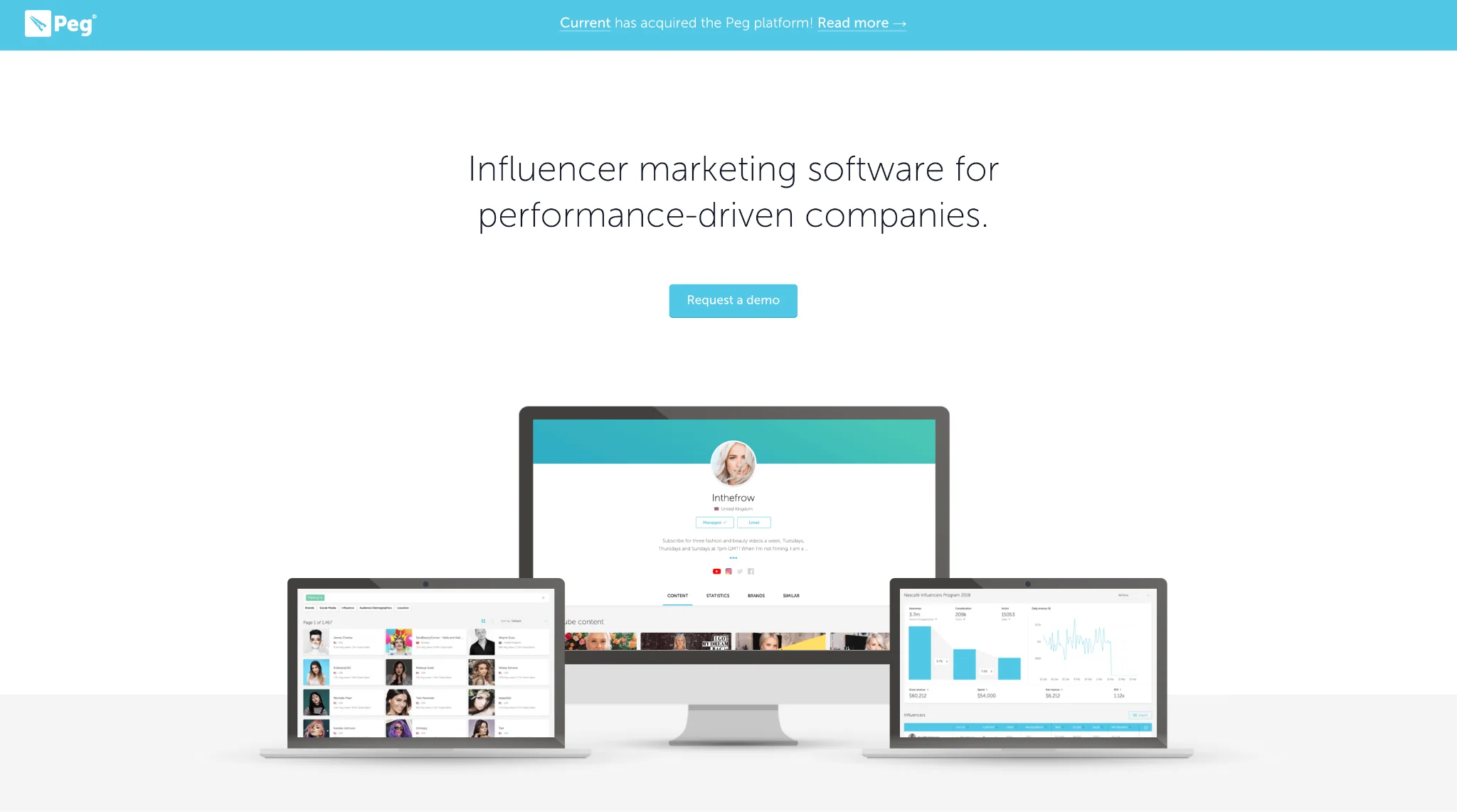
Peg.co is an influencer marketing platform built for brands and agencies, offering influencer discovery, campaign management, performance reporting, and audience retargeting. It specializes in finding YouTube and Instagram influencers using filters such as keywords, audience demographics, brand affinity, and engagement, with a strong focus on measuring campaign ROI rather than vanity metrics.
Key Features
- Curated creator database: Around 33,000 vetted creators, built through talent agency partnerships rather than open scraping, weighted heavily to YouTube with Instagram added later.
- Safety Score: An algorithmic rating of how family-friendly a creator is, tracking problematic language and sentiment trends across their catalogue.
- Backlash Meter: Public sentiment tracked over time with the underlying content shown, so a dip can be read in context rather than taken on trust.
- Collaborative shortlisting: Team messaging with public and private modes, shared shortlists and pitch decks built inside the platform.
- Campaign tracking: Project management, real-time reporting and visibility of a creator’s previous brand collaborations.
Pricing
- No pricing was ever published. Access ran through a sales conversation sized to company and usage.
- Subscriptions were sold on six or twelve month agreements, with a single-project option for brands wanting to test before committing.
- A 5% finder’s fee applied where Peg recommended a creator who then signed a deal, charged on top of the subscription.
- Creator and talent manager profiles were free, so the cost sat entirely on the brand side.
- The platform was acquired by Current in 2021 and peg.co now routes buyers to Current rather than selling a standalone plan.
Reviews
There is no G2 or Capterra listing for Peg, so no verified software buyer rating exists. The 4.7/5.0 figure that circulates comes from an Influencer Marketing Hub editorial review, which is a publication’s assessment rather than user feedback, and it dates from before the platform stopped being sold independently. Third-party write-ups consistently flag the same practical complaints: a small database next to competitors, no pricing transparency, occasional platform glitches and difficulty reaching support.
Integrations
- YouTube: The core data source, with channel-level performance and audience data.
- Instagram: Added after launch, though coverage stayed thinner than the YouTube index.
- Current platform: Since the acquisition, Peg’s analytics sit inside Current alongside creator payments and in-platform messaging.
- Exports and reporting: Campaign data available for reporting outside the tool.
- No published store connectors: No Shopify, WooCommerce or Magento integration and no documented affiliate attribution.
Pros
- Brand safety few match: The Backlash Meter and Safety Score went further than the fake-follower checks most platforms call vetting.
- Agency-vetted curation: Creators entered through talent agency partnerships, so the roster was cleaner than an open database.
- Genuine YouTube depth: Long-form creators are the hardest cohort to research properly, and this was built for them first.
Common Drawbacks of Peg.co
No longer sold on its own
Acquired by Current in 2021, so a new buyer is really buying a different product with Peg’s analytics inside it.
No independent review evidence
No G2 or Capterra listing at all, which leaves nothing to check a sales pitch against.
Discovery only
No affiliate tracking, no store connectors and no revenue attribution, so the commercial half of the program sits outside.
Committed cost with a percentage attached
Six or twelve month minimums plus a 5% finder’s fee on recommended creators who sign.
Best Peg.co Alternatives
| TOOL | REVIEWS | BEST FOR | TRIAL INFO | PRICING | ||
|---|---|---|---|---|---|---|
1 |

|
⭐ | Influencer CRM & automation | Book Demo | Pricing | Website |
2 |

|
⭐ | Enterprise influencer marketing | Book Demo | Pricing | Website |
3 |

|
⭐ | Influencer discovery | Book Demo | Pricing | Website |
4 |

|
⭐ | Influencer marketplace campaigns | Book Demo | Pricing | Website |
5 |

|
⭐ | Influencer partnerships | Book Demo | Pricing | Website |
6 |

|
⭐ | Influencer campaigns & data analytics | Book Demo | Pricing | Website |
7 |
|
⭐ | Influencer analytics | Book Demo | Pricing | Website |
8 |

|
⭐ | Enterprise influencer analytics | Book Demo | Pricing | Website |
9 |

|
⭐ | Micro-Influencer Campaigns | Book Demo | Pricing | Website |
10 |

|
⭐ | Influencer discovery | Book Demo | Pricing | Website |
Influencer Hero
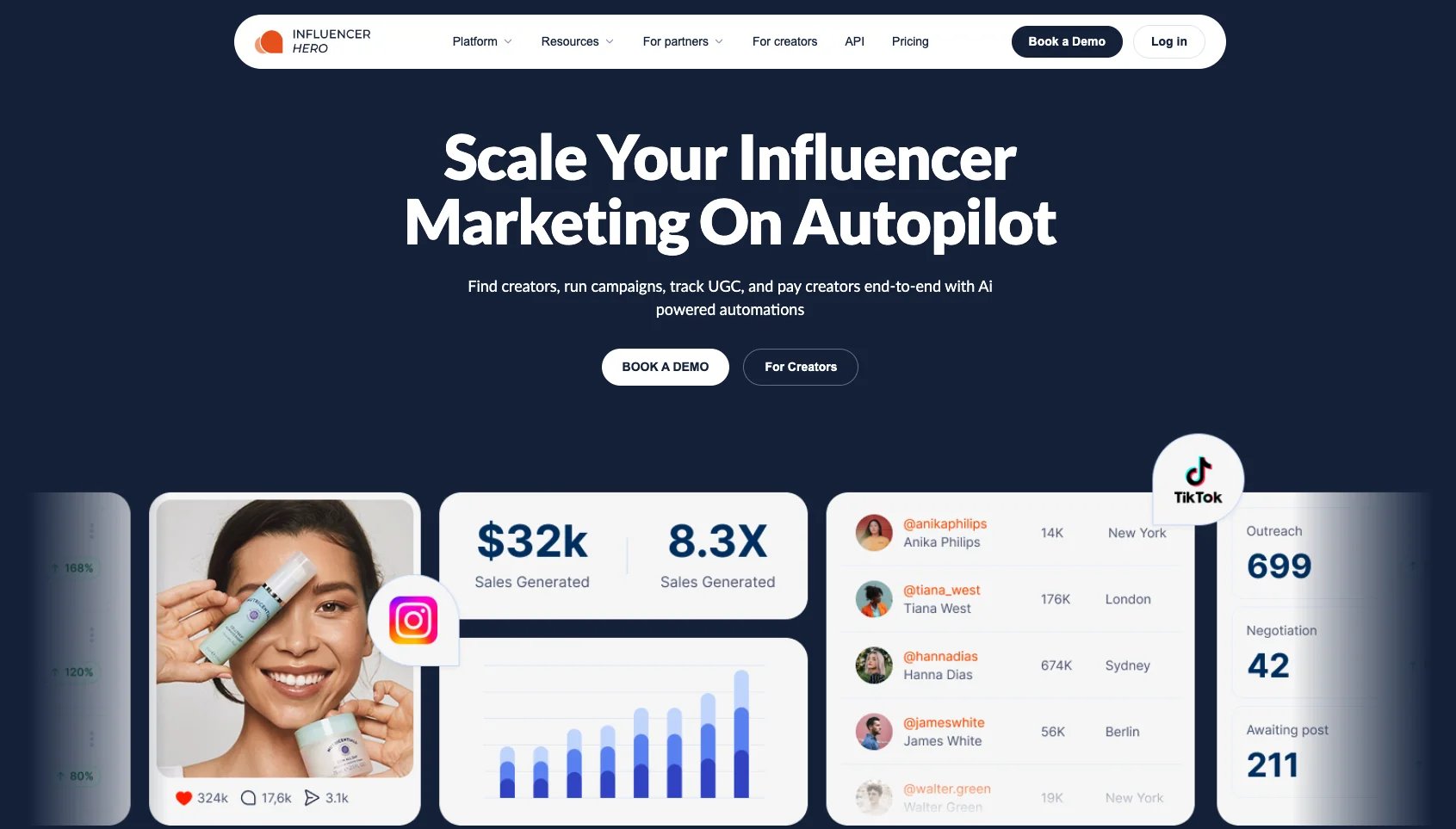
Influencer Hero is an all-in-one influencer marketing platform for D2C and eCommerce teams, covering creator discovery, audience screening, outreach, CRM, gifting, affiliate tracking, UGC collection and campaign reporting in one system. It searches eight social networks and connects to Shopify, WooCommerce and custom stores. For a brand replacing a discovery-only tool, it is the option that also closes the loop to revenue.
Key Features
- Fake follower detection: Audience authenticity screening before a creator enters a campaign, which is the closest direct equivalent to Peg’s vetting layer.
- Creator discovery: Instagram, TikTok, YouTube, Facebook, Pinterest, Snapchat, X and Twitch, filtered by location, audience demographics, niche, engagement rate and follower quality.
- Lookalike creator search: Build the next shortlist from the creators already performing rather than starting from scratch each time.
- Brand follower identification: Surface creators who already follow or buy from you, a warmer starting point than a curated third-party roster.
- Outreach automation: Bulk and one-to-one email with AI personalisation, drip sequences and reply tracking through outreach automation run from your own domain.
- Affiliate management: Links, codes, commission tracking and automated payouts tied to store-level orders.
- Chrome extension: Live creator stats while browsing social platforms, with one-click import into a campaign.
- AI UGC search: Locate delivered creator content by keyword, visual or caption and push the best performers into paid social.
Pricing
- Standard: $649 a month, up to 1,000 creators.
- Pro: $1,049 a month, up to 5,000 creators.
- Business: $2,490 a month, up to 10,000 creators.
- Custom and agency pricing available, with every tier published and no percentage charged on creators you sign.
Reviews
5.0/5.0 (Capterra)
Pros
- Vetting plus the commercial layer: Audience screening and affiliate attribution in the same system, rather than screening alone.
- Eight networks, not one: Coverage well beyond a YouTube-first index.
- No finder’s fee: A flat subscription with nothing charged per creator signed.
Cons
- No free trial: Evaluation runs through a demo rather than hands-on access.
- Expensive for smaller brands: $649 a month is a real commitment at the bottom of the range.
- Learning curve: A broad platform takes longer to master than a single-purpose research tool.
Integrations
- Shopify, WooCommerce and Magento for attribution, with script support for custom builds.
- GoAffPro for affiliate tracking and DocuSign for creator contracts.
- Klaviyo for lifecycle email and Slack for internal alerts.
- Gmail, Outlook and Zapier across the wider stack.
- A documented API for pulling creator data into internal systems.
Peg.co vs Influencer Hero
Peg was research. It told you who a creator was, how their audience felt about them and whether a campaign was likely to embarrass you, then handed the shortlist over. Influencer Hero does the screening too, through fake follower detection and audience quality filters, but continues into outreach, contracts, influencer gifting, affiliate codes and per-creator revenue reporting, so the shortlist turns into a program without a second tool.
The commercial terms differ as much as the scope. Peg sold on six or twelve month minimums with no published price and a 5% fee when a recommended creator signed; Influencer Hero publishes $649, $1,049 and $2,490 a month with contact limits attached and takes nothing per signing. What Peg did better, and this is worth being honest about, is sentiment and controversy analysis. Nothing in this comparison reproduces the Backlash Meter.
CreatorIQ
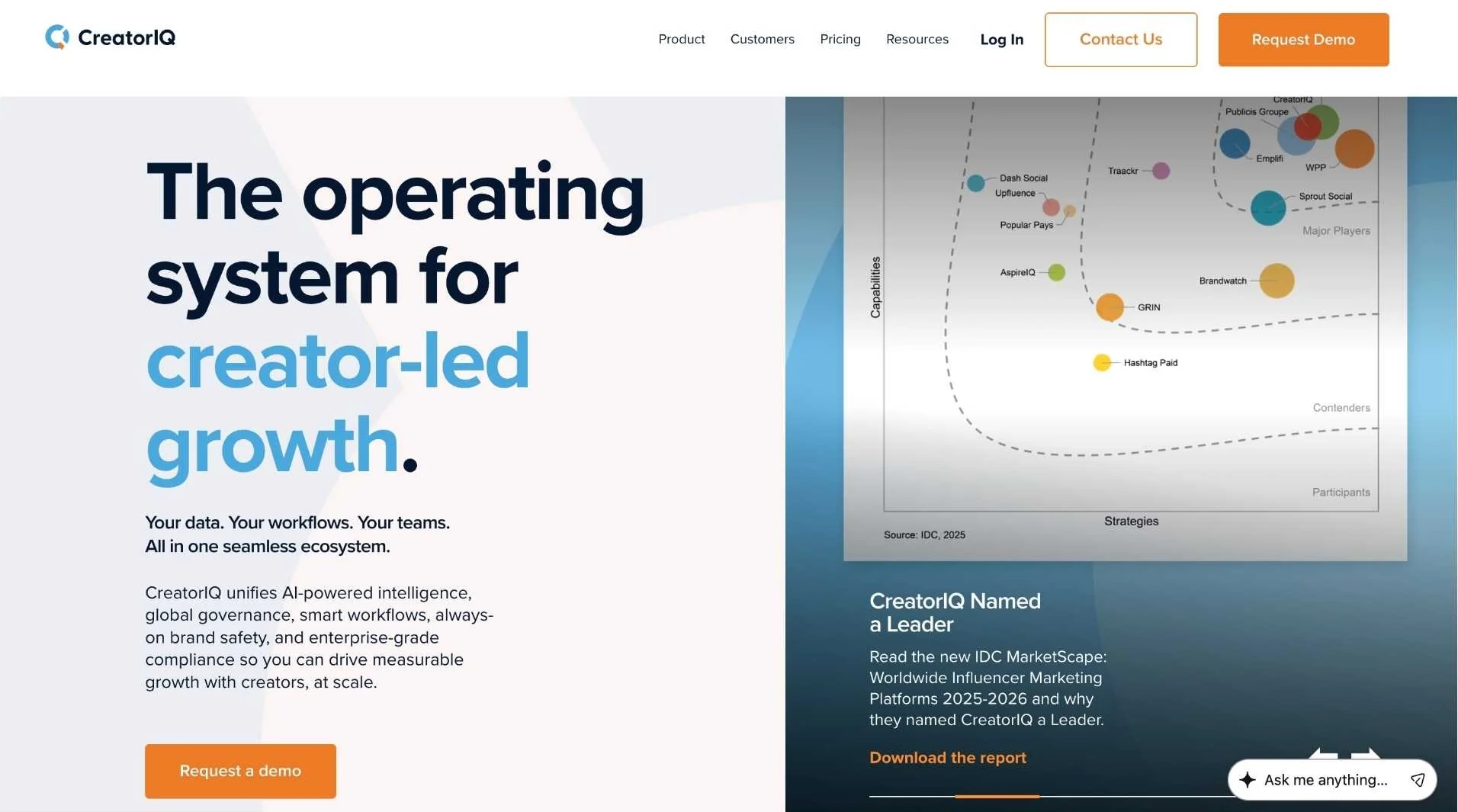
CreatorIQ is enterprise influencer marketing software for large brands and agencies that need first-party creator data, configurable brand safety and reporting robust enough for procurement. It is the closest thing in this list to a professionalised version of what Peg did, with the vetting depth extended across every asset format a creator publishes. It is priced accordingly.
Key Features
- SafeIQ brand safety: Scanning across text, image, video and audio with rules configured per brand.
- First-party creator data: Sourced through official platform partnerships rather than inferred from public pages.
- BenchmarkIQ: Program performance measured against category peers rather than your own history.
- Global creator payments: Payouts handled in-platform across markets and currencies.
- Data export API: A dedicated product for moving creator and campaign data into your own warehouse.
Pricing
- Quote-based, with a call booking form rather than published tiers.
- Third-party listings report entry around $36,000 a year, with buyer medians near $39,000.
- Annual contracts, no free trial and no free version.
Reviews
4.6/5.0 (G2, 581 reviews) and 4.5/5.0 (Capterra, 17 reviews).
Pros
- Brand safety at asset level: The closest available replacement for Peg’s screening, applied across every format.
- Nearly 600 buyer reviews: Exactly the independent evidence Peg never had.
- Affiliate network connections: CJ, Awin, Impact, Rakuten and Partnerize reporting alongside owned activity.
Cons
- Around $36,000 a year: A serious step up from a discovery subscription.
- Nothing published: Budgeting starts with procurement, as it did with Peg.
- Shopify only: No WooCommerce path for store-level attribution.
Integrations
- Shopify, Google Analytics and Tableau for commerce and reporting.
- Salesforce, DocuSign and Sprinklr for enterprise workflow.
- CJ, Awin, Impact, Rakuten and Partnerize for affiliate attribution.
- Single sign-on for enterprise identity management.
- An export API for internal data pipelines.
Peg.co vs CreatorIQ
If brand safety was the reason you used Peg, this is the direct successor. SafeIQ scans text, image, video and audio with rules you configure per brand, which is a broader net than a score built mainly on language and sentiment, and it runs continuously rather than at the point of shortlisting.
The gap is money and scale. Peg sold to mid-market brands on six-month terms; CreatorIQ reports entry around $36,000 a year on annual contracts. For a brand that used Peg to vet a handful of YouTube partnerships a quarter, that is a large jump to make for a capability upgrade rather than a scope one.
Upfluence

Upfluence is a creator marketing platform best known for identifying influencers inside a brand’s own customer and website data rather than in an external roster. It sells modularly, so brands enable discovery, outreach, gifting or payments as needed, and states publicly that it takes no commission on creator-driven sales. It suits brands with enough traffic and order history to mine.
Key Features
- Live Capture: Detects creators sitting inside your existing customer list and site traffic.
- Jaice AI co-pilot: Builds shortlists and drafts outreach for your approval.
- Order triggering: Creates and ships gifting orders straight from your store.
- Multi-currency payments: Creator payouts across international markets.
- Creator marketplace: Inbound applications collected against briefs you publish.
Pricing
- Quote-based and modular, priced on the modules you switch on.
- A fixed platform fee with no commission on creator-driven sales, published by the vendor.
- No setup fee, with a 12 month minimum on annual plans.
- Buyer-reported medians around $15,000 a year.
Reviews
4.6/5.0 (G2, 140 reviews) and 4.4/5.0 (Capterra, 44 reviews).
Pros
- A warmer starting pool: Creators found among your own customers need less vetting than strangers from a database.
- No percentage on signings: A fixed fee with nothing charged per creator or per sale.
- Four store platforms: Shopify, WooCommerce, Magento and BigCommerce.
Cons
- Twelve month minimum: Longer than the six-month option Peg offered.
- Modular cost creep: The quote grows as payments and automation are added.
- No published pricing: Nothing on the site to budget against.
Integrations
- Shopify, WooCommerce, Magento and BigCommerce for commerce data.
- Klaviyo and Hootsuite across the marketing stack.
- Amazon Attribution and Refersion for tracking beyond your storefront.
- Zapier for internal tooling.
- Gmail and Outlook for outreach.
Peg.co vs Upfluence
Peg reduced risk by curating who was allowed into the database in the first place. Upfluence reduces it differently, by starting from people who already bought from you, where the brand affinity is demonstrated rather than inferred and the audience mismatch problem largely disappears.
Neither approach removes the need for the other half of the job, and that is where Upfluence pulls ahead of a discovery tool. Gifting orders trigger from your own store, payouts run in multiple currencies, and revenue tracks across four eCommerce platforms plus Amazon, so the shortlist ends in a number rather than a spreadsheet.
Afluencer
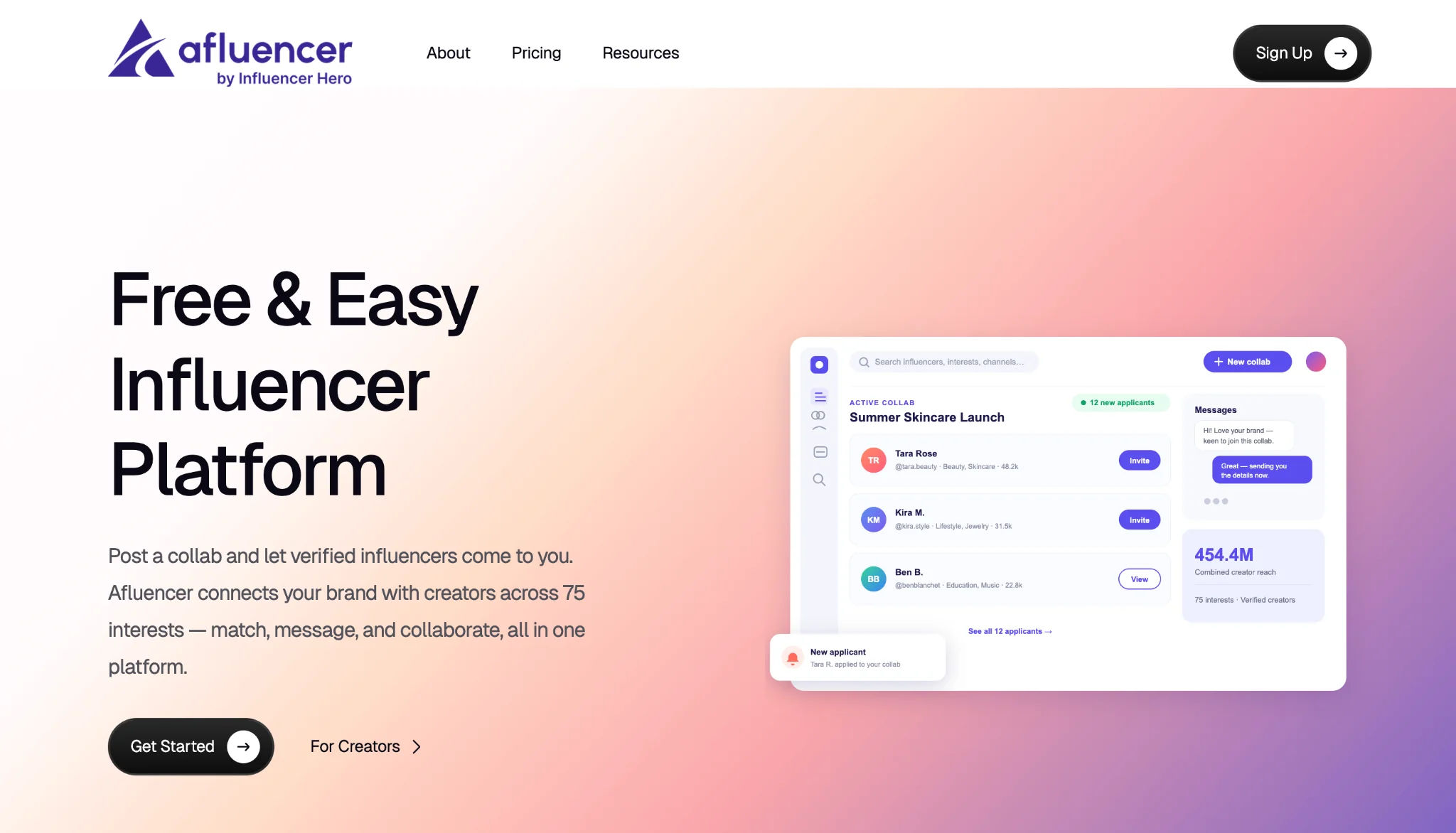
Afluencer is a creator marketplace where brands publish campaign listings and creators apply to them, priced from a published $49 a month with no cut of what creators are paid. It replaces database search with inbound applications, which suits brands that would rather review interested candidates than cold-approach a curated roster. It is the cheapest genuine entry point in this comparison.
Key Features
- Campaign listings: Publish a brief and collect applications from creators who chose it.
- Premium filters: Screen applicants by niche, audience size and social network.
- In-app messaging: Agree rates and deliverables directly with each creator.
- Send-outs and payments: Product delivery and creator payment handled on higher tiers.
- Micro and nano focus: A pool weighted towards micro-influencer marketing rather than established mid-tier YouTubers.
Pricing
- Marketplace: $49 a month with 60 invitation credits and premium filters.
- Standard: $649 a month with 1,000 reach-outs, product send-outs and payments.
- Pro: $1,049 a month with 5,000 reach-outs and a dedicated account manager.
- Creators join and apply free, every tier is published, and there is no minimum term.
Reviews
4.6/5.0 (Shopify App Store, 36 reviews).
Pros
- No committed term: Monthly billing against a six or twelve month minimum.
- Published entry price: $49 a month, with no finder’s fee on anyone you sign.
- Self-selected candidates: Applicants have already read the brief and want the collaboration.
Cons
- No safety scoring: Vetting applicants is your job, with no controversy or sentiment analysis provided.
- Marketplace-bound: You reach creators on Afluencer, not the open web.
- Credit ceiling: 60 invitations on the entry plan disappear quickly.
Integrations
- Shopify for gifting and collaboration workflow.
- Instagram, TikTok and YouTube for reviewing applicant profiles.
- Native in-platform messaging.
- Creator payments handled in-platform on higher tiers.
- Email alerts for new applications on live briefs.
Peg.co vs Afluencer
These sit at opposite ends of the market and the contrast is mostly about who carries the risk. Peg charged for curation and screening so a large brand could partner with a mid-tier YouTuber without a reputational surprise. Afluencer charges $49 a month, hands you applicants and leaves the vetting entirely to you.
For a brand working with nano and micro creators that trade is usually fine, because the exposure from any single partnership is small and the volume is what matters. For a brand whose main worry is a creator’s back catalogue, it is not a replacement, and pairing it with a separate vetting tool costs less than a curated database subscription anyway.
Aspire
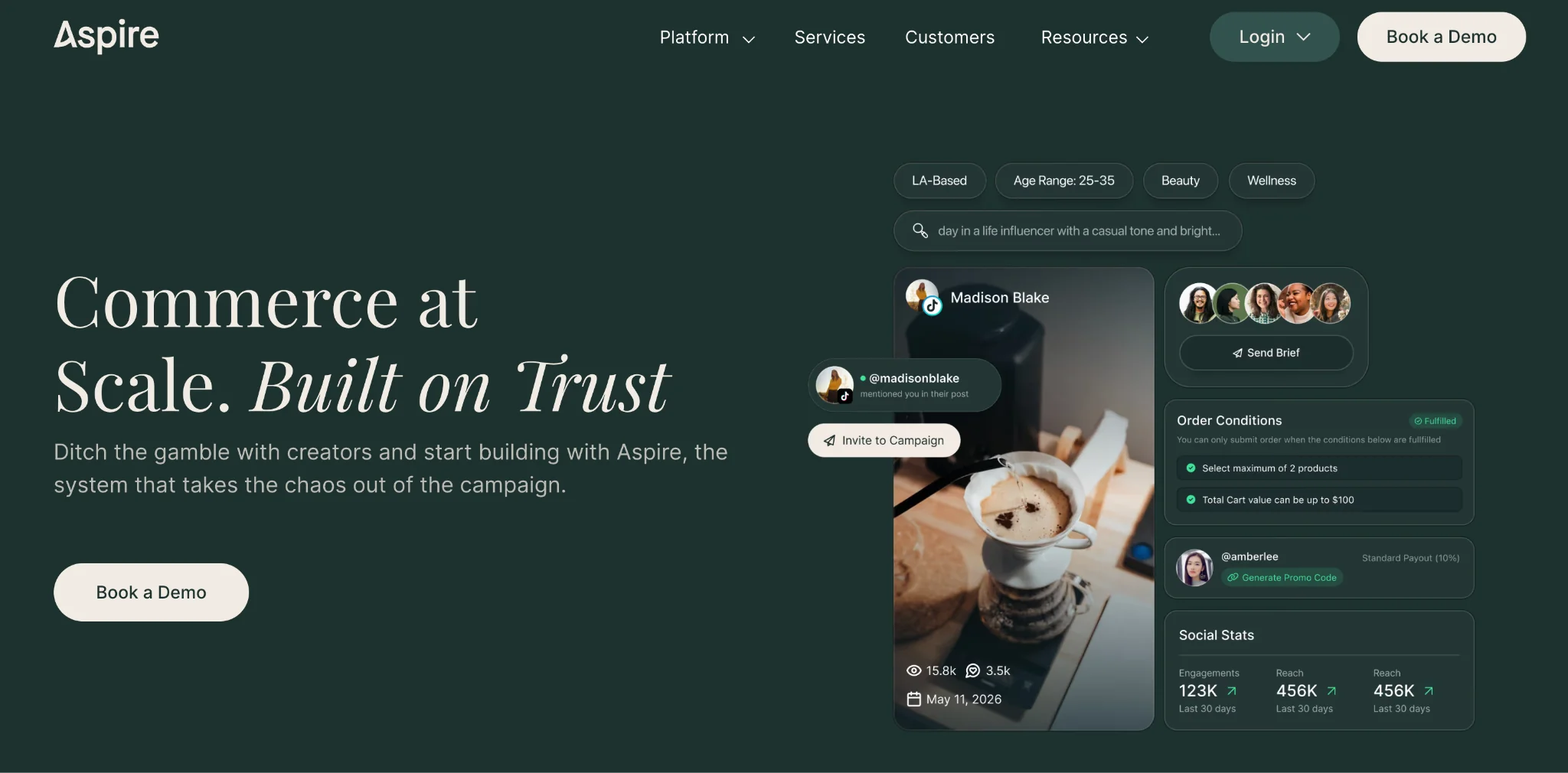
Aspire is a creator marketing platform for D2C brands running influencer gifting, affiliate and paid amplification in one workflow. Creators apply to briefs you publish, you set commission rates per creator, and approved content can run as paid media from the creator’s own handle. It is a program tool rather than a research tool, priced at the enterprise end.
Key Features
- Creator marketplace: Applications collected against briefs you publish.
- Promo codes and affiliate links: Issued per creator at rates you configure.
- Whitelisting: Creator content run as paid ads through Meta Ads Manager from the creator’s handle.
- Content approval and rights: Configurable review rounds with usage licensing attached to each asset.
- Attribution dashboards: Creator activity tied directly to Shopify revenue.
Pricing
- Quote-based, with no published pricing page.
- A 2% handling fee on creator fee budget payments, disclosed in the vendor’s terms.
- Buyer-reported medians near $15,600 a year on annual contracts.
- No free trial.
Reviews
4.6/5.0 (G2, 146 reviews) and 3.5/5.0 (Capterra, 6 reviews, low volume and polarised).
Pros
- Content approval before publication: Review rounds catch a problem asset in draft rather than after it posts.
- Whitelisting: Vetted Meta, TikTok and Pinterest partnerships for amplifying creator content.
- Rights handled in workflow: Usage licensing attached at approval rather than negotiated by email.
Cons
- No creator safety scoring: Approval covers the asset you commissioned, not the creator’s history.
- Shopify only: No WooCommerce attribution path.
- Thin Capterra sample: Six reviews at 3.5 against 146 at 4.6 on G2.
Integrations
- Shopify for revenue attribution and product send-outs.
- CJ, Impact and ShareASale for affiliate tracking.
- Klaviyo for lifecycle marketing.
- PayPal for creator payments.
- Gmail and Outlook for outreach.
Peg.co vs Aspire
The two tools guard against different failures. Peg screened the creator, looking backwards at their catalogue and their audience sentiment. Aspire screens the content, with configurable approval rounds that stop an off-brief asset going live and usage rights fixed at the same moment.
Aspire also does the thing a discovery tool structurally cannot, which is turn a good post into ongoing media. Whitelisting runs a creator’s converting content as a paid ad from their own handle, so the value of a single collaboration keeps compounding instead of decaying in the week after it publishes.


NeoReach
NeoReach pairs a very large creator index with managed campaign execution, aimed at brands that would rather buy a team than operate software. It sells platform access and services separately or bundled, and covers Twitch alongside the mainstream networks. Its index includes fraud detection, which makes it the closest thing here to Peg’s vetting at scale.
Key Features
- Large creator index: Reported at 250 million plus profiles with 400 plus data points each, plus fraud detection.
- Managed execution: Strategists sourcing, briefing, negotiating and reporting on your behalf.
- Seeding logistics: Gifting and fulfilment handled operationally rather than by your team.
- Commissioned UGC: Content production sold as a standalone deliverable.
- API access: Creator data and reporting pushed into internal systems.
Pricing
- Quote-based through an inquiry form, sold individually or bundled.
- A third-party listing reports platform access from around $399 per user per month.
- Managed service retainers are quoted separately and unpublished.
- No free trial.
Reviews
4.5/5.0 (G2, 11 reviews, very low volume), with an empty Capterra listing.
Pros
- Vetting data at depth: 400 plus data points per creator with fraud detection before activation.
- A self-serve tier exists: Reported from around $399 per user per month, below most managed models.
- Twitch coverage: Useful for gaming and hardware brands the mainstream networks underserve.
Cons
- Eleven G2 reviews: Thin evidence, much like Peg’s.
- No published store connectors: Attribution has to be assembled elsewhere.
- Retainer on top: Managed service costs quoted separately and unpublished.
Integrations
- An API for moving creator data into internal reporting.
- Instagram, TikTok and YouTube for performance data.
- Twitch for gaming campaigns.
- Exports into business intelligence dashboards.
- Single sign-on for larger teams.
Peg.co vs NeoReach
Peg took the curated route, capping the database at around 33,000 creators it had vetted through agency relationships. NeoReach takes the opposite one, indexing 250 million plus profiles and layering fraud detection and 400 data points on top so the filtering happens after the fact rather than at the door.
Which is better depends on how you work. A curated list of a few thousand relevant creators is faster to shortlist from; an enormous index with strong filters finds people nobody else has approached. The relevant caution is that NeoReach’s review evidence is as thin as Peg’s, at eleven G2 entries, so neither can be checked properly against a sales pitch.
Klear

Klear is Meltwater’s influencer marketing product, combining a large creator database with audience authenticity screening and compliant international payouts. It arrives inside the Meltwater suite, so social listening and PR data come with it, along with enterprise contract terms. Its screening and listening combination is the closest structural echo of what Peg offered.
Key Features
- Creator database: Over 30 million profiles with AI matching on brand and audience fit.
- True Reach: Bot detection and dormancy analysis that discounts inactive followers from headline reach.
- Social listening: The wider Meltwater suite tracking sentiment around brands and creators.
- Global coverage: 190 plus countries and dozens of languages.
- Compliant payouts: Tipalti and Gigapay handling creator payments and tax by jurisdiction.
Pricing
- Quote-based through Meltwater across Starter, Pro, Enterprise and Agency tiers, with no figures published.
- Influencer marketing is included only on the Enterprise and Agency tiers.
- A 12 month minimum is typical, with no free trial.
- Implementation fees can apply for custom integrations.
Reviews
4.1/5.0 (G2, 2,638 reviews), a suite-wide score covering all of Meltwater rather than the influencer module alone.
Pros
- Sentiment tooling in the same suite: Social listening alongside creator search, which is the nearest thing to a Backlash Meter still sold.
- Inspectable authenticity data: Bot and dormancy analysis rather than a single opaque score.
- Both major store platforms: Shopify and WooCommerce with a pixel fallback.
Cons
- Enterprise gating: Influencer marketing sits on the top two tiers only.
- A suite-wide rating: 4.1 across all Meltwater products, not this module.
- Twelve month term: Longer than Peg’s six-month option, with no trial.
Integrations
- Shopify and WooCommerce for discount codes and tracking links.
- A tracking pixel for stores on other platforms.
- Tipalti and Gigapay for international payouts with tax compliance.
- The wider Meltwater suite for social listening and PR data.
- Single sign-on and enterprise identity management.
Peg.co vs Klear
Of everything here, this comes closest to reproducing the specific thing Peg was bought for. Klear pairs creator search with Meltwater’s social listening, so you can look at how sentiment around a creator or a topic has moved over time rather than only at their follower quality on the day you shortlist them.
The catch is packaging. Influencer marketing only appears on the Enterprise and Agency tiers, nothing is published, and the standard term is twelve months. You are buying a suite to get a module, which is a familiar frustration for anyone who liked Peg precisely because it did one job.
Traackr
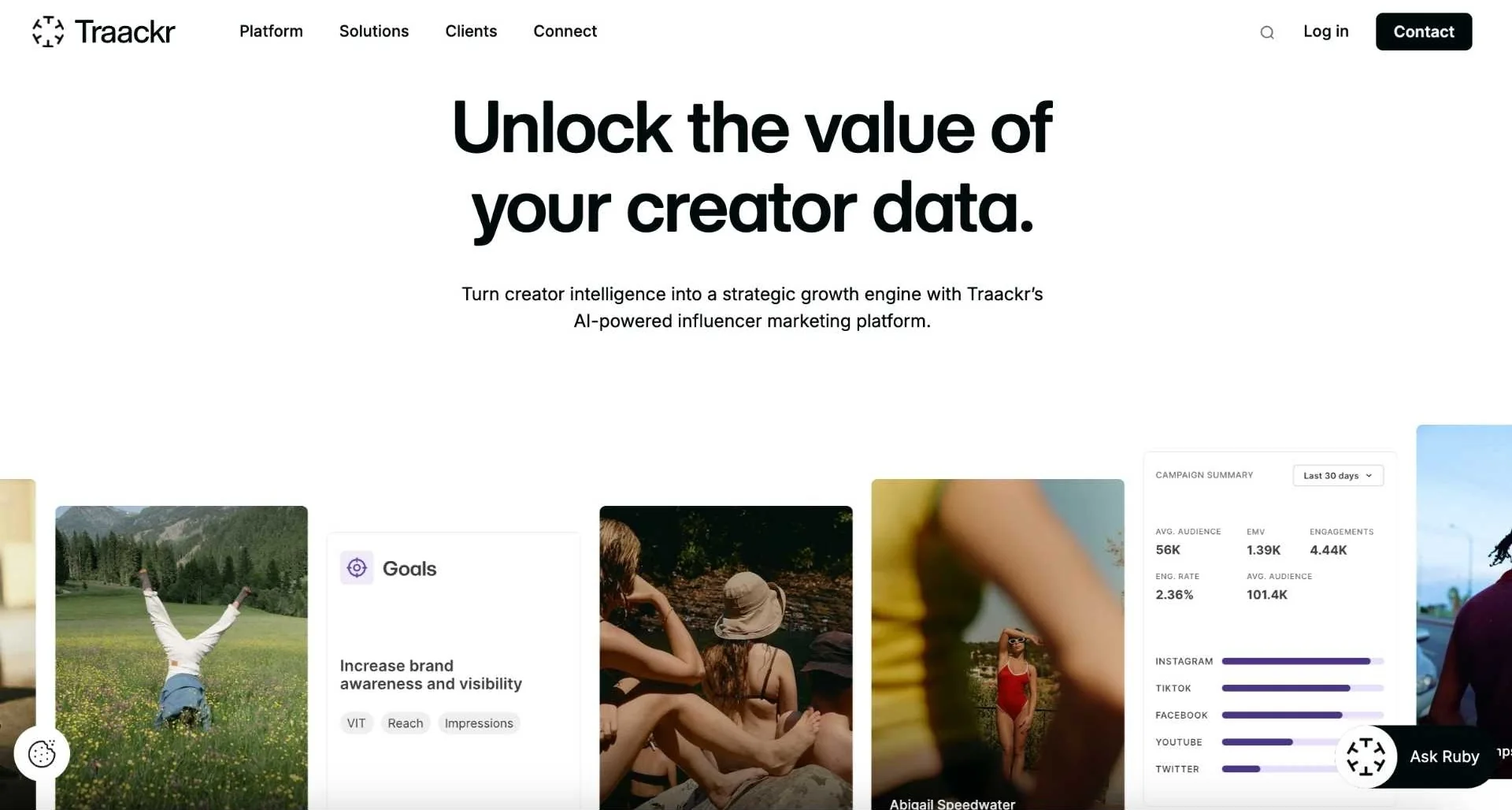
Traackr is a measurement-led influencer marketing platform for brands running continuous creator programs rather than campaign bursts, with heavy adoption in beauty and CPG. It splits the work into planning, activation and measurement, and benchmarks spend efficiency against named competitors. The reporting is the reason to buy it.
Key Features
- Plan, Activate and Measure: Three modules covering an always-on program end to end.
- Shopify seeding app: Inventory-synced ordering so creators select their own products.
- Revenue tracking: Conversions attributed to individual creator links and codes.
- Local currency payments: Creator payouts made in market.
- Brand vitality benchmarking: The dataset behind its published category rankings.
Pricing
- Quote-based, with a pricing page offering only a call.
- No credible third-party figure exists and buyer-benchmark databases hold no entry.
- No free trial and no free tier.
- Annual contracts are standard.
Reviews
4.3/5.0 (G2, 377 reviews) and 4.6/5.0 (Capterra, 32 reviews).
Pros
- Over 400 reviews: Consistent across two independent sources.
- Competitive benchmarking: Spend efficiency measured against named rivals.
- Creator-led seeding: Inventory-synced ordering direct from Shopify.
Cons
- No pricing signal anywhere: Even benchmark databases have nothing on file.
- Shopify only: No WooCommerce and a short named integration list.
- Light on creator vetting: Measurement is the strength; controversy screening is not.
Integrations
- A free Shopify app for inventory-synced seeding.
- Single sign-on for enterprise identity management.
- A data lake connection for pushing campaign data into your warehouse.
- Instagram, TikTok and YouTube for creator performance data.
- Local payment rails for creator payouts by market.
Peg.co vs Traackr
These solve opposite halves of the same programme and neither covers both. Peg was strongest before a campaign started, deciding who was worth approaching and who was a liability. Traackr is strongest afterwards, attributing revenue to individual creators, benchmarking spend efficiency against named competitors and pushing the underlying data into your warehouse.
A brand switching from one to the other should expect to gain a defensible number and lose a screening step. If reputational risk was the reason Peg was on the roster, Traackr does not replace it, and something like CreatorIQ or Klear is the closer match.
Social Cat
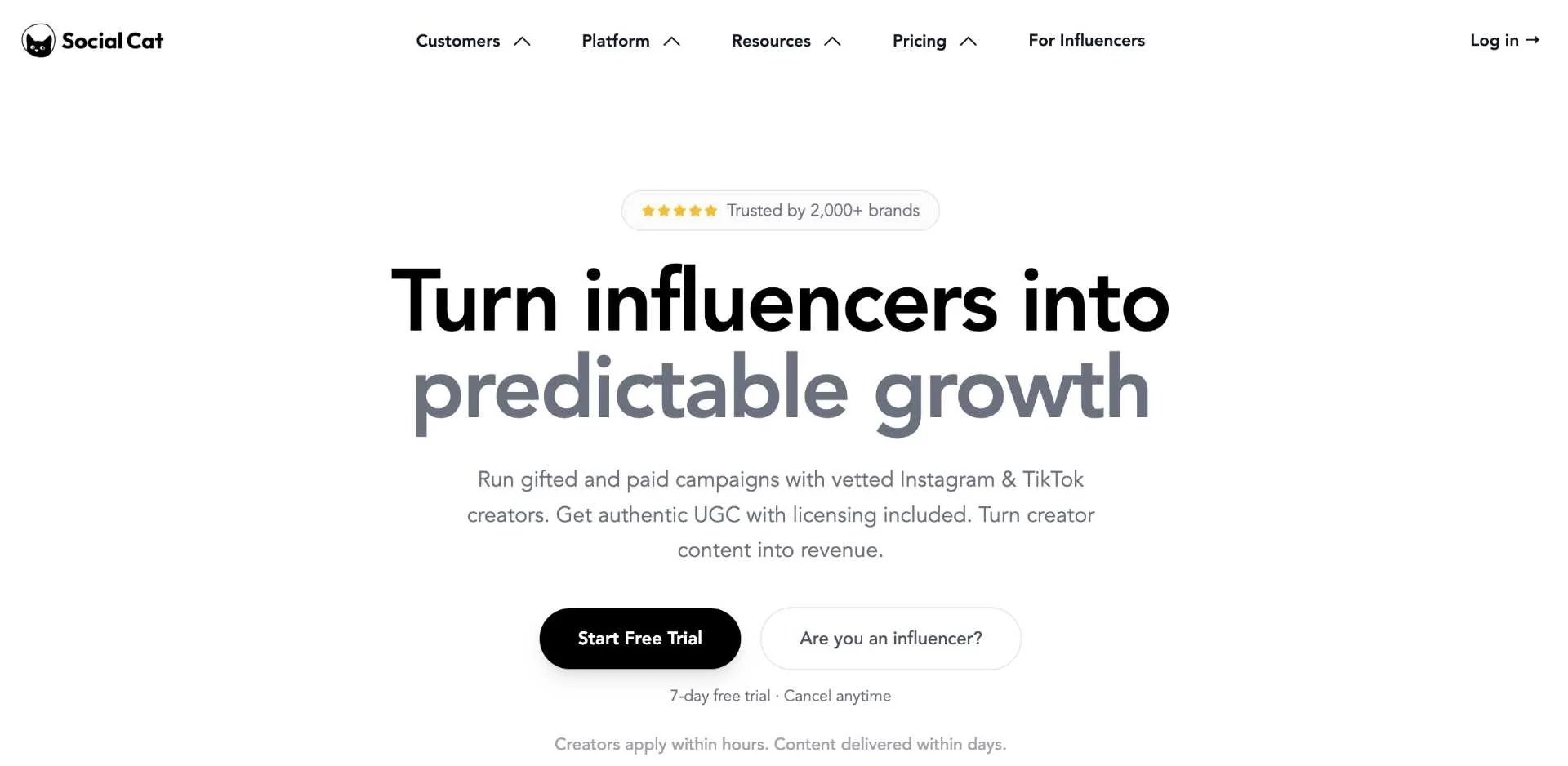
Social Cat is a micro-influencer marketplace for small and mid-sized brands, connecting them with Instagram and TikTok creators for gifted and paid collaborations. Contracts and usage rights are included at every tier and pricing is published in full. It is built for brands that need volume and predictable cost rather than deep vetting.
Key Features
- Vetted micro network: Over 500,000 creators filterable by niche, location and engagement.
- Gifted and paid collaborations: Both handled in the same workspace.
- Contracts and licensing: Included on every plan rather than sold separately.
- Invitation-based matching: 1,000 to 5,000 creator invitations a month by plan.
- Content library: Delivered assets organised, reviewed and downloadable in one place.
Pricing
- Essentials: $99 a month, up to 5 collaborations, 1,000 invitations, 1 campaign, 1 seat.
- Performance: $199 a month, up to 15 collaborations, 2,500 invitations, 3 campaigns, 5 seats.
- Pro: $299 a month, up to 30 collaborations, 5,000 invitations, unlimited campaigns, 10 seats.
- A free trial is available and product costs sit outside the subscription.
Reviews
4.7/5.0 (Reviews.co.uk, 2,772 reviews). This is a two-sided marketplace page mixing creator and brand feedback rather than a verified software buyer rating, and the G2 listing carries no reviews.
Pros
- A free trial and monthly billing: No six or twelve month agreement to sign.
- Contracts included everywhere: Usage rights on every tier, including the $99 plan.
- Fully published pricing: Collaboration limits stated against each tier.
Cons
- No YouTube: Instagram and TikTok only, which is the exact coverage Peg was built around.
- Hard collaboration caps: 30 a month at the top tier, whatever your budget.
- Light vetting: Filtering by engagement, not by controversy or sentiment history.
Integrations
- Meta for Instagram and Facebook performance data.
- TikTok for collaboration metrics.
- An internal content library with no storefront connection.
- In-platform messaging for creator conversations.
- Contract signature handled natively.
Peg.co vs Social Cat
The straightforward answer here is that Social Cat does not cover YouTube, so for the long-form review campaigns Peg specialised in it is not a candidate at all. What it does offer is the opposite operating model: $99 to $299 a month, published, cancellable, with a free trial to inspect the pool first.
For a brand whose creator strategy has drifted from a few large YouTube partnerships towards many small Instagram and TikTok collaborations, that shift in cost structure is the point. Thirty collaborations a month with contracts and rights included costs less than most single mid-tier YouTube placements.
Heepsy

Heepsy is a creator discovery and outreach tool built around audience quality analysis, letting brands search and screen profiles before committing budget. It has a free tier and published European pricing, making it the closest low-cost equivalent to what Peg did. It handles research and outreach and nothing commercial.
Key Features
- Four search modes: AI search, text match, lookalike search and direct handle lookup.
- Authenticity analysis: Follower growth curves and engagement quality rather than a single opaque score.
- Bulk outreach: 300 to 6,000 emails a month depending on tier.
- Campaign marketplace: Publish briefs and collect inbound applications.
- Campaign pipelines: With a media gallery for content delivered against each brief.
Pricing
- Free: 500 results and 10 advanced creator profiles a month.
- Starter: €69 a month, 5,000 results, 100 advanced profiles, 300 outreach emails.
- Plus: €149 a month, 25,000 results, 500 advanced profiles, 1,200 emails, AI email compose and creator payments.
- Advanced: €229 a month, 50,000 results, 1,000 advanced profiles, 6,000 emails and priority support.
Reviews
4.5/5.0 (G2, 41 reviews) and 4.5/5.0 (Capterra, 72 reviews), consistent across roughly 113 reviews.
Pros
- The same job, published and cheap: Discovery and audience screening from €69 a month with a free tier.
- YouTube included: Alongside Instagram, TikTok and LinkedIn.
- Real review evidence: 4.5 on both G2 and Capterra across roughly 113 reviews.
Cons
- Follower quality, not reputation: Authenticity analysis, with no controversy or sentiment screening.
- Hard metering: 100 advanced profile views a month on the entry plan.
- No commercial layer: No affiliate links, attribution or revenue reporting.
Integrations
- Shopify on higher tiers for sales visibility.
- Instagram, TikTok, YouTube and LinkedIn for search and profile analysis.
- In-platform outreach with email templates.
- Creator payments on the Plus tier and above.
- CSV export for moving shortlists into other tools.
Peg.co vs Heepsy
This is the closest like-for-like swap on scope and the furthest apart on price. Both are discovery tools that screen audiences and hand you a shortlist; Heepsy publishes €69, €149 and €229 a month with a free tier, against an unpublished quote on a six or twelve month term plus 5% on recommended creators who signed.
The honest gap is vetting depth. Heepsy tells you whether an audience is real, which is not the same as telling you whether a creator has said something that will follow your brand around. For most D2C programmes that distinction does not justify the price difference, but for regulated categories or family products it might.
Final Thoughts on Peg.co Alternatives
The right replacement depends entirely on which part of Peg you were paying for, and the two answers point in opposite directions. If it was brand safety, CreatorIQ and Klear are the only tools here that take creator reputation seriously, and both cost considerably more, arrive as part of a larger suite and expect an annual commitment. If it was simply curated discovery with audience screening, Heepsy does the same job from €69 a month with published pricing, real review volume and a free tier, and the six-month minimum disappears. The brands least well served by a straight swap are the ones who used Peg as their only creator tool, because a shortlist was never the expensive part of the programme. Influencer Hero covers discovery across eight networks with fake-follower screening, then continues into outreach, contracts, gifting, affiliate codes and store-level revenue attribution on published pricing from $649 a month, and Upfluence finds creators inside your existing customer data with no percentage taken on anything they sell.
Whichever way you go, ask for the contract term and any per-signing fee in writing before you compare headline prices, and be clear about whether you are buying research or creator relationship management.

.png)


.jpg)










