


10 Best MuseFind Alternatives for Influencer Marketing
If you have run influencer campaigns before, MuseFind is not built for you. It is built for a founder who has never done this, wants a short list of creators who have worked with brands before, and does not want to learn a filter set to get one.
At $50 a month that is a fair trade. The problem arrives later, when the 23,000-creator pool runs out in your niche, or when you need a discount code, a payout or a number that proves the campaign worked. None of that exists here.
Ten alternatives follow, in this order: GRIN, Influencer Hero, Later, Heepsy, Afluencer, Social Cat, Ainfluencer, Insense, The Cirqle and Creator.co.
Key Criteria for Evaluating Influencer Marketing Platforms
Core Features
Evaluation of essential influencer marketing capabilities, including influencer discovery, outreach, CRM, campaign management, reporting, and content workflows.
Pricing & Flexibility
Comparison of pricing models, subscription plans, and contract terms to match different budgets and growth stages.
Customer Reviews & Satisfaction
Analysis of user feedback from trusted review platforms, focusing on usability, reliability, customer support, and overall performance.
Pros & Cons
Review of each platform’s strengths and limitations to highlight where it performs well and where it may fall short based on different use cases.
Integrations
Review of the most important integrations (e.g., Shopify and other tech tools), highlighting what each integration enables in one sentence.
MuseFind Overview
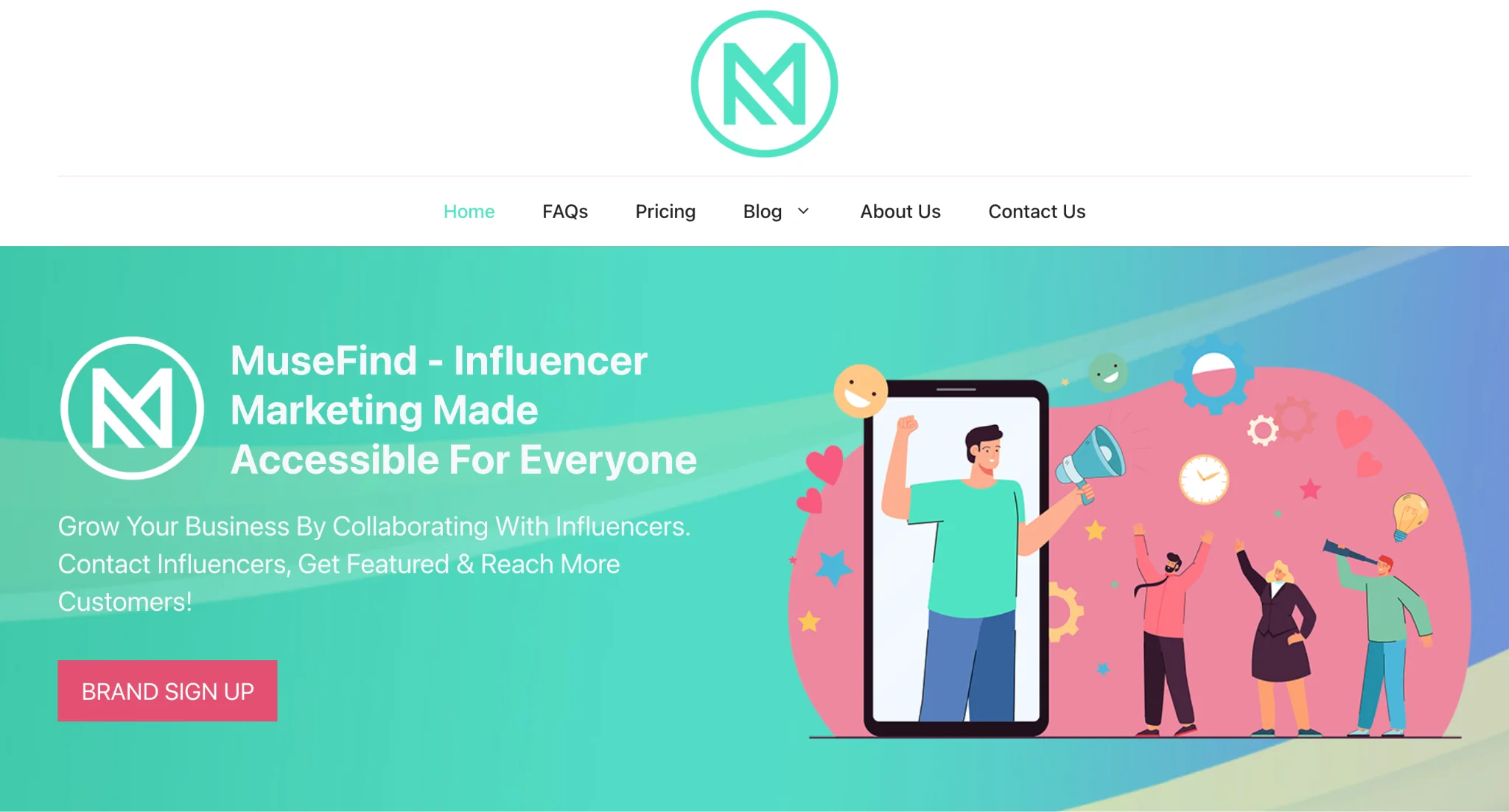
MuseFind is a small curated marketplace run from Vancouver, holding more than 23,000 vetted creators sorted into eight content categories. Every profile carries credentials and past collaborations, so the judgement about whether someone is worth approaching has partly been made for you. One flat plan buys unlimited contact and unlimited collaborations.
The workflow is short by design. Browse a category, read a creator’s work history, message several at once with a template, and track replies on a collaboration workboard. It is a deliberately narrow answer to one problem, and brands who need a larger creator database or anything past the first reply will be buying a second tool alongside it.
Key Features
- Vetted creator pool: 23,000-plus creators checked before listing, rather than scraped from public profiles.
- Visible work history: Past brand collaborations on every profile, which is the signal a first-time buyer needs most.
- One-click multi-creator messaging: Contact a batch at once instead of opening conversations one at a time.
- Outreach templates: Editable message templates that solve the blank-page problem for a founder who has never pitched a creator.
- Collaboration workboard: A simple board tracking who you contacted and where each conversation stands.
Pricing
One plan at $50 a month, which is $600 a year. No tiers, no credits, no published seat limit, and no annual discount described. A separate white-glove managed service is offered to selected clients and priced by inquiry, with no figures published anywhere.
There is no free version and no free trial, so the first month is the evaluation. Creator fees, product and shipping all sit on top and will pass $600 quickly.
Reviews
- Capterra: listed with no reviews
- G2 and Trustpilot: no listing found
No verifiable rating. The company publishes its own figure of 150 million consumers reached, which is a cumulative reach claim with no methodology attached.
Integrations
- eCommerce platforms: None published, so orders and creator activity never meet.
- Affiliate tools: None named, with no codes, links or commission tracking.
- Payment providers: None described, so paying creators happens entirely outside the platform.
- Email and marketing tools: No Klaviyo or equivalent, so creator contacts stay where they are.
- API and automation: No public API and no Zapier connector documented.
Pros
- Vetting done for you: Credentials and track records instead of an unfiltered index.
- Outreach is genuinely unlimited: No contact caps or credit meters at $50 a month.
- Built for a beginner: Category browsing and templates rather than filters and a blank message box.
Common Drawbacks of MuseFind
Twenty-three thousand creators is the ceiling
Split across eight categories, the pool relevant to your niche is a fraction of that. Once you have contacted everyone who fits, there is no larger tier to move to.
No independent reviews anywhere
An empty Capterra listing and no G2 or Trustpilot presence. There is no outside account of whether creators reply or collaborations complete.
Nothing happens after the reply
No discount codes, no affiliate links, no revenue attribution, no payouts and no content library. Everything that turns a collaboration into a result happens in another tool.
No trial, so month one is the test
There is no free version, so evaluation starts with a payment. Check that creator profiles show recent activity rather than collaborations from several years ago.
Best MuseFind Alternatives
| TOOL | REVIEWS | BEST FOR | TRIAL INFO | PRICING | ||
|---|---|---|---|---|---|---|
1 |

|
⭐ | DTC creator management | Book Demo | Pricing | Website |
2 |

|
⭐ | Influencer CRM & automation | Book Demo | Pricing | Website |
3 |

|
⭐ | Social media & influencer campaigns | Book Demo | Pricing | Website |
4 |

|
⭐ | Influencer discovery | Book Demo | Pricing | Website |
5 |

|
⭐ | Influencer marketplace campaigns | Book Demo | Pricing | Website |
6 |

|
⭐ | Micro-Influencer Campaigns | Book Demo | Pricing | Website |
7 |

|
⭐ | Influencer discovery & outreach | Book Demo | Pricing | Website |
8 |

|
⭐ | UGC creators & paid social ads | Book Demo | Pricing | Website |
9 |

|
⭐ | Creator Performance Platform | Book Demo | Pricing | Website |
10 |

|
⭐ | Influencer campaigns & creator marketplace | Book Demo | Pricing | Website |
GRIN

GRIN is a creator management platform used mostly by eCommerce brands running ongoing programs rather than one-off collaborations. It has been in the category long enough to accumulate one of its largest review bases. Plans are now credit-based, self-serve and start at nothing.
Key Features
- Open creator search: Find creators anywhere rather than choosing from a curated list someone else assembled.
- Relationship management: Every conversation, contract and deliverable held on one creator record.
- Product gifting: Seeding orders raised from your store and tracked through to delivery.
- GMV attribution: Revenue traced back to the creator who generated it.
- Free plan: 200 credits a month with no card, which is more than a trial and cheaper than $50.
Pricing
- Free: $0 a month, 200 credits
- Starter: $200 a month, 2,000 credits
- Growth: $500 a month, 7,500 credits, 100 active creators
- Scale: $1,000 a month, 20,000 credits, 250 active creators
- Complete: $1,500 a month, 30,000 credits, 500 active creators
Extra credits are $0.10 each and every plan is month-to-month.
Reviews
4.5/5.0 (G2, 483 reviews).
Pros
- Free is cheaper than $50: A permanent free plan with real campaign tools attached.
- 483 reviews: Evidence where MuseFind has none at all.
- The program runs here: Codes, content and payments rather than a workboard.
Cons
- Costs jump quickly: $200 a month is the first paid step, four times MuseFind’s price.
- Credits meter everything: Overage at $0.10 a credit on busy months.
- Reviewers report bugs: Slow loading and reporting accuracy come up repeatedly.
Integrations
- Shopify: Store orders tied to the creator who drove them.
- WooCommerce: The same coverage for WordPress storefronts.
- Klaviyo: Creator contacts pushed into email flows.
- PayPal: Creator payments handled in the workflow.
- Zapier: Wider stack connections without engineering work.
MuseFind vs GRIN
MuseFind hands you a curated list and a message box. GRIN hands you the machinery that runs after the yes: gifting, content, discount codes and revenue attribution, with the creator search included rather than being the whole product.
The odd part is the price. GRIN’s free plan costs less than MuseFind’s only plan and includes campaign tooling MuseFind does not have at any price. What MuseFind still offers is human vetting, which GRIN’s open search does not do for you.
Influencer Hero
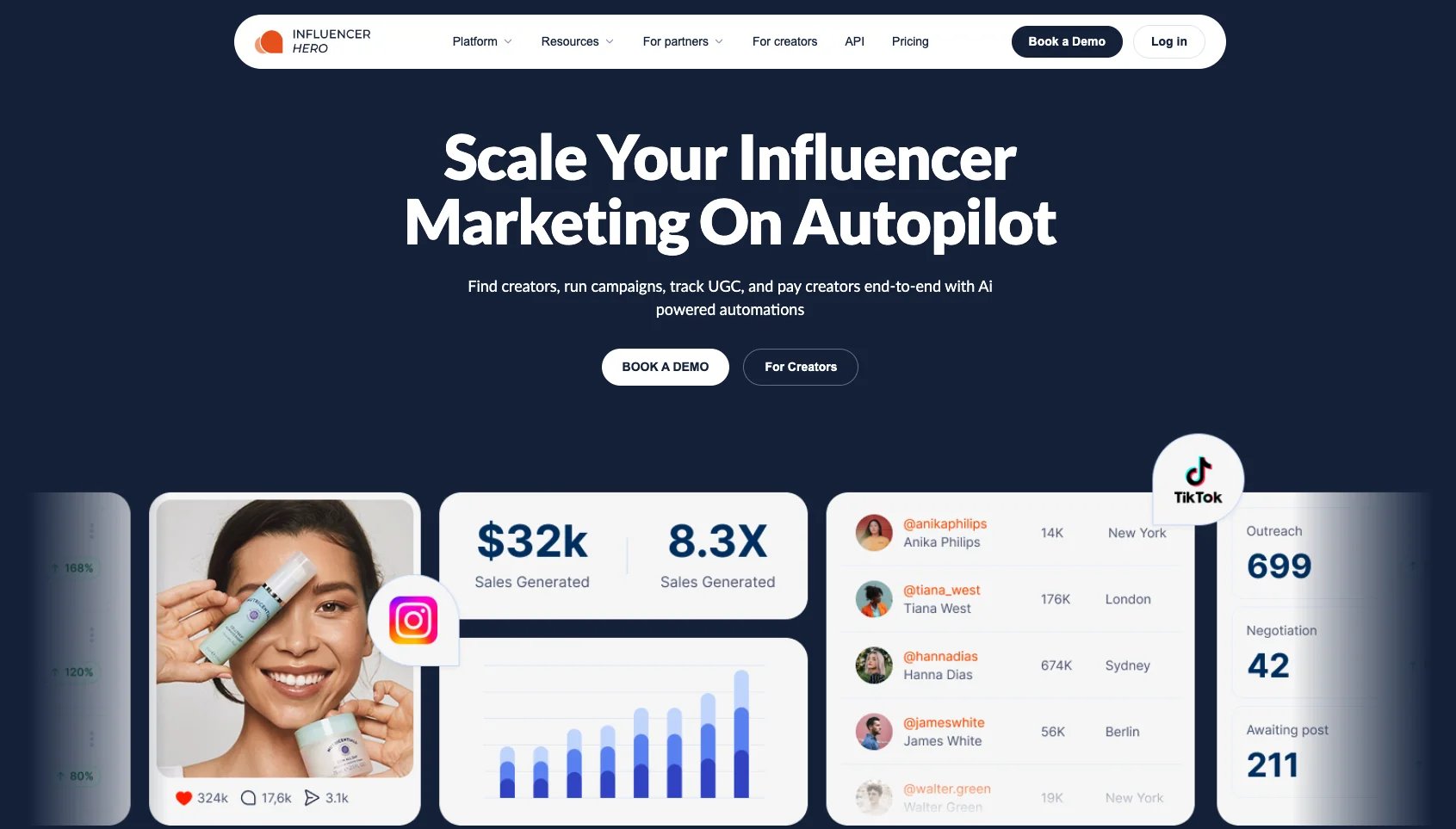
Influencer Hero is an all-in-one influencer marketing platform for D2C and eCommerce brands, working across 8 social platforms with Instagram, YouTube and TikTok emphasised. It runs the full sequence in one system: find creators, contact them, ship product, collect content, track affiliate revenue and pay them. Plans are published and sized by outreach volume.
Key Features
- Global creator search: Over 20 filters and AI search across eight networks, with worldwide coverage rather than a curated pool.
- Fake-follower detection: Audience authenticity checked automatically, so vetting does not depend on a work history alone.
- Brand-follower identification: Surface creators who already follow and buy from you, who convert better than cold contacts.
- Outreach at volume: Email, Instagram DM and WhatsApp with drip sequences and AI-drafted replies, from 1,000 reachouts a month.
- Creator storefronts: Each creator gets a shoppable page tied to their own tracking.
- Application pages: Branded landing pages where creators apply, with a product catalogue they choose from.
- Affiliate codes and payouts: Codes, commission and creator payments handled at 0.1% to 0.4% with invoices attached.
- Free scanning tools: Fake-follower scanners and engagement calculators usable without an account.
Pricing
- Standard: $649 a month, up to 1,000 reachouts a month
- Pro: $1,049 a month, up to 5,000 reachouts a month
- Business: $2,490 a month, up to 10,000 reachouts a month
- Custom & Agency: custom pricing
Quarterly billing saves 20% and yearly saves 30%.
Reviews
5.0/5.0 (Capterra)
Pros
- The pool never runs out: Eight networks worldwide rather than 23,000 profiles.
- Vetting is automated: Fake-follower screening on every creator, not just a track record.
- Revenue is measurable: Codes and store integration connect a creator to an order.
Cons
- No free trial
- Expensive for smaller brands
- Steep learning curve
Integrations
- Shopify: Gifting orders raised and creator sales attributed automatically.
- WooCommerce: The same for WordPress stores, with scripts covering Magento and custom builds.
- Klaviyo: Creator and customer segments into lifecycle email.
- DocuSign: Creator agreements signed and stored on the deal record.
- Zapier: Over 8,000 further apps for anything not native.
MuseFind vs Influencer Hero
MuseFind does one thing genuinely well: it removes the fear of picking badly, because every creator has a visible track record. Influencer Hero solves the same worry differently and then keeps going. Influencer discovery runs across eight networks with over 20 filters and fake-follower screening, so authenticity is checked on any creator rather than only the 23,000 someone pre-approved. Outreach covers email, Instagram DM and WhatsApp from one inbox, gifting is raised straight from Shopify or WooCommerce, content comes back into a searchable library with approvals, and affiliate codes plus payouts close the loop. None of that has an equivalent in MuseFind.
The prices sit far apart and the comparison is still worth making. MuseFind is $50 a month, or $600 a year, and buys unlimited outreach to a small pool. Influencer Hero publishes $649, $1,049 and $2,490 a month, with 20% off quarterly and 30% off yearly. That is a real step up, so the honest test is whether your program has outgrown a workboard. Once you are paying creators, tracking codes and reporting on revenue in three separate places, one platform doing all of it costs less than the hours you are spending.
Later

Later is a social media suite built around visual planning, with a separate influencer product attached. In-house social teams are its typical users. It also owns Mavely, an affiliate network where creators earn commission on brand links without signing anything directly with the brand.
Key Features
- Publishing calendar: Plan and schedule posts across every connected network from one view.
- Creator campaign briefs: Deliverables and approvals tracked through the Later Influence product.
- Mavely affiliate network: Creators monetise brand links without a direct contract in place.
- Performance analytics: History from three months on entry up to two years at the top tier.
- AI credits: Caption and content assistance metered per plan, from 5 to 100 a month.
Pricing
- Starter: $25 a month, or $18.75 billed yearly
- Growth: $50 a month, or $37.50 billed yearly
- Scale: $110 a month, or $82.50 billed yearly
Those are the social plans, with a 14-day trial. Later Influence is quoted separately.
Reviews
4.5/5.0 (G2, 469 reviews) for Later Influence and 4.5/5.0 (G2, 384 reviews) for Later Social.
Pros
- Cheaper than $50: The entry plan is $18.75 a month billed yearly.
- You can test it first: 14 days free, which MuseFind does not offer.
- 853 reviews across two products: A serious evidence base either way.
Cons
- Not a creator marketplace: The social plans do not find you anyone.
- The influencer product is quote-only: No published price for Later Influence.
- No creator vetting: Nothing checks whether an audience is real.
Integrations
- Instagram: Scheduling, publishing and creator content in one place.
- TikTok: Short-form posts planned and measured alongside the rest.
- Shopify: Shoppable posts drawn from your catalogue.
- Canva: Assets pulled into the planner without a download step.
- Slack: Approvals and alerts routed to the team.
MuseFind vs Later
These solve different halves of the same week. MuseFind finds you creators and stops. Later publishes your own content and schedules the posts, but will not introduce you to anyone on its social plans.
For a founder doing everything alone, the honest answer is that these are complements rather than competitors. If the choice has to be made, ask whether your bigger problem is having nobody to work with or having nothing scheduled. Teams sizing up influencer analytics platforms alongside publishing tools usually find the two budgets are separate anyway.
Heepsy

Heepsy is a discovery and outreach platform spanning Instagram, TikTok, YouTube and LinkedIn, sold on plans that meter search results and emails rather than users. Small businesses account for 93% of its reviewers. Search, email and creator payments all sit in the same product.
Key Features
- Free plan with real search: 500 results and 10 full profiles a month at no cost.
- Lookalike discovery: Turn one creator who worked into a list of similar profiles.
- Marketplace listings: Publish a campaign and let creators apply, from one listing up.
- Bulk outreach with sync: Send in batches and take replies in your own inbox.
- In-platform payments: Pay creators from the Plus plan onward.
Pricing
- Free: $0, 500 search results and 10 advanced profiles a month
- Starter: $69 a month billed annually, 300 outreach emails
- Plus: $149 a month billed annually, 1,200 outreach emails
- Advanced: $229 a month billed annually, 6,000 outreach emails
A 14-day trial runs with a work email and no card.
Reviews
4.5/5.0 (Capterra, 72 reviews).
Pros
- A free tier and a trial: Two ways to test before paying, against none.
- Four networks, not eight categories: Search by attribute rather than browsing a taxonomy.
- Payments included higher up: Something MuseFind leaves entirely outside.
Cons
- Outreach is capped: 300 emails a month on Starter, against no limit at all.
- No human vetting: Metrics and filters, but no curated work history.
- Annual pricing on the sticker: The headline rates assume a yearly commitment.
Integrations
- Shopify: A store connection linking campaigns to sales.
- Instagram: Profile data and content inside the search results.
- TikTok: Short-form creator coverage on the same filters.
- YouTube: Channel analytics beside the short-form networks.
- LinkedIn: Professional creator search most rivals skip.
MuseFind vs Heepsy
Both are entry-level tools for brands without a specialist, and they disagree about what beginners need. MuseFind removes the search problem by curating. Heepsy gives you the filters and a free plan to learn them on.
Heepsy is the one that grows with you. It adds sequences, content tracking and creator payments as you move up the tiers, and its pool is not a fixed 23,000. What it does not do is tell you which creators have completed brand work before, and for a first campaign that is worth something.
Afluencer
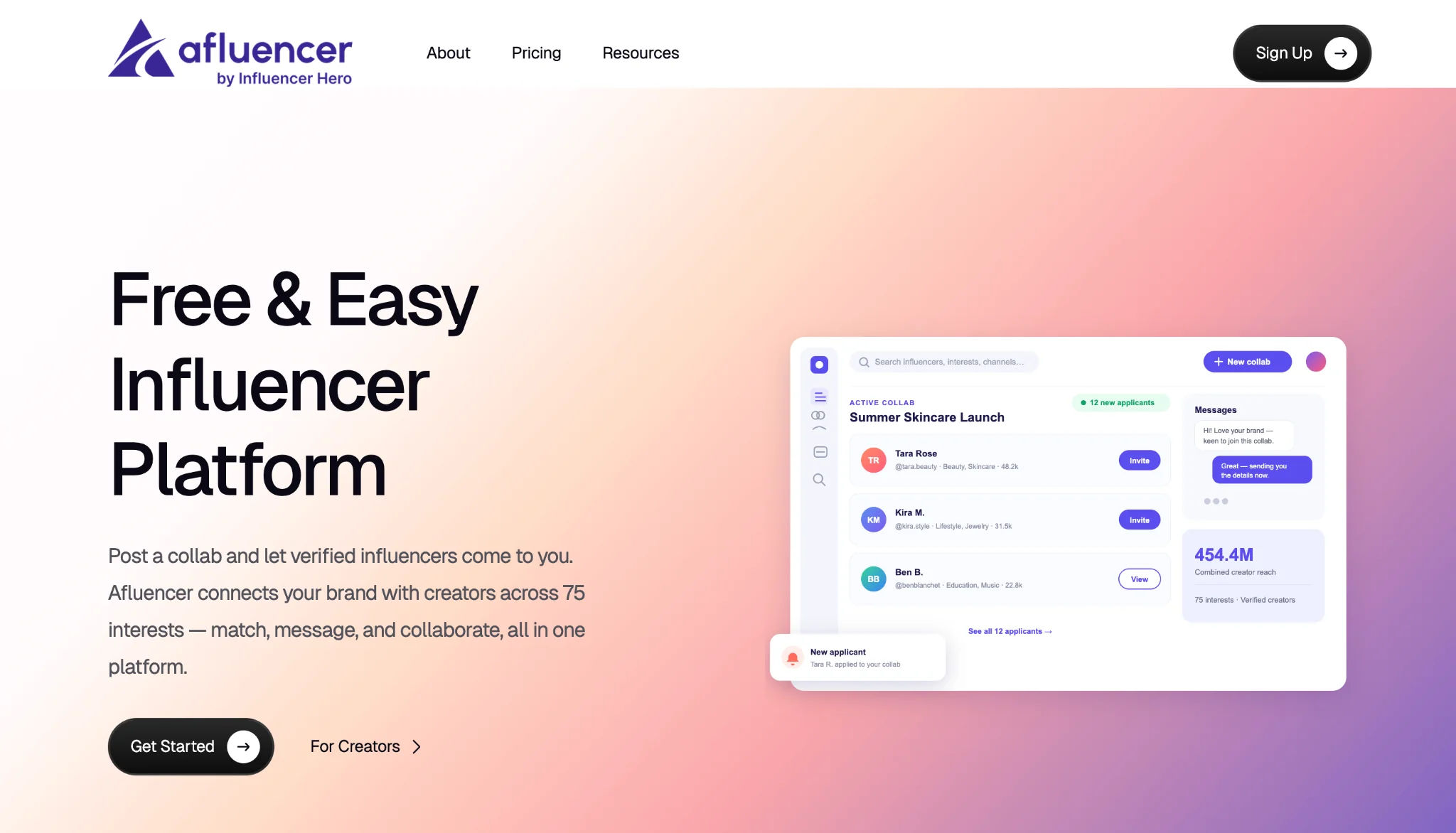
Afluencer is a marketplace built on applications. You post a collaboration listing, verified creators across Instagram, TikTok, YouTube, Facebook and X apply, and you choose from the responses. Shopify merchants and small D2C teams make up most of its customers, on a published monthly fee with no contract.
Key Features
- Applications instead of search: Creators respond to your brief, so you never build a query.
- Verified membership: Accounts registered and checked before they can apply to anything.
- CreatorGPT ranking: AI scores the applicant queue against your brief before a person reads it.
- Direct invites: Credits for outbound approaches when applications run thin.
- Store-linked codes: Discount codes and creator fees handled through the storefront connection.
Pricing
- VIP: $49 a month
- Concierge: $99 a month
No minimum term, and creator-side plans are billed separately.
Reviews
4.6/5.0 (G2, 738 reviews) and 4.7/5.0 (Shopify App Store, 34 reviews). The G2 pool leans creator-side, so read it beside the Shopify score.
Pros
- A dollar cheaper, and reviewed: $49 a month with 738 reviews behind it.
- Creators come to you: The same beginner-friendly promise, sourced from applications rather than curation.
- Connects to your store: Codes and orders tracked, which MuseFind cannot do.
Cons
- Listing quality decides everything: A weak brief brings weak applicants.
- No work-history vetting: Members are verified, but past brand collaborations are not the organising principle.
- North America weighted: Creator supply thins outside its main markets.
Integrations
- Shopify: Codes, referrals and creator orders tracked from the store.
- BigCommerce: The same for BigCommerce merchants.
- Klaviyo: Creator contacts pushed into your email lists.
- DocuSign: Collaboration terms signed inside the flow.
- Slack: New applications announced to the team.
MuseFind vs Afluencer
This is the closest comparison on the page, because both cost about the same and both exist to spare you a search. The difference is where the shortlist comes from: MuseFind curates it in advance, Afluencer generates it from people who read your brief and want the work.
Two things separate them. Afluencer has 738 reviews and MuseFind has none, and Afluencer connects to Shopify so codes and orders are tracked. For a brand comparing creator CRM software at the cheap end, that combination is hard to argue against at a dollar less a month.


Social Cat
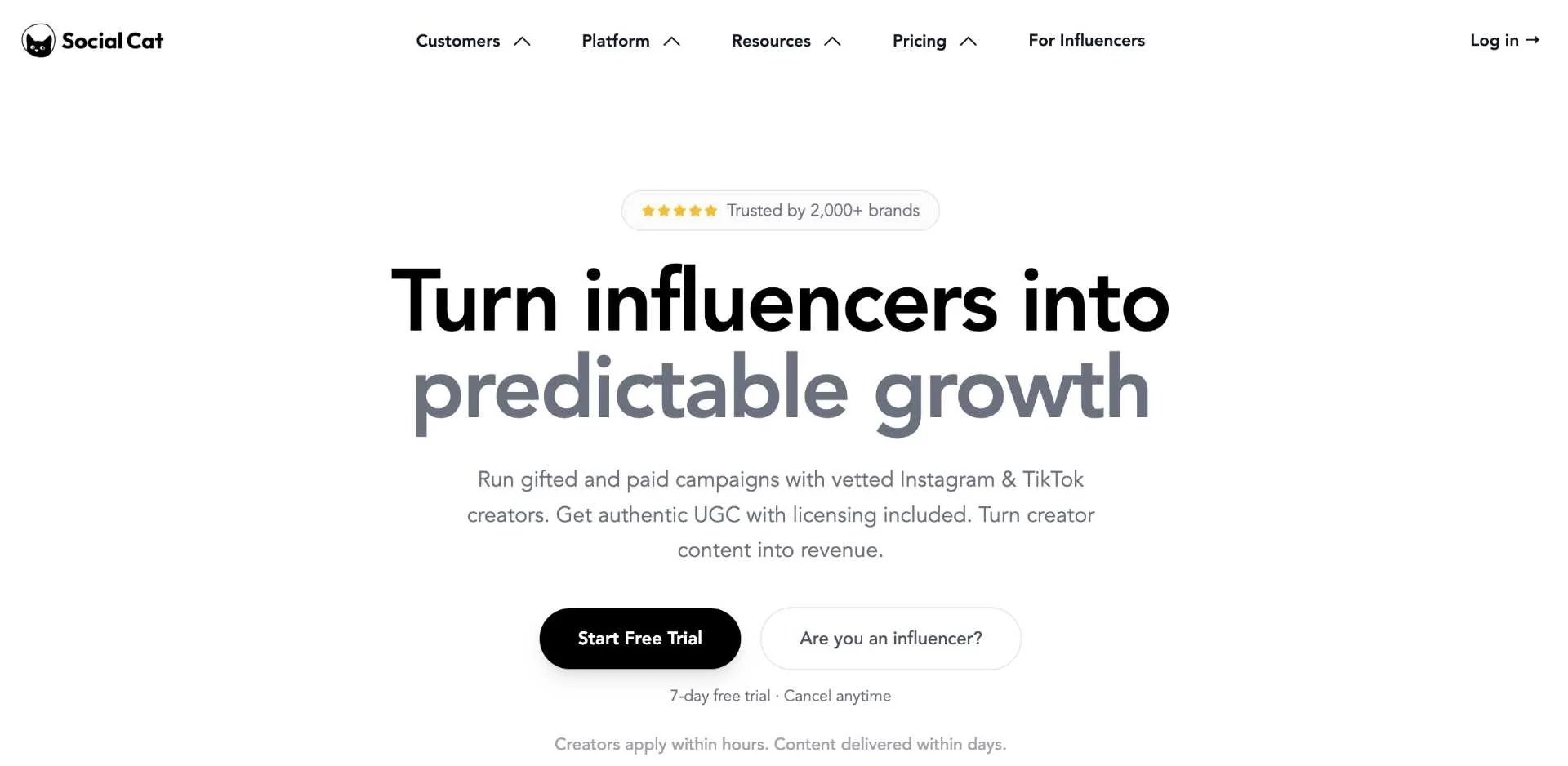
Social Cat pairs smaller brands with micro-influencers for gifted and paid work, and prices plans by the number of collaborations you complete each month. Content comes back licensed for your own channels. It is aimed at brands that want posts and assets rather than a research exercise.
Key Features
- Micro-influencer matching: Creators who work for product or small fees, matched to your campaign.
- Completed collaborations as the unit: Plans are sized by finished work, not by searches or seats.
- Creator ratings: Past performance scores visible before you send an invitation.
- Contracts before shipping: Terms agreed with each creator ahead of any product moving.
- Usage rights included: Delivered content licensed from the entry plan upward.
Pricing
- Essentials: $99 a month, up to 5 collaborations, 1,000 invitations
- Performance: $199 a month, up to 15 collaborations, 2,500 invitations
- Pro: $299 a month, up to 30 collaborations, 5,000 invitations
All three plans include a free trial.
Reviews
3.9/5.0 (Trustpilot, 364 reviews). Roughly 80% five-star and 15% one-star, with support response times the recurring complaint.
Pros
- 364 reviews to read: Imperfect, but far better than an empty listing.
- Assets are the deliverable: You finish the month with licensed content.
- Free trial on every plan: A way in that does not start with a charge.
Cons
- Twice the price: $99 a month against $50, for a capped number of collaborations.
- Five collaborations on entry: Outreach is generous but completions are limited.
- Support is the weak spot: One review in seven is a one-star about response times.
Integrations
- Shopify: Gifted orders raised against the campaign automatically.
- Instagram: Creator profiles and delivered posts pulled in.
- TikTok: The same for short-form deliverables.
- Email: Creator conversations handled from the campaign record.
- Content export: Approved assets downloaded for paid social.
MuseFind vs Social Cat
MuseFind sells you access to creators. Social Cat sells you finished collaborations, which is a more specific promise and a more expensive one. At $99 you get five completed collaborations a month rather than unlimited conversations that may go nowhere.
Which is better depends on your bottleneck. If you can convert conversations into posts yourself, MuseFind at $50 with no cap is the better economics. If your outreach keeps stalling before anyone actually posts, paying for completions solves the real problem.
Ainfluencer

Ainfluencer is a marketplace of over 25 million creators across Instagram, TikTok and YouTube, free for brands to use. Deals are agreed in the platform and paid through escrow once content lands. The company earns from a margin on creator payouts instead of charging a subscription.
Key Features
- No subscription at all: Full brand access without a plan, a card or a seat count.
- Escrow on every deal: Money held until the agreed content is delivered.
- Filtered discovery: Niche, location and engagement filters across a pool a thousand times larger.
- Seeding and paid deals: Gifted, cash and affiliate arrangements set up from one dashboard.
- Negotiation in-platform: Offers and counter-offers logged rather than lost in email.
Pricing
Free for brands. There is no plan at any level, and the company takes a deduction from creator payouts instead, so your spend is creator fees plus that margin.
Reviews
4.7/5.0 (G2, low review volume at 24 reviews).
Pros
- It costs nothing: $600 a year cheaper than MuseFind, for a far larger pool.
- Escrow protects both sides: First collaborations stop being a leap of faith.
- Some review evidence: 24 reviews is thin, but it is not zero.
Cons
- The margin is invisible: Free to you, funded from what creators receive.
- No curation: 25 million profiles means the filtering problem is back.
- Only 24 reviews: A light record for a platform that holds money.
Integrations
- Instagram: Creator profiles, engagement data and delivered posts.
- TikTok: Short-form coverage across all deal types.
- YouTube: Channel data for longer-form work.
- Escrow payments: Funds handled natively without a separate processor.
- Data export: Campaign and creator records out for your own reporting.
MuseFind vs Ainfluencer
One charges $600 a year for 23,000 curated creators. The other charges nothing for 25 million uncurated ones and holds your money safely while a deal completes. On paper that looks decisive.
The catch is the thing MuseFind was built to solve. A pool that size hands the filtering problem straight back to you, and nothing there tells you who has completed brand work before. Brands leaning on AI matching tools to narrow a large index are doing the job MuseFind does by hand.
Insense
Insense produces UGC video for paid social on a fixed schedule. Vetted creators apply to your brief, deliver in around ten business days, and usage rights arrive with the content. Performance marketers buying ad creative are its main users.
Key Features
- Guaranteed applicants: Five matching creators respond to your brief or the subscription is refunded.
- Structured revisions: Up to three rounds built into the brief rather than negotiated case by case.
- Product seeding: Physical product shipped to creators as part of the campaign.
- Whitelisted ads: Meta Partnership Ads run from the creator’s own handle.
- Payment in the platform: Creator fees handled through Stripe without an invoice chase.
Pricing
- Trial: $650 for one month, 1 campaign and 10 creators, 20% marketplace fee
- Brand: $500 a month billed quarterly, or $400 a month annually, 10% fee
- Agency: $800 a month billed quarterly, or $640 a month annually, 7% fee
Campaigns and creators are unlimited on both paid plans.
Reviews
4.5/5.0 (G2, 374 reviews).
Pros
- Delivery on a clock: Content in about two weeks rather than whenever a reply arrives.
- 374 reviews: A large, checkable record.
- Rights are cleared: Content licensed for ads as part of the deal.
Cons
- Eight times the price: $400 a month annually against $50.
- A percentage on top: 7% to 20% of what creators are paid.
- Ad creative, not reach: Built for paid social rather than a creator’s own audience.
Integrations
- Meta: Partnership Ads and whitelisted creator content.
- TikTok: Assets routed into ad formats without re-uploading.
- Shopify: Seeding orders raised from your catalogue.
- Stripe: Creator payments processed inside the workflow.
- Ad account export: Approved content pushed into live campaigns.
MuseFind vs Insense
MuseFind gets you talking to creators and hopes something comes of it. Insense guarantees five applicants and delivers finished video in around ten business days, with the rights sorted. That certainty is what the extra money buys.
For a founder with $50 a month to spend, Insense is out of reach and saying so is more useful than pretending otherwise. The point at which it starts making sense is when unreliable delivery is costing you more than the subscription would.
The Cirqle

The Cirqle treats influencer marketing as a revenue channel, ranking creators on measured return from first-party data and automating everything around the campaign. Briefs, negotiation, contracts, shipping, approvals and payouts run as one chain, and licensed content can be published as paid ads. Loop Earplugs, ABOUT YOU and Lookfantastic are among its named customers.
Key Features
- Return-based ranking: Creators scored on revenue produced rather than followers or work history.
- Contracts and shipping: Agreements generated and product sends handled inside the campaign flow.
- Content into paid ads: Licensed assets published on Meta, TikTok and YouTube.
- Ambassador tracking: Long-running programs measured alongside one-off campaigns.
- MCP access: Campaign data queried from Claude, ChatGPT and similar clients.
Pricing
The company publishes nothing on its own site and routes you to a demo. Its Shopify App Store listing shows Base at $999 a month or $9,998 a year and Base Plus at $1,999 a month or $19,999 a year, with per-creator fees negotiated on top.
Reviews
4.8/5.0 (G2, 8 Reviews)
Pros
- Proof is the product: Creators ranked on what they actually returned.
- Everything is automated: Contracts, shipping and payouts run without manual steps.
- Named enterprise brands: Recognisable customers published openly.
Cons
- Twenty times the price: $999 a month before per-creator fees are agreed.
- No reviews either: The same evidence gap as MuseFind, at a far higher cost.
- Enterprise-shaped: Built for brands with an established program, not a first campaign.
Integrations
- Shopify: Orders matched to creators for revenue attribution.
- Meta: Creator content published and measured as paid media.
- TikTok: The same route for short-form creative.
- Northbeam: Results reconciled against your wider attribution stack.
- Impact.com: Affiliate and partnership data connected in.
MuseFind vs The Cirqle
These are at opposite ends of the market and they share one awkward trait: neither has a review record you can check. MuseFind asks $600 a year on that basis. The Cirqle asks at least $11,988 plus negotiated creator fees.
The gap in what you get is proportionate. The Cirqle scores creators on measured revenue, connects to Shopify and Northbeam and turns content into ads. MuseFind gives you a list and a message box. Both are defensible, at very different stages of a business.
Creator.co

Creator.co runs a 400 million creator index with AI matching and drafted outreach, sold self-serve or as a managed engagement with an account manager. Nike, Oakley and Best Buy appear in its published customer list. Contact credits and insight reports are the metered units.
Key Features
- Very large index: 400 million creators across Instagram, TikTok and YouTube.
- AI matching: Shortlists scored against your campaign instead of filtered by hand.
- Insight reports: Deeper analysis on 50 creators a month at the self-serve tier.
- Managed option: Their team recruits, communicates and optimises on the higher plan.
- TikTok Shop tracking: Social commerce sales attributed natively.
Pricing
- Self-Serve: $299 a month, or $199 a month annually, on a 3-month minimum
- Managed: $2,199 a month, or $1,499 a month annually, on a 6-month minimum
- Enterprise: custom pricing on an annual commitment
Self-Serve includes 100 contact credits and 50 insight reports, with extra credits at $99 per 100.
Reviews
4.6/5.0 (G2, 124 reviews).
Pros
- The pool is effectively endless: 400 million profiles against 23,000.
- Someone can run it for you: A managed tier for brands with no time.
- 124 reviews: Independent evidence where MuseFind has none.
Cons
- Contacts are rationed: 100 credits a month, then $99 per extra hundred.
- Minimum terms apply: Three months self-serve, six months managed.
- Four times the price: $199 a month annually against $50 flat.
Integrations
- Shopify: Creator-driven orders and codes tracked from the store.
- TikTok Shop: Native attribution for social commerce revenue.
- Google Analytics: Campaign traffic joined to on-site behaviour.
- Instagram: Creator profiles and post performance in the campaign view.
- Data exports: Creator and campaign records out for reporting.
MuseFind vs Creator.co
The contrast is unlimited contacts against an unlimited pool. MuseFind lets you message everybody in a small database. Creator.co gives you 400 million creators and rations you to 100 contacts a month.
Which constraint hurts more depends on your niche. If MuseFind covers your category properly, unlimited outreach into it beats a credit meter. If it does not, no amount of free messaging helps, and Creator.co’s index plus Shopify and TikTok Shop attribution is the more durable purchase.
Final Thoughts on MuseFind Alternatives
MuseFind is a sensible first purchase and a poor second one. For $50 a month you get vetted creators with visible track records, unlimited outreach and a board to keep track, which is a proportionate answer for a founder who has never done this before.
What it will not survive is your program growing. The pool is finite, nothing connects to your store, and there is no independent review record to check any of it against. Open the categories that match your product, count how many creators genuinely fit, and treat that number as the real ceiling.

.png)


.jpg)










