


10 Best Massfluencer Alternatives for Influencer Marketing
Three absences define this comparison, and each one is checkable in about a minute. Massfluencer runs on Instagram and nothing else, with TikTok and YouTube appearing nowhere on the site. It publishes no pricing, and not in the usual way either, since the URL returns a 404 and no such page exists in its own sitemap. And it carries no independent reviews on G2, Capterra or Trustpilot despite operating since 2017. None of those is fatal on its own. Together they mean a D2C brand is asked for a great deal of trust before the vendor has shown any of its working.
Ten alternatives are compared below: Upfluence, Influencer Hero, Afluencer, Aspire, IZEA, Insense, Later Influence, Influencity, Skeepers and Lefty.
Key Criteria for Evaluating Influencer Marketing Platforms
Core Features
Evaluation of essential influencer marketing capabilities, including influencer discovery, outreach, CRM, campaign management, reporting, and content workflows.
Pricing & Flexibility
Comparison of pricing models, subscription plans, and contract terms to match different budgets and growth stages.
Customer Reviews & Satisfaction
Analysis of user feedback from trusted review platforms, focusing on usability, reliability, customer support, and overall performance.
Pros & Cons
Review of each platform’s strengths and limitations to highlight where it performs well and where it may fall short based on different use cases.
Integrations
Review of the most important integrations (e.g., Shopify and other tech tools), highlighting what each integration enables in one sentence.
Massfluencer Overview
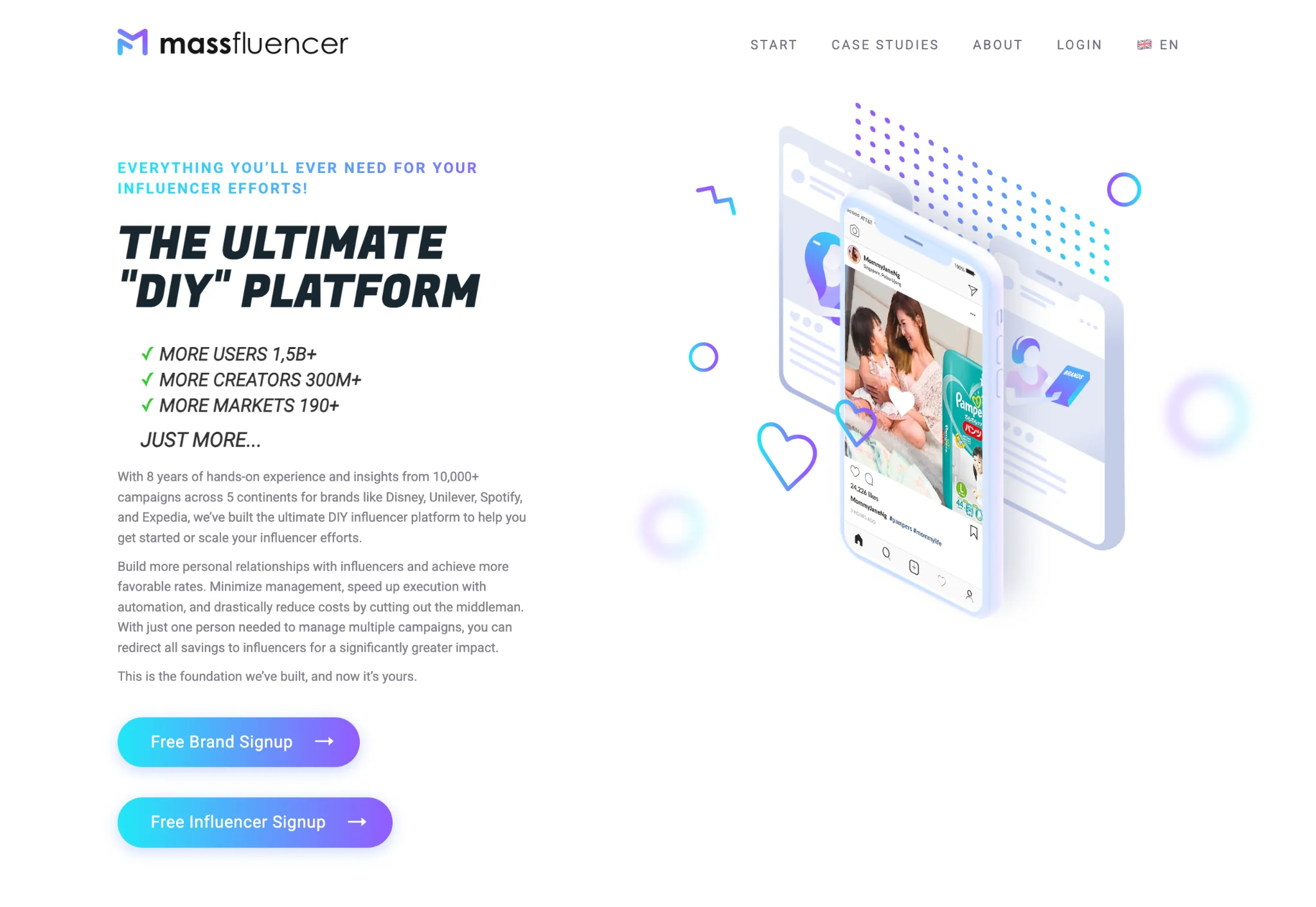
Massfluencer is a Singapore-headquartered marketing technology company with a second office in Stockholm, operating since 2017. It positions itself as a DIY platform rather than a service and runs a two-sided model, with brands on one side and creators on the other, the creator side free to join and carrying no exclusivity. The owned network is the product: rather than indexing public profiles the way most influencer marketing software does, it recruits creators into its own pool and lets brands run campaigns against them with contracts, pre-approval and payments bundled in. The case studies lean Nordic and enterprise, with Spotify, Disney, Pampers and Arla among them, and they report reach and engagement rather than revenue.
Key Features
- Creator network access: A claimed 300M-plus creator database across 190-plus markets, though the figure is vendor-stated and unaudited.
- Campaign creation: On-demand campaign setup with creators self-selecting the briefs they want to take.
- Pre-approval and contracts: Content is approved before it goes live, with agreements handled automatically inside the platform.
- Payments with compliance: Creators are paid directly to their bank accounts through several payout methods.
- Fake detection and sentiment: AI fraud screening on creator accounts, plus comment sentiment analysis scoped to Instagram campaigns.
Pricing
Massfluencer publishes no pricing, and unusually there is no pricing page to publish it on. The URL returns a 404 and no such page appears in the site’s own sitemap, so this is an absence by design rather than a figure held back behind a demo form.
The creator side is explicitly free, with the site stating there are no fees whatsoever for signing up or participating in campaigns. That means the entire commercial model sits on the brand side through a mechanism the company does not describe anywhere. There is a free brand signup and a demo request, but no advertised free trial and no way to size the commitment before talking to sales.
Reviews
There is no independent review base at all. The G2 product page returns a 404, there is no Capterra listing, the Trustpilot profile does not exist, and there is no Shopify App Store presence. For a company operating since 2017, a complete absence across every major B2B review platform is the finding rather than a research gap.
A vendor-reference aggregator carries a 4.8 figure, but that is calculated from the company’s own case studies rather than customer reviews, and the same page shows no testimonials. Treat it as marketing, not a rating.
Integrations
- Instagram: The only social platform named anywhere on the site, and the sole network the product operates on.
- UTM tracking: Campaign links carry UTM parameters, which is the full extent of the attribution method.
- Direct creator payouts: Bank transfers to creators through the platform, with several payout methods supported.
- No ecommerce connectors: No Shopify, WooCommerce or BigCommerce integration is published, so store data stays disconnected.
- No API or automation layer: Nothing published for API access, Zapier or webhook workflows.
Massfluencer names no integrations anywhere. There is no integrations page, and a full-text scan of the site returns nothing for Shopify, WooCommerce, Klaviyo, Zapier or API. That is the narrowest surface in this comparison by a wide margin.
Pros
- Self-serve positioning with a free signup: Brands can register without a sales process, which is more open than the agency-style vendors it competes with.
- Creator supply costs creators nothing: A free creator side removes the friction that keeps smaller creators off paid marketplaces, which helps campaign fill rates.
- Compliance handled in-platform: Contracts, content pre-approval and creator payments are bundled rather than left to spreadsheets and bank transfers.
Common Drawbacks of Massfluencer
Instagram and nothing else
No TikTok, no YouTube, no coverage beyond Instagram itself, which rules out the surfaces where most creator-led growth now happens. For a D2C brand that is a strategic gap rather than a missing feature.
Attribution stops at the click
With no ecommerce connectors published, campaign measurement ends at UTM links. There is no order-level revenue tracking, no automated discount codes and no seeding fulfilment, so results arrive as reach rather than sales.
No pricing page exists at all
The URL 404s and nothing appears in the sitemap, so there is no figure, no trial and no way to run procurement or budget a year without booking a call first.
Nine years and no reviews
Nothing on G2, Capterra, Trustpilot or the Shopify App Store since 2017, which leaves no way to check support quality, data accuracy or churn against anything other than the vendor’s own case studies.
Best Massfluencer Alternatives
| TOOL | REVIEWS | BEST FOR | TRIAL INFO | PRICING | ||
|---|---|---|---|---|---|---|
1 |

|
⭐ | Influencer discovery | Book Demo | Pricing | Website |
2 |

|
⭐ | Influencer CRM & automation | Book Demo | Pricing | Website |
3 |

|
⭐ | Influencer marketplace campaigns | Book Demo | Pricing | Website |
4 |

|
⭐ | Influencer partnerships | Book Demo | Pricing | Website |
5 |

|
⭐ | Influencer marketplace | Book Demo | Pricing | Website |
6 |

|
⭐ | UGC creators & paid social ads | Book Demo | Pricing | Website |
7 |

|
⭐ | Social media & influencer campaigns | Book Demo | Pricing | Website |
8 |

|
⭐ | Campaign management | Book Demo | Pricing | Website |
9 |

|
⭐ | Influencer gifting & UGC campaigns with micro-influencers | Book Demo | Pricing | Website |
10 |

|
⭐ | Influencer analytics & discovery | Book Demo | Pricing | Website |
Upfluence

Upfluence indexes the open social web rather than recruiting a closed pool, which makes it the structural opposite of Massfluencer’s model. It serves ecommerce brands and their agencies, and its signature capability is reading store data to identify customers who already have an audience worth activating. An AI layer called Jaice now sits across the workflow.
Key Features
- Creator search: Filters on audience demographics and performance data across Instagram, TikTok, YouTube and more.
- Customer-creator identification: Reads Shopify or WooCommerce records to surface buyers with meaningful followings.
- Program management: Handles outreach, briefs and campaign workflow at volume.
- Upfluence Pay: Global creator payments tied to tracked campaign performance.
- Influencer API: Pushes creator data into the brand’s own systems.
Pricing
Quote-based, with no figures on the vendor site. Cost varies by module, team size and program volume on a twelve-month minimum, with no setup fee and no share of sales. Vendr procurement data from 2025 puts the median annual contract near $15,000, ranging roughly $9,300 to $27,000.
Reviews
4.6/5.0 (G2, 140 reviews) and 4.4/5.0 (Capterra, 44 reviews)
Pros
- Discovery is not confined to one app: Search runs across the major networks rather than stopping where Instagram stops.
- Results land as orders: Store integrations tie creator activity to revenue rather than to UTM clicks.
- Something to diligence: Nearly 200 independent reviews across two platforms, against none.
Cons
- Campaigns lock after setup: Live campaigns cannot be edited and partial setup does not save.
- Thin outreach automation: Sequencing is limited, with no automatic invoice generation.
- Quote-only pricing: It publishes no figures either, though independent contract data at least exists.
Integrations
- Shopify: Syncs catalogue, orders and commission tracking into campaigns.
- Klaviyo: Moves creator and customer lists into email flows.
- Amazon Attribution: Connects off-Amazon creator traffic to Amazon conversions.
- WooCommerce and BigCommerce: Extends tracking to other storefronts.
- Zapier: Wires campaign events into the wider stack without engineering time.
Massfluencer vs Upfluence
The two differ on where creators come from and where the resulting data goes. Massfluencer supplies its own Instagram pool and hands back UTM links; Upfluence supplies an open multi-network index and store-level revenue attribution.
Neither publishes a price, so transparency is not the separator here. What separates them is whether a creator program can be defended in a budget meeting. Reach and comment sentiment describe activity; orders attributed to individual creators describe return, and only one of these two produces the second kind of number.
Influencer Hero
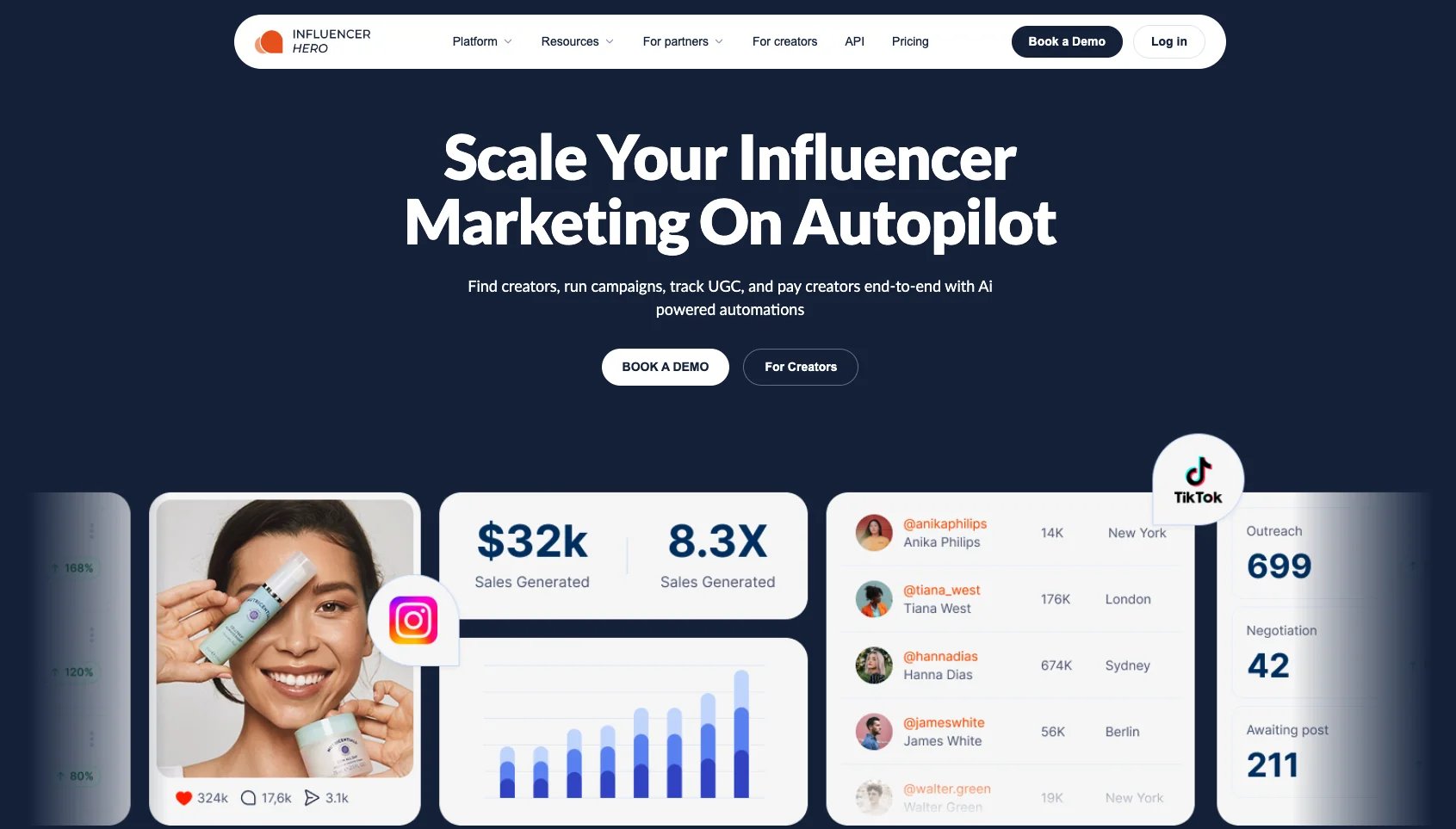
Influencer Hero covers the full program in one system across Instagram, TikTok and YouTube: influencer discovery, outreach, CRM, gifting, UGC, affiliate tracking and payouts. It is built for D2C and eCommerce teams running the channel themselves. Against a vendor with no pricing page, its most conspicuous trait is that every tier is published openly.
Key Features
- Three-network discovery: Instagram, TikTok and YouTube searched together with 20-plus filters covering location, audience demographics, interests, engagement rate and follower quality.
- Fake-follower detection: Audience authenticity and fraud screening before budget reaches a creator.
- Brand-follower and lookalike search: Finds creators already engaging with your brand, and creators resembling your top performers.
- Chrome extension: Pulls live creator stats while browsing social platforms and imports profiles in one click.
- Outreach automation: Bulk and one-to-one email with drip sequences and AI personalisation, plus Instagram DM and WhatsApp replies in one inbox.
- Influencer CRM: Campaign boards, an All Influencers view with natural-language filtering, custom fields and stage-triggered automations.
- Multi-platform eCommerce support: Native Shopify and WooCommerce plus script-based tracking for Magento and custom builds, so gifting and attribution reach order level.
- Affiliate management and creator payouts: Custom links and codes, bulk and scheduled payouts at 0.1% to 0.4% via bank debit, invoicing workflows, and AI monitoring that rotates leaked discount codes.
Pricing
- Standard: $649/month, up to 1,000 reachouts per month
- Pro: $1,049/month, up to 5,000 reachouts per month
- Business: $2,490/month, up to 10,000 reachouts per month
- Custom & Agency: Custom pricing
Quarterly billing saves 20% and yearly billing saves 30%. There is no free trial.
Reviews
5.0/5.0 (Capterra).
Pros
- Covers the networks that matter: Instagram, TikTok and YouTube in one workflow rather than a single-platform program.
- Attribution beyond Shopify: WooCommerce and script-based tracking mean custom storefronts still get order-level data.
- A price you can act on: Every tier and reachout limit is public, so a year can be budgeted before any conversation.
Cons
- No free trial: Evaluation runs through a demo rather than hands-on testing with your own data.
- Entry price: $649 per month is a genuine floor for brands running occasional campaigns.
- Learning curve: The feature depth takes time to work through during onboarding.
Integrations
- Shopify: Automates gift fulfilment and attributes affiliate revenue per creator.
- WooCommerce: The same seeding and tracking for WordPress storefronts.
- Klaviyo: Syncs creator and customer segments into email programs.
- DocuSign: Issues and tracks creator contracts inside the campaign workflow.
- Slack and Zapier: Routes alerts to team channels and connects to 8,000-plus further apps.
Massfluencer vs Influencer Hero
Both platforms cover creator discovery, influencer outreach, campaign management and payments, but they take different approaches. Massfluencer focuses on broad creator access and DIY campaign management, while Influencer Hero is more geared toward brands looking to manage influencer campaigns alongside their ecommerce operations.
Influencer Hero offers ecommerce integrations, TikTok support and clear pricing, while Massfluencer provides a large creator pool, UTM tracking and free brand signup. For D2C brands focused on sales attribution and ecommerce workflows, Influencer Hero is the stronger fit; Massfluencer is better suited to brands prioritising creator reach and flexible campaign management.
Afluencer
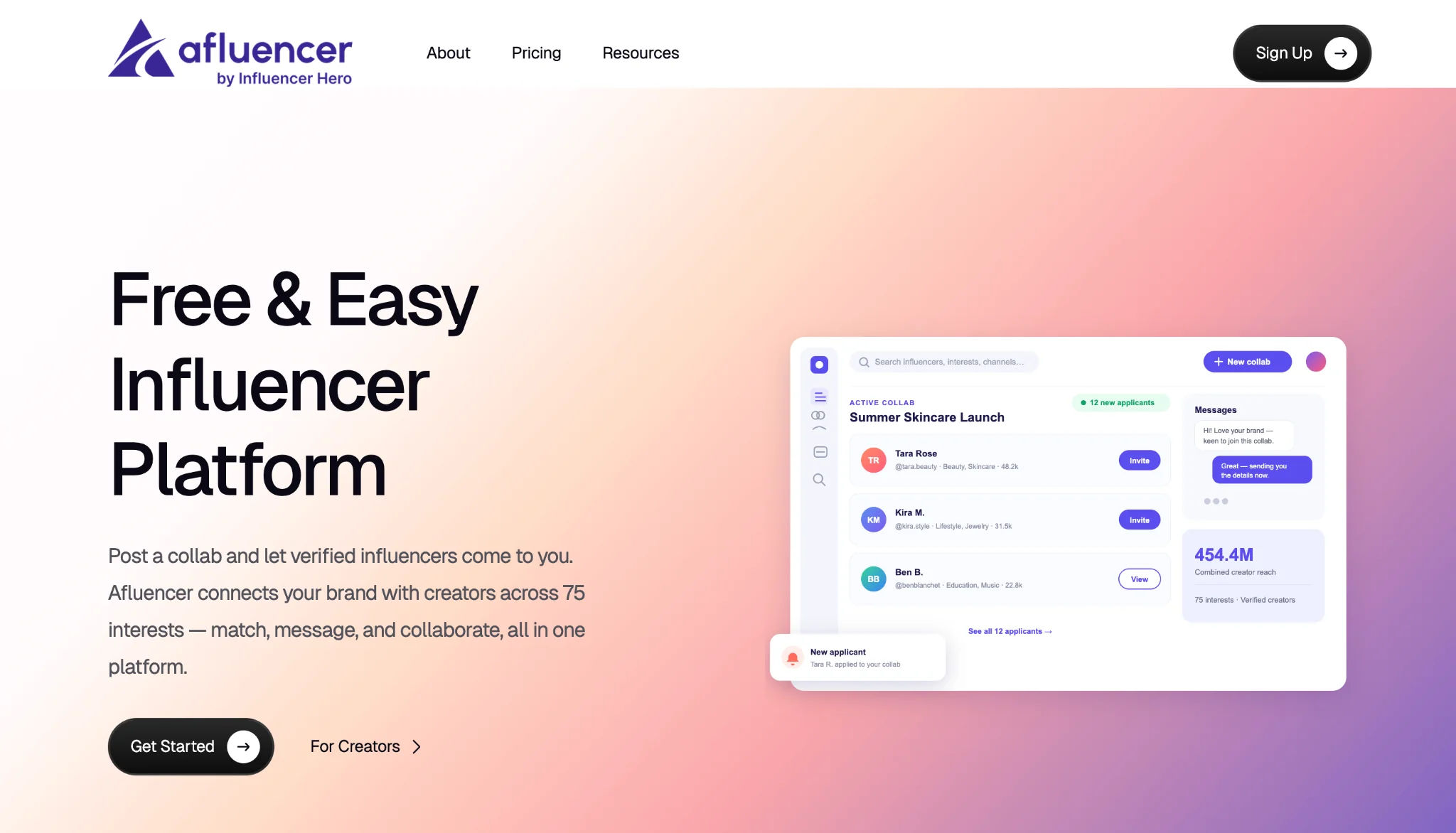
Afluencer runs the same two-sided marketplace shape as Massfluencer, with the economics and the platform coverage pointed differently. Brands post collaboration listings, verified creators apply, and the opt-in network spans Instagram, TikTok, YouTube, Facebook and X. It skews to Shopify merchants and smaller D2C brands.
Key Features
- Collab listings: Brands publish opportunities and review inbound applications rather than prospecting individually.
- Opt-in creator network: Creators are registered users who chose to be there, never scraped from social profiles.
- CreatorGPT matching: AI shortlists applicants against brand criteria to speed up review.
- Invitation credits: Tiered outbound allowances for direct outreach alongside inbound applications.
- Gifting and payments: Coordinates send-outs and pays creators in-platform, with discount codes and referral tracking on Shopify.
Pricing
From $49 per month on the Marketplace plan, with higher tiers for more outbound volume and creator-side plans priced separately. A free trial runs through the Shopify listing, though the entry plan itself is paid.
Reviews
4.6/5.0 (G2, 738 reviews) and 4.7/5.0 (Shopify App Store, 34 reviews). The G2 pool skews creator-side, so it is not directly comparable with brand-side scores elsewhere.
Pros
- The same model with a published price: A directly comparable marketplace at $49 per month, where the incumbent names no figure at all.
- Five networks instead of one: Instagram, TikTok, YouTube, Facebook and X across the creator base.
- Evidence in volume: Hundreds of independent reviews, and its guide to how to find micro-influencers shows the workflow before you sign up.
Cons
- Demand-dependent: Weak listings draw weak interest, and reviewers report invitations going unanswered.
- Regional depth: Strongest in the US, with gaps flagged in MENA, the UK and Latin America.
- Lighter campaign tooling: Complex multi-stage programs will outgrow it.
Integrations
- Shopify: Connects the store for discount codes, referral tracking and creator orders.
- BigCommerce: The same connection for BigCommerce merchants.
- Klaviyo: Feeds creator contacts into email campaigns.
- DocuSign: Handles creator agreements in the collaboration flow.
- Slack: Pushes application notifications to team channels.
Massfluencer vs Afluencer
This is the closest like-for-like on the list, since both are opt-in creator marketplaces with a free creator side and both bundle payments. Structurally they are the same product.
Afluencer wins on the three things a buyer can actually check before committing: it publishes $49 per month, it carries hundreds of independent reviews, and it connects to Shopify and BigCommerce for real order tracking. Massfluencer’s counter is a larger stated network at 300M-plus creators, though that figure is unaudited and confined to a single platform, which makes it difficult to weigh against a number anyone can verify.
Aspire
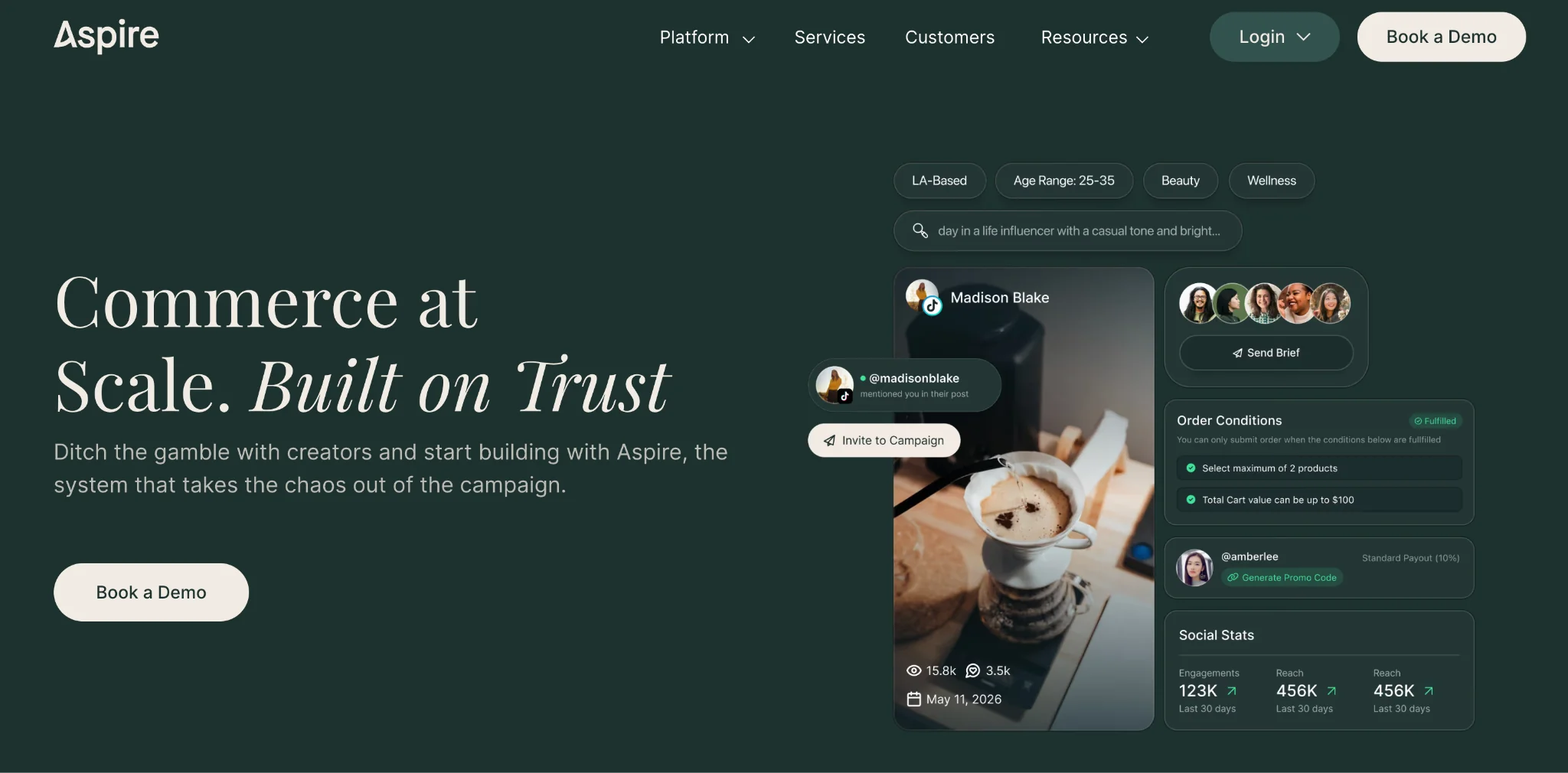
Aspire, formerly AspireIQ, is a full creator marketing platform spanning influencers, ambassadors, affiliates and product seeding. Its customers are ecommerce and D2C brands and the agencies serving them, with Samsung, Keurig and HelloFresh among the names, and it claims $100M distributed to creators.
Key Features
- Multi-type discovery: Searches influencers, ambassadors and affiliates on any combination of criteria across channels.
- Creator Marketplace: Inbound applications from creators who opted into your campaign.
- Customizable CRM: One workflow spanning campaigns, affiliate programs and seeding.
- Full-funnel measurement: Clicks, promo codes and reach attributed back to individual creators.
- UGC licensing: Collects creator content with rights to reuse it across organic and paid channels.
Pricing
No published pricing. The pricing URL returns a 404 and the plans page is a demo form. Vendr procurement data for 2025 places the median annual contract at roughly $15,600, ranging about $11,100 to $36,600.
Reviews
4.6/5.0 (G2, 146 reviews). Its Capterra listing shows 3.5/5.0 from 6 reviews, too small a sample to weigh.
Pros
- Seeding is a real workflow: Product gifting and fulfilment are native, where the incumbent never mentions seeding at all.
- Rights handled in-platform: UGC licensing terms live in the tool rather than in separate agreements.
- First-party ads data: Direct Meta, TikTok and Pinterest partnerships underpin reporting that scraped metrics cannot match.
Cons
- Speed and interface age: Reviewers describe the platform as slow with a dated UI.
- Creator account linking: Instagram and TikTok connections fail often enough to slow onboarding.
- No published pricing: Budgeting requires a sales cycle.
Integrations
- Shopify: Drives orders, seeding logistics and affiliate attribution.
- Klaviyo: Syncs creator and customer segments across platforms.
- Impact, CJ and ShareASale: Connects existing affiliate networks into creator campaigns.
- Meta, TikTok and Pinterest: First-party partnerships behind campaign and profile reporting.
- Gmail and Outlook: Keeps creator email threads inside the platform.
Massfluencer vs Aspire
Aspire is the upgrade path for a brand that has outgrown single-network campaign posting. Seeding, affiliate programs, ambassador tiers and content licensing are all native, and none of them appears in Massfluencer’s published feature set.
Both keep pricing off the site, so this is not a transparency contest. The difference is the size of the unknown: Aspire has independent procurement data putting the median near $15,600 a year and 146 G2 reviews behind it, so a buyer can estimate both cost and experience before the call. With Massfluencer there is nothing to estimate from at all.
IZEA
IZEA has operated in this category since 2006 and trades on the NASDAQ, which makes it the most transparent business on this list by obligation as much as by choice. It sells managed services where its own team runs campaigns, plus software through IZEA Flex and a self-serve Creator Marketplace with genuinely published tiers.
Key Features
- Discovery: Filtering across millions of creator profiles, with a visual search reviewers highlight.
- ShareMonitor: Tracks hashtags, keywords and brand mentions across multiple social platforms.
- ContentMine: Content management with real-time AI analysis on IZEA’s BrandGraph data.
- Tracking links: A campaign-grade link shortener for measuring performance by creator.
- Flat-fee payments: Creator payouts processed at $2 per payment rather than a percentage.
Pricing
Creator Marketplace tiers are published: free, then $9, $23, $47 and $129 per month, with 20% off annually. Managed services are quote-only. IZEA Flex tiers appeared on G2 at $130 and $500 per month as of October 2024, but those are no longer on IZEA’s own site and should be treated as dated.
Reviews
3.9/5.0 (G2, 32 reviews). Its Capterra listing carries no reviews, so there is no Capterra score to cite.
Pros
- Published entry pricing that exists: Tiers from $9 to $129 per month plus a free plan, against a vendor with no pricing page.
- Disclosure by obligation: Financials and operating scale are matters of public record rather than marketing claims.
- Cross-platform monitoring: ShareMonitor tracks mentions across several networks rather than one.
Cons
- Stability: Reviewers describe the software as slow and prone to issues.
- Navigation: Several report needing heavy onboarding and repeat support contact to operate it.
- Sparse integrations: Only Shopify and Google Analytics are published, with no email, ads or affiliate connectors.
Integrations
- Shopify: Store data connection for campaign attribution, with a published app listing.
- Google Analytics: Feeds campaign traffic and conversions into existing reporting.
- Instagram and TikTok: Creator account connections powering discovery and monitoring.
- YouTube: Channel connection for video creator metrics.
- X, Facebook and Pinterest: Further creator account linking for tracking and reports.
Massfluencer vs IZEA
IZEA’s software scores are the weakest in this comparison at 3.9, so the argument for it is not product polish. It is verifiability.
A brand can read the price, read the reviews and read the accounts of a listed company before committing, none of which is possible with Massfluencer. For a small D2C team weighing counterparty risk on creator contracts and payment rails, being able to check who you are transacting with carries real weight, and it is the one dimension where a mediocre product can still be the safer purchase.


Insense
Insense exists to keep paid social fed. Brands post a brief, vetted creators apply, licensed content comes back, and it flows into Meta Partnership Ads and TikTok Spark Ads without leaving the platform. It serves D2C brands, mobile apps and agencies buying creative volume.
Key Features
- Brief-and-apply marketplace: A network of 100,000-plus creators across 35-plus countries responding to briefs, usually inside 48 hours.
- Meta Partnership Ads: Connects creator handles as ad accounts so ads run from the creator’s own profile.
- TikTok Spark Ads: Spark code workflows plus guided briefs for TikTok Shop campaigns.
- Shopify seeding: Creates and sends creator orders from the dashboard with delivery tracking.
- Lifetime usage rights: Automated contracting and payouts with perpetual rights on delivered assets.
Pricing
Fully published. Brand is $500 per month, or $400 billed annually, with unlimited campaigns, 2 seats, 10 Partnership Ads connections and a 10% marketplace fee. Agency is $800 per month, or $640 annually, with 4 seats, 5 brands, unlimited connections and a 7% fee. A one-month trial plan costs $650 with a 20% fee. Creator fees sit outside the subscription.
Reviews
4.5/5.0 (G2, 374 reviews) and 3.7/5.0 (Trustpilot, 187 reviews). The G2 pool leans creator-side, so weigh it accordingly as a brand-buyer signal.
Pros
- TikTok is first-class: Spark Ads and TikTok Shop workflows are native, covering the network the incumbent does not touch.
- Content becomes paid media: Whitelisting runs ads through the creator’s own handle rather than leaving posts organic-only.
- Every fee published: Subscription and marketplace fee both visible before purchase.
Cons
- Support responsiveness: Slow replies and limited human contact are the most common complaints.
- Variable creative quality: Output consistency varies, and creative control is thinner than a managed brief process.
- Narrow scope: No searchable creator index, and seats capped at 2 on Brand and 4 on Agency.
Integrations
- Shopify: One-click connection for creating and tracking seeding orders.
- Meta: Powers Partnership Ads whitelisting from creator accounts.
- TikTok: Spark Ads codes for boosting creator posts as paid media.
- TikTok Shop: Guided briefs for TikTok Shop campaign content.
- Gmail: Keeps creator correspondence in the workflow.
Massfluencer vs Insense
Massfluencer produces Instagram posts that stay organic and get measured in reach. Insense produces licensed assets designed to become paid media on Meta and TikTok, with perpetual rights attached and the whole fee structure printed on the page.
For a D2C brand where creator content mainly exists to feed the ad account, these are different products rather than competing versions of the same one, and only one of them reaches TikTok at all. The honest caveat is the marketplace fee: Insense takes 20%, 10% or 7% of creator spend on top of the subscription, which a flat platform fee does not.
Later Influence
Later Influence is the enterprise influencer product Later built from its Mavrck acquisition, sold alongside Later’s social suite and the Mavely affiliate network. It targets enterprise and mid-market brands, with Nike, Unilever, Wayfair and Chewy named, and is available as software or as a managed service.
Key Features
- Signal-based discovery: Surfaces best-fit creators from brand signals and flags brand-safety risks before activation.
- Incentive Advisor: Benchmarks creator payment rates across channels so teams can price offers with evidence.
- Later EdgeAI: Prediction layer built on 20M-plus analysed creators and more than $2B in verified influencer-driven purchases.
- Unified reporting: Brings paid, organic and sales performance into one full-funnel view.
- Mavely affiliate network: Creator links across nine affiliate networks with real-time conversion and commission data.
Pricing
Only the social management tiers are published, at $18.75, $37.50 and $82.50 per month billed yearly. The influencer product is quote-only and routes to a strategy call, with no free trial. No credible public figure exists for Later Influence.
Reviews
4.5/5.0 (G2, 469 reviews) and 4.6/5.0 (Capterra, 135 reviews), with a 4.8 customer service sub-score on Capterra.
Pros
- Sales attribution as standard: The Mavely layer ties creator activity to revenue across nine affiliate networks.
- Support quality: A 4.8 Capterra support sub-score, the strongest here, backed by consistent written praise.
- Roughly 600 reviews to read: Independent feedback across two platforms, where the incumbent offers none.
Cons
- Reliability: Reviewers report a clunky inbox, crashes on large campaigns and tracking problems.
- Complexity: Confusing tab structure and navigation slow new teams down.
- No pricing signal: Quote-gated throughout, with reviewers describing contract terms as inflexible.
Integrations
- Instagram, Facebook and Pinterest: Official platform partnerships for publishing and analytics.
- TikTok and YouTube: Creator content tracking and performance data on video platforms.
- Impact, Rakuten and AWIN: Affiliate network connections feeding conversion and commission data.
- Bazaarvoice and Yotpo: Routes creator content into on-site reviews and UGC displays.
- Mailchimp and Google: Links campaign data to email and analytics workflows.
Massfluencer vs Later Influence
These sit at opposite ends of the market, so the comparison is mostly instructive on measurement rather than on price.
Later reports paid, organic and sales performance in one funnel with affiliate attribution underneath it. Massfluencer reports reach, engagement and comment sentiment from a single network. A brand that has to justify creator spend against revenue rather than impressions will find that gap settles the question long before cost enters the conversation, which is fortunate, because Later will not name a cost until late in the process either.
Influencity
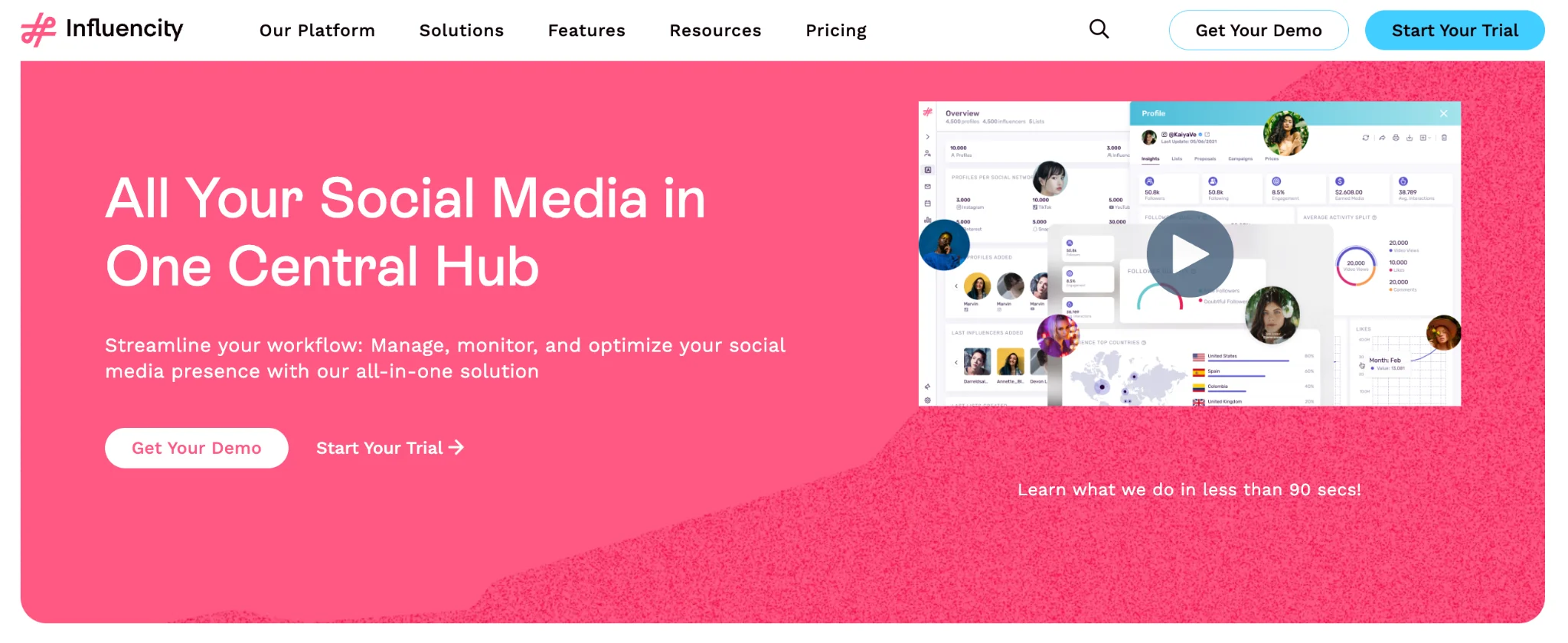
Influencity is a self-serve influencer relationship management platform spanning discovery, IRM, campaigns, reporting and payments, with publishing and listening modules alongside. It serves brands, agencies and ecommerce teams across 70-plus countries. Index depth relative to price is its strongest card.
Key Features
- Large-scale discovery: Filters 200M-plus profiles on Instagram, TikTok and YouTube by interests, brand affinity and audience demographics.
- Proprietary IRM: Builds your own creator database with follower-quality metrics and branded recruitment landing pages.
- Campaign workflow: Visual campaign management with creator task assignment, cost tracking and seeding.
- Shareable reporting: Publication performance exported to PDF, Excel or a public URL.
- Global payments: Multi-currency payouts across 180-plus countries with invoice generation.
Pricing
The public pricing page confirms a 7-day free trial on all plans, monthly and annual billing and usage limits on analyses and tracked creators, but does not render prices. Plans are Basic, Professional, Business and Custom. Software directories report Professional at $398 per month and Business at $998 per month as of August 2026, which should be read as reported rather than vendor-confirmed.
Reviews
4.5/5.0 (G2, 282 reviews) and 4.2/5.0 (Capterra, 5 reviews). The Capterra sample is too small to carry weight.
Pros
- An open index across three networks: 200M-plus searchable profiles, and one of the deeper options among influencer search tools.
- Seven days to test the claims: Hands-on evaluation without a sales process, which is the only way to check whether filters return usable creators.
- The database is yours: The IRM accumulates your roster on your side rather than inside someone else’s closed network.
Cons
- Data accuracy: Reviewers report metric mismatches and filters returning off-criteria profiles.
- Performance: Slow loading and occasional freezes recur in reviews.
- Billing friction: Cancellation reportedly requires emailing the vendor, and the pricing page renders no figures.
Integrations
- Shopify: Runs seeding through zero-dollar orders and gift codes.
- Instagram: Discovery, analytics and publishing on the largest creator base.
- TikTok: Creator discovery and post-level analytics.
- YouTube: Channel discovery and video performance data.
- Social Hub and Social Ads: Native publishing, unified inbox and paid social modules.
Massfluencer vs Influencity
Both claim large creator numbers, and only one of them can be tested. Influencity offers seven days of hands-on access to check whether the filters return creators that actually match a brief, while the 300M-plus figure quoted elsewhere is unaudited and only assessable after a sales conversation.
Influencity also searches an open index across three networks rather than a closed Instagram pool, which matters whenever a brief calls for creators who have not joined anyone’s marketplace. Its own weakness is honest to state: reviewers report metric mismatches, so the trial is not a formality but the point.
Skeepers

Skeepers is a European UGC suite where influencer campaigns sit beside verified reviews, consumer feedback and brand communities. The influencer module runs gifting programs with micro and nano creators, and the customer base leans toward European beauty, fashion and CPG names including Sephora, Dyson and Laneige.
Key Features
- AI creator matching: Matches briefs against a community of 400,000-plus micro-influencers on brand criteria.
- Gifting campaigns: Runs and tracks Instagram, TikTok and YouTube gifting programs from one interface.
- Licensed content delivery: Supplies creator photos, videos and reviews with rights for owned and paid reuse.
- Paid amplification: Pushes organic creator content into Spark Ads and Meta partnership placements.
- Review syndication: Collects, AI-moderates, translates and syndicates customer reviews to retail destinations.
Pricing
Nothing published. There is no pricing page and every route is a demo request. Capterra lists a starting figure near €1,250 per month with no free trial, but that is directory-listed rather than vendor-published.
Reviews
4.4/5.0 (G2, 87 reviews) and 4.3/5.0 (Capterra, 35 reviews)
Pros
- European depth across three networks: A 400,000-strong micro-creator community on Instagram, TikTok and YouTube, well suited to EU markets.
- Gifting at volume: Product seeding is the core motion rather than an unlisted capability.
- Reviews and creator content together: Social proof and UGC arrive from one vendor under one contract.
Cons
- Applicant quality: The dominant G2 complaint is that many applicants read as product testers, with only a minority usable.
- Bugs and sync delays: Repetitive bugs, slowness and delayed post syncing come up regularly.
- No pricing transparency: Every cost conversation starts with sales.
Integrations
- Shopify: Connects the storefront for gifting orders and review collection.
- Magento: The same connection for Adobe Commerce merchants.
- PrestaShop: Ecommerce coverage for European storefronts.
- Salesforce: Pushes review and campaign data into CRM records.
- Zendesk: Routes customer feedback into support workflows.
Massfluencer vs Skeepers
For a European brand these are the two most directly comparable options on the list, and Skeepers is the more complete one.
It runs the same micro-creator gifting motion across three networks instead of one, connects to Shopify, Magento and PrestaShop for real order data, and carries 122 independent reviews across G2 and Capterra. Both hide their pricing, so cost transparency is a wash. The deciding factors are platform coverage and whether campaign results need to reach a storefront, and on both counts the answer points the same way.
Lefty
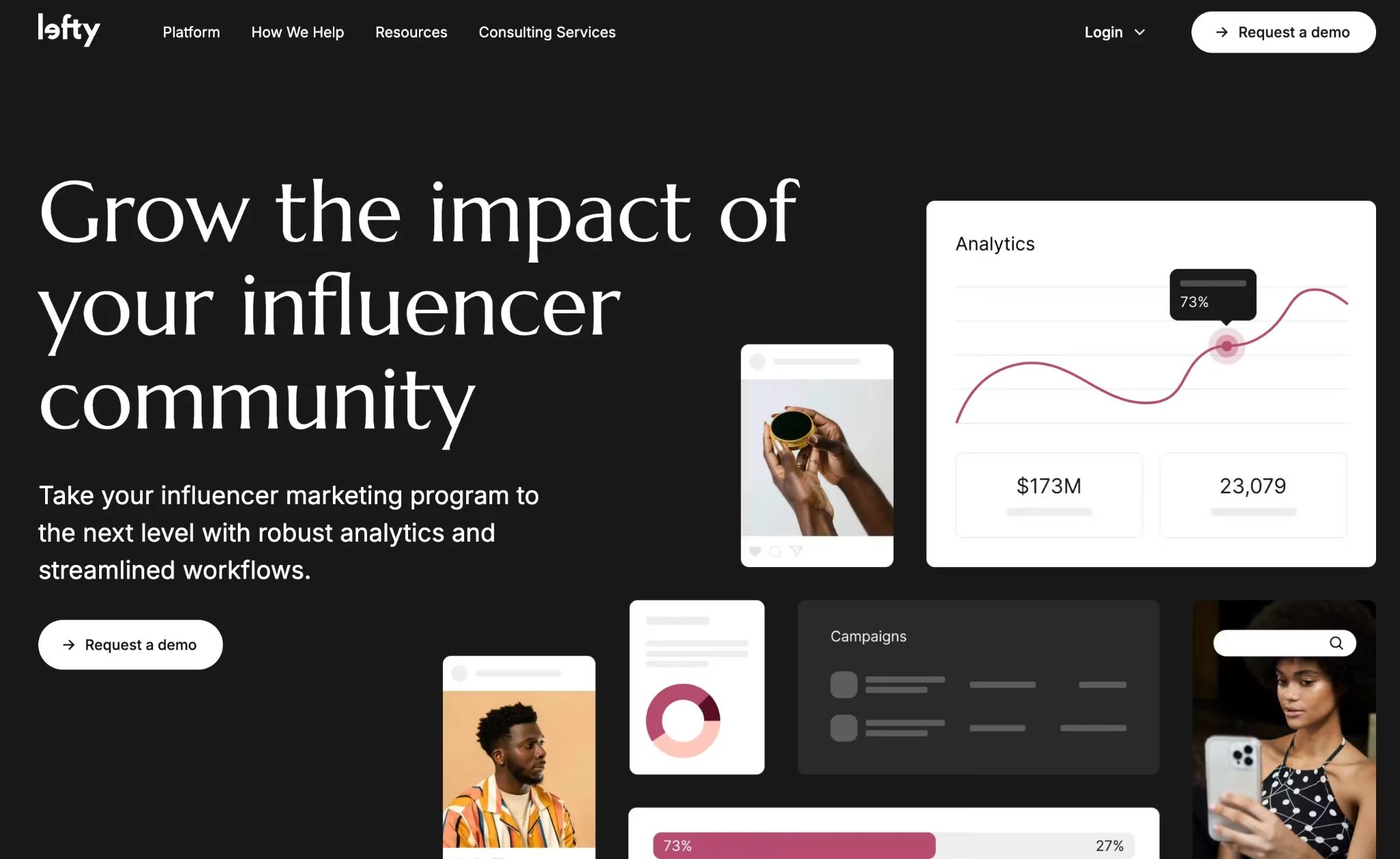
Lefty works with global luxury, fashion and beauty brands including Louis Vuitton, Tommy Hilfiger, Clarins and Vans. It pairs a proprietary creator index with CRM, campaign tracking, affiliate and seeding, plus competitive benchmarking, and reports in earned media value. Its Weibo, Douyin and RED coverage is unmatched elsewhere in this comparison.
Key Features
- Eight-network discovery: Indexes creators across Instagram, TikTok, YouTube, X, Snapchat, Weibo, Douyin and RED with demographic and brand-affinity filters.
- Partner CRM: One record per creator with custom fields, bulk labels and a health score alongside impressions and EMV.
- Automatic content capture: Collects campaign posts and reports EMV, impressions and ROI without manual tracking.
- Affiliation and social commerce: Affiliate links and promo codes with Stripe-based commission and flat-fee payouts.
- Share-of-voice benchmarking: Compares performance against named competitors and rolls results up across markets.
Pricing
Nothing published. There is no pricing page and the only route is a demo request.
Reviews
4.7/5.0 (G2, roughly 91 reviews), the highest score in this comparison. No Capterra listing was found.
Pros
- The widest network coverage here: Eight platforms including three Chinese networks, against a single-platform incumbent.
- Reporting automation: Reviewers credit it with removing hours of weekly manual tracking and EMV calculation.
- Highest independent score: 4.7 on G2 across roughly 91 reviews.
Cons
- Cost: Consistently described as expensive, with reviewers citing unused features inflating the price.
- Profile caps: Tracked-profile limits are called excessively restrictive for large rosters.
- Discovery and data gaps: Niche searches underperform, there is no creator email data and no social listening.
Integrations
- Shopify: Connects the store for affiliate attribution and seeding.
- Magento: Commerce integration for Adobe Commerce storefronts.
- Salesforce Commerce Cloud: Enterprise commerce connection for larger retail operations.
- Stripe: Processes creator commission and flat-fee payouts.
- Gmail and Outlook: Runs creator pitching and follow-up inside the CRM.
Massfluencer vs Lefty
If the problem with a single-network tool is that your creators are not all in one place, Lefty is the furthest thing from it, indexing eight platforms including Weibo, Douyin and RED.
It is priced for global luxury brands and will be overkill for most D2C teams, and it publishes no pricing either. For a brand with genuine international creator programs, though, it is the option that stops platform coverage from being the constraint at all, and it is the only one here that reaches the Chinese networks.
Final Thoughts on Massfluencer Alternatives
Three checks decide this, and they are the same three that make Massfluencer difficult to recommend to a D2C brand. Does the tool cover the networks your creators actually publish on, or only one of them. Does it connect to your store, so results arrive as orders rather than UTM clicks. And is there independent evidence that other brands have used it successfully. On the first, Influencer Hero, Influencity, Skeepers and Lefty all run across three or more networks. On the second, anything with a Shopify or WooCommerce connection clears a bar that Instagram creator search on its own cannot. On the third, Afluencer, Insense, Later Influence and Upfluence each carry hundreds of reviews a buyer can read this afternoon. A vendor that fails all three is asking for a lot of faith very early in the relationship.

.png)


.jpg)










