


10 Best Makeinfluence Alternatives for Influencer Marketing
Makeinfluence sorts its four tiers by service fee, and the fee is almost never why anyone upgrades. What forces the move is the caps. Five creators on Entry, twenty on Basic, fifty on Growth, and one single market on three of the four plans.
That last one matters most. A Danish brand adding Sweden, which is the obvious next step for a platform whose network lives in those two countries, jumps to €1,205 a month. And because everything here ends in a tracked sale, there is no seeding, no content rights management and no way to recruit creators from outside the network.
Ten alternatives follow, in order: Influencer Hero, NeoReach, Insense, Afluencer, Aspire, Influencity, IMAI, HypeAuditor, Julius and Brandbassador.
Key Criteria for Evaluating Influencer Marketing Platforms
Core Features
Evaluation of essential influencer marketing capabilities, including influencer discovery, outreach, CRM, campaign management, reporting, and content workflows.
Pricing & Flexibility
Comparison of pricing models, subscription plans, and contract terms to match different budgets and growth stages.
Customer Reviews & Satisfaction
Analysis of user feedback from trusted review platforms, focusing on usability, reliability, customer support, and overall performance.
Pros & Cons
Review of each platform’s strengths and limitations to highlight where it performs well and where it may fall short based on different use cases.
Integrations
Review of the most important integrations (e.g., Shopify and other tech tools), highlighting what each integration enables in one sentence.
Makeinfluence Overview
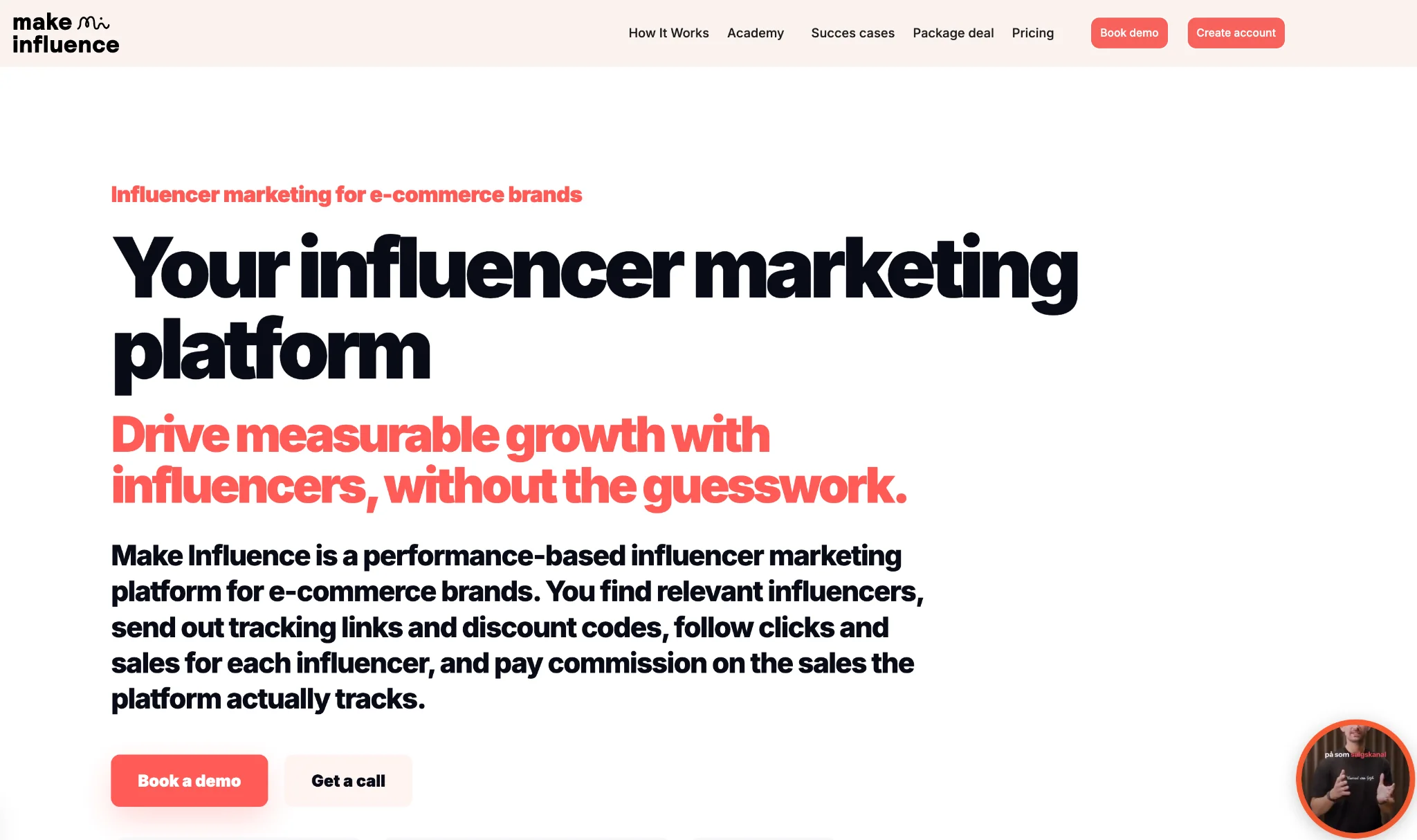
Makeinfluence is a Danish performance marketplace for eCommerce brands, live since 2020, with around 5,000 verified creators concentrated in Denmark and Sweden. Brands recruit from that network, hand creators tracked links, and pay commission only on attributed sales, with the platform taking a percentage of that commission on top. The company reports more than €65 million in attributed revenue and 930,000 sales since launch. It is closer to affiliate tracking and payouts with a creator marketplace attached than to influencer software with affiliate features added.
Key Features
- Commission-only creator payment: Creators earn on attributed sales rather than a flat fee per post.
- Tracked links per creator: Clicks, traffic and sales reported individually, on a 30-day cookie window.
- Curated Nordic network: Around 5,000 verified creators across fashion, beauty, food, health and home.
- Automated invoicing and payouts: Commission calculated, invoiced and paid without manual reconciliation.
- Dedicated customer success manager: Included from Basic upward, with the top tier sold as a managed service.
Pricing
- Entry: €95 a month, 30% service fee, 5 influencers, 1 market, 1 campaign, €6,700 revenue cap
- Basic: €535 a month, 25% fee, 20 influencers, 1 market, 2 campaigns
- Growth: €805 a month, 20% fee, 50 influencers, 1 market, 4 campaigns
- Full Service Pro: €1,205 a month, 15% fee, unlimited on all three
Annual billing takes 15% off. The service fee applies to the creator’s commission rather than your revenue, so at a 10% commission rate a 30% fee costs 3% of revenue. Onboarding is optional at €670.
Reviews
3.5/5.0 (Trustpilot, 57 reviews). Brands report multi-year profitability and responsive setup support; the complaints cluster on binding contracts, difficulty cancelling and attention dropping after the sale.
Integrations
- Webshop tracking: Connects to your site to capture conversions, which the whole model depends on.
- Named eCommerce platforms: None published, so confirm Shopify or WooCommerce support explicitly.
- Payments and invoicing: Handled natively rather than through a named provider.
- Analytics tools: No named Google Analytics or BI connection, so reporting stays inside the platform.
- API and automation: No public API or Zapier connector published.
Pros
- Four real prices on the page: Plus a worked example of how the fee is calculated.
- Creators cost nothing until they sell: Every euro of creator cost attaches to a euro of revenue.
- A track record with numbers: €65 million attributed and 930,000 sales since 2020.
Common Drawbacks of Makeinfluence
One market on three of four tiers
Entry, Basic and Growth each cover a single country. Adding a second market means Full Service Pro at €1,205 a month, a 50% jump over Growth for one extra country.
The subscription is not performance-based
The fee only triggers on a sale; the plan bills regardless. Growth costs €8,220 a year before anything is attributed, and reviewers report paying for extended stretches with minimal results.
Binding contracts are the recurring complaint
Long-term commitments and difficulty cancelling come up repeatedly across the review base, alongside post-sale attention that fades. Ask for the minimum term and notice period in writing.
Nothing outside a tracked sale
No product seeding, no UGC rights management and no outreach to creators beyond the network. Brands wanting content for paid media, or relationships before revenue, need a second platform.
Best Makeinfluence Alternatives
| TOOL | REVIEWS | BEST FOR | TRIAL INFO | PRICING | ||
|---|---|---|---|---|---|---|
1 |

|
⭐ | Influencer CRM & automation | Book Demo | Pricing | Website |
2 |
|
⭐ | Influencer campaigns & data analytics | Book Demo | Pricing | Website |
3 |

|
⭐ | UGC creators & paid social ads | Book Demo | Pricing | Website |
4 |

|
⭐ | Influencer marketplace campaigns | Book Demo | Pricing | Website |
5 |

|
⭐ | Influencer partnerships | Book Demo | Pricing | Website |
6 |

|
⭐ | Campaign management | Book Demo | Pricing | Website |
7 |

|
⭐ | AI influencer discovery & analytics | Book Demo | Pricing | Website |
8 |

|
⭐ | Influencer analytics | Book Demo | Pricing | Website |
9 |
-1.webp)
|
⭐ | Discovery and campaign platform | Book Demo | Pricing | Website |
10 |

|
⭐ | Ambassador Marketing | Book Demo | Pricing | Website |
Influencer Hero

Influencer Hero is an all-in-one influencer marketing platform for D2C and eCommerce brands, working across 8 social platforms with Instagram, YouTube and TikTok at the core. It covers influencer discovery, outreach, gifting, content collection, affiliate tracking and creator payouts inside one subscription, with pricing set by outreach volume rather than by creator count or market. Nothing is taken from what creators earn.
Key Features
- Global creator discovery: Over 20 filters across eight networks, with no cap on which countries you search.
- Lookalike and brand-follower search: Find creators resembling top performers, and people already following your brand.
- Product seeding automation: Gifting orders raised through Shopify or WooCommerce and tracked to delivery.
- UGC library with approvals: Creator content captured, searchable by quality, routed through approve or request-edit.
- Creator relationship management: Campaign boards with automations and custom fields per creator.
- Affiliate codes and commission: Codes and links per creator with commission calculated in-platform.
- Payouts and invoicing: Bulk and scheduled bank-debit payments at 0.1% to 0.4% with invoice approval.
- Coupon leakage prevention: Leaked codes spotted on aggregator sites and rotated automatically.
Pricing
- Standard: $649 a month, up to 1,000 reachouts a month
- Pro: $1,049 a month, up to 5,000 reachouts a month
- Business: $2,490 a month, up to 10,000 reachouts a month
- Custom & Agency: custom pricing
Quarterly billing saves 20% and yearly saves 30%. Creator count and markets are not what the plan meters.
Reviews
5.0/5.0 (Capterra)
Pros
- No market caps: Sell in five countries on the entry tier without a price change.
- Seeding and content included: Gifting, UGC collection and rights workflows in the same subscription.
- No cut of creator earnings: The subscription is the entire platform cost.
Cons
- No free trial
- Expensive for smaller brands
- Steep learning curve
Integrations
- Shopify: Named and documented, rather than described generically.
- WooCommerce: Native support, with Magento and custom stores through a script.
- Klaviyo: Creator segments into lifecycle email programs.
- DocuSign: Creator agreements signed and filed on the deal record.
- Zapier: 8,000-plus further apps for anything not covered natively.
Makeinfluence vs Influencer Hero
Makeinfluence does the affiliate half genuinely well. Tracked links, per-creator sales, automated invoicing and commission-only payment are a clean way to run creators as an acquisition channel, and the €65 million attributed figure suggests the tracking holds up. What it does not do is anything before or after the sale. Influencer Hero covers discovery across eight networks with fake-follower screening, outreach with drip sequences, campaign boards, product seeding raised straight from your store, a searchable UGC library with approval workflows, and affiliate codes with commission calculated in-platform, then pays creators at 0.1% to 0.4%. It also names its eCommerce integrations, where Makeinfluence describes webshop tracking without listing a single platform.
On price the models diverge at the caps rather than the headline. Influencer Hero publishes $649, $1,049 and $2,490 a month, and none of those tiers restricts how many creators you work with or how many countries you sell in. Makeinfluence charges €805 for fifty creators in one market, and €1,205 the moment you add a second country, plus a service fee on every creator commission on top. For a brand selling across the Nordics rather than in one of them, the flat published tier is both cheaper and less likely to force an upgrade you did not plan.
NeoReach
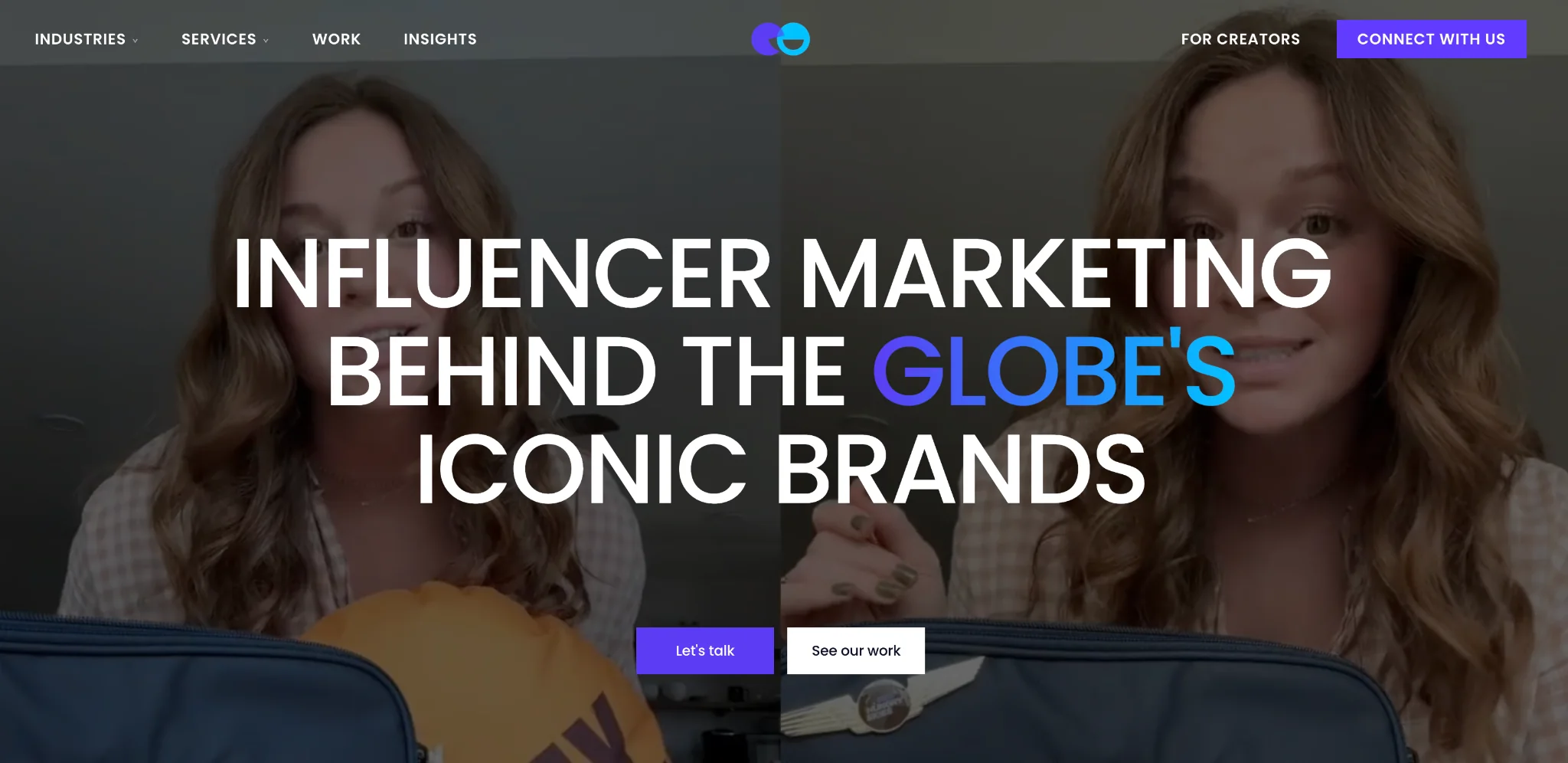
NeoReach sells influencer marketing software alongside a managed-service team, and a large share of its work is full campaign management rather than a licence. Reviewers rate its audience analysis and segmentation particularly highly. It is bought by brands and agencies running large activations who want people as well as tooling.
Key Features
- Audience segmentation depth: Creator audiences broken down to a level that supports media planning.
- Full-service campaign teams: Strategy and execution handled for brands with no in-house specialist.
- Cross-network discovery: Search across the major platforms with industry filters.
- Live performance tracking: Campaign results monitored across creators in one dashboard.
- Executive reporting: Analysis packaged for stakeholders outside marketing.
Pricing
Not published, and quoted per engagement rather than per seat, since the service element drives the figure.
Reviews
4.5/5.0 (G2, low review volume at 11 reviews).
Pros
- Nobody in-house needed: The managed model covers the gap a small team cannot fill.
- Analytics are genuinely strong: Audience analysis scores among the highest in its comparison set.
- No creator or market caps: Scope is set by the engagement rather than by a plan.
Cons
- No published price: Nothing to budget against before a call.
- Eleven reviews: A very thin public record.
- Not performance-priced: You pay for the campaign whether it sells or not.
Integrations
- Shopify: Store connection for tracking creator-driven sales.
- Instagram and TikTok: Creator performance pulled into reporting.
- YouTube: Long-form campaign data alongside short-form.
- Google Analytics: Campaign traffic connected to site behaviour.
- Reporting exports: Data out for internal analysis.
Makeinfluence vs NeoReach
These take opposite views of risk. Makeinfluence ties creator cost to sales and charges a modest subscription underneath. NeoReach charges for a campaign and a team, and the return is whatever the campaign produces.
For a small Nordic brand the first shape is easier to defend internally. For a brand running one large activation a year with nobody to manage it, paying for expertise is the point, and no commission model supplies that.
Insense
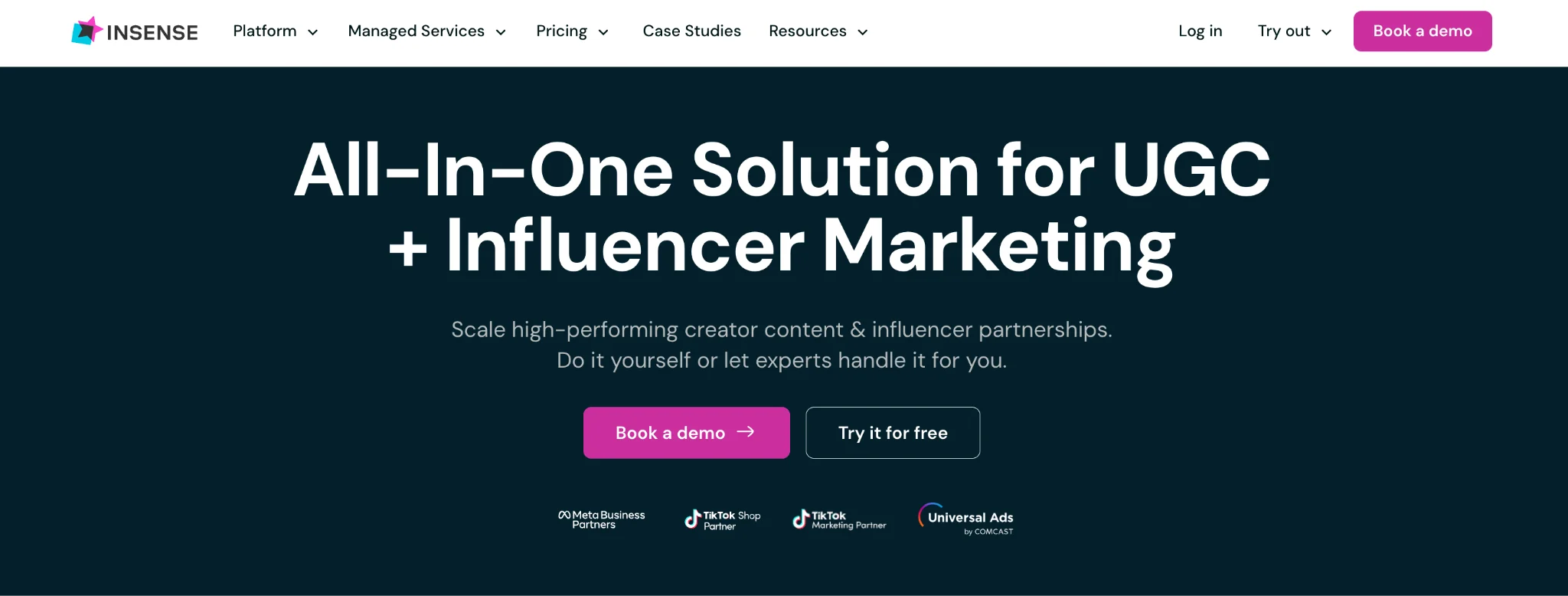
Insense is a creator marketplace built around content rather than reach, connecting brands with vetted UGC creators and micro-influencers who deliver video for paid social. Briefs, contracts, revisions and payments run in the platform, with content typically arriving inside ten business days. Performance teams buying ad creative are its main audience.
Key Features
- Guaranteed applicant volume: At least five creators matching your brief, or the subscription is refunded.
- Structured revisions: Up to three rounds before you accept a piece of content.
- Product seeding: Physical product sent to creators, which pure affiliate platforms do not handle, and one of the gifting platforms brands shortlist for it.
- Meta Partnership Ads: Creator handles connected for whitelisted paid social.
- Full digital usage rights: Rights to run the content included rather than negotiated separately.
Pricing
- Trial: $650 for one month, 1 campaign and 10 creators, 20% marketplace fee
- Brand: $500 a month billed quarterly, or $400 a month annually, 10% fee
- Agency: $800 a month billed quarterly, or $640 a month annually, 7% fee
Campaigns and creators are unlimited on both paid plans.
Reviews
4.5/5.0 (G2, 373 reviews).
Pros
- Unlimited creators on every paid plan: No roster cap forcing an upgrade.
- Content rights settled: Usage included, which an affiliate platform leaves to you.
- 373 reviews: A far larger evidence base than most of this comparison.
Cons
- A fee on creator payments: 7% to 20% depending on tier, on top of the subscription.
- Content, not reach: Built for ad creative rather than for driving sales organically.
- $650 to trial: An expensive first month by any standard here.
Integrations
- Meta: Powers Partnership Ads and whitelisted creator content.
- TikTok: Creator content routed into TikTok ad formats.
- Shopify: Named store connection for seeding and creator orders.
- Stripe: Creator payment processing.
- Content library: Approved assets exported into ad accounts.
Makeinfluence vs Insense
Both charge a subscription plus a percentage, which makes the structures unusually comparable. The difference is what the percentage buys. Makeinfluence takes a cut of commission on sales that already happened; Insense takes a cut of creator payments for content you then own and can run as ads.
Creator limits separate them further. Insense allows unlimited creators and campaigns on a $500 plan, where Makeinfluence caps fifty creators at €805 and one market. For a brand whose bottleneck is creative volume rather than attribution, that is not a close call.
Afluencer
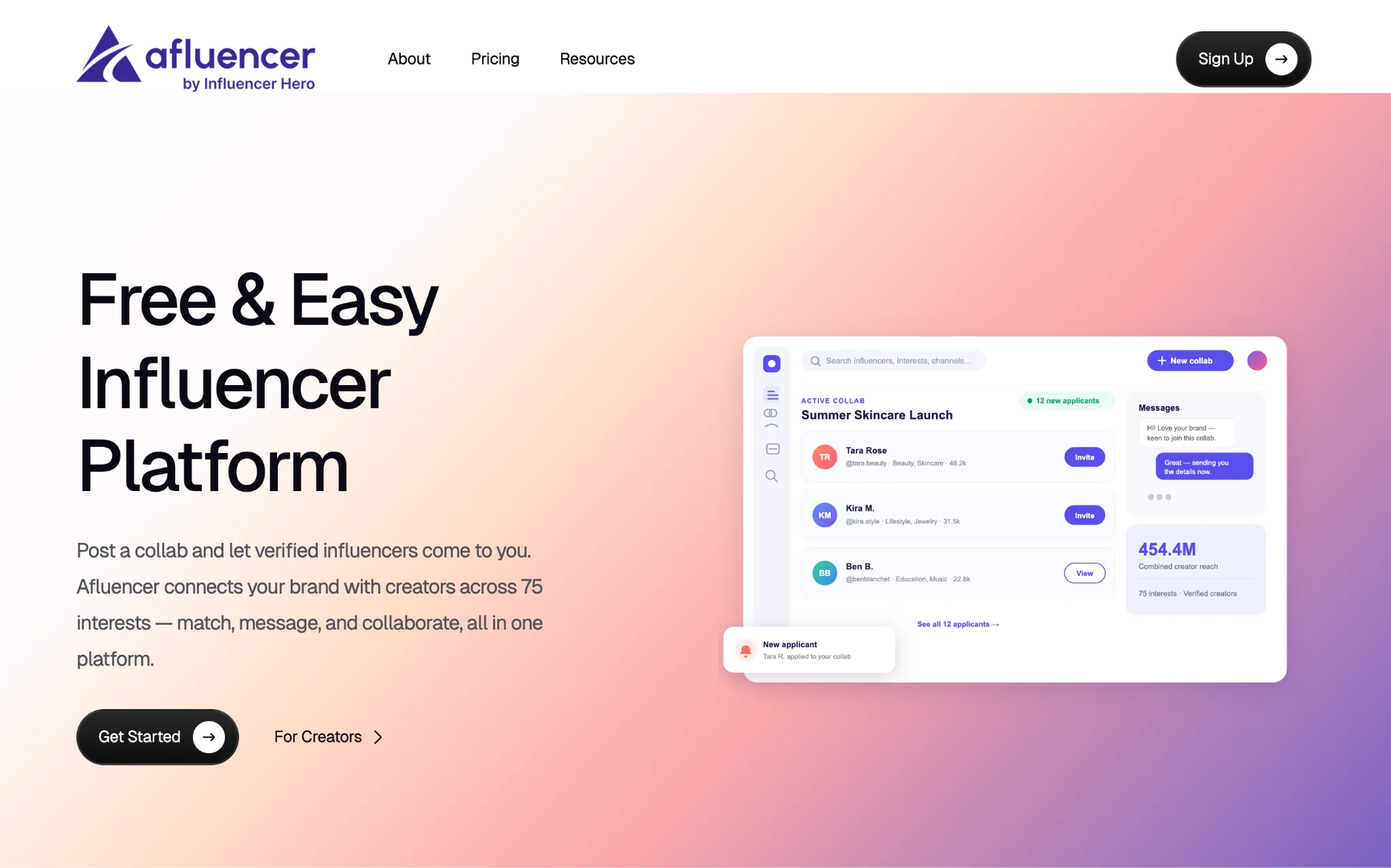
Afluencer runs on inbound applications. Brands post a collaboration listing, verified creators across Instagram, TikTok, YouTube, Facebook and X apply, and the brand picks who to work with. Shopify merchants and small D2C teams are its core users, and the plan is a flat monthly fee with nothing taken from creator payments.
Key Features
- Open collaboration listings: Any creator in the network can apply, not just a curated regional pool.
- Verified member profiles: Applicants arrive registered and checked, with stats attached.
- AI creator matching: CreatorGPT ranks applicants against the brief before review.
- Outbound invite credits: Approach specific creators when inbound interest is thin.
- Gifting and codes: Product send-outs and discount codes through the Shopify connection.
Pricing
From $49 a month on the Marketplace plan, with higher tiers for more outbound invites. Creator-side plans are billed separately.
Reviews
4.6/5.0 (G2, 738 reviews) and 4.7/5.0 (Shopify App Store, 34 reviews). The G2 sample leans creator-side, so read it beside the Shopify score.
Pros
- A tenth of the entry price: $49 a month against €95, with no revenue ceiling attached.
- No caps on creators or markets: The listing reaches whoever is in the network.
- Gifting included: Product-only collaborations, which a commission model cannot run.
Cons
- Applicant quality varies: A weak listing draws weak interest.
- North America weighted: Thin coverage in the Nordics specifically.
- Reporting is basic: No per-creator sales analysis of the kind an affiliate platform provides.
Integrations
- Shopify: Named connection for codes, referrals and creator orders.
- BigCommerce: The same for BigCommerce merchants.
- Klaviyo: Creator contacts into email campaigns.
- DocuSign: Collaboration terms signed in the flow.
- Slack: New application alerts to the team.
Makeinfluence vs Afluencer
Both are marketplaces, both are cheap to start, and both keep the work inside the platform. Where they part is geography and payment model. Makeinfluence gives you 5,000 vetted Nordic creators paid on commission; Afluencer gives you a larger, mostly North American pool paid however you agree.
For a Danish or Swedish brand, the regional network is the reason to stay put, and it is a real one. For a brand selling into the US, $49 a month with no revenue cap and no market limit beats €95 with both.
Aspire
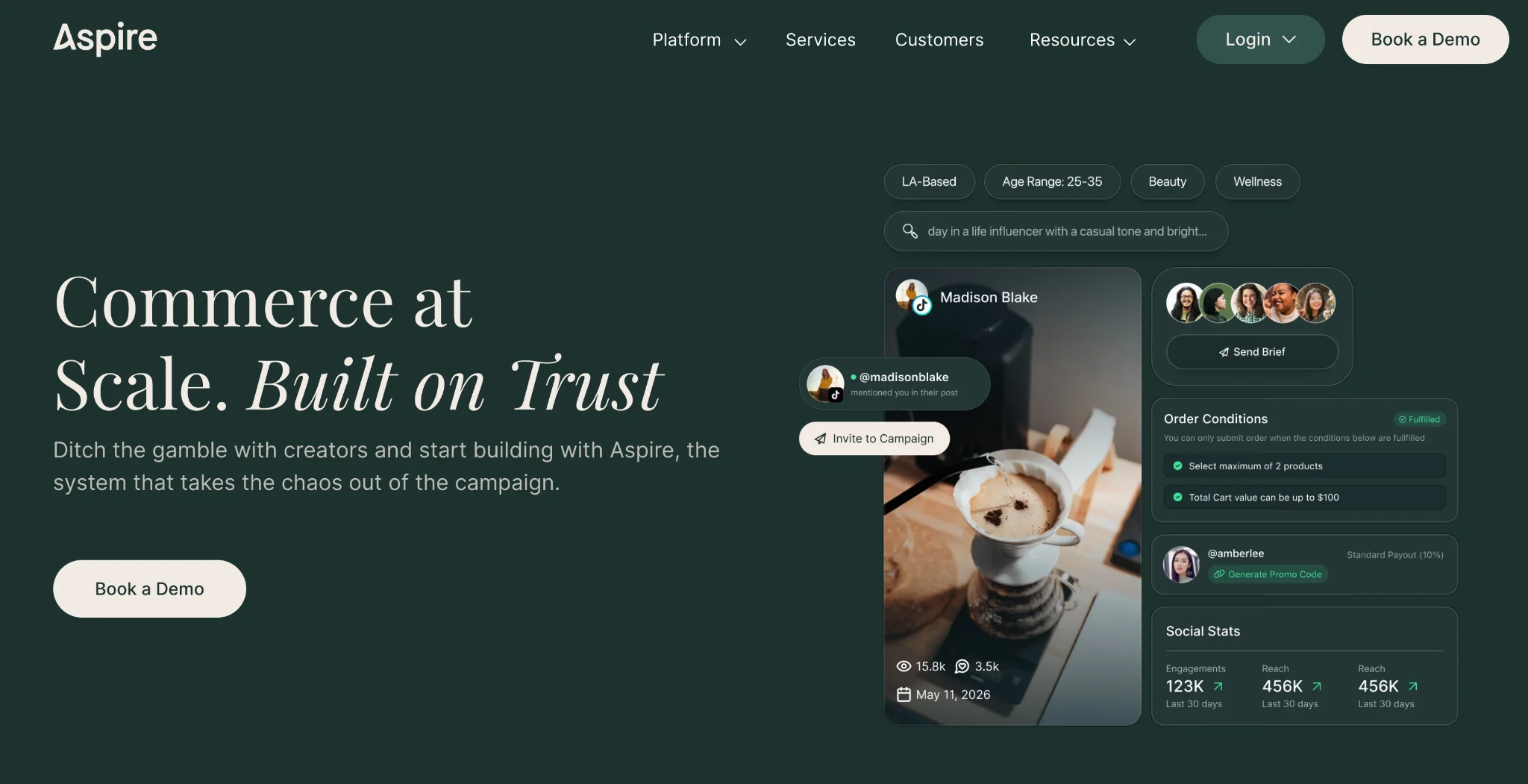
Aspire is an established influencer platform for mid-market and enterprise eCommerce brands, pairing creator discovery with campaign workflow, seeding and affiliate tracking. It is designed for always-on programs with a roster that grows over time rather than one-off pushes. Reviewers most often name ease of use and influencer management as its strengths.
Key Features
- Creator search with lookalikes: Discovery across networks with similar-creator suggestions.
- Seeding at volume: Product send-outs managed as a workflow rather than a spreadsheet.
- Brief and approval flow: Content requested, reviewed and signed off before it goes live.
- Affiliate links and codes: Creator-driven revenue attributed and commission tracked.
- Rights-managed content library: Approved assets stored with usage terms for paid reuse.
Pricing
Not published. Third-party sources report an annual commitment starting around $2,000 a month, with other estimates near $2,499, and the figures disagree enough that only a quote settles it. No free trial.
Reviews
4.6/5.0 (G2, 146 reviews).
Pros
- Seeding and affiliate together: Both halves of a creator program in one system.
- No market restrictions: Programs run across countries without a tier change.
- Well reviewed at scale: 146 reviews at 4.6.
Cons
- Roughly double the top tier here: Reported figures start near $2,000 a month.
- Quote-only and no trial: Evaluation runs entirely through sales.
- Heavier than a small team needs: Built for programs with staff behind them.
Integrations
- Shopify: Seeding orders and creator revenue attribution.
- WooCommerce: The same coverage for WordPress stores.
- Klaviyo: Creator contacts into email programs.
- Slack: Campaign alerts into team channels.
- Zapier: Wider stack connections where no native option exists.
Makeinfluence vs Aspire
This is the upgrade path a growing Nordic brand eventually faces. Aspire does everything Makeinfluence does on attribution, and adds seeding, content rights and discovery outside a curated network, with no cap on creators or countries.
It costs considerably more. Reported figures near $2,000 a month sit well above €1,205, and there is no trial to test it first. The honest read is that Aspire is what you move to when the caps have already cost you more than the difference.


Influencity

Influencity is a discovery and audience-analysis platform spanning Instagram, TikTok, YouTube and Twitch, with published tiers and a free trial. Reviewers consistently name the interface and the support team, and the tooling is aimed at teams doing their own creator research. Plans meter usage rather than seats.
Key Features
- Four-network discovery: Instagram, TikTok, YouTube and Twitch in one search.
- Audience demographics: Follower composition and authenticity assessed before outreach.
- Linked creator profiles: Several accounts belonging to one creator joined into a single record.
- Campaign tracking: Briefs, monitoring and reporting alongside discovery.
- Usage-based plans: Creator analyses and tracked creators metered rather than headcount.
Pricing
Published from around $318 a month, with annual billing lowering the effective rate and a 7-day free trial on every plan.
Reviews
4.5/5.0 (G2, 282 reviews).
Pros
- Search before you commit: A seven-day trial on every tier.
- Global creator pool: No regional limit on who you can find.
- Strong support scores: Rated highly on quality of support against direct competitors.
Cons
- No commission tracking: Discovery-led rather than sales-attributed.
- Metered analyses: Heavy research runs into plan limits.
- No payouts: Paying creators happens elsewhere.
Integrations
- Instagram and TikTok: Creator data and campaign performance.
- YouTube: Channel analytics alongside short-form.
- Twitch: Streaming creator coverage, unusual at this price.
- Shopify: Store connection for creator sales tracking.
- Exports: Campaign and creator data out for internal reporting.
Makeinfluence vs Influencity
These solve different ends of the problem. Influencity finds creators anywhere and tells you who follows them; Makeinfluence supplies a pre-vetted Nordic pool and tracks what they sell.
The gap shows in what each cannot do. Influencity will not calculate a commission or pay anyone. Makeinfluence will not let you look outside its 5,000 creators or tell you much about their audiences. Brands often end up wanting both, and at $318 plus €535 that is a real combined number to weigh.
IMAI

IMAI, also sold as InfluencerMarketing.ai, is a discovery-led platform built on a large creator index, with campaign management and white-label reporting for agencies on higher tiers. Pricing is published and a free trial is available. Agencies managing several clients make up much of its base.
Key Features
- Very large creator index: Discovery across a database the vendor places in the hundreds of millions.
- Fake-follower detection: Authenticity screening surfaced in search results.
- Multi-client campaign management: Separate campaigns and reporting per client account.
- White-label outputs: Agency-branded reports on higher plans.
- Social listening: Brand and category monitoring above the entry tiers.
Pricing
Published tiers reported from about $175 a month, through roughly $349 and $499, to $1,200 and up for enterprise and white-label. Report volumes vary by tier and a free trial is offered.
Reviews
4.1/5.0 (GetApp, low review volume at 16 reviews). Sourcing speed and fraud detection draw praise; support and account access draw the criticism.
Pros
- Cheapest real database here: Around $175 a month for discovery at scale.
- Free trial: Testable before any commitment.
- Agency tooling included: White-label reporting without building it.
Cons
- Support is the weak point: Reviewers report slow help and, in one case, lost access.
- Thin review base: Sixteen reviews on the listing that publishes a count.
- No sales attribution: Discovery and campaigns rather than commission tracking.
Integrations
- Shopify: Named store connection for creator-driven orders.
- WooCommerce: Coverage for WordPress storefronts.
- Instagram and TikTok: Creator data and campaign performance.
- YouTube: Channel-level analytics.
- Exports: Creator and campaign data out for client reporting.
Makeinfluence vs IMAI
IMAI answers the question a curated marketplace cannot: who else is out there. A database in the hundreds of millions against a network of 5,000 is not a comparison of quality, it is a comparison of scope.
What IMAI does not do is close the loop. There is no commission calculation and no creator payment, so a brand that wants sales attributed still needs the affiliate layer. At $175 a month it is cheap enough to sit alongside one rather than replace it.
HypeAuditor
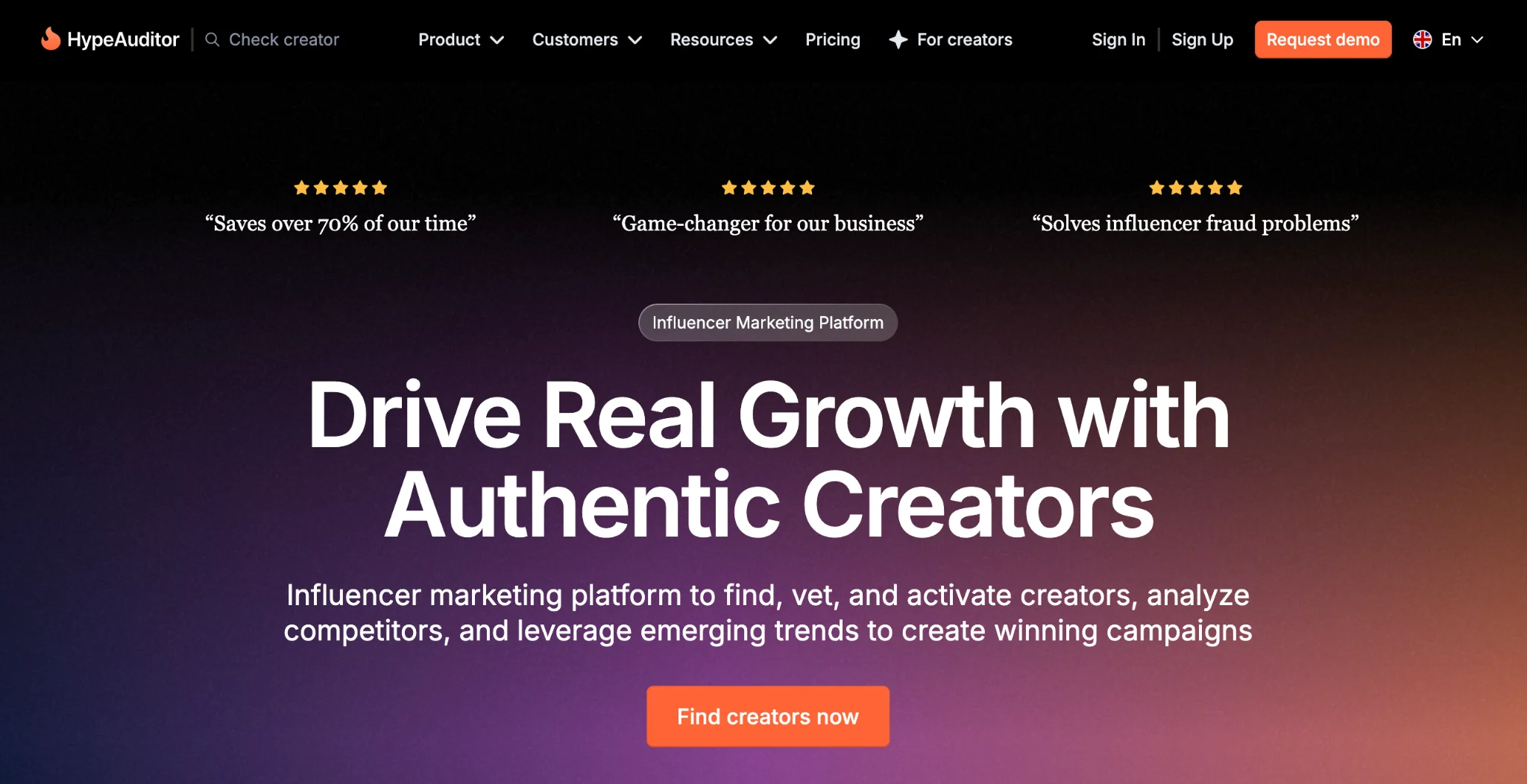
HypeAuditor is best known for audience fraud detection, and authenticity analysis remains its centre of gravity. Discovery, campaign tracking, competitor visibility and market analytics sit around it, across the main consumer networks. Brands and agencies that vet carefully before committing budget are its typical buyers.
Key Features
- Audience quality reports: The deepest fraud analysis in this comparison set.
- Discovery with demographic filters: Search backed by the same authenticity data.
- Campaign performance tracking: Live results measured against stated goals, closer to full campaign reporting than most discovery tools manage.
- Competitor creator tracking: See which creators rival brands are using.
- Free public audit tools: Account checks and calculators available without signing up.
Pricing
Not published. HypeAuditor works from demo-led quotes, with a free entry point covering media plans and demo versions of paid features.
Reviews
4.6/5.0 (G2, 262 reviews).
Pros
- Vetting you can trust: Fraud detection is the reason most teams buy it.
- Free tools first: Test the data on creators you already know before paying.
- Global coverage: No regional restriction on who can be analysed.
Cons
- Quote-only: No published figure despite the free tier.
- No commerce layer: No codes, commission or payouts.
- Analysis over execution: Light on outreach and campaign operations.
Integrations
- Instagram and TikTok: Creator data and audience analysis.
- YouTube: Channel analytics and audience breakdowns.
- Twitch: Limited streaming coverage.
- API access: Creator data programmatically on higher plans.
- Report exports: Audits shared as files with clients or stakeholders.
Makeinfluence vs HypeAuditor
Vetting is handled at opposite ends here. Makeinfluence verifies its creators once, at the point of joining the network, and you take the pool as given. HypeAuditor lets you audit any creator anywhere, continuously, which matters more when the pool is open.
Neither substitutes for the other. HypeAuditor cannot pay a creator or attribute a sale, and Makeinfluence cannot tell you much about who follows the creators it supplies. A curated network reduces the need for the first; an open one makes it essential.
Julius
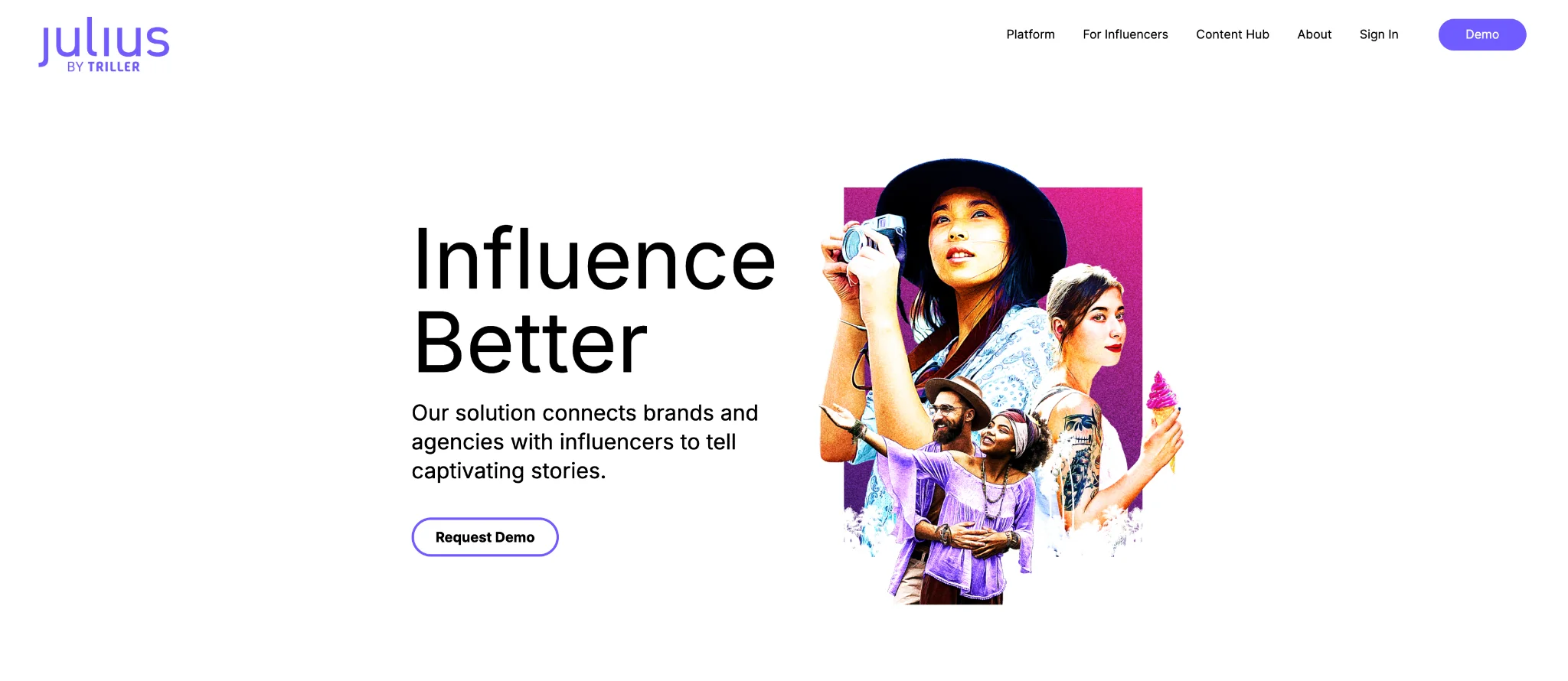
Julius is a discovery and campaign platform whose creator profiles are assembled by hand rather than scraped, covering interests, brand affinities and past partnerships. Smaller teams and agencies make up most of its users, and ease of setup is what reviewers name most often. Search quality is its argument.
Key Features
- Hand-curated profiles: Creator data compiled by researchers, including past brand work.
- Deep search filters: Attributes well beyond follower count and category.
- Audience analytics: Demographic breakdowns reviewers rate as a strength.
- Campaign workflow: Briefs, tracking and reporting in the same tool.
- Free trial: Hands-on access before committing.
Pricing
Not published, quoted per account, though a free trial is available which softens the absence of a rate card.
Reviews
4.5/5.0 (G2, 96 reviews).
Pros
- Curation beats scraping: Profiles surface creators an index would miss.
- Quick to set up: Ease of setup rated above larger competitors.
- Trial before contract: Testable despite the quote-only pricing.
Cons
- No published price: Budgeting waits for a sales call.
- No affiliate tracking: Sales attribution happens elsewhere.
- Smaller data footprint: Curation limits raw scale.
Integrations
- Instagram and TikTok: Creator data and campaign performance.
- YouTube: Channel analytics.
- Twitter/X: Additional creator coverage.
- Email tools: Outreach run from the creator record.
- Exports: Creator lists and reports for client work.
Makeinfluence vs Julius
Both bet on curation over volume, which is a fair bet and unusual in this category. Makeinfluence curates 5,000 Nordic creators and pays them on results; Julius curates profiles across consumer categories and tells you far more about each one.
Neither will do the other’s job. Julius has no commission engine and no payouts; Makeinfluence has no audience data worth the name. The deciding question is whether your problem is choosing creators or paying them fairly for outcomes.
Brandbassador (Club)

Brandbassador, now also branded as Club, turns customers and micro-creators into an ongoing ambassador community activated through gamified missions. Rewards, commission and participation are tracked per ambassador, and the model assumes a base of people who already like the brand. It sits closer to loyalty than to campaign management.
Key Features
- Missions with rewards: Tasks published to the community, completed for points, product or commission.
- Gamified participation: Leaderboards and tiers that sustain activity over months.
- Ambassador recruitment: Customers converted into a managed community at scale.
- Commission and reward tracking: Payments and incentives handled per ambassador.
- Community analytics: Participation and content output measured across the programme.
Pricing
Not published, with third-party listings reporting no free trial. Every quote comes through the vendor.
Reviews
4.7/5.0 (G2, 107 reviews), the highest score here. Ease of use and support are praised; ambassador search and filtering draw the complaints.
Pros
- Commission plus community: Rewards go beyond cash, which a pure affiliate model cannot offer.
- Four named eCommerce integrations: Published rather than described generically.
- Best-rated in this set: 4.7 across 107 reviews.
Cons
- No published price: And no trial reported either.
- Search is the weak spot: Finding the right ambassadors is the recurring criticism.
- Requires an existing base: Little use without customers to recruit.
Integrations
- Shopify: Discount codes and ambassador sales tracked from the store.
- WooCommerce: The same for WordPress storefronts.
- Adobe Commerce: Enterprise commerce coverage.
- BigCommerce: Additional storefront support.
- Instagram and TikTok: Ambassador content tracked against missions.
Makeinfluence vs Brandbassador
Both pay creators on results and both connect to a store, so the commercial logic rhymes. The difference is who the creators are. Makeinfluence supplies a vetted network of strangers; Brandbassador turns your own customers into the roster.
That changes the economics. Ambassadors recruited from a customer base cost less per activation and stay longer, but only exist if the base does. And Brandbassador names four eCommerce integrations publicly, where Makeinfluence names none, which is a strange gap for a platform whose entire model depends on tracking a checkout.
Final Thoughts on Makeinfluence Alternatives
The trade here is clean once you see it. You get a vetted Nordic creator network, tracking that demonstrably works and creators who cost nothing until they sell, and in exchange you accept a roster cap, a single market on three of four tiers, no seeding, no content rights and a contract reviewers say is hard to leave. For a Danish or Swedish brand selling in one country and wanting creators judged on revenue, that swap is defensible and the multi-year profitability reports back it up. For a brand adding a second country, or one that wants creator content for paid media as well as sales, the caps start costing more than the platform saves.

.png)


.jpg)










