

10 Best Lefty Alternatives • Key Criteria • Lefty Overview • Best Lefty Alternatives • Aspire • Influencer Hero • SARAL • Influencity • Captiv8 • IZEA • Modash • Klear • Traackr • IMAI • Final Thoughts • FAQs
10 Best Lefty Alternatives for Influencer Marketing
Managing influencer marketing at scale is no longer optional for D2C brands—it’s a core growth lever. The right influencer marketing software helps teams move faster on creator discovery, streamline outreach, manage campaigns end-to-end, and track real ROI without relying on spreadsheets or manual workflows. Lefty is one of the more well-known platforms in this space, offering strong visual search and brand-focused campaign management. However, based on feedback across G2, Reddit, and marketing communities, users often point out limitations around pricing transparency, reporting depth, and flexibility for scaling or customizing workflows—leading many teams to actively look for Lefty alternatives.
For D2C founders and marketing teams evaluating influencer marketing software, choosing the right platform often comes down to how well it fits your workflow, budget, and growth stage. In this article, we’ll compare the 10 best Lefty alternatives—including Aspire, Influencer Hero, SARAL, Influencity, Captiv8, IZEA, Modash, Klear, Traackr, and IMAI—to help you find the right fit for your influencer marketing strategy.
Key Criteria for Evaluating Influencer Marketing Platforms
Core Features
Evaluation of essential influencer marketing capabilities, including influencer discovery, outreach, CRM, campaign management, reporting, and content workflows.
Pricing & Flexibility
Comparison of pricing models, subscription plans, and contract terms to match different budgets and growth stages.
Customer Reviews & Satisfaction
Analysis of user feedback from trusted review platforms, focusing on usability, reliability, customer support, and overall performance.
Pros & Cons
Review of each platform’s strengths and limitations to highlight where it performs well and where it may fall short based on different use cases.
Integrations
Review of the most important integrations (e.g., Shopify and other tech tools), highlighting what each integration enables in one sentence.
Lefty Overview
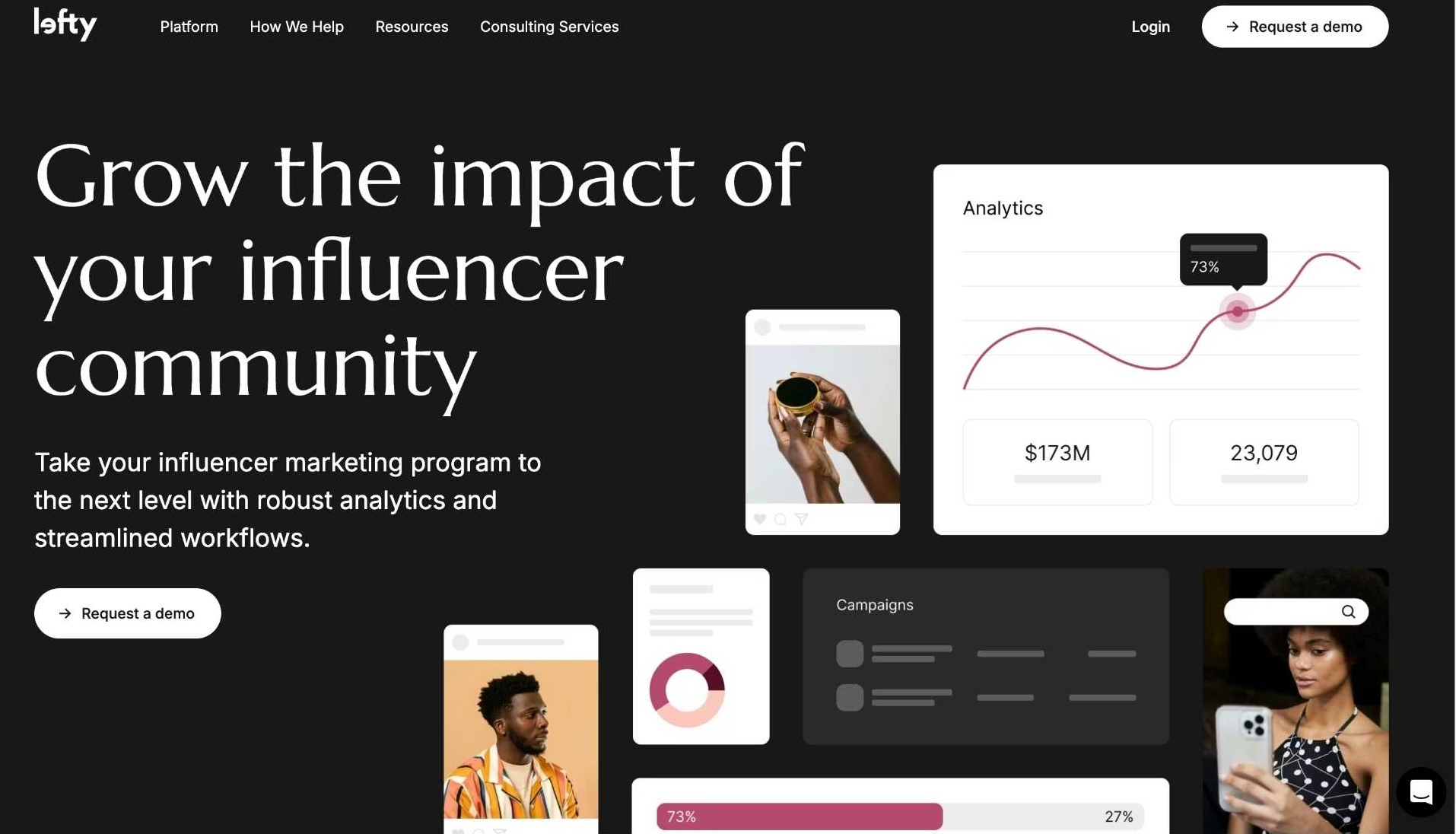
Lefty is an influencer marketing platform built for brands and agencies that want to manage creator discovery, relationship management, campaign execution, content tracking, and performance reporting in one place. The company positions itself especially strongly for lifestyle, beauty, fashion, and eCommerce teams, with a product built around influencer search, campaign workflows, automated reporting, affiliate tracking, and competitive benchmarking. Its recent product direction has also leaned further into eCommerce operations, with updates around product gifting, affiliate management, direct emailing, and new analytics metrics.
Key Features
- Influencer discovery and qualification: Lefty offers an influencer search engine with smart filters, audience-quality data, historical performance stats, brand-collaboration filters, and demographic targeting to help teams shortlist creators that fit a campaign more precisely.
- Influencer CRM and data centralization: The platform keeps creator relationship history, campaign activity, and performance data in one shared database so teams can manage partners across markets and campaigns without relying on scattered spreadsheets.
- Campaign management and automated tracking: Lefty lets teams set up custom campaigns, track ad hoc or always-on activations, and automatically collect creator publications and metrics across supported social networks.
- Content library and reporting: Campaign content is pulled into a centralized library where teams can sort outputs by metrics such as impressions, EMV, or date, then use dashboard reporting to monitor KPIs and ROI over time.
- Affiliate links and promo codes: Lefty supports affiliate-style programs with trackable links and promo codes, giving brands visibility into clicks, conversions, and top-performing creators or products.
- Product gifting and seeding: Through its eCommerce workflows, brands can sync product catalogs, manage gifting and lending, track shipments, and connect sent products back to campaign reporting.
- Email-based outreach inside the platform: Lefty supports Gmail and Outlook syncing so teams can send personalized outreach, track conversations, and manage follow-ups without switching tools.
- Competitive analytics and benchmarking: The platform includes competitive and market-level analytics so brands can benchmark their influencer performance and refine local or global strategy.
- Recent analytics upgrades: Newer updates include the Z-Factor KPI for spotting high-impact creators, a unified Views metric aligned with updated Instagram reporting, improved discovery filters, and stronger affiliate/seeding tooling.
Pricing
Public pricing is limited. Lefty’s website primarily directs buyers to request a demo or start a free trial rather than displaying a full self-serve pricing grid. One public software directory lists the following pricing tiers:
- Starting price: ~€590 per month
- Pro plan: ~€990/month, including 2 users, 5 campaigns, and unlimited reports
- Premium plan: ~€1,690/month, which adds a dedicated manager
- Premium+ plan: ~€3,490/month for 10 users and 25 campaigns
However, buyers need to book a demo to confirm pricing.
Reviews
4.7 / 5.0 (G2)
Integrations
- Shopify: Sync product catalogs, manage gifting and lending, generate affiliate links or promo codes, and tie influencer activity back to store revenue and conversion tracking.
- Salesforce Commerce Cloud: Connect your store to Lefty for product sync, inventory-aware gifting, and centralized seeding operations tied to campaign reporting.
- Magento: Use Magento integration to bring product catalogs and inventory into Lefty so teams can run gifting and product-request workflows from the platform.
- Gmail: Sync Gmail to send personalized influencer outreach, monitor replies, and manage follow-ups directly inside Lefty.
- Outlook: Connect Outlook for the same in-platform outreach workflow, helping teams keep communication and campaign management in one place.
Pros
- Strong recent eCommerce rollout: Lefty has recently expanded its eCommerce feature set with one-click product gifting, store integrations, smarter product lending, promo-code support, and stronger affiliation reporting, making it more useful for D2C brands that care about seeding and revenue attribution.
- Useful new analytics layers: Recent product releases added the Z-Factor KPI, a unified Views metric, richer discovery filters, and better market filtering in competitive analytics, which gives teams more control over how they evaluate creators and campaign performance.
- Cleaner workflow for outreach and reporting: Direct emailing, centralized CRM records, automatic content capture, and export-ready dashboards make Lefty appealing for teams that want fewer manual steps between discovery, activation, and reporting.
Common Drawbacks of Lefty
Pricing is not very transparent
Buyers usually need to go through sales to understand the real package structure, and public pricing visibility is limited, which makes comparison-shopping harder.
Search and discovery can still feel limiting for some teams
While discovery is one of Lefty’s strengths, recurring feedback points to cases where search functionality, profile coverage, or filtering can feel restrictive when teams need highly specific creator sourcing.
AI and social-listening depth are still developing
Lefty has added AI capabilities, but there is still room for stronger recommendation quality, better automatic location/tag detection, and deeper social-listening functionality for trend spotting and creator discovery.
Feature mix may not fit every budget
Some teams see the platform as expensive relative to the functionality they actually use, especially if they do not need the broader workflow or reporting stack.
Best Lefty Alternatives
| TOOL | REVIEWS | BEST FOR | TRIAL INFO | PRICING | ||
|---|---|---|---|---|---|---|
1 |

|
⭐ | Influencer partnerships | Book Demo | Pricing | Website |
2 |

|
⭐ | Influencer CRM & automation | Book Demo | Pricing | Website |
3 |

|
⭐ | Influencer outreach | Book Demo | Pricing | Website |
4 |

|
⭐ | Campaign management | Book Demo | Pricing | Website |
5 |
|
⭐ | Enterprise influencer campaigns | Book Demo | Pricing | Website |
6 |
|
⭐ | Influencer marketplace | Book Demo | Pricing | Website |
7 |

|
⭐ | Influencer discovery | Book Demo | Pricing | Website |
8 |
|
⭐ | Influencer analytics | Book Demo | Pricing | Website |
9 |

|
⭐ | Enterprise influencer analytics | Book Demo | Pricing | Website |
10 |

|
⭐ | AI influencer discovery & analytics | Book Demo | Pricing | Website |
1. Aspire
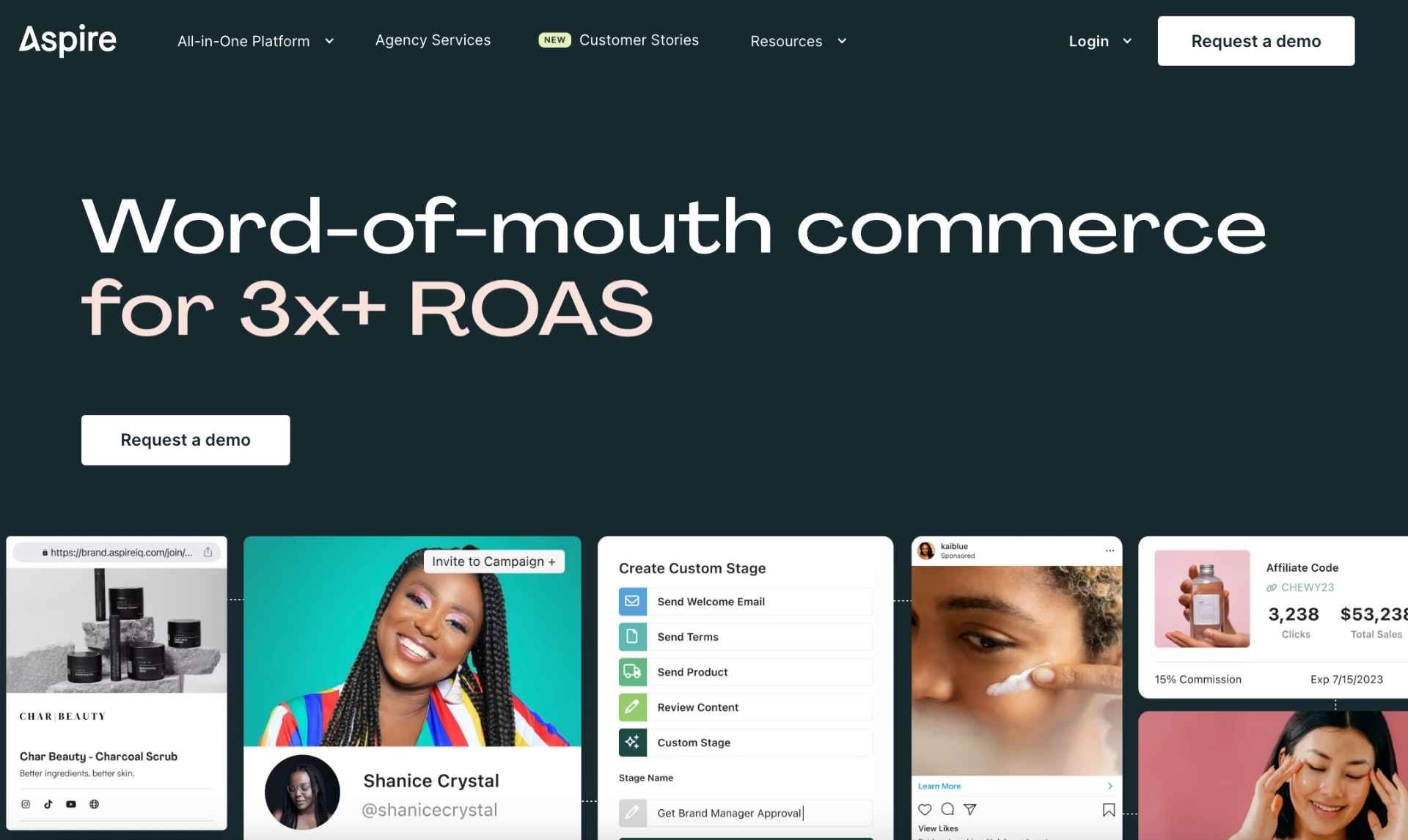
Aspire is an end-to-end influencer marketing platform built for eCommerce brands that want to run influencer, ambassador, affiliate, and UGC programs in one system. It stands out for combining creator discovery, inbound applications, workflow automation, product gifting, content approvals, and sales attribution, with a particularly strong focus on ROI for Shopify-driven brands. Aspire also emphasizes its direct partnerships with major social platforms, which it positions as a data-quality advantage over tools that rely more heavily on scraped data.
Key Features
- Creator search and marketplace: Aspire combines traditional creator discovery with an inbound Creator Marketplace, so brands can both source creators proactively and receive applications directly.
- First-party social data partnerships: Aspire highlights direct partnerships with Meta, TikTok, and Pinterest, which helps brands validate audience and performance data with more confidence.
- Campaign workflow automation: Brands can automate briefs, contracts, follow-ups, approvals, and status changes across campaigns, which is useful for teams scaling beyond one-off influencer campaigns.
- Product gifting and affiliate tracking: The Shopify integration supports product seeding, order syncing, creator stores, discount codes, and revenue attribution tied back to influencer activity.
- Content approvals and UGC management: Aspire lets brands manage content submissions, approvals, and performance tracking in one place, which is especially helpful for D2C teams reusing creator assets across paid and owned channels.
- Agency services and managed support: Beyond software, Aspire also offers managed services for brands that want strategic help with execution.
Pricing
A mid-tier plan for a brand targeting roughly 20 to 40 creators per month was quoted at about $2,300/month, including unlimited user seats and up to 500 creators in the CRM.
Reviews
4.0 /5.0 (Capterra)
Pros
- First-party platform data: Aspire’s direct partnerships with Meta, TikTok, and Pinterest are a real differentiator if your team cares about more reliable audience and campaign data.
- Large inbound creator marketplace: Its creator application flow and marketplace make it easier to fill campaigns with interested creators rather than relying only on cold outreach.
- Strong ROI tooling for eCommerce: Recent Aspire positioning puts a lot of emphasis on affiliate sales tracking, creator payments, and eCommerce ROI measurement, which is a strong fit for D2C brands.
Cons
- Higher entry cost: Aspire is usually priced for brands with a meaningful influencer budget, so it may feel expensive for smaller teams.
- Feature depth can add complexity: Teams sometimes need time to get comfortable with the workflow and navigation.
- Custom pricing slows evaluation: Since pricing is not fully transparent, it can be harder to compare quickly against lower-cost alternatives.
Integrations
- Shopify: Sync products, automate gifting, generate discount codes, and measure influencer-driven revenue inside Aspire.
- Gmail: Manage creator outreach, replies, and relationship history from your existing inbox.
- Outlook: Keep influencer communication and campaign operations connected for teams already using Microsoft email workflows.
- PayPal: Process creator payouts without moving payment operations into a separate tool.
- Klaviyo: Sync campaign and audience data to improve email personalization and lifecycle marketing around influencer programs.
Lefty vs Aspire
Compared with Lefty, Aspire is more commerce-oriented and operational for D2C teams that need gifting, affiliate attribution, creator applications, and workflow automation tied closely to store performance. Lefty is strong for influencer discovery, campaign reporting, and lifestyle-brand collaboration workflows, but Aspire goes further on first-party platform data, inbound creator sourcing, and eCommerce ROI infrastructure.
2. Influencer Hero

Influencer Hero is an all-in-one influencer marketing platform built around discovery, outreach, CRM, gifting, affiliate tracking, payouts, and reporting. It is positioned more squarely toward growing D2C brands that want strong automation and eCommerce integrations without stepping into enterprise-level pricing too early. A major part of its appeal is that it packages a lot of workflow functionality into lower-cost plans than many established platforms.
Key Features
- Influencer discovery with detailed filters: Search creators by niche, location, audience, engagement, and other fit signals.
- Outreach & automation: Scale personalized email outreach with AI-generated messages, automated follow-ups, and multi-step sequences
- CRM and relationship boards: Structured outreach and relationship campaign boards help teams manage creator pipelines, deliverables, and performance in one place.
- Automated outreach: Influencer Hero supports personalized bulk outreach, follow-up flows, and synced email communication.
- Affiliate, gifting, and payments: Brands can create links and codes, run gifting workflows, and process payouts while tracking clicks and sales.
- Brand-follower identification: The platform can help brands identify creators who already know or buy from the brand, which is useful for improving outreach conversion.
- Broad integration ecosystem: Influencer Hero has expanded its integrations significantly, including eCommerce, email, reporting, and automation tools.
- Campaign analytics & ROI tracking: Monitor performance across engagement, clicks, conversions, and revenue with real-time reporting dashboards
- UGC library: Automatically collect and organize influencer content for reuse across ads, social media, and product pages
- Application pages & storefronts: Capture inbound creators through branded application pages and enable influencers to promote products via custom storefronts
Pricing
Influencer Hero offers flexible pricing based on outreach volume and you can have unlimited creators in your CRM:
- Standard — $649/month (up to 1,000 outreach messages per month)
- Pro — $1,049/month (up to 5,000 outreach messages per month)
- Business — $2,490/month (up to 10,000 outreach messages per month)
- Custom / Agency — Tailored pricing
Custom pricing is available for agencies and larger teams
Reviews
5.0/5.0 (Capterra)
Pros
- Campaign-centric CRM automation: Its strongest differentiator is the combination of relationship boards, bulk actions, and automated follow-up flows built for high-volume creator management.
- Deep eCommerce fit without enterprise pricing: Shopify and WooCommerce integrations make it attractive for D2C brands that want affiliate tracking, gifting, and sales attribution without jumping straight to a much larger annual contract.
- Fast-growing integration ecosystem: Influencer Hero has recently pushed 30+ integrations, which makes it more flexible for modern commerce stacks.
Cons
- Higher pricing for smaller teams: May be less accessible for early-stage brands or those with limited budgets
- Steep learning curve: Feature depth means onboarding and setup can take time
Integrations
- Shopify: Generate discount codes and affiliate links, sync products, and track creator-driven revenue.
- WooCommerce: Sync store data for codes, links, gifting, and sales tracking.
- Gmail: Send outreach at scale, sync threads, and track creator replies inside the CRM.
- Outlook: Run and log influencer outreach from existing Microsoft email workflows.
- Klaviyo: Connect influencer performance data to lifecycle and retention marketing workflows.
- GoAffPro: Manage affiliate programs, track commissions, and handle payouts tied to influencer performance.
Lefty vs Influencer Hero
Lefty is better known for polished campaign reporting, influencer discovery, and a strong fit with lifestyle and fashion-oriented teams, while Influencer Hero leans more heavily into CRM automation, flexible pricing, and D2C eCommerce workflows. For brands that need outreach scale, relationship boards, Shopify or WooCommerce tracking, and lower-cost entry points, Influencer Hero is typically the more operational choice.
3. SARAL

SARAL is an influencer marketing platform built primarily for consumer and eCommerce brands that want a simpler, more execution-focused workflow. Its positioning is clear: help brands find influencers, automate outreach, manage relationships, handle gifting and affiliate tracking, and report on performance without stitching together several different tools. It is especially appealing to D2C teams that want something more focused and easier to adopt than large enterprise platforms.
Key Features
- Influencer discovery in bulk: SARAL helps brands identify creators quickly and save large batches of prospects into outreach workflows.
- Personalized outreach automation: The platform is designed to automate email-based creator outreach and follow-up so teams can scale seeding programs without manual tracking.
- Seeding and affiliate workflows: SARAL supports product sending, discount codes, affiliate links, and performance tracking in one system.
- Relationship management: Brands can manage active partnerships, track post performance, and organize influencer pipelines without relying on spreadsheets.
- Social listening and performance reporting: Higher plans include social listening and broader program reporting to show what is working and where to optimize.
Pricing
- Starter: $3.6k/quarter; up to 20% off annual plans.
- Business: $4.5k/quarter; up to 20% off annual plans.
- Professional: $7.5k/quarter; up to 20% off annual plans.
Reviews
4.7/5.0 (G2)
Pros
- Very clear D2C workflow: SARAL is built around the day-to-day reality of seeding, affiliate tracking, and ongoing creator management for consumer brands, not broad enterprise use cases.
- Strong mix of software and support: Its pricing page emphasizes onboarding, dedicated success support, and shared Slack access, which is a real plus for lean teams.
- Transparent packaging: Compared with many platforms in this category, SARAL is more upfront about plan structure and included capacity.
Cons
- Less enterprise depth: SARAL is more focused than broad enterprise platforms, which can be a downside for brands needing very advanced governance or analytics.
- Smaller review footprint: It is well-liked, but it has a smaller public review base than more established enterprise tools.
- Best suited to commerce-led teams: Brands looking for broader cross-channel reporting or agency-style benchmarking may outgrow it faster.
Integrations
- Shopify: Send products, create discount codes, generate affiliate links, and track performance.
- WooCommerce: Run store-connected gifting and affiliate tracking for non-Shopify stores.
- Klaviyo: Sync influencer data into lifecycle email campaigns and nurture flows.
- Slack: Coordinate program updates and workflows with your team in real time.
- Gmail/Outlook: Connect your inbox for creator communication and outreach management.
Lefty vs SARAL
Lefty is the stronger fit for brands that want a more polished enterprise-style platform around discovery, reporting, and competitive benchmarking, especially in lifestyle categories. SARAL is the better fit for D2C teams that care more about practical seeding, affiliate workflows, simpler execution, and clearer pricing.
4. Influencity

Influencity is a full-suite influencer marketing platform that covers discovery, outreach, CRM, campaign management, reporting, and social listening. One of its biggest differentiators is breadth of discovery: it uses public data rather than relying only on opt-in creator profiles, which gives brands access to a much wider search universe. It also has a relatively accessible entry point compared with many enterprise-focused competitors.
Key Features
- Large creator database: Influencity says brands can search a very large creator base with audience, performance, and profile insights.
- Influencer relationship management: The platform includes creator lists, tagging, segmentation, and campaign organization tools for ongoing programs.
- Campaign manager and reports: Teams can run campaigns end to end and export campaign reporting for internal and client use.
- Influencer seeding and payments: Shopify-based gifting and payment support are part of the broader workflow.
- Social Hub: Influencity has expanded into broader social media management with planning, inbox, analytics, and ad tools in its Social Hub.
- Email integration: Brands can connect their inbox for outreach and follow-up from within the platform.
Pricing
Influencity currently lists pricing publicly:
- Professional Plan: $318/month or $3,816/year
- Business Plan: $798/month or $9,576/year
- Enterprise Plan: Custom pricing
Reviews
4.3 / 5.0 (G2)
Pros
- Public-data discovery at scale: Influencity’s biggest edge is broad discovery beyond opt-in-only databases.
- Balanced feature depth for the price: It offers discovery, CRM, outreach, reporting, and now social management capabilities at a lower entry point than many enterprise tools.
- Useful new Social Hub expansion: The addition of Social Hub gives teams more value if they want social scheduling, inbox management, analytics, and ads closer to influencer workflows.
Cons
- Some search and filter friction: Users sometimes point to filter resets and workflow friction when refining creator searches.
- Email is integrated, not fully native negotiation: Influencity supports inbox connection, but some teams may prefer a stronger native communication layer.
- Auto-tracking and advanced workflows can require add-ons or higher plans: Full campaign automation may cost more than the entry plan suggests.
Integrations
- Shopify: Manage gifting, discount codes, and influencer-attributed sales from your store.
- Gmail / Office 365 / Outlook: Connect your inbox for outreach and follow-up from creator profiles or account settings.
- Instagram: Connect profiles for planning, analytics, and campaign-related social workflows in Social Hub.
- Facebook Pages: Manage and analyze connected social accounts from within Social Hub.
- Threads: Connect Threads as part of Influencity’s broader social media management layer.
Lefty vs Influencity
Lefty is typically the more premium-feeling choice for lifestyle brands that want polished campaign reporting, competitive benchmarking, and social commerce workflows. Influencity, on the other hand, gives brands broader public-data discovery, lower entry pricing, and a wider all-in-one toolkit that now stretches into social media management as well.
5. Captiv8
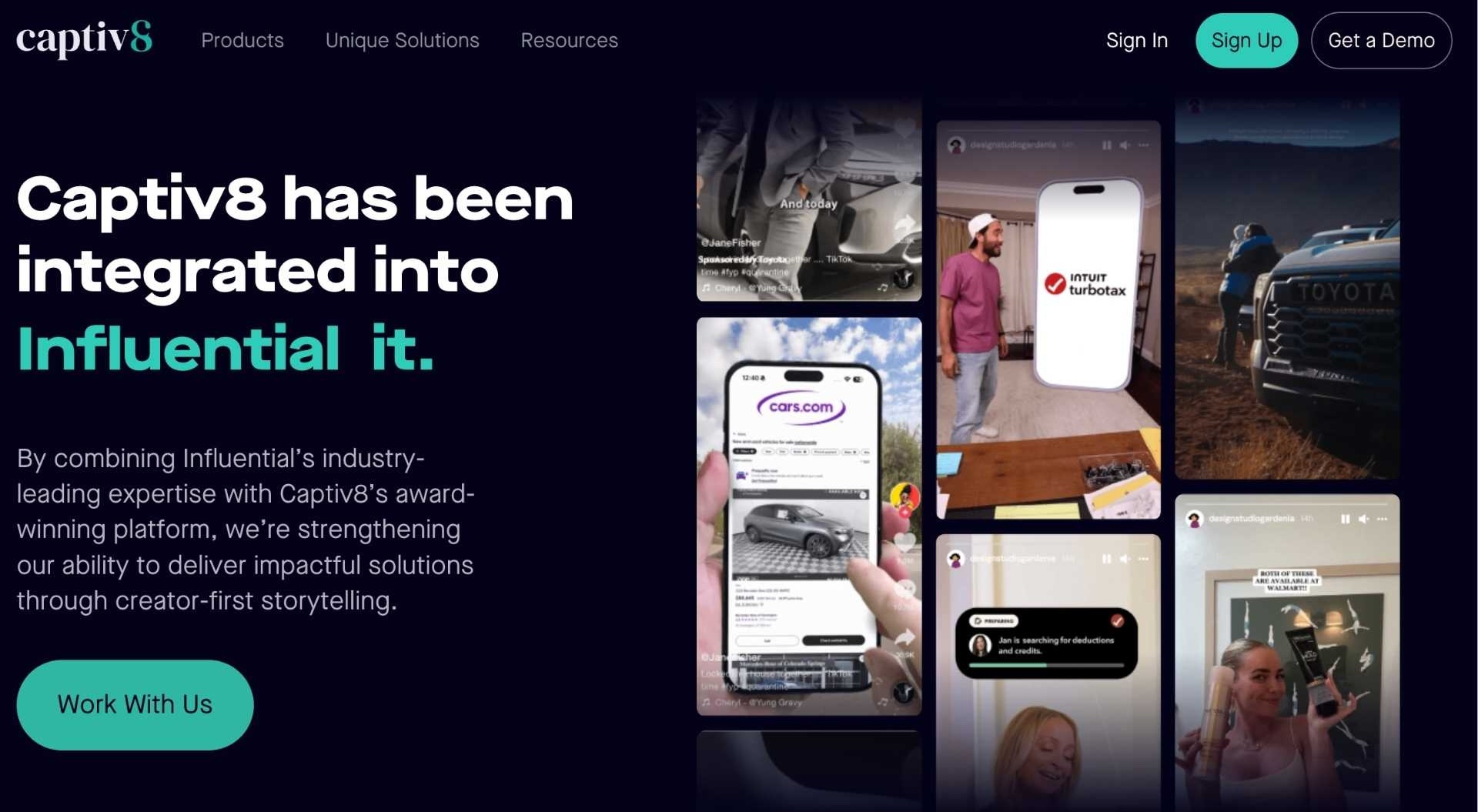
Captiv8 is an enterprise influencer marketing platform focused on creator discovery, campaign execution, payments, brand safety, social commerce, and advanced analytics. It is built for larger organizations running complex influencer programs and tends to emphasize data depth, customization, and enterprise reporting. Captiv8 is also now integrated into Influential, strengthening its position at the enterprise end of the market.
Key Features
- Advanced creator discovery: Captiv8 supports granular filtering across creator, post, and audience data, including competitor activity and brand safety signals.
- Collaborative campaign management: Teams can approve creators, collaborate internally, and manage multiple campaigns at once.
- Deep analytics and custom reporting: The platform is built for detailed campaign reporting, custom KPIs, and broad performance measurement.
- Paid media support: Captiv8 also supports boosting creator content through paid media workflows.
- Commerce infrastructure: Captiv8 supports commerce-focused creator programs through Shopify and Refersion integrations.
Pricing
- Captiv8 does not publish a transparent pricing table on its website.
- Recent buyer-facing research and market coverage place Captiv8 at roughly $25,000/year with annual commitment, plus a $3,000 onboarding fee in some packages.
- Storefront and broader creator-commerce or affiliate modules can materially increase total cost.
Reviews
4.7/5.0 (G2)
Pros
- Enterprise-grade analytics: Captiv8 is one of the stronger options here for large teams that need custom reporting, BI connectivity, and advanced ROI analysis.
- Strong brand safety and discovery depth: Filters, safety scoring, and competitive discovery make it a good fit for bigger brands with stricter controls.
- Paid media plus influencer workflow: The platform goes further than many alternatives in connecting creator campaigns to paid amplification.
Cons
- Enterprise pricing: Captiv8 is expensive for smaller or mid-market brands.
- Can feel complex at first: Some users find the system harder to learn and navigate than simpler D2C-focused tools.
- Data and support concerns do come up: Common complaints include data accuracy issues and frustration with responsiveness.
Integrations
- Shopify: Run creator-commerce workflows, connect store data, and measure influencer-attributed sales.
- Refersion: Track affiliate clicks, coupon codes, and sales across creator programs.
- Looker: Pull campaign and creator performance into BI dashboards for custom analysis.
- Tableau: Use the API and prebuilt connectors to visualize cross-channel influencer performance.
- Google Analytics: Connect influencer performance data to broader marketing measurement.
Lefty vs Captiv8
Lefty is generally the better fit for brands that want a more focused influencer marketing platform with strong campaign reporting and social commerce workflows without going full enterprise. Captiv8 is the heavier-duty option for large teams that need advanced brand safety, deeper analytics, BI integrations, and paid media support, but it usually comes with higher complexity and a much bigger budget requirement.


6. IZEA
IZEA is one of the longest-standing influencer marketing platforms, offering a combination of influencer discovery, campaign management, content collaboration, and a built-in creator marketplace. It is known for its dual approach—providing both software and managed services—making it suitable for brands that want either full control or hands-on campaign execution support.
Key Features
- IZEA Marketplace: A large opt-in creator network where influencers actively list their services, pricing, and content offerings for brands to browse and hire directly.
- Creator discovery and targeting: Advanced filters for audience demographics, engagement, niche, and historical brand collaborations.
- Campaign lifecycle management: End-to-end campaign workflows including casting, contracting, approvals, and performance tracking.
- Content collaboration tools: Built-in tools for managing briefs, reviewing drafts, and approving deliverables before publishing.
- Payment and contract management: Automated payments and contract handling within the platform, reducing operational overhead.
- BrandGraph analytics: Provides insights into brand mentions, share of voice, and influencer impact across campaigns.
Pricing
- IZEA Flex (self-serve platform): Custom pricing, typically based on usage and scale.
- Managed Services: Custom pricing depending on campaign scope.
- No public standardized pricing; primarily annual contracts or custom agreements.
Reviews
3.9/ 5.0 (G2)
Pros
- Marketplace-based hiring model: Unlike many tools, IZEA allows direct hiring from a creator marketplace with transparent pricing and deliverables.
- Flexible execution model: Brands can choose between self-serve software or fully managed campaigns, which is useful for teams with limited bandwidth.
- Strong content workflow tools: Built-in collaboration and approval flows are well-suited for content-heavy campaigns.
Cons
- Limited non-opt-in discovery: The marketplace model means discovery is largely limited to creators who have signed up.
- Pricing lacks transparency: Custom pricing makes it harder for smaller teams to evaluate quickly.
- UI and navigation can feel dated: Some users report that the interface feels less modern compared to newer tools.
Integrations
- Shopify: Track influencer-driven sales and manage product seeding campaigns.
- Google Analytics: Connect campaign performance to website traffic and conversion data.
- PayPal: Automate influencer payments directly within campaigns.
- Instagram API: Pull content and performance metrics for campaign tracking.
- YouTube: Track video performance and influencer content metrics.
Lefty vs IZEA
Lefty focuses more on influencer discovery, analytics, and campaign reporting with a strong emphasis on visual and brand-fit analysis, while IZEA stands out with its marketplace-driven hiring model and managed services. IZEA is better suited for teams that want a plug-and-play creator marketplace, whereas Lefty is stronger for brands that want deeper analytics and more control over campaign strategy.
7. Modash
Modash is a fast-growing influencer marketing platform focused on discovery, outreach, and performance tracking, particularly for eCommerce brands. It is known for its massive creator database built on public data rather than opt-in networks, making it one of the strongest tools for large-scale influencer discovery.
Key Features
- Massive creator database: Access to hundreds of millions of public creator profiles across Instagram, TikTok, and YouTube.
- Advanced filtering and lookalike search: Filter by audience demographics, engagement, niche, and use lookalike search to find similar creators.
- Bulk outreach and CRM: Send large-scale outreach campaigns and manage conversations directly within the platform.
- Affiliate and gifting workflows: Shopify integration enables product seeding, discount codes, and affiliate tracking.
- Fake follower detection: Analyze audience authenticity and engagement quality to avoid low-quality creators.
- AI-powered discovery: Visual and keyword-based search to find creators based on content style or “vibe.”
Pricing
- Essentials: starts at $199/month billed yearly or $299 month-to-month, for campaigns with up to 100 creators.
- Enterprise: starts at $14,700/year, with custom usage for larger programs above 250 creators.
- Free trial: Modash offers a 14-day free trial with no credit card required.
Reviews
4.9/5.0 (Capterra)
Pros
- One of the largest creator databases: Public data approach enables broader discovery than opt-in platforms.
- Strong discovery and filtering capabilities: Particularly useful for brands scaling outreach across multiple markets.
- AI-powered visual search: A newer feature that helps brands find creators based on aesthetic or content style.
Cons
- Limited integrations beyond Shopify: Not ideal for brands using other eCommerce platforms.
- No built-in content licensing tools: Requires external handling of usage rights.
- No paid media/whitelisting features: Lacks deeper ad amplification workflows.
Integrations
- Shopify: Automate gifting, affiliate tracking, and revenue attribution.
- Gmail: Manage outreach and track conversations.
- Outlook: Sync communication workflows for influencer outreach.
- Stripe: Handle influencer payouts and commissions.
- Zapier: Connect Modash with other tools in your stack.
Lefty vs Modash
Lefty is more focused on campaign management, reporting, and brand analytics, while Modash is significantly stronger in large-scale creator discovery and outreach. Modash is ideal for brands prioritizing top-of-funnel influencer sourcing, whereas Lefty provides a more structured environment for campaign execution and reporting.
8. Klear
Klear is part of the Meltwater suite and combines influencer marketing with broader social listening and media intelligence capabilities. It is designed for brands that want influencer marketing tightly integrated with PR, social monitoring, and brand analytics.
Key Features
- Large influencer database: Access to millions of creators with detailed audience insights and performance metrics.
- True Reach metric: AI-powered estimation of actual audience reach rather than inflated follower counts.
- Social listening integration: Monitor brand mentions, trends, and competitor activity alongside influencer campaigns.
- Campaign management and communication: Manage campaigns, track deliverables, and communicate with creators within the platform.
- Advanced reporting: Includes engagement, reach, sentiment analysis, and ROI metrics.
- Affiliate and payment tools: Track links, codes, and manage payouts.
Pricing
Starts from $2,300/month
Reviews
4.3 / 5.0 (G2)
Pros
- Strong social listening integration: Combines influencer marketing with PR and brand monitoring.
- True Reach metric: Helps brands avoid misleading vanity metrics.
- Enterprise-level reporting: Deep analytics across campaigns and broader brand performance.
Cons
- High pricing: Not accessible for smaller or mid-sized brands.
- Interface performance issues: Some users report lag and slow loading.
- Overkill for simple campaigns: Best suited for teams needing PR + influencer integration.
Integrations
- Shopify: Track influencer-driven sales and product performance.
- Google Analytics: Connect influencer campaigns to website data.
- Slack: Share reports and campaign updates internally.
- Salesforce: Sync influencer data with CRM systems.
- Meltwater Suite: Integrate with media monitoring and PR tools.
Lefty vs Klear
Lefty is more focused on influencer marketing workflows and campaign execution, while Klear offers a broader ecosystem that includes social listening and PR analytics. Klear is better suited for enterprise teams managing brand reputation and media alongside influencer campaigns, whereas Lefty is more streamlined for influencer-specific use cases.
9. Traackr
Traackr is an enterprise influencer marketing platform focused heavily on performance measurement, benchmarking, and budget optimization. It is widely used by global brands that need to justify influencer spend and optimize campaigns across regions.
Key Features
- Influencer discovery with performance data: Identify creators based on past campaign performance and audience insights.
- Advanced reporting and benchmarking: Track metrics like CPC, CPE, CPV, and compare against industry benchmarks.
- Brand Vitality Score (BVS): Proprietary metric to measure brand influence and visibility across social platforms.
- Budget optimization tools: Allocate spend based on predicted ROI and historical performance.
- CRM and campaign management: Manage relationships, outreach, and campaign workflows.
- Affiliate and payment tools: Track commissions and manage payouts.
Pricing
Pricing started at $32,500/year for a standard package, with custom-built plans and annual billing.
Reviews
4.3 / 5.0 (G2)
Pros
- Best-in-class analytics: One of the strongest platforms for performance benchmarking and ROI tracking.
- Budget optimization tools: Helps teams allocate spend more efficiently across creators.
- Real-time performance tracking: Enables mid-campaign optimization.
Cons
- High cost and rigid contracts: Not suitable for smaller teams.
- Occasional platform lag: Performance issues reported during heavy usage.
- Learning curve: Requires onboarding to fully leverage advanced analytics.
Integrations
- Shopify: Track influencer-driven revenue and affiliate performance.
- Google Analytics: Connect campaign metrics to web performance.
- Slack: Share reports and updates internally.
- CRM tools: Sync influencer data with broader marketing systems.
- Custom APIs: Export data into BI tools.
Lefty vs Traackr
Lefty provides strong campaign management and reporting for D2C teams, while Traackr is more focused on enterprise analytics and benchmarking. Traackr is ideal for brands prioritizing ROI measurement and budget optimization at scale, whereas Lefty is more accessible for execution and day-to-day campaign management.
10. IMAI (InfluencerMarketing.ai)

IMAI is an AI-driven influencer marketing platform designed to help brands discover influencers, manage campaigns, and analyze performance using machine learning. It positions itself as a more accessible, data-driven alternative with strong automation capabilities.
Key Features
- AI-powered discovery: Find influencers using advanced filters, lookalike search, and AI recommendations.
- Campaign management tools: Manage outreach, track deliverables, and monitor performance.
- Audience and fraud analysis: Detect fake followers and assess audience quality.
- Performance tracking: Measure engagement, reach, and ROI across campaigns.
- Influencer CRM: Manage relationships and campaign pipelines.
- Competitive analysis: Benchmark campaigns against competitors.
Pricing
Starting price at $99/month and notes that a free trial is available.
Reviews
4.5 / 5.0 (G2)
Pros
- Strong AI-driven discovery: Focus on automation and smart recommendations.
- Affordable entry point: More accessible than enterprise tools.
- Good balance of features: Covers discovery, CRM, and analytics without heavy complexity.
Cons
- Smaller ecosystem: Fewer integrations compared to larger platforms.
- Less advanced workflow automation: Not as deep as enterprise tools.
- UI can feel less polished: Some users note usability improvements needed.
Integrations
- Shopify: Track influencer sales and manage affiliate campaigns.
- Instagram: Pull influencer data and campaign performance.
- YouTube: Analyze video-based influencer performance.
- Google Analytics: Measure traffic and conversions from campaigns.
- Stripe: Manage influencer payments.
Lefty vs IMAI
Lefty offers a more mature platform with stronger campaign workflows and reporting for established brands, while IMAI focuses on AI-driven discovery and affordability. IMAI is a good fit for teams looking for a cost-effective, data-driven solution, whereas Lefty is better suited for brands needing more structured campaign execution and reporting.
Final Thoughts on Lefty Alternatives
Lefty remains a solid option for brands that prioritize campaign reporting, influencer discovery, and structured workflows, particularly in lifestyle and fashion categories. However, as this comparison shows, many alternatives offer stronger capabilities in specific areas—whether it’s eCommerce integrations and ROI tracking (Aspire, Influencer Hero), scalable outreach and affordability (SARAL, Modash, IMAI), or enterprise-level analytics and benchmarking (Traackr, Klear, Captiv8). The right choice ultimately depends on your team’s priorities, including budget, workflow complexity, and how closely you need influencer marketing tied to revenue and performance.

.png)


.jpg)